Phonics Level 3 Sound Mat 1: Consonants and Short Vowels
Children see the consonant sounds and the five short vowel sounds, each with its spellings (for example f, ff, ph, gh) and picture words such as sun, dog, fish, bat and bug.
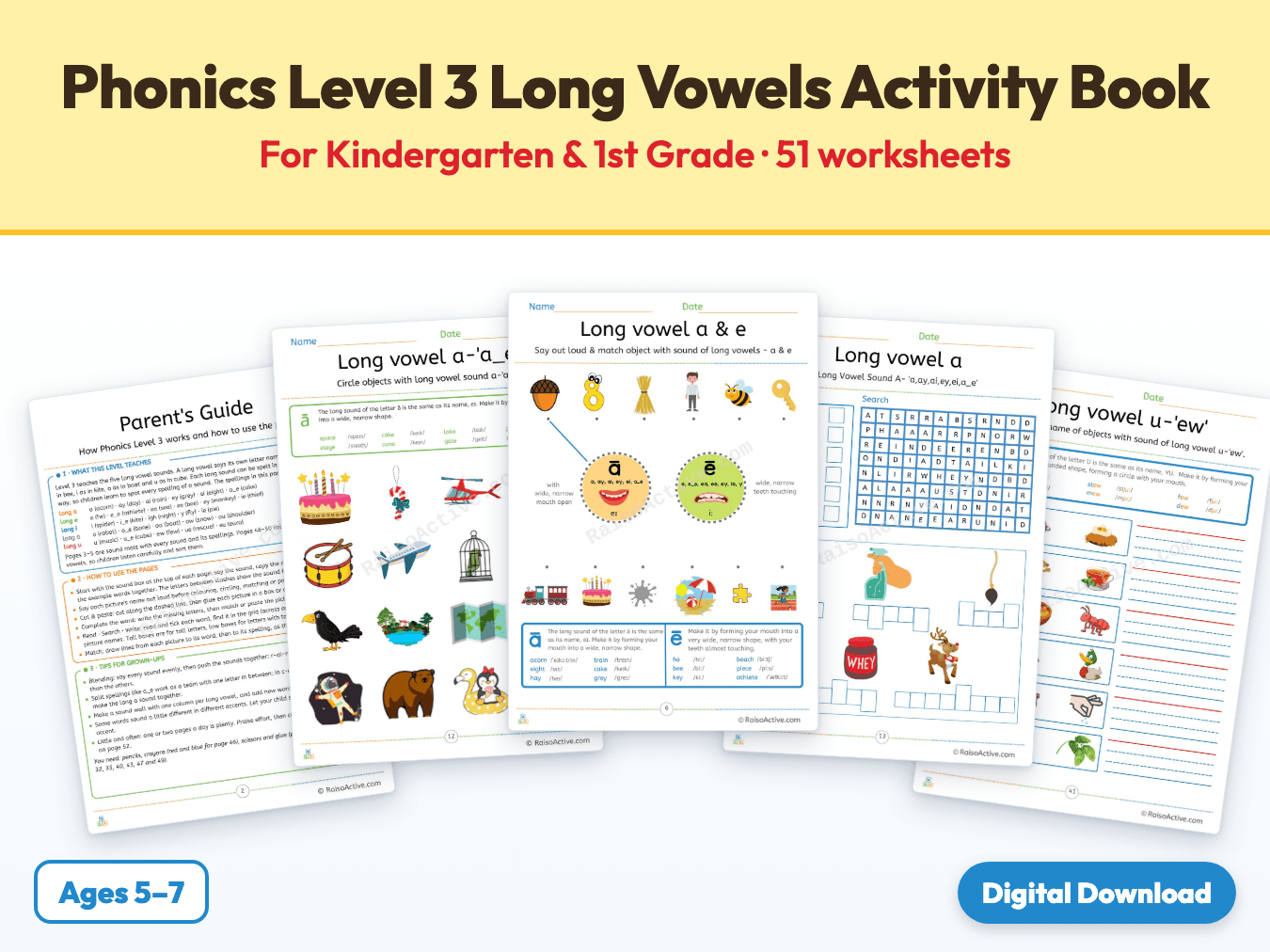
Part of the pack
Phonics Level 3 Long Vowels Activity Book for Kindergarten & 1st Grade
This is page 3 of the pack. Ages 5-7 · Kindergarten–Grade 1Ages 5-7 · Year 1–Year 2Ages 5-7 · UKG–Class 1Ages 5-7
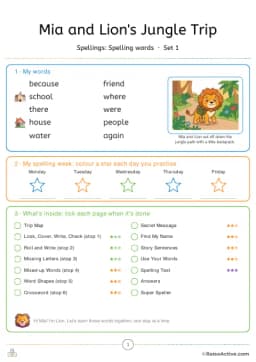
Made for your child
Spelling practice, made for your child
Their own spelling words turned into a pack: trace or look-cover-write-check, roll and write, a secret picture code, a word search, a crossword and a test, with their name in it.
Make a spelling packFree preview · free for members
Or start free: a word search with sight wordsCurriculum
- Phonics - Letter Sounds > Short Vowel Sounds
- Phonics - Letter Sounds > Consonant Sounds
How to use this worksheet
Point to each picture, say the sound and read the example words together. Keep the mat on the table or the wall while working through the long vowel pages.
Materials needed
- Printer
- Optional laminator or plastic sleeve
Extension activities
- 1Play 'I spy a sound' with the pictures
- 2Add a new word for each sound from a storybook

Written by
Hemsweta Jain · Teacher Cheena
MBA and Early Childhood Educator, teaching since 2014 · Founder of RaisoActive, Mumbai
Every RaisoActive worksheet is designed and checked by the founder before publishing.
Published · Last reviewed
More from Phonics Level 3 Long Vowels Activity Book for Kindergarten & 1st Grade

Long Vowel o 'oa' Circle and Write Worksheet
Ages 5-7 · Kindergarten–Grade 1Ages 5-7 · Year 1–Year 2Ages 5-7 · UKG–Class 1Ages 5-7
Children spot the long o 'oa' word in each row of three pictures, then spell it: boat, goat, loaf, toast, soap and road.
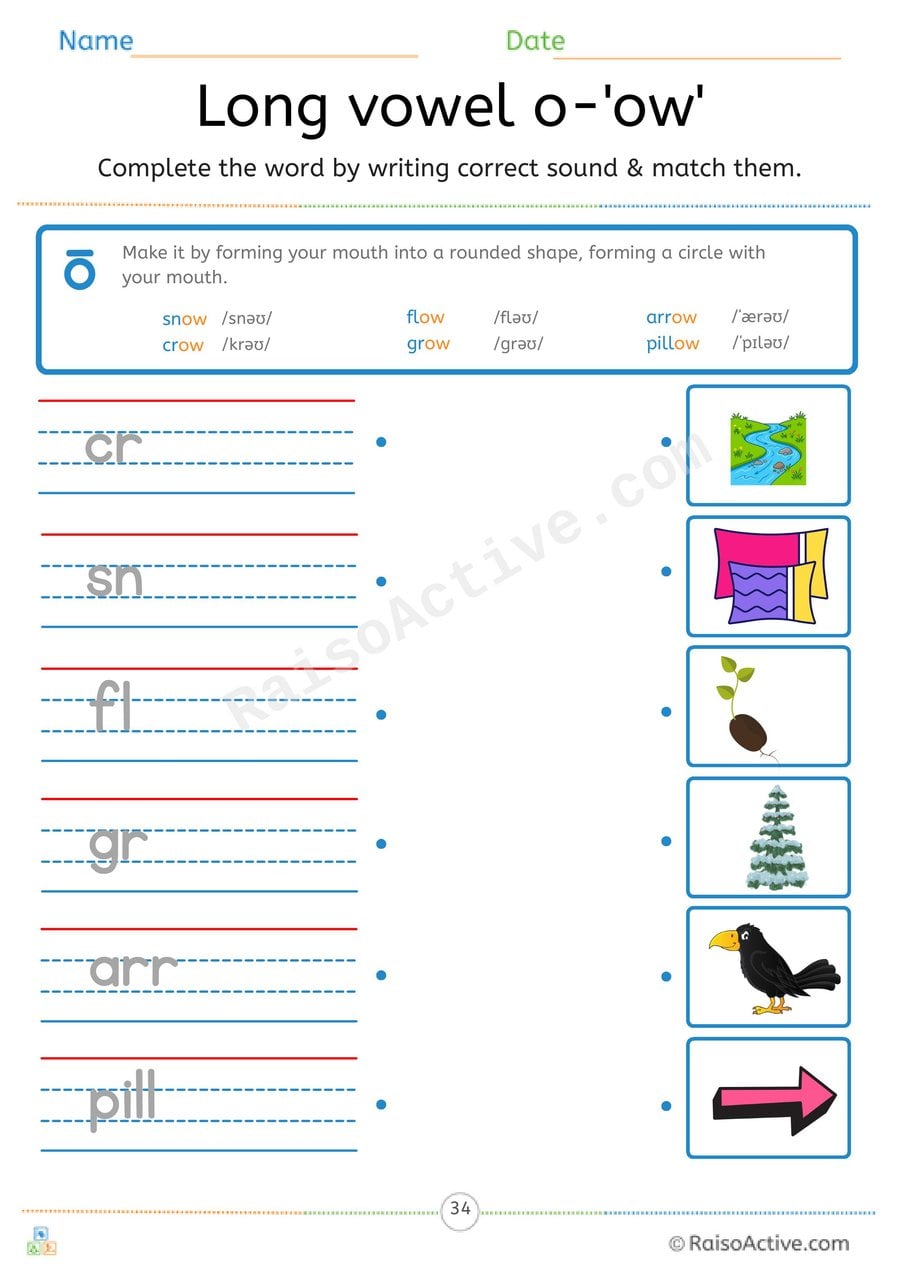
Long Vowel o 'ow' Complete the Word and Match Worksheet
Ages 5-7 · Kindergarten–Grade 1Ages 5-7 · Year 1–Year 2Ages 5-7 · UKG–Class 1Ages 5-7
Children finish six long o words by writing the 'ow' letters (crow, snow, flow, grow, arrow and pillow) and match each word to its picture.

Long Vowel a Spellings Match Worksheet: a, ay, ai, ey, ei, a_e
Ages 5-7 · Kindergarten–Grade 1Ages 5-7 · Year 1–Year 2Ages 5-7 · UKG–Class 1Ages 5-7
Children link each picture to its word and then to its long a spelling (snail: ai; baby: a; play: ay; veil: ei; cake: a_e; hey: ey).

Long Vowel a Say and Colour Worksheet
Ages 5-7 · Kindergarten–Grade 1Ages 5-7 · Year 1–Year 2Ages 5-7 · UKG–Class 1Ages 5-7
Children listen for the long a sound, which says its own letter name, and colour only the pictures that have it: paper, acorn, lady, radio, table and baby.

Phonics Level 3 Long Vowels Answer Key for Grown-ups
Ages 5-7 · Kindergarten–Grade 1Ages 5-7 · Year 1–Year 2Ages 5-7 · UKG–Class 1Ages 5-7
Grown-ups get every answer for the long a, e, i, o and u pages and the long-or-short sorting pages, including word search positions by row and column.

Long Vowel u 'u_e' Cut and Paste Worksheet
Ages 5-7 · Kindergarten–Grade 1Ages 5-7 · Year 1–Year 2Ages 5-7 · UKG–Class 1Ages 5-7
Children practise the long u spelling 'u_e' by finding the six pictures that have it: mute, cute, cube, perfume, mule and tube.
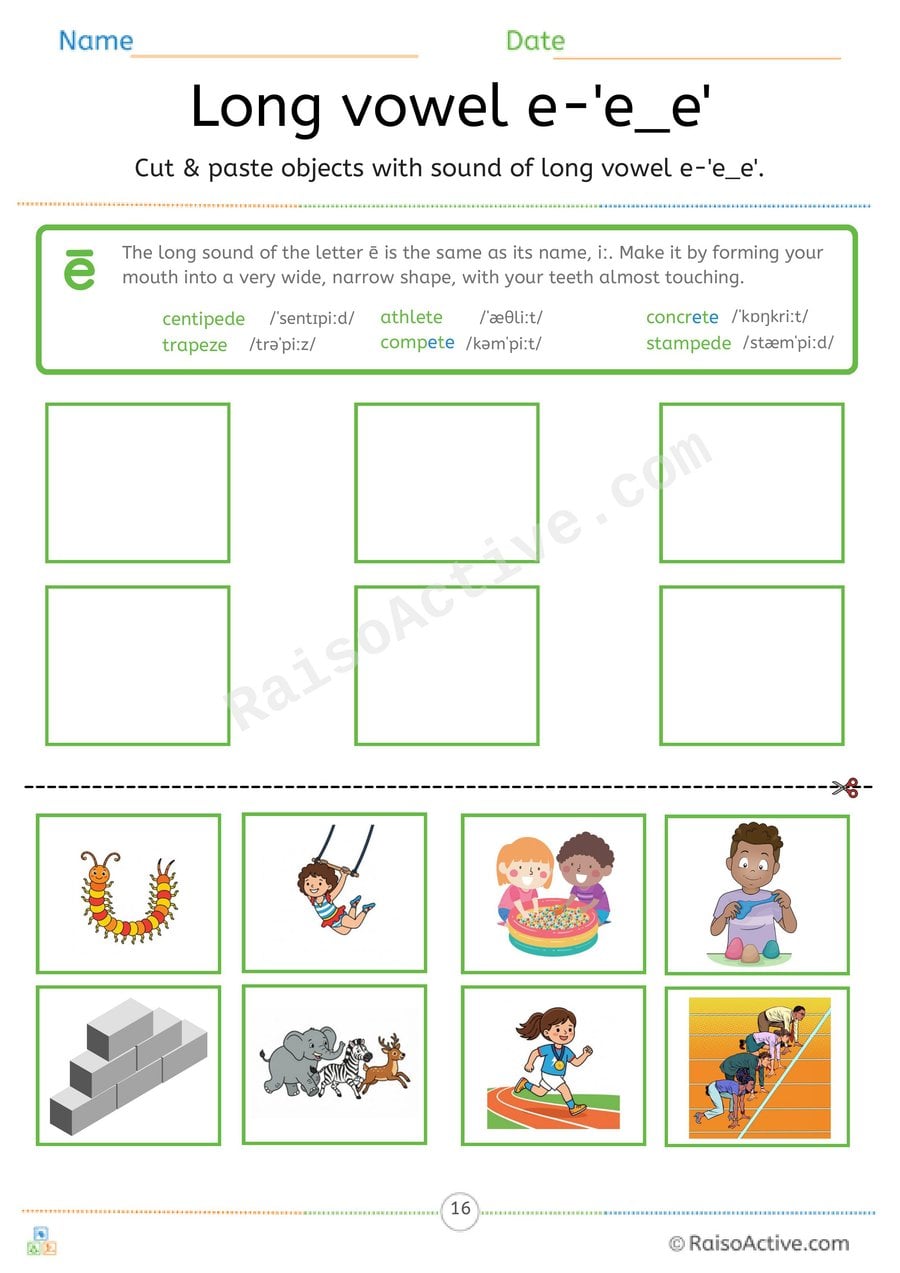
Long Vowel e 'e_e' Cut and Paste Worksheet
Ages 5-7 · Kindergarten–Grade 1Ages 5-7 · Year 1–Year 2Ages 5-7 · UKG–Class 1Ages 5-7
Children practise the long e spelling 'e_e' by finding the six pictures that have it: centipede, trapeze, concrete, stampede, athlete and compete.

Long Vowel i 'i_e' Cut and Paste Worksheet
Ages 5-7 · Kindergarten–Grade 1Ages 5-7 · Year 1–Year 2Ages 5-7 · UKG–Class 1Ages 5-7
Children practise the long i spelling 'i_e' by finding the six pictures that have it: ice, bike, dice, prize, kite and smile.
Related worksheets

Phonics Level 2 Answer Key
Ages 4-7 · Pre-K–Grade 1Ages 4-7 · Reception–Year 2Ages 4-7 · LKG–Class 1Ages 4-7
Grown-ups can check the answers for every page in the pack that has one right answer, grouped by section.

Say My Sound: Beginning Letter Sounds Worksheet for Preschoolers
Ages 3-5 · Preschool–Pre-KAges 3-5 · Nursery–ReceptionAges 3-5 · Nursery–LKGAges 3-5
Saying a picture's name aloud and then circling the letter that matches its beginning sound builds phonemic awareness in children ages 3-5, teaching them to isolate the very first sound in a spoken word before connecting it to a printed letter. Because several letter options are given for each picture, this worksheet requires children to actively compare sounds rather than simply recognize a single correct letter by memory. This kind of applied letter-sound practice is one of the strongest early predictors of later reading success.

Sight Words Worksheet: Practice with 'is', 'we', and 'my'
Ages 4-6 · Pre-K–KindergartenAges 4-6 · Reception–Year 1Ages 4-6 · LKG–UKGAges 4-6
This worksheet challenges children ages 4-6 to choose the correct sight word from a small word bank — 'is,' 'we,' or 'my' — to complete a sentence, rather than simply tracing or copying a single word. Selecting the right word based on sentence meaning requires a deeper level of reading comprehension than earlier single-word practice, since children must understand what each sentence is saying before choosing correctly. Writing the chosen word from memory also builds spelling recall for these common words.

Learn the Sight Word 'My' - Tracing, Writing, and Matching Worksheet
Ages 3-5 · Preschool–Pre-KAges 3-5 · Nursery–ReceptionAges 3-5 · Nursery–LKGAges 3-5
This worksheet builds sight-word fluency for the word 'my' in children ages 3-5 through a combination of tracing, independent writing, fill-in-the-blank sentences, and a matching activity. Working with the same word across several different formats helps cement recognition, since 'my' is a high-frequency word that appears constantly in early reading material but doesn't follow simple phonics patterns. The matching component adds a visual-recognition check to confirm the word sticks even without tracing cues.

Phonics Level 2 Sound Mat 1: Consonants and Short Vowels
Ages 4-7 · Pre-K–Grade 1Ages 4-7 · Reception–Year 2Ages 4-7 · LKG–Class 1Ages 4-7
Children see the consonant sounds and the five short vowels, each with a picture, its common spellings and example words.
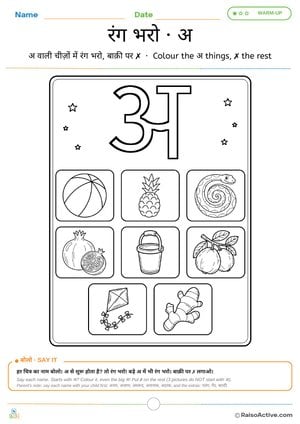
Colour the अ Things: Hindi Letter अ Colouring Page | रंग भरो · अ
Ages 3-7 · Preschool–Grade 1Ages 3-7 · Nursery–Year 2Ages 3-7 · Nursery–Class 1Ages 3-7
Children listen for the first sound of each picture name and decide whether it starts with अ. They colour the अ pictures, cross out the others and colour the big letter.
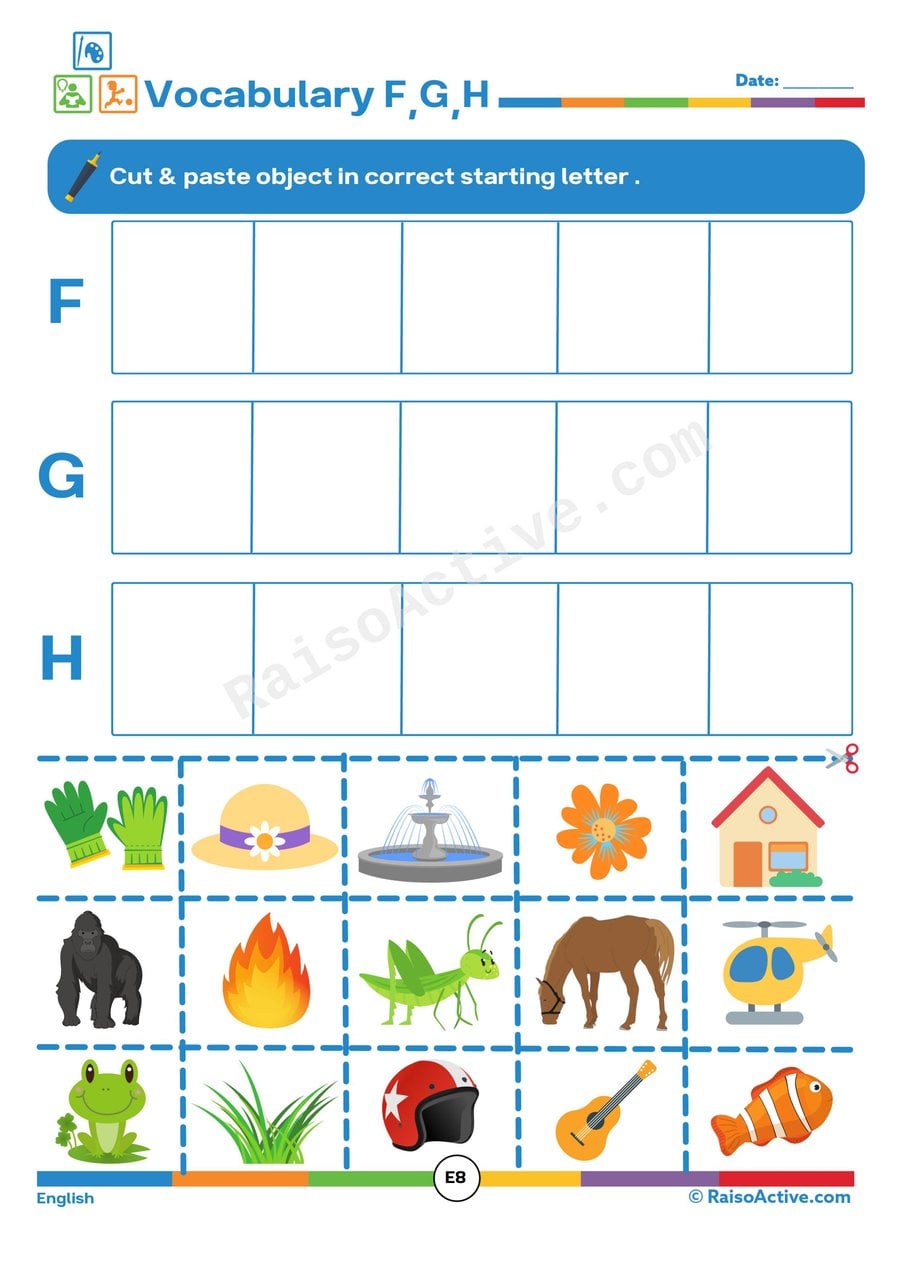
F, G, H Letter Sounds Cut and Paste Worksheet
Ages 4-5 · Pre-KAges 4-5 · ReceptionAges 4-5 · LKGAges 4-5
This worksheet builds phonemic awareness in children ages 4-5 by asking them to isolate the beginning sound of each picture and sort it under the correct letter — F, G, or H. Sorting across three letters at once, rather than just one, requires children to hold multiple sound-letter associations in mind and choose between them, which is a step up in difficulty from single-letter worksheets. This kind of comparative sound-sorting strengthens the phonics foundation needed for early reading.
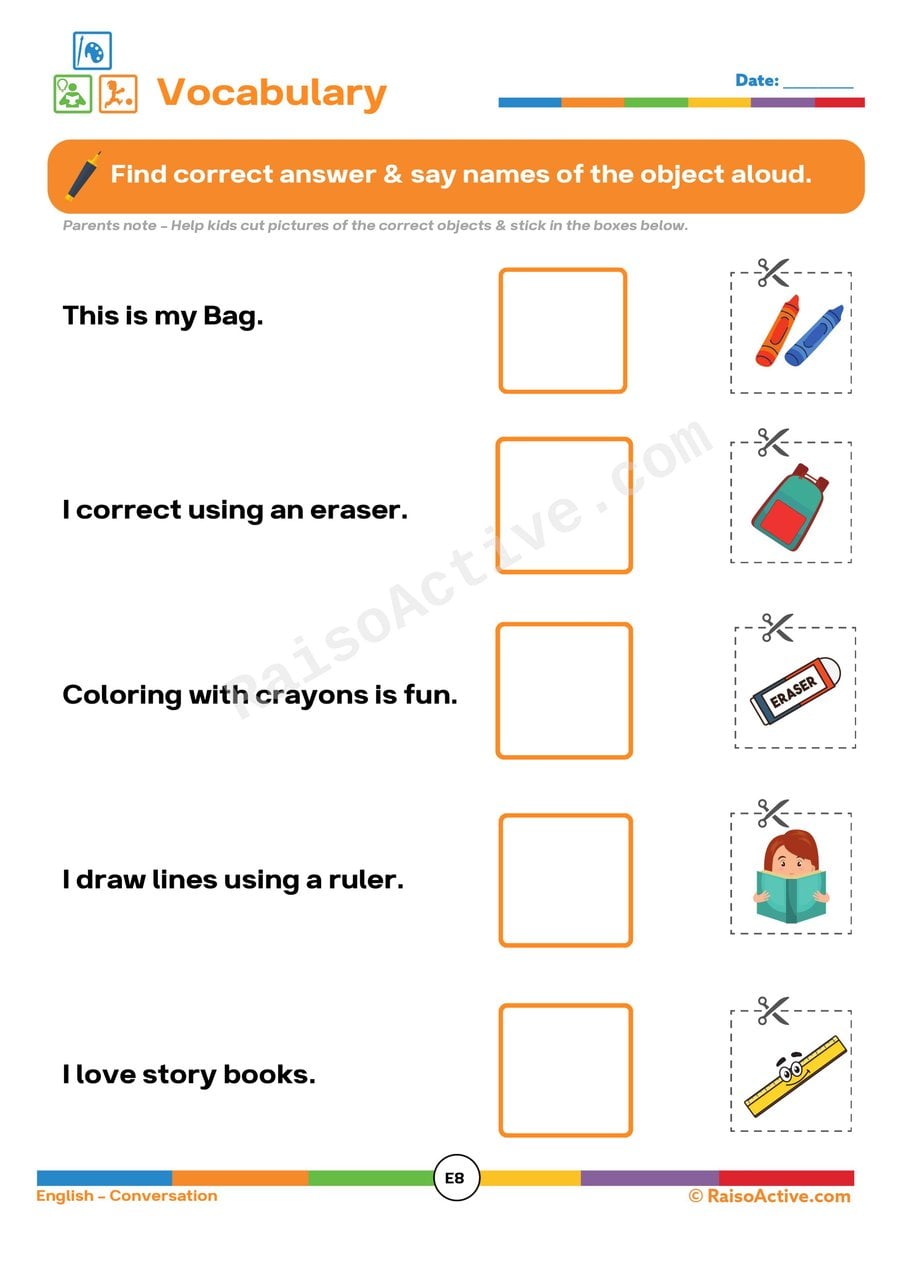
Vocabulary Fun: Match the Pictures! (Ages 3-5)
Ages 3-5 · Preschool–Pre-KAges 3-5 · Nursery–ReceptionAges 3-5 · Nursery–LKGAges 3-5
Cutting out pictures and matching them to sentences builds early reading comprehension in children ages 3-5, since they must listen to or read a sentence and connect its meaning to the correct image rather than just recognizing an isolated word. This combination of cutting, listening, and matching strengthens vocabulary retention because the word is reinforced through multiple senses at once: hearing it, seeing it in print, and seeing its picture. Pasting the correct picture into place also adds fine motor practice to the vocabulary lesson.
Guides for this topic

How to Teach CVC Blending: A Step-by-Step Method That Works in Two Weeks
A step-by-step method for teaching CVC blending, covering continuous sounds, word families, common errors, and a 14-day plan that most children finish reading CVC words.
Phase 2 Phonics at Home: Sound Order, Blending Games, Worksheets
Phase 2 phonics at home: the five sound sets in order, oral blending, tricky words, a two-week routine, common mistakes, and free worksheets.

Reception Year Explained: EYFS Learning and How to Help at Home
A teacher's plain-English guide to the Reception Year: the seven areas of learning, Early Learning Goals, Phase 2/3 phonics, the RBA and home routines.
Reviews
Every worksheet for ages 5–7, no watermark
Members download the full library of 1,000+ worksheets and every activity pack without watermarks or daily limits. One year costs ₹999 in India or $20 elsewhere.
See membership plansOr download any worksheet free with a watermark (5 a day).