CCVC Words with cl and sl Blends Read and Match Worksheet
Children read ten CCVC words with sound buttons (clap, clip, club, clan, clog, slab, slim, slug, slap, slip) and draw a line from each word to its picture.
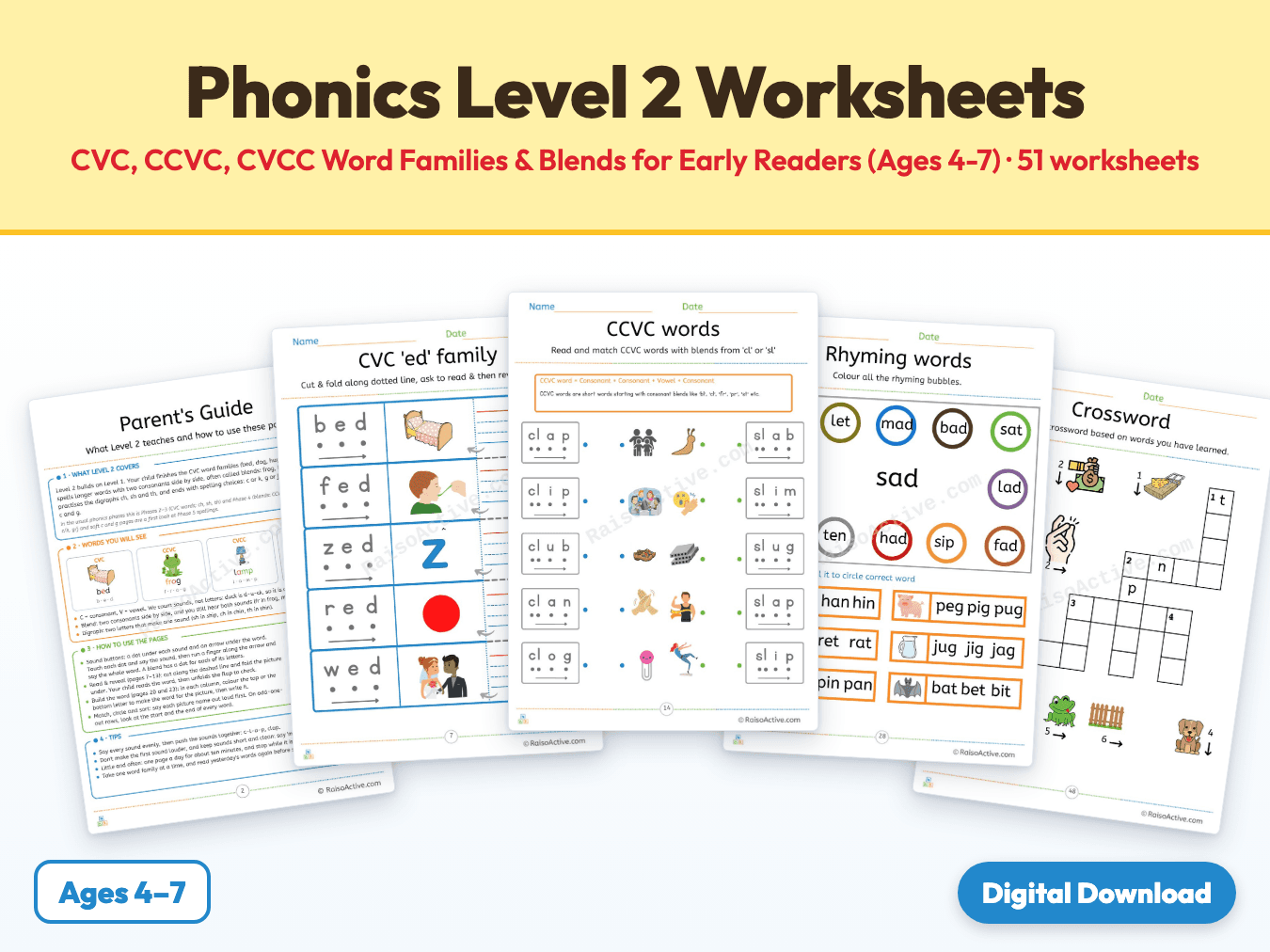
Part of the pack
Phonics Level 2 Worksheets: CVC, CCVC, CVCC Word Families & Blends for Early Readers (Ages 4-7)
This is page 14 of the pack. Ages 4-7 · Pre-K–Grade 1Ages 4-7 · Reception–Year 2Ages 4-7 · LKG–Class 1Ages 4-7
Made for your child
Adding within 10, made for your child
A maths pack with your child's name in it: pictures that explain, practice at three levels, puzzles and story sums about them. Print a new set whenever they finish.
Make a maths packFree preview · free for members
Curriculum
- Phonics - Blends > CCVC Words
- Phonics - Blends > Consonant Blends
How to use this worksheet
Read the box at the top together. Your child blends each word, then joins the dot by the word to the dot by the right picture.
Materials needed
- Pencil
- Crayons
Extension activities
- 1Act out clap, slap and slip
- 2Sort the ten words into cl and sl piles

Written by
Hemsweta Jain · Teacher Cheena
MBA and Early Childhood Educator, teaching since 2014 · Founder of RaisoActive, Mumbai
Every RaisoActive worksheet is designed and checked by the founder before publishing.
Published · Last reviewed
More from Phonics Level 2 Worksheets: CVC, CCVC, CVCC Word Families & Blends for Early Readers (Ages 4-7)

CVC Vocabulary Write the Words and Cut and Paste Pictures Worksheet
Ages 4-7 · Pre-K–Grade 1Ages 4-7 · Reception–Year 2Ages 4-7 · LKG–Class 1Ages 4-7
Children spell net, box, lid, ten, cap and fig in letter boxes, then cut out ten small pictures and paste each beside its word: bus, dad, sun, bed, cut, mad, cat, sit, mum and dog.
CVC 'ed' Word Family Read, Cut and Reveal Worksheet
Ages 4-7 · Pre-K–Grade 1Ages 4-7 · Reception–Year 2Ages 4-7 · LKG–Class 1Ages 4-7
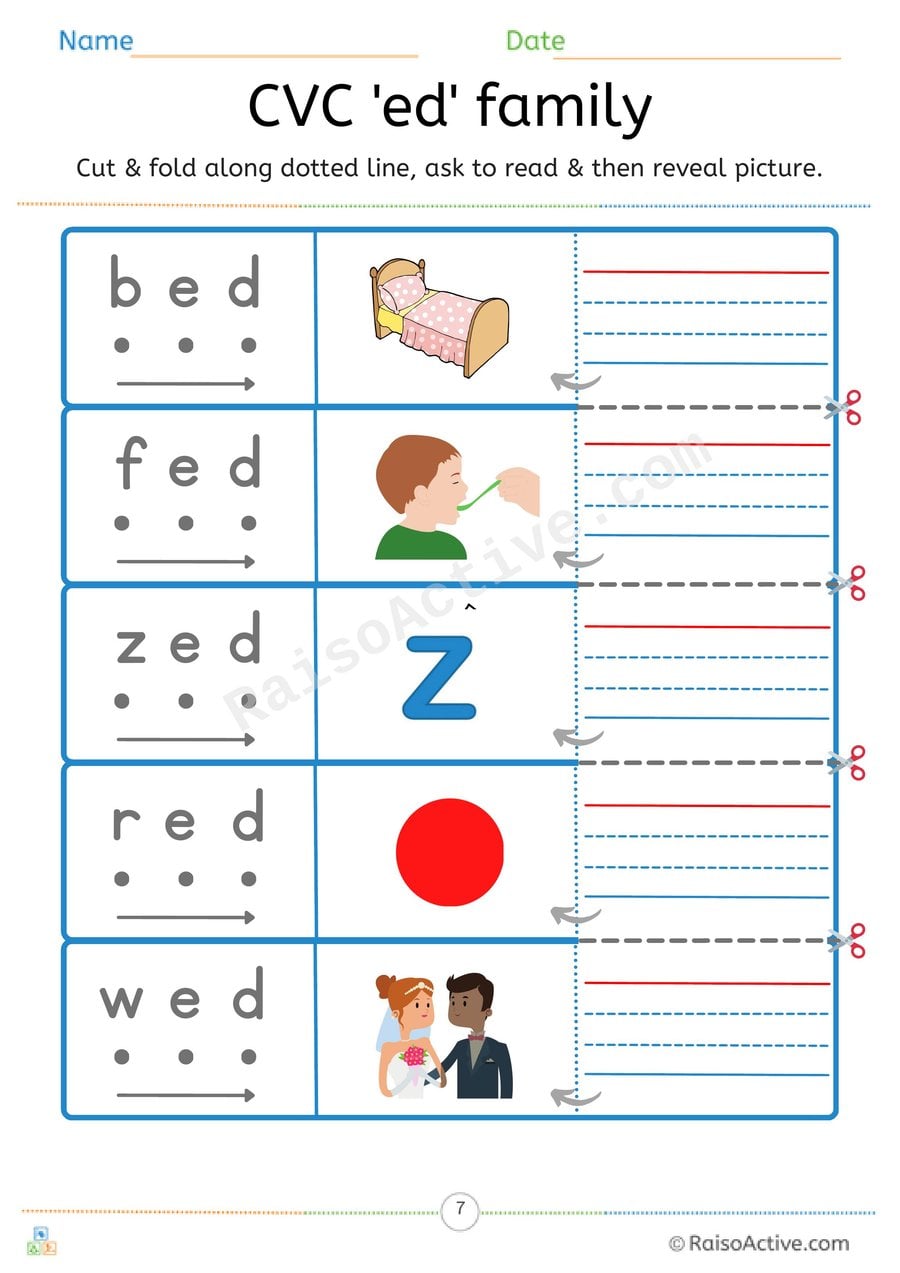
Children read five 'ed' words (bed, fed, zed, red, wed) by blending three sounds, check each one against a hidden picture (a bed, a child being fed, a letter z, a red dot and a wedding) and write it, so they see that changing the first sound makes a new word.

CVC Revision: Colour the Word and Build 'ap' Words Worksheet
Ages 4-7 · Pre-K–Grade 1Ages 4-7 · Reception–Year 2Ages 4-7 · LKG–Class 1Ages 4-7
Children colour the word that names each picture (dog, jet, pan, pig) from three rhyming choices, then write the first letter to make map, lap, nap, gap, cap and tap.

Phonics Level 2 Sound Mat 4: Consonant Blends and ck
Ages 4-7 · Pre-K–Grade 1Ages 4-7 · Reception–Year 2Ages 4-7 · LKG–Class 1Ages 4-7
Children see how two consonants keep both their sounds in a blend, at the start of words (bl, cl, fl, sl, br, cr, dr, tr, st, sw) and at the end (nd, nt, mp), and that ck makes one /k/ sound.
Beginning Blends cl and sl Circle the Pictures Worksheet
Ages 4-7 · Pre-K–Grade 1Ages 4-7 · Reception–Year 2Ages 4-7 · LKG–Class 1Ages 4-7
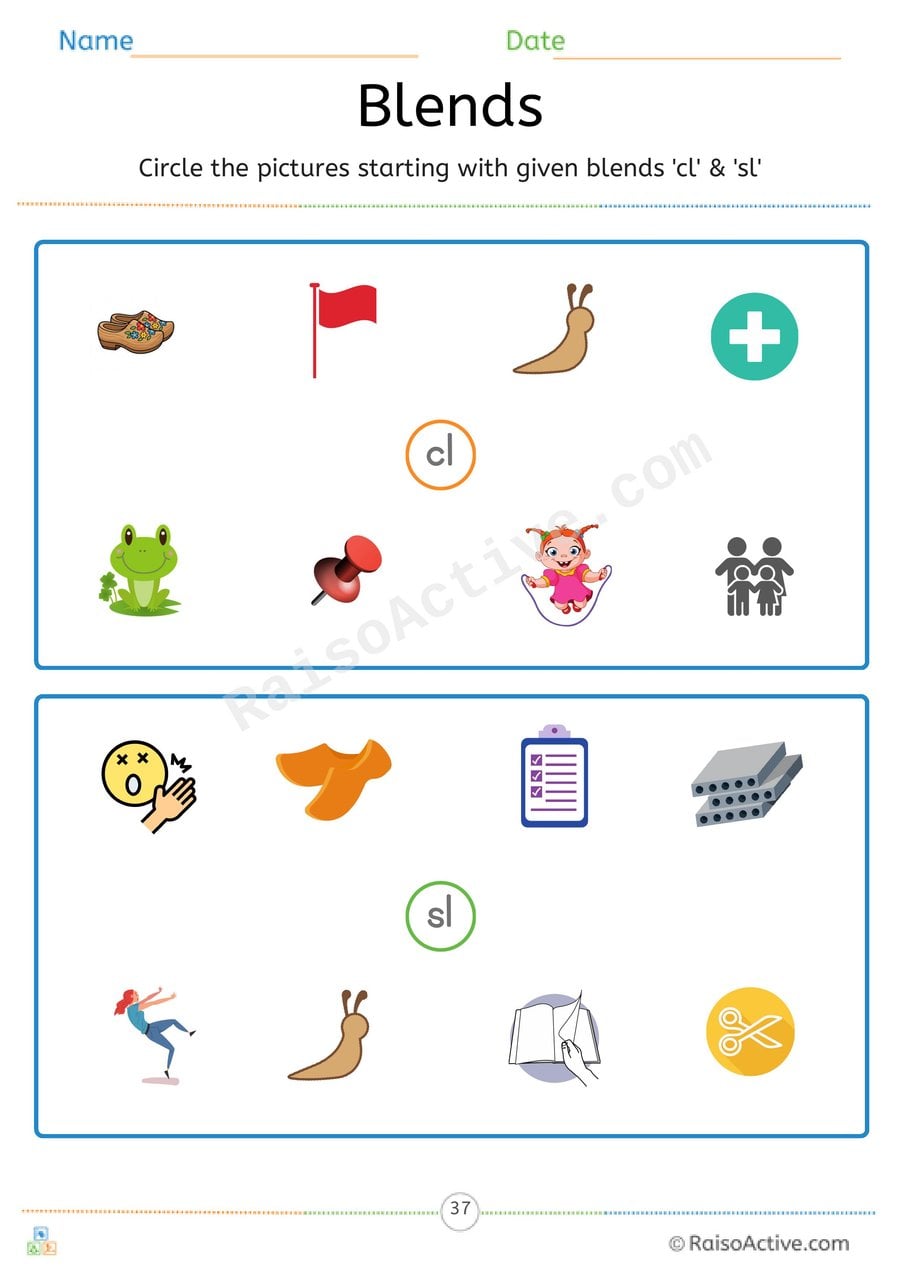
Children listen for the first two sounds and circle the pictures that start with cl (clogs, clan) and with sl (slap, slabs, slip, slug, slipper), leaving the others.

Unscramble CVC Words and Missing First Letter Worksheet
Ages 4-7 · Pre-K–Grade 1Ages 4-7 · Reception–Year 2Ages 4-7 · LKG–Class 1Ages 4-7
Children unscramble the letters to write cat, pan and map, then write the missing first letter of gate, cow, bus, ant, hat, bed, car and sun.

Write the CVC Word and Short Vowel a Fill-in Worksheet
Ages 4-7 · Pre-K–Grade 1Ages 4-7 · Reception–Year 2Ages 4-7 · LKG–Class 1Ages 4-7
Children add the last letter to spell cat, sun, fox, web, gum and lip, then write the missing letters to spell short a words: bag, cap, tap, bat, man and cab.

Short e Word Puzzle and First Letter Sounds Worksheet
Ages 4-7 · Pre-K–Grade 1Ages 4-7 · Reception–Year 2Ages 4-7 · LKG–Class 1Ages 4-7
Children find leg, beg, met, pet and vet hidden in rows of letters, then write the first letter of candle, octopus, umbrella, hat, butterfly, tree, igloo, clock and apple.
Related worksheets

Easter Egg Color by Hints Worksheet for Preschoolers
Ages 3-5 · Preschool–Pre-KAges 3-5 · Nursery–ReceptionAges 3-5 · Nursery–LKGAges 3-5
This worksheet has children ages 3-5 listen to or read simple written hints describing shapes and colors, then apply that information correctly while coloring each Easter egg, building early reading comprehension and the ability to follow multi-step verbal instructions. Because the hints must be followed precisely rather than colored freely, children also practice patience and careful attention to detail.

Navratri Colour Hunt: Colour Words, Matching and Bangles
Ages 4-6 · Pre-K–KindergartenAges 4-6 · Reception–Year 1Ages 4-6 · LKG–UKGAges 4-6
Children read colour words, colour bangles to match, count how many of each colour, match everyday things to their colours and find colours around the home.

Festivals of Many Faiths: Places of Worship and Greetings
Ages 4-8 · Pre-K–Grade 2Ages 4-8 · Reception–Year 3Ages 4-8 · LKG–Class 2Ages 4-8
Children learn that India is home to many faiths, each with its own festivals, places of worship and festival greetings.

Match the Flags! A Fun Coloring Worksheet for Kids
Ages 3-5 · Preschool–Pre-KAges 3-5 · Nursery–ReceptionAges 3-5 · Nursery–LKGAges 3-5
This worksheet combines coloring with flag recognition, helping children ages 3-5 practice fine motor control while learning to match a colored flag to its correct blank outline. Coloring the flags first, then matching them, adds an extra layer of visual processing as children must recall the colors they just used to complete the matching step.

Easter Egg Match: Add and Find the Matching Designs!
Ages 3-5 · Preschool–Pre-KAges 3-5 · Nursery–ReceptionAges 3-5 · Nursery–LKGAges 3-5
This worksheet blends early addition with visual matching as children ages 3-5 combine two separate shape groups and then search for the Easter egg design that shows the same total. Because the 'answer' is a picture rather than a written number, children practice quantity comparison and pattern-matching without needing to know written numerals yet.

Easter Egg Color Match Worksheet for Preschoolers
Ages 3-5 · Preschool–Pre-KAges 3-5 · Nursery–ReceptionAges 3-5 · Nursery–LKGAges 3-5
Children ages 3-5 practice color recognition and following a visual code as they color Easter eggs to match a key provided at the top of the page. Using a color-coded key rather than free coloring adds an instruction-following element, teaching children to check a reference and apply it consistently across a whole page.

Halloween Match: Find and Color the Identical Objects!
Ages 3-5 · Preschool–Pre-KAges 3-5 · Nursery–ReceptionAges 3-5 · Nursery–LKGAges 3-5
This visual discrimination worksheet asks children ages 3-5 to scan a row of similar-looking Halloween objects and identify the two that are truly identical, sharpening their attention to small details like size, shading, and shape. Coloring the matched pair afterward gives a satisfying finishing step while reinforcing which items they correctly identified.

Symmetry Worksheet for Kids: Mirror Halves and Shadow Match
Ages 4-7 · Pre-K–Grade 1Ages 4-7 · Reception–Year 2Ages 4-7 · LKG–Class 1Ages 4-7
Children complete the other half of a butterfly and a house on a dot grid so both sides match like a mirror, then draw lines to match eight pictures to their shadows. This builds spatial reasoning and visual discrimination.
Guides for this topic

How to Teach CVC Blending: A Step-by-Step Method That Works in Two Weeks
A step-by-step method for teaching CVC blending, covering continuous sounds, word families, common errors, and a 14-day plan that most children finish reading CVC words.

Best Worksheets for 3-Year-Olds: What Works and What to Avoid
What works on worksheets for 3-year-olds: short sessions, crayons, tracing lines, matching, cutting, a free weekly plan, and signs one is too advanced.
Phase 2 Phonics at Home: Sound Order, Blending Games, Worksheets
Phase 2 phonics at home: the five sound sets in order, oral blending, tricky words, a two-week routine, common mistakes, and free worksheets.
Reviews
Every worksheet for ages 4–7, no watermark
Members download the full library of 1,000+ worksheets and every activity pack without watermarks or daily limits. One year costs ₹999 in India or $20 elsewhere.
See membership plansOr download any worksheet free with a watermark (5 a day).