CVC Vocabulary Write the Words and Cut and Paste Pictures Worksheet
Children spell net, box, lid, ten, cap and fig in letter boxes, then cut out ten small pictures and paste each beside its word: bus, dad, sun, bed, cut, mad, cat, sit, mum and dog.
Part of the pack
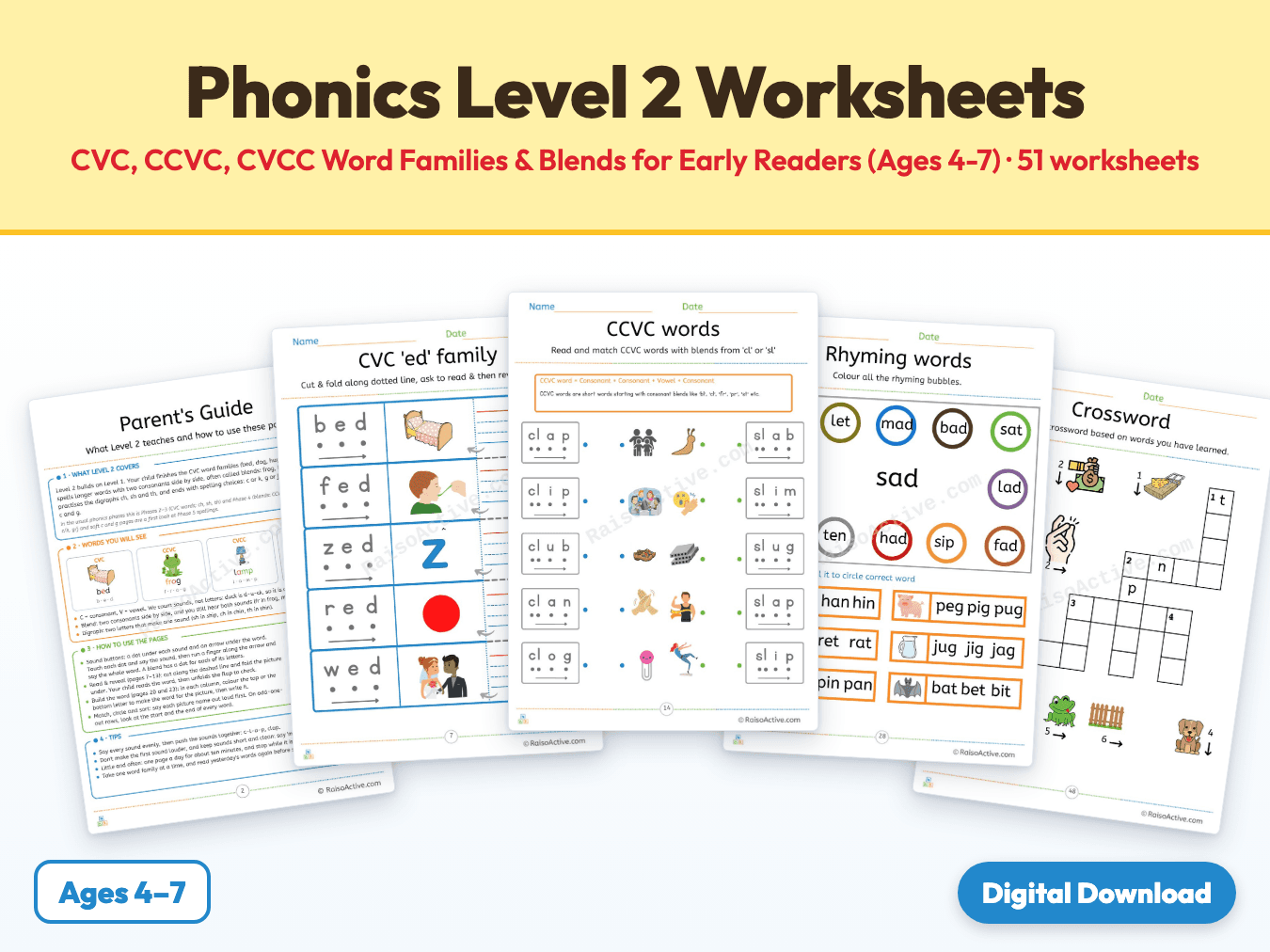
Phonics Level 2 Worksheets: CVC, CCVC, CVCC Word Families & Blends for Early Readers (Ages 4-7)
This is page 34 of the pack. Ages 4-7 · Pre-K–Grade 1Ages 4-7 · Reception–Year 2Ages 4-7 · LKG–Class 1Ages 4-7
Made for your child
Spelling practice, made for your child
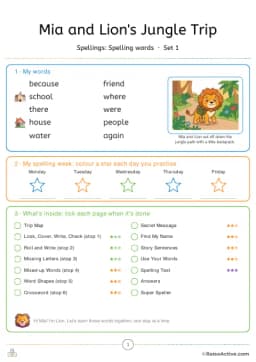
Their own spelling words turned into a pack: trace or look-cover-write-check, roll and write, a secret picture code, a word search, a crossword and a test, with their name in it.
Make a spelling packFree preview · free for members
Or start free: a word search with sight wordsCurriculum
- Phonics - CVC Words > CVC Words
How to use this worksheet
The first word (net) is done. Your child writes one letter in each box, then cuts the picture strip and pastes each picture next to the right word.
Materials needed
- Pencil
- Scissors
- Glue
Extension activities
- 1Make a picture card for another CVC word
- 2Read the paste words in a funny voice

Written by
Hemsweta Jain · Teacher Cheena
MBA and Early Childhood Educator, teaching since 2014 · Founder of RaisoActive, Mumbai
Every RaisoActive worksheet is designed and checked by the founder before publishing.
Published · Last reviewed
More from Phonics Level 2 Worksheets: CVC, CCVC, CVCC Word Families & Blends for Early Readers (Ages 4-7)

CVC Revision: Colour the Word and Build 'ap' Words Worksheet
Ages 4-7 · Pre-K–Grade 1Ages 4-7 · Reception–Year 2Ages 4-7 · LKG–Class 1Ages 4-7
Children colour the word that names each picture (dog, jet, pan, pig) from three rhyming choices, then write the first letter to make map, lap, nap, gap, cap and tap.

Ending Sounds Write and Circle the Last Sound Worksheet
Ages 4-7 · Pre-K–Grade 1Ages 4-7 · Reception–Year 2Ages 4-7 · LKG–Class 1Ages 4-7
Children write the last letter of rat, tap, hat, bag, bat and pen, then circle the ending sound of hen, bag, pig, cap, yak and sun.
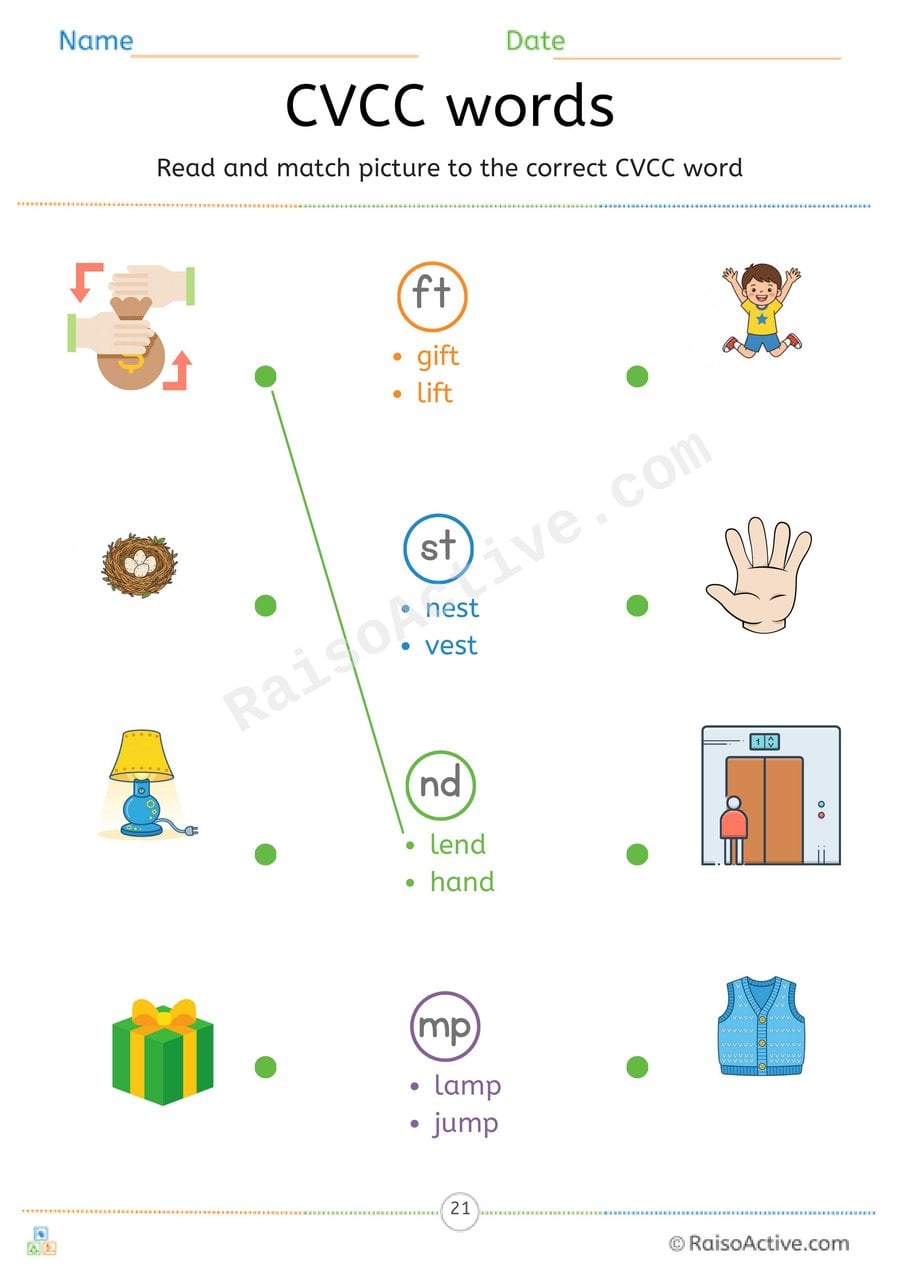
CVCC Ending Blends ft, st, nd and mp Read and Match Worksheet
Ages 4-7 · Pre-K–Grade 1Ages 4-7 · Reception–Year 2Ages 4-7 · LKG–Class 1Ages 4-7
Children read eight CVCC words grouped by their ending blend (gift, lift, nest, vest, lend, hand, lamp, jump) and match each word to its picture.

Phonics Level 2 Sound Mat 3: Long Vowel and R-Influenced Vowel Sounds
Ages 4-7 · Pre-K–Grade 1Ages 4-7 · Reception–Year 2Ages 4-7 · LKG–Class 1Ages 4-7
Children see the long vowel sounds, the r-influenced vowels such as ar, er and or, and other vowel sounds such as ow, oy and oo, each with spellings and examples.
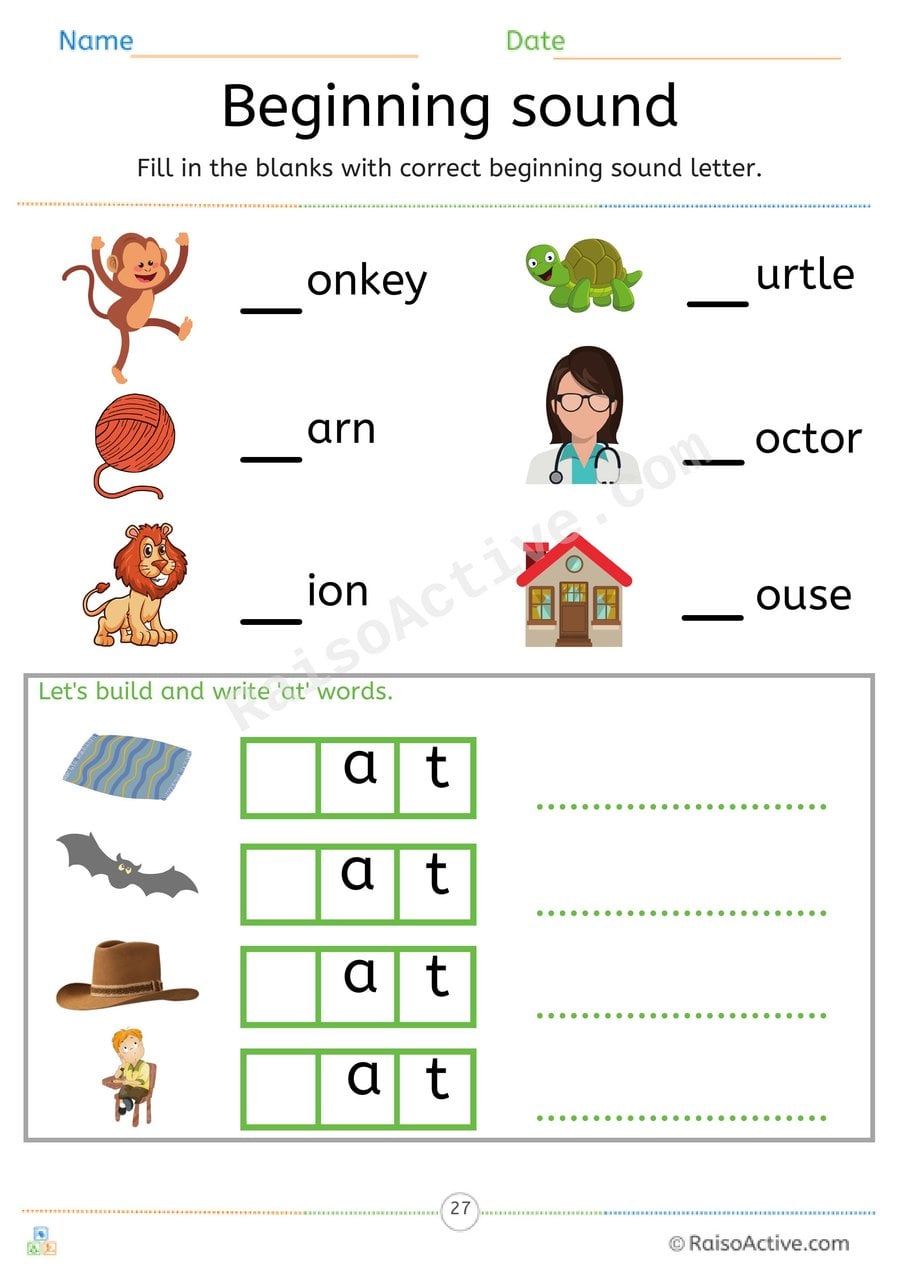
Beginning Sounds and 'at' Word Building Worksheet
Ages 4-7 · Pre-K–Grade 1Ages 4-7 · Reception–Year 2Ages 4-7 · LKG–Class 1Ages 4-7
Children write the first letter of monkey, turtle, yarn, doctor, lion and house, then build and write four 'at' words: mat, bat, hat and sat.
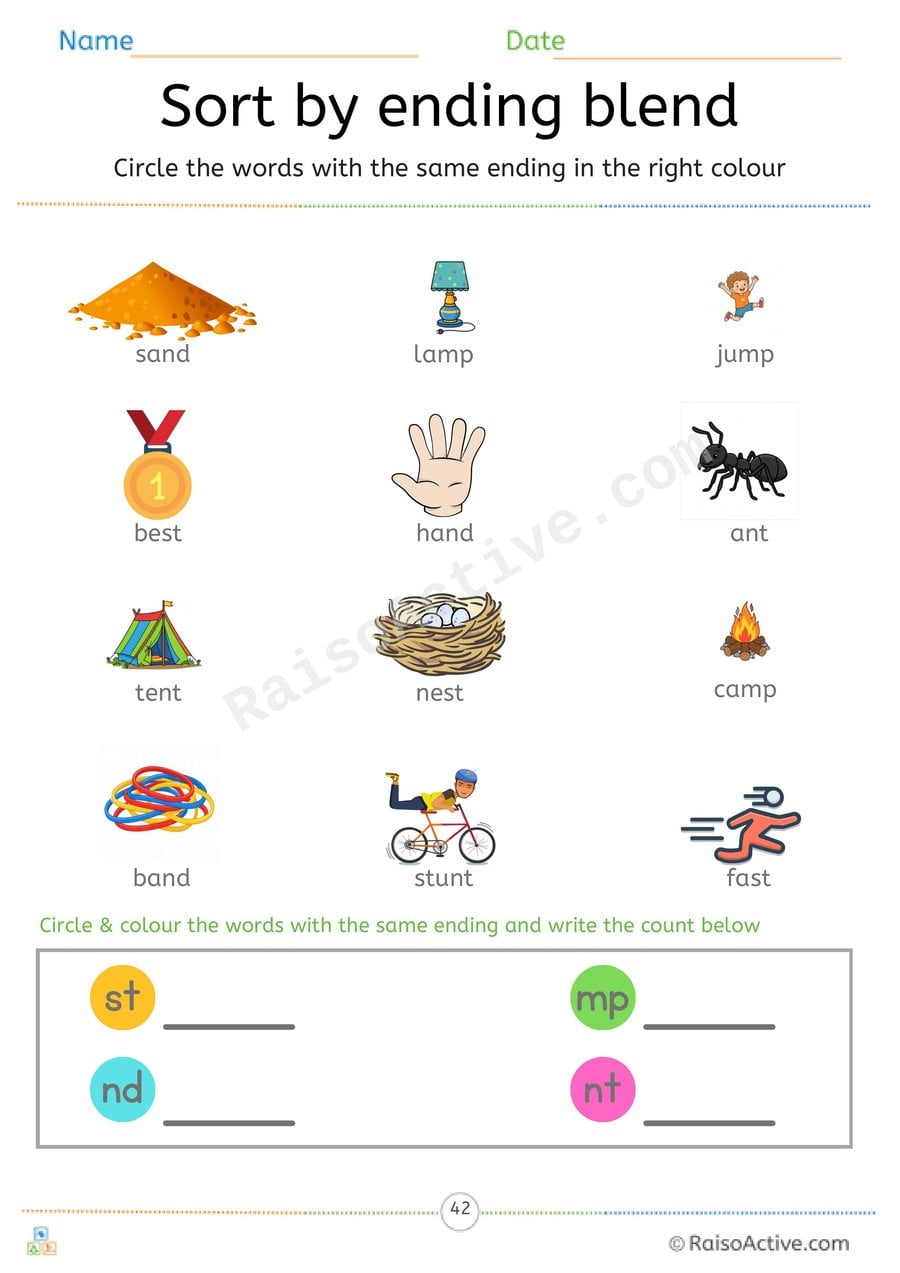
Sort by Ending Blend Worksheet: st, mp, nd and nt
Ages 4-7 · Pre-K–Grade 1Ages 4-7 · Reception–Year 2Ages 4-7 · LKG–Class 1Ages 4-7
Children read twelve words and colour each by its ending blend: st (best, nest, fast), mp (lamp, jump, camp), nd (sand, hand, band) and nt (ant, tent, stunt), then write how many of each.

Phonics Level 2 Sound Mat 1: Consonants and Short Vowels
Ages 4-7 · Pre-K–Grade 1Ages 4-7 · Reception–Year 2Ages 4-7 · LKG–Class 1Ages 4-7
Children see the consonant sounds and the five short vowels, each with a picture, its common spellings and example words.

CVC 'ob' Word Family Read, Cut and Reveal Worksheet
Ages 4-7 · Pre-K–Grade 1Ages 4-7 · Reception–Year 2Ages 4-7 · LKG–Class 1Ages 4-7
Children read five 'ob' words (cob, job, mob, rob, sob) by blending three sounds, check each one against a hidden picture (a corn cob, a person at work, a crowd, a monkey taking fruit and a crying child) and write it, so they see that changing the first sound makes a new word.
Related worksheets

Phonics Level 3 Long Vowels Answer Key for Grown-ups
Ages 5-7 · Kindergarten–Grade 1Ages 5-7 · Year 1–Year 2Ages 5-7 · UKG–Class 1Ages 5-7
Grown-ups get every answer for the long a, e, i, o and u pages and the long-or-short sorting pages, including word search positions by row and column.
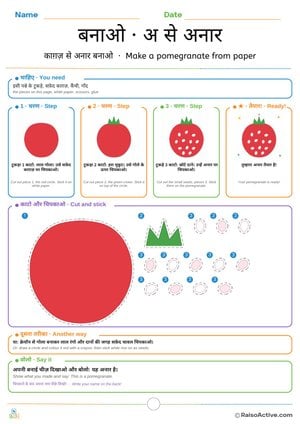
Make a Paper Pomegranate: Hindi Letter अ Craft | बनाओ · अ से अनार
Ages 3-7 · Preschool–Grade 1Ages 3-7 · Nursery–Year 2Ages 3-7 · Nursery–Class 1Ages 3-7
Children cut out the pieces, put them together following three step pictures and make a paper pomegranate. Saying the word अनार as they make it links the sound अ to something they built themselves.

Phonics Level 3 Long Vowels Certificate of Achievement
Ages 5-7 · Kindergarten–Grade 1Ages 5-7 · Year 1–Year 2Ages 5-7 · UKG–Class 1Ages 5-7
Children celebrate finishing Phonics Level 3 and look back at the five long vowel sounds they can now read: long a, e, i, o and u.
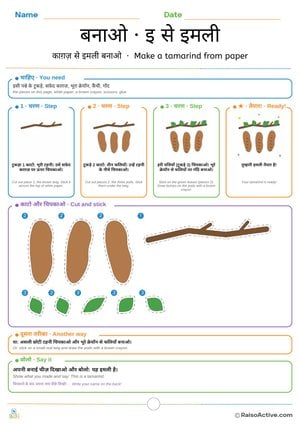
Make a Paper Tamarind: Hindi Letter इ Craft | बनाओ · इ से इमली
Ages 3-7 · Preschool–Grade 1Ages 3-7 · Nursery–Year 2Ages 3-7 · Nursery–Class 1Ages 3-7
Children cut out the pieces, put them together following three step pictures and make a paper tamarind. Saying the word इमली as they make it links the sound इ to something they built themselves.
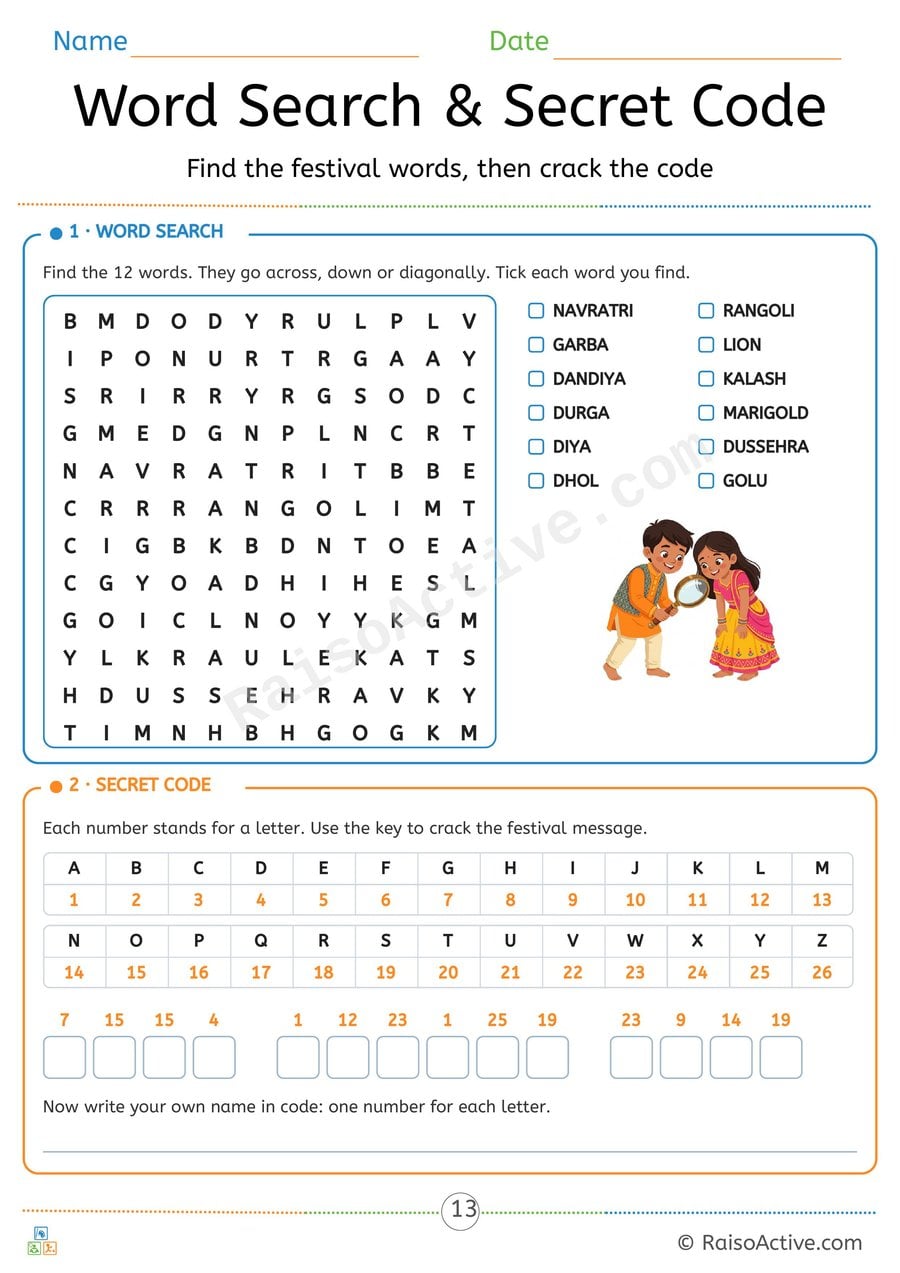
Navratri Word Search and Secret Code Puzzle
Ages 7-11 · Grade 2–Grade 3Ages 7-11 · Year 3–Year 4Ages 7-11 · Class 2–Class 3Ages 7-11
Children find 12 festival words that run across, down and diagonally, and use an A = 1 to Z = 26 key to decode a message about the festival. Then they write their own name in code.
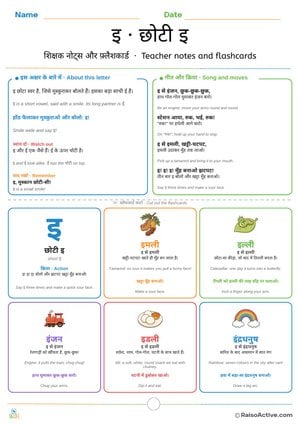
Hindi Letter इ (i) Teacher Notes and Flashcards | इ · छोटी इ
Ages 3-7 · Preschool–Grade 1Ages 3-7 · Nursery–Year 2Ages 3-7 · Nursery–Class 1Ages 3-7
Children meet the short vowel इ with a short note for adults, a song with actions and cut-out flashcards for इमली (tamarind), इल्ली (caterpillar), इंजन (engine), इडली (idli), इंद्रधनुष (rainbow). They hear the sound at the start of real words and link it to a hand action.
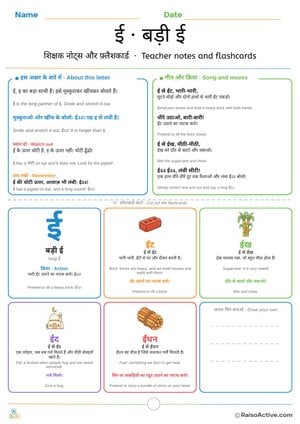
Hindi Letter ई (ee) Teacher Notes and Flashcards | ई · बड़ी ई
Ages 3-7 · Preschool–Grade 1Ages 3-7 · Nursery–Year 2Ages 3-7 · Nursery–Class 1Ages 3-7
Children meet the long vowel ई with a short note for adults, a song with actions and cut-out flashcards for ईंट (brick), ईख (sugarcane), ईद (Eid), ईंधन (fuel). They hear the sound at the start of real words and link it to a hand action.

Rocking Santa Card Craft Worksheet for Preschoolers
Ages 3-5 · Preschool–Pre-KAges 3-5 · Nursery–ReceptionAges 3-5 · Nursery–LKGAges 3-5
This rocking Santa card craft has children ages 3-5 cut out individual shape pieces and assemble them onto a folded card base, combining scissor control with an early understanding of how folding creates movement, since the 'rocking' effect comes from the card's fold. Following the assembly steps in order also reinforces sequencing and attention to visual instructions.
Guides for this topic

Sight Words by Age: The First 50 Words and How to Teach Them Without Flashcard Fatigue
Which sight words to teach first and why, the heart-word method, a read-trace-write-find routine, games, and a by-age table of typical sight-word progress.
How to Teach CVC Blending: A Step-by-Step Method That Works in Two Weeks
A step-by-step method for teaching CVC blending, covering continuous sounds, word families, common errors, and a 14-day plan that most children finish reading CVC words.
Phase 2 Phonics at Home: Sound Order, Blending Games, Worksheets
Phase 2 phonics at home: the five sound sets in order, oral blending, tricky words, a two-week routine, common mistakes, and free worksheets.
Reviews
Every worksheet for ages 4–7, no watermark
Members download the full library of 1,000+ worksheets and every activity pack without watermarks or daily limits. One year costs ₹999 in India or $20 elsewhere.
See membership plansOr download any worksheet free with a watermark (5 a day).