Easter Egg Color Match Worksheet for Preschoolers
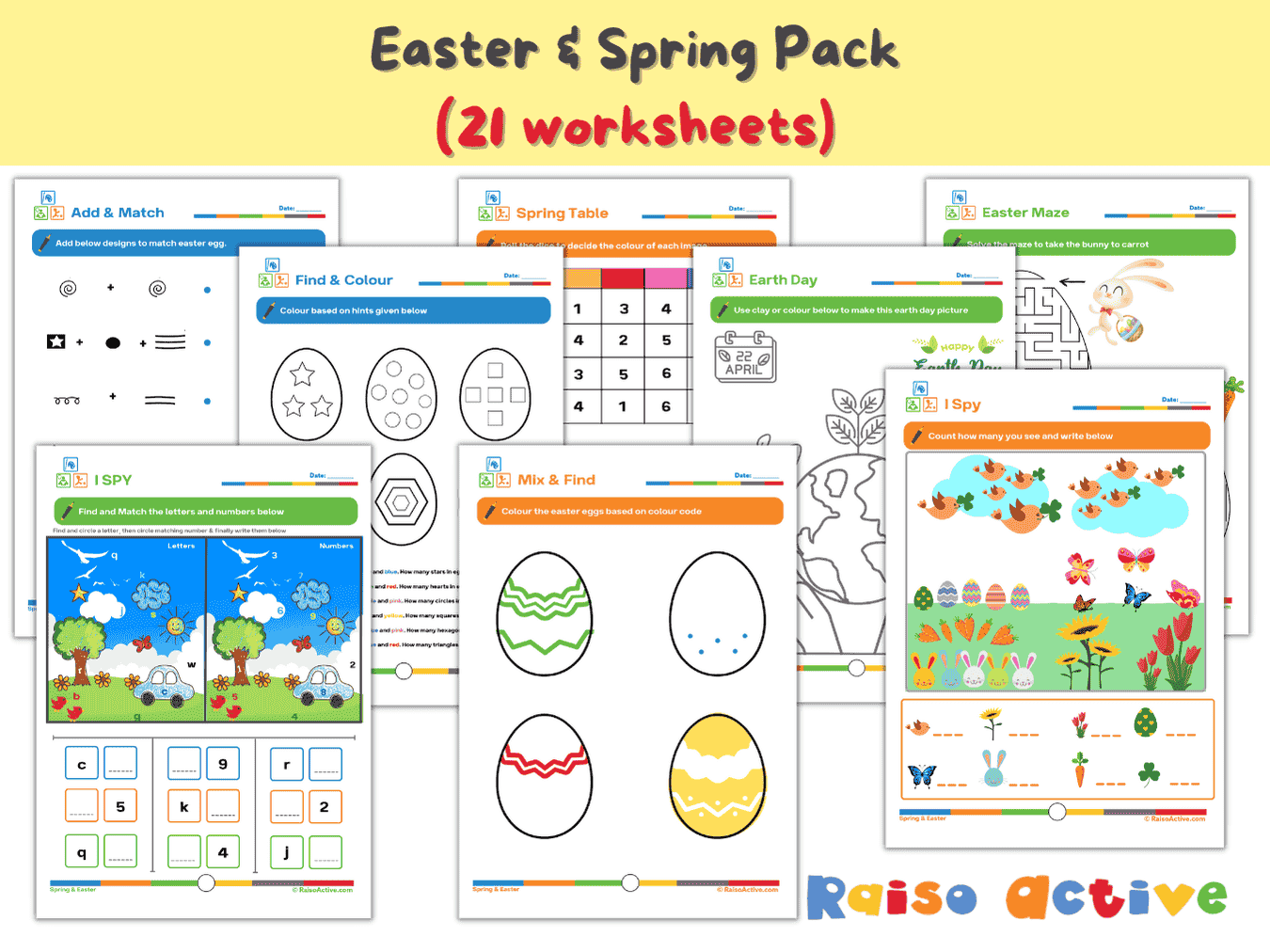
Children ages 3-5 practice color recognition and following a visual code as they color Easter eggs to match a key provided at the top of the page. Using a color-coded key rather than free coloring adds an instruction-following element, teaching children to check a reference and apply it consistently across a whole page.
Part of the pack
Spring & Easter Activity Book: Counting, Patterns, & Mazes for Preschool & Kindergarten
This is page 18 of the pack. Ages 3-7 · Preschool–Grade 1Ages 3-7 · Nursery–Year 2Ages 3-7 · Nursery–Class 1Ages 3-7
Made for your child
A whole activity pack made with their name
60 pages to spot, build, trace and write their own name, plus pages about their favourites, feelings and family. See a free preview with their name.
Make an All About Me packFree preview · free for members
Or start free: a name tracing sheet with their nameCurriculum
- Cognitive - Attention > Colors & Sorting
How to use this worksheet
Look at the color code at the top of the page together and name each color out loud. Point to the first egg and help your child find which color it should be based on the code, then let them color it in. Continue through the remaining eggs one at a time, encouraging your child to check the code before each one rather than guessing. Review the finished page together, checking that each egg matches its assigned color.
Materials needed
- Crayons or colored pencils
- Pencil
Extension activities
- 1Create your own color code and draw additional eggs for your child to color using it.
- 2Go on a color hunt around the house, finding objects that match each color in the code.
- 3Sort a basket of small toys or blocks by color as a related color-matching activity.
- 4Play a simple 'Simon says' game using color names as the instructions.
- 5Dye real hard-boiled eggs together using a similar color-matching approach.

Written by
Hemsweta Jain · Teacher Cheena
MBA and Early Childhood Educator, teaching since 2014 · Founder of RaisoActive, Mumbai
Every RaisoActive worksheet is designed and checked by the founder before publishing.
Published · Last reviewed
More from Spring & Easter Activity Book: Counting, Patterns, & Mazes for Preschool & Kindergarten
Spring Shadow Match Worksheet for Preschoolers
Ages 3-5 · Preschool–Pre-KAges 3-5 · Nursery–ReceptionAges 3-5 · Nursery–LKGAges 3-5
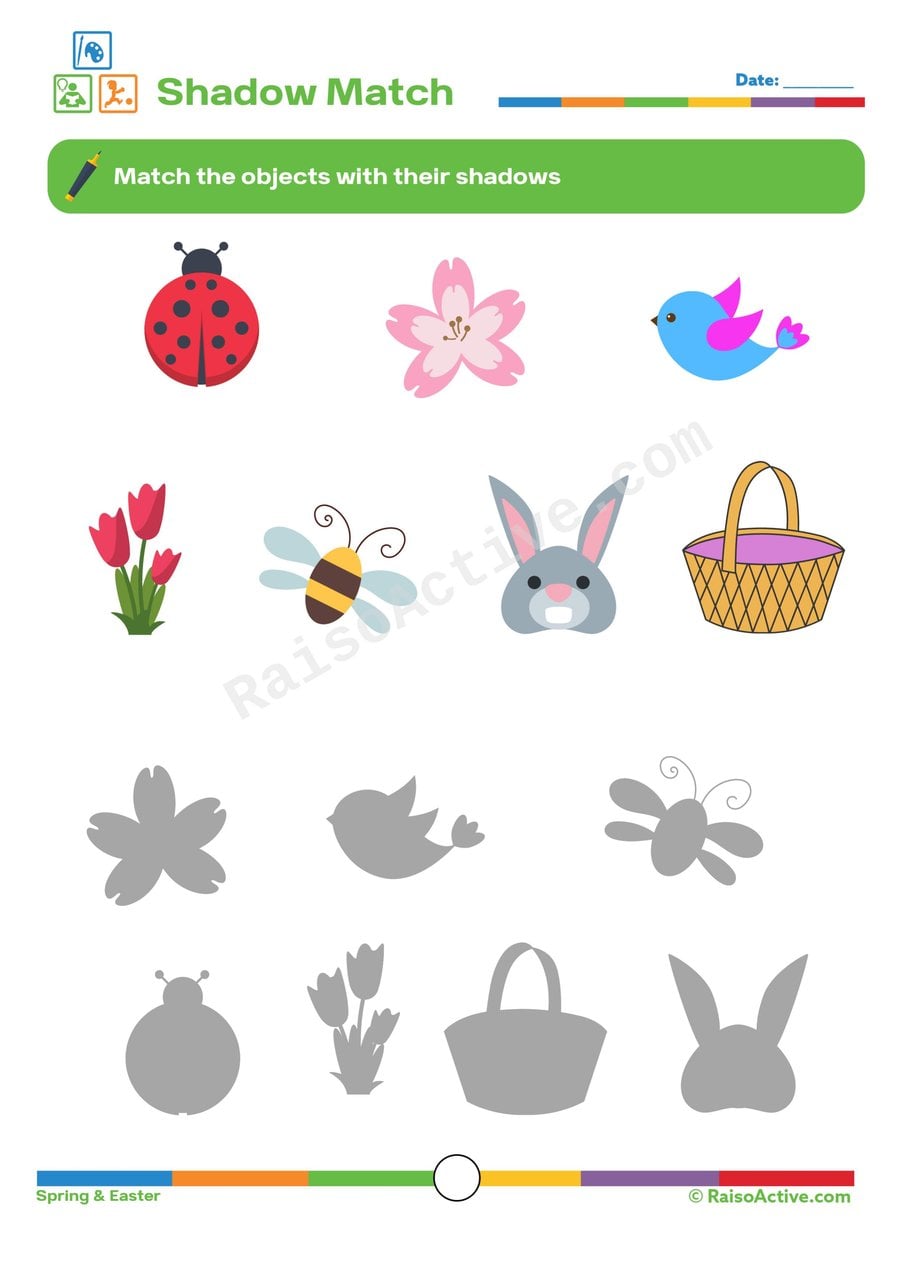
Children ages 3-5 practice visual discrimination by matching spring-themed objects to their correct silhouette shadows. Because shadows strip away color and detail, leaving only outline shape, this activity sharpens a child's ability to focus on form alone — a more advanced visual skill than matching by color or pattern.

Easter Egg Match: Add and Find the Matching Designs!
Ages 3-5 · Preschool–Pre-KAges 3-5 · Nursery–ReceptionAges 3-5 · Nursery–LKGAges 3-5
This worksheet blends early addition with visual matching as children ages 3-5 combine two separate shape groups and then search for the Easter egg design that shows the same total. Because the 'answer' is a picture rather than a written number, children practice quantity comparison and pattern-matching without needing to know written numerals yet.
Earth Day Coloring Worksheet for Kids
Ages 3-5 · Preschool–Pre-KAges 3-5 · Nursery–ReceptionAges 3-5 · Nursery–LKGAges 3-5
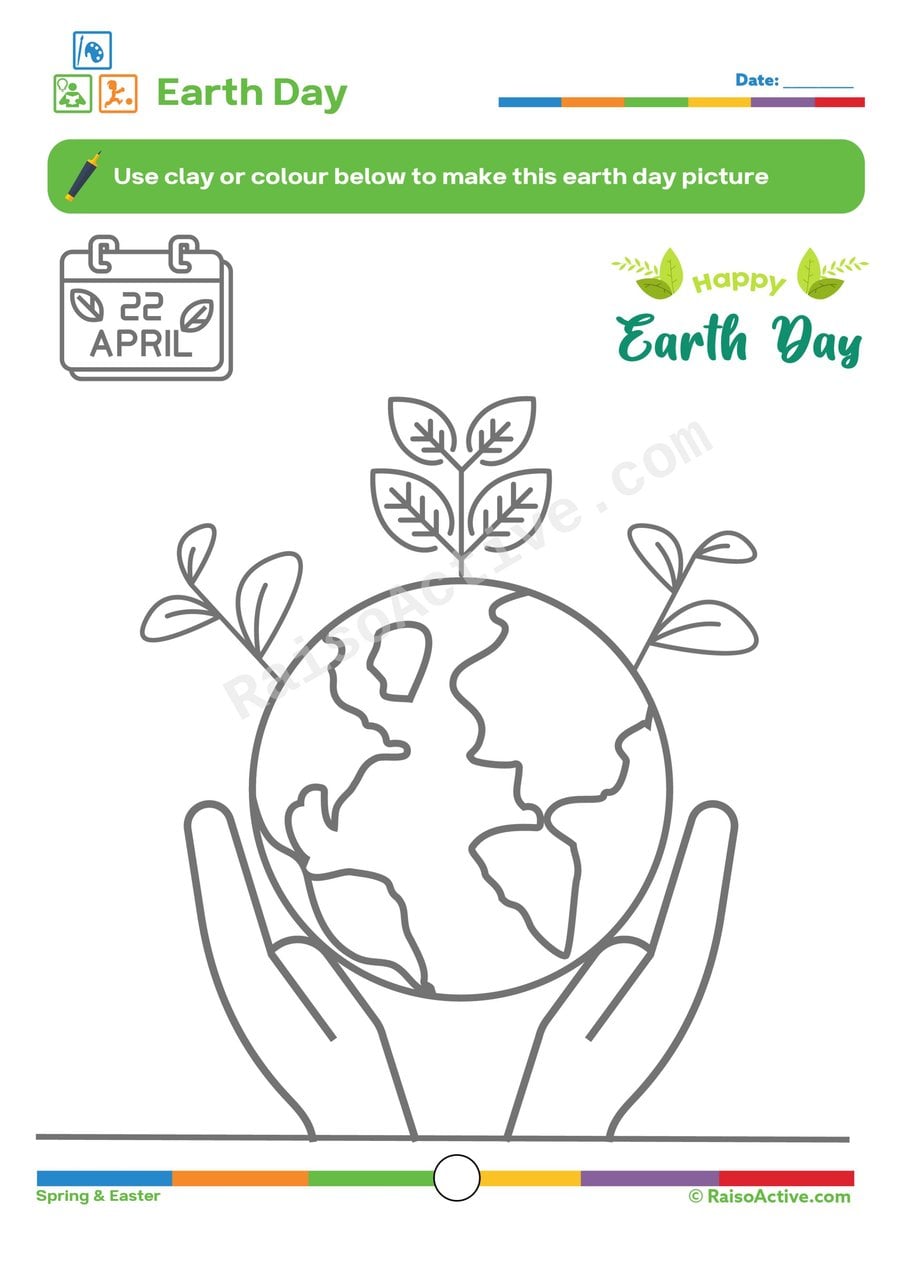
This Earth Day worksheet has children ages 3-5 color an image of the Earth and hands, likely representing the idea of caring for our planet, while practicing crayon control and color selection. Introducing an optional clay element also adds a tactile, three-dimensional layer to the activity, giving children another way to represent the Earth beyond flat coloring.

Spring Table Color by Number Worksheet for Preschoolers
Ages 3-5 · Preschool–Pre-KAges 3-5 · Nursery–ReceptionAges 3-5 · Nursery–LKGAges 3-5
This color-by-number worksheet has children ages 3-5 practice matching numerals to a specific color key and then applying that color accurately across a picture, reinforcing both number recognition and one-to-one correspondence between a symbol and an action. Rolling a dice to determine which color to use next also adds an element of chance that keeps the repetitive coloring task engaging.

Easter Egg Color Code Worksheet for Preschoolers
Ages 3-5 · Preschool–Pre-KAges 3-5 · Nursery–ReceptionAges 3-5 · Nursery–LKGAges 3-5
Matching numbers on each Easter egg section to a color key builds number recognition and color-word association in children ages 3-5, since they must hold both a numeral and its assigned color in mind while coloring. This kind of coded coloring activity also strengthens visual scanning, as children need to locate the small numbers printed inside each egg section before choosing the right crayon. Completing the code correctly gives an immediate, visible reward when a colorful, patterned egg emerges from the numbered outline.

Spring Sudoku Worksheet: Cut and Paste Puzzle for Kids
Ages 4-6 · Pre-K–KindergartenAges 4-6 · Reception–Year 1Ages 4-6 · LKG–UKGAges 4-6
Placing cut-out pictures into a sudoku-style grid so that no image repeats in any row, column, or box teaches children ages 4-6 early logical reasoning and systematic thinking, since they must check multiple directions before deciding where each piece belongs. Cutting out the small picture squares beforehand also builds scissor control and hand-eye coordination. Together, this combines a pre-math logic puzzle with fine motor practice in a single spring-themed activity.

Easter Egg Color by Hints Worksheet for Preschoolers
Ages 3-5 · Preschool–Pre-KAges 3-5 · Nursery–ReceptionAges 3-5 · Nursery–LKGAges 3-5
This worksheet has children ages 3-5 listen to or read simple written hints describing shapes and colors, then apply that information correctly while coloring each Easter egg, building early reading comprehension and the ability to follow multi-step verbal instructions. Because the hints must be followed precisely rather than colored freely, children also practice patience and careful attention to detail.

Spring Vocabulary Unscramble Worksheet for Preschoolers
Ages 4-5 · Pre-KAges 4-5 · ReceptionAges 4-5 · LKGAges 4-5
This unscrambling worksheet has children ages 4-5 rearrange jumbled letters into correctly spelled spring vocabulary words, strengthening letter-sound awareness and reinforcing the idea that letters have a fixed, meaningful order. Working from a picture clue to a written word also builds the bridge between spoken vocabulary and early spelling.
Related worksheets

Symmetry Worksheet for Kids: Mirror Halves and Shadow Match
Ages 4-7 · Pre-K–Grade 1Ages 4-7 · Reception–Year 2Ages 4-7 · LKG–Class 1Ages 4-7
Children complete the other half of a butterfly and a house on a dot grid so both sides match like a mirror, then draw lines to match eight pictures to their shadows. This builds spatial reasoning and visual discrimination.

Diwali Picture Bingo: Four Boards and Call Cards to Cut Out
Ages 4-6 · Pre-K–KindergartenAges 4-6 · Reception–Year 1Ages 4-6 · LKG–UKGAges 4-6
Children match picture call cards to their bingo board, covering diyas, lanterns, sweets, garlands, rangolis, gift boxes and fireworks. They practise looking closely, taking turns and waiting, and win by covering three in a row.

Soap & Pepper Science Experiment Worksheet for Preschoolers
Ages 3-5 · Preschool–Pre-KAges 3-5 · Nursery–ReceptionAges 3-5 · Nursery–LKGAges 3-5
This simple experiment introduces children ages 3-5 to the basic science of surface tension and how soap breaks it, using pepper flakes sprinkled on water as a visual demonstration. Watching the pepper scatter away the instant soap touches the water gives children a concrete, memorable example of cause and effect, an early building block for scientific thinking.

Match the Flags! A Fun Coloring Worksheet for Kids
Ages 3-5 · Preschool–Pre-KAges 3-5 · Nursery–ReceptionAges 3-5 · Nursery–LKGAges 3-5
This worksheet combines coloring with flag recognition, helping children ages 3-5 practice fine motor control while learning to match a colored flag to its correct blank outline. Coloring the flags first, then matching them, adds an extra layer of visual processing as children must recall the colors they just used to complete the matching step.

Halloween Match: Find and Color the Identical Objects!
Ages 3-5 · Preschool–Pre-KAges 3-5 · Nursery–ReceptionAges 3-5 · Nursery–LKGAges 3-5
This visual discrimination worksheet asks children ages 3-5 to scan a row of similar-looking Halloween objects and identify the two that are truly identical, sharpening their attention to small details like size, shading, and shape. Coloring the matched pair afterward gives a satisfying finishing step while reinforcing which items they correctly identified.
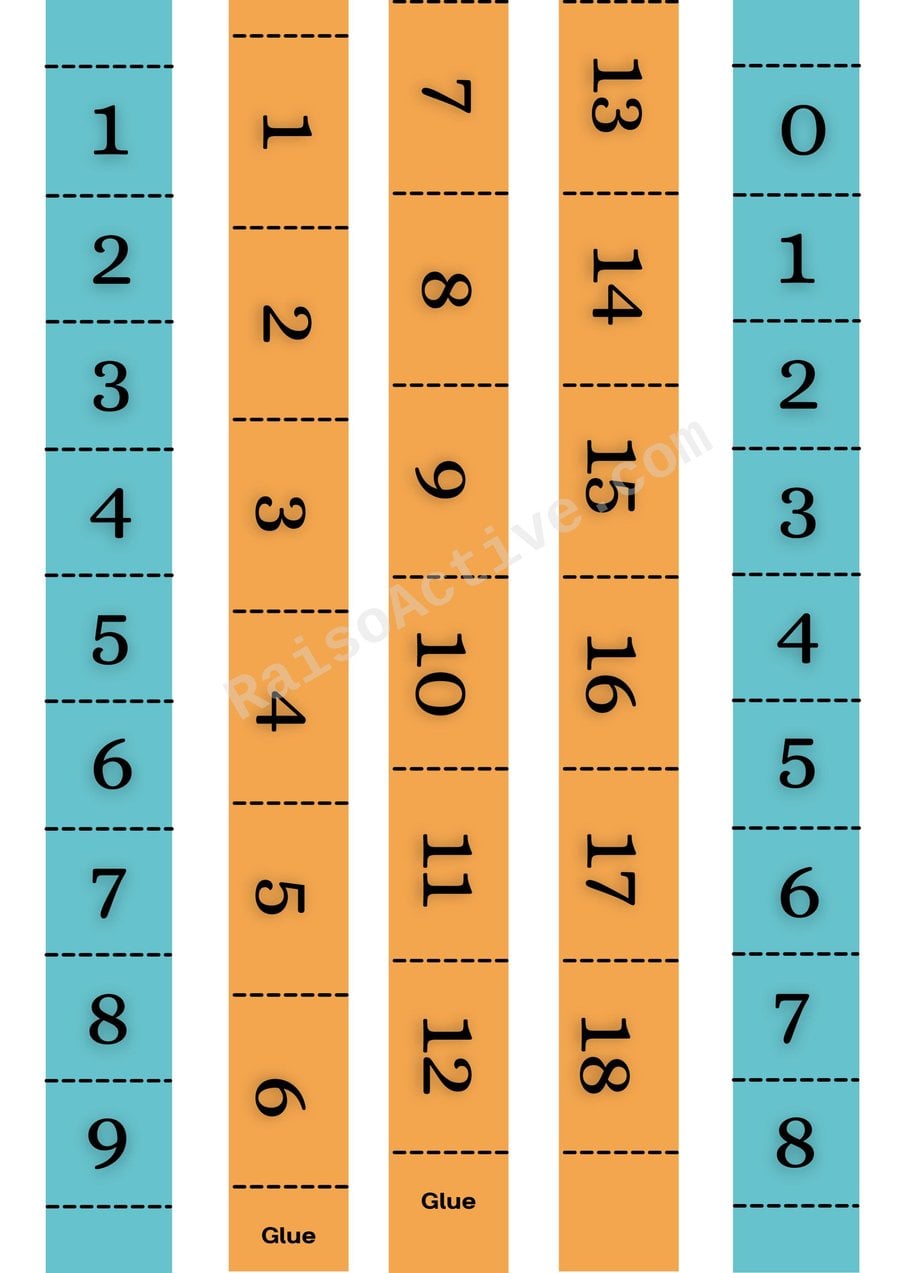
Number Matching Worksheet: 0-18
Ages 3-5 · Preschool–Pre-KAges 3-5 · Nursery–ReceptionAges 3-5 · Nursery–LKGAges 3-5
This activity strengthens numeral recognition for children ages 3-5 by having them find and pair matching numbers from 0 to 18 printed on separate strips. Because the numbers are scattered rather than in order, children must recognize each digit shape on its own rather than relying on counting sequence, which builds true number recognition instead of rote list-reciting.

Plant Parts Worksheet: Identify and Label the Parts of a Plant!
Ages 4-6 · Pre-K–KindergartenAges 4-6 · Reception–Year 1Ages 4-6 · LKG–UKGAges 4-6
This worksheet teaches children ages 4-6 to identify and independently label the flower, stem, leaf, and roots of a plant, moving a step beyond simple matching toward recalling vocabulary from memory. Optionally adding pulses or grains to the diagram introduces a tactile, sensory layer that helps reinforce which part is which through touch as well as sight.

Navratri Look Closely: Spot the Difference and Shadow Match
Ages 4-6 · Pre-K–KindergartenAges 4-6 · Reception–Year 1Ages 4-6 · LKG–UKGAges 4-6
Children compare two pictures carefully to find what is different and match objects to their shadows by looking at shape.
Guides for this topic

Best Worksheets for 3-Year-Olds: What Works and What to Avoid
What works on worksheets for 3-year-olds: short sessions, crayons, tracing lines, matching, cutting, a free weekly plan, and signs one is too advanced.

Discovering Wonder: Nature-Based Learning Activities That Captivate Young Children
Explore nature-based learning activities for children ages 2–7 — leaf rubbings, bug hunts, nature journals, and seasonal Indian outdoor ideas that spark wonder.
Spring and Summer Learning Activities: Harnessing Nature's Classroom for Year-Round Growth
Discover heat-safe outdoor activities, monsoon science experiments, and summer holiday learning plans for young children in India. Prevent summer slide with fun ideas for ages 1-8.
Reviews
Every worksheet for ages 3–5, no watermark
Members download the full library of 1,000+ worksheets and every activity pack without watermarks or daily limits. One year costs ₹999 in India or $20 elsewhere.
See membership plansOr download any worksheet free with a watermark (5 a day).