Spring Vocabulary Unscramble Worksheet for Preschoolers
This unscrambling worksheet has children ages 4-5 rearrange jumbled letters into correctly spelled spring vocabulary words, strengthening letter-sound awareness and reinforcing the idea that letters have a fixed, meaningful order. Working from a picture clue to a written word also builds the bridge between spoken vocabulary and early spelling.
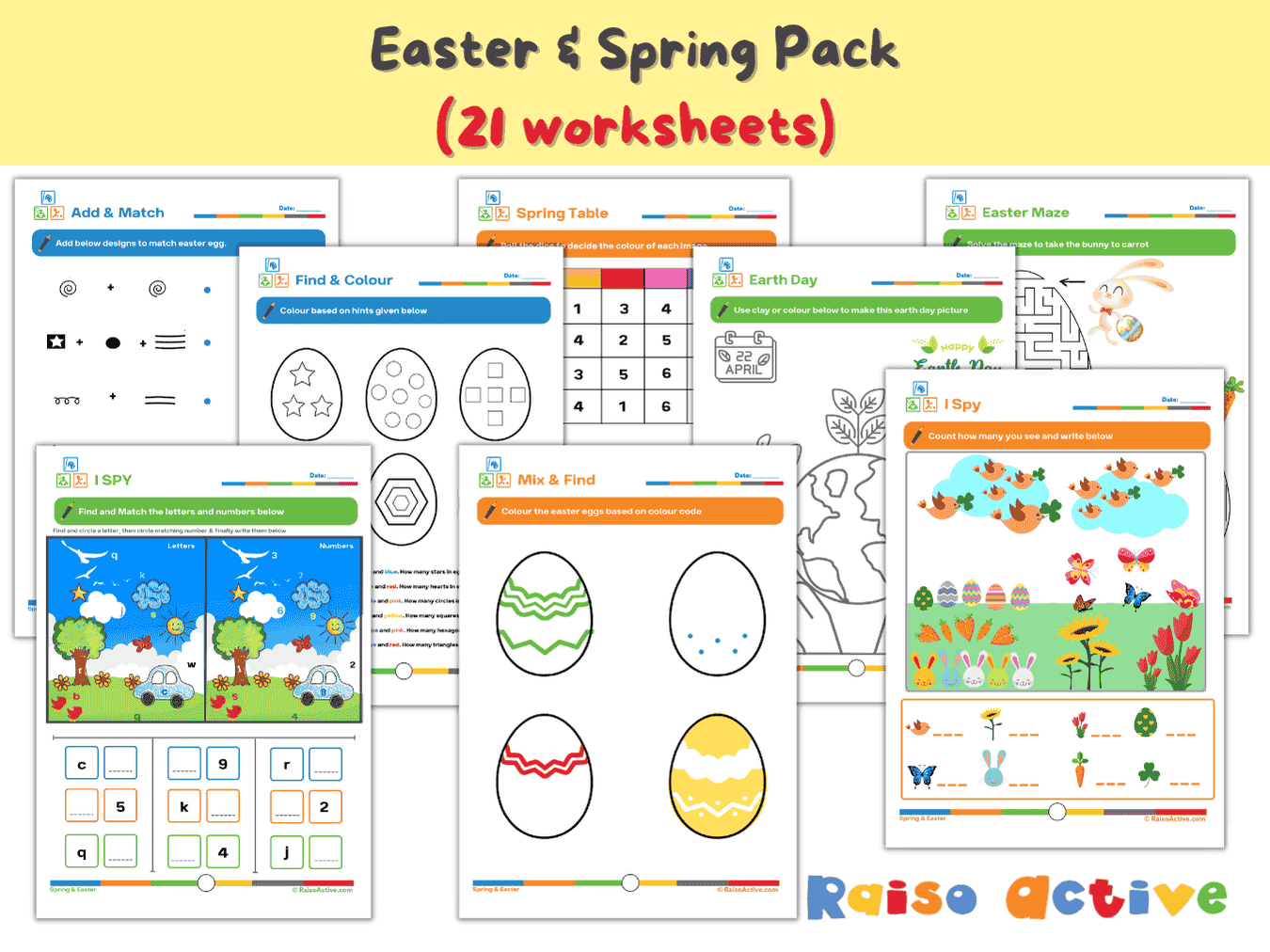
Part of the pack
Spring & Easter Activity Book: Counting, Patterns, & Mazes for Preschool & Kindergarten
This is page 20 of the pack. Ages 3-7 · Preschool–Grade 1Ages 3-7 · Nursery–Year 2Ages 3-7 · Nursery–Class 1Ages 3-7
Made for your child
Spelling practice, made for your child
Their own spelling words turned into a pack: trace or look-cover-write-check, roll and write, a secret picture code, a word search, a crossword and a test, with their name in it.
Make a spelling packFree preview · free for members
Or start free: a word search with sight wordsCurriculum
- Cognitive - Attention > Observation Skills
How to use this worksheet
Look at the picture beside each scrambled word to figure out what the word should say. Say the word slowly together, stretching out each sound before attempting to reorder the letters. Have your child write the correctly spelled word on the blank line, checking it against the picture for accuracy. Continue through each scrambled spring word the same way, using the picture as a hint whenever needed.
Materials needed
- Pencil
Extension activities
- 1Draw a picture of each spring word after unscrambling it.
- 2Use the words in simple spoken or written sentences.
- 3Make letter tiles from paper scraps and physically slide them into order.
- 4Go on a spring walk to find real examples of the words, like flowers or rain.
- 5Time a friendly race to see who can unscramble a word fastest.

Written by
Hemsweta Jain · Teacher Cheena
MBA and Early Childhood Educator, teaching since 2014 · Founder of RaisoActive, Mumbai
Every RaisoActive worksheet is designed and checked by the founder before publishing.
Published · Last reviewed
More from Spring & Easter Activity Book: Counting, Patterns, & Mazes for Preschool & Kindergarten

I Spy Letters and Numbers Worksheet: Find, Match, and Write!
Ages 4-5 · Pre-KAges 4-5 · ReceptionAges 4-5 · LKGAges 4-5
This worksheet blends letter and number recognition for children ages 4-5, asking them to spot a hidden letter within a picture, find its matching number, and then write both symbols down, combining visual search with early literacy and numeracy in a single activity. Working with letters and numbers side by side reinforces that both are symbols that carry specific meaning and can be found, matched, and recorded.

Easter Maze Adventure: Help the Bunny Find the Carrot!
Ages 3-5 · Preschool–Pre-KAges 3-5 · Nursery–ReceptionAges 3-5 · Nursery–LKGAges 3-5
Tracing a path from the bunny to the carrot builds fine motor control and pencil steadiness in children ages 3-5, since staying within the maze's narrow lines requires more precision than open coloring. Navigating around dead ends also develops early problem-solving and planning skills, as children learn to look ahead and backtrack when a path doesn't work out. This kind of visual-spatial puzzle strengthens the ability to plan a route mentally before committing it to paper, a skill that supports later map-reading and logical thinking.

Spring Table Color by Number Worksheet for Preschoolers
Ages 3-5 · Preschool–Pre-KAges 3-5 · Nursery–ReceptionAges 3-5 · Nursery–LKGAges 3-5
This color-by-number worksheet has children ages 3-5 practice matching numerals to a specific color key and then applying that color accurately across a picture, reinforcing both number recognition and one-to-one correspondence between a symbol and an action. Rolling a dice to determine which color to use next also adds an element of chance that keeps the repetitive coloring task engaging.

Spring Sudoku Worksheet: Cut and Paste Puzzle for Kids
Ages 4-6 · Pre-K–KindergartenAges 4-6 · Reception–Year 1Ages 4-6 · LKG–UKGAges 4-6
Placing cut-out pictures into a sudoku-style grid so that no image repeats in any row, column, or box teaches children ages 4-6 early logical reasoning and systematic thinking, since they must check multiple directions before deciding where each piece belongs. Cutting out the small picture squares beforehand also builds scissor control and hand-eye coordination. Together, this combines a pre-math logic puzzle with fine motor practice in a single spring-themed activity.

Easter Egg Match: Add and Find the Matching Designs!
Ages 3-5 · Preschool–Pre-KAges 3-5 · Nursery–ReceptionAges 3-5 · Nursery–LKGAges 3-5
This worksheet blends early addition with visual matching as children ages 3-5 combine two separate shape groups and then search for the Easter egg design that shows the same total. Because the 'answer' is a picture rather than a written number, children practice quantity comparison and pattern-matching without needing to know written numerals yet.

Spot the Spots! Spring Coloring Worksheet for Preschoolers
Ages 3-5 · Preschool–Pre-KAges 3-5 · Nursery–ReceptionAges 3-5 · Nursery–LKGAges 3-5
This worksheet pairs counting practice with coloring as children ages 3-5 look at a number written beside each picture and color exactly that many spots onto it, reinforcing one-to-one correspondence between a numeral and a matching quantity. Because the target number changes from picture to picture, children must check the number freshly each time rather than coloring on autopilot.
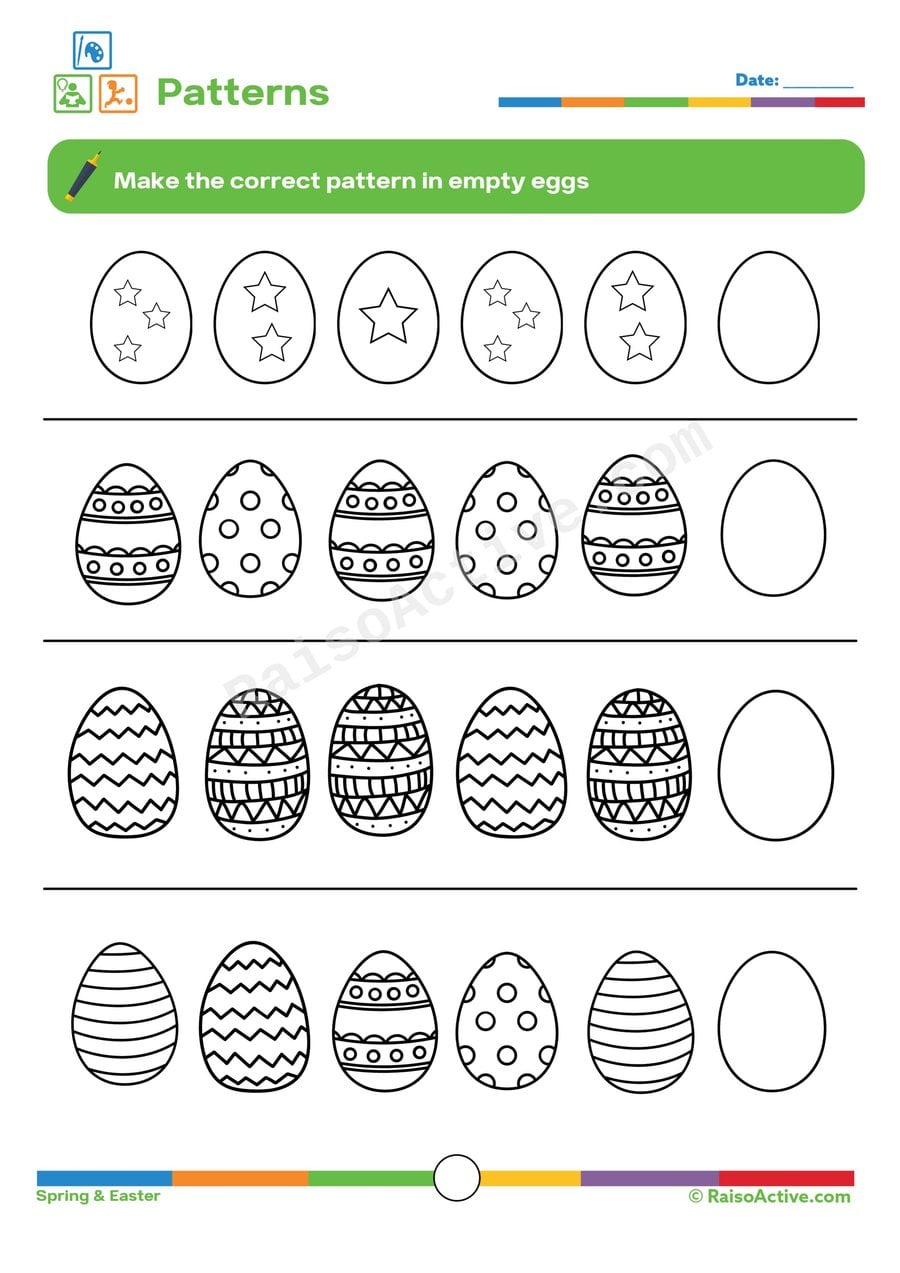
Easter Egg Patterns Worksheet for Preschoolers
Ages 3-5 · Preschool–Pre-KAges 3-5 · Nursery–ReceptionAges 3-5 · Nursery–LKGAges 3-5
This worksheet asks children ages 3-5 to study a sequence of patterned Easter eggs and figure out what design should come next, then draw it into the empty egg themselves. Predicting and completing a pattern, rather than just matching an existing one, pushes children a step further into the kind of what-comes-next reasoning that underlies early math and logic.
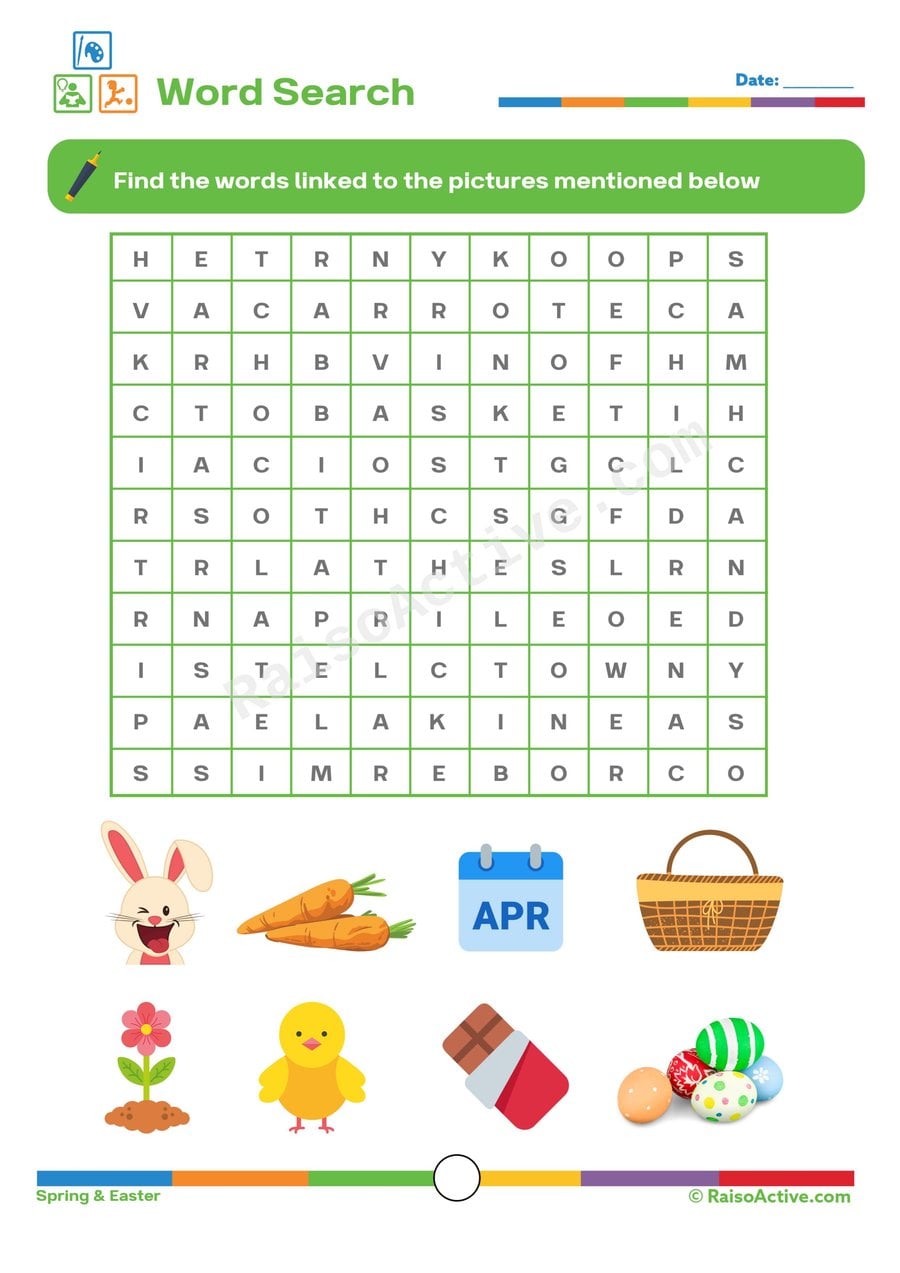
Spring Word Search Worksheet for Preschoolers
Ages 3-5 · Preschool–Pre-KAges 3-5 · Nursery–ReceptionAges 3-5 · Nursery–LKGAges 3-5
This Spring Word Search sharpens visual scanning and letter-tracking skills for children ages 3-5 as they hunt for season words hidden inside a grid of letters. Searching row by row and diagonally builds the same left-to-right tracking habit needed for reading, while recognizing whole words like 'FLOWER' or 'RAIN' strengthens early sight-word memory and spring vocabulary.
Related worksheets
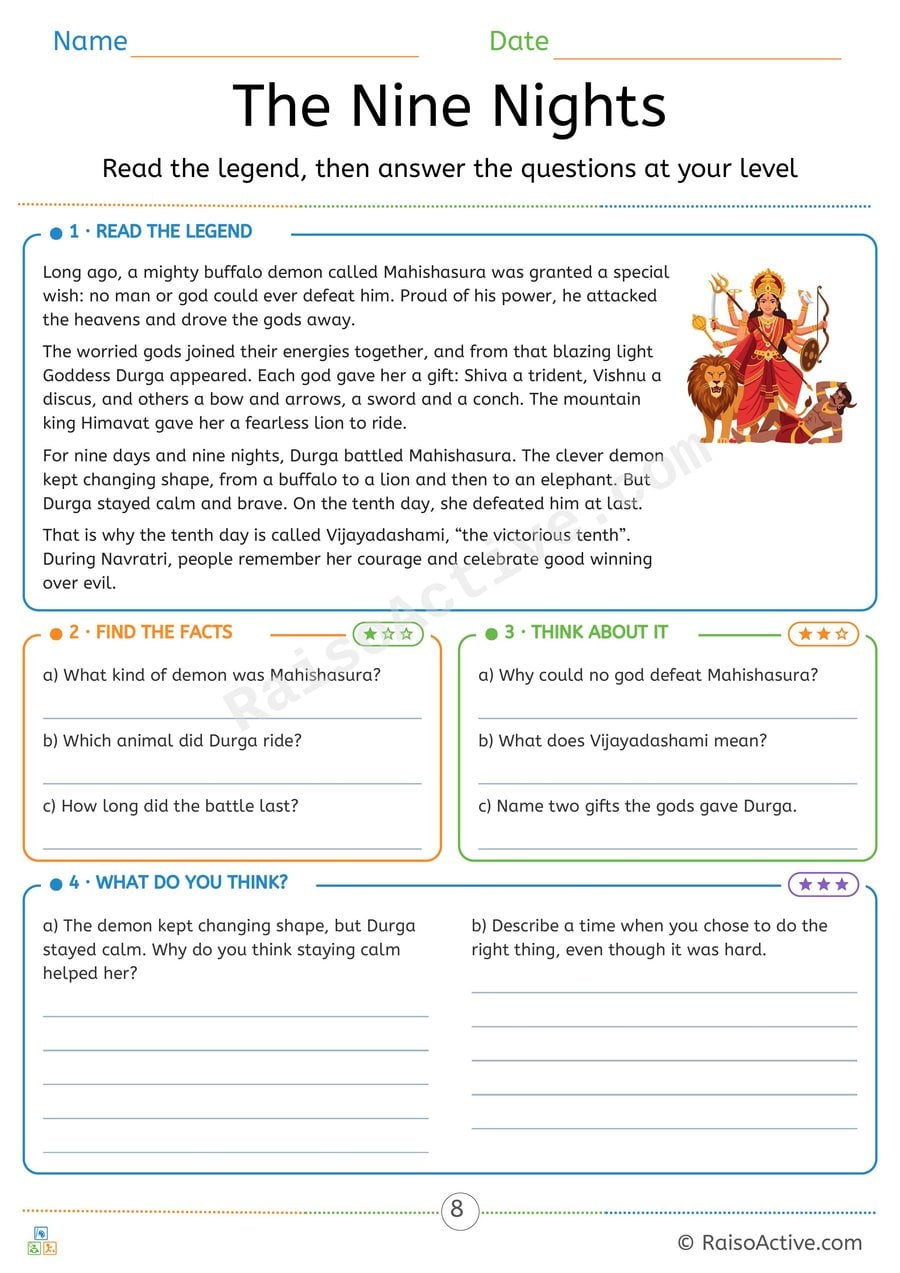
The Nine Nights: Durga and Mahishasura Reading Comprehension
Ages 7-11 · Grade 2–Grade 3Ages 7-11 · Year 3–Year 4Ages 7-11 · Class 2–Class 3Ages 7-11
Children read a retelling of the legend of Durga and Mahishasura, find facts in the text, answer inference questions about why things happened, and write their own opinion about staying calm and doing the right thing.

When Do We Celebrate? Indian Festivals and the Months of the Year
Ages 4-8 · Pre-K–Grade 2Ages 4-8 · Reception–Year 3Ages 4-8 · LKG–Class 2Ages 4-8
Children connect each festival to the month it falls in and learn that some festivals follow the moon, so their dates change each year.
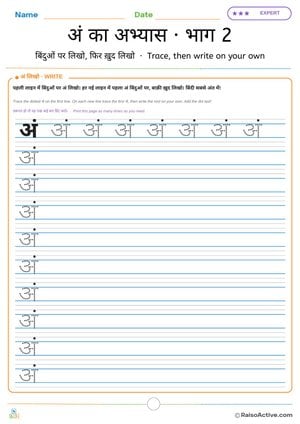
Hindi Letter अं (am) Practice 2: Trace, then Write on Your Own | अं का अभ्यास · भाग 2
Ages 5-7 · Kindergarten–Grade 1Ages 5-7 · Year 1–Year 2Ages 5-7 · UKG–Class 1Ages 5-7
An expert page for confident writers: trace the dotted अं on the first line, then on each new line trace the first अं and write the rest on your own, adding the dot last.
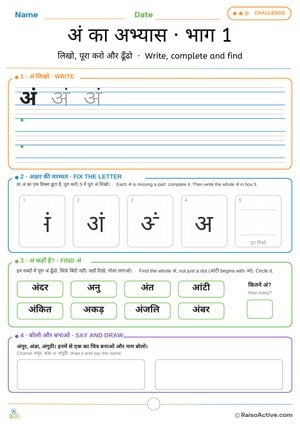
Hindi Letter अं (am) Practice 1: Write, Fix the Letter and Find | अं का अभ्यास · भाग 1
Ages 4-7 · Pre-K–Grade 1Ages 4-7 · Reception–Year 2Ages 4-7 · LKG–Class 1Ages 4-7
A challenge page: write अं between the lines, complete four letters that are each missing a part and then write the whole अं in box 5, find अं in words such as अंदर, अंत, अंकित, अंजलि and अंबर, and draw a picture. Children find the whole अं, not just a dot: आंटी begins with आं, not अं.
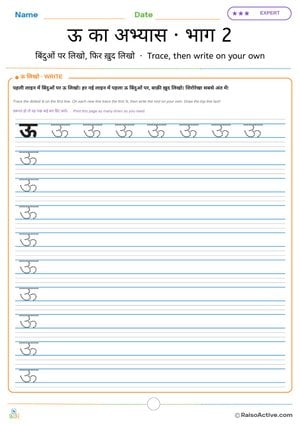
Hindi Letter ऊ Practice Part 2: Trace and Write on Your Own | ऊ का अभ्यास · भाग 2
Ages 3-7 · Preschool–Grade 1Ages 3-7 · Nursery–Year 2Ages 3-7 · Nursery–Class 1Ages 3-7
Children build writing fluency by tracing the dotted line ऊ on the first line and then writing the letter on their own, line after line, as the dotted help fades. The headline (शिरोरेखा) is drawn last, as in Hindi handwriting.
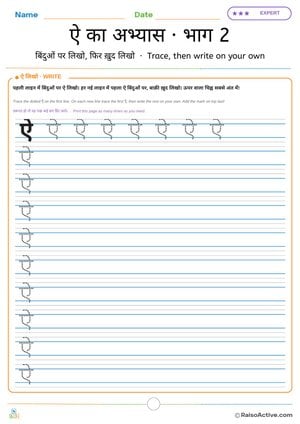
Hindi Letter ऐ (ai) Practice 2: Trace, then Write on Your Own | ऐ का अभ्यास · भाग 2
Ages 5-7 · Kindergarten–Grade 1Ages 5-7 · Year 1–Year 2Ages 5-7 · UKG–Class 1Ages 5-7
An expert page for confident writers: trace the dotted ऐ on the first line, then on each new line trace the first ऐ and write the rest on your own, adding the mark on top last.
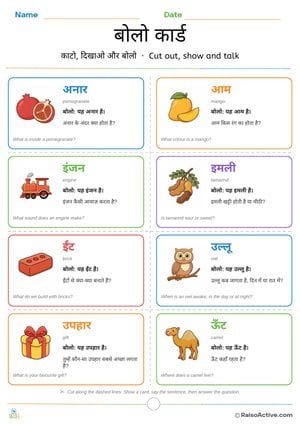
Hindi Bolo Cards: Cut-Out Speaking Cards for Vowels Part 1 | बोलो कार्ड
Ages 3-7 · Preschool–Grade 1Ages 3-7 · Nursery–Year 2Ages 3-7 · Nursery–Class 1Ages 3-7
Eight picture cards (अनार, आम, इंजन, इमली, ईंट, उल्लू, उपहार, ऊँट), each with the sentence बोलो: यह ___ है! and a question to talk about, for example what colour is a mango? Children practise speaking in full sentences.
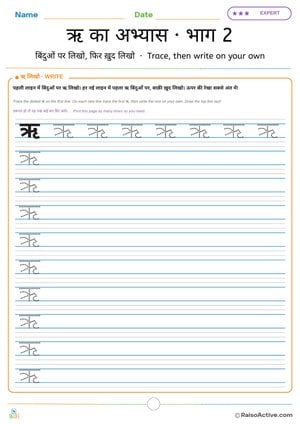
Hindi Letter ऋ (ri) Practice 2: Trace, then Write on Your Own | ऋ का अभ्यास · भाग 2
Ages 5-7 · Kindergarten–Grade 1Ages 5-7 · Year 1–Year 2Ages 5-7 · UKG–Class 1Ages 5-7
An expert page for confident writers: trace the dotted ऋ on the first line, then on each new line trace the first ऋ and write the rest on your own, adding the top line last.
Guides for this topic

Sight Words by Age: The First 50 Words and How to Teach Them Without Flashcard Fatigue
Which sight words to teach first and why, the heart-word method, a read-trace-write-find routine, games, and a by-age table of typical sight-word progress.
How to Teach CVC Blending: A Step-by-Step Method That Works in Two Weeks
A step-by-step method for teaching CVC blending, covering continuous sounds, word families, common errors, and a 14-day plan that most children finish reading CVC words.

Documenting Learning Without Drowning in Data: A Practical Guide for Parents and Teachers
Learn practical ways to document your child's learning without overwhelm. Simple portfolios, observation tips, and printable trackers for ages 1-8.
Reviews
Every worksheet for ages 4–5, no watermark
Members download the full library of 1,000+ worksheets and every activity pack without watermarks or daily limits. One year costs ₹999 in India or $20 elsewhere.
See membership plansOr download any worksheet free with a watermark (5 a day).