Christmas Shadow Matching Worksheet for Preschoolers
Children match bells, stockings, reindeer, a gift and a gingerbread house to their shadows, building visual discrimination.
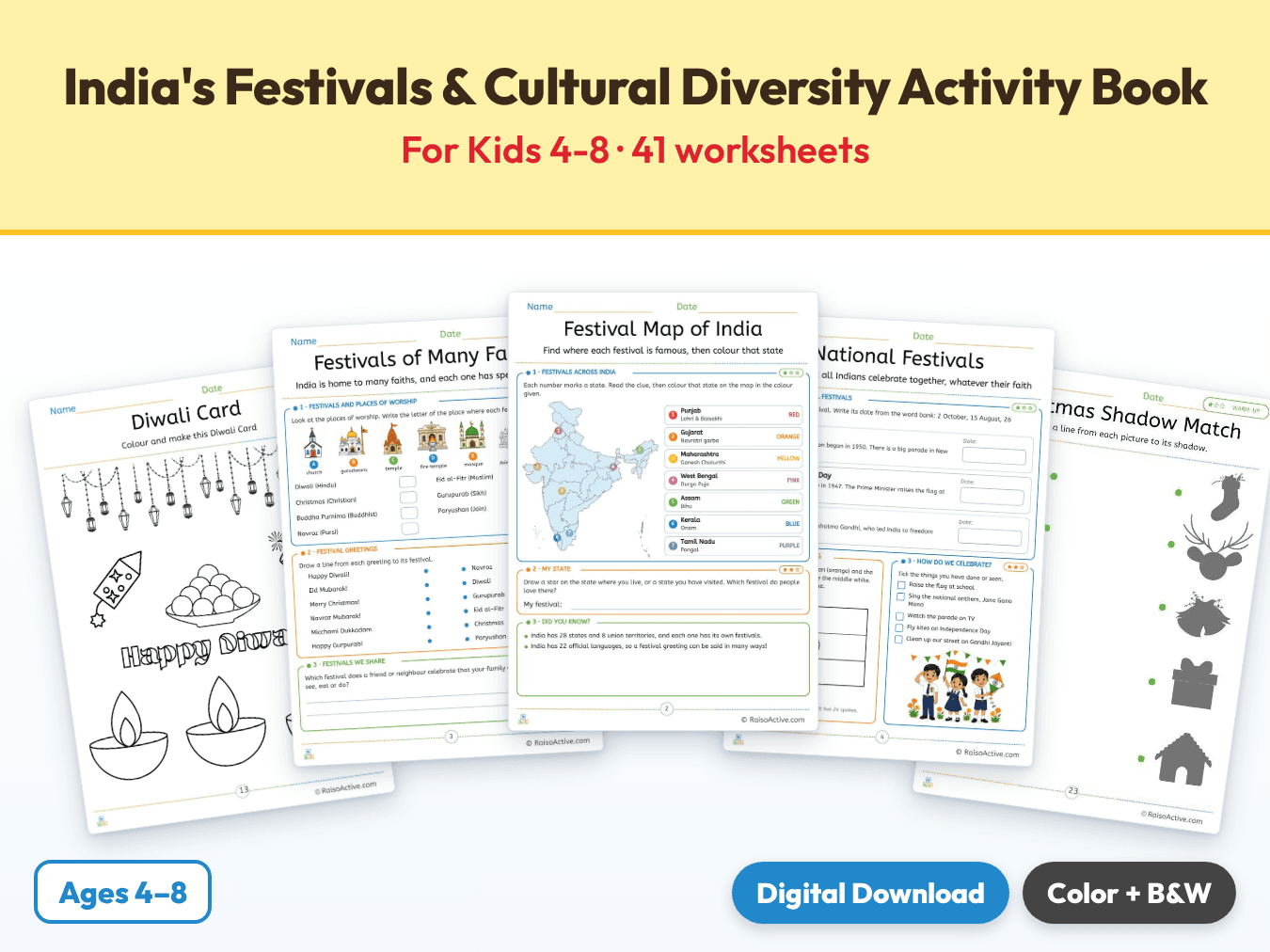
Part of the pack
India's Festivals & Cultural Diversity Activity Book for Kids 4-8
This is page 23 of the pack. Ages 4-8 · Pre-K–Grade 2Ages 4-8 · Reception–Year 3Ages 4-8 · LKG–Class 2Ages 4-8
Made for your child
Adding within 10, made for your child
A maths pack with your child's name in it: pictures that explain, practice at three levels, puzzles and story sums about them. Print a new set whenever they finish.
Make a maths packFree preview · free for members
Curriculum
- Culture & Festivals > Christmas Activities
How to use this worksheet
Look at each picture on the left, find the shadow with the same shape on the right and draw a line between the dots.
Materials needed
- Pencil
- Crayons
Extension activities
- 1Make shadows of toys with a torch
- 2Colour the pictures after matching

Written by
Hemsweta Jain · Teacher Cheena
MBA and Early Childhood Educator, teaching since 2014 · Founder of RaisoActive, Mumbai
Every RaisoActive worksheet is designed and checked by the founder before publishing.
Published · Last reviewed
More from India's Festivals & Cultural Diversity Activity Book for Kids 4-8
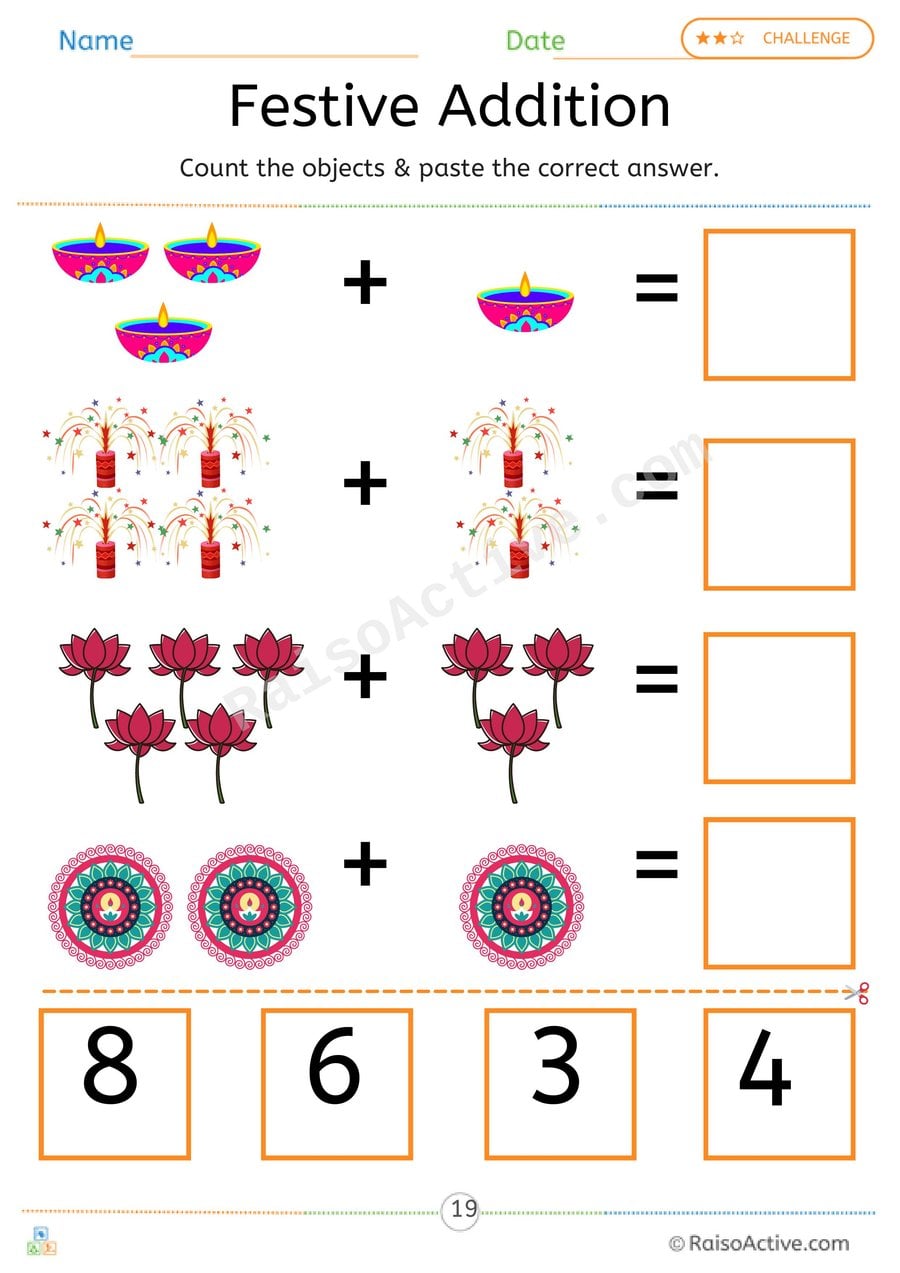
Festive Math: Count and Add Objects Worksheet
Ages 4-8 · Pre-K–Grade 2Ages 4-8 · Reception–Year 3Ages 4-8 · LKG–Class 2Ages 4-8
Children count festive objects in each picture sum, add the two groups and paste the right answer card, practising addition within 10.

When Do We Celebrate? Indian Festivals and the Months of the Year
Ages 4-8 · Pre-K–Grade 2Ages 4-8 · Reception–Year 3Ages 4-8 · LKG–Class 2Ages 4-8
Children connect each festival to the month it falls in and learn that some festivals follow the moon, so their dates change each year.

Ganesha Colouring Page for Ganesh Chaturthi
Ages 4-8 · Pre-K–Grade 2Ages 4-8 · Reception–Year 3Ages 4-8 · LKG–Class 2Ages 4-8
Children learn that Ganesh Chaturthi celebrates the arrival of Lord Ganesha and that people offer him modaks, his favourite sweet.

India's Festivals Activity Book Answer Key (Part 2)
Ages 4-8 · Pre-K–Grade 2Ages 4-8 · Reception–Year 3Ages 4-8 · LKG–Class 2Ages 4-8
Grown-ups can check children's answers quickly for the second part of the book.
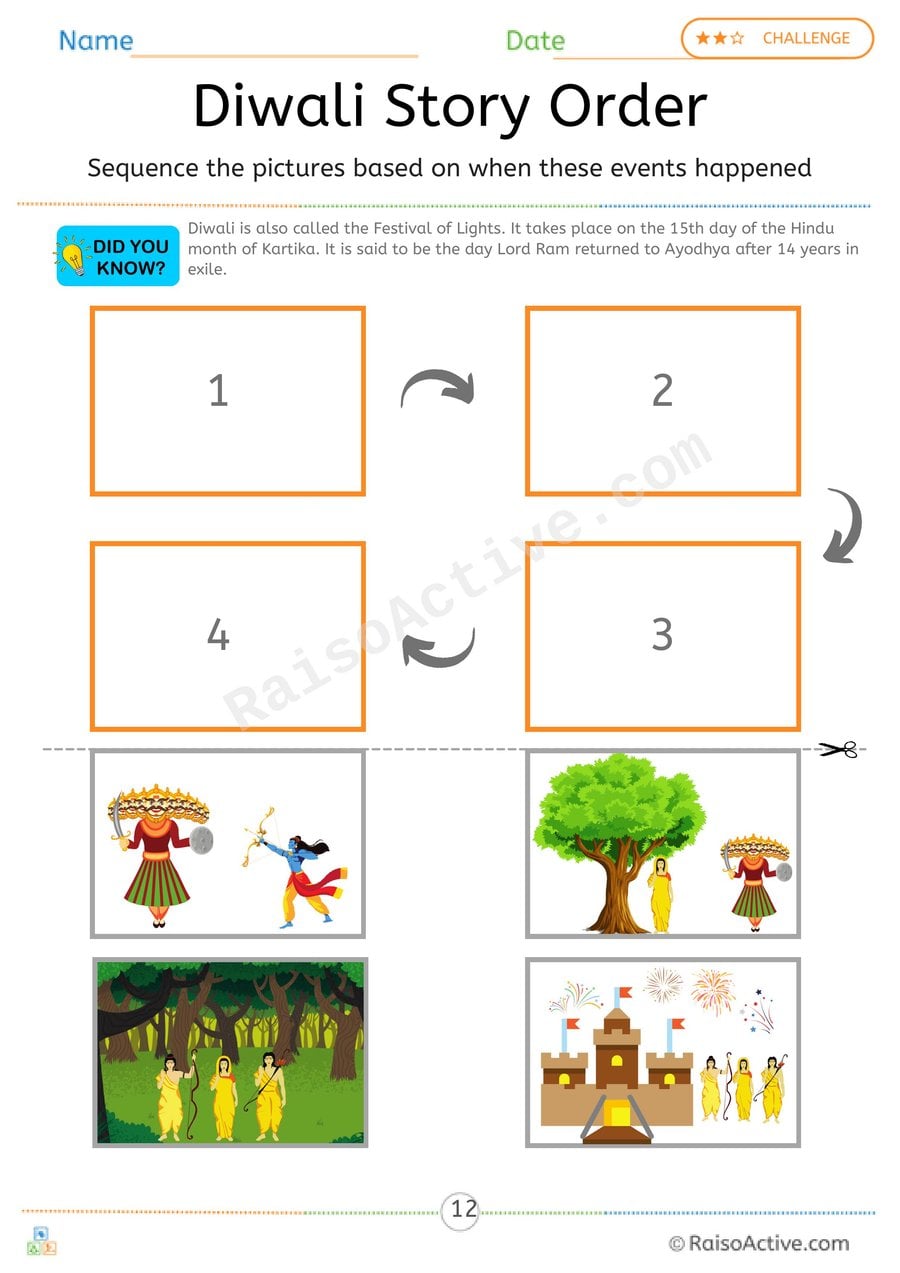
Diwali Sequencing Worksheet for Kids
Ages 4-8 · Pre-K–Grade 2Ages 4-8 · Reception–Year 3Ages 4-8 · LKG–Class 2Ages 4-8
Children learn that Diwali, the Festival of Lights, marks Lord Ram's return to Ayodhya, and put four pictures of the story in the right order.

Help Ganesha Find His Father: A Fun Maze Worksheet
Ages 4-8 · Pre-K–Grade 2Ages 4-8 · Reception–Year 3Ages 4-8 · LKG–Class 2Ages 4-8
Children help Ganesha find his way through a round maze to his father, Lord Shiva, then colour and count modaks and spot Ganesha's mouse, Mooshak.

National Festivals of India: Republic Day, Independence Day and Gandhi Jayanti
Ages 4-8 · Pre-K–Grade 2Ages 4-8 · Reception–Year 3Ages 4-8 · LKG–Class 2Ages 4-8
Children learn the three national festivals all Indians celebrate together, their dates, and the colours and wheel of the Indian flag.

Navaratri Dance Count: A Fun Counting Worksheet for Kids!
Ages 4-8 · Pre-K–Grade 2Ages 4-8 · Reception–Year 3Ages 4-8 · LKG–Class 2Ages 4-8
Children learn that Navratri honours Goddess Durga and that people dance garba and dandiya for nine nights, then count matching dance poses.
Related worksheets

Navratri Nine Colours Colouring Page: Colour the Garba Dancers
Ages 4-6 · Pre-K–KindergartenAges 4-6 · Reception–Year 1Ages 4-6 · LKG–UKGAges 4-6
Children learn the colour linked with each of the nine days of Navratri 2026 and practise colouring inside the lines.
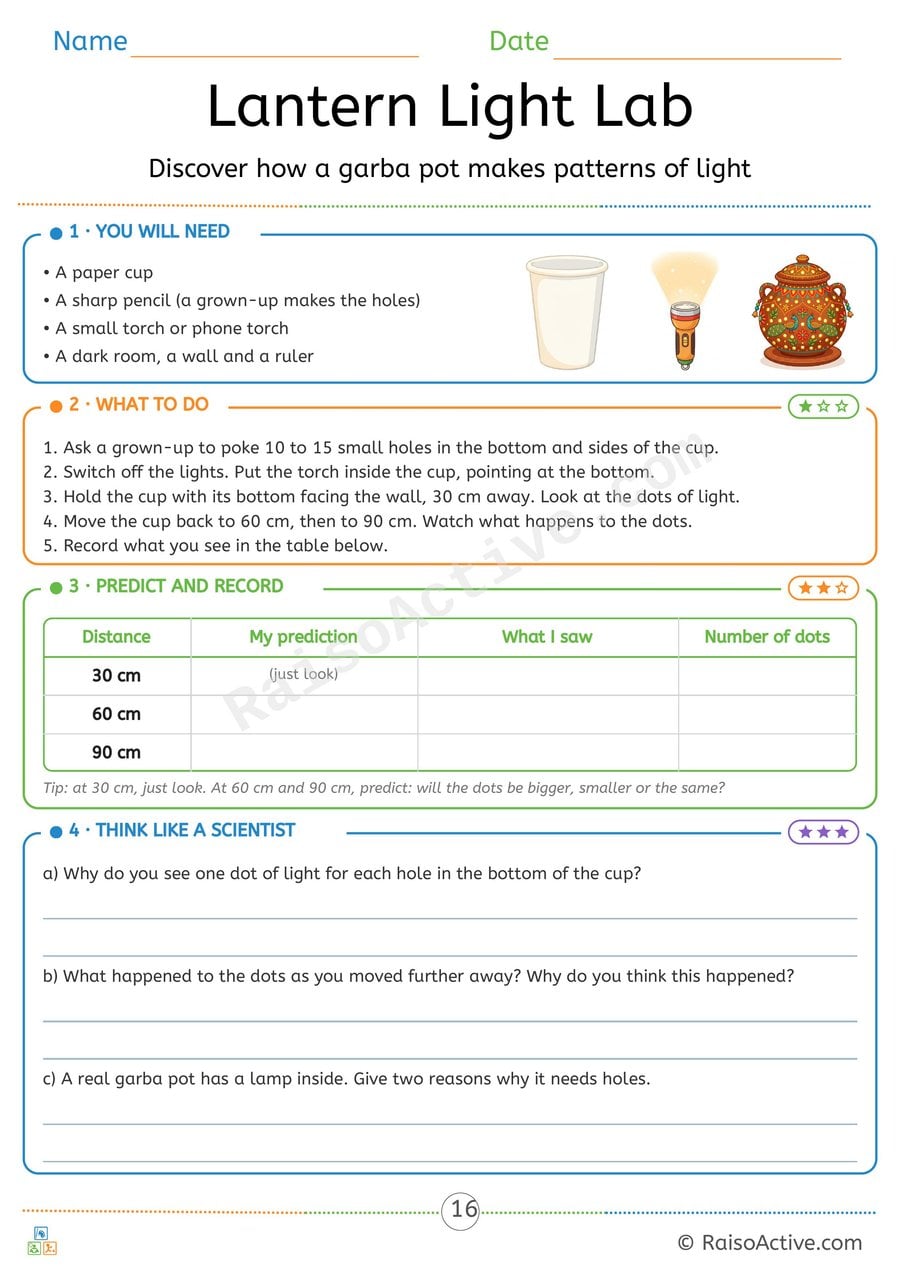
Lantern Light Lab: Navratri Garba Pot Light Experiment
Ages 7-11 · Grade 2–Grade 3Ages 7-11 · Year 3–Year 4Ages 7-11 · Class 2–Class 3Ages 7-11
Children make holes in a paper cup, shine a torch through it and see one spot of light for each hole. They predict and record what happens as they move further from the wall, and explain the results and why a real garba pot needs holes.
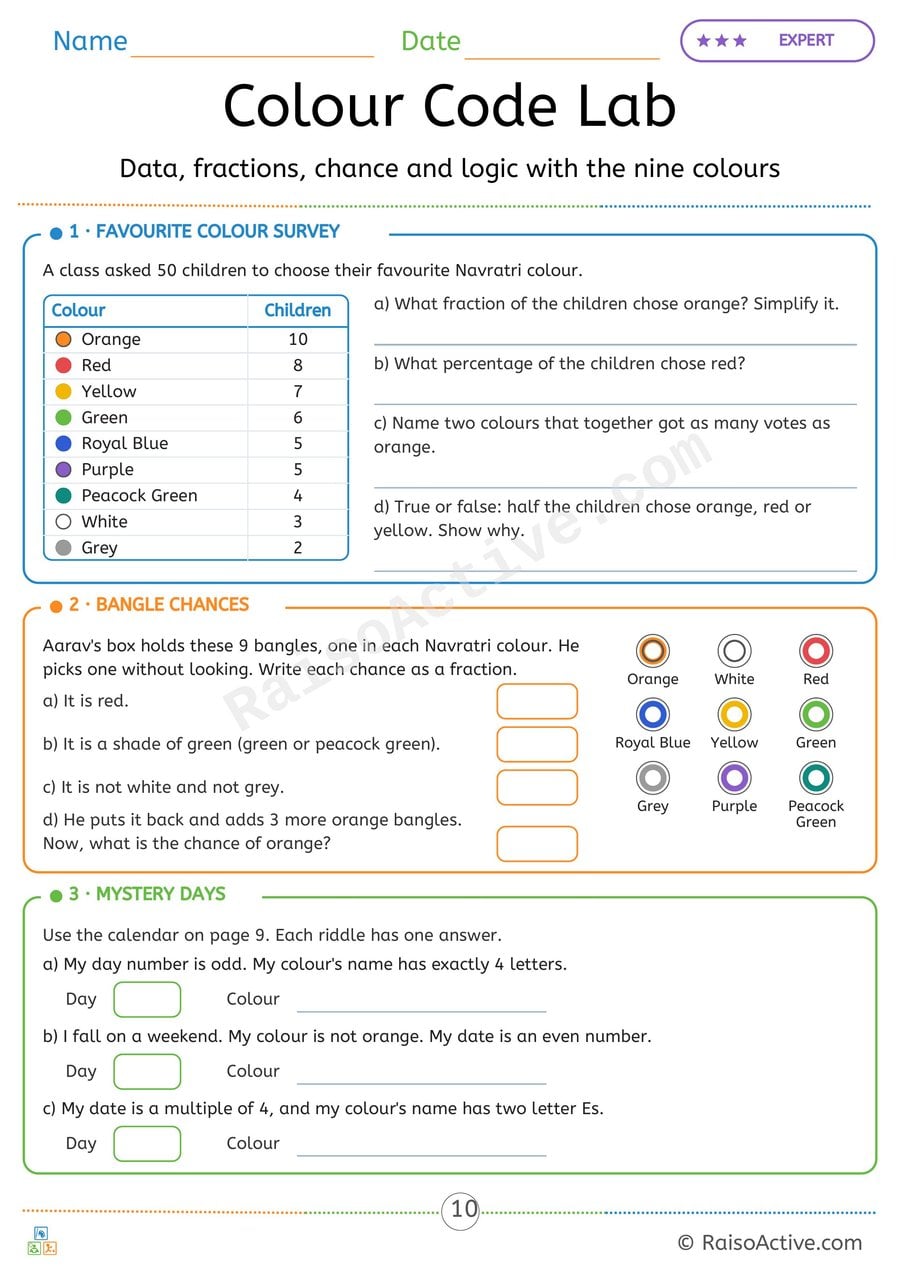
Colour Code Lab: Navratri Fractions, Percentages and Probability
Ages 7-11 · Grade 2–Grade 3Ages 7-11 · Year 3–Year 4Ages 7-11 · Class 2–Class 3Ages 7-11
Children read a survey of 50 children's favourite Navratri colours and write fractions and percentages, write the chance of picking each kind of bangle as a fraction, and solve three riddles using the colour calendar on page 9.
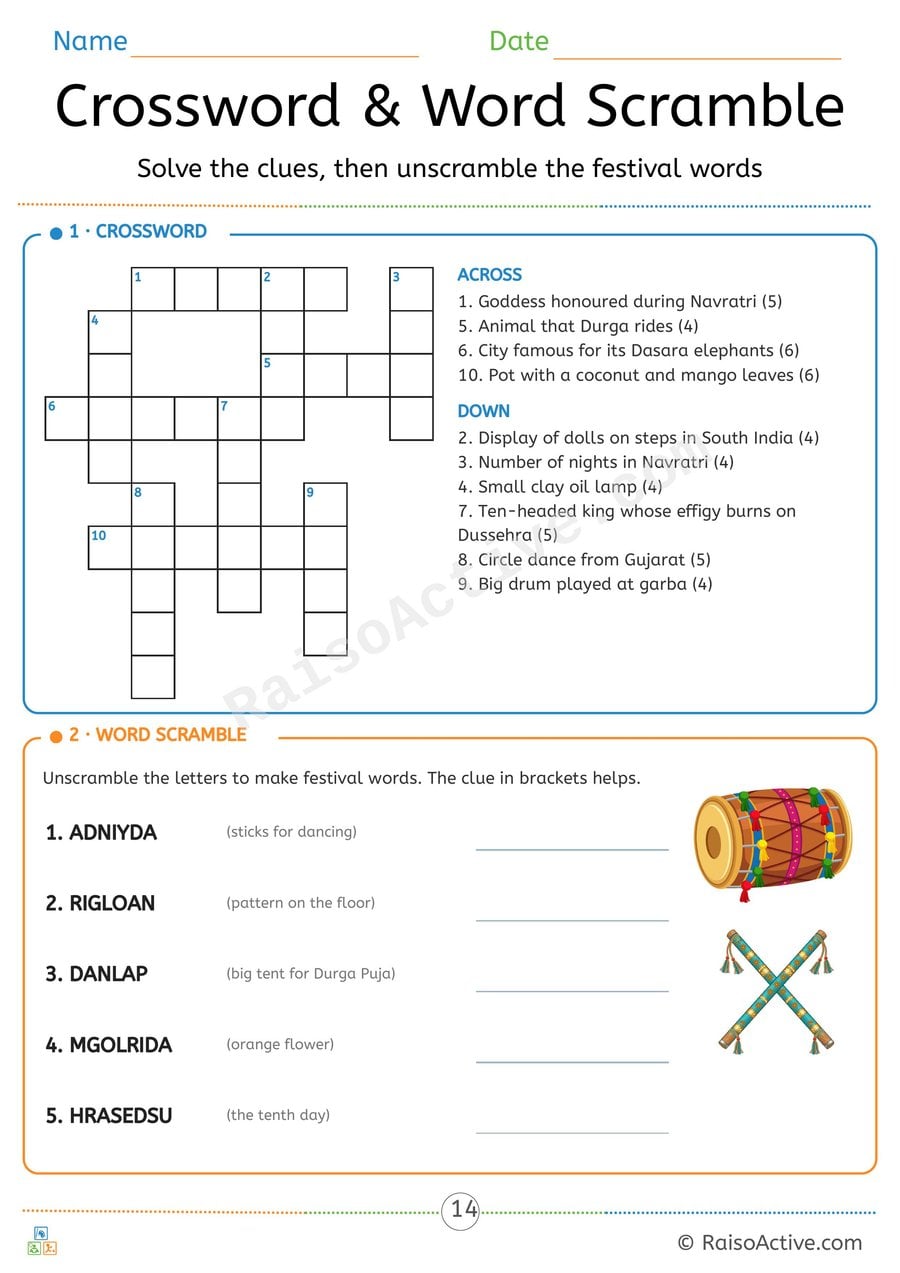
Navratri Crossword and Word Scramble
Ages 7-11 · Grade 2–Grade 3Ages 7-11 · Year 3–Year 4Ages 7-11 · Class 2–Class 3Ages 7-11
Children solve 10 crossword clues about the goddess, the lion, Mysuru, the kalash, Golu, diyas, Ravan, garba and the dhol, and unscramble five festival words with a clue for each.

Vijayadashami Challenge: Vidyarambham, Dussehra and Calendar Maths
Ages 7-11 · Grade 2–Grade 3Ages 7-11 · Year 3–Year 4Ages 7-11 · Class 2–Class 3Ages 7-11
Children read about Saraswati, Vidyarambham and Dussehra. They time themselves writing letters in a rice tray and draw a bar chart, plan reading a 60-page book with division, remainders and calendar dates, and multiply and use fractions with Ravana figures.
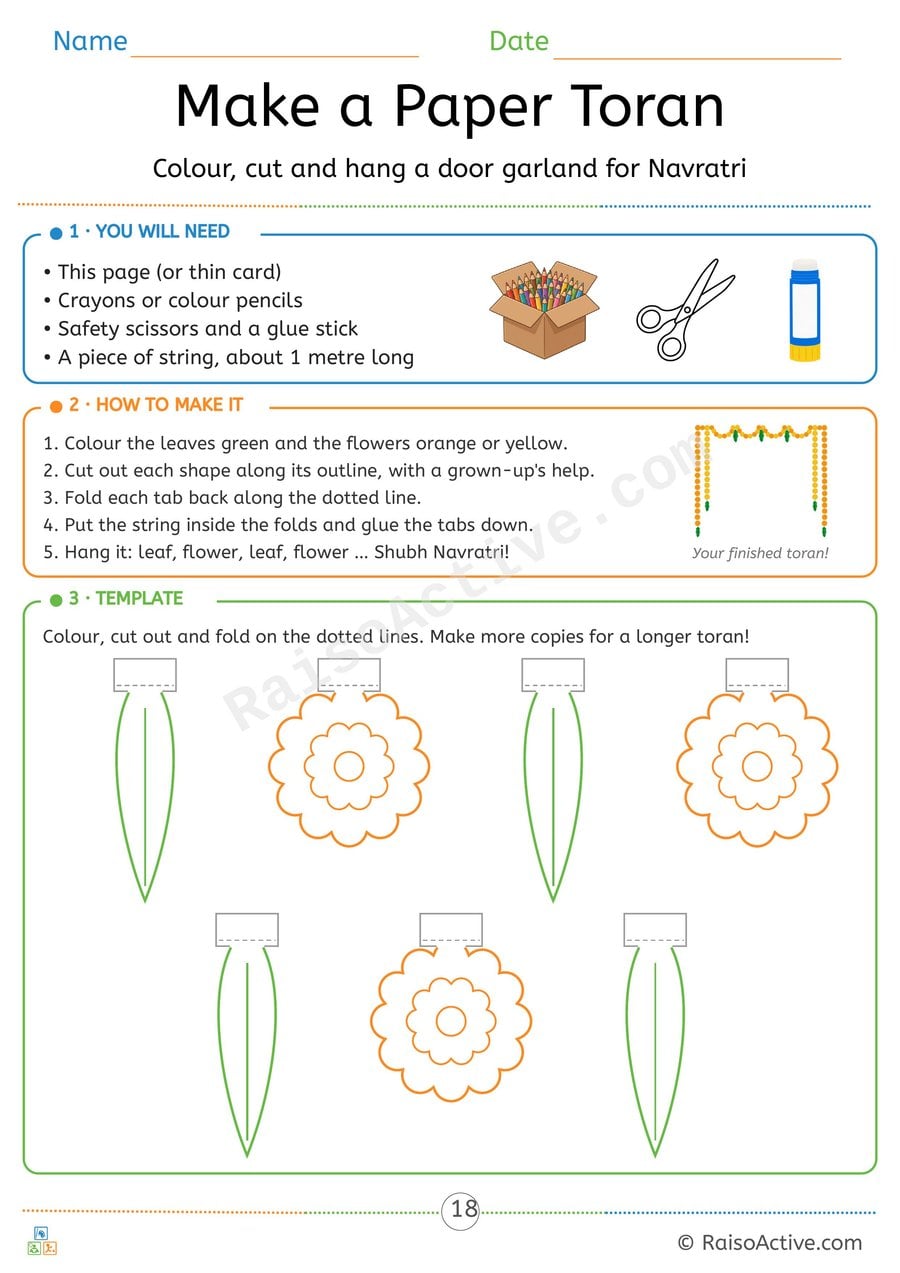
Make a Paper Toran: Navratri Craft Template
Ages 4-6 · Pre-K–KindergartenAges 4-6 · Reception–Year 1Ages 4-6 · LKG–UKGAges 4-6
Children follow step-by-step instructions to colour, cut, fold and glue a festival decoration, building scissor skills and fine motor control.
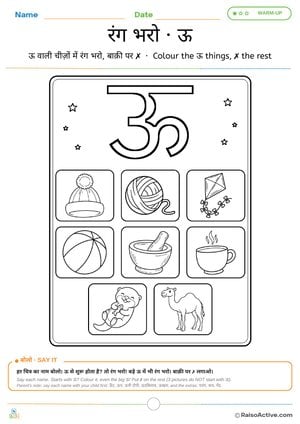
Colour the ऊ Things: Hindi Letter ऊ Colouring Page | रंग भरो · ऊ
Ages 3-7 · Preschool–Grade 1Ages 3-7 · Nursery–Year 2Ages 3-7 · Nursery–Class 1Ages 3-7
Children listen for the first sound of each picture name and decide whether it starts with ऊ. They colour the ऊ pictures, cross out the others and colour the big letter.
Navratri Fun Time Certificate of Achievement
Ages 4-6 · Pre-K–KindergartenAges 4-6 · Reception–Year 1Ages 4-6 · LKG–UKGAges 4-6
Children celebrate finishing the Navratri Fun Time pages and see which levels they completed.
Guides for this topic

Best Worksheets for 3-Year-Olds: What Works and What to Avoid
What works on worksheets for 3-year-olds: short sessions, crayons, tracing lines, matching, cutting, a free weekly plan, and signs one is too advanced.
Celebrating Diversity: How to Incorporate Cultural Awareness in Learning Activities for Young Children
Practical cultural awareness activities for young children aged 2-8. Explore Indian festivals, world cultures, food, music, and crafts to teach diversity and inclusion.
Christmas and Winter Activities That Combine Fun and Learning: Creating Magical Educational Experiences
Discover Christmas and winter activities that combine festive fun with real learning. Crafts, counting, literacy, and printable worksheets for ages 2 to 8 — perfect for home and school.
Reviews
Every worksheet for ages 4–8, no watermark
Members download the full library of 1,000+ worksheets and every activity pack without watermarks or daily limits. One year costs ₹999 in India or $20 elsewhere.
See membership plansOr download any worksheet free with a watermark (5 a day).