Sight Word 'From' Worksheet: Trace, Find, and Write!
This worksheet targets the sight word 'from' through a five-step sequence of coloring, searching, tracing, writing, and sentence practice, giving children ages 4-5 the repeated, varied exposure needed to recognize this common word instantly rather than sounding it out each time. Because 'from' appears constantly in early reading material, building fluency with it directly supports smoother, more confident reading of simple sentences and books.
Part of the pack
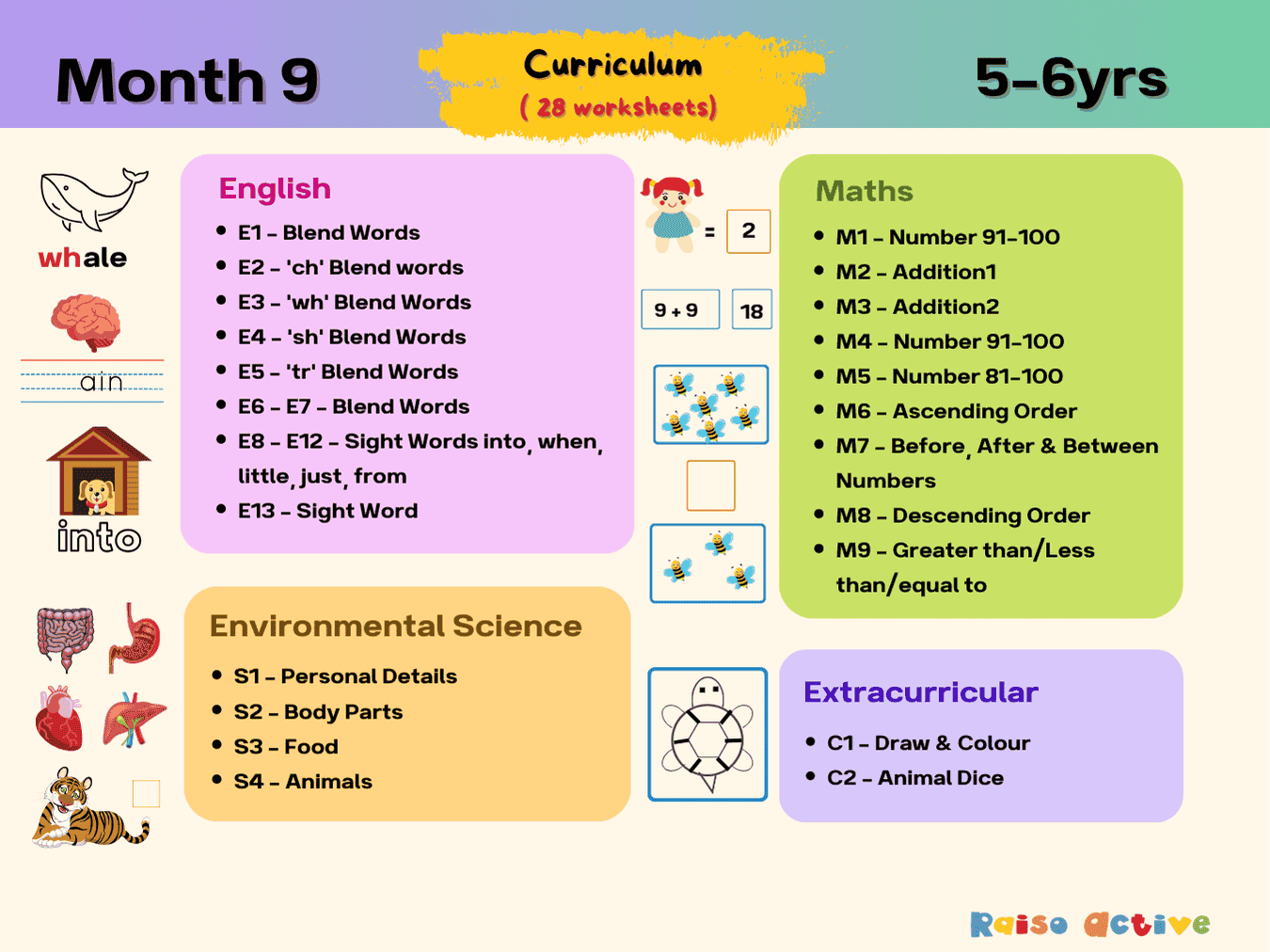
Month 9: Early Learning English Math Science | Ages 5-6
This is page 15 of the pack. Ages 5-6 · KindergartenAges 5-6 · Year 1Ages 5-6 · UKGAges 5-6
Made for your child
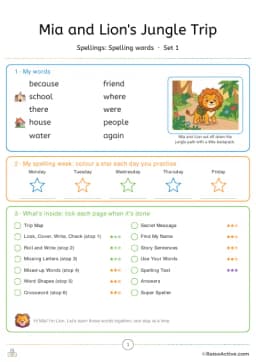
Spelling practice, made for your child
Their own spelling words turned into a pack: trace or look-cover-write-check, roll and write, a secret picture code, a word search, a crossword and a test, with their name in it.
Make a spelling packFree preview · free for members
Or start free: a word search with sight wordsCurriculum
- Fluency > Sight Words
How to use this worksheet
Start by having your child color the large printed word 'from' at the top of the page, saying it aloud with each letter they color. Have them search the grid of words to find and highlight every occurrence of 'from,' then guide their hand through tracing the dotted version before writing it independently on the practice lines. Read the fill-in-the-blank sentences together and help your child decide where 'from' fits, then finish with the letter-pasting activity, where they arrange and glue individual letters in the correct order to spell the word.
Materials needed
- Pencil
- Crayons
- Scissors
- Glue
Extension activities
- 1Talk about where different family members or friends are 'from,' like a city or country, and write simple sentences together.
- 2Look through mail or packages at home and point out any addresses that use the word 'from.'
- 3Play a simple sentence game where your child finishes the phrase 'I am from...' about themselves and other family members.
- 4Search a picture book together for the word 'from' and count how many times it appears.
- 5Practice writing 'from' with different tools, like a paintbrush and water on pavement, to reinforce the letter shapes through movement.

Written by
Hemsweta Jain · Teacher Cheena
MBA and Early Childhood Educator, teaching since 2014 · Founder of RaisoActive, Mumbai
Every RaisoActive worksheet is designed and checked by the founder before publishing.
Published · Last reviewed
More from Month 9: Early Learning English Math Science | Ages 5-6

Animal Sorting Worksheet: Wild, Domestic, and Sea Animals!
Ages 3-5 · Preschool–Pre-KAges 3-5 · Nursery–ReceptionAges 3-5 · Nursery–LKGAges 3-5
This worksheet asks children ages 3-5 to classify animals into three categories - wild, domestic, and sea animals - based on where and how each one lives, building early categorization skills alongside animal and habitat vocabulary. Learning to sort by a shared characteristic, like habitat, is foundational scientific thinking that children will use again and again as they group and compare other things in the world around them.

Blend Words: Color the Correct Picture Worksheet for Preschoolers
Ages 4-5 · Pre-KAges 4-5 · ReceptionAges 4-5 · LKGAges 4-5
This worksheet gives children ages 4-5 practice reading consonant blend words — words that start with two consonant sounds blended together, like 'bl' or 'sn' — and coloring the picture that matches each one. Consonant blends are trickier to decode than single-letter sounds, so this focused, low-pressure coloring format lets children practice blending without the added challenge of writing at the same time.
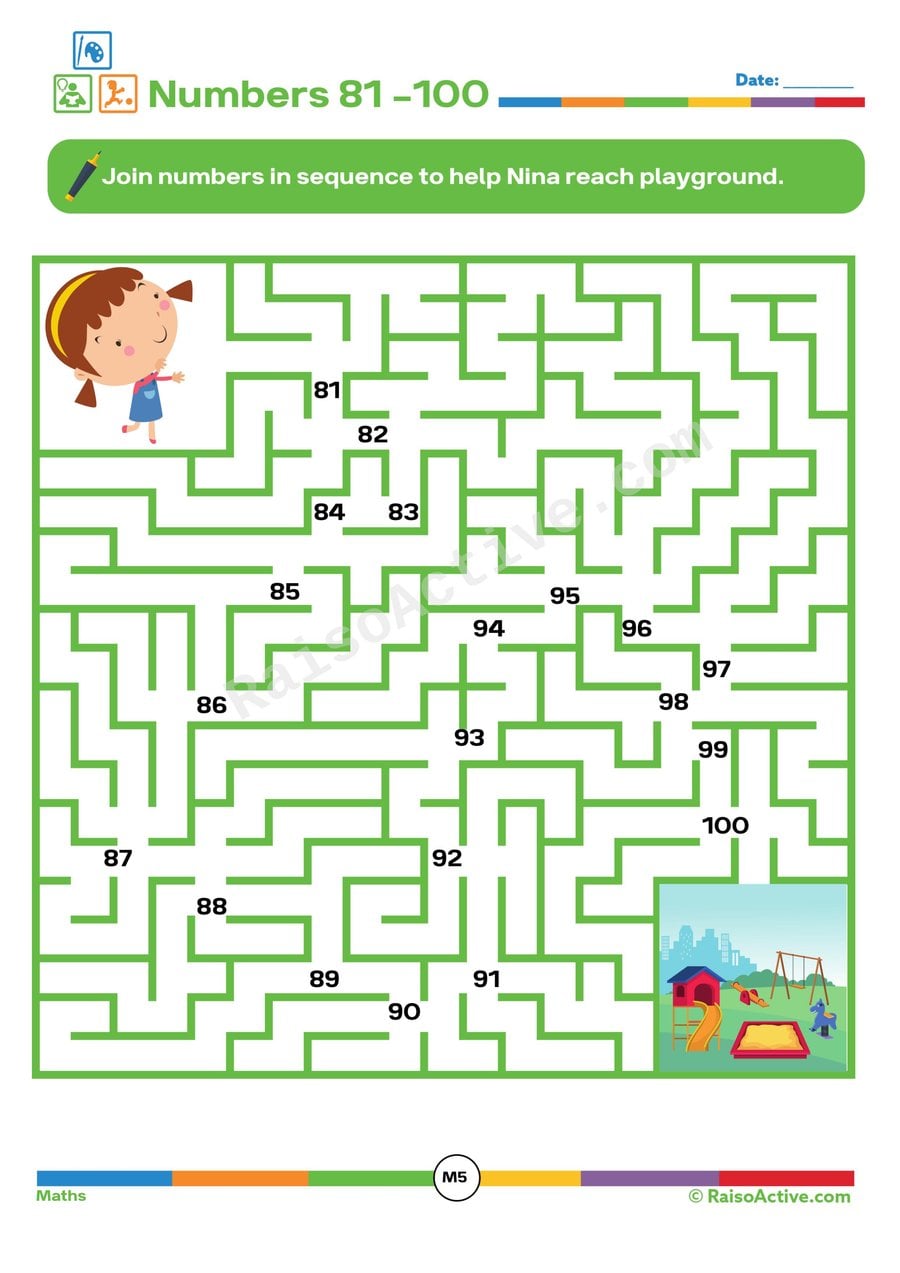
Nina's Playground Maze: Numbers 81-100 Worksheet
Ages 4-6 · Pre-K–KindergartenAges 4-6 · Reception–Year 1Ages 4-6 · LKG–UKGAges 4-6
This maze-style worksheet asks children ages 4-6 to trace a path by joining numbers in sequence from 81 to 100, combining number recognition and counting fluency with the fine motor demands of following a winding path. Because children must find the next correct number among several nearby options rather than simply reciting a memorized sequence, the activity sharpens visual scanning alongside numeracy. Successfully completing a 20-number sequence like this also builds stamina and confidence for handling longer counting ranges without losing track.

Cut and Glue: Comparing Quantities Worksheet for Preschoolers
Ages 3-5 · Preschool–Pre-KAges 3-5 · Nursery–ReceptionAges 3-5 · Nursery–LKGAges 3-5
Comparing quantities using the greater than, less than, and equal to symbols is an early step toward formal mathematical notation for children ages 3-5, building on the counting skills they already have. This cut-and-paste worksheet asks children to count two sets of objects, decide which set is larger, smaller, or the same, and then physically select and glue the correct comparison symbol between them. Handling the symbol pieces themselves, rather than writing the symbols freehand, lets younger children engage with this abstract math concept before their fine motor skills are ready for symbol writing.

Color the Sight Words! A Fun Sight Word Coloring Worksheet
Ages 3-5 · Preschool–Pre-KAges 3-5 · Nursery–ReceptionAges 3-5 · Nursery–LKGAges 3-5
This worksheet turns sight word recognition into a color-matching game, asking children ages 3-5 to read a sight word and then color a shape with the color that corresponds to it, which keeps repeated word exposure feeling playful rather than like drilling. Because children must actually read each word correctly before knowing which color to use, the coloring choice becomes a built-in check on whether the word was recognized accurately. Repeating this recognize-and-respond pattern across many candies or shapes gives children dozens of low-pressure reps with common sight words in a single sitting.
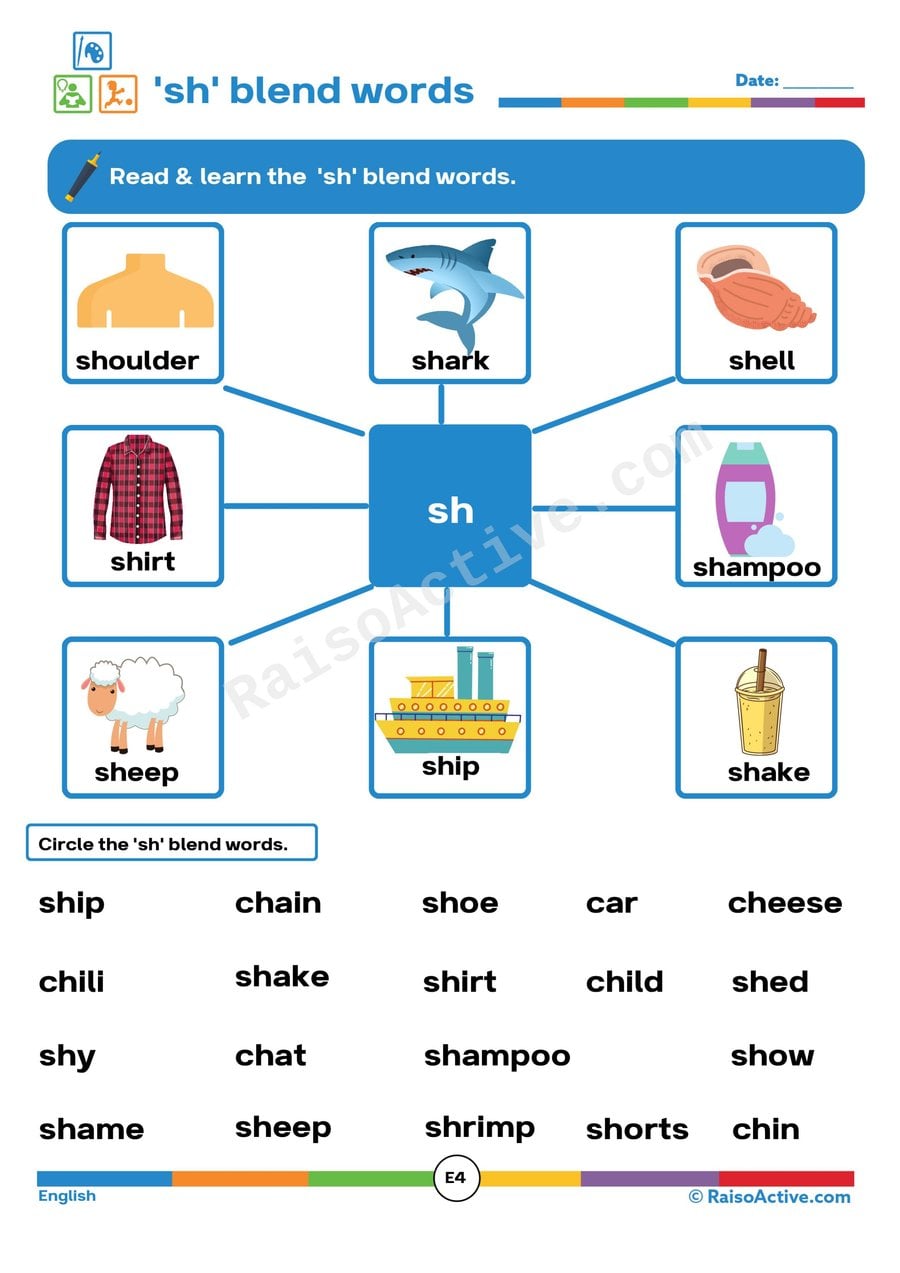
Sh Blend Words Worksheet: Read, Learn, and Circle!
Ages 4-6 · Pre-K–KindergartenAges 4-6 · Reception–Year 1Ages 4-6 · LKG–UKGAges 4-6
The 'sh' blend is one of the most common digraphs in early English words, appearing in everyday vocabulary like 'ship,' 'shell,' and 'shop,' which makes this worksheet especially useful for children ages 4-6 building toward independent reading. Recognizing that two letters, 's' and 'h,' combine to make one brand-new sound (rather than two separate sounds) is a key phonics milestone, since digraphs behave differently from regular consonant blends. Reading and then circling 'sh' words from a list reinforces both the sound and the specific letter pattern that represents it.

Ascending Order Worksheet: Heart-Filled Number Fun!
Ages 4-6 · Pre-K–KindergartenAges 4-6 · Reception–Year 1Ages 4-6 · LKG–UKGAges 4-6
Using a set of numbered hearts, this worksheet asks children ages 4-6 to compare several numbers at once and arrange them from smallest to largest, building number comparison and ordering skills that go beyond simple counting. Understanding relative size - knowing that 7 is bigger than 3 without needing to count up from one each time - is an important step toward more advanced number sense and mental math.

Descending Order Worksheet for Kids: Numbers 63-100
Ages 4-6 · Pre-K–KindergartenAges 4-6 · Reception–Year 1Ages 4-6 · LKG–UKGAges 4-6
Arranging numbers from largest to smallest asks children ages 4-6 to apply their counting knowledge in reverse, which is a genuinely different mental skill from counting forward and helps solidify a flexible, deep understanding of number order rather than rote recitation. Working within the 63 to 100 range also pushes children to compare two-digit numbers directly, deciding which of two numbers is bigger based on both digits rather than just the first one. This kind of descending practice complements ascending counting practice and rounds out a child's overall number sense.
Related worksheets
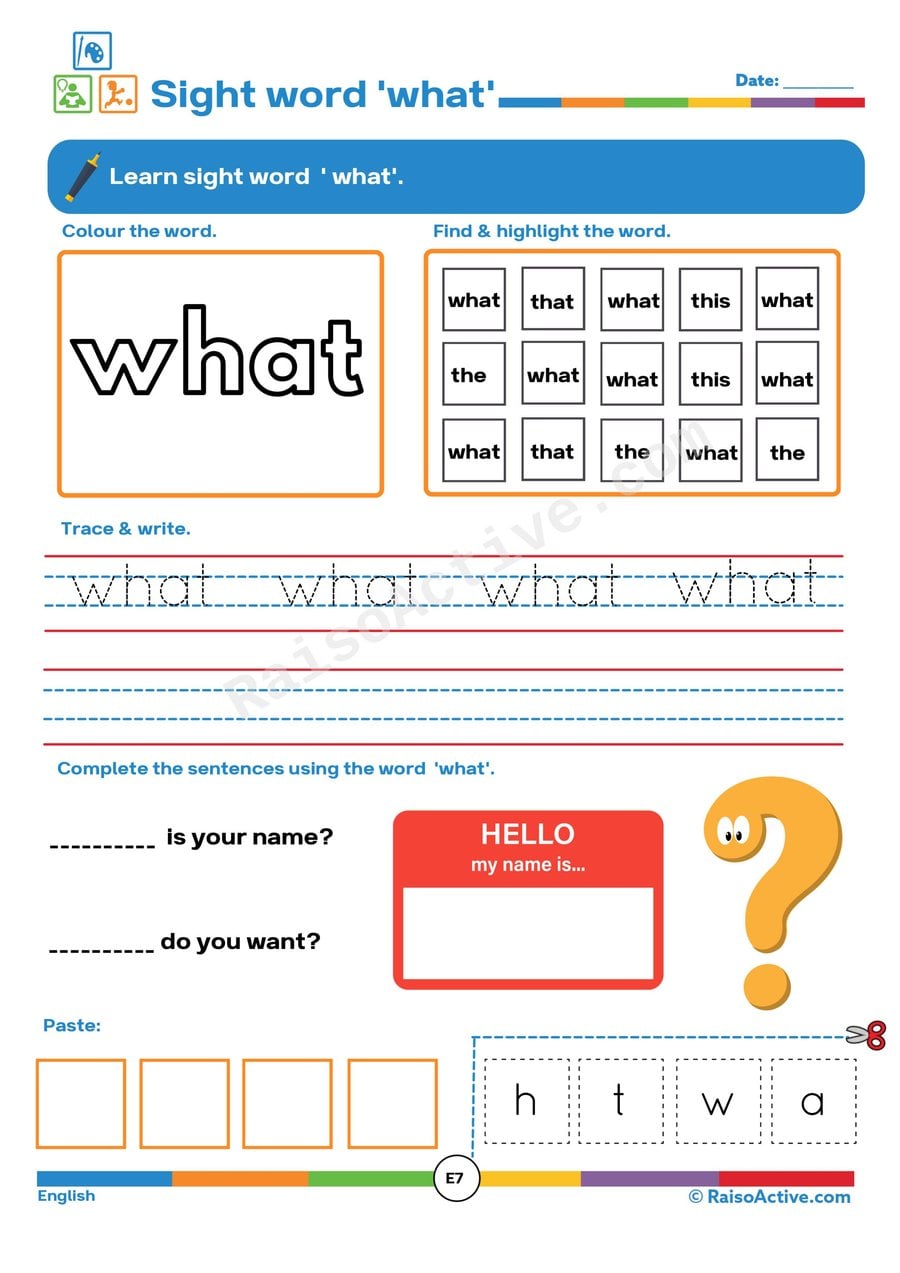
Sight Word 'What' Worksheet: Learn, Trace, and Find!
Ages 4-5 · Pre-KAges 4-5 · ReceptionAges 4-5 · LKGAges 4-5
The word 'what' is a common question word that children ages 4-5 encounter constantly in both spoken conversation and early reading, making it an important addition to their sight word vocabulary. This worksheet builds recognition through several formats — coloring, tracing, word searching, sentence completion, and cut-and-paste spelling — giving the word repeated, varied exposure in a single sitting. Because 'what' is a question word, practicing it in sentences also gives children an early sense of how question structures differ from statement structures.

Learn to Read and Write the Sight Word 'Like' - Fun Worksheet for Kids!
Ages 3-5 · Preschool–Pre-KAges 3-5 · Nursery–ReceptionAges 3-5 · Nursery–LKGAges 3-5
Children ages 3-5 build sight-word fluency with the word 'like,' a common word used to express preference, through tracing, coloring, a word search, and sentence reading. Because 'like' doesn't follow simple phonics rules and appears constantly in early books and everyday speech, repeated multi-format exposure like this worksheet provides is exactly how young readers commit it to memory.

Read and Match: Sight Word Sentences Worksheet for Early Readers
Ages 4-5 · Pre-KAges 4-5 · ReceptionAges 4-5 · LKGAges 4-5
Children ages 4-5 practice reading simple sight-word sentences and matching them to the picture that shows their meaning, building early reading comprehension by connecting printed words directly to what they represent. This bridges the gap between recognizing individual sight words and understanding a full sentence's meaning.

Sight Word Fun: Fill-in-the-Blank Worksheet for Preschoolers
Ages 4-5 · Pre-KAges 4-5 · ReceptionAges 4-5 · LKGAges 4-5
Reading a sentence with a missing sight word and selecting the correct choice builds early reading fluency for children ages 4-5, since recognizing common sight words by sight — rather than sounding them out — speeds up overall reading comprehension.
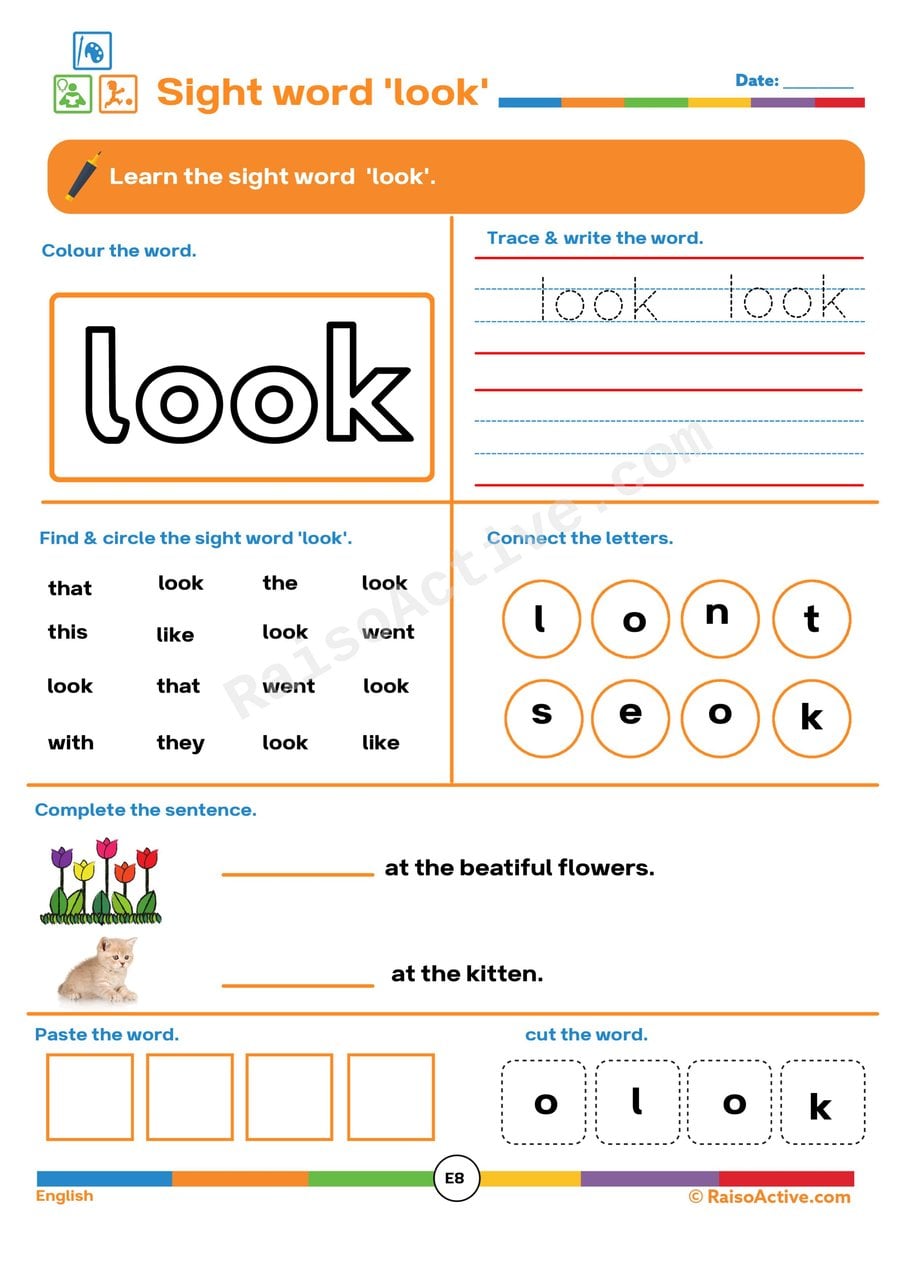
Look! Sight Word 'Look' Worksheet for Preschoolers
Ages 3-5 · Preschool–Pre-KAges 3-5 · Nursery–ReceptionAges 3-5 · Nursery–LKGAges 3-5
This worksheet builds automatic recognition of the sight word 'look' through six different activities — coloring, tracing, finding it in a list, spelling it by connecting letters, completing a sentence, and pasting it — which matters because sight words like 'look' don't sound out easily and have to be memorized by sight through repeated, varied exposure. Hitting the same word from six angles in one sitting is exactly the kind of repetition that turns a word from something your child sounds out slowly into one they recognize instantly.
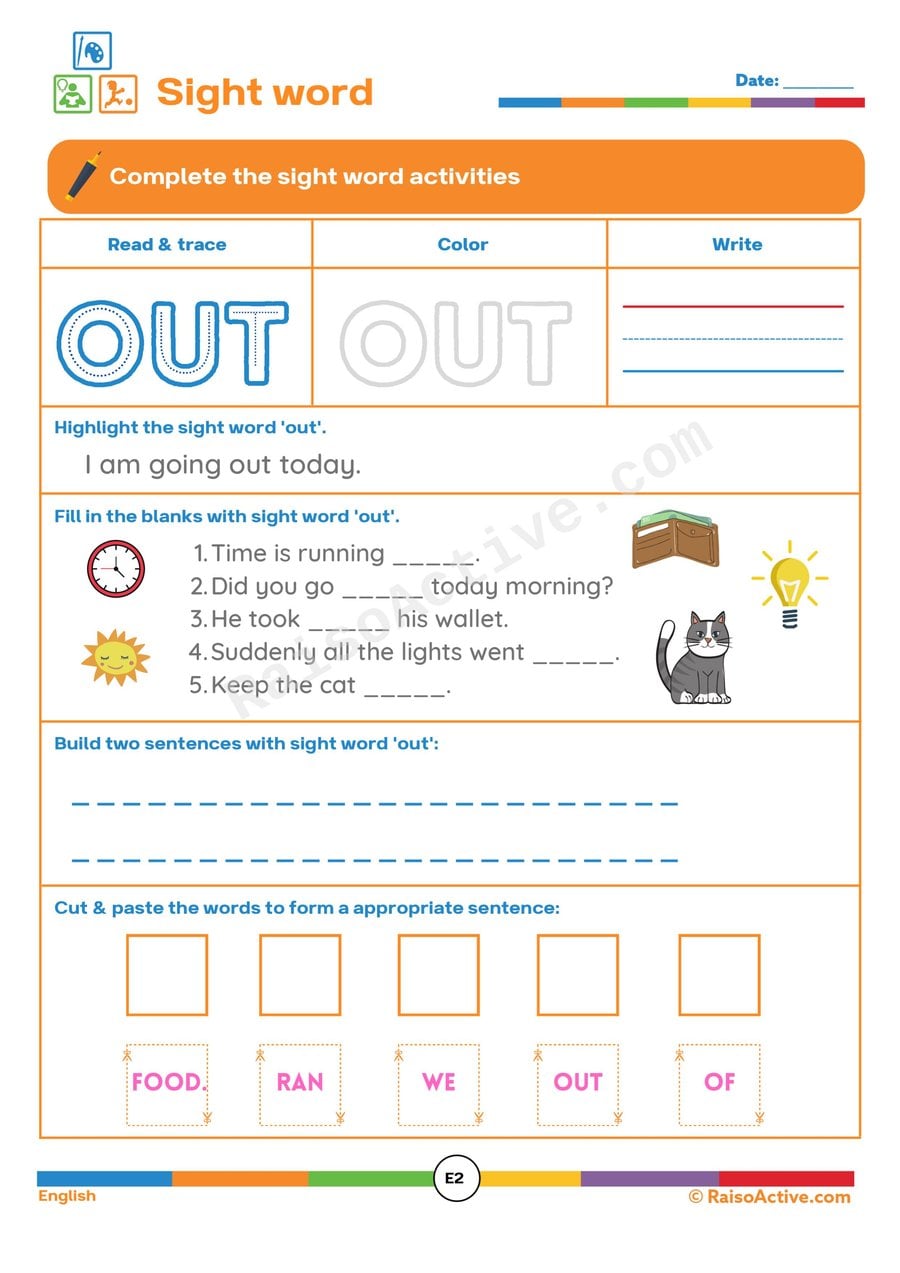
Sight Word 'Out' Worksheet: Read, Trace, and Write!
Ages 3-5 · Preschool–Pre-KAges 3-5 · Nursery–ReceptionAges 3-5 · Nursery–LKGAges 3-5
Reading fluency for young children depends on instantly recognizing common sight words that don't sound out easily, and this worksheet gives children ages 3-5 focused, repeated exposure to the word 'out' through tracing, coloring, and sentence practice. Seeing the word in context within simple sentences also helps children start connecting sight-word recognition to real reading comprehension.

Sight Words Coloring Worksheet: 'His', 'My', and 'Her' Fun!
Ages 3-5 · Preschool–Pre-KAges 3-5 · Nursery–ReceptionAges 3-5 · Nursery–LKGAges 3-5
This coloring activity helps children ages 3-5 recognize and internalize the common sight words 'his,' 'my,' and 'her' by following a color-coded key, an approach that builds sight word memory through repeated visual association rather than isolated flashcard drilling. Because sight words like these don't sound out easily using phonics rules, repeated exposure in a fun context like coloring is one of the most effective ways for young children to memorize them. The activity also reinforces fine motor control as children carefully color within the lines of each labeled section.

Learn to Read: Sight Word 'Hear' Worksheet for Preschoolers
Ages 3-5 · Preschool–Pre-KAges 3-5 · Nursery–ReceptionAges 3-5 · Nursery–LKGAges 3-5
'Hear' is a sight word children ages 3-5 encounter often in early books, and its spelling doesn't clearly match its sound, so children need repeated exposure to recognize it instantly rather than sound it out each time. This worksheet reinforces the word through five different activities — coloring, searching, tracing, sentence completion, and cut-and-paste spelling — which research on early literacy shows builds much stronger retention than repeating a single format. Because 'hear' is often confused with the similar-sounding word 'here,' practicing it in full sentences also helps children start to notice the meaning difference between the two.
Guides for this topic

Sight Words by Age: The First 50 Words and How to Teach Them Without Flashcard Fatigue
Which sight words to teach first and why, the heart-word method, a read-trace-write-find routine, games, and a by-age table of typical sight-word progress.
How to Teach CVC Blending: A Step-by-Step Method That Works in Two Weeks
A step-by-step method for teaching CVC blending, covering continuous sounds, word families, common errors, and a 14-day plan that most children finish reading CVC words.
Phase 2 Phonics at Home: Sound Order, Blending Games, Worksheets
Phase 2 phonics at home: the five sound sets in order, oral blending, tricky words, a two-week routine, common mistakes, and free worksheets.
Reviews
Every worksheet for ages 4–5, no watermark
Members download the full library of 1,000+ worksheets and every activity pack without watermarks or daily limits. One year costs ₹999 in India or $20 elsewhere.
See membership plansOr download any worksheet free with a watermark (5 a day).