Free printable worksheets · United States
1st Grade Phonics Worksheets (Ages 6–7)
1st Grade phonics worksheets are practice sheets for children aged 6–7 in First Grade in the US. Phonics is the practice of connecting letters to the sounds they represent, then blending those sounds together to decode and read words. The sheets on this page cover letter-sound correspondence, blending sounds into words, segmenting words into sounds and digraphs and consonant blends.
First grade pushes reading toward fluency and math toward larger numbers: consonant digraphs, long vowels and silent e appear in decodable passages, while place value work extends to 120 and addition and subtraction move from within 10 to within 20. By six to seven, phonics moves into long vowel spellings, magic e, ai, ee, oa and similar vowel teams, alongside consonant blends and digraphs already learned. A worksheet should include reading and sorting words by their vowel spelling, a short decodable passage that uses only patterns taught so far, and spelling from dictation that tests whether the pattern is remembered. Fluent, word-by-word reading without sounding aloud each time is the aim by the end of the year.
258+ worksheets · free PDF download · print on A4 or Letter
1st Grade Phonics Worksheets to print
Browse all worksheets for ages 6–7
Personal Pronouns Worksheet for Kids: Circle and Underline!
Circling the subject pronoun and underlining the object pronoun in each sentence teaches children ages 5-7 to recognize that pronouns play different grammatical roles depending on their position in a sentence, an important step toward more advanced grammar understanding. This careful, close-reading task also builds attention to sentence structure that supports stronger writing later on.

Punctuation Adventure: End Punctuation Worksheet for Kids
Children ages 5-7 practice choosing between periods, question marks, and exclamation points based on the meaning and tone of a sentence, a skill that connects punctuation directly to how a sentence should sound when read aloud. This builds the foundation for expressive, correctly punctuated writing later in school.

Sun Safety Worksheet for Kids: Learn About Staying Safe in the Sun!
This worksheet has children ages 4-7 answer questions about sun safety, such as why sunscreen and hats matter, building early health literacy alongside writing practice as they put their understanding into their own words. Because the questions ask children to reason about why certain sun-safety habits matter rather than just label a picture, this worksheet develops early explanatory thinking, a step up from simple factual recall. Practicing writing full answers, even short ones, also builds sentence-forming skills appropriate for this age range.
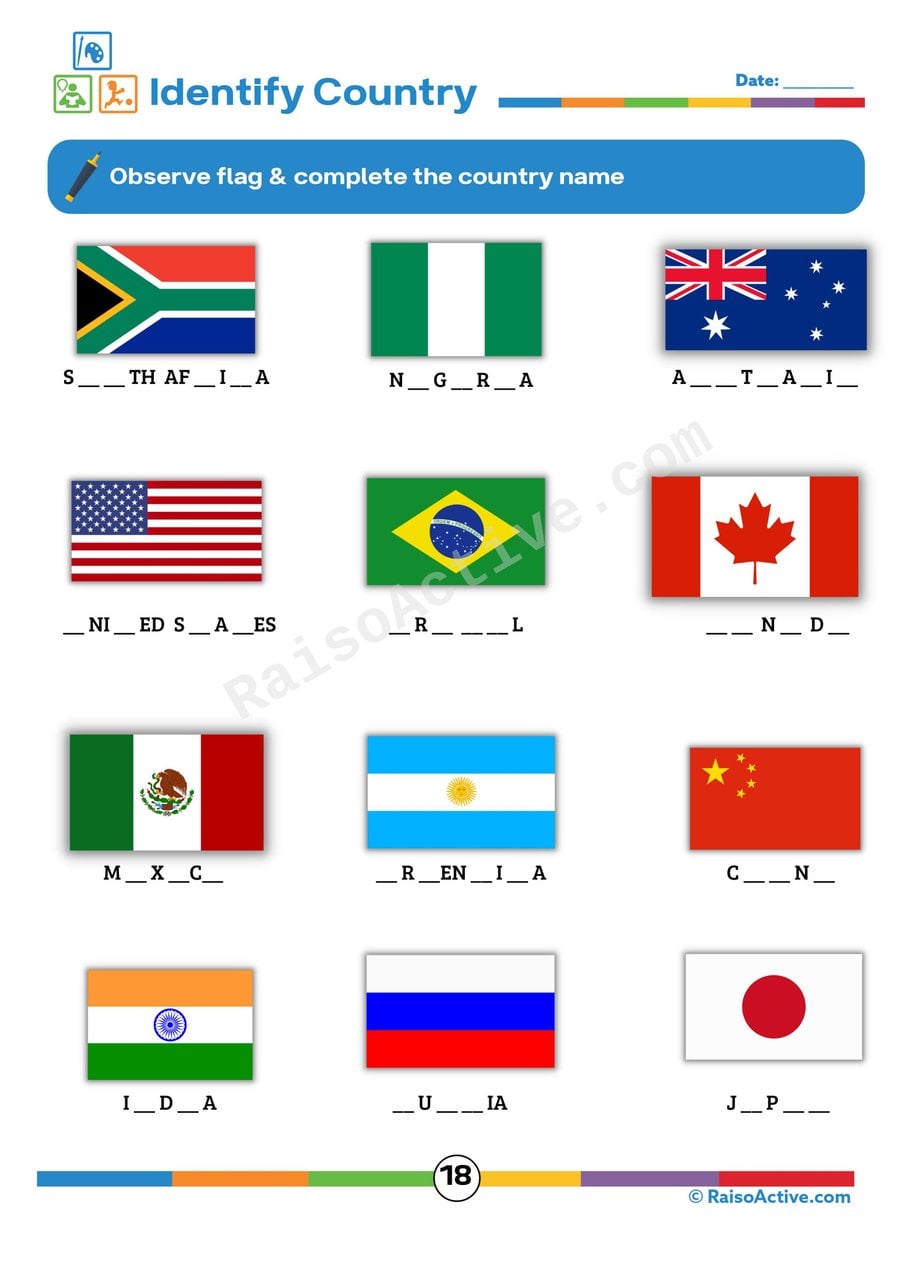
Identify the Country: Flag Matching Worksheet
Filling in the missing letters of each country's name while studying its flag gives children ages 4-7 practice with letter-sound correspondence and spelling patterns, since they must sound out the word and recall which letters are already provided as clues. It also builds early geography knowledge, helping children connect a visual symbol (the flag) to a country's name for the first time. This dual practice of decoding and world knowledge lays groundwork for both literacy and social studies skills.

Number Names Worksheet: Writing and Matching Numbers 41-50
Writing number names like 'forty-one' through 'fifty' next to their numerals helps children ages 4-6 connect the spoken word for a two-digit number to both its written word form and its digit form, deepening overall number sense in this specific range. This worksheet also revisits missing-number sequencing and color-coded boxes, reinforcing the same number range through several different, related tasks rather than one repetitive drill. Building fluency with number names in the 40s prepares children to confidently read numbers they encounter in daily life, from clocks to price tags.
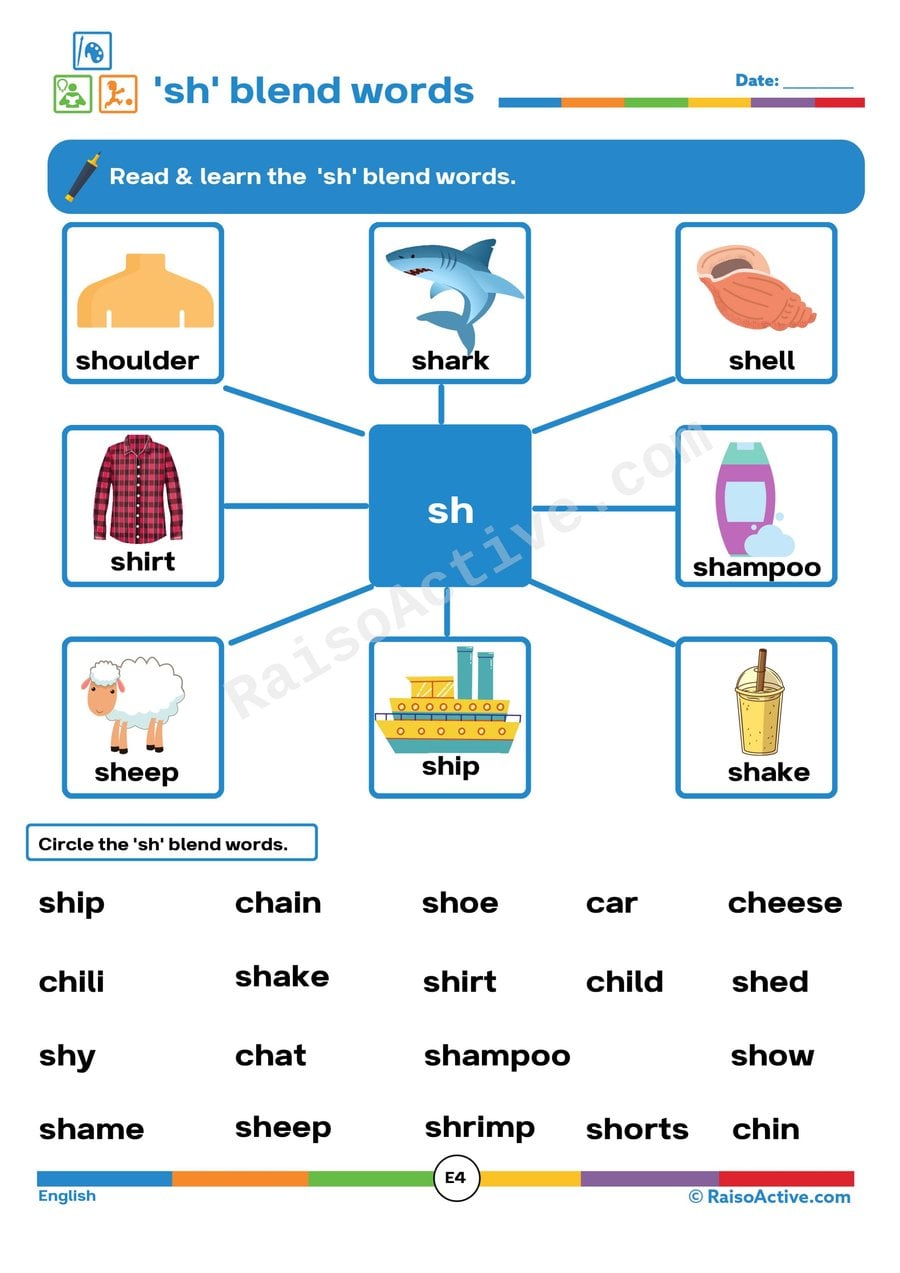
Sh Blend Words Worksheet: Read, Learn, and Circle!
The 'sh' blend is one of the most common digraphs in early English words, appearing in everyday vocabulary like 'ship,' 'shell,' and 'shop,' which makes this worksheet especially useful for children ages 4-6 building toward independent reading. Recognizing that two letters, 's' and 'h,' combine to make one brand-new sound (rather than two separate sounds) is a key phonics milestone, since digraphs behave differently from regular consonant blends. Reading and then circling 'sh' words from a list reinforces both the sound and the specific letter pattern that represents it.

Fall Vocabulary Unscramble Worksheet for Preschoolers
This unscrambling activity asks children ages 4-6 to rearrange jumbled letters into correctly spelled fall vocabulary words, building letter-sound awareness and an early sense of correct spelling patterns. Because each word relates to a picture clue, children also practice connecting spoken vocabulary to its written form, a key step on the road to independent reading.

Alphabet Adventures: Complete the Vocabulary Table!
This worksheet helps children ages 4-6 strengthen letter-picture-word associations by filling in missing letters, finding matching pictures for each letter, and pasting them into a vocabulary table. Combining letter recall, picture matching, and gluing into one multi-step task pushes children beyond simple letter recognition into actively building and organizing vocabulary, an important step toward independent reading and writing.

Read and Match: Sentence Reading Worksheet for Early Learners
This worksheet has 4-6 year olds read a full sentence aloud and then identify which picture actually matches its meaning by coloring the circle beside it, building reading comprehension in a format that requires understanding the whole sentence rather than picking out a single keyword. Because more than one picture on the page may share surface similarities, your child has to genuinely process what the sentence says, which is a stronger comprehension check than simple word-picture matching.

Match the Sentence: Picture Matching Worksheet for Early Readers
Reading a full sentence and connecting it to the picture it describes asks children ages 4-6 to move beyond single-word recognition into genuine sentence comprehension, checking that they understood the sentence's overall meaning rather than just decoding individual words. This worksheet builds that comprehension skill by having children read several simple sentences and match each one to the correct illustration, reinforcing that reading is about extracting meaning, not just producing sounds. Developing this kind of sentence-level comprehension early is an important bridge between phonics-based decoding and true reading fluency.

S and T Sounds Worksheet: Matching Sounds to Objects
This matching worksheet helps children ages 4-6 build beginning-sound awareness for the letters 's' and 't' by listening to each sound and connecting it to the correct object. Distinguishing between these two common consonant sounds strengthens the foundational skill of linking a spoken sound to its written letter, which is essential before children can spell or decode independently. Matching by sound, rather than by sight alone, keeps the focus on auditory phonics rather than memorized shapes.
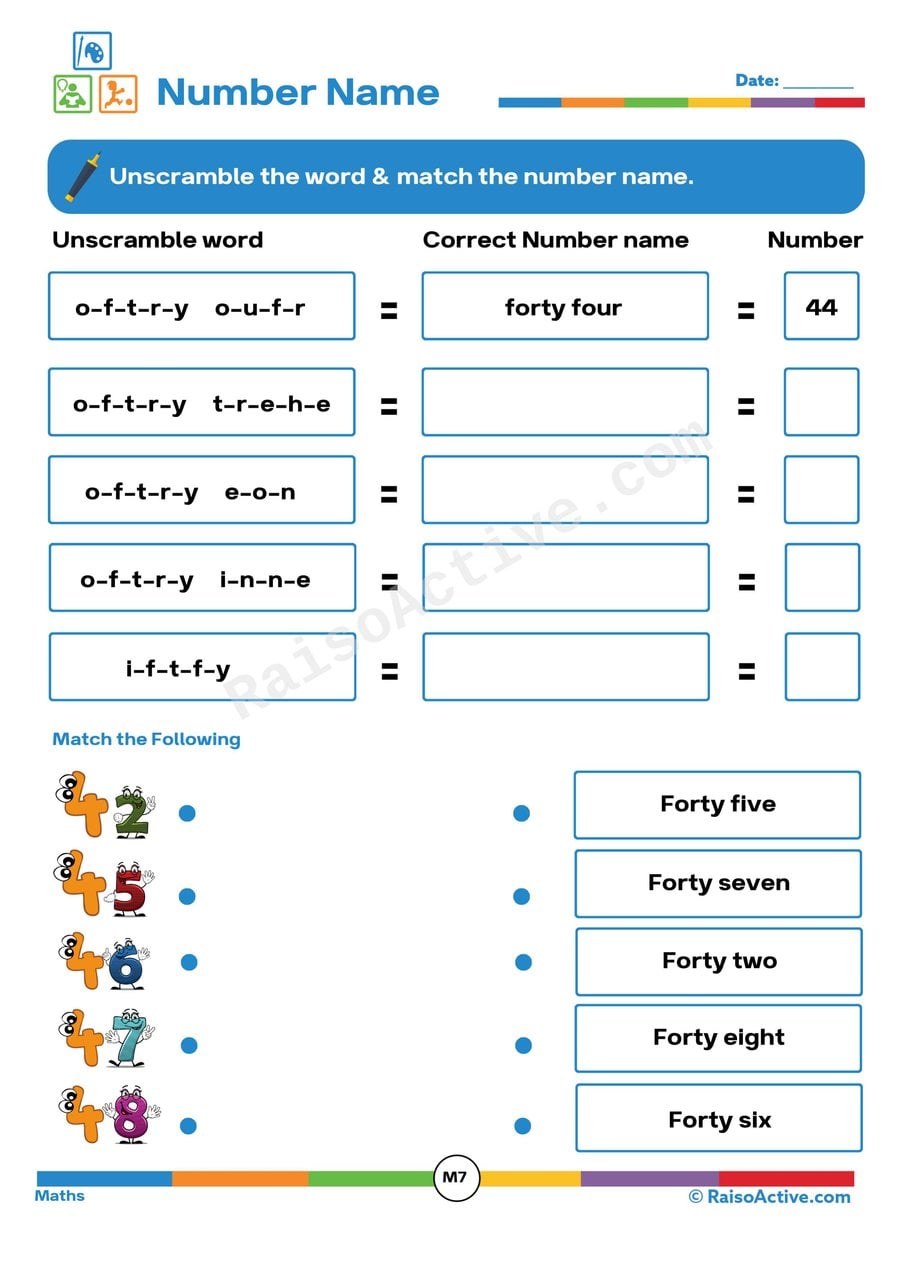
Number Name Matching Worksheet for Preschoolers
This worksheet connects three related number skills at once: unscrambling a jumbled word to spell a number name correctly, writing that number name out, and then matching it to its numeral — a layered task that builds both early spelling and number recognition together. Because number-name spelling (like 'seven' or 'eight') doesn't always follow simple sound-out rules, this worksheet gives 4-6 year olds valuable repeated exposure to sight-word-style number vocabulary.

Adjective Adventure: Matching Sentences Worksheet for Kids
This worksheet teaches 4-6 year olds that adjectives are the words that describe nouns, asking them to fill in a missing adjective in a sentence and then physically mark the noun and adjective separately by underlining and circling. That separation step — telling apart which word names a thing and which word describes it — is a genuinely useful grammar distinction that most children haven't consciously noticed before, even though they use adjectives constantly in speech.

Present Tense Worksheet: Fill in the Blanks and Identify Sentences!
This worksheet gives children ages 4-6 focused practice with present tense verbs, both producing them correctly in fill-in-the-blank sentences and recognizing them when identifying whether a given sentence is written in the present tense. Distinguishing tense is an important grammar milestone that helps children communicate clearly about what is happening right now versus what already happened, a distinction they're actively sorting out in their own speech at this age.

Hopscotch Numbers 1-50 Worksheet: Fill in the Missing Numbers!
This hopscotch-themed worksheet gives children ages 4-6 practice filling in missing numbers within the 1-50 range, extending their number sequencing beyond the more commonly rehearsed 1-20 range and building familiarity with two-digit number patterns like the '20s' or '30s.' Framing the numbers as a hopscotch grid connects the paper activity to a familiar physical game, helping children mentally picture themselves counting forward as they move up the grid. This kind of extended-range practice is an important bridge toward comfortable counting to 100.

Sentence Building Fun: Using Words to Create Sentences Worksheet
This worksheet helps children ages 4-6 practice constructing complete, grammatically sound sentences by using a set of provided words alongside a picture prompt. Building sentences from a word bank forces children to think about word order and sentence structure directly, rather than just filling in a single blank, which is a meaningful step up in independent writing skill.
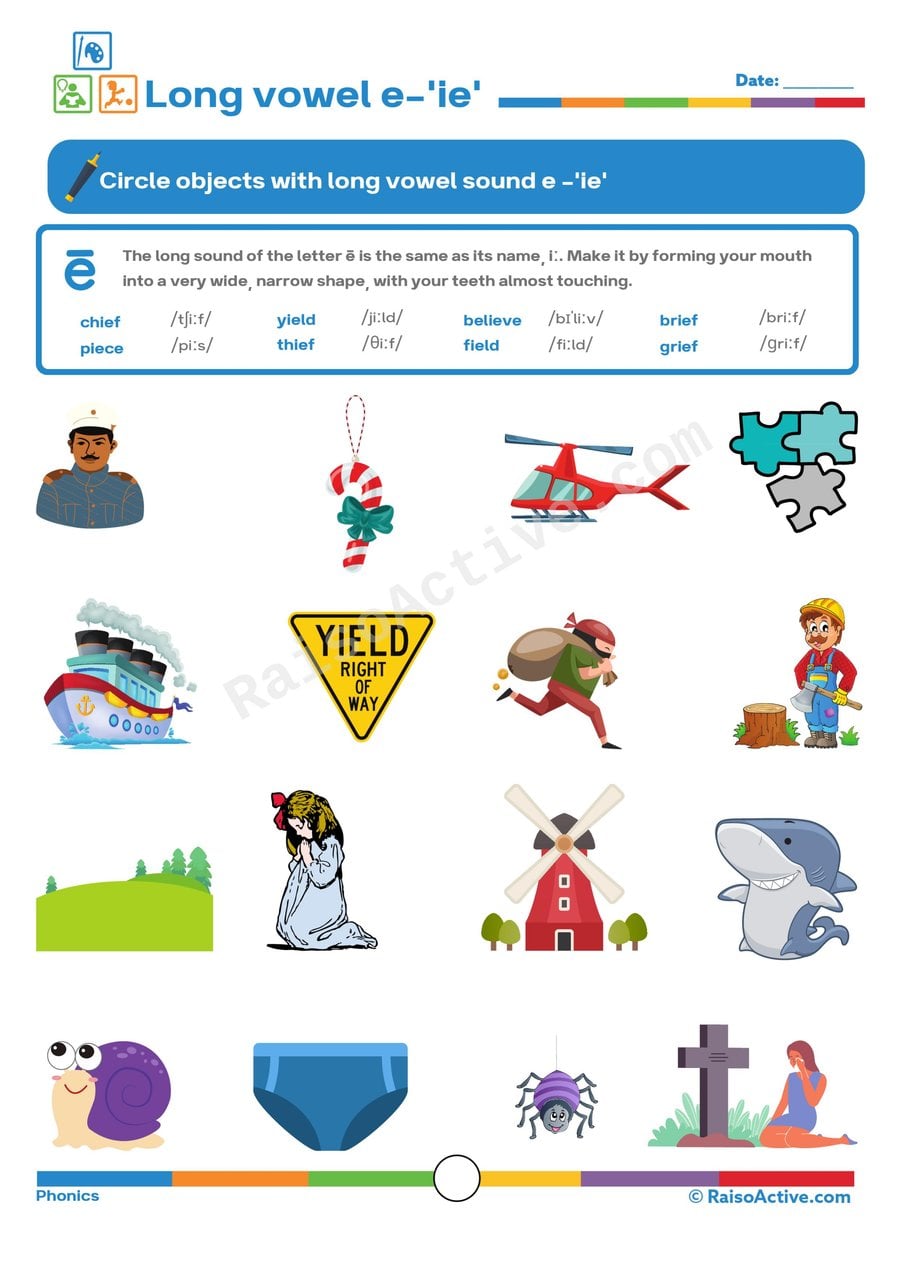
Long Vowel E 'ie' Worksheet: Circle the Pictures!
This worksheet asks children ages 4-6 to identify words with the long 'e' sound spelled using the less common 'ie' pattern, as in 'chief' and 'field', and circle the matching pictures. Because 'ie' is a trickier, less intuitive spelling for the long 'e' sound than more familiar patterns like 'ee', this worksheet stretches children's phonics knowledge toward more advanced and irregular spelling patterns.

Pronoun Power: Matching and Writing Practice Worksheet
Matching nouns to their correct pronouns and then rewriting sentences with a pronoun in place of an underlined word teaches children ages 4-6 how pronouns work as stand-ins for people, places, or things, a key grammar concept for writing smoother sentences. Practicing both matching and substitution gives two different angles on the same underlying skill.

Comma Practice Worksheet for Kids: Separating Items in a List!
Children ages 4-6 learn exactly where commas belong when writing a list of three or more items in a sentence, a specific punctuation rule that makes their early writing readable to others. Practicing this now, before they start composing longer sentences independently, builds a habit that carries straight into school writing tasks.

First Letter Fun: Identify and Write! A Vocabulary Worksheet for Kids
Designed for 4-6 year olds, this worksheet pairs vocabulary building with first-letter phonics — your child has to recognize or learn each pictured object's name and then isolate and write its opening sound, which stretches both spoken vocabulary and early spelling skills together. Because this version targets a slightly older age range, it's a good check for whether your child can move through the naming-and-writing process more independently than a beginning 3-year-old would.

Articles Adventure: A, An, and The Worksheet for Preschoolers
Choosing between 'a,' 'an,' and 'the' teaches children ages 4-6 one of English grammar's trickier rules — that 'an' is used before words starting with a vowel sound while 'a' comes before consonant sounds — building an ear for language patterns that native speakers often absorb through repetition rather than explicit rules. Practicing these small but frequent words also smooths out overall sentence fluency, since articles appear constantly in everyday speech and writing.

Alphabet Adventures: Write the First Letter - Small Alphabet Worksheet
This worksheet strengthens phonemic awareness by asking children ages 4-6 to isolate the very first sound in a spoken word and match it to its lowercase letter - a skill that sits at the heart of early decoding and spelling. Because it uses small (lowercase) letters specifically, it also reinforces letter-case recognition, since children encounter lowercase print far more often than capitals once they begin reading books.

Blend Words Worksheet: Circle the Correct Picture!
This worksheet strengthens blending skills for children ages 4-6, asking them to say a consonant blend like 'bl' or 'st' together with different word endings and identify which resulting word matches a picture. Blending two consonant sounds smoothly before adding a vowel is a more advanced phonics skill than single-letter sounds, and this practice directly supports decoding multisyllabic and blended words during independent reading.

Family Words Worksheet: Picture Matching and Word Recognition
This worksheet gives children ages 4-6 another round of practice recognizing family-member vocabulary words, reinforcing the connection between a printed word and the picture it names through both a tick-the-answer step and a cut-and-paste matching step. Repeating this pairing across two different formats on one page helps move these words from recognition with support toward more independent reading.
What 1st Grade phonics worksheets cover
By six to seven, phonics moves into long vowel spellings, magic e, ai, ee, oa and similar vowel teams, alongside consonant blends and digraphs already learned. A worksheet should include reading and sorting words by their vowel spelling, a short decodable passage that uses only patterns taught so far, and spelling from dictation that tests whether the pattern is remembered. Fluent, word-by-word reading without sounding aloud each time is the aim by the end of the year.
- Read and sort words by their long vowel spelling pattern
- Read a short decodable passage using known letter patterns
- Spell a dictated word choosing the correct vowel spelling
- Read common blends and digraphs without sounding them aloud
How to use these worksheets at home or in class
Fifteen to twenty minutes on most school days, split between a decodable passage with questions and a math page, matches what many first grade teachers assign. Keep base-ten blocks or bundled straws nearby so place value stays physical before it becomes purely written.
Start with the sheet that matches what your child can already do, then move one step up. Keep finished sheets in a folder: 1st Grade teachers often ask for evidence of practice, and children like seeing their own progress.
Is your child ready for 1st Grade phonics work?
A child ready for this stage decodes CVC words automatically, writes a simple sentence with a capital letter and end punctuation, adds and subtracts fluently within 10, and counts and writes numerals confidently to 20.
Frequently asked questions
Why does my six-year-old read hop correctly but not hope?
Because the silent e at the end changes the vowel sound, and that rule has to be taught directly rather than picked up from context. Point out that the e is not read but still changes the word, then practice pairs like hop and hope, cap and cape, side by side so the pattern becomes visible. Confusing short and long vowel spellings is one of the most common phonics errors at this age and usually clears with focused pair practice.
What should a 1st Grade child be able to do in phonics?
By six to seven, phonics moves into long vowel spellings, magic e, ai, ee, oa and similar vowel teams, alongside consonant blends and digraphs already learned. A worksheet should include reading and sorting words by their vowel spelling, a short decodable passage that uses only patterns taught so far, and spelling from dictation that tests whether the pattern is remembered. Fluent, word-by-word reading without sounding aloud each time is the aim by the end of the year. A child ready for this stage decodes CVC words automatically, writes a simple sentence with a capital letter and end punctuation, adds and subtracts fluently within 10, and counts and writes numerals confidently to 20.
Do these worksheets follow the 1st Grade curriculum?
The sheets cover letter-sound correspondence, blending sounds into words, segmenting words into sounds and digraphs and consonant blends, which sit inside the Common Core Grade 1 (1.OA, 1.NBT, RF.1.3) outcomes for 1st Grade. Year 1 / Year 2 (UK), Class 1 (India) use the same skills at this age, so the sheets also fit families following those programmes.
Are these 1st Grade phonics worksheets free?
Yes. Each worksheet downloads free as a watermarked PDF once you create an account, with a limit of five a day. An annual membership ($20) removes the watermark and the limit for the whole library of over 1,000 worksheets and every printable pack.

Written by
Hemsweta Jain · Teacher Cheena
MBA and Early Childhood Educator, teaching since 2014 · Founder of RaisoActive, Mumbai
Written and reviewed by Hemsweta Jain (Teacher Cheena), who designs every RaisoActive worksheet.
Last reviewed
Printable packs for ages 6–7
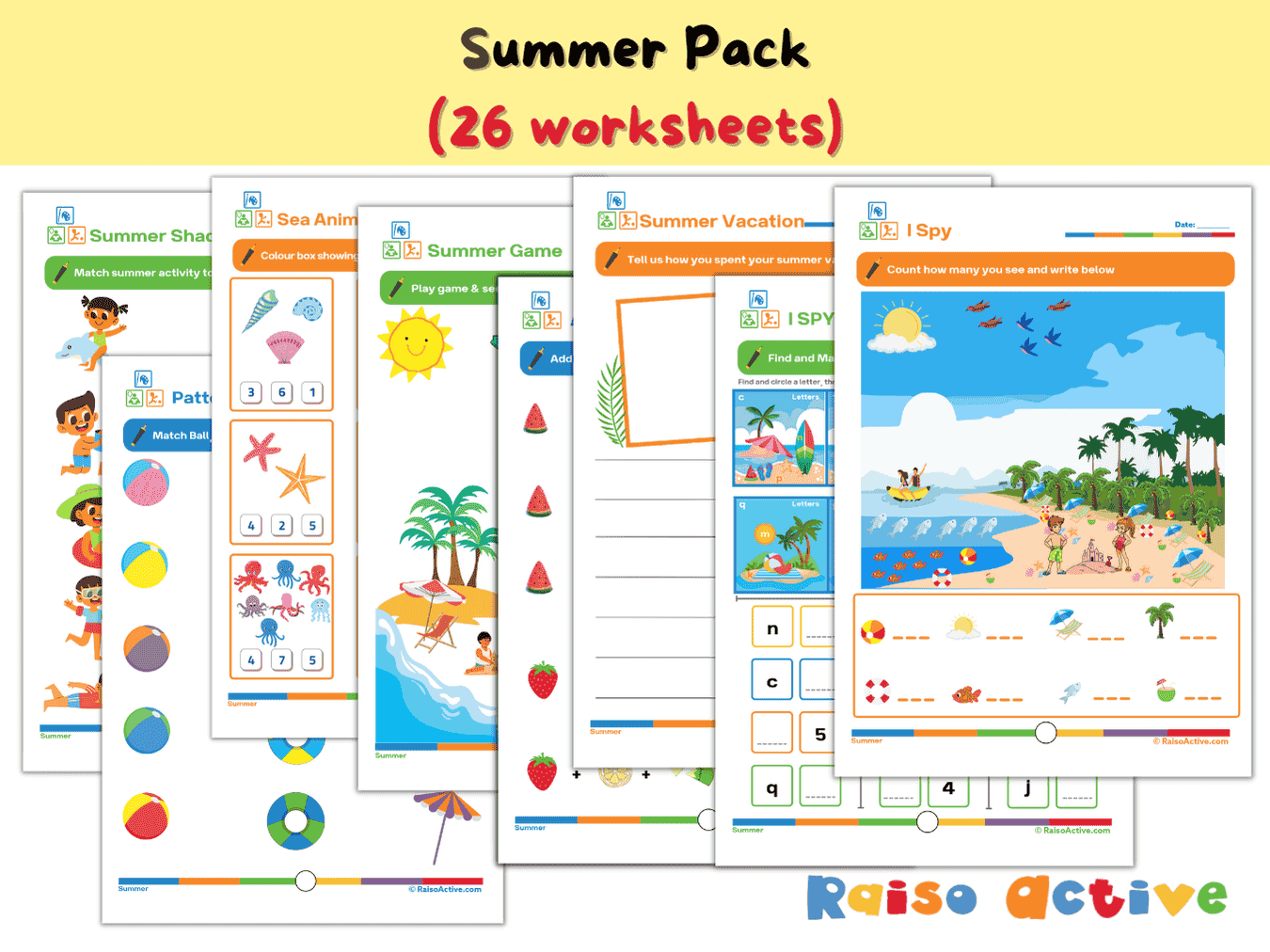
Summer Activity Pack: Math, Literacy, Puzzles & More for Preschool & Kindergarten
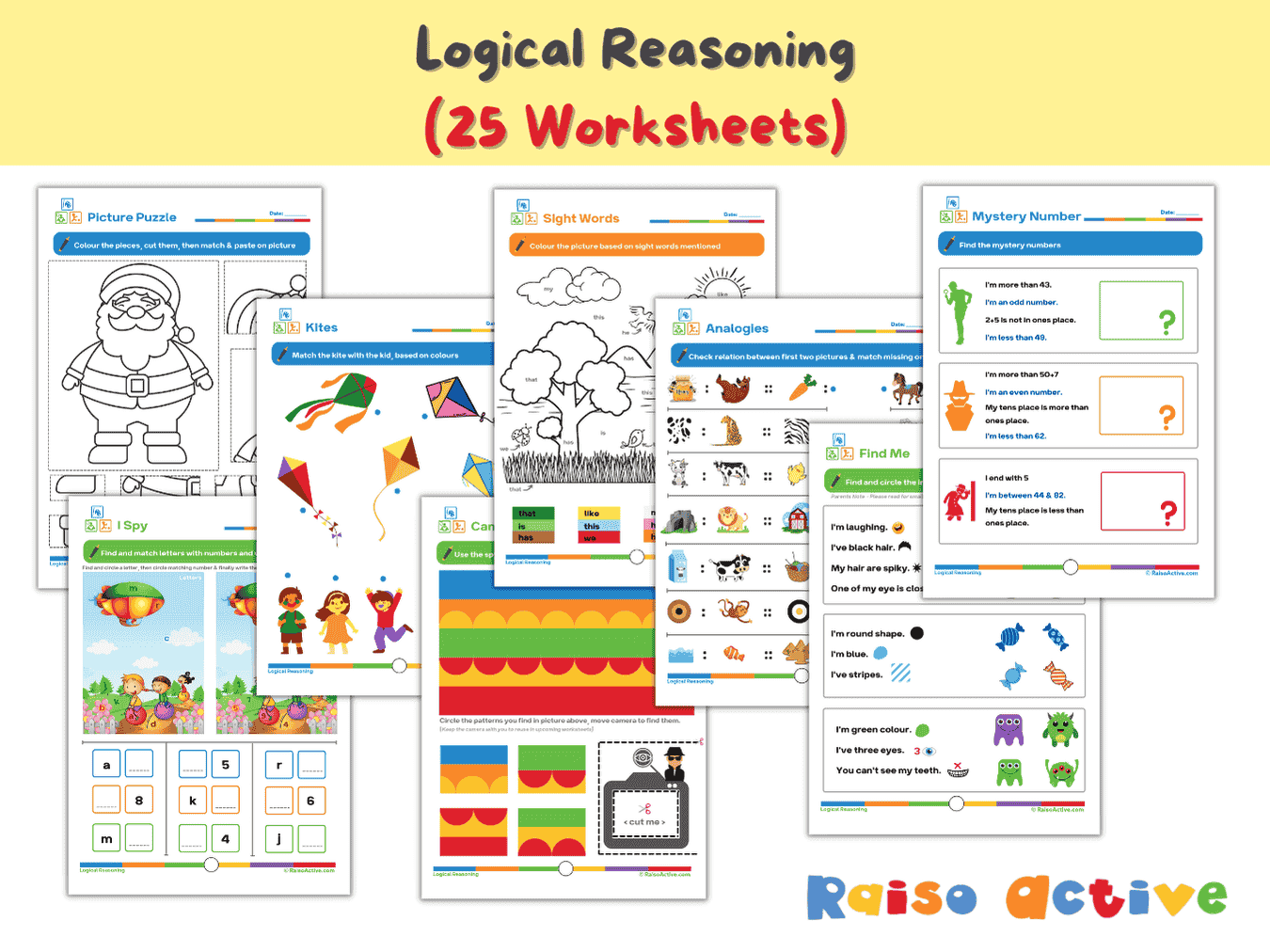
Logical Reasoning Activity Book for Preschool & Kindergarten | Patterns, Puzzles & Analogies
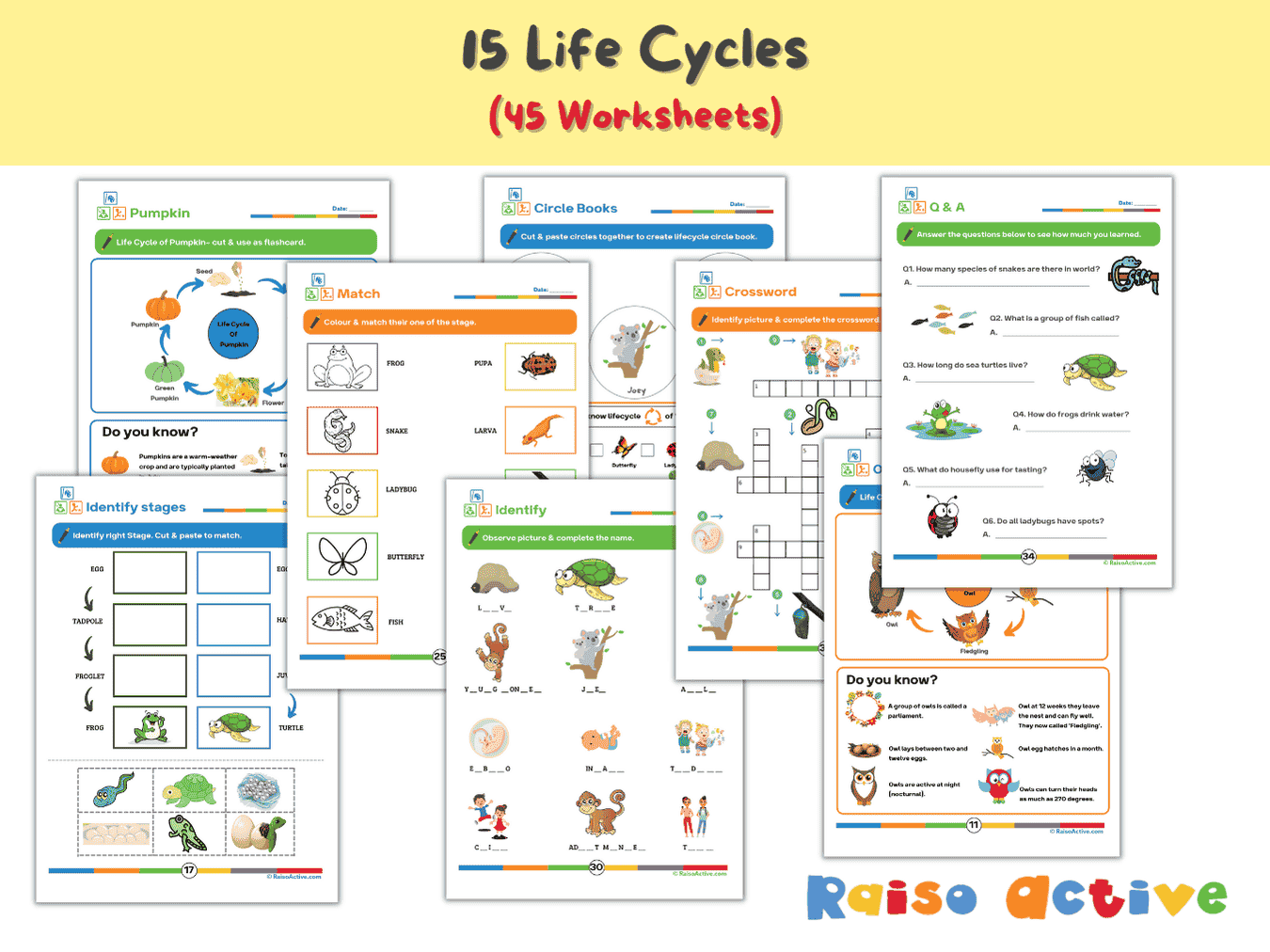
Lifecycles Activity Book & Flashcards for Preschool & Early Elementary
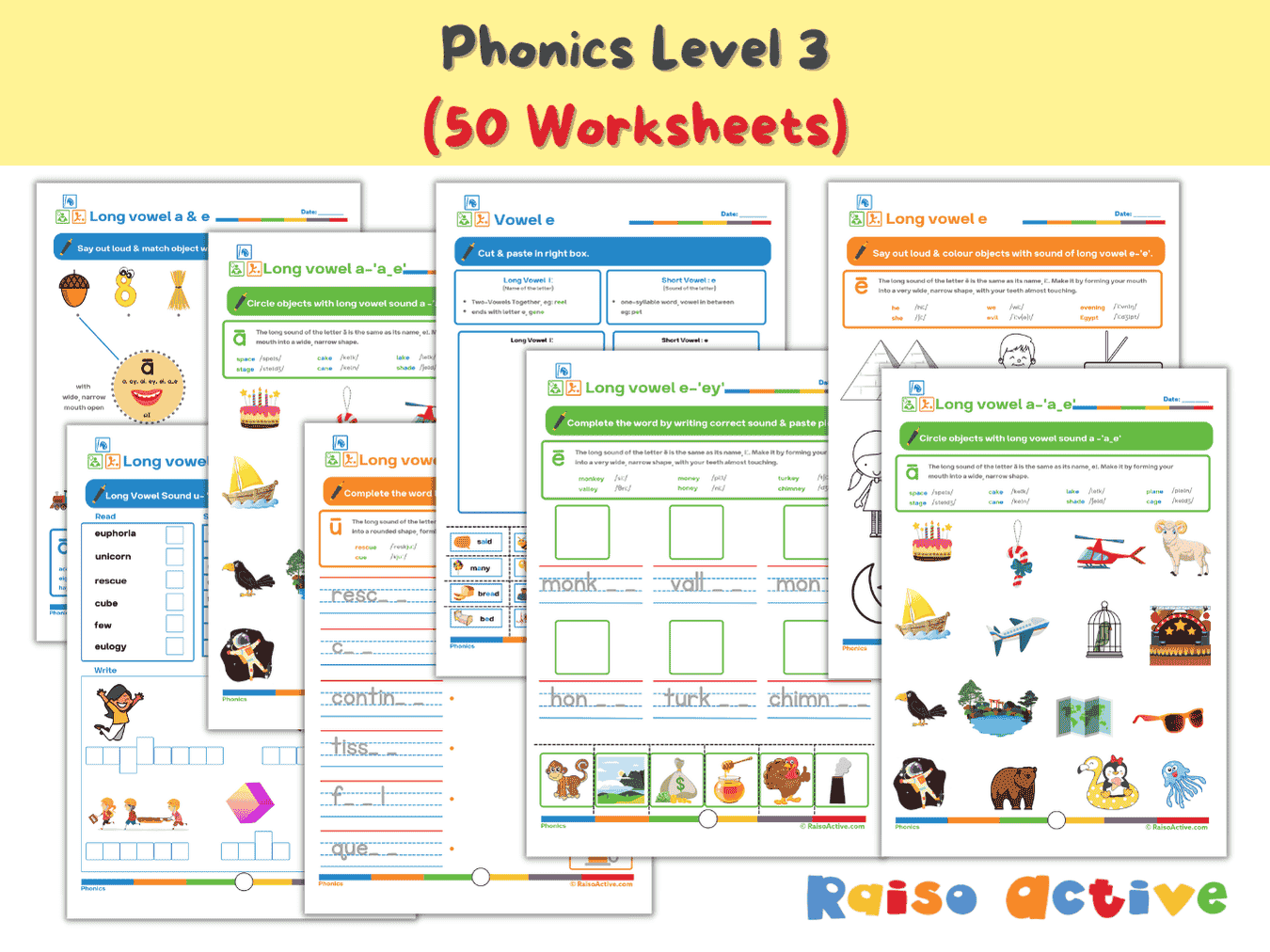
Phonics Level 3 Long Vowels Activity Book for Kindergarten & 1st Grade
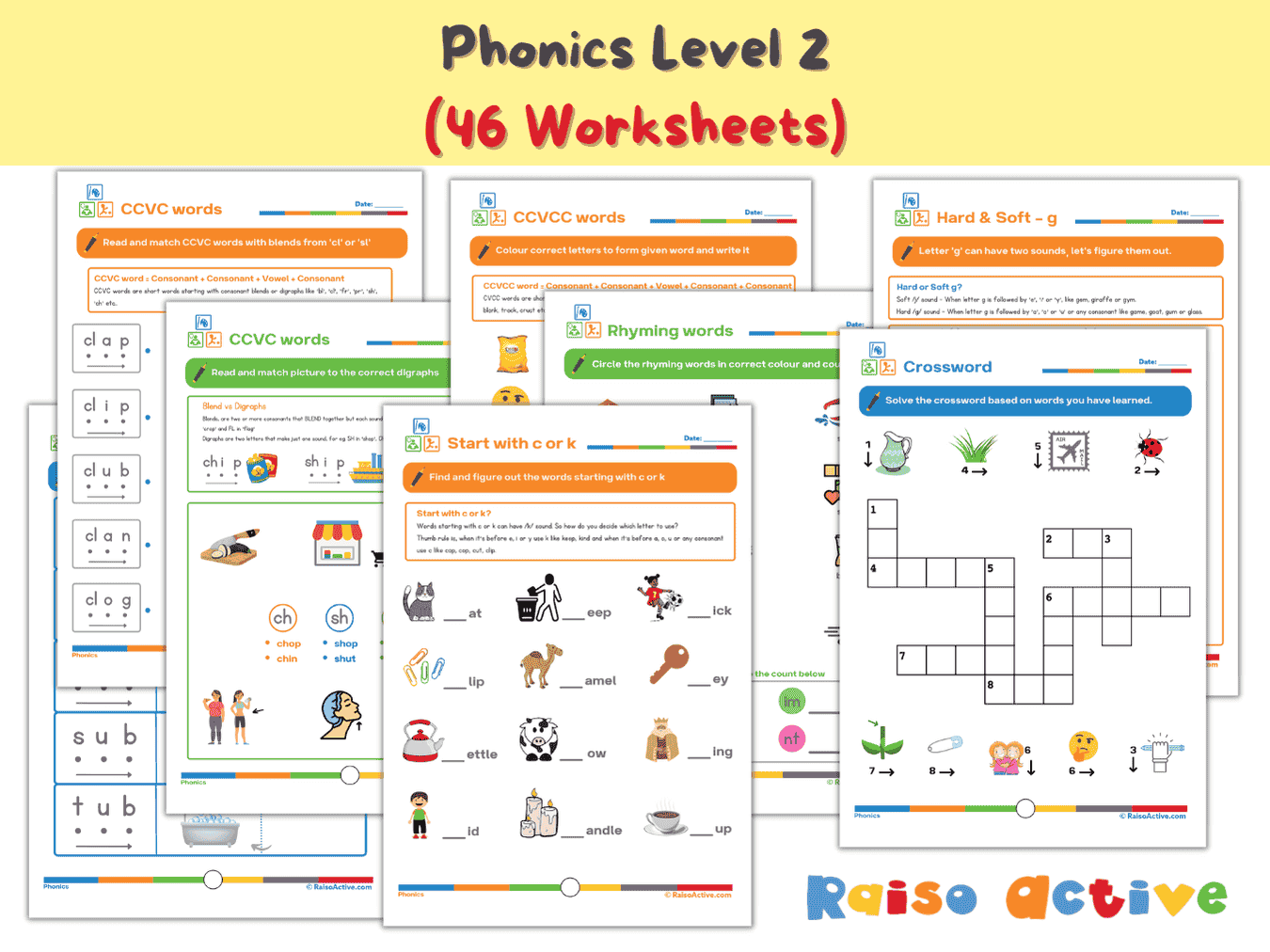
Phonics Level 2 Worksheets: CVC, CCVC, CVCC Word Families & Blends for Early Readers (Ages 4-7)
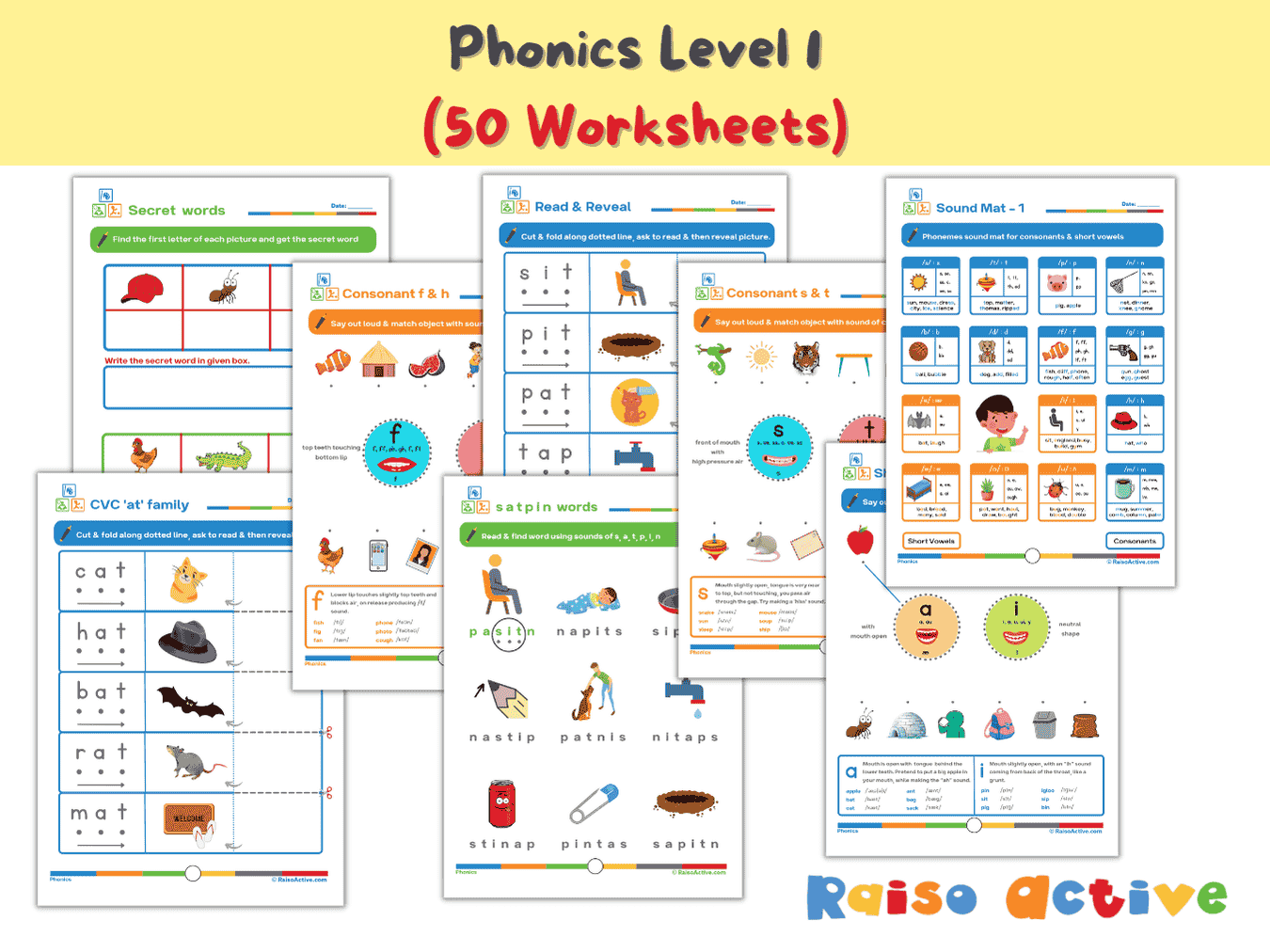
Phonics Level 1 Activity Book: Letter Sounds, Blending & CVC Words for Preschool & Kindergarten
Guides for parents and teachers
See all guides →Sight Words by Age: The First 50 Words and How to Teach Them Without Flashcard Fatigue
Which sight words to teach first and why, the heart-word method, a read-trace-write-find routine, games, and a by-age table of typical sight-word progress.
How to Teach CVC Blending: A Step-by-Step Method That Works in Two Weeks
A step-by-step method for teaching CVC blending, covering continuous sounds, word families, common errors, and a 14-day plan that most children finish reading CVC words.
Phase 2 Phonics at Home: Sound Order, Blending Games, Worksheets
Phase 2 phonics at home: the five sound sets in order, oral blending, tricky words, a two-week routine, common mistakes, and free worksheets.
Reception Year Explained: EYFS Learning and How to Help at Home
A teacher's plain-English guide to the Reception Year: the seven areas of learning, Early Learning Goals, Phase 2/3 phonics, the RBA and home routines.
UKG Syllabus Explained: English, Maths and EVS Month by Month
What UKG classes typically cover in English, maths and EVS, month by month, aligned to NEP 2020, with ways to support at home and signs your child is behind.
Bridging Two Worlds: A Complete Guide to Teaching Heritage Languages Alongside English
A practical guide to raising bilingual children who speak both their heritage language and English with confidence. Research-backed strategies, activities, and tips for Indian families.
Canonical: https://raisoactive.com/worksheets/first-grade-phonics