Free printable worksheets · United Kingdom
Year 1 Phonics Worksheets (Ages 5–6)
Year 1 phonics worksheets are practice sheets for children aged 5–6 in Year 1 in the UK. Phonics is the practice of connecting letters to the sounds they represent, then blending those sounds together to decode and read words. The sheets on this page cover letter-sound correspondence, blending sounds into words, segmenting words into sounds and digraphs and consonant blends.
Year 1 opens the National Curriculum proper: daily phonics moves through Phases 3 to 5, written number sentences replace counted objects, and the phonics screening check in June asks each child to read forty words, some of them invented, to confirm they can decode reliably. Five-year-olds blend printed letters into words, not just spoken sounds, reading simple three-letter words by sounding out each letter and pushing them together. Worksheets should introduce the common digraphs sh, ch and th as single sounds, ask the child to segment a spoken word into sound boxes for spelling, and mix a few nonsense words in to check that blending, not memory, is doing the work. Longer vowel patterns with a silent e are not expected yet.
- 437 worksheets
- Free PDF download
- Print on A4 or Letter
Made for your child
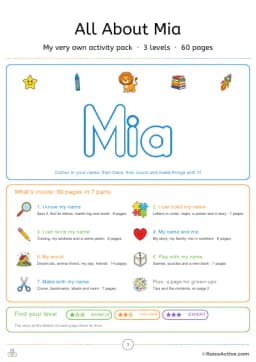
A whole activity pack made with their name
60 pages to spot, build, trace and write their own name, plus pages about their favourites, feelings and family. See a free preview with their name.
Make an All About Me packFree preview · free for members
Or start free: a name tracing sheet with their nameYear 1 Phonics Worksheets to print
Browse all worksheets for ages 5–6
CVC Revision: First Sounds and 'og' Rhyming Words Worksheet
Ages 4-7 · Pre-K–Grade 1Ages 4-7 · Reception–Year 2Ages 4-7 · LKG–Class 1Ages 4-7
Children write the first sound of fish, hat, bucket, hook, net and pod, then colour the bubbles that rhyme with dog: fog, log, jog and hog.

CVC 'um' Word Family Read, Cut and Reveal Worksheet
Ages 4-7 · Pre-K–Grade 1Ages 4-7 · Reception–Year 2Ages 4-7 · LKG–Class 1Ages 4-7
Children read five 'um' words (yum, gum, hum, mum, sum) by blending three sounds, check each one against a hidden picture (a yummy face, bubble gum, a child humming, a mum and a baby, and a sum) and write it, so they see that changing the first sound makes a new word.
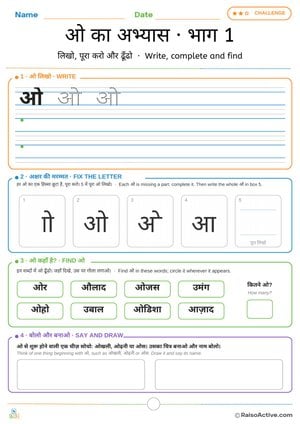
Hindi Letter ओ (o) Practice 1: Write, Fix the Letter and Find | ओ का अभ्यास · भाग 1
Ages 4-7 · Pre-K–Grade 1Ages 4-7 · Reception–Year 2Ages 4-7 · LKG–Class 1Ages 4-7
A challenge page: write ओ between the lines, complete four letters that are each missing a part and then write the whole ओ in box 5, find ओ in words such as ओर, ओजस, ओहो and ओडिशा, and draw a picture. ओ and औ are different vowels; औ has two marks on top and ओ has one.
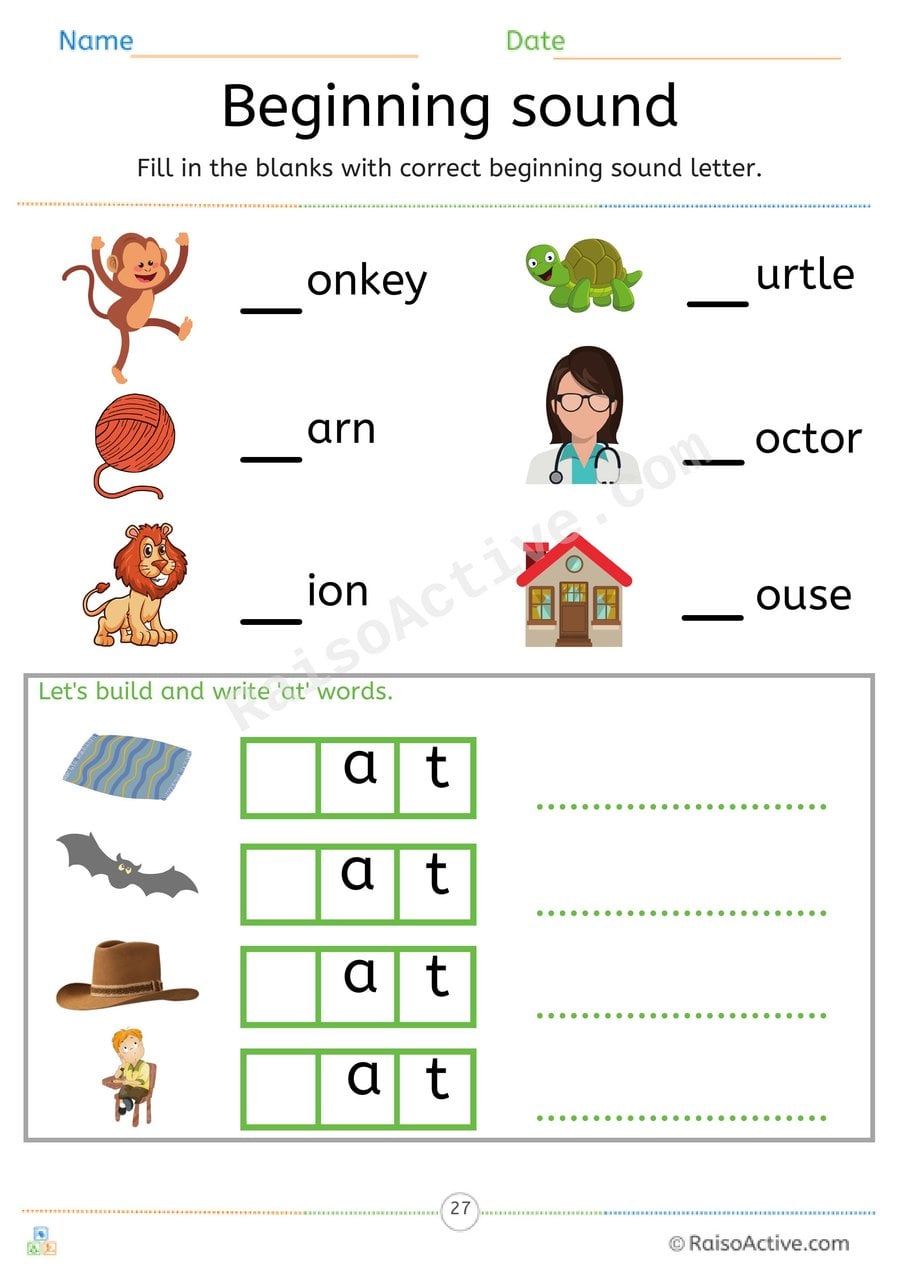
Beginning Sounds and 'at' Word Building Worksheet
Ages 4-7 · Pre-K–Grade 1Ages 4-7 · Reception–Year 2Ages 4-7 · LKG–Class 1Ages 4-7
Children write the first letter of monkey, turtle, yarn, doctor, lion and house, then build and write four 'at' words: mat, bat, hat and sat.

Short Vowels Missing Vowel and Word Grid Worksheet
Ages 4-7 · Pre-K–Grade 1Ages 4-7 · Reception–Year 2Ages 4-7 · LKG–Class 1Ages 4-7
Children write the missing short vowel in bug, cat, ten and kit, then find and colour the short a words from each word wheel in a letter grid (cat, map, sat, pat, tan, bad, man, mat, pad, tad, mad, nap).

CCVC Words Circle the Right Word and Missing Blend Worksheet
Ages 4-7 · Pre-K–Grade 1Ages 4-7 · Reception–Year 2Ages 4-7 · LKG–Class 1Ages 4-7
Children circle the word for each picture (prep, twig, skip, snap, swim, prop), then write the missing blend to spell spot, spin, crab, drip, drag, flat, plan and step.
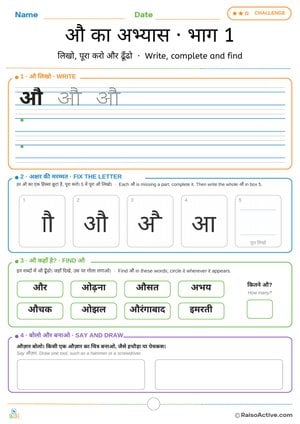
Hindi Letter औ (au) Practice 1: Write, Fix the Letter and Find | औ का अभ्यास · भाग 1
Ages 4-7 · Pre-K–Grade 1Ages 4-7 · Reception–Year 2Ages 4-7 · LKG–Class 1Ages 4-7
A challenge page: write औ between the lines, complete four letters that are each missing a part and then write the whole औ in box 5, find औ in words such as और, औसत, औचक and औरंगाबाद, and draw a picture. औ and ओ are different vowels; औ has two marks on top and ओ has one.

Ending Sounds Write and Circle the Last Sound Worksheet
Ages 4-7 · Pre-K–Grade 1Ages 4-7 · Reception–Year 2Ages 4-7 · LKG–Class 1Ages 4-7
Children write the last letter of rat, tap, hat, bag, bat and pen, then circle the ending sound of hen, bag, pig, cap, yak and sun.

CCVC Words Match the Same Starting Blend Worksheet
Ages 4-7 · Pre-K–Grade 1Ages 4-7 · Reception–Year 2Ages 4-7 · LKG–Class 1Ages 4-7
Children read twelve CCVC words with pictures and join the pairs that start with the same blend: skip and skin, blot and blob, snip and snap, brag and brim, pram and prop, twig and twin.

Rhyming '-ock' Words and Say, Tap, Spell Blends Worksheet
Ages 4-7 · Pre-K–Grade 1Ages 4-7 · Reception–Year 2Ages 4-7 · LKG–Class 1Ages 4-7
Children colour the bubbles that rhyme with clock (stock, block, flock, dock), then say, tap and spell to circle the correct spelling of think, stamp, brush, grass, clamp and crisp.

CVC 'og' Word Family Read, Cut and Reveal Worksheet
Ages 4-7 · Pre-K–Grade 1Ages 4-7 · Reception–Year 2Ages 4-7 · LKG–Class 1Ages 4-7
Children read five 'og' words (dog, fog, hog, jog, log) by blending three sounds, check each one against a hidden picture (a dog, fog, a hog, two joggers and a log) and write it, so they see that changing the first sound makes a new word.

Digraph and Blend Words Circle the Word and First Sound Worksheet
Ages 4-7 · Pre-K–Grade 1Ages 4-7 · Reception–Year 2Ages 4-7 · LKG–Class 1Ages 4-7
Children circle the word for each picture (ship, shut, chop, chin, thin, chat), then circle the blend or digraph each picture starts with: st (stem), gr (grab), br (bread), sh (shop), cr (crib) and sl (slug).
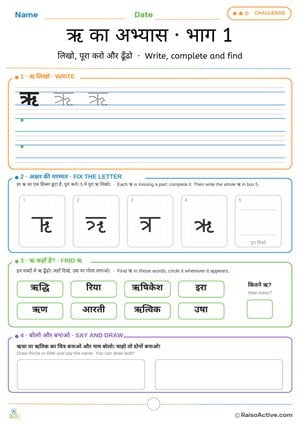
Hindi Letter ऋ (ri) Practice 1: Write, Fix the Letter and Find | ऋ का अभ्यास · भाग 1
Ages 4-7 · Pre-K–Grade 1Ages 4-7 · Reception–Year 2Ages 4-7 · LKG–Class 1Ages 4-7
A challenge page: write ऋ between the lines, complete four letters that are each missing a part and then write the whole ऋ in box 5, find ऋ in words such as ऋद्धि, ऋषिकेश, ऋण and ऋत्विक, and draw a picture. Because ऋ is a special vowel, this page helps adults say it as 'ri' and keep it apart from इ and र.
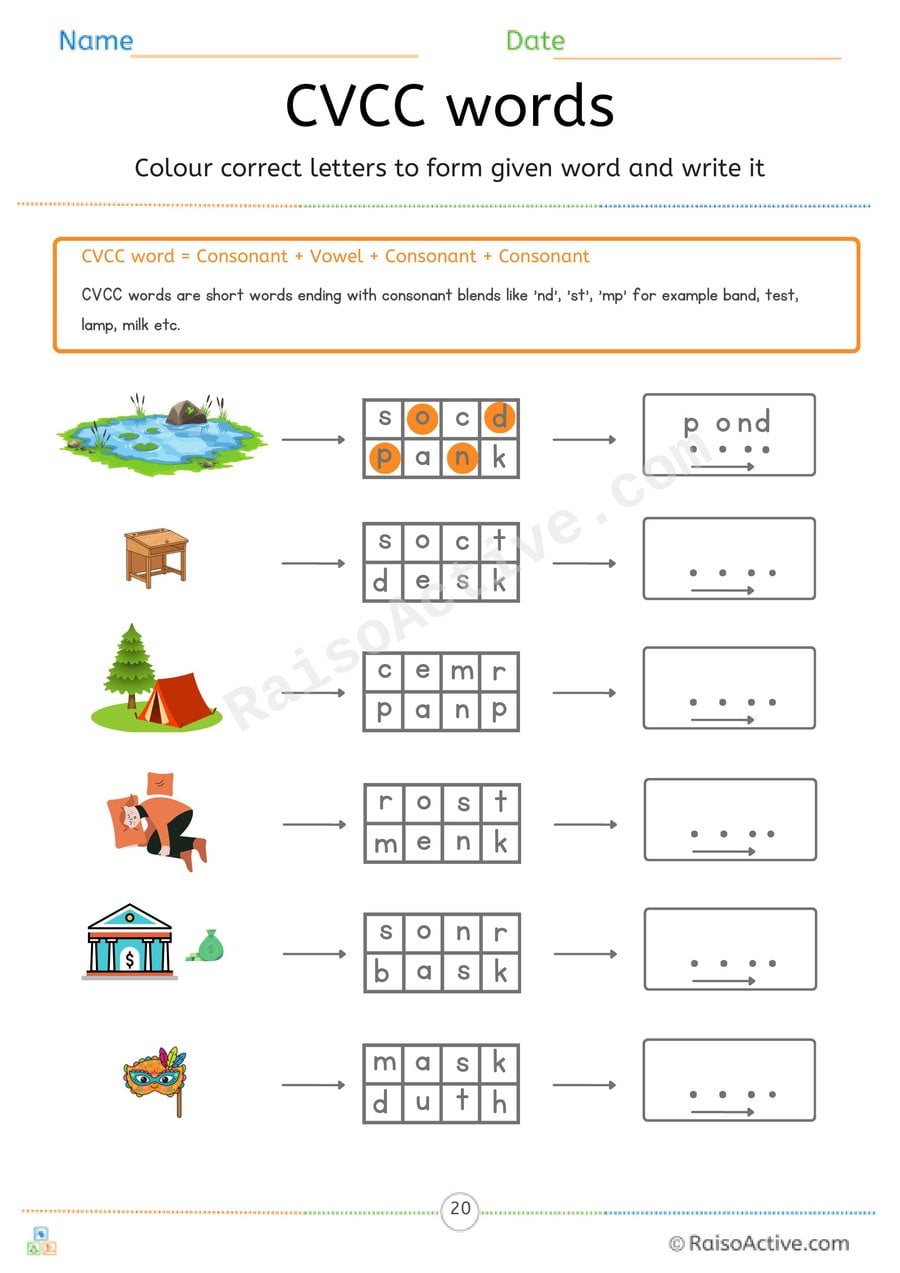
CVCC Words Colour the Letters and Write Worksheet
Ages 4-7 · Pre-K–Grade 1Ages 4-7 · Reception–Year 2Ages 4-7 · LKG–Class 1Ages 4-7
Children find the letters for each picture in a grid, colour them in order and write the CVCC word: pond, desk, camp, rest, bank and mask.
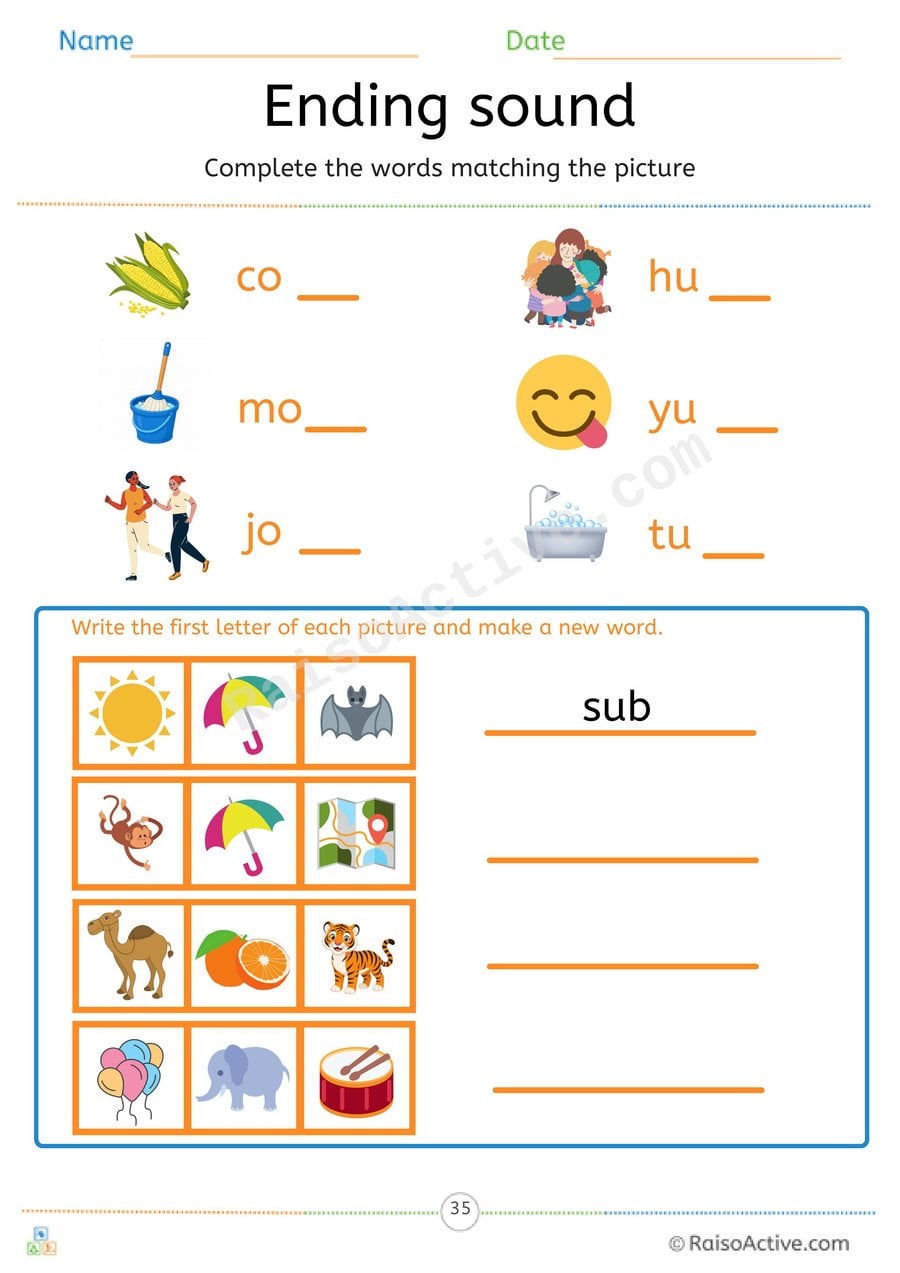
Ending Sounds and First Letter Word Making Worksheet
Ages 4-7 · Pre-K–Grade 1Ages 4-7 · Reception–Year 2Ages 4-7 · LKG–Class 1Ages 4-7
Children write the ending sound of cob, hug, mop, yum, jog and tub, then take the first letter of three pictures to make sub, mum, cot and bed.

Write the CVC Word and Short Vowel a Fill-in Worksheet
Ages 4-7 · Pre-K–Grade 1Ages 4-7 · Reception–Year 2Ages 4-7 · LKG–Class 1Ages 4-7
Children add the last letter to spell cat, sun, fox, web, gum and lip, then write the missing letters to spell short a words: bag, cap, tap, bat, man and cab.

Unscramble CVC Words and Missing First Letter Worksheet
Ages 4-7 · Pre-K–Grade 1Ages 4-7 · Reception–Year 2Ages 4-7 · LKG–Class 1Ages 4-7
Children unscramble the letters to write cat, pan and map, then write the missing first letter of gate, cow, bus, ant, hat, bed, car and sun.
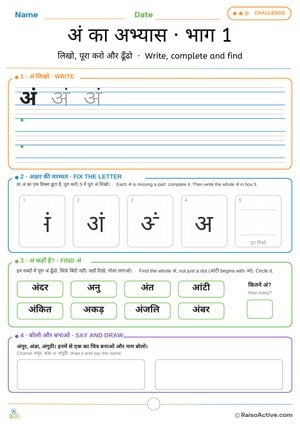
Hindi Letter अं (am) Practice 1: Write, Fix the Letter and Find | अं का अभ्यास · भाग 1
Ages 4-7 · Pre-K–Grade 1Ages 4-7 · Reception–Year 2Ages 4-7 · LKG–Class 1Ages 4-7
A challenge page: write अं between the lines, complete four letters that are each missing a part and then write the whole अं in box 5, find अं in words such as अंदर, अंत, अंकित, अंजलि and अंबर, and draw a picture. Children find the whole अं, not just a dot: आंटी begins with आं, not अं.
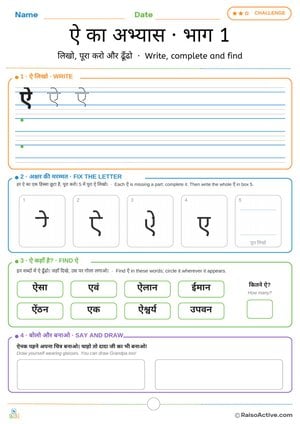
Hindi Letter ऐ (ai) Practice 1: Write, Fix the Letter and Find | ऐ का अभ्यास · भाग 1
Ages 4-7 · Pre-K–Grade 1Ages 4-7 · Reception–Year 2Ages 4-7 · LKG–Class 1Ages 4-7
A challenge page: write ऐ between the lines, complete four letters that are each missing a part and then write the whole ऐ in box 5, find ऐ in words such as ऐसा, ऐलान, ऐंठन and ऐश्वर्य, and draw a picture. ऐ is a different vowel from ए, not a long version of it.

CCVC Words with cl and sl Blends Read and Match Worksheet
Ages 4-7 · Pre-K–Grade 1Ages 4-7 · Reception–Year 2Ages 4-7 · LKG–Class 1Ages 4-7
Children read ten CCVC words with sound buttons (clap, clip, club, clan, clog, slab, slim, slug, slap, slip) and draw a line from each word to its picture.
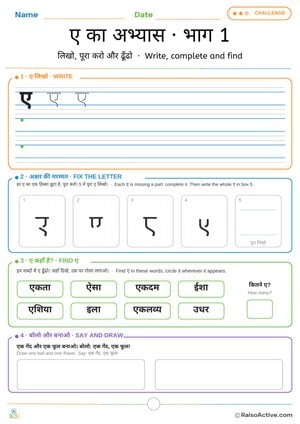
Hindi Letter ए (e) Practice 1: Write, Fix the Letter and Find | ए का अभ्यास · भाग 1
Ages 4-7 · Pre-K–Grade 1Ages 4-7 · Reception–Year 2Ages 4-7 · LKG–Class 1Ages 4-7
A challenge page: write ए between the lines, complete four letters that are each missing a part and then write the whole ए in box 5, find ए in words such as एकता, एकदम, एशिया and एकलव्य, and draw a picture. ए is not the short form of ऐ; the practice page keeps them apart.
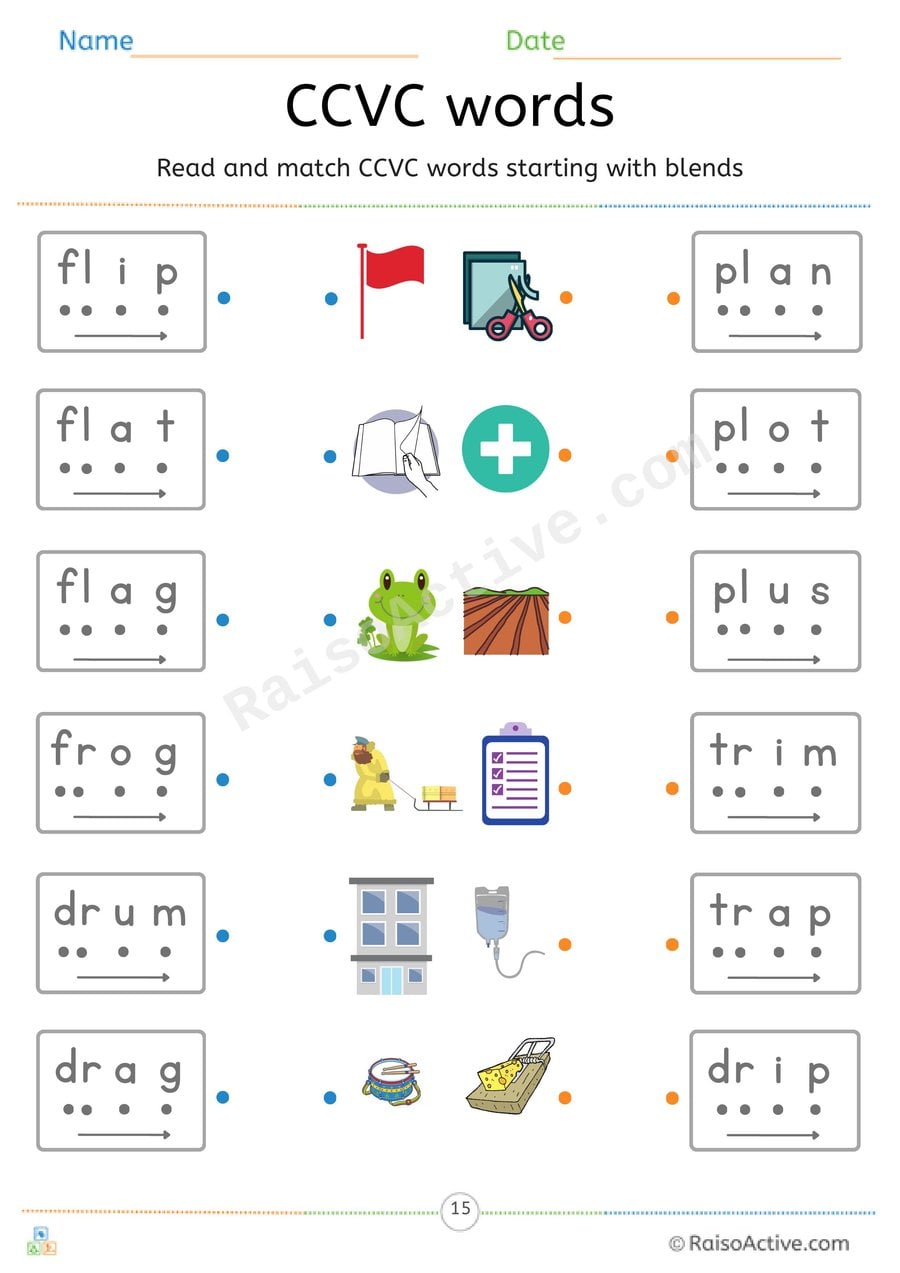
CCVC Words with fl, fr, dr, pl and tr Blends Read and Match Worksheet
Ages 4-7 · Pre-K–Grade 1Ages 4-7 · Reception–Year 2Ages 4-7 · LKG–Class 1Ages 4-7
Children read twelve CCVC words (flip, flat, flag, frog, drum, drag, plan, plot, plus, trim, trap, drip) and match each one to its picture.
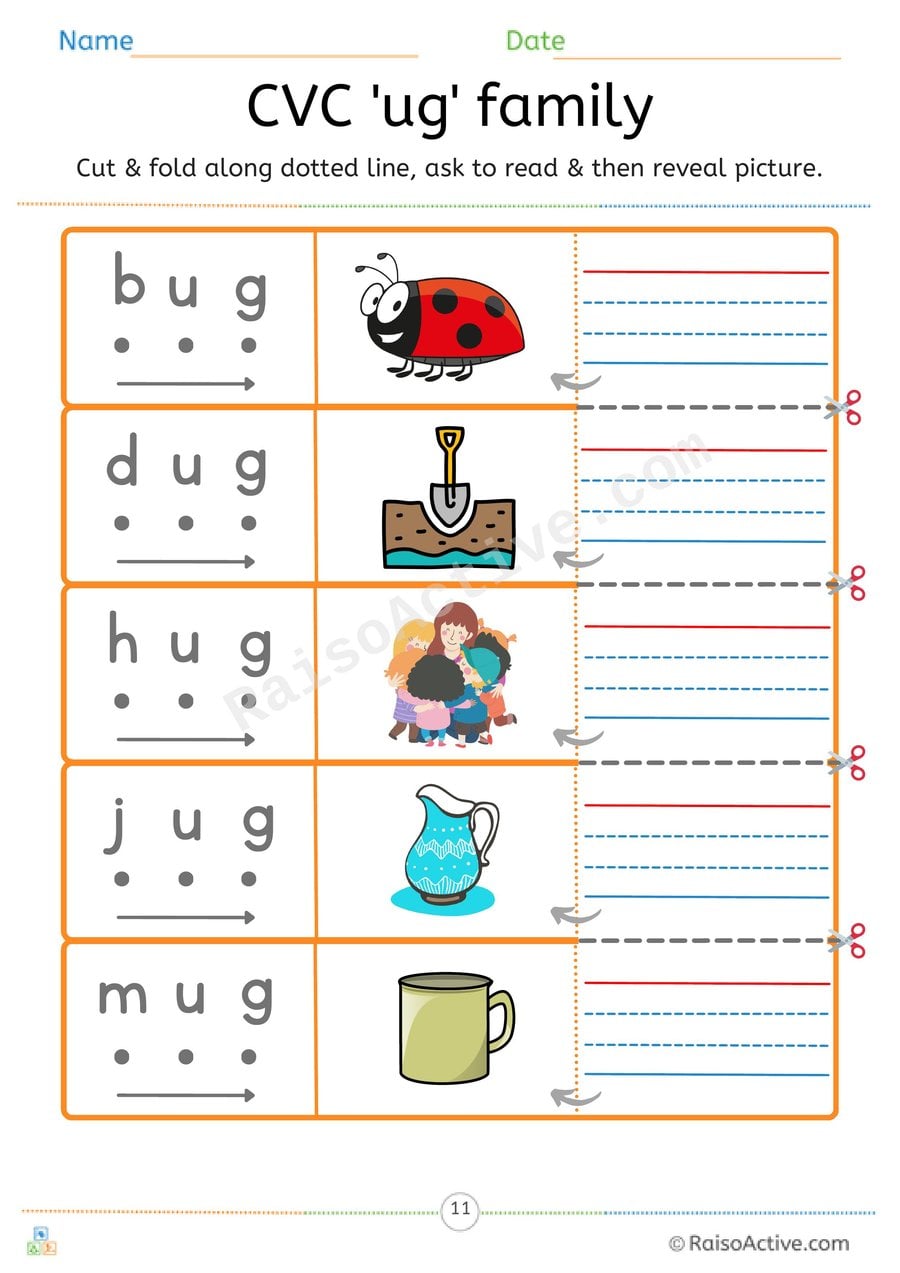
CVC 'ug' Word Family Read, Cut and Reveal Worksheet
Ages 4-7 · Pre-K–Grade 1Ages 4-7 · Reception–Year 2Ages 4-7 · LKG–Class 1Ages 4-7
Children read five 'ug' words (bug, dug, hug, jug, mug) by blending three sounds, check each one against a hidden picture (a ladybird, a spade in soil, a family hug, a jug and a mug) and write it, so they see that changing the first sound makes a new word.

CVC Revision: Colour the Word and Build 'ap' Words Worksheet
Ages 4-7 · Pre-K–Grade 1Ages 4-7 · Reception–Year 2Ages 4-7 · LKG–Class 1Ages 4-7
Children colour the word that names each picture (dog, jet, pan, pig) from three rhyming choices, then write the first letter to make map, lap, nap, gap, cap and tap.
What Year 1 phonics worksheets cover
Five-year-olds blend printed letters into words, not just spoken sounds, reading simple three-letter words by sounding out each letter and pushing them together. Worksheets should introduce the common digraphs sh, ch and th as single sounds, ask the child to segment a spoken word into sound boxes for spelling, and mix a few nonsense words in to check that blending, not memory, is doing the work. Longer vowel patterns with a silent e are not expected yet.
- Blend printed letters in a three-letter word into speech
- Read words with the digraphs sh, ch and th
- Write a spoken word into sound boxes, one box per sound
- Read a nonsense word like vop to check real blending
How to use these worksheets at home or in class
A decodable passage or word list most days, plus a short number bonds sheet, keeps pace with a Year 1 classroom. Fifteen minutes is a reasonable ceiling, and reading the passage twice in one sitting builds the fluency the screening check rewards.
Start with the sheet that matches what your child can already do, then move one step up. Keep finished sheets in a folder: Year 1 teachers often ask for evidence of practice, and children like seeing their own progress.
Is your child ready for Year 1 phonics work?
Entering this stage, a child should blend most Phase 3 sounds into words, write a few letters correctly formed, count reliably to twenty, and sit through a short table task without needing constant redirection.
Frequently asked questions
My five-year-old guesses words instead of sounding them out. What helps?
Cover all but the first letter and ask for its sound before revealing the rest, which stops the habit of glancing at a word and guessing from its shape or the picture nearby. Nonsense words are useful here too, since they cannot be guessed and force real sounding out. Slow the pace deliberately for a few sessions, sound by sound, and only speed up once accuracy on both real and nonsense words is solid.
What should a Year 1 child be able to do in phonics?
Five-year-olds blend printed letters into words, not just spoken sounds, reading simple three-letter words by sounding out each letter and pushing them together. Worksheets should introduce the common digraphs sh, ch and th as single sounds, ask the child to segment a spoken word into sound boxes for spelling, and mix a few nonsense words in to check that blending, not memory, is doing the work. Longer vowel patterns with a silent e are not expected yet. Entering this stage, a child should blend most Phase 3 sounds into words, write a few letters correctly formed, count reliably to twenty, and sit through a short table task without needing constant redirection.
Do these worksheets follow the Year 1 curriculum?
The sheets cover letter-sound correspondence, blending sounds into words, segmenting words into sounds and digraphs and consonant blends, which sit inside the National Curriculum KS1 (Year 1); Letters and Sounds Phase 3–5 outcomes for Year 1. Kindergarten / 1st Grade (US), UKG (India) use the same skills at this age, so the sheets also fit families following those programmes.
Are these Year 1 phonics worksheets free?
Yes. Each worksheet downloads free as a watermarked PDF once you create an account, with a limit of five a day. An annual membership ($20) removes the watermark and the limit for the whole library of over 1,000 worksheets and every printable pack.

Written by
Hemsweta Jain · Teacher Cheena
MBA and Early Childhood Educator, teaching since 2014 · Founder of RaisoActive, Mumbai
Written and reviewed by Hemsweta Jain (Teacher Cheena), who designs every RaisoActive worksheet.
Last reviewed
Printable packs for ages 5–6
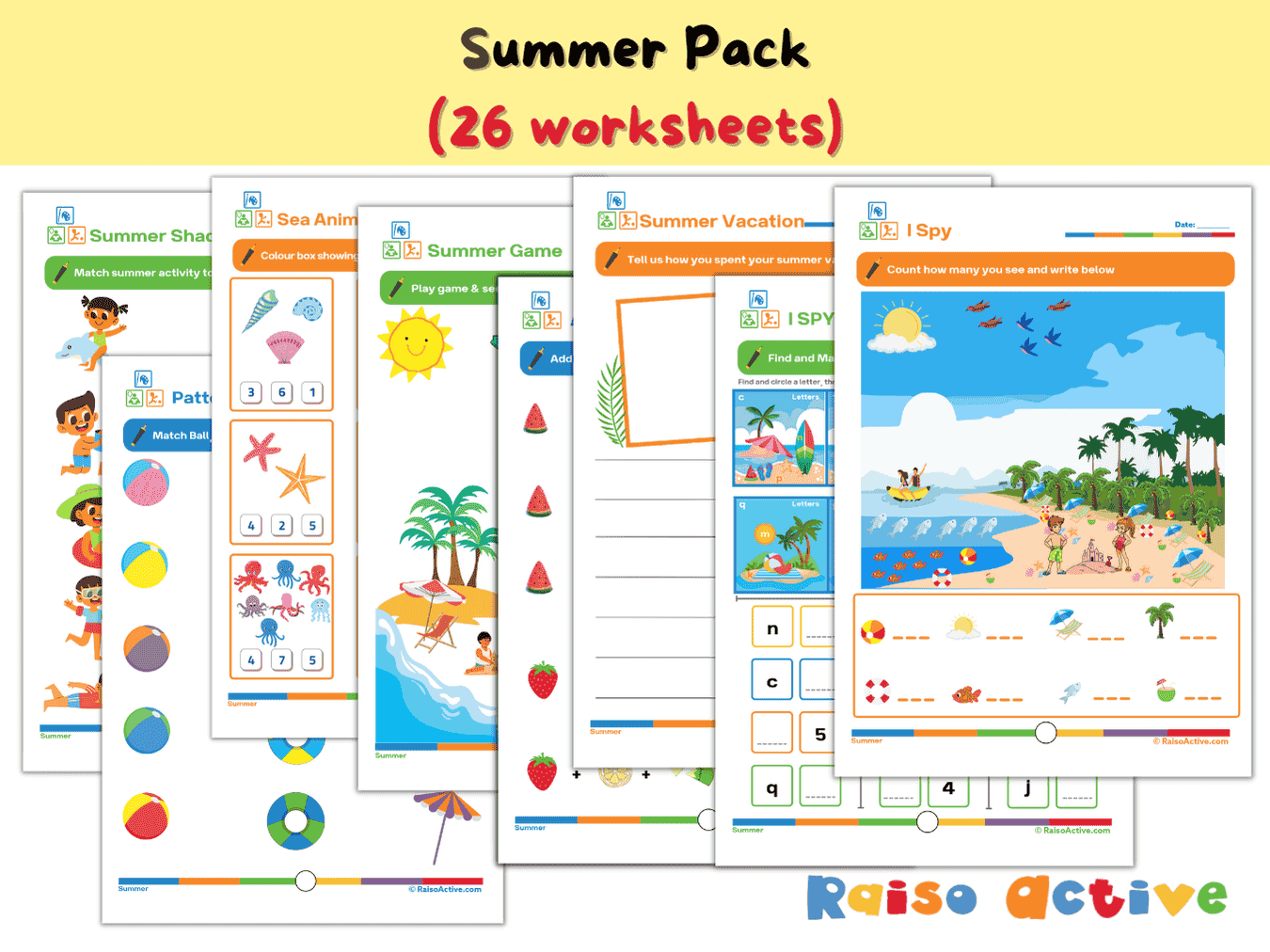

Summer Activity Pack: Math, Literacy, Puzzles & More for Preschool & Kindergarten
Ages 3-7 · Preschool–Grade 1Ages 3-7 · Nursery–Year 2Ages 3-7 · Nursery–Class 1Ages 3-7 · 26 pages
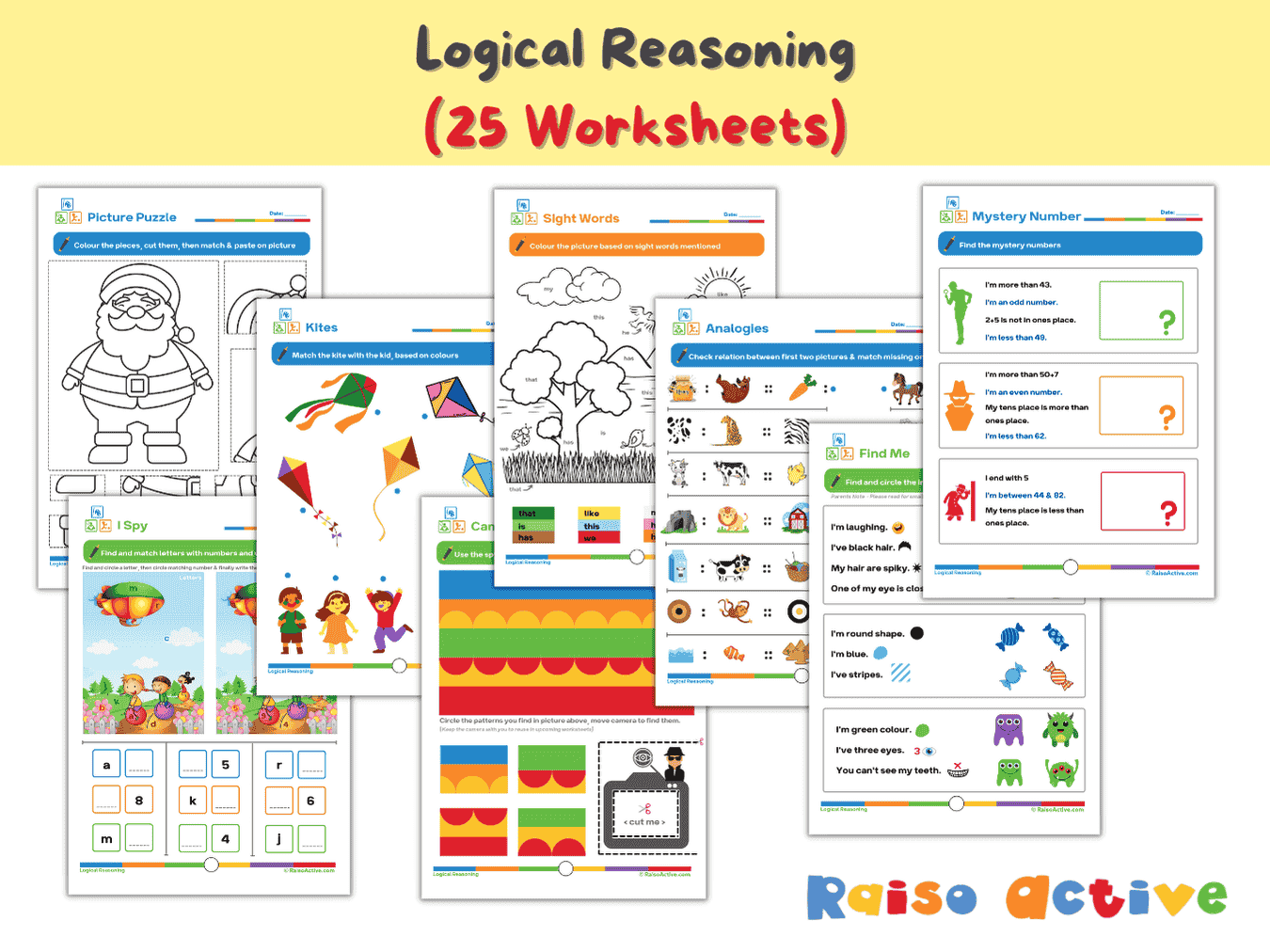

Logical Reasoning Activity Book for Preschool & Kindergarten | Patterns, Sudoku, Mazes & Coding
Ages 4-7 · Pre-K–Grade 1Ages 4-7 · Reception–Year 2Ages 4-7 · LKG–Class 1Ages 4-7 · 34 pages
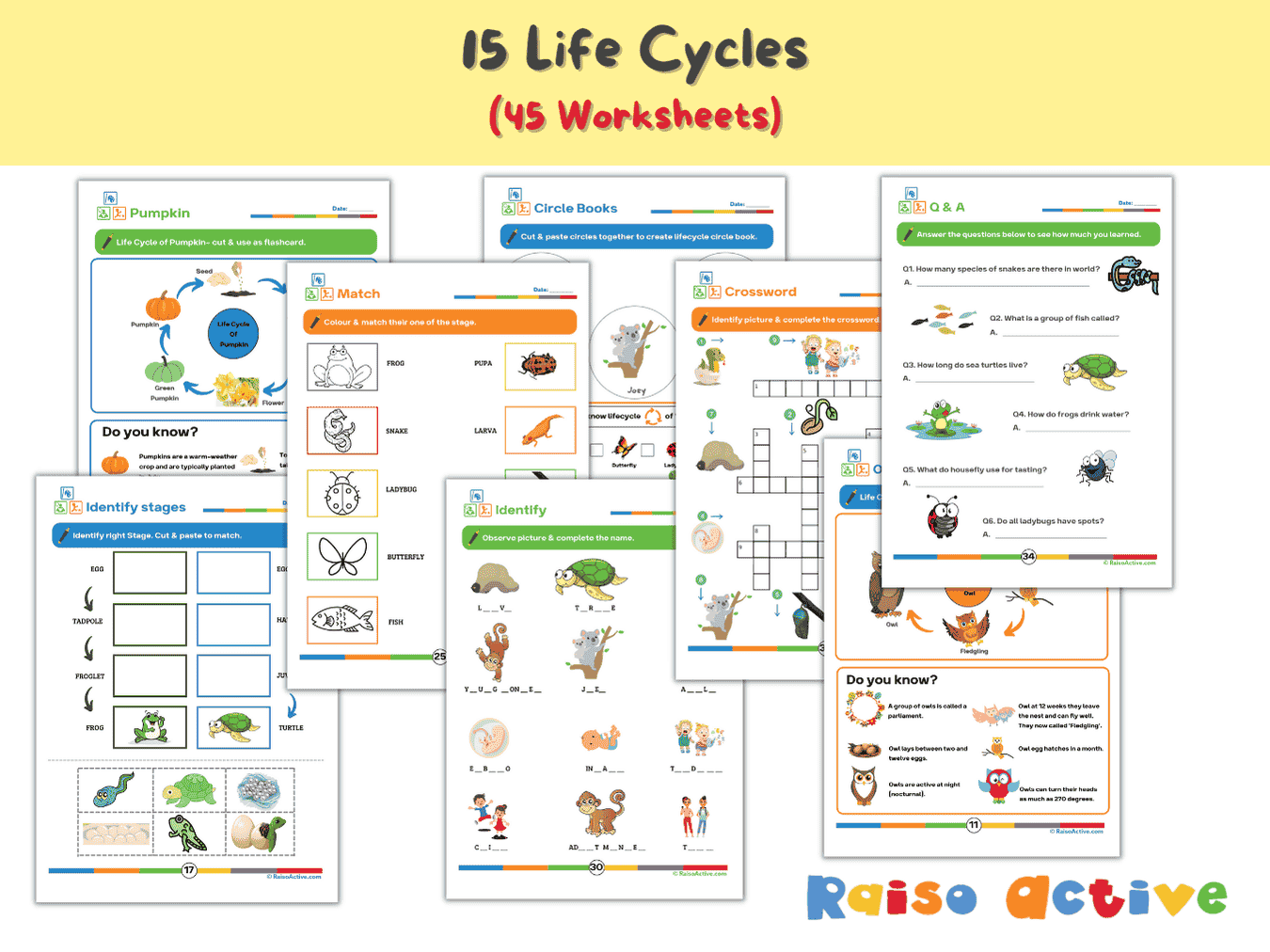

Lifecycles Activity Book & Flashcards for Preschool & Early Elementary
Ages 3-8 · Preschool–Grade 2Ages 3-8 · Nursery–Year 3Ages 3-8 · Nursery–Class 2Ages 3-8 · 46 pages
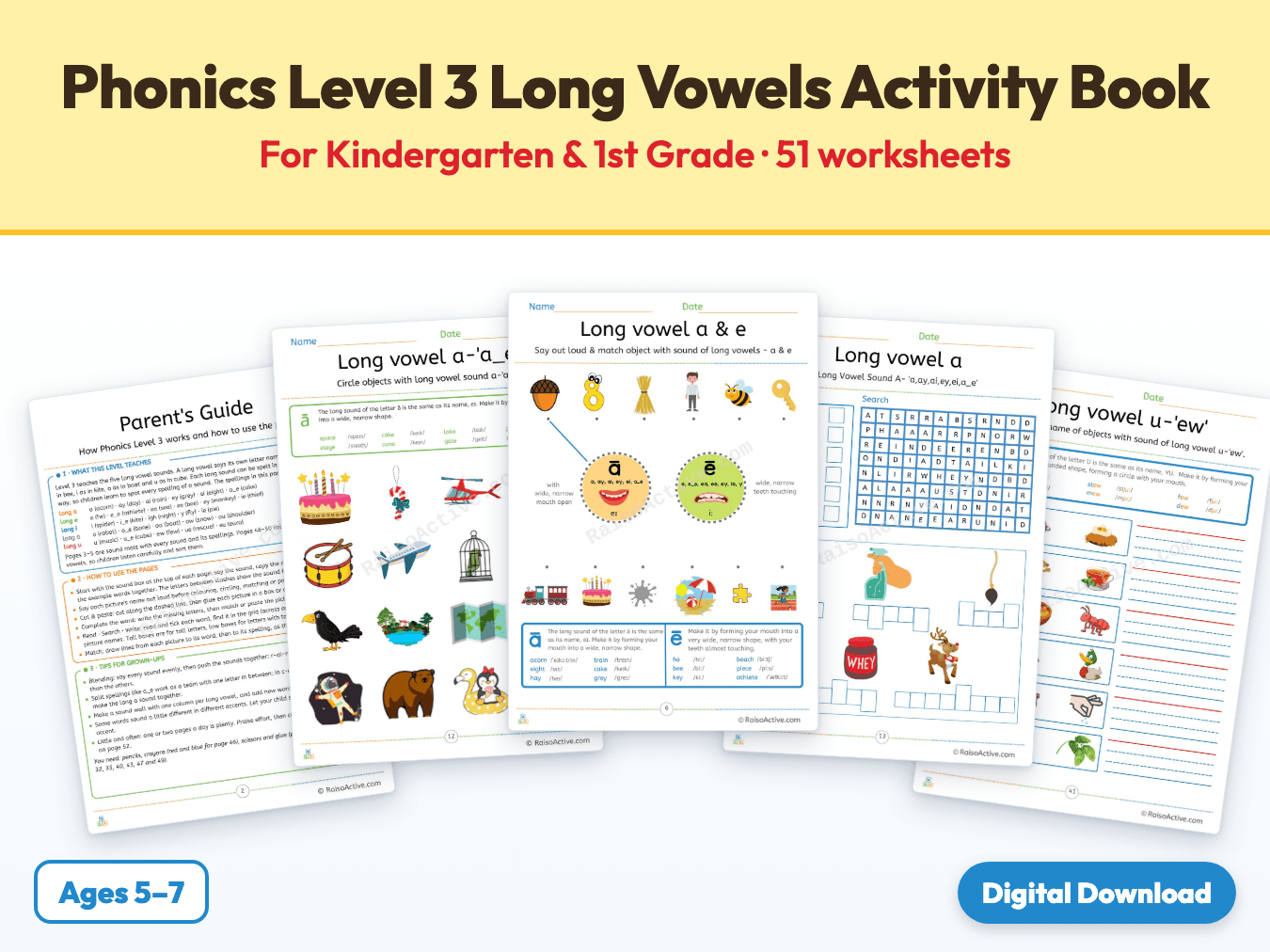

Phonics Level 3 Long Vowels Activity Book for Kindergarten & 1st Grade
Ages 5-7 · Kindergarten–Grade 1Ages 5-7 · Year 1–Year 2Ages 5-7 · UKG–Class 1Ages 5-7 · 52 pages
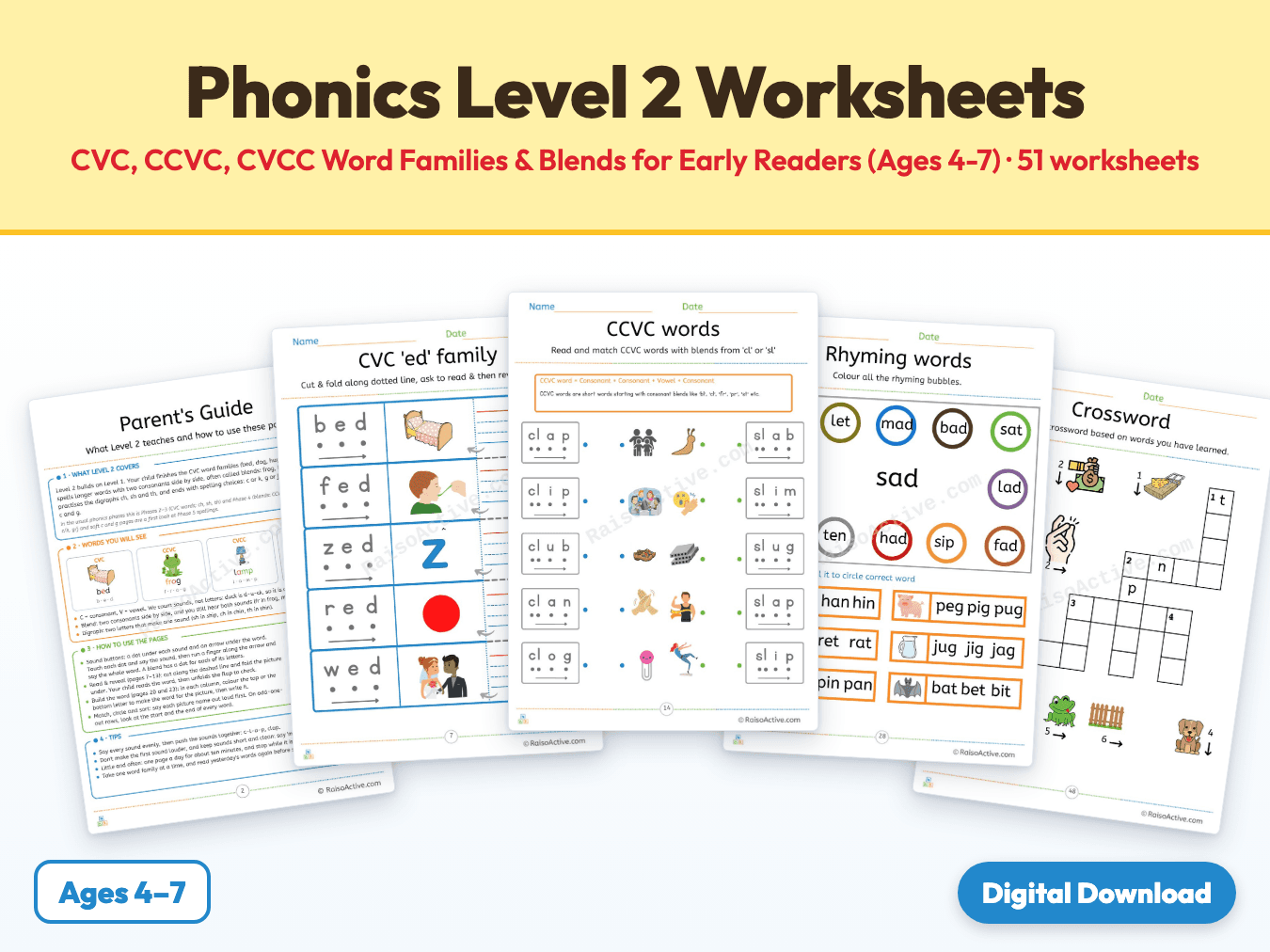
Phonics Level 2 Worksheets: CVC, CCVC, CVCC Word Families & Blends for Early Readers (Ages 4-7)
Ages 4-7 · Pre-K–Grade 1Ages 4-7 · Reception–Year 2Ages 4-7 · LKG–Class 1Ages 4-7 · 52 pages
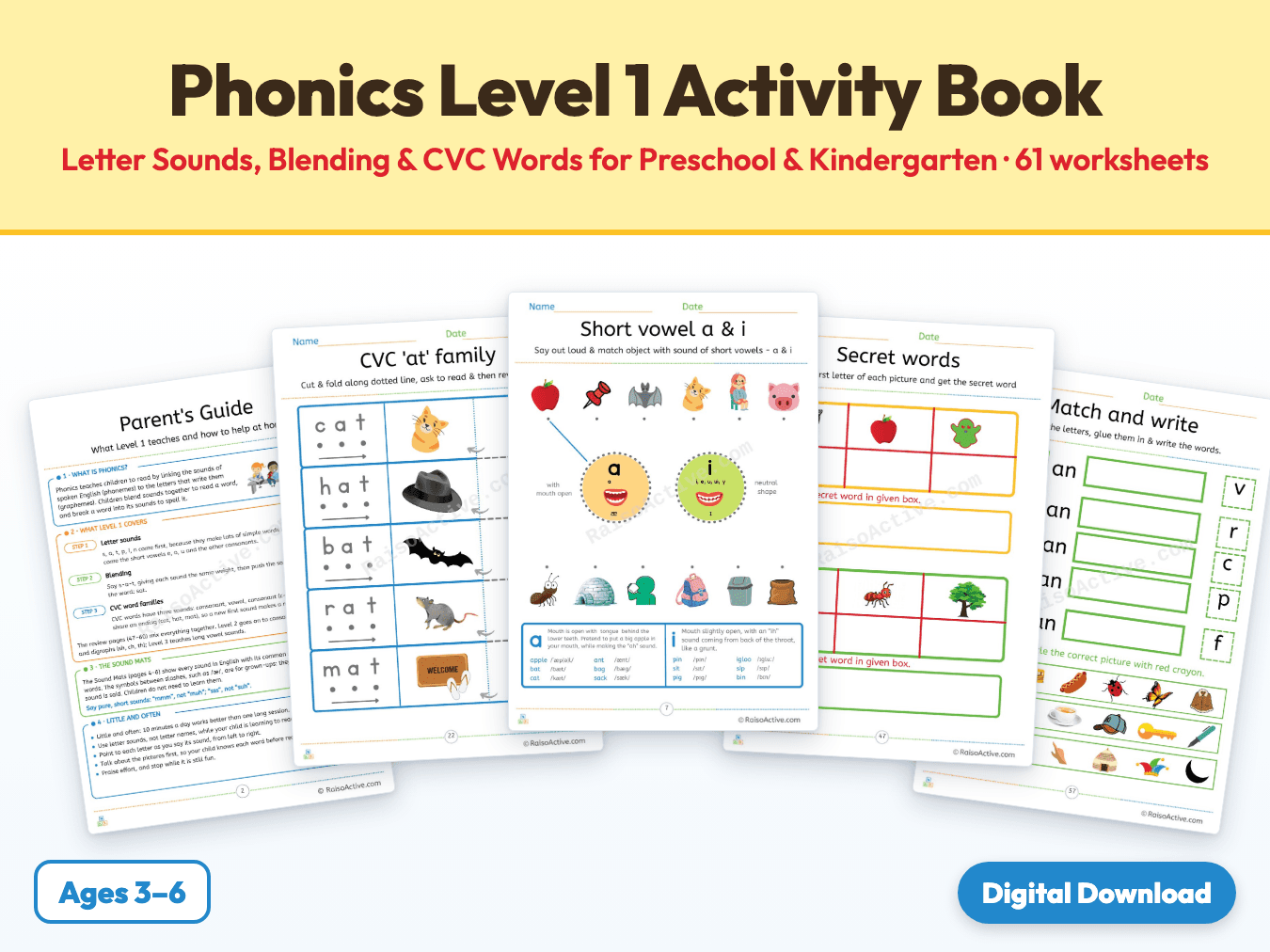
Phonics Level 1 Activity Book: Letter Sounds, Blending & CVC Words for Preschool & Kindergarten
Ages 3-6 · Preschool–KindergartenAges 3-6 · Nursery–Year 1Ages 3-6 · Nursery–UKGAges 3-6 · 62 pages
Guides for parents and teachers
See all guides
Sight Words by Age: The First 50 Words and How to Teach Them Without Flashcard Fatigue
Which sight words to teach first and why, the heart-word method, a read-trace-write-find routine, games, and a by-age table of typical sight-word progress.
How to Teach CVC Blending: A Step-by-Step Method That Works in Two Weeks
A step-by-step method for teaching CVC blending, covering continuous sounds, word families, common errors, and a 14-day plan that most children finish reading CVC words.
Phase 2 Phonics at Home: Sound Order, Blending Games, Worksheets
Phase 2 phonics at home: the five sound sets in order, oral blending, tricky words, a two-week routine, common mistakes, and free worksheets.

Reception Year Explained: EYFS Learning and How to Help at Home
A teacher's plain-English guide to the Reception Year: the seven areas of learning, Early Learning Goals, Phase 2/3 phonics, the RBA and home routines.
UKG Syllabus Explained: English, Maths and EVS Month by Month
What UKG classes typically cover in English, maths and EVS, month by month, aligned to NEP 2020, with ways to support at home and signs your child is behind.
Bridging Two Worlds: A Complete Guide to Teaching Heritage Languages Alongside English
A practical guide to raising bilingual children who speak both their heritage language and English with confidence. Research-backed strategies, activities, and tips for Indian families.