Mosaic Art Shapes Worksheet for Kids
This mosaic craft asks children ages 3-5 to color, cut, and arrange individual shape pieces into a larger picture, combining shape recognition with sustained fine motor practice in scissor use and precise placement. Working piece by piece toward a bigger image also builds early planning skills, as children must think about how small parts combine to form a whole.
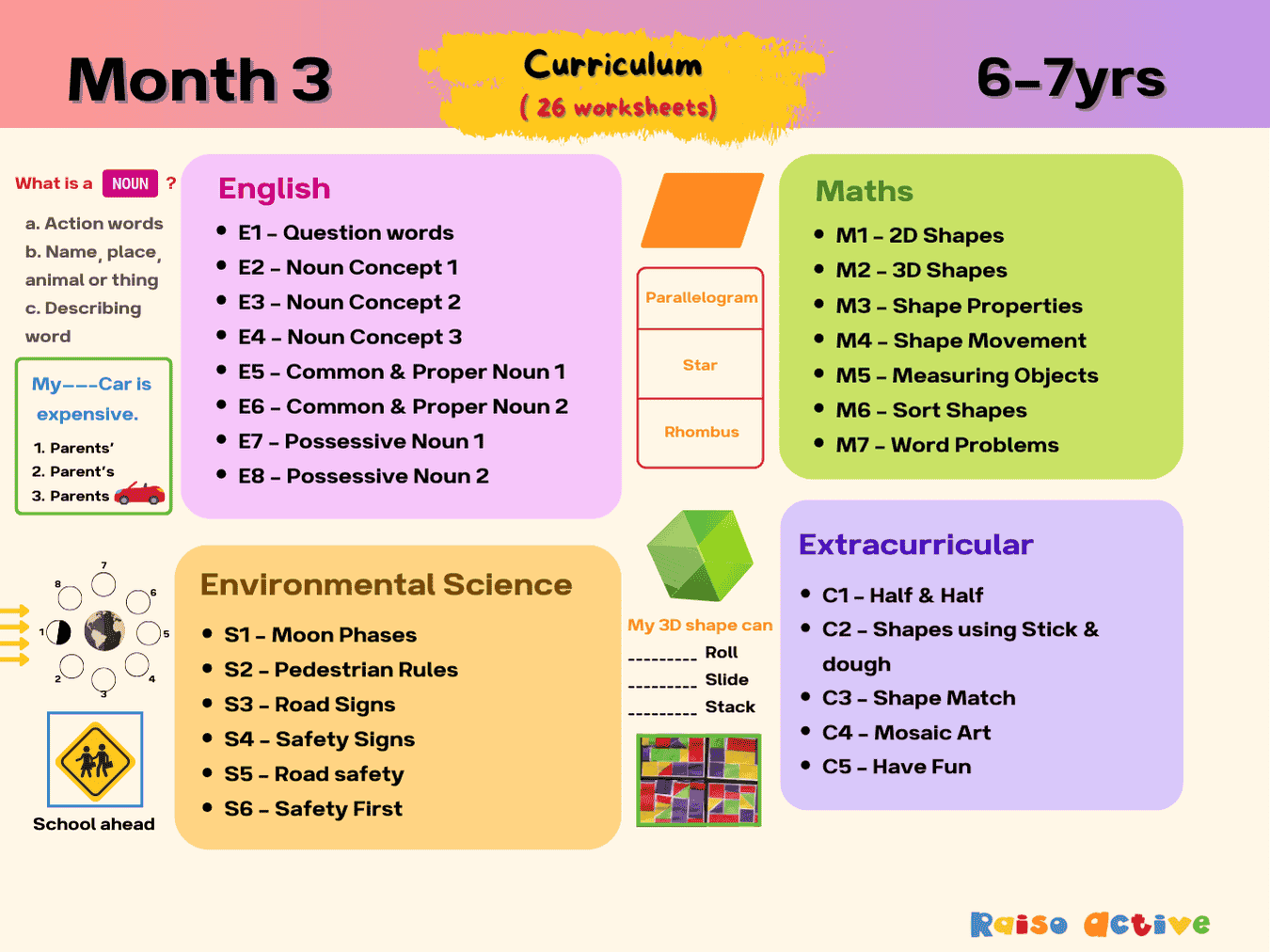
Part of the pack
Month 3: Learning & Development | Ages 6-7
This is page 28 of the pack. Ages 6-7 · Grade 1Ages 6-7 · Year 2Ages 6-7 · Class 1Ages 6-7
Curriculum
- 2D Shapes > Shapes & Sorting
How to use this worksheet
Have your child color each shape piece on the page using whatever colors they like. Once colored, help them cut out each shape carefully along its outline. Lay the pieces out on the target surface first without gluing, letting your child experiment with arrangement. When they're happy with the layout, glue each shape into place one at a time to build the finished mosaic.
Materials needed
- Crayons or colored pencils
- Scissors
- Glue or paste
- Paper or a surface to create the mosaic on
Extension activities
- 1Create a second mosaic using only one shape type, like squares or triangles, in different colors.
- 2Cut small squares of colored paper and arrange them into a simple picture, like a sun or a house.
- 3Sort the leftover shape scraps by color or shape before starting a new project with them.
- 4Look at pictures of real mosaic art or tile work and talk about how many small pieces make up the picture.
- 5Build a mosaic pattern using dried pasta, buttons, or beans glued onto paper instead of paper shapes.

Written by
Hemsweta Jain · Teacher Cheena
MBA and Early Childhood Educator, teaching since 2014 · Founder of RaisoActive, Mumbai
Every RaisoActive worksheet is designed and checked by the founder before publishing.
Published · Last reviewed
More from Month 3: Learning & Development | Ages 6-7
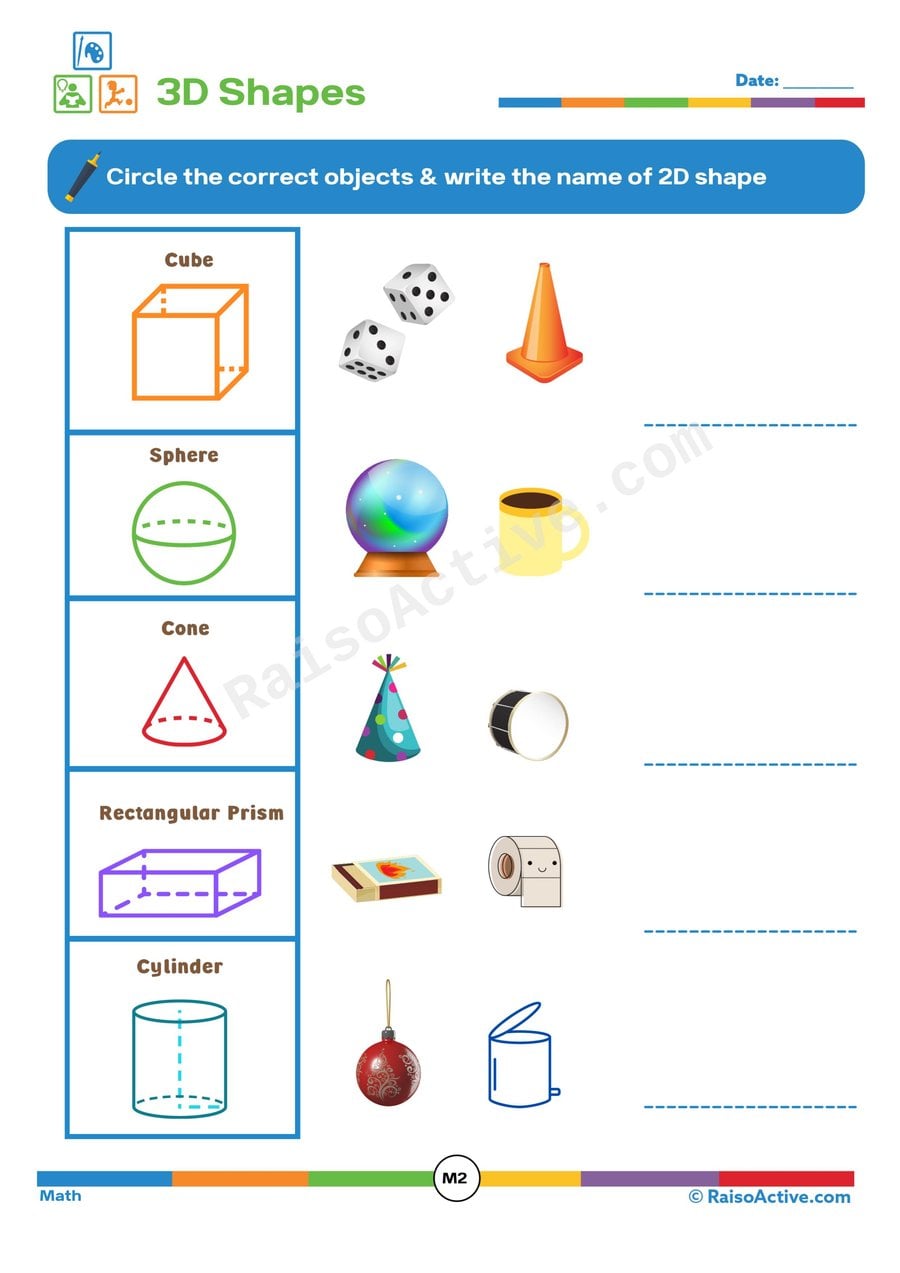
3D Shapes Worksheet: Circle and Name the Shapes!
Ages 4-6 · Pre-K–KindergartenAges 4-6 · Reception–Year 1Ages 4-6 · LKG–UKGAges 4-6
This worksheet helps children ages 4-6 identify common 3D shapes like spheres, cubes, and cylinders by matching them to real objects, then connects each 3D shape to its related 2D shape, such as a cube's square face or a sphere's circular outline. Understanding that 3D shapes are built from 2D shapes is an important early geometry concept that supports later spatial reasoning and measurement skills.
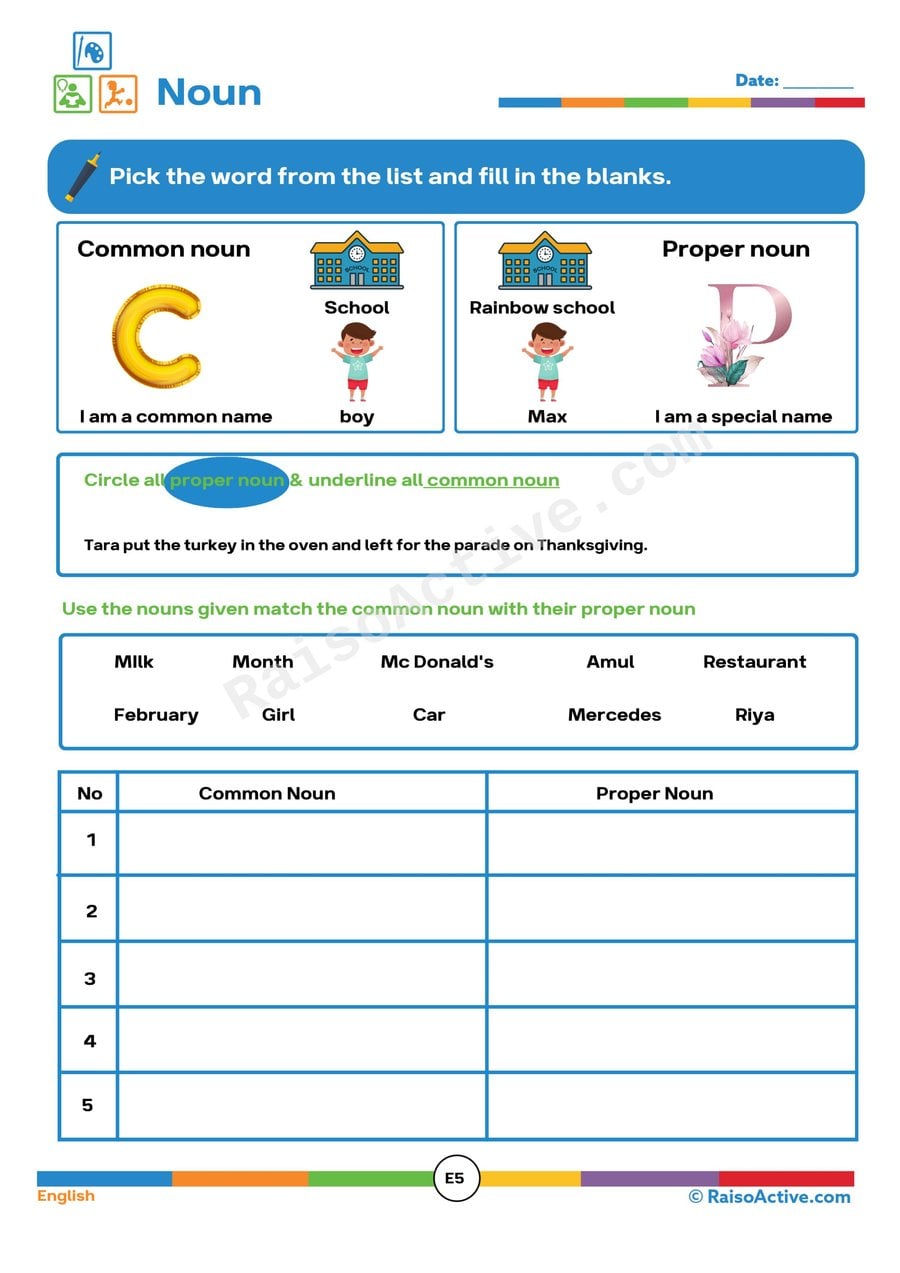
Common and Proper Nouns Worksheet for Kids
Ages 4-6 · Pre-K–KindergartenAges 4-6 · Reception–Year 1Ages 4-6 · LKG–UKGAges 4-6
This worksheet introduces children ages 4-6 to the grammar concept of common nouns (general words like city or dog) versus proper nouns (specific names like Mumbai or Rex), building an early foundation for capitalization rules and sentence structure. Learning to tell the two apart also sharpens attention to detail, since proper nouns are marked by capital letters that common nouns don't use.

Possessive Noun Worksheet for Kids: Practice with Apostrophes!
Ages 4-6 · Pre-K–KindergartenAges 4-6 · Reception–Year 1Ages 4-6 · LKG–UKGAges 4-6
Children ages 4-6 practice forming possessive nouns by choosing the correct apostrophe-s form to complete a sentence, building an understanding that an apostrophe signals ownership ('the dog's bone' rather than 'the dogs bone'). This is an early but important punctuation skill that sets the foundation for more advanced grammar and writing clarity later on.

3D Shapes Worksheet: Explore Faces, Vertices, and Edges!
Ages 4-6 · Pre-K–KindergartenAges 4-6 · Reception–Year 1Ages 4-6 · LKG–UKGAges 4-6
This worksheet pushes children ages 4-6 beyond simply naming 3D shapes into analyzing their structural properties — counting faces, vertices, and edges — while also connecting those properties to how each shape moves (rolling, sliding, or stacking). Understanding that a shape's number of flat surfaces and corners directly determines its physical behavior is an early but genuine geometric reasoning skill.

Noun Detective: A Fun Worksheet for Identifying Nouns!
Ages 4-6 · Pre-K–KindergartenAges 4-6 · Reception–Year 1Ages 4-6 · LKG–UKGAges 4-6
This detective-themed worksheet has children ages 4-6 practice identifying nouns within sentences and pictures, then writing them down, building on the basic concept of what a noun is with more active, applied identification tasks. Framing the task as detective work turns grammar analysis into an engaging search-and-find challenge rather than a dry drill.
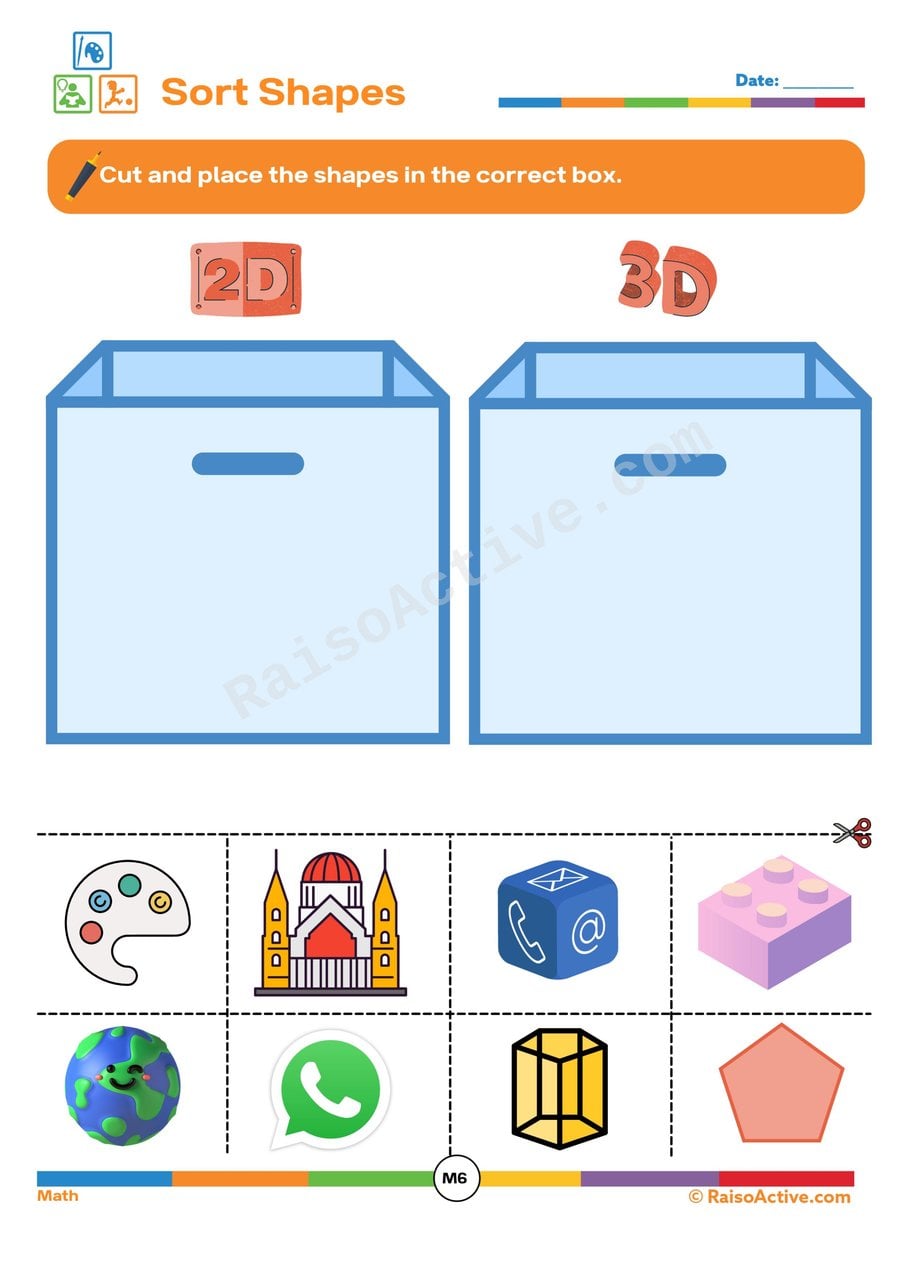
Month 3: Learning & Development | Ages 6-7 - Page 17
Ages 6-7 · Grade 1Ages 6-7 · Year 2Ages 6-7 · Class 1Ages 6-7
As part of a structured monthly learning sequence, this page gives children ages 6-7 continued practice across reading, observation, and critical thinking skills, building on the concepts introduced earlier in the Month 3 program. Working through a numbered page within a longer curriculum also helps children build the stamina and consistency needed for sustained, sequential learning.

Road Safety Worksheet for Kids: Fill-in-the-Blanks
Ages 3-5 · Preschool–Pre-KAges 3-5 · Nursery–ReceptionAges 3-5 · Nursery–LKGAges 3-5
This worksheet teaches children ages 3-5 essential road safety vocabulary and rules — like looking both ways, using crosswalks, and obeying traffic signals — by having them choose the correct word to complete each safety-related sentence. Learning these rules in a reading and writing context, rather than just hearing them, helps reinforce safety habits that protect children in real traffic situations.

Shape Properties Worksheet: Identify and Match Shapes!
Ages 4-6 · Pre-K–KindergartenAges 4-6 · Reception–Year 1Ages 4-6 · LKG–UKGAges 4-6
This worksheet moves beyond simply naming 3D shapes to analyzing their properties — counting faces, edges, and vertices — which builds the early geometric reasoning children need before formal geometry lessons. For four- to six-year-olds, learning that a cube has 6 faces while a sphere has none introduces the idea that shapes can be described by measurable features, not just their overall look.
Related worksheets
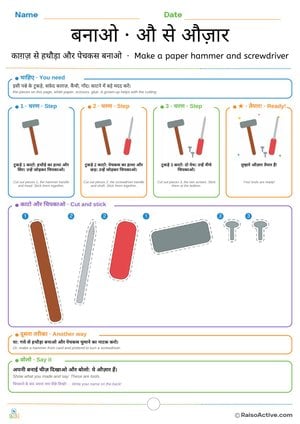
Make a Paper Hammer and Screwdriver: Hindi Letter औ (au) Cut and Stick Craft | बनाओ · औ से औज़ार
Ages 4-7 · Pre-K–Grade 1Ages 4-7 · Reception–Year 2Ages 4-7 · LKG–Class 1Ages 4-7
Children cut out the numbered pieces and stick them in order to make a hammer and a screwdriver with two screws, then show it and say a full sentence about it. It links the letter औ with a real picture word, औज़ार (tools), and practises scissor control and following steps.
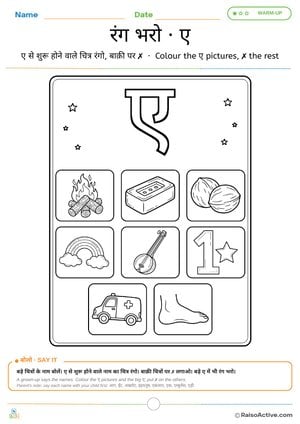
Colour the ए Words – Hindi Letter ए (e) Colouring Worksheet | ए वाली चीज़ों में रंग भरो
Ages 3-7 · Preschool–Grade 1Ages 3-7 · Nursery–Year 2Ages 3-7 · Nursery–Class 1Ages 3-7
Children say each picture name aloud, decide whether it starts with ए, colour the matching pictures (एकतारा, एक, एम्बुलेंस and एड़ी) and the big outline letter, and put a cross on the rest. Sorting by first sound trains the ear and colouring builds hand control.

Maze Worksheet for Kids: Bee Maze and Tangled Lines
Ages 4-7 · Pre-K–Grade 1Ages 4-7 · Reception–Year 2Ages 4-7 · LKG–Class 1Ages 4-7
Children plan a route through a maze to take the bee home, then trace three tangled lines with their eyes and finger to match each child to a toy. Both tasks build focus, planning and visual tracking.
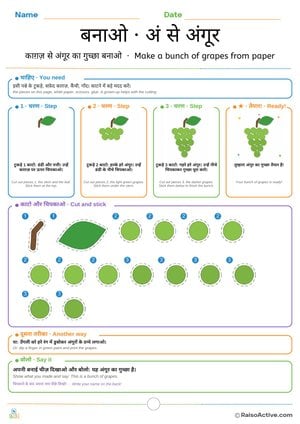
Make a Bunch of Paper Grapes: Hindi Letter अं (am) Cut and Stick Craft | बनाओ · अं से अंगूर
Ages 4-7 · Pre-K–Grade 1Ages 4-7 · Reception–Year 2Ages 4-7 · LKG–Class 1Ages 4-7
Children cut out the numbered pieces and stick them in order to make a bunch of grapes from light and dark green circles, then show it and say a full sentence about it. It links the letter अं with a real picture word, अंगूर, and practises scissor control and following steps.
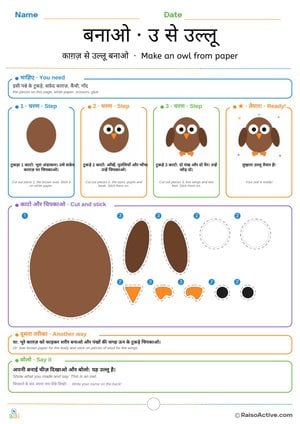
Make a Paper Owl: Hindi Letter उ Craft | बनाओ · उ से उल्लू
Ages 3-7 · Preschool–Grade 1Ages 3-7 · Nursery–Year 2Ages 3-7 · Nursery–Class 1Ages 3-7
Children cut out the pieces, put them together following three step pictures and make a paper owl. Saying the word उल्लू as they make it links the sound उ to something they built themselves.
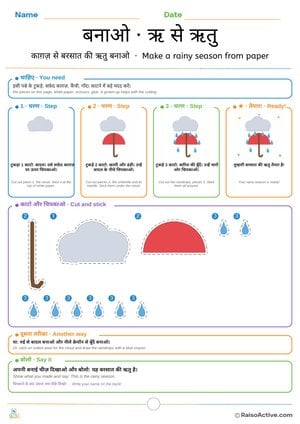
Make a Paper Rainy Season: Hindi Letter ऋ (ri) Cut and Stick Craft | बनाओ · ऋ से ऋतु
Ages 4-7 · Pre-K–Grade 1Ages 4-7 · Reception–Year 2Ages 4-7 · LKG–Class 1Ages 4-7
Children cut out the numbered pieces and stick them in order to make a rainy season scene with a cloud, umbrella and rain, then show it and say a full sentence about it. It links the letter ऋ with a real picture word, ऋतु (season), and practises scissor control and following steps.
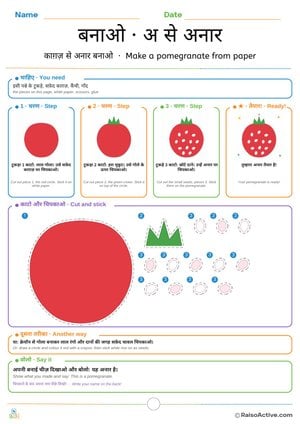
Make a Paper Pomegranate: Hindi Letter अ Craft | बनाओ · अ से अनार
Ages 3-7 · Preschool–Grade 1Ages 3-7 · Nursery–Year 2Ages 3-7 · Nursery–Class 1Ages 3-7
Children cut out the pieces, put them together following three step pictures and make a paper pomegranate. Saying the word अनार as they make it links the sound अ to something they built themselves.
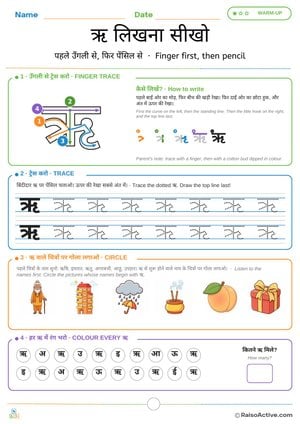
Learn to Write Hindi Letter ऋ (ri) – Tracing Worksheet | ऋ लिखना सीखो
Ages 3-7 · Preschool–Grade 1Ages 3-7 · Nursery–Year 2Ages 3-7 · Nursery–Class 1Ages 3-7
Children learn to write ऋ step by step: the curve on the left, the standing line, the little hook on the right, and the top line last. They trace with a finger first, then trace dotted rows with a pencil, circle the ऋ pictures and colour every ऋ in a grid.
Guides for this topic

Number Formation Rhymes 0–9 and How to Fix Reversals
Original number formation rhymes for 0–9, the correct stroke order for each digit, why 3, 5 and 7 get reversed most often, and multisensory fixes that work.

Pre-Writing Strokes in Order: From Standing Lines to Loops (With Printable Patterns)
The developmental order of pre-writing strokes, from vertical lines to loops, and why practicing them in sequence makes letter formation much easier to learn.

Kindergarten Readiness Checklist: 25 Skills to Practice Before the First Day
A kindergarten readiness checklist of 25 literacy, math, motor, self-regulation and self-help skills, with an 8-week summer plan and notes on when not to worry.
Reviews
Every worksheet for ages 3–5, no watermark
Members download the full library of 1,000+ worksheets and every activity pack without watermarks or daily limits. One year costs ₹999 in India or $20 elsewhere.
See membership plansOr download any worksheet free with a watermark (5 a day).