Free printable worksheets · India
LKG Colouring Worksheets (Ages 4–5)
LKG colouring worksheets are practice sheets for children aged 4–5 in Lower Kindergarten (Junior KG) in India. Colouring is filling a printed outline with colour using a crayon or pencil, practicing pressure control, staying inside a line and naming colours. The sheets on this page cover staying inside an outline, crayon or pencil pressure control, colour recognition and naming and filling a large area evenly.
Lower Kindergarten turns a scribbling hand into a writing one: capital letters A to Z and numbers up to twenty become the daily target, alongside pattern practice that keeps curves and loops steady. Reversed letters and numerals are still common at this stage and settle with repetition rather than correction. At four to five, colouring pages become reading pages. A key at the top says 1 is red and 2 is blue, or A is yellow and B is green, and the child has to read the symbol in each region before filling it. Regions get smaller, crayons give way to thick coloured pencils, and a page is finished in one sitting of ten minutes. Colour by sight word and dense mystery grids come a year later.
325+ worksheets · free PDF download · print on A4 or Letter
LKG Colouring Worksheets to print
Browse all worksheets for ages 4–5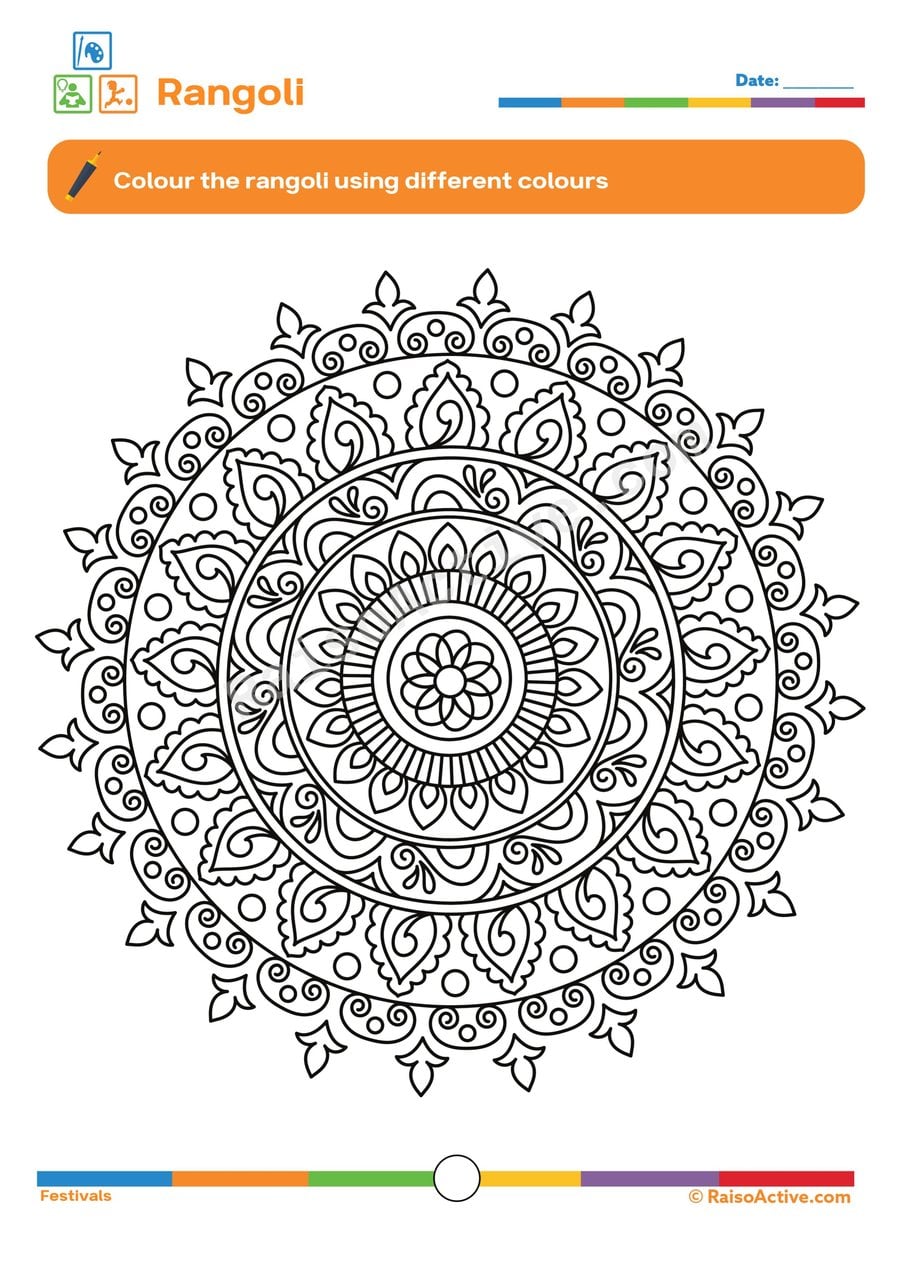
Rangoli Coloring Worksheet for Kids
Children ages 3-6 practice fine motor control and pattern following as they color a symmetrical rangoli design using multiple colors. Because rangoli patterns are built from repeating shapes, this activity also introduces early geometry and symmetry awareness in a hands-on, visual way.

Letter Sounds Worksheet: Color the Letter That Begins the Word!
This worksheet strengthens phonemic awareness in children ages 4-5 by asking them to isolate the very first sound of a picture's name and match it to its printed letter. Identifying beginning sounds is one of the strongest early predictors of reading success, since it teaches children that spoken words are made of individual sounds that map onto letters. The coloring component adds a motivating, low-pressure way to record each answer.

Blend Words: Color the Correct Picture Worksheet for Preschoolers
This worksheet gives children ages 4-5 practice reading consonant blend words — words that start with two consonant sounds blended together, like 'bl' or 'sn' — and coloring the picture that matches each one. Consonant blends are trickier to decode than single-letter sounds, so this focused, low-pressure coloring format lets children practice blending without the added challenge of writing at the same time.

Color the Pictures! Kk, Ll, and Mm Letter Sounds Worksheet
Coloring a circle beneath a picture only when its name starts with a target letter sound builds beginning-sound discrimination for children ages 4-5 across three letters — K, L, and M — sharpening their ability to isolate initial phonemes.

Rhyming Words Worksheet: Color and Circle the Rhymes!
This worksheet builds phonological awareness in children ages 4-5 by having them color word bubbles that rhyme with 'sad' and then circle the word in each box that rhymes with its picture. Practicing rhyme recognition across two different formats — coloring a themed rhyme set and then identifying new rhymes independently — deepens a skill that's strongly linked to later reading and spelling success.
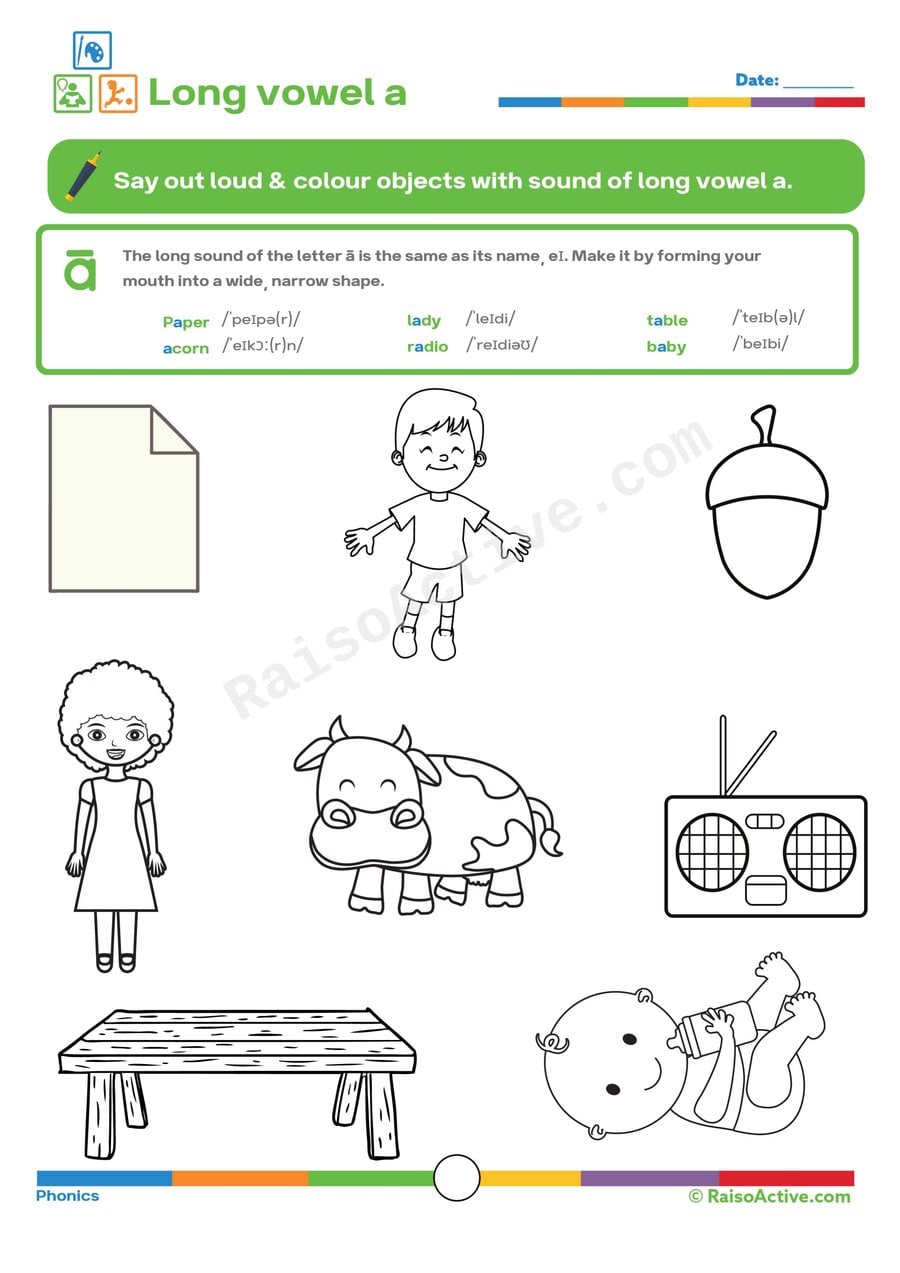
Long Vowel A Coloring Worksheet: Say the Sounds!
This coloring worksheet has children ages 4-5 say each pictured object's name aloud and decide whether it contains the long 'a' sound, as in 'acorn' or 'cake,' before coloring only the matching pictures. Turning a listening task into a coloring activity keeps young children engaged while training their ear to isolate a specific vowel sound within a spoken word - an essential pre-reading skill.
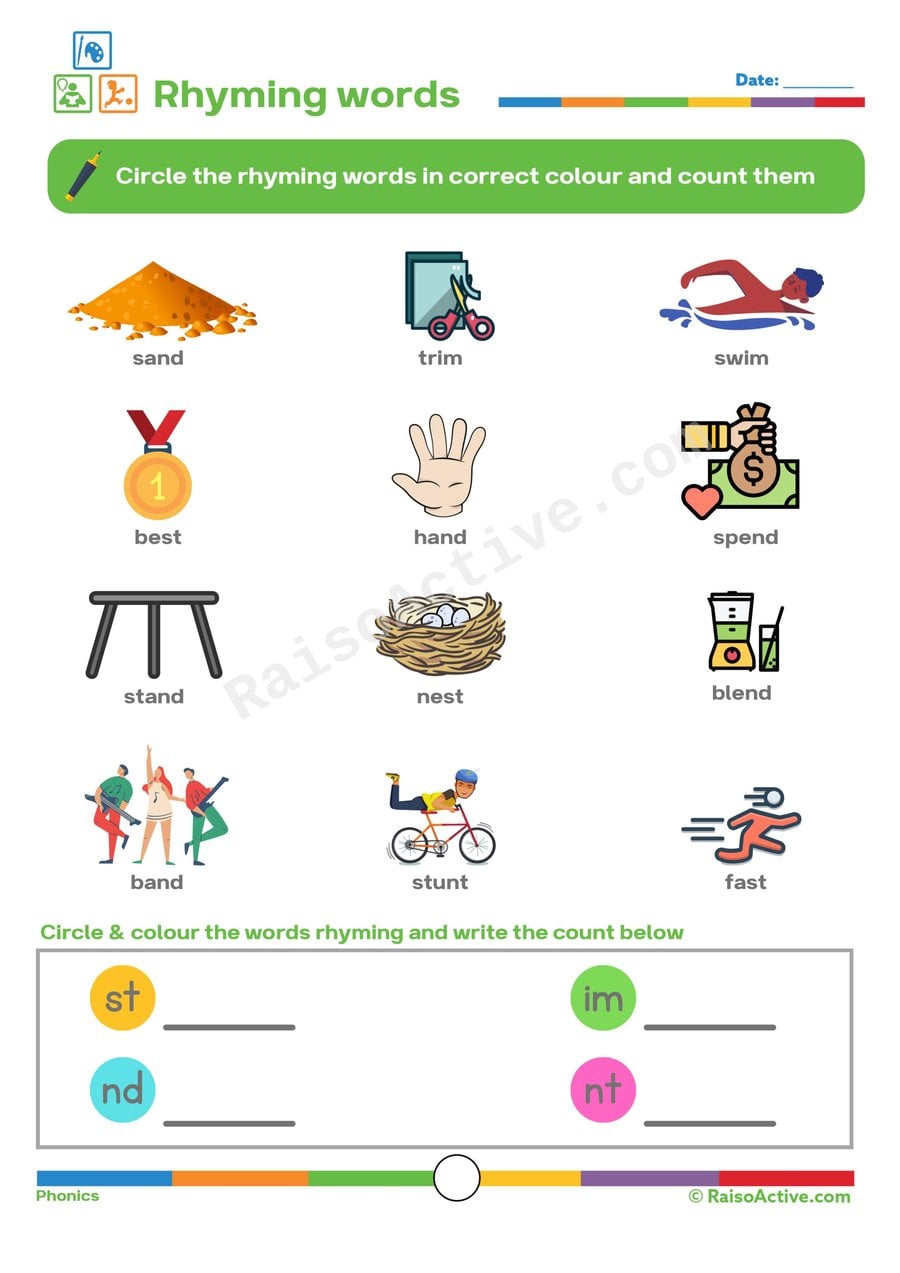
Rhyming Words Worksheet: Find and Count!
Rhyming awareness is one of the earliest and most predictive phonological awareness skills for children ages 4-5, since recognizing that two words share an ending sound pattern lays the groundwork for later word-family and spelling instruction. This worksheet has children identify rhyming pairs by color-coding them and then count the total number of pairs they found, adding a light counting and math element on top of the core phonics task. Combining rhyme detection with counting keeps the activity varied while reinforcing that rhyming pairs come in twos, a small but meaningful numeracy connection.

Christmas Blend Words Coloring Worksheet for Preschoolers
Coloring words by their beginning blend sound on a Christmas tree turns phonics practice into a festive, motivating activity for children ages 4-5, reinforcing that blends like 'br,' 'cl,' or 'sn' keep their combined sound even though they're made of two consonants. Because each color represents a different blend, children must listen carefully to each word before choosing a crayon, strengthening auditory discrimination alongside seasonal fun.
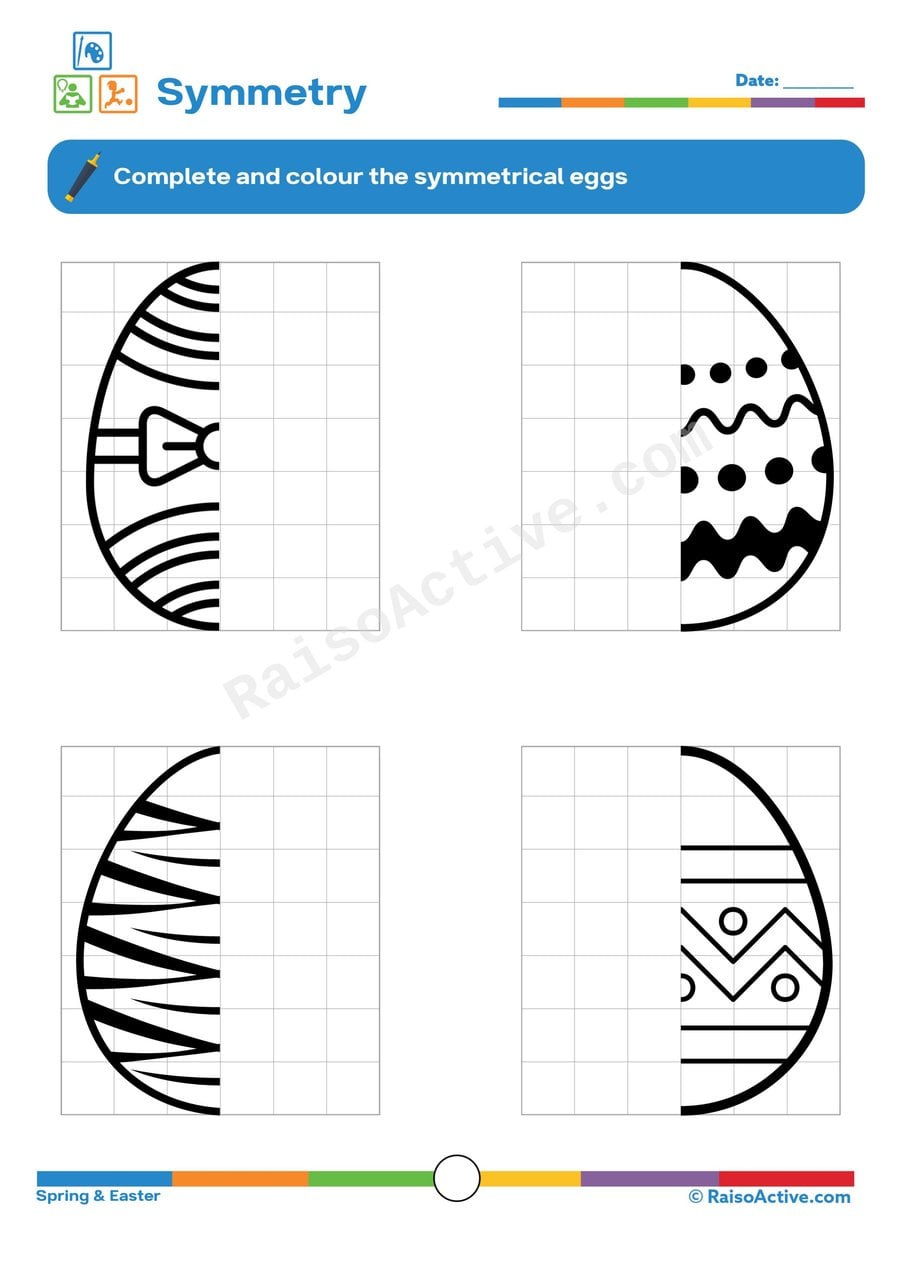
Symmetry Eggs Worksheet for Preschoolers
This worksheet introduces children ages 4-6 to the concept of symmetry by having them complete the missing mirrored half of an egg design. Drawing a matching reflection requires children to closely observe shape, size, and placement on one side and reproduce it accurately on the other — an early geometry skill that also sharpens visual attention to detail.

Color the Reindeer! Christmas Coloring Worksheet for Kids
Coloring the reindeer and gift bag illustrations gives children ages 3-5 focused practice with crayon control and color selection, helping them build the hand strength and precision needed for later handwriting tasks. Choosing colors for a familiar character like a reindeer also encourages imaginative decision-making, since there's no single 'correct' color for a fictional animal's coat or a wrapped gift. The festive subject matter keeps a repetitive fine motor task feeling like a treat rather than a chore.

Letter Sounds: Color the Letter Worksheet for Preschoolers
Matching a picture — a ball, a cat, a dog — to the letter it starts with asks a 3-5 year old to isolate the very first sound of a word, which is one of the core building blocks of phonemic awareness before formal reading begins. Coloring the matching letter circle adds a low-pressure, motor-skill layer to what's really a listening and sound-matching task.

Fruit and Vegetable Sorting Worksheet for Preschoolers
This worksheet helps children ages 3-5 practice identifying and categorizing fruits and vegetables by coloring circles next to each pictured food item. Learning to tell fruits and vegetables apart, and eventually name specific ones, builds early categorization skills alongside healthy eating awareness, since recognizing food groups is a foundation for later nutrition education.
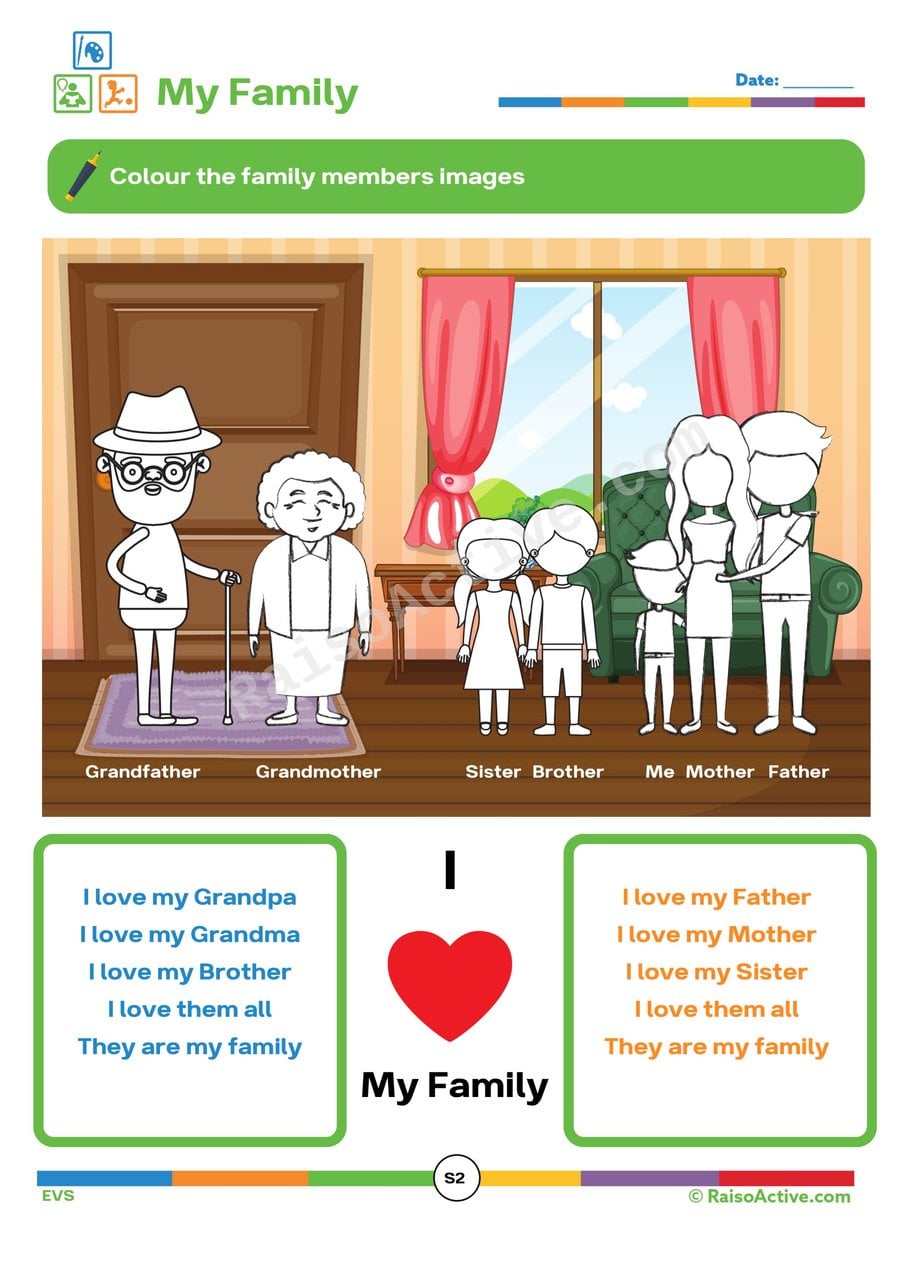
My Family Coloring Worksheet for Preschoolers
This worksheet helps children ages 3-5 practice fine motor control and color-staying-in-the-lines skills while coloring pictures of family members, giving them a personal, meaningful subject that keeps engagement high. Reading and coloring a heart after the family sentences also introduces the idea that words can express feelings, linking literacy with emotional expression.

Hard and Soft 'g' Sounds Worksheet for Preschoolers
This worksheet teaches children ages 3-5 that the letter 'g' can make two different sounds — a hard /g/ as in 'goat' and a soft /j/ as in 'giraffe' — and asks them to sort words by color to show which sound applies. Understanding that one letter can represent more than one sound is an important step beyond basic phonics, preparing children for the many spelling irregularities they'll encounter as readers.

Pongal Celebration Coloring Worksheet for Preschoolers
Children ages 3-5 build fine motor control and instruction-following skills while coloring a Pongal-themed design, and are introduced to a South Indian harvest festival through its visual symbols. Coloring within a detailed scene also helps children practice sustained attention across multiple sections of one image.
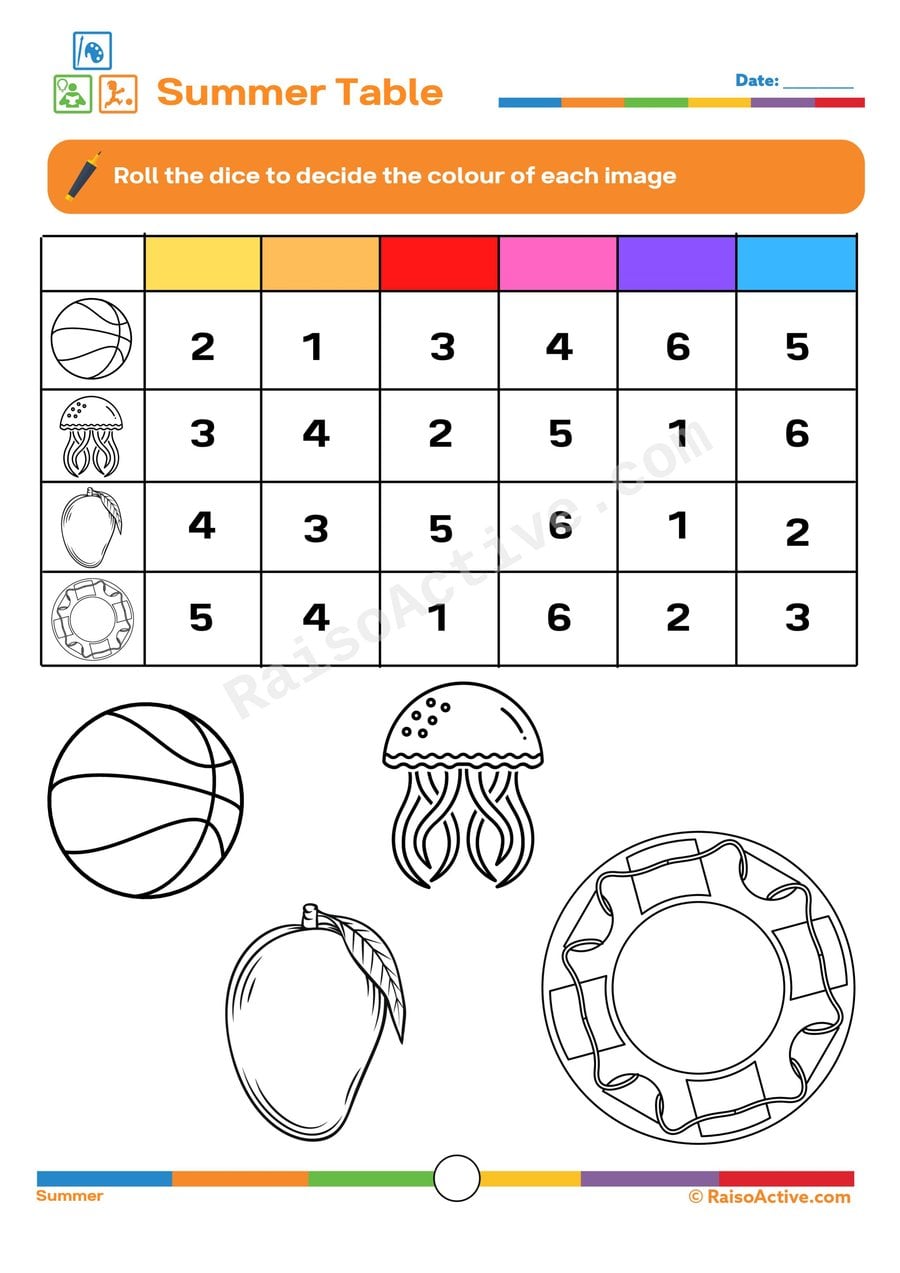
Summer Colors Worksheet: Roll the Dice and Color!
This worksheet turns color recognition into a game for children ages 3-5, who roll a die and then color part of a summer picture based on a color chart that assigns a color to each number. Beyond simply recognizing colors, children practice matching a rolled numeral to its position on a chart and following a multi-step instruction, both important readiness skills before formal schoolwork. The randomness of the dice also keeps the activity fresh each time it's played, unlike a fixed coloring page.

Color the Shapes! A Fun Coloring Worksheet for Kids
This worksheet strengthens children ages 3-5 in both shape recognition and color matching by having them reproduce a colored key onto a black-and-white picture made of shapes. Matching a printed example rather than choosing colors freely also builds a new skill: following a visual reference precisely, which is different from — and complements — open-ended coloring.
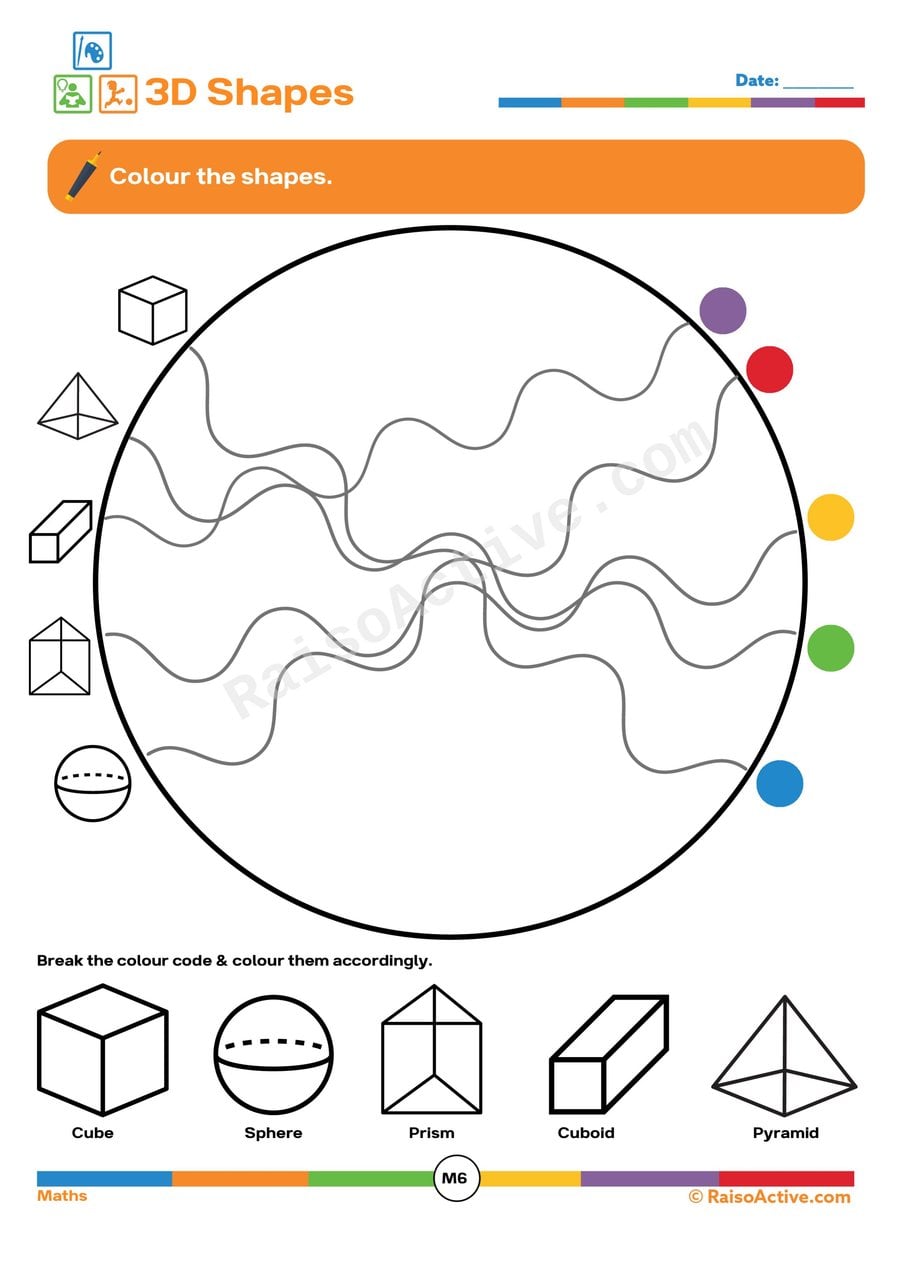
Color the 3D Shapes Worksheet for Kids
Children ages 3-5 build early geometry vocabulary by learning to name and visually recognize five 3D shapes — cube, sphere, prism, cuboid, and pyramid — a step beyond the flat 2D shapes most preschool worksheets cover. Following a color-code instruction while coloring also strengthens their ability to hold and apply a rule, and the repeated coloring motion builds hand strength and control useful for future writing.

Many or Few Fish Bowl Worksheet for Preschoolers
This worksheet builds the comparative concepts of 'many' and 'few' — an early step toward understanding quantity that comes before formal counting comparisons like greater-than and less-than. By having your child actually draw bubbles and fish into the bowls following directions, it also reinforces following multi-step instructions and one-to-one correspondence, since each fish or bubble they add has to be drawn individually. Coloring the bowl with the most fish at the end ties the abstract idea of 'more' back to a concrete, visible outcome.

Color Mixing Fun: A Primary and Secondary Colors Worksheet
This worksheet helps children ages 3-5 understand that the three primary colors, red, yellow, and blue, combine to create secondary colors like orange, green, and purple. Coloring circles and observing how colors combine introduces an early, hands-on science concept about mixing, which also supports color vocabulary used throughout art and everyday description.

Solve & Color: Fun Addition and Subtraction Worksheet for Kids!
This worksheet combines early arithmetic practice with a color-by-number format, as children ages 4-6 solve simple addition and subtraction problems and then use a color key to fill in each shape based on their answer. Because getting the coloring 'right' depends on solving the math correctly, children get built-in, self-checking feedback on their arithmetic while also practicing shape recognition and staying within lines.
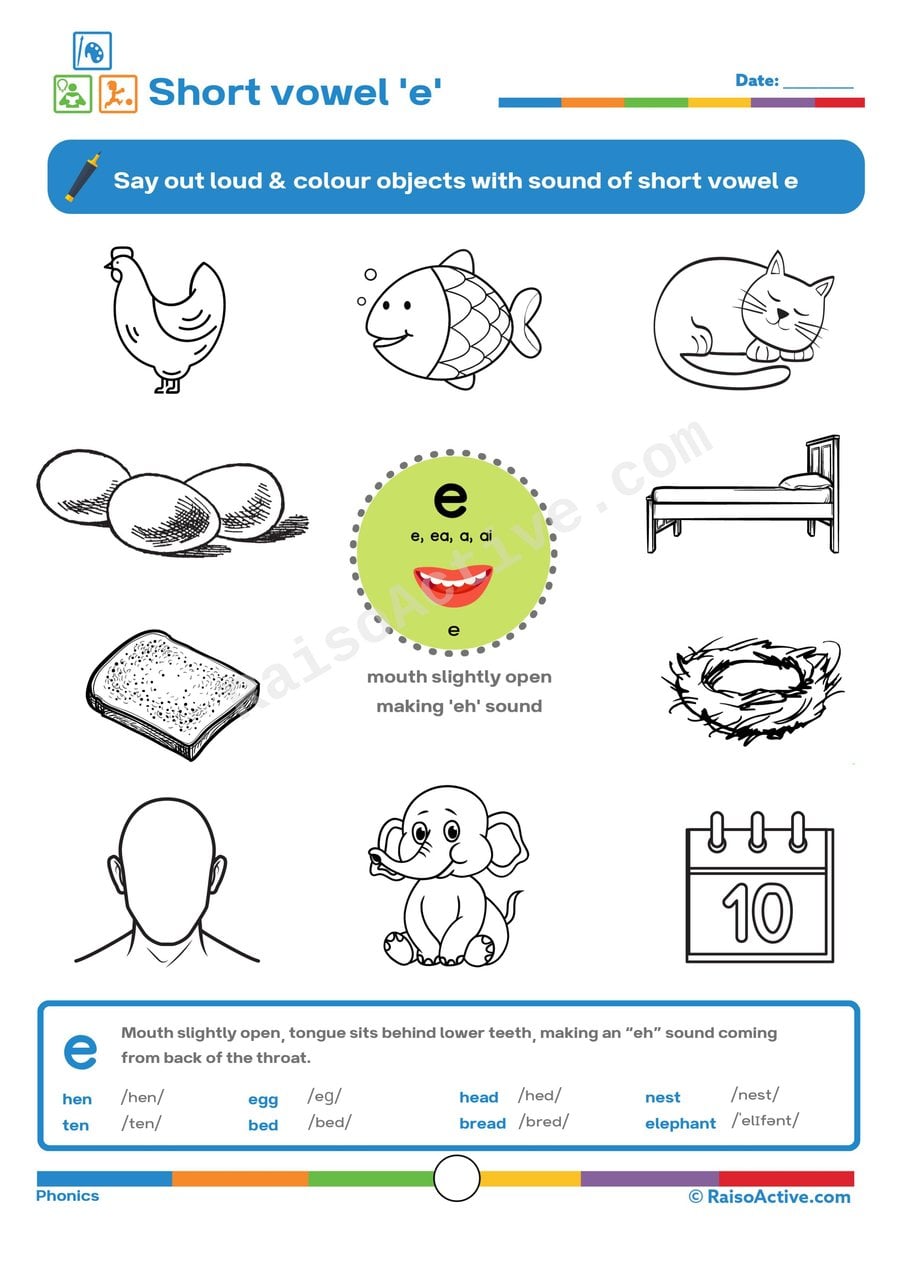
Short Vowel 'e' Worksheet: Say, Color, and Learn!
This worksheet helps children ages 3-5 tune their ears to the short vowel 'e' sound, as in 'bed' or 'net', by saying words aloud and coloring only the pictures that contain that sound. Focusing on a single vowel sound at a time, rather than comparing multiple vowels, lets younger children build a strong, specific auditory memory before they're asked to distinguish between several vowel sounds. Tracing the letter 'e' afterward links the sound they just practiced to its written form.

Air Balloon Color by Sums Worksheet for Preschoolers
This color-by-sums worksheet combines basic addition practice with color-by-number skills, asking children ages 3-5 to solve simple addition problems within each section of an air balloon and then color that section according to a matching color key. Solving a math problem correctly before coloring turns each section into a small, self-checking task, since an incorrect sum would lead to the wrong color choice. This blend of math and art keeps repetitive addition practice feeling like a creative activity rather than a drill.

Sight Word Coloring Fun: 'am', 'has', 'had', and 'have' Worksheet
This worksheet helps children ages 3-5 build automatic recognition of four common sight words — am, has, had, and have — words that appear so frequently in early reading that sounding them out every time would slow a beginning reader down. Coloring by a color key also reinforces visual discrimination, since children must distinguish between similar-looking short words rather than relying on pictures.
What LKG colouring worksheets cover
At four to five, colouring pages become reading pages. A key at the top says 1 is red and 2 is blue, or A is yellow and B is green, and the child has to read the symbol in each region before filling it. Regions get smaller, crayons give way to thick coloured pencils, and a page is finished in one sitting of ten minutes. Colour by sight word and dense mystery grids come a year later.
- Colour by number using numerals 1 to 5
- Colour by capital letter, then by lowercase letter
- Colour by beginning sound: everything that starts with "b" is blue
- Fill medium-sized regions with a thick coloured pencil
- Finish a whole page in one ten-minute sitting
How to use these worksheets at home or in class
Ten to fifteen minutes with one warm-up pattern sheet followed by a single letter or number page fits a four-year-old's attention span. Read each instruction aloud before your child begins, and show a correct starting point once rather than repeatedly erasing an attempt.
Start with the sheet that matches what your child can already do, then move one step up. Keep finished sheets in a folder: LKG teachers often ask for evidence of practice, and children like seeing their own progress.
Is your child ready for LKG colouring work?
A child entering this stage should already trace straight and curved lines confidently, hold a pencil with three fingers rather than a fist, sit for ten minutes without wandering off, and recognise a handful of capital letters from their own name.
Frequently asked questions
What does a colour by number page teach a four-year-old?
Three things. Reading the numeral in each region and finding it in the key practices number recognition, usually 1 to 5 at this age. Filling the region with the right colour practices matching and following an instruction with two steps. And the colouring itself works the grip and the small wrist movements that letter writing will need. Pages with fewer, larger regions suit the start of the year; ten regions and numerals to 10 suit the end.
What should a LKG child be able to do in colouring?
At four to five, colouring pages become reading pages. A key at the top says 1 is red and 2 is blue, or A is yellow and B is green, and the child has to read the symbol in each region before filling it. Regions get smaller, crayons give way to thick coloured pencils, and a page is finished in one sitting of ten minutes. Colour by sight word and dense mystery grids come a year later. A child entering this stage should already trace straight and curved lines confidently, hold a pencil with three fingers rather than a fist, sit for ten minutes without wandering off, and recognise a handful of capital letters from their own name.
Do these worksheets follow the LKG curriculum?
The sheets cover staying inside an outline, crayon or pencil pressure control, colour recognition and naming and filling a large area evenly, which sit inside the NEP 2020 Foundational Stage (NCF-FS 2022) outcomes for LKG. Pre-K (US), Reception (UK) use the same skills at this age, so the sheets also fit families following those programmes.
Are the LKG colouring worksheets free to download?
Yes. Every sheet on this page can be downloaded free as a watermarked PDF after creating an account, up to five downloads a day. The annual membership (₹1000) removes the watermark and the daily limit across the full library of more than 1,000 worksheets and all activity packs.

Written by
Hemsweta Jain · Teacher Cheena
MBA and Early Childhood Educator, teaching since 2014 · Founder of RaisoActive, Mumbai
Written and reviewed by Hemsweta Jain (Teacher Cheena), who designs every RaisoActive worksheet.
Last reviewed
Printable packs for ages 4–5
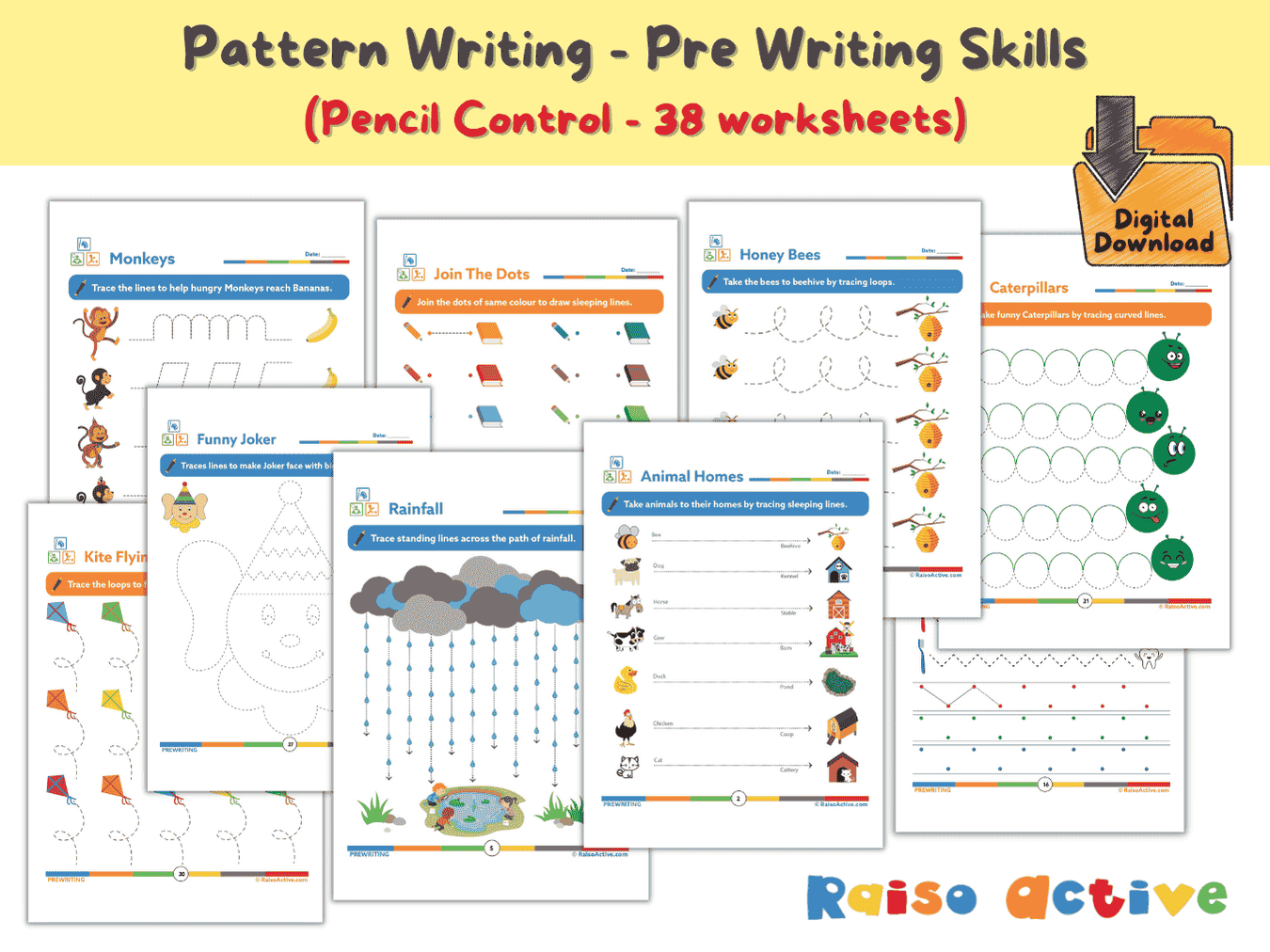
Pattern Writing Pre-writing Skills Activity Book for 3-4 Year Olds
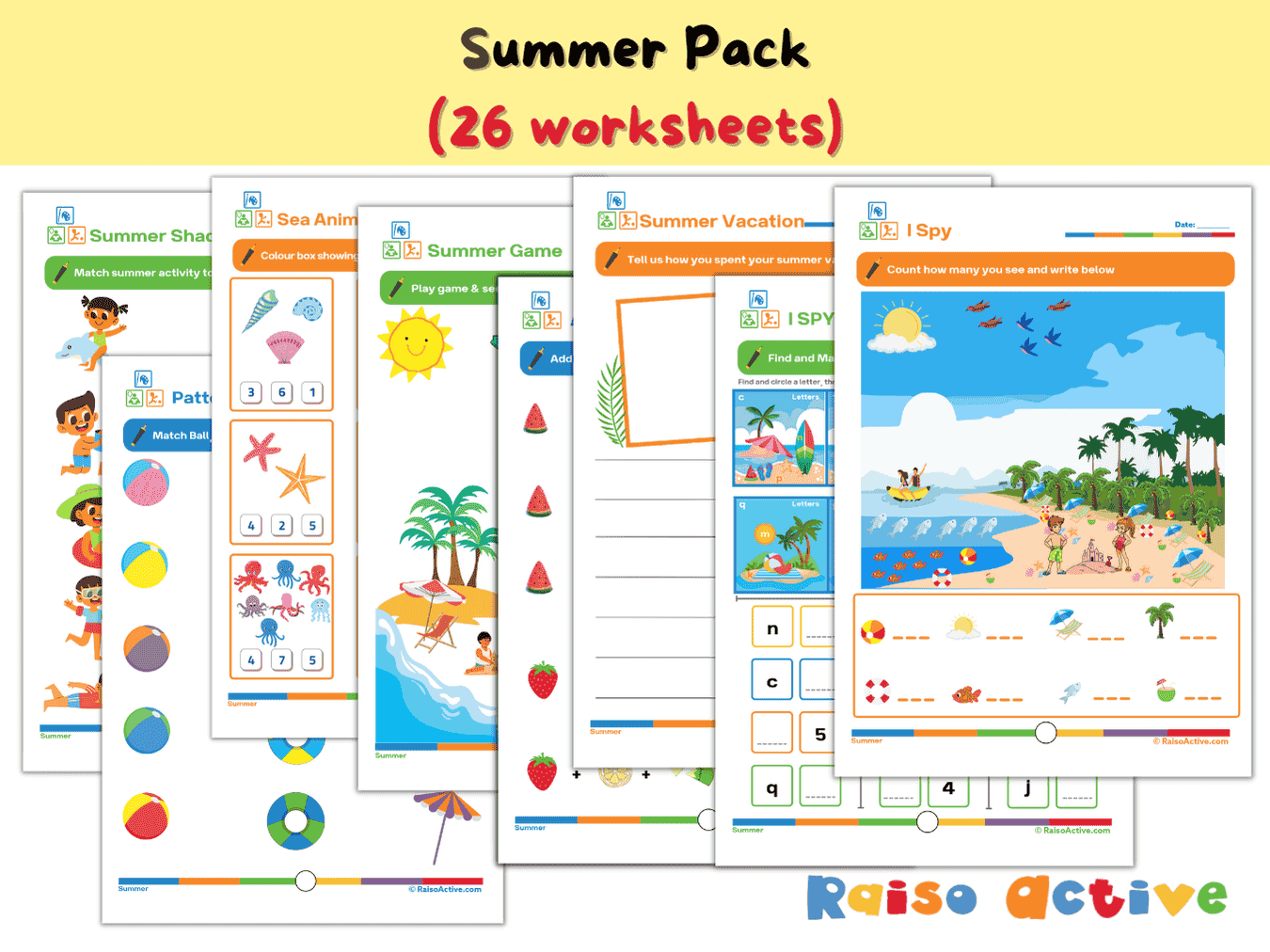
Summer Activity Pack: Math, Literacy, Puzzles & More for Preschool & Kindergarten
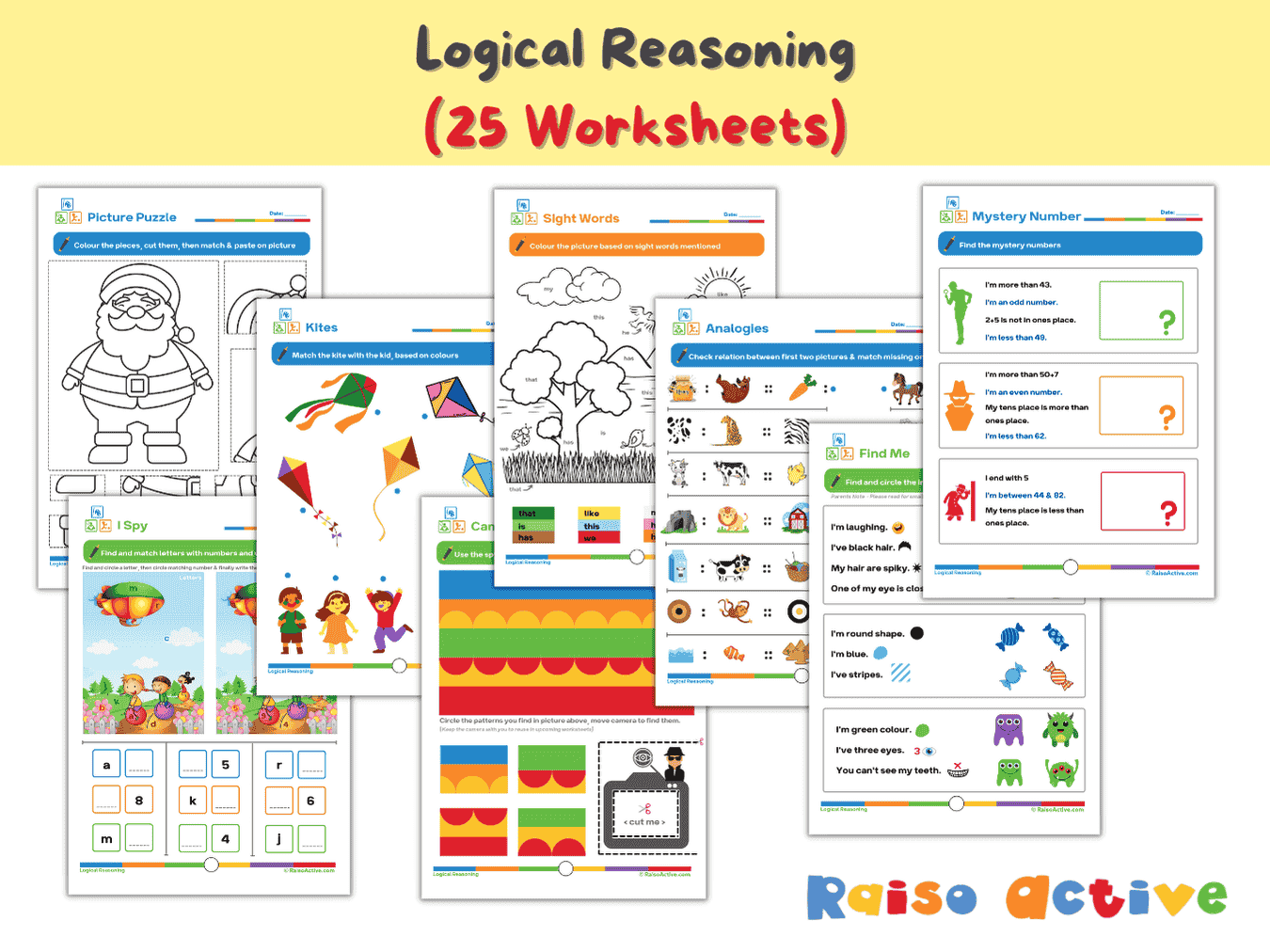
Logical Reasoning Activity Book for Preschool & Kindergarten | Patterns, Puzzles & Analogies
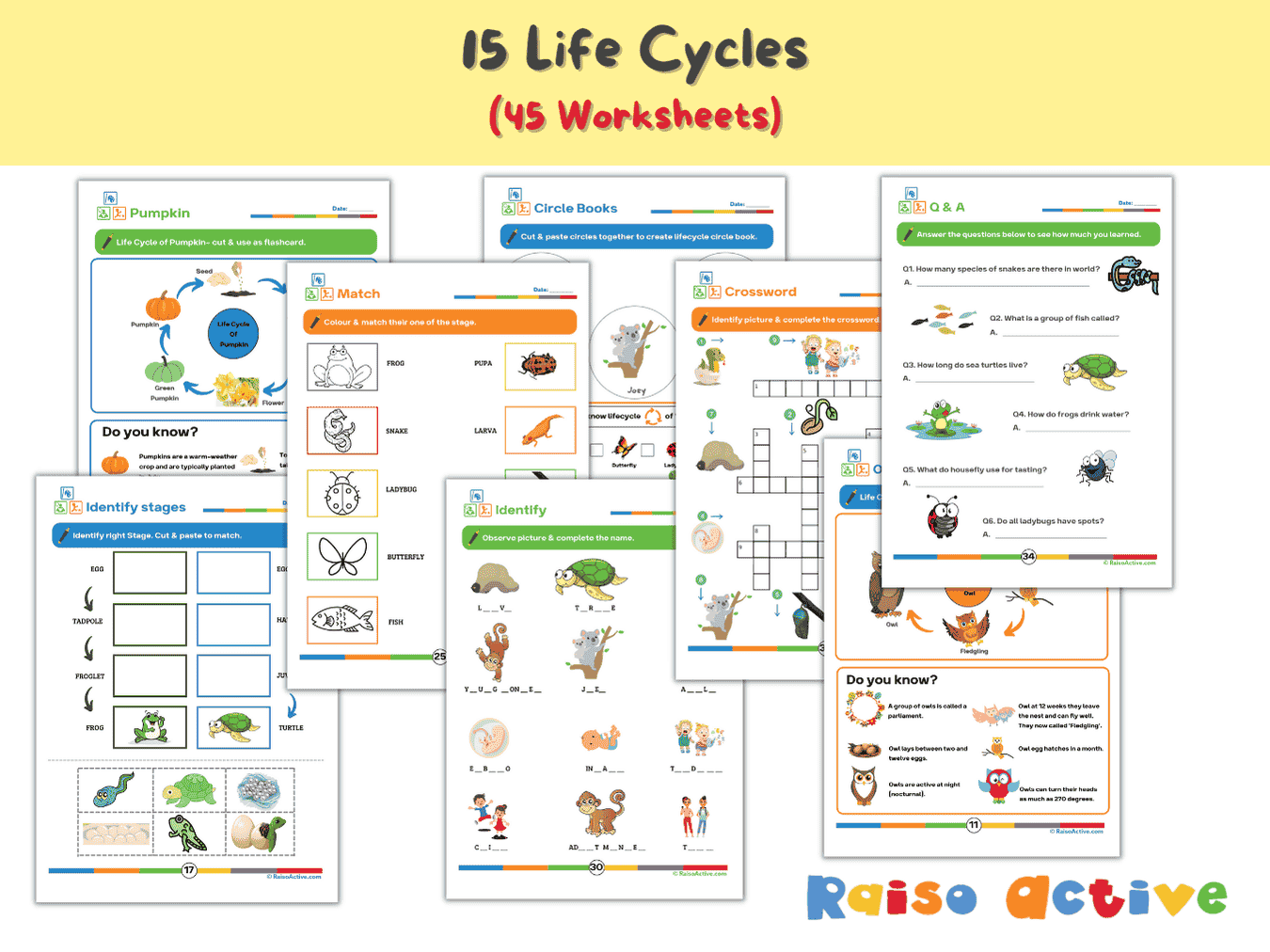
Lifecycles Activity Book & Flashcards for Preschool & Early Elementary
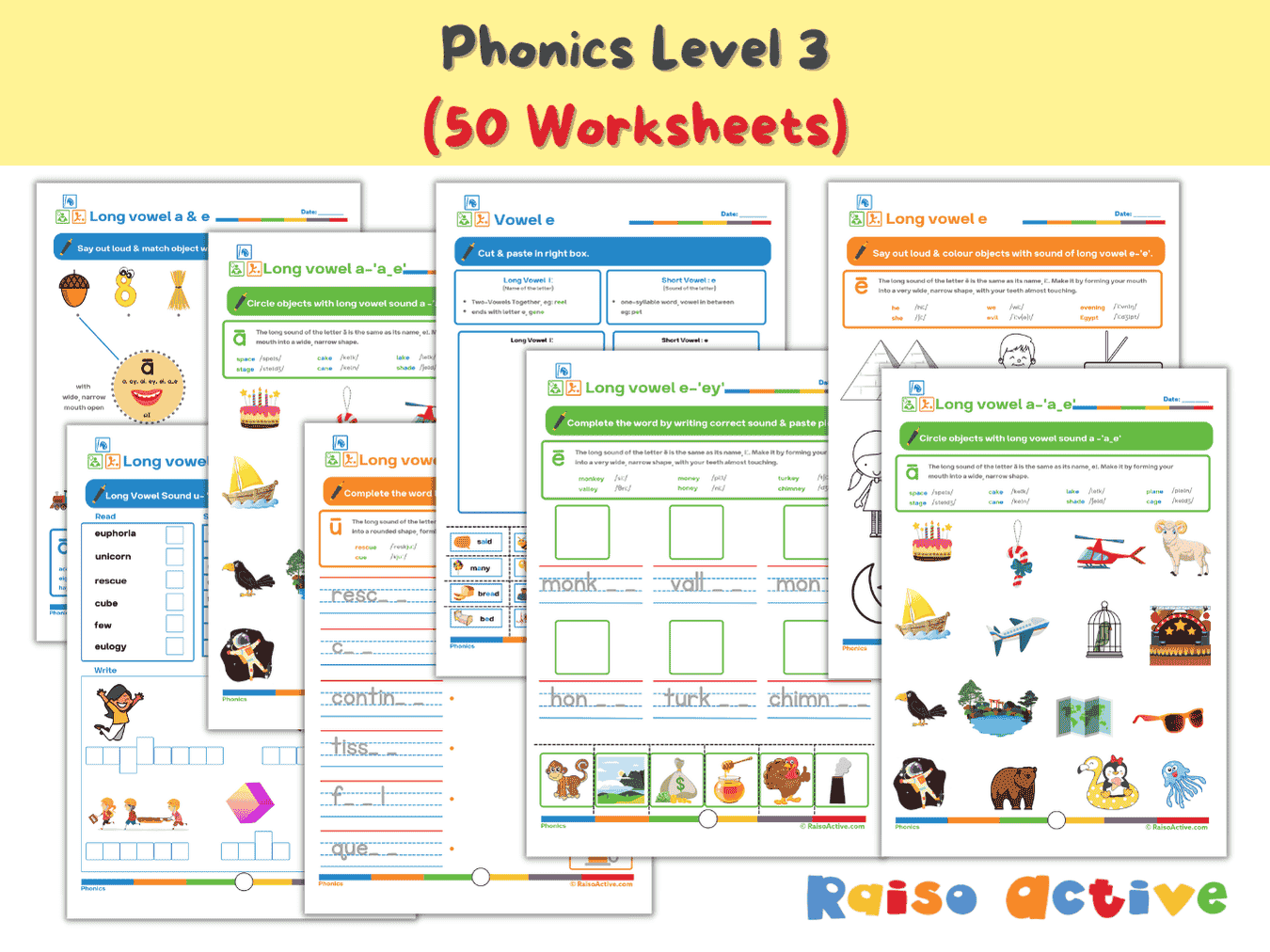
Phonics Level 3 Long Vowels Activity Book for Kindergarten & 1st Grade
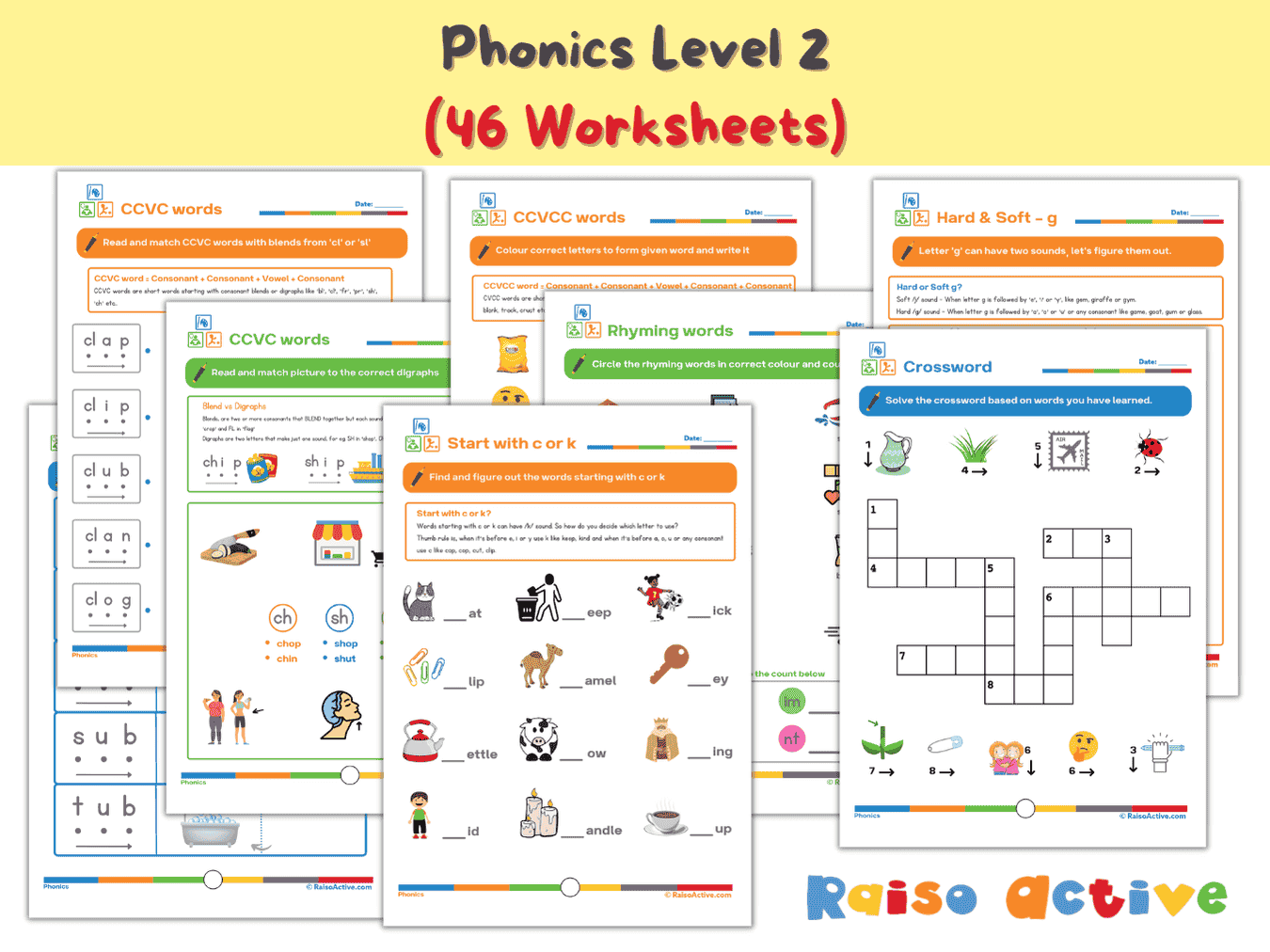
Phonics Level 2 Worksheets: CVC, CCVC, CVCC Word Families & Blends for Early Readers (Ages 4-7)
Guides for parents and teachers
See all guides →Best Worksheets for 3-Year-Olds: What Works and What to Avoid
What works on worksheets for 3-year-olds: short sessions, crayons, tracing lines, matching, cutting, a free weekly plan, and signs one is too advanced.
Portfolio Assessment with Young Children: A Comprehensive Guide to Meaningful Documentation
Learn how portfolio assessment captures your child's growth through meaningful documentation. Practical tips, templates, and age-appropriate strategies for ages 1-8.
Fostering Creativity in Structured Learning: The Perfect Balance for Young Minds
Learn how to blend creativity with structured learning for children ages 1-8. Practical strategies, activities, and printable worksheets for parents and teachers.
Preparing Your Child for a Rapidly Changing World: Essential Skills for Future Success
Discover the essential 21st century skills your child needs for future success. Practical tips on creativity, critical thinking, digital literacy & emotional intelligence for ages 1-8.
Celebrating Diversity: How to Incorporate Cultural Awareness in Learning Activities for Young Children
Practical cultural awareness activities for young children aged 2-8. Explore Indian festivals, world cultures, food, music, and crafts to teach diversity and inclusion.
How to Balance Structured Learning with Free Play: A Complete Guide for Parents and Educators
Learn how much free play vs structured learning young children need by age, signs of over-scheduling, and practical tips for Indian parents to design a balanced day.