Sight Word Coloring Fun: 'am', 'has', 'had', and 'have' Worksheet
This worksheet helps children ages 3-5 build automatic recognition of four common sight words — am, has, had, and have — words that appear so frequently in early reading that sounding them out every time would slow a beginning reader down. Coloring by a color key also reinforces visual discrimination, since children must distinguish between similar-looking short words rather than relying on pictures.
Part of the pack
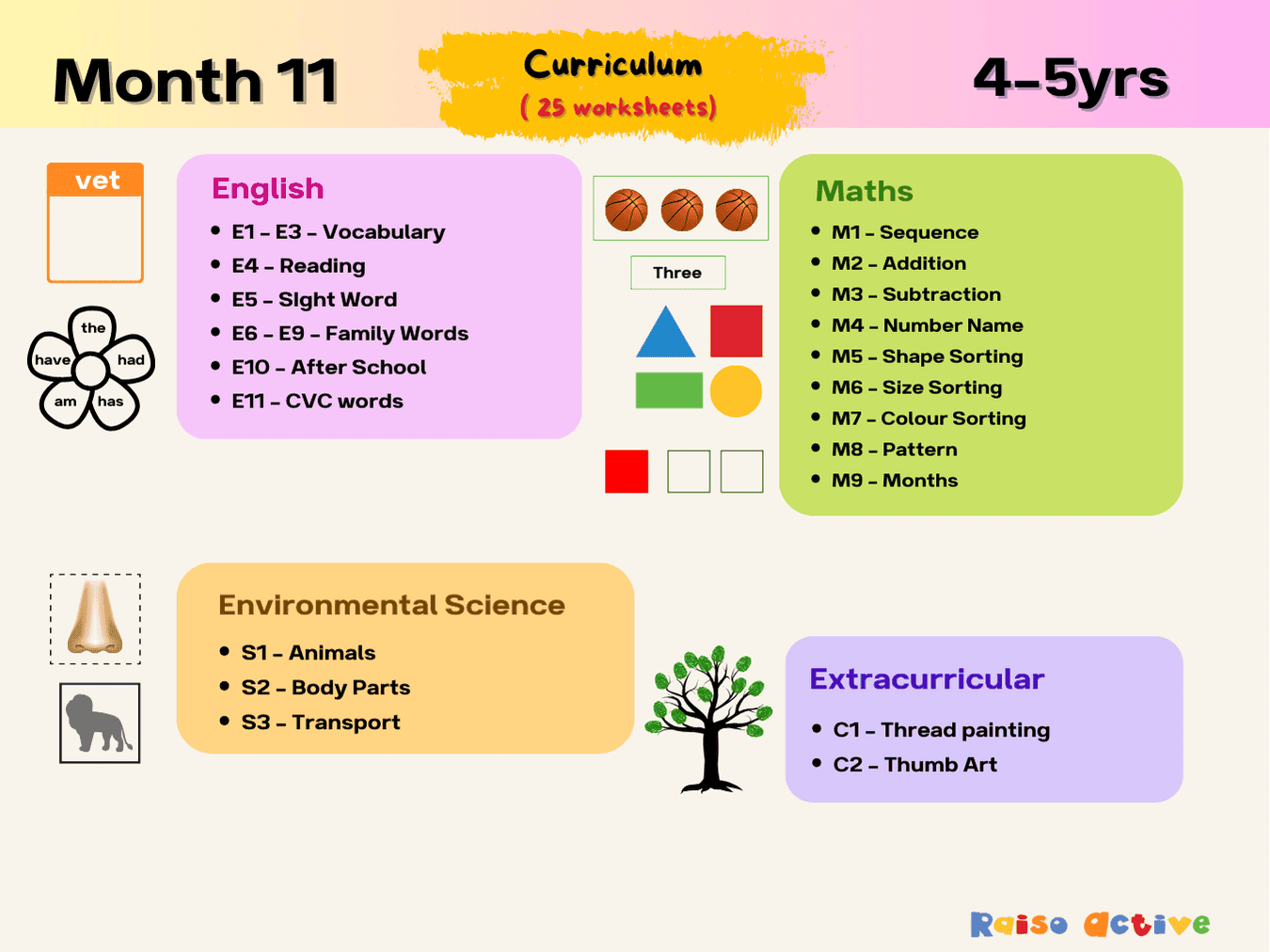
Month 11: Learning & Development | Ages 4-5
This is page 8 of the pack. Ages 4-5 · Pre-KAges 4-5 · ReceptionAges 4-5 · LKGAges 4-5
Made for your child
Spelling practice, made for your child
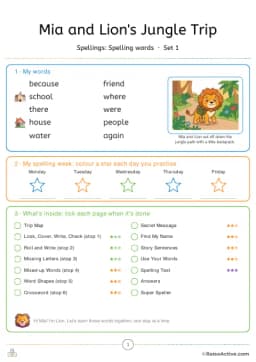
Their own spelling words turned into a pack: trace or look-cover-write-check, roll and write, a secret picture code, a word search, a crossword and a test, with their name in it.
Make a spelling packFree preview · free for members
Or start free: a word search with sight wordsCurriculum
- Fluency > Sight Words
How to use this worksheet
Review the color key at the top of the page together, reading each sight word aloud and naming its assigned color. Go flower by flower, having your child read the word inside before choosing the matching crayon — am is pink, has is yellow, had is green, and have is red. Encourage your child to look carefully at each word's letters rather than guessing from the first letter alone, since 'has' and 'had' look quite similar.
Materials needed
- Crayons or colored pencils
- Pencil
Extension activities
- 1Create simple sentences using each sight word and read them together.
- 2Write the sight words on flashcards and practice reading them quickly, like a speed round.
- 3Find the sight words in a favorite picture book and point them out whenever they appear.
- 4Play a memory matching game using cards with the four sight words written twice each.

Written by
Hemsweta Jain · Teacher Cheena
MBA and Early Childhood Educator, teaching since 2014 · Founder of RaisoActive, Mumbai
Every RaisoActive worksheet is designed and checked by the founder before publishing.
Published · Last reviewed
More from Month 11: Learning & Development | Ages 4-5

Color the Pictures! Kk, Ll, and Mm Letter Sounds Worksheet
Ages 4-5 · Pre-KAges 4-5 · ReceptionAges 4-5 · LKGAges 4-5
Coloring a circle beneath a picture only when its name starts with a target letter sound builds beginning-sound discrimination for children ages 4-5 across three letters — K, L, and M — sharpening their ability to isolate initial phonemes.
Flower Power Subtraction Worksheet for Kids
Ages 4-6 · Pre-K–KindergartenAges 4-6 · Reception–Year 1Ages 4-6 · LKG–UKGAges 4-6
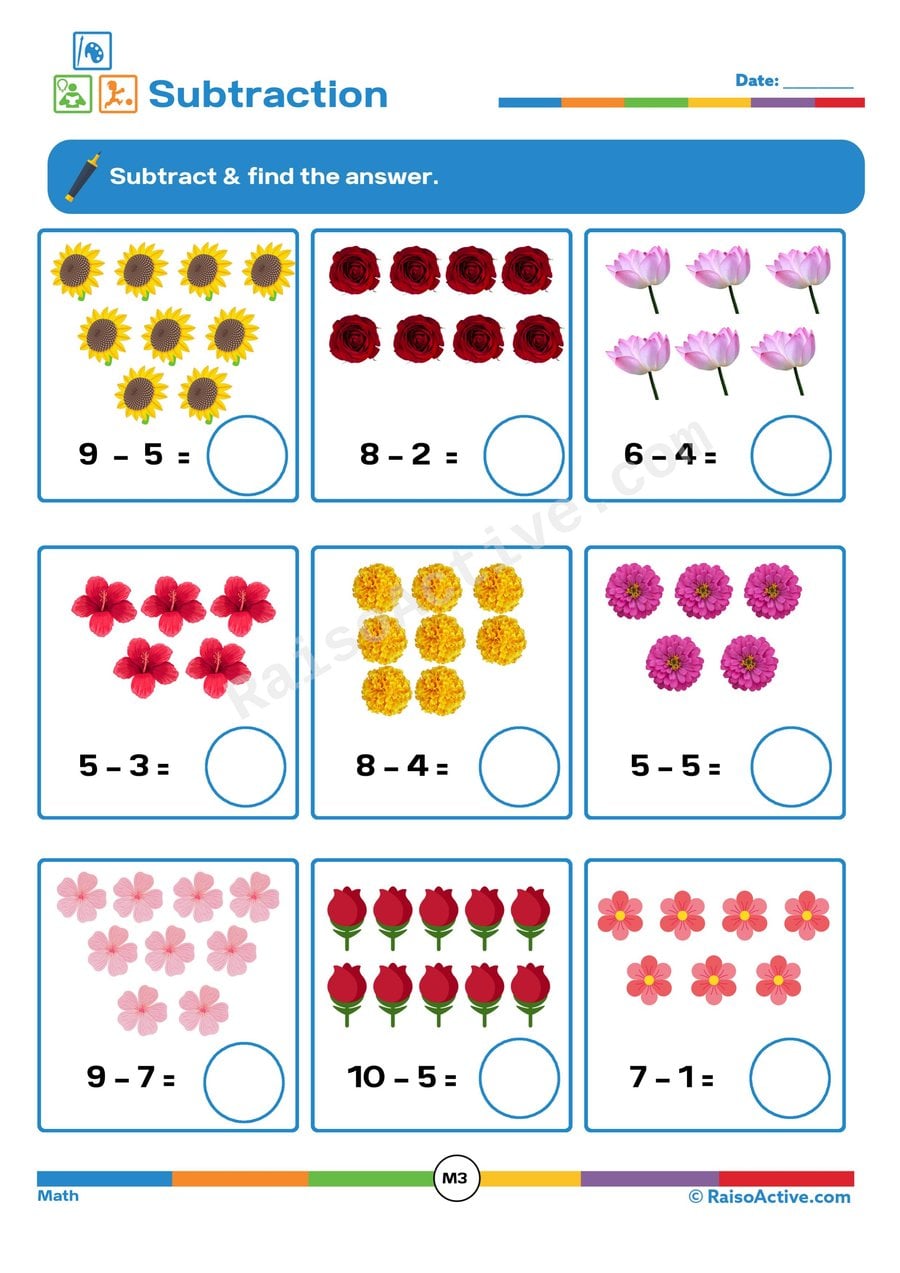
This worksheet gives children ages 4-6 hands-on subtraction practice using a flower-themed counting context, asking them to count pictured objects, subtract a given amount, and write the difference in a circle. The visual, countable format helps make subtraction concrete rather than abstract, reinforcing that 'taking away' reduces a group's total in a way children can see and verify by recounting.

Letter Sounds: Cut and Paste 'Ii' and 'Jj' Pictures Worksheet
Ages 3-5 · Preschool–Pre-KAges 3-5 · Nursery–ReceptionAges 3-5 · Nursery–LKGAges 3-5
Sorting pictures by their beginning sound into 'Ii' and 'Jj' groups builds phonemic awareness for children ages 3-5, training their ear to isolate the first sound of a word before connecting it to its written letter.

Parent's Guide: Fun Activities for Early Learning!
Ages 3-5 · Preschool–Pre-KAges 3-5 · Nursery–ReceptionAges 3-5 · Nursery–LKGAges 3-5
This parent's guide gathers a set of adaptable, no-worksheet activities that build early reading, science exploration, and creative thinking for children ages 3-5. Because the activities span different domains — from a family memory book to sink-or-float experiments — this guide supports well-rounded early learning that goes beyond pencil-and-paper practice into hands-on discovery.

Pattern Recognition Worksheet: Cut and Paste the Next Picture!
Ages 3-5 · Preschool–Pre-KAges 3-5 · Nursery–ReceptionAges 3-5 · Nursery–LKGAges 3-5
This worksheet builds pattern recognition for children ages 3-5 by having them identify a repeating sequence in each row and then cut out and glue the picture that correctly continues it. Because the correct piece must be found among several distractor options, this task sharpens visual discrimination alongside the logical thinking needed to predict what comes next in a sequence.

Count and Match: Number Names Worksheet for Preschoolers
Ages 3-5 · Preschool–Pre-KAges 3-5 · Nursery–ReceptionAges 3-5 · Nursery–LKGAges 3-5
This worksheet helps children ages 3-5 connect a counted group of objects to its written number name, reinforcing that a quantity, a numeral, and a number word all represent the same idea. Counting a group and then finding its matching name — rather than just its matching numeral — adds an extra layer of number literacy, since your child must recognize or read the word form as well as understand the quantity.

Thread Painting Fun: A Creative Craft Worksheet for Kids!
Ages 3-5 · Preschool–Pre-KAges 3-5 · Nursery–ReceptionAges 3-5 · Nursery–LKGAges 3-5
Dipping thread in watercolor, folding paper, and pulling the thread introduces children ages 3-5 to an unusual printmaking technique that builds fine motor control and cause-and-effect thinking, since the pulled thread creates a surprising symmetrical design they couldn't fully plan in advance.

Shape Sorting Fun: Cut and Paste Worksheet for Preschoolers
Ages 3-5 · Preschool–Pre-KAges 3-5 · Nursery–ReceptionAges 3-5 · Nursery–LKGAges 3-5
Matching pictures of everyday objects to the 2D shape they resemble builds shape recognition and categorization for children ages 3-5, helping them see geometric shapes as patterns that exist in the real world around them.
Related worksheets

Learn the Sight Word 'Want' Worksheet for Preschoolers
Ages 3-5 · Preschool–Pre-KAges 3-5 · Nursery–ReceptionAges 3-5 · Nursery–LKGAges 3-5
The word 'want' doesn't sound out easily using regular phonics rules, which is exactly why children ages 3-5 need to memorize it by sight as a whole word — a core early reading strategy for high-frequency words. This worksheet builds that sight-word memory through several different tasks: tracing, finding the word among distractors, filling it into a sentence, and reassembling its letters, giving repeated exposure in varied formats rather than one repetitive drill. Mastering common sight words like 'want' dramatically speeds up early reading fluency since these words appear constantly in beginning books.

Learn to Read and Write the Sight Word 'Like' - Fun Worksheet for Kids!
Ages 3-5 · Preschool–Pre-KAges 3-5 · Nursery–ReceptionAges 3-5 · Nursery–LKGAges 3-5
Children ages 3-5 build sight-word fluency with the word 'like,' a common word used to express preference, through tracing, coloring, a word search, and sentence reading. Because 'like' doesn't follow simple phonics rules and appears constantly in early books and everyday speech, repeated multi-format exposure like this worksheet provides is exactly how young readers commit it to memory.

Sight Word 'Did' Worksheet: Read, Trace, and Complete Sentences!
Ages 3-5 · Preschool–Pre-KAges 3-5 · Nursery–ReceptionAges 3-5 · Nursery–LKGAges 3-5
This worksheet strengthens sight-word recognition for children ages 3-5 through repeated exposure to the word 'did' — tracing it, writing it, completing sentences with it, and spelling it by cutting and pasting letters. Because 'did' is a past-tense helper word that doesn't sound out easily, this kind of varied repetition is exactly what builds the instant recognition needed for reading fluency.

Sight Word 'Away' Worksheet: Learn to Read and Write!
Ages 3-5 · Preschool–Pre-KAges 3-5 · Nursery–ReceptionAges 3-5 · Nursery–LKGAges 3-5
Like many high-frequency words, 'away' doesn't follow standard phonics rules cleanly, so children ages 3-5 need to build instant visual recognition of it as a whole sight word rather than sounding it out each time. This worksheet delivers that repetition through several varied tasks — coloring, tracing, word-hunting, sentence completion, and letter reassembly — which keeps a young learner engaged while reinforcing the same word from multiple angles. Strong sight-word recognition for common words like 'away' is one of the biggest accelerators of early reading fluency.

Learn the Sight Word 'Is' - Tracing and Writing Worksheet for Preschoolers
Ages 4-5 · Pre-KAges 4-5 · ReceptionAges 4-5 · LKGAges 4-5
This worksheet helps children ages 4-5 build instant recognition of the sight word 'is' through a layered sequence of tracing, independent writing, sentence fill-in, coloring, and letter-order cut-and-paste practice. Because 'is' can't easily be sounded out using typical phonics rules, repeated multi-format exposure like this is exactly what helps a sight word move into a child's automatic reading vocabulary. Using the word inside real sentence blanks also connects the isolated word to meaningful, functional reading.

Learn the Sight Word 'Has' - Fun Tracing and Matching Worksheet!
Ages 3-5 · Preschool–Pre-KAges 3-5 · Nursery–ReceptionAges 3-5 · Nursery–LKGAges 3-5
'Has' is a high-frequency verb that children ages 3-5 encounter constantly in early sentences describing possession, like 'the dog has a bone,' making it an important addition to their sight word vocabulary. This worksheet builds recognition of the word through coloring, tracing, word searching, and sentence completion, giving repeated exposure across formats that reinforces memory more effectively than a single repetition. Practicing 'has' inside complete sentences also helps children understand its grammatical role, connecting a subject to something it possesses.

Sight Word Fun: 'Yes' Word Activities Worksheet for Preschoolers
Ages 3-5 · Preschool–Pre-KAges 3-5 · Nursery–ReceptionAges 3-5 · Nursery–LKGAges 3-5
Practicing the sight word 'yes' through tracing, writing, circling, and underlining gives children ages 3-5 several different ways to encounter the same high-frequency word, which builds the instant word recognition that supports early reading fluency. Repetition across different formats, rather than just one activity, helps the word move from a puzzle to be solved into a word recognized on sight.

Sight Words Coloring Worksheet: 'His', 'My', and 'Her' Fun!
Ages 3-5 · Preschool–Pre-KAges 3-5 · Nursery–ReceptionAges 3-5 · Nursery–LKGAges 3-5
This coloring activity helps children ages 3-5 recognize and internalize the common sight words 'his,' 'my,' and 'her' by following a color-coded key, an approach that builds sight word memory through repeated visual association rather than isolated flashcard drilling. Because sight words like these don't sound out easily using phonics rules, repeated exposure in a fun context like coloring is one of the most effective ways for young children to memorize them. The activity also reinforces fine motor control as children carefully color within the lines of each labeled section.
Guides for this topic

Sight Words by Age: The First 50 Words and How to Teach Them Without Flashcard Fatigue
Which sight words to teach first and why, the heart-word method, a read-trace-write-find routine, games, and a by-age table of typical sight-word progress.
How to Teach CVC Blending: A Step-by-Step Method That Works in Two Weeks
A step-by-step method for teaching CVC blending, covering continuous sounds, word families, common errors, and a 14-day plan that most children finish reading CVC words.

Best Worksheets for 3-Year-Olds: What Works and What to Avoid
What works on worksheets for 3-year-olds: short sessions, crayons, tracing lines, matching, cutting, a free weekly plan, and signs one is too advanced.
Reviews
Every worksheet for ages 3–5, no watermark
Members download the full library of 1,000+ worksheets and every activity pack without watermarks or daily limits. One year costs ₹999 in India or $20 elsewhere.
See membership plansOr download any worksheet free with a watermark (5 a day).