Complete Guide to Jack Hartmann Worksheets: Enhancing Educational Videos with Hands-On Learning
Author
RaisoActive - Kids Activities and Fun Learning
Published
Updated
Reading Time
16 min read

- Jack Hartmann's YouTube videos combine catchy music and movement to teach counting, alphabets, sight words, and phonics to children aged 2–7
- Pairing videos with printable worksheets transforms passive screen time into active, multi-sensory learning that sticks
- Number and counting videos work best alongside tracing worksheets, ten-frames, and hands-on counting activities
- Alphabet videos pair perfectly with letter tracing, beginning sounds matching, and CVC word worksheets
- Indian parents and teachers use Jack Hartmann widely — his content adapts beautifully to our classrooms and home learning setups
Why Jack Hartmann Has Become a Classroom Staple Worldwide
If you have ever watched a child jump up and count to 100 while following a video on YouTube, there is a very good chance Jack Hartmann was playing. With over six million subscribers and hundreds of millions of views, Jack Hartmann Kids Music Channel has become one of the most trusted educational resources for early childhood teachers and parents around the world — including in India, where his videos have found an enthusiastic audience in homes and classrooms from Kerala to Kashmir.
What makes Jack Hartmann so effective? The answer lies in a well-established principle from early childhood research: children learn best when movement, music, and academics are woven together. His videos do not just play a song — they invite children to clap, jump, hop, and gesture along with letters, numbers, and sight words. This multi-sensory engagement creates stronger memory traces than passive listening or watching alone. A child who has acted out counting by tens while hopping on one foot is far more likely to recall that sequence than a child who simply heard it once.
However, video learning — even excellent video learning — has an important limitation: it ends when the screen goes off. The key to truly consolidating what children learn from Jack Hartmann videos is immediate hands-on follow-up. Printable worksheets, manipulatives, and simple activities provide the practice repetition that builds genuine mastery. In this guide, we explore exactly how to pair his most popular video series with targeted worksheets for numbers, counting, alphabets, phonics, and sight words — with practical suggestions for Indian home and classroom settings.
Want ready-to-print worksheets for your videos?
Subscribe for a weekly selection of printable activities paired with popular educational video themes — delivered straight to your inbox.
The Science Behind Pairing Videos with Worksheets
Educational researchers call it the multimedia learning principle: people learn more deeply from words and pictures (or movement) combined than from either alone. Jack Hartmann's videos deliver the audio-visual-kinaesthetic input — your child hears, sees, and moves. Worksheets then add the crucial next layer: retrieval practice, where the child must actively recall and apply what they absorbed. Together, they create a complete learning loop.
The sequencing matters enormously. Watch the video first to build familiarity and enthusiasm, then immediately move to the worksheet while the content is fresh. This is very different from using a worksheet in isolation, where the child has no prior engagement with the concept. After watching the Jack Hartmann counting-by-twos video three times with great excitement, a child who then sits down with a skip-counting worksheet is not doing boring drill — they are reliving and extending an experience they enjoyed.
Always watch the video first, then move to the worksheet within 5–10 minutes while the learning is fresh.
This sequence — engage, then apply — is far more effective than using worksheets cold. The video creates enthusiasm and initial understanding; the worksheet deepens it through active recall and fine motor practice.
Counting Songs + Number Worksheets: Building Strong Numeracy
Jack Hartmann's number and counting videos are among his most popular and most powerful. Titles like Count to 100, Count by 10s, Count by 2s, and Number Formation Rhymes have been viewed hundreds of millions of times because they work — the songs are genuinely catchy, the movements are engaging, and the repetition is built in naturally. Here is how to extend this learning with printable worksheets.
Number Tracing and Formation
Many Jack Hartmann videos include a verbal number formation cue — he narrates how to form each numeral as children write in the air. This is a perfect bridge to number tracing worksheets. After watching the number formation video, print a tracing sheet for the numbers covered (say, 1–5 or 1–10). Ask your child to trace the numbers saying the formation cue aloud as they write — "Big curve, little bump — that's an 8!" This combines the auditory memory from the video with the physical act of writing.
- Number tracing (1–10, 1–20): Start with large, bold numerals and dotted trace lines. Children who have watched the Jack Hartmann number song will recognise the numbers eagerly.
- Ten-frame worksheets: After watching counting videos, use ten-frame mats to count objects — buttons, seeds, or small stones work perfectly in an Indian home setting.
- Cut-and-paste number ordering: Cut number cards (1–10 or 1–20) and arrange them in sequence, reinforcing the order practised in the counting videos.
- Colouring-by-number pages: These consolidate number recognition in a fun, low-pressure format that young children find deeply satisfying.
- Number-to-objects matching: Draw lines from numbers to groups of objects — directly practices the one-to-one correspondence emphasised in Hartmann's counting songs.
Skip Counting with Patterns and Worksheets
Jack Hartmann's skip-counting videos — counting by 2s, 5s, and 10s — are particularly popular with kindergarten and Grade 1 teachers. The videos use physical movement (patting knees, jumping) to mark each count, which creates a kinaesthetic anchor for the number pattern. To deepen this, number line worksheets and skip-counting charts give children a visual map of the same pattern they just danced to. Ask your child to colour every second number on a 1–20 chart after watching the count-by-2s video — they will immediately connect the pattern to the song.
- Use dried rajma (kidney beans), moong dal, or small pebbles as counting manipulatives to place on ten-frames or number mats
- Count chapati pieces, fruit slices, or flowers from the garden during the video — connecting counting to real life in familiar Indian contexts
- Write numbers on small stones with a marker and arrange them in skipping sequences — a tactile activity that reinforces video learning beautifully
- Use a simple abacus (available at any stationery shop in India) to practise skip counting in tens after the Jack Hartmann 100s video
Research from the University of Washington found that children who combine movement-based learning with follow-up hands-on practice show significantly stronger retention of early numeracy concepts compared to those who use either method alone.
Source: Deans for Impact, Science of Early Learning Report
Alphabet Videos + Letter Tracing: From Songs to Writing
Jack Hartmann's alphabet content is extraordinary in its range. From the classic ABC Song to more advanced videos on Letter Sounds, Uppercase and Lowercase Letters, and Beginning Sounds, he covers every stage of early literacy with the same infectious energy. For children aged 3–6, these videos often create the first genuine excitement about the alphabet — and that enthusiasm is exactly the right moment to introduce letter tracing worksheets.
The connection between video and worksheet here is particularly direct. In his Alphabet Workout video, Jack Hartmann introduces each letter with a physical action — jumping for J, stretching for S, and so on. After watching this video, a letter tracing worksheet becomes an extension of that physical experience. As your child traces the letter S, they can quietly hiss like a snake — a sound Hartmann often uses — reinforcing the letter-sound connection at the same time.
Letter Tracing and Recognition Worksheets
- Uppercase and lowercase tracing sheets: After a Hartmann alphabet video, trace the specific letter featured. Use the same verbal cues from the video as you trace.
- Letter-picture matching: Match letters to objects beginning with that sound — A for apple, B for ball — extending the beginning sounds work in the videos.
- Alphabet dot-to-dot: Sequence activities that reinforce alphabetical order after watching the ABC sequence videos.
- My Letter Book pages: One page per letter with tracing, a picture to colour, and a space to draw something starting with that letter.
- Uppercase-lowercase matching: Cut and match cards connecting capital and small forms — ideal after the Hartmann uppercase/lowercase videos.
- After tracing on paper, form the same letter in a tray of fine rava (semolina) or rice flour — Indian kitchens are full of perfect sensory writing materials
- Use playdough to form letters after watching the alphabet video — the 3D formation deepens muscle memory built by the Hartmann movement song
- Stamp letters using bottle caps dipped in poster colour onto the tracing worksheet — great fine motor activity that reinforces letter shapes
- Go on an "alphabet hunt" around the house — find something beginning with the letter of the day, connecting the Hartmann song to the real environment
Letter recognition and letter formation are two distinct skills — Jack Hartmann videos build the first; worksheets and tactile activities build the second.
A child can recognise a letter by sight without being able to form it correctly. Use Hartmann videos for recognition and songs, then immediately follow with tracing and writing activities to build the motor pathway for formation. Both are essential for early literacy.
Sight Words Videos + Reading Worksheets: Building Fluency
One of Jack Hartmann's most valuable contributions to early literacy is his vast library of sight word videos. He has created energetic, movement-based songs for Dolch pre-primer, primer, and Grade 1 sight words — the high-frequency words that appear in almost every text children will encounter (words like the, and, is, was, have, said). Because these words are often phonetically irregular, they genuinely need to be memorised by sight, and Hartmann's combination of chanting, movement, and visual display makes that memorisation far more enjoyable.
The worksheet pairings for sight words require a slightly different approach than for numbers or letters. The goal is not tracing but automatic recognition and contextual use. After watching a sight word video, the most effective worksheets ask children to find the word in a sentence, fill in a blank with the correct word, or write a sentence using it. This shifts from mere memorisation to genuine reading comprehension — the ultimate goal.
Sight Word Worksheet Ideas to Pair with Hartmann Videos
- Trace, copy, and write: Simple three-step practice — trace the sight word, copy it, then cover and write from memory.
- Find and highlight: Circle or highlight the sight word every time it appears in a short passage — builds scanning fluency.
- Fill in the blank: Short sentences with the target sight word missing — children choose from a word bank.
- Sight word sentences: Children read a sentence with the sight word used correctly, then draw a picture to match.
- Rainbow writing: Write the sight word repeatedly in different colours — a child-favourite activity that provides repetition without feeling repetitive.
- Sight word bingo: A printable bingo card with sight words — play after watching the corresponding video for a fun review.
Research on early reading development suggests that children who master common high-frequency sight words by the end of Grade 1 are significantly more fluent readers by Grade 3. Jack Hartmann's videos, paired with consistent worksheet practice, give children a joyful path to this milestone.
Source: National Reading Panel Report; Dolch Word Research
Phonics Videos + Worksheets: Cracking the Code of Reading
Beyond individual letter sounds, Jack Hartmann has a strong phonics series covering CVC words (consonant-vowel-consonant, like cat, dog, pin), vowel sounds, blends, and digraphs. These are the building blocks of decoding — the ability to sound out unfamiliar words. His phonics videos are particularly well-suited to a blended approach because they introduce the sound pattern first, then the worksheet can provide the practice examples.
In Indian classrooms and homes, phonics has gained enormous traction over the past decade as parents and teachers have moved away from rote reading towards systematic decoding skills. Jack Hartmann's phonics content dovetails perfectly with structured literacy approaches, and his cheerful, accessible style makes phonics feel like a game rather than a chore.
A Phonics Learning Session Using Jack Hartmann Videos
Choose a focus sound or word pattern
Select a Jack Hartmann phonics video — for example, the short-A CVC words video (cat, bat, hat, mat). Watch it together once, joining in with the movements and repetitions. Keep this to 5–8 minutes.
Watch and act a second time
On the second watch, give your child a small whiteboard or paper. Each time a new word appears, they write it down. This transforms passive viewing into active note-taking and practises the CVC pattern simultaneously.
Move to the worksheet immediately
Pick a CVC short-A worksheet — ideally one with pictures to label (cat, bat, hat) or a word-building activity using letter tiles. The child is now applying the pattern from the video to new, similar words.
Read aloud from the worksheet
Ask the child to read each word they have written or circled on the worksheet. Encourage sounding out rather than guessing from pictures. Celebrate each correct decoding — "You sounded that out perfectly!"
Play a quick word-family game
Write the rime (-at) on a sticky note and swap onset letters: c-at, b-at, h-at, r-at, s-at. How many words can you make? This extends the video's pattern into a playful oral and written activity.
- Jack Hartmann's videos use American English pronunciation — be aware that some vowel sounds differ slightly from Indian English. Focus on the letter patterns rather than exact sound reproduction.
- Many Indian children are learning English as a second or third language. Phonics videos are still excellent — but pair them with picture worksheets so context supports understanding.
- CVC words in Indian contexts can include words children know: *cap*, *bus*, *pen*, *hen*, *pot*, *cup* — use familiar vocabulary when possible on follow-up worksheets.
- Combine phonics practice with Hindi or regional language sounds to celebrate multilingualism — the phonological awareness built in any language transfers across languages.
- +Child actively applies what they watched
- +Fine motor skills are practised alongside concepts
- +Learning is consolidated through retrieval practice
- +Child has a tangible record of their work
- +Multiple learning modes engaged (visual, auditory, kinaesthetic, written)
- +Skills transfer to books and independent reading/writing
- -Learning remains passive and easily forgotten
- -No fine motor development occurs
- -Concepts fade quickly without practice
- -No record of progress or achievement
- -Only visual and auditory modes engaged
- -May not transfer without applied practice
Setting Up Your Jack Hartmann + Worksheet Routine at Home
The beauty of the Jack Hartmann approach is that it requires almost no preparation and very little equipment. A device with internet access, a printed worksheet, a crayon, and 20 minutes is genuinely all you need. But a little structure goes a long way in making this a consistent, enjoyable habit rather than an occasional activity.
Consistency matters more than duration. A 20-minute Jack Hartmann + worksheet session three times a week outperforms a two-hour session once a week.
Young children's brains consolidate learning through spaced repetition — revisiting a concept across multiple shorter sessions is far more effective than one long session. Even a single Jack Hartmann video followed by one worksheet page, done regularly, creates remarkable progress over a term.
- **Monday: Counting or numbers** — Pick a Jack Hartmann number video matched to the week's focus (e.g., numbers 11–20) and follow with the corresponding tracing or ordering worksheet.
- **Wednesday: Alphabet or phonics** — Watch a letter or phonics video and immediately trace that letter or complete a beginning-sounds worksheet.
- **Friday: Sight words** — Hartmann sight word video followed by rainbow writing, fill-in-the-blank, or a sight word hunt in a familiar picture book.
- Keep a simple worksheet folder per child — watching progress accumulate is deeply motivating for both children and parents.
- Let your child choose which video to watch first — ownership over the process increases engagement and reduces resistance.
Which Jack Hartmann Videos and Worksheets for Which Age?
Jack Hartmann produces content for a wide age range, from toddlers to early primary. Matching the right videos and worksheets to your child's developmental stage is important — too easy and they are bored, too hard and they are frustrated. Here is a practical guide by age group:
- Ages 2–3 (Nursery/Playgroup): Simple counting songs (1–5, 1–10), colour songs, basic shape songs. Pair with colouring worksheets, dot-painting number mats, and large simple tracing pages. Focus on familiarity and fun, not accuracy.
- Ages 3–4 (Preschool/LKG): Counting 1–20, ABC songs, beginning letter sounds. Pair with number tracing 1–10, letter tracing (uppercase), and picture-letter matching worksheets.
- Ages 4–5 (UKG/Junior KG): Counting 1–50, uppercase and lowercase letters, beginning and ending sounds. Pair with number ordering, lowercase letter tracing, CVC word matching, and basic sight word tracing.
- Ages 5–6 (Kindergarten/Prep): Counting to 100, skip counting by 2s, 5s, 10s; phonics blends; Dolch pre-primer sight words. Pair with skip-counting number lines, blend worksheets, and sight word sentences.
- Ages 6–7 (Grade 1): Number patterns, addition and subtraction songs, primer and Grade 1 sight words, digraphs and vowel teams. Pair with addition/subtraction worksheets, word family flip books, and reading comprehension passages using target sight words.
Get Your Video + Worksheet Pairing Pack
Subscribe and receive a free weekly collection of printable worksheets matched to popular Jack Hartmann video themes — counting, alphabets, phonics, and sight words for ages 2–7.
Frequently Asked Questions About Jack Hartmann Worksheets
How long should a Jack Hartmann video + worksheet session be?
Can Jack Hartmann videos replace formal reading instruction?
My child only wants to watch the videos and refuses the worksheets. What do I do?
Are Jack Hartmann videos appropriate for Indian children specifically?
Which Jack Hartmann videos should I start with?
How many worksheets should I print per video session?
Free worksheets for this topic
Browse all worksheets
Clothing Pattern Match Worksheet for Preschoolers
Ages 3-5 · Preschool–Pre-KAges 3-5 · Nursery–ReceptionAges 3-5 · Nursery–LKGAges 3-5
This worksheet has children ages 3-5 study repeating patterns on clothing items — stripes, polka dots, or checks — and match each item to its identical twin, building visual discrimination and early pattern-sequencing skills. Distinguishing between similar-looking patterns also sharpens attention to detail, a skill that later supports letter and word recognition.

Autumn Words and Rhymes: Rhyming, Syllables and Sentence Writing Worksheet
Ages 4-8 · Pre-K–Grade 2Ages 4-8 · Reception–Year 3Ages 4-8 · LKG–Class 2Ages 4-8
Children hear rhymes, split words into syllables by clapping and write a sentence using new autumn words.

Treat Count Picture Graph: Halloween Data Handling Worksheet
Ages 4-8 · Pre-K–Grade 2Ages 4-8 · Reception–Year 3Ages 4-8 · LKG–Class 2Ages 4-8
Children count five kinds of Halloween treats, record them as a picture graph and read it to compare amounts.

Pumpkin Patch Maze, Seek and Count and Odd One Out Worksheet
Ages 4-8 · Pre-K–Grade 2Ages 4-8 · Reception–Year 3Ages 4-8 · LKG–Class 2Ages 4-8
Children plan a route through a maze, count small pictures and spot which picture does not belong in a row.

Written by
Hemsweta Jain · Teacher Cheena
MBA and Early Childhood Educator, teaching since 2014 · Founder of RaisoActive, Mumbai
Published · Last reviewed
Related Resources
Printable Resources(10)
View all
Pattern Writing Pre-writing Skills Activity Book for 3-4 Year Olds
Ages 3-4 · PreschoolAges 3-4 · NurseryAges 3-4 · 44 pages
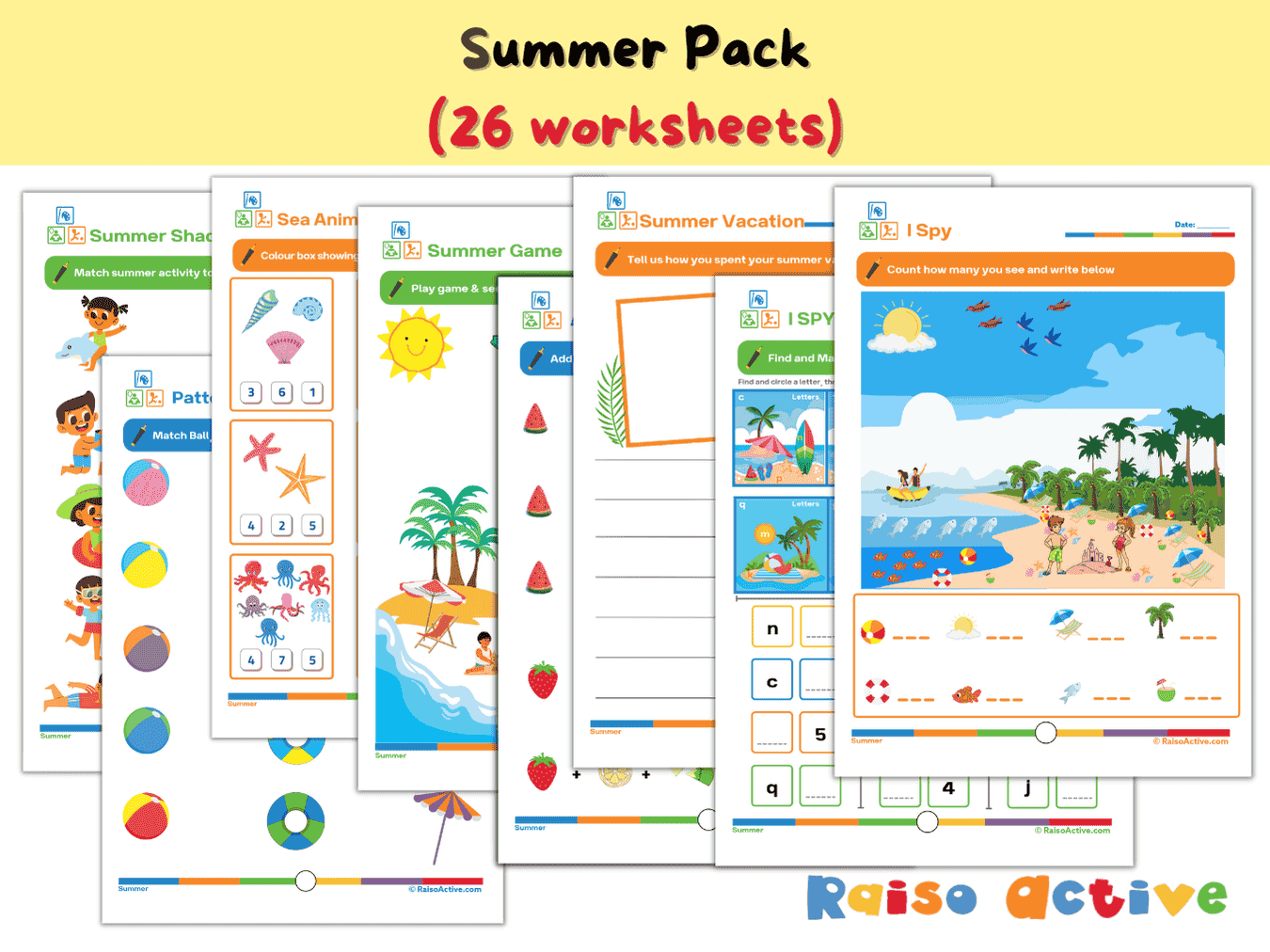

Summer Activity Pack: Math, Literacy, Puzzles & More for Preschool & Kindergarten
Ages 3-7 · Preschool–Grade 1Ages 3-7 · Nursery–Year 2Ages 3-7 · Nursery–Class 1Ages 3-7 · 26 pages
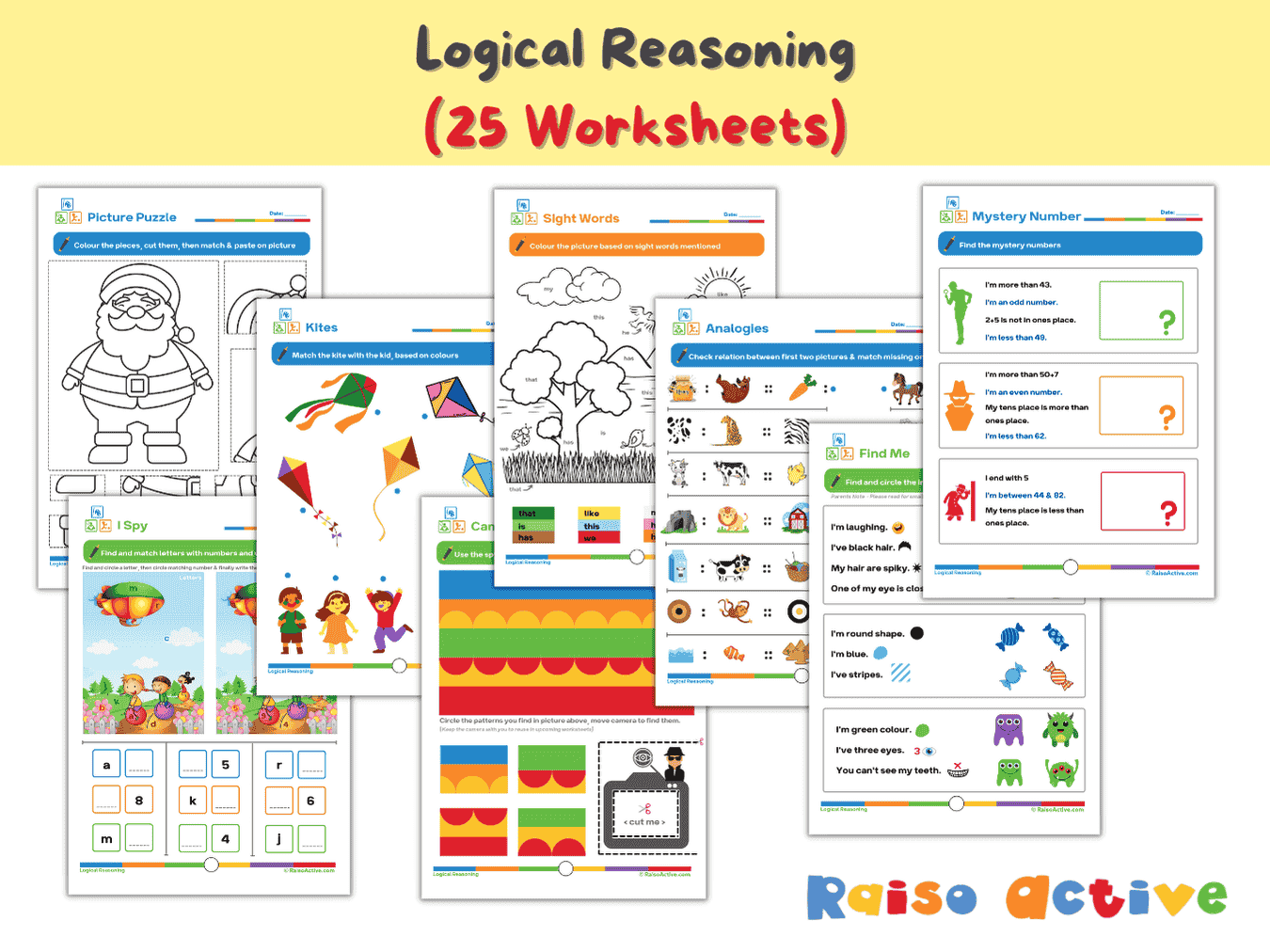

Logical Reasoning Activity Book for Preschool & Kindergarten | Patterns, Puzzles & Analogies
Ages 4-7 · Pre-K–Grade 1Ages 4-7 · Reception–Year 2Ages 4-7 · LKG–Class 1Ages 4-7 · 26 pages
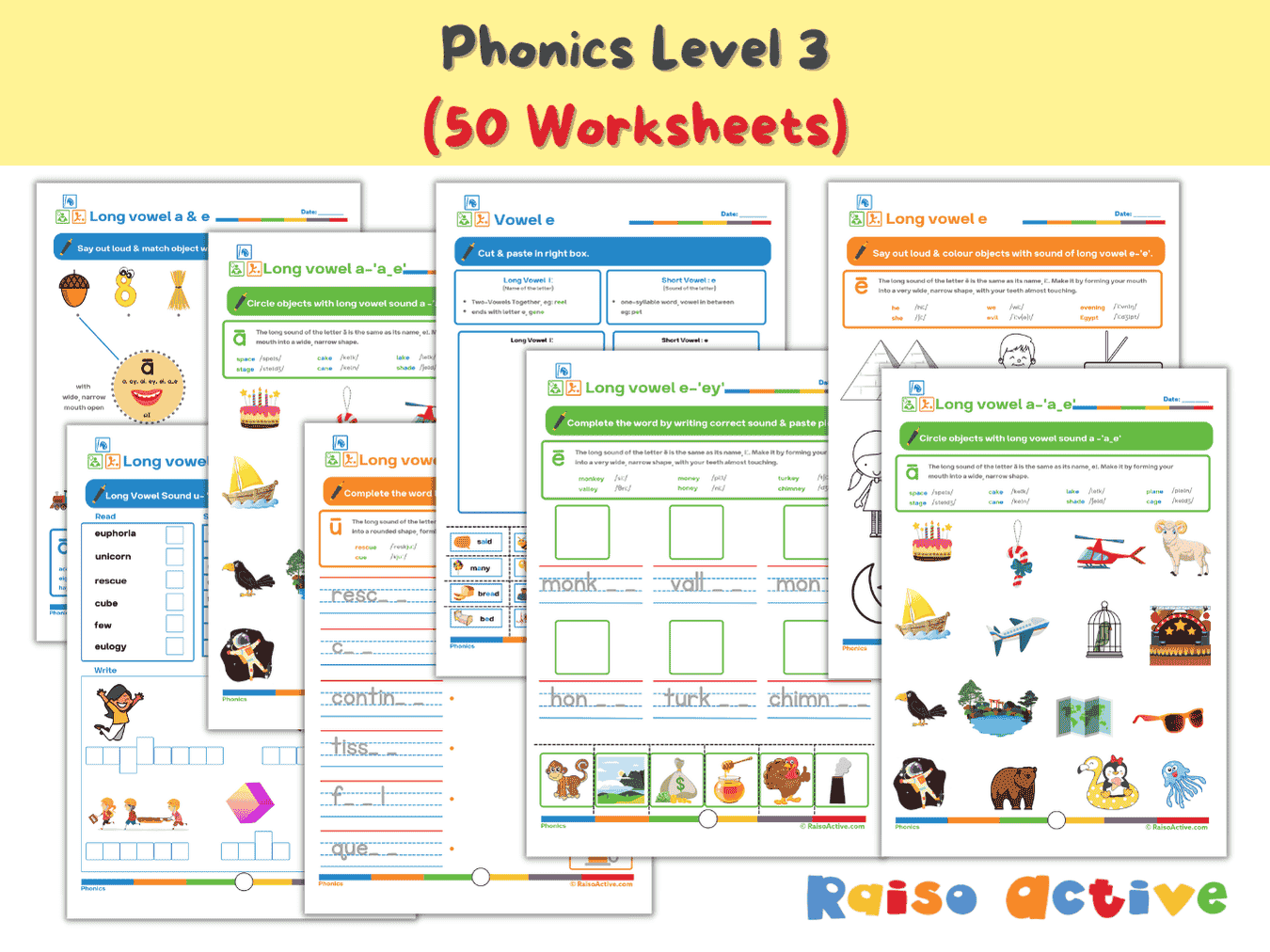

Phonics Level 3 Long Vowels Activity Book for Kindergarten & 1st Grade
Ages 5-7 · Kindergarten–Grade 1Ages 5-7 · Year 1–Year 2Ages 5-7 · UKG–Class 1Ages 5-7 · 51 pages
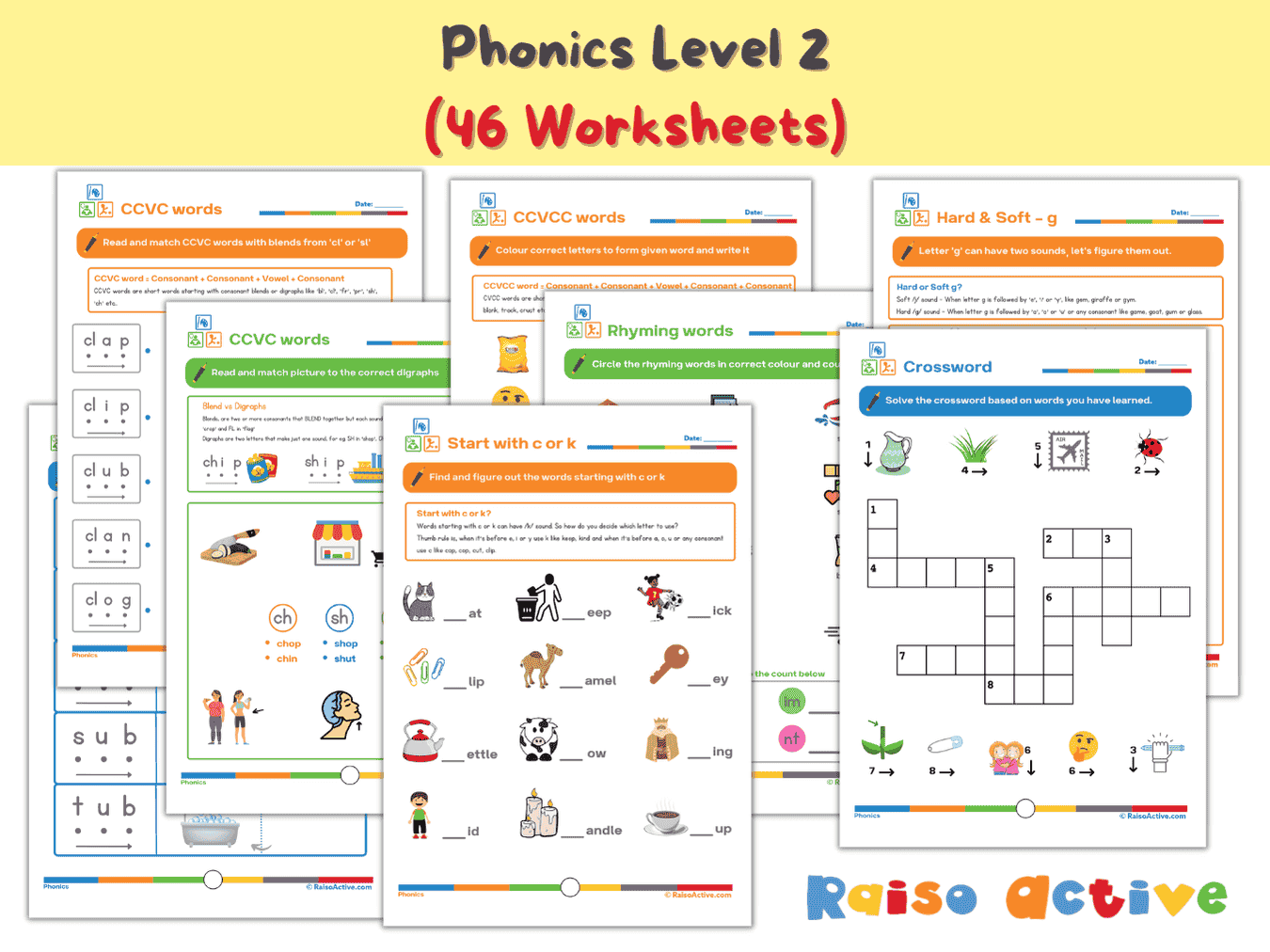
Phonics Level 2 Worksheets: CVC, CCVC, CVCC Word Families & Blends for Early Readers (Ages 4-7)
Ages 4-7 · Pre-K–Grade 1Ages 4-7 · Reception–Year 2Ages 4-7 · LKG–Class 1Ages 4-7 · 47 pages
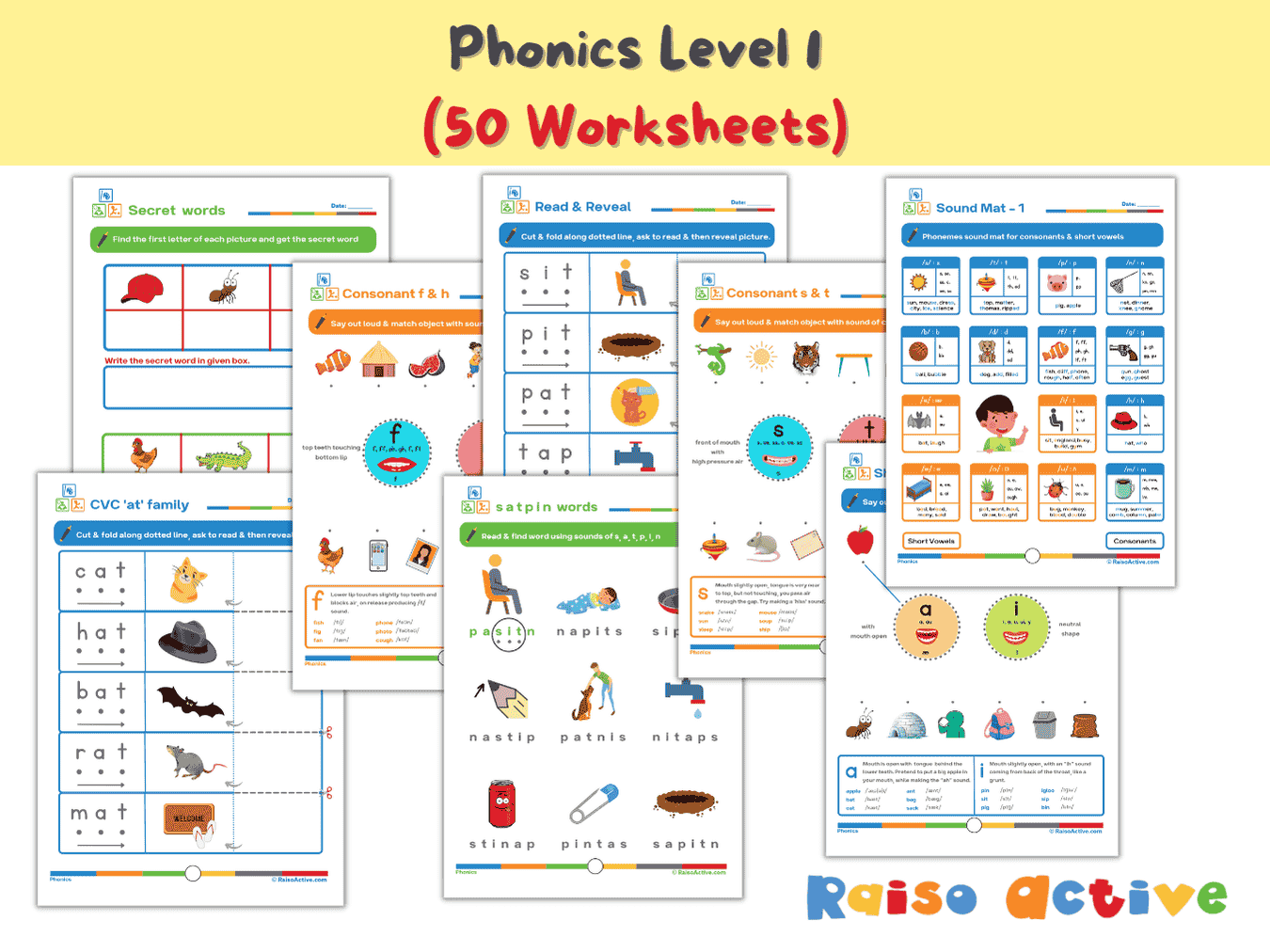
Phonics Level 1 Activity Book: Letter Sounds, Blending & CVC Words for Preschool & Kindergarten
Ages 3-6 · Preschool–KindergartenAges 3-6 · Nursery–Year 1Ages 3-6 · Nursery–UKGAges 3-6 · 60 pages
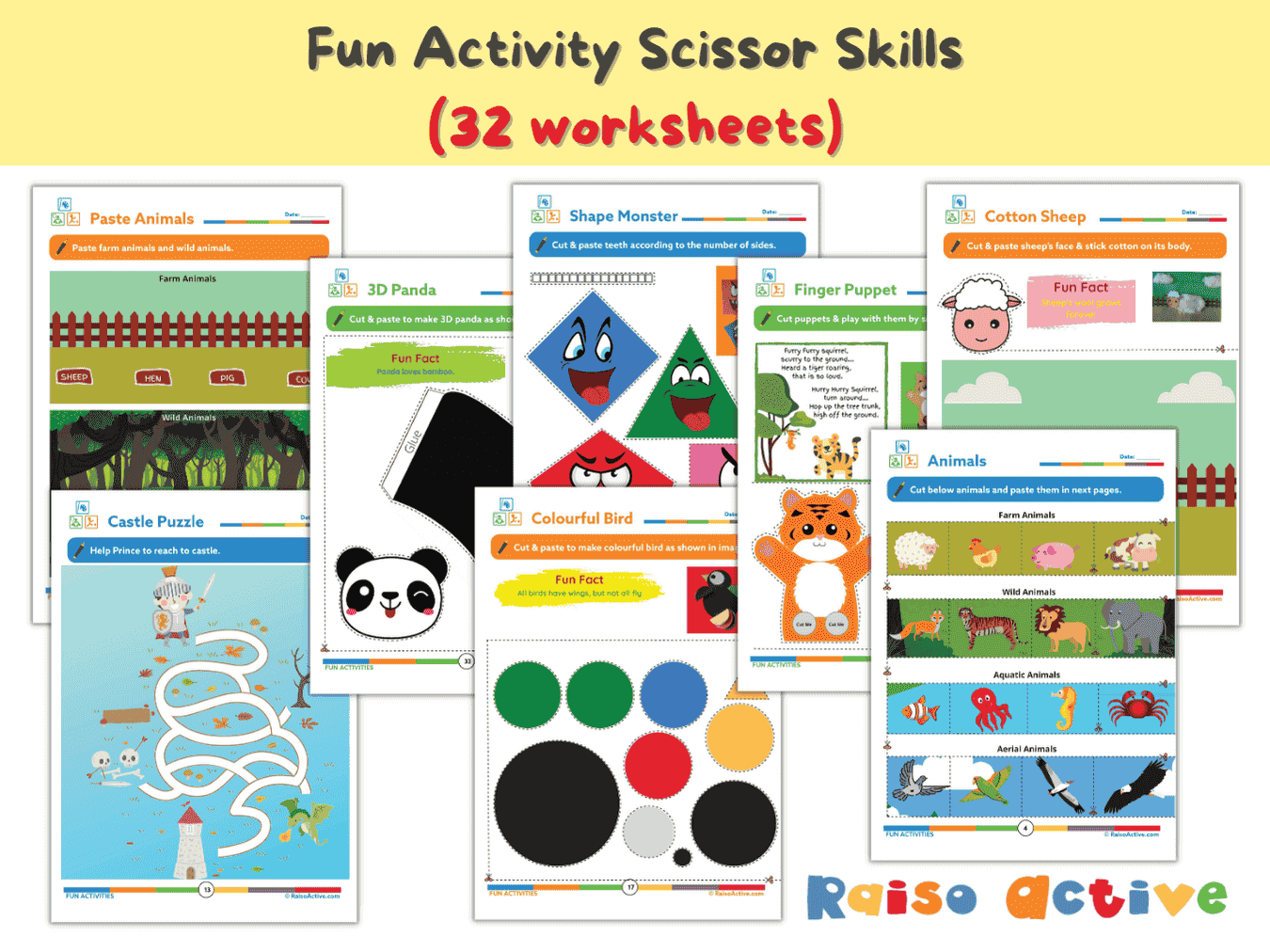
Preschool Scissor Skills Activity Book: Fine Motor & Craft Fun for Ages 3-6
Ages 3-6 · Preschool–KindergartenAges 3-6 · Nursery–Year 1Ages 3-6 · Nursery–UKGAges 3-6 · 35 pages
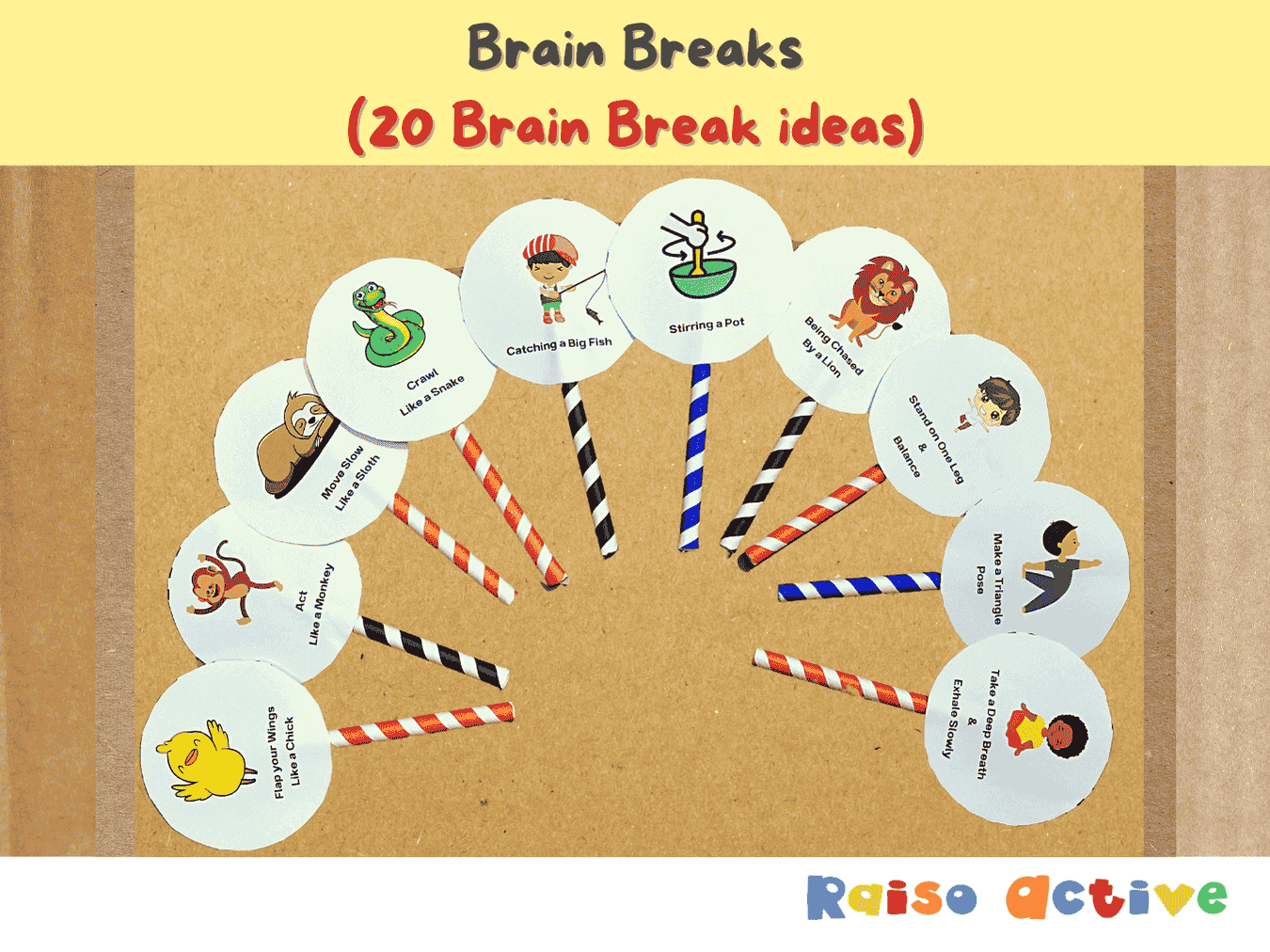
Gross Motor Movement & Imaginative Play Flashcards for Toddlers & Preschoolers
Ages 2-5 · Preschool–Pre-KAges 2-5 · Nursery–ReceptionAges 2-5 · Nursery–LKGAges 2-5 · 5 pages
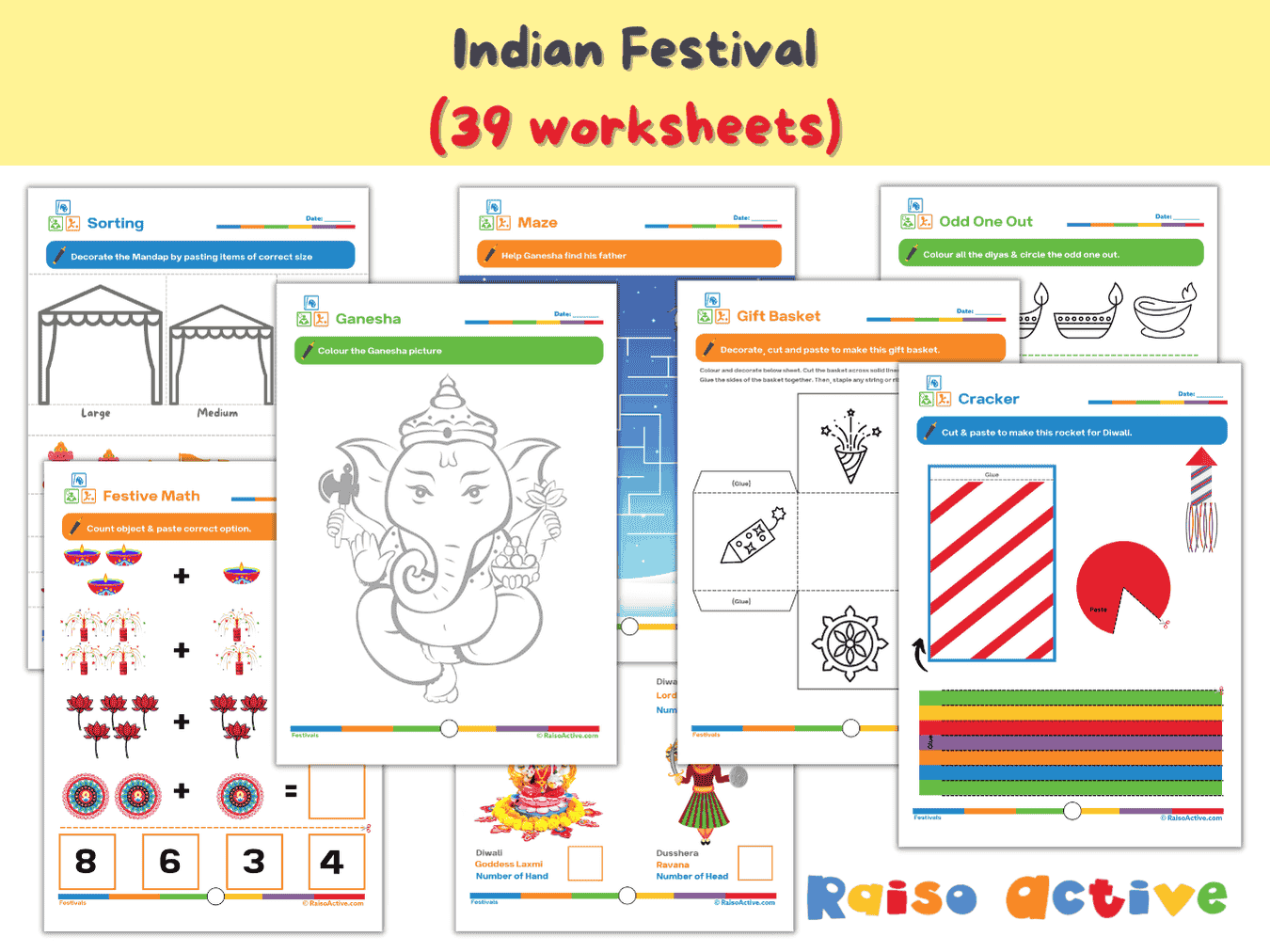
Festivals & Cultural Diversity Activity Book for Kids (Ages 4-8)
Ages 4-8 · Pre-K–Grade 2Ages 4-8 · Reception–Year 3Ages 4-8 · LKG–Class 2Ages 4-8 · 30 pages
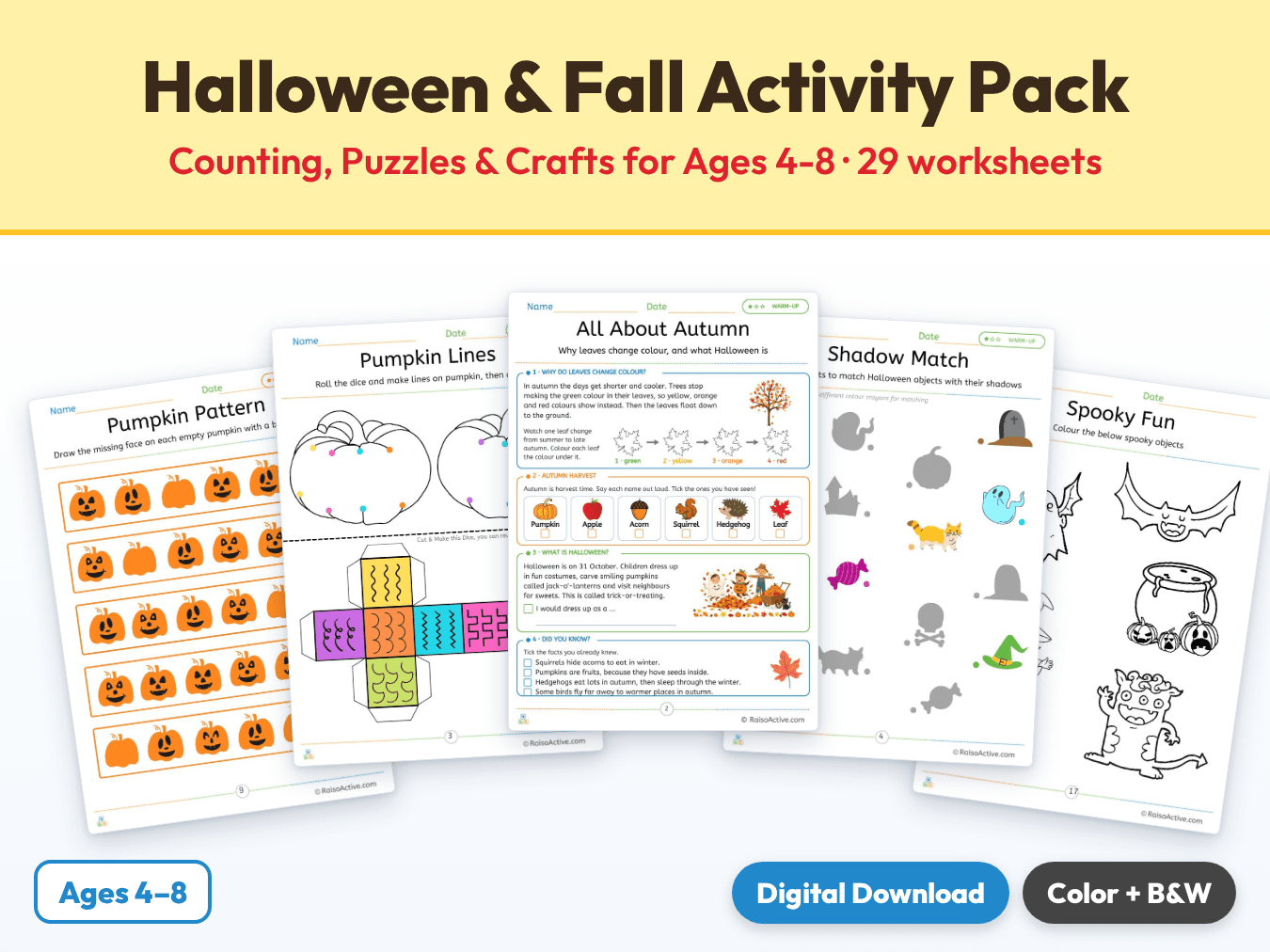
Halloween & Fall Activity Pack: Counting, Puzzles & Crafts for Ages 4-8
Ages 4-8 · Pre-K–Grade 2Ages 4-8 · Reception–Year 3Ages 4-8 · LKG–Class 2Ages 4-8 · 30 pages