How to Document Your Child's Learning Progress: A Comprehensive Guide for Parents and Educators
Author
RaisoActive - Kids Activities and Fun Learning
Published
Updated
Reading Time
19 min read

- Documenting your child's learning helps you spot gaps early, celebrate growth, and have evidence-based conversations with teachers at PTMs
- Methods range from simple learning journals and work sample folders to photos, video clips, and anecdotal notes — choose what suits your lifestyle
- A portfolio approach collects real evidence over time, giving a far richer picture than a single report card or test score
- You do not need special training or expensive tools — a ring binder, a smartphone, and fifteen minutes a week are enough to get started
- Involving children in reviewing their own work builds self-awareness, confidence, and a genuine love of learning
Why Documenting Your Child's Learning Matters
Picture this: it is Parent-Teacher Meeting time at your child's school. The teacher spends three minutes summarising your child's term with comments like "doing well overall" and "could improve in reading." You walk out with a report card full of grades but very little sense of how your child is actually learning, where they struggled, what lit them up, or how much they have grown since June. Sound familiar?
Documenting your child's learning at home changes this entirely. When you keep a thoughtful record of what your child is doing, making, saying, and discovering, you gain something far more valuable than a termly grade — you gain a real, living story of their development. And that story becomes a powerful tool: for spotting learning gaps before they widen, for celebrating milestones big and small, for sharing meaningful evidence with teachers, and for building your child's own sense of pride and progress.
This guide is written for Indian parents and educators navigating the landscape of home documentation — whether you are homeschooling, supplementing school learning with home activities, or simply wanting to be a more informed, engaged participant in your child's educational journey.
Want practical parenting tips in your inbox?
Get age-appropriate activity ideas, milestone guides, and free printable worksheets delivered weekly — made for Indian families.
Why Documentation Matters: Three Compelling Reasons
Before we get into the how, it helps to be clear on the why. There are three core reasons that make documentation genuinely worth your time and effort.
1. Spotting gaps before they become problems. Children are masters at hiding confusion. A child who is struggling with number concepts may still appear engaged in class and may even score adequately on MCQ-based tests. But when you look at their work over weeks — at home writing, counting activities, the questions they ask during play — patterns emerge. You might notice that your four-year-old consistently skips the number thirteen when counting aloud, or that your six-year-old's writing shows letter reversals that are persisting beyond what is typical. Documentation makes the invisible visible.
2. Celebrating growth in meaningful ways. There is a particular magic in showing a child a drawing they made six months ago alongside one they made this morning. The delight on their face — Did I really draw that? Look how much better I am now! — is pure gold. Documentation turns abstract notions of "progress" into something a child can actually see and feel. This builds intrinsic motivation in a way that stickers and gold stars simply cannot.
3. Evidence for schools, transitions, and assessments. In India, parents who come to PTMs with organised evidence of their child's home learning — a portfolio of artwork, writing samples, a note about milestones achieved — are taken far more seriously by teachers. If you ever need to advocate for additional support for your child, or apply for a selective programme, or explain why you believe your child is ready for the next level, documented evidence speaks louder than impressions alone.
Six Practical Documentation Methods
There is no single right way to document learning. The best method is the one you will actually stick to. Here are six approaches — from the simplest to the most comprehensive — so you can find what fits your family's rhythm.
Learning Journals. A simple notebook in which you jot down what your child did, said, or discovered each day or week. It does not need to be elaborate — even three sentences are enough. "Priya counted to 50 without any help today for the first time. She was very excited. Later she tried to write all the numbers but got confused after 39." Over months, these brief entries build a remarkably detailed developmental picture. A learning journal is especially useful for homeschooling families who need a record of coverage.
Photo Documentation. Your smartphone is one of the most powerful documentation tools available. Photograph your child's art, their block constructions, their science experiments, their first attempt at writing their name, their puzzles mid-assembly. A dated photo album (Google Photos works beautifully with its automatic date sorting) becomes a visual timeline of development. Photos capture three-dimensional, process-based learning that worksheets cannot — the tower of blocks before it fell, the playdough dinosaur they made, the way they sorted seeds by size.
Work Samples. Collect actual pieces of your child's work — drawings, colouring pages, worksheets, writing attempts, cut-and-paste projects. The key is to save samples consistently (say, one or two pieces per week) and to date every single piece. When you lay out November's drawing next to March's, the growth is unmistakable. Work samples are particularly powerful for tracking fine motor development, early literacy, and numeracy skills.
Video Clips. Some of the most meaningful learning is entirely invisible on paper — a child explaining their reasoning aloud, reading a sentence for the first time, counting objects by touching each one. Short video clips (even 30-60 seconds) capture this process learning beautifully. A monthly video of your child reading the same short passage or counting the same set of objects becomes a moving portrait of growth.
Anecdotal Notes. These are brief, factual descriptions of specific learning moments written as close to the event as possible. Unlike a learning journal (which can be reflective and narrative), anecdotal notes are observational: "Arjun (age 5 yrs 2 months), 12th March — independently sorted 20 buttons into groups by colour without being asked. Counted each group and announced which had the most. Used the word 'equal' correctly when two groups had 5 each." Anecdotal notes are the gold standard in early childhood assessment and are used by trained educators worldwide.
Audio Recordings. Ask your child to tell you a story, describe a picture, or explain how something works — and record it on your phone. Children's oral language development is one of the best predictors of later literacy, and audio recordings make it possible to track vocabulary growth, sentence complexity, and narrative skills over time. These also make the most wonderful keepsakes.
Date everything — without exception.
The single most important habit in documentation is dating every piece, every photo, every note. An undated drawing is charming. A dated drawing is evidence. Make it a reflex: date first, then file.
The Portfolio Approach: Bringing It All Together
A learning portfolio is not simply a pile of saved worksheets — it is a curated collection of evidence that tells the story of a child's learning over time. Think of it as a scrapbook with purpose: every item has been chosen because it shows something meaningful about where the child was, how they were thinking, or what they were working towards.
Portfolios work across all ages — from a toddler's handprint art and first scribbles to a seven-year-old's chapter summaries and self-assessment sheets. The portfolio can live in a large ring binder with plastic sleeves, an accordion folder, a dedicated box for 3D items, or a digital folder of scanned documents and photos. Many families use a hybrid: physical originals at home, digital copies shared with grandparents in another city.
The portfolio approach aligns beautifully with the spirit of India's National Education Policy (NEP) 2020, which specifically encourages moving away from rote-based assessment towards holistic, competency-based evaluation at the foundational stage. Keeping a portfolio at home is one of the most concrete ways a parent can embody this shift.
Digital Tools vs Physical Folders: What Works Best?
Parents often ask whether they should go digital or stick with physical documentation. The honest answer is: it depends on your habits and your child's age — and often a combination works best.
Physical folders shine for young children (ages 1-5) whose work is tactile and three-dimensional. There is something irreplaceable about a child flipping through an actual folder and holding a drawing they made eight months ago. Physical portfolios also do not require battery life or a working internet connection at the PTM.
Digital tools become increasingly valuable as children get older and produce more varied work — recorded reading sessions, voice memos, videos of projects, scanned writing samples. Apps like Google Drive, Seesaw (popular in international schools), or even a private Google Photos album organised by date are all excellent options. Seesaw in particular allows children to add their own voice reflections to digital portfolio items, which is a lovely feature for ages 4 and up.
The best documentation system is the one you will actually maintain.
An elaborate digital system you abandon after two weeks is far less useful than a simple notebook and a box of dated worksheets that you add to consistently every Sunday. Start simple and build complexity only if you find yourself wanting more.
What to Document — and What to Let Go
One of the most common fears parents express is: "I'll drown in paperwork." The antidote is intentionality. You do not need to save every worksheet or photograph every activity. Be selective.
Document: First attempts at new skills (first time writing their name, first time reading a word independently, first time cutting along a line). Samples that show something interesting about how your child thinks or problem-solves. Work that represents a significant improvement from a previous attempt. Photos or videos of learning that cannot be captured on paper. Your own observations of moments that felt important or surprising.
Let go of: Repetitive practice sheets that all look similar (keep one representative sample rather than twenty). Activities that were purely mechanical and do not reveal anything about understanding. Work your child did not engage with genuinely. The impulse to document everything — it leads to burnout and a portfolio that is impossible to use.
How Often Should You Document? Daily, Weekly, or Monthly?
For most families, a weekly rhythm is the sustainable sweet spot. Every Sunday (or whatever day works for you), spend fifteen minutes doing three things: take a few photos of the week's highlights, add one or two work samples to the portfolio folder, and jot two or three sentences in a learning journal.
Daily documentation is valuable for homeschooling families who need a coverage record, or during periods of intensive skill development (learning to read, for example). Keep daily notes light — bullet points are enough.
Monthly reviews are the most important documentation habit of all. Once a month, sit with your child and look through the portfolio together. Let them see how far they have come. Ask them to choose a favourite piece and tell you why they like it. Ask what they found hard this month and what they want to try next. This reflection process builds metacognition — the ability to think about one's own thinking — which is one of the strongest predictors of academic success.
- On the first day of each month, ask your child to draw a self-portrait using the same size paper and the same materials (crayons or pencil).
- Date each portrait and keep them in order in the portfolio.
- By December, you will have twelve drawings that show extraordinary growth in body awareness, fine motor control, and artistic skill.
- Children from age two upwards can participate in this activity — early portraits are just circles and scribbles, which makes the later ones even more impressive.
Using Documentation to Communicate with Teachers
In the Indian school context, Parent-Teacher Meetings (PTMs) often feel rushed — ten to fifteen minutes per family, a stack of report cards on the desk, and very little time for nuanced conversation. Coming to a PTM with your own documentation changes the dynamic entirely.
When you can say, "I noticed that in November she was struggling with letter spacing in her writing, so we worked on it at home — here are her writing samples from November and from this week — and I would love to know if you are seeing similar improvement in class," you signal to the teacher that you are a serious, observant parent. The conversation shifts from one-directional report delivery to genuine two-way collaboration.
Documentation is also invaluable if you ever need to raise a concern about your child's learning. If you suspect a learning difficulty, or feel your child needs additional challenge, or disagree with a school assessment, documented evidence from home gives your concern weight and specificity. "Here are twelve weeks of reading samples showing consistent letter reversal past the age when this typically resolves" is a much stronger basis for conversation than "I feel like something is not quite right."
- Look through your documentation from the past term and write a brief one-page summary: what your child has been working on at home, milestones achieved, areas you've noticed as challenging, and one or two specific questions you want the teacher's input on.
- Bring two or three sample pieces that illustrate your observations — do not bring the whole portfolio.
- End the meeting by establishing a shared next goal: one thing you will work on at home and one thing the teacher will focus on in class.
Involving Children in Reflecting on Their Own Work
Perhaps the most undervalued aspect of documentation is what happens when children are invited into the process. From around age three, children can begin to participate in reflecting on their own work — and the benefits are profound.
When you sit with your child and flip through their portfolio together, asking questions like "Which of these drawings do you like best?" or "What do you notice about your writing from last month compared to now?" or "What was really hard for you to learn this term?" — you are building exactly the kind of self-awareness, growth mindset, and reflective thinking that research consistently links with long-term learning success.
For children who cannot yet write, you can scribe their reflections for them: write their exact words on a sticky note and attach it to the piece. "Meera (age 4) said: 'I like this one because the dog has a big smile.'" For older children, provide simple self-assessment prompts: "I am proud of this because... / This was hard because... / Next time I want to try..."
- Do not turn documentation into a performance — if your child feels they are being constantly observed and evaluated, it can create anxiety. Keep it warm, conversational, and celebratory.
- Never use documentation to compare your child with neighbours', cousins', or classmates' children. Portfolios measure a child's growth against their own previous self — not against anyone else.
- Do not document only successes. Include early attempts, works-in-progress, and things your child found difficult. The struggle is part of the story.
Children who regularly reflect on their own learning are three times more likely to develop strong metacognitive skills — the ability to plan, monitor, and evaluate their own thinking — which is one of the most powerful predictors of academic achievement across all subjects.
Source: Hattie & Timperley, Review of Educational Research
India's National Education Policy 2020 explicitly calls for holistic, multidimensional assessment in the foundational years (ages 3-8), moving away from summative, exam-based evaluation. Home documentation portfolios align directly with this national vision for early childhood education.
Source: Ministry of Education, Government of India
How to Start Documenting Your Child's Learning: A Practical Setup
Gather your basic materials
You need: one large ring binder with clear plastic sleeves (for flat work), one box or large ziplock bag (for 3D items and bulky projects), a permanent marker or pen for dating, a pack of sticky notes for adding context, and a dedicated album or folder on your phone for learning photos. That is it. Start simple.
Set up your portfolio sections
Divide the binder using tab dividers into five sections: Literacy (drawing, writing, reading), Numeracy (counting, patterns, number work), Fine Motor (cutting, colouring, tracing), Creative & Play (photos of projects, craft work), and My Voice (dictated reflections, self-assessments). Adapt these sections to what your child is actually working on.
Establish your weekly documentation habit
Choose one day per week — Sunday works well for many families — and block out fifteen minutes. Take any photos from the week off your phone and save them to the dedicated album. Add one or two work samples to the binder (write the date and a brief note on the back of each). Jot two or three sentences in your learning journal about anything that stood out this week.
Begin your anecdotal notes habit
Keep a small notebook or use the notes app on your phone to capture specific learning moments as they happen. Aim for one anecdotal note per week. Include the date, your child's age, what happened, and what it suggests about their development. These informal observations become some of the most valuable records in your portfolio.
Start monthly photo documentation
At the start of each month, do a dedicated ten-minute photo session: photograph your child's self-portrait (see activity tip above), a piece of their current writing or drawing, and one activity that represents something they are working on. This gives you a reliable monthly snapshot that makes growth easy to track.
Schedule your monthly portfolio review
Put a recurring reminder in your calendar: first Sunday of each month, fifteen minutes, portfolio review with your child. Sit together, flip through recent additions, celebrate what you see, and let your child choose something to add or remove. Ask reflection questions. This is the moment the documentation truly comes to life.
Prepare for PTMs with your documentation
Two days before each Parent-Teacher Meeting, spend twenty minutes reviewing your documentation from the past term. Write a brief one-page note summarising what you have observed at home — milestones, challenges, interests, questions. Bring two or three representative work samples. Walk into the PTM as an informed, prepared partner in your child's education.
- +Easy to search and organise by date
- +Can include video and audio recordings
- +Simple to share with teachers and family members remotely
- +No storage space needed at home
- +Risk of loss if not backed up
- +Requires device and battery
- +Best for ages 5 and up with varied, multimedia work
- -Tangible — children can hold and handle their work
- -No technology required
- -Original artwork preserved
- -Easier for young children to engage with during reviews
- -Requires physical storage and organisation
- -Harder to share with distant family members
- -Best for ages 1-5 with lots of art, craft, and hands-on work
Get Free Printables to Build Your Child's Learning Portfolio
Join thousands of Indian parents using our age-appropriate worksheets and activity sheets to document and celebrate their children's progress. Subscribe for free resources every week.
Frequently Asked Questions About Documenting Your Child's Learning
How do I find the time to document my child's learning alongside everything else?
My child's school already does assessments and sends home report cards. Why should I document separately?
At what age should I start documenting my child's learning?
How do I use my documentation effectively at Parent-Teacher Meetings (PTMs)?
What if I notice something concerning in my documentation — a pattern that worries me?
How do I handle it if my child does not want to look at their portfolio or gets upset seeing old work?
Free worksheets for this topic
Browse all worksheets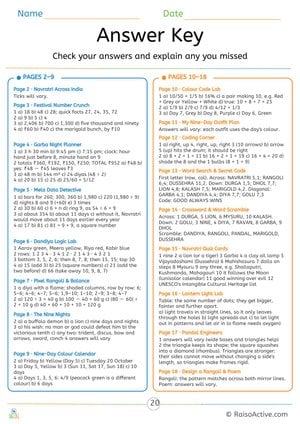
Navratri Festival Quest Answer Key for Grown-ups
Ages 7-11 · Grade 2–Grade 3Ages 7-11 · Year 3–Year 4Ages 7-11 · Class 2–Class 3Ages 7-11
Grown-ups can check every answer in the pack, with workings for the maths, grid positions for the word search, the logic grid and sudoku solutions, and the reasons behind the science results.
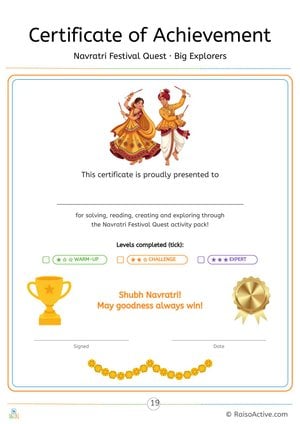
Navratri Festival Quest Certificate of Achievement
Ages 7-11 · Grade 2–Grade 3Ages 7-11 · Year 3–Year 4Ages 7-11 · Class 2–Class 3Ages 7-11
Children celebrate finishing the Navratri Festival Quest pack and record which levels they completed.
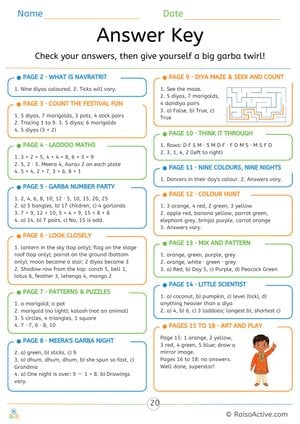
Navratri Fun Time Answer Key for Grown-ups
Ages 4-6 · Pre-K–KindergartenAges 4-6 · Reception–Year 1Ages 4-6 · LKG–UKGAges 4-6
Grown-ups can quickly check every answer in the Navratri Fun Time pack, page by page.

Navratri Fun Time Certificate of Achievement
Ages 4-6 · Pre-K–KindergartenAges 4-6 · Reception–Year 1Ages 4-6 · LKG–UKGAges 4-6
Children celebrate finishing the Navratri Fun Time pages and see which levels they completed.

Written by
Hemsweta Jain · Teacher Cheena
MBA and Early Childhood Educator, teaching since 2014 · Founder of RaisoActive, Mumbai
Published · Last reviewed
Related Resources
Printable Resources(2)
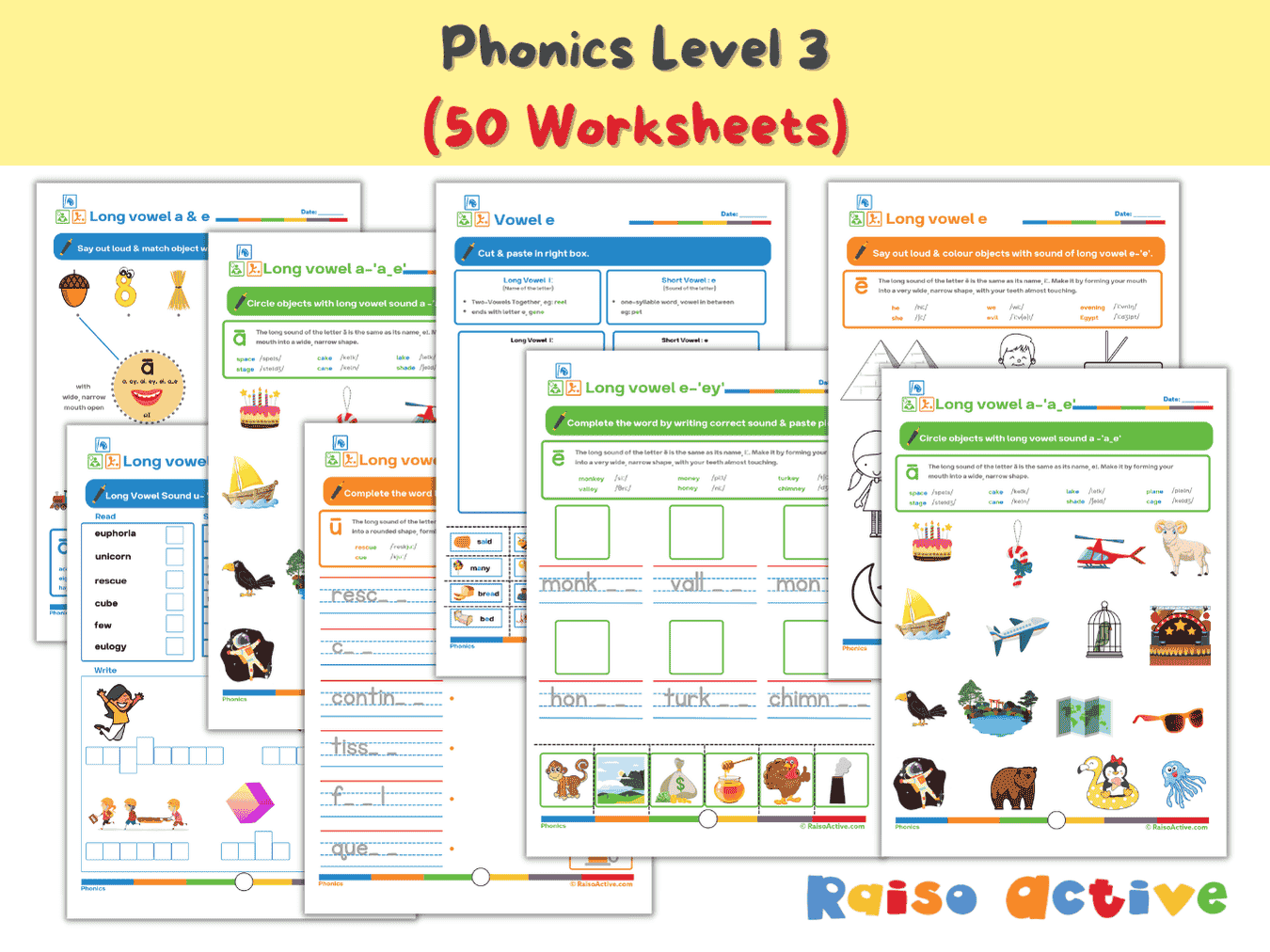

Phonics Level 3 Long Vowels Activity Book for Kindergarten & 1st Grade
Ages 5-7 · Kindergarten–Grade 1Ages 5-7 · Year 1–Year 2Ages 5-7 · UKG–Class 1Ages 5-7 · 51 pages

Flags of the World Activity Book & Flashcards for Kids (Ages 5-9)
Ages 5-8 · Kindergarten–Grade 2Ages 5-8 · Year 1–Year 3Ages 5-8 · UKG–Class 2Ages 5-8 · 23 pages