Looking for a structured learning path?
Explore our age-wise monthly curriculum with 4 subjects per month
Free Printable Worksheets
Browse Worksheets
Download free educational worksheets for children ages 1-8. Perfect for preschool, kindergarten, and early elementary learning activities.
Filters
Age Range
Curriculum
Tags

Classify Animals: Sorting Worksheet for Preschoolers
Deciding which category — birds, fish, insects, or reptiles — each animal belongs to builds classification thinking for children ages 3-5, an early scientific skill of grouping things by shared characteristics.

Classify Animals: Cut and Paste Worksheet for Preschoolers
Children ages 3-5 practice classifying animals by their natural habitat, sorting pictures into groups like forest animals and farm animals, building early science reasoning about how different environments support different animals. Combining this classification task with cutting and pasting also strengthens fine motor control.

Wild Animals Cut and Paste Worksheet for Preschoolers
Children ages 3-5 practice fine motor cutting and pasting skills while learning to recognize wild animals such as lions, tigers, or elephants that live in jungle habitats rather than around a home. This builds early classification knowledge about animal habitats alongside hands-on scissor practice.

Domestic Animals Cut and Paste Worksheet for Kids
Children ages 3-5 practice classifying domestic animals by recognizing which animals typically live around a house or garden, building early animal-classification knowledge alongside fine motor cutting and pasting skills. Sorting animals by where they live is a first step toward broader science categorization skills.
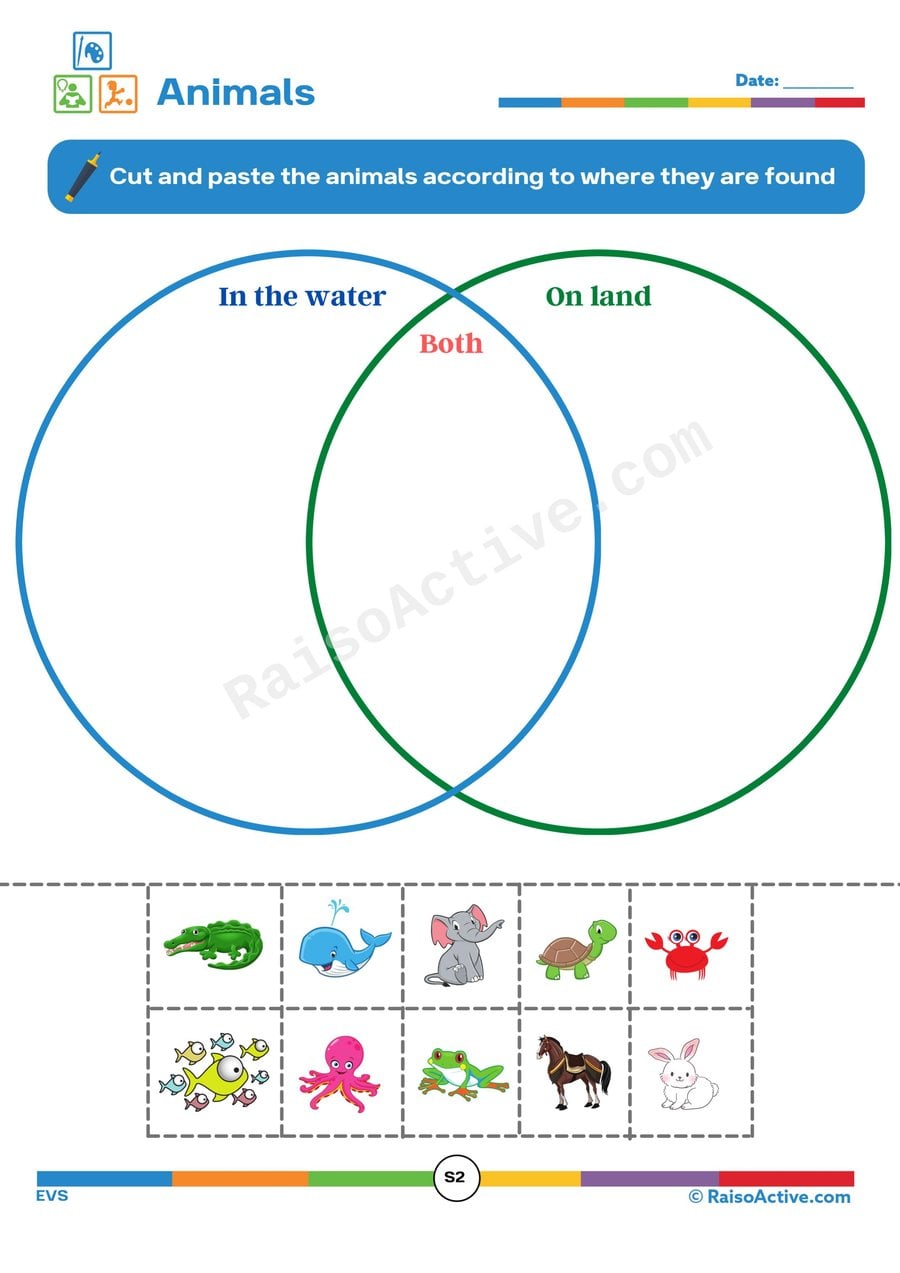
Animals: Sorting Worksheet for Preschoolers
This sorting worksheet has children ages 3-5 cut out animal pictures and paste each one into either a water or land habitat circle, building an early classification skill around where different animals naturally live. Sorting animals by habitat, rather than by type or size, introduces the idea that an animal's environment is a meaningful category on its own.

Domestic Animals Worksheet for Preschoolers: Circle the Animals!
Circling only the domestic animals among a mixed group teaches children ages 3-5 to apply a category rule to unfamiliar examples, an early reasoning skill that goes beyond simply naming animals they recognize. This visual discrimination task also builds vocabulary as children practice identifying each animal before deciding whether it belongs.

Wild Animals Cut and Paste Worksheet for Preschoolers
Children ages 3-5 practice scissor control and glue placement while learning to identify wild animals and place them into a jungle habitat, connecting the idea that specific animals belong to specific environments. This activity builds fine motor precision — cutting along a line and centering an object with glue — while introducing early habitat vocabulary like jungle, forest floor, and trees.

Animal Sorting Worksheet: Wild vs. Domestic Animals
Sorting animal pictures into wild and domestic categories teaches children ages 3-5 an early form of classification, deciding where an animal belongs based on how it lives rather than its size or appearance alone. Cutting and pasting the animals also builds fine motor precision while reinforcing new animal vocabulary along the way.

Farm Animal Fun: Cut and Paste Worksheet for Preschoolers
Coloring, cutting, and pasting farm animals onto a scene teaches children ages 3-5 farm animal vocabulary while giving substantial fine motor practice through careful cutting along lines. Building the completed farm scene also lets children practice spatial placement, deciding where each animal fits within the picture.
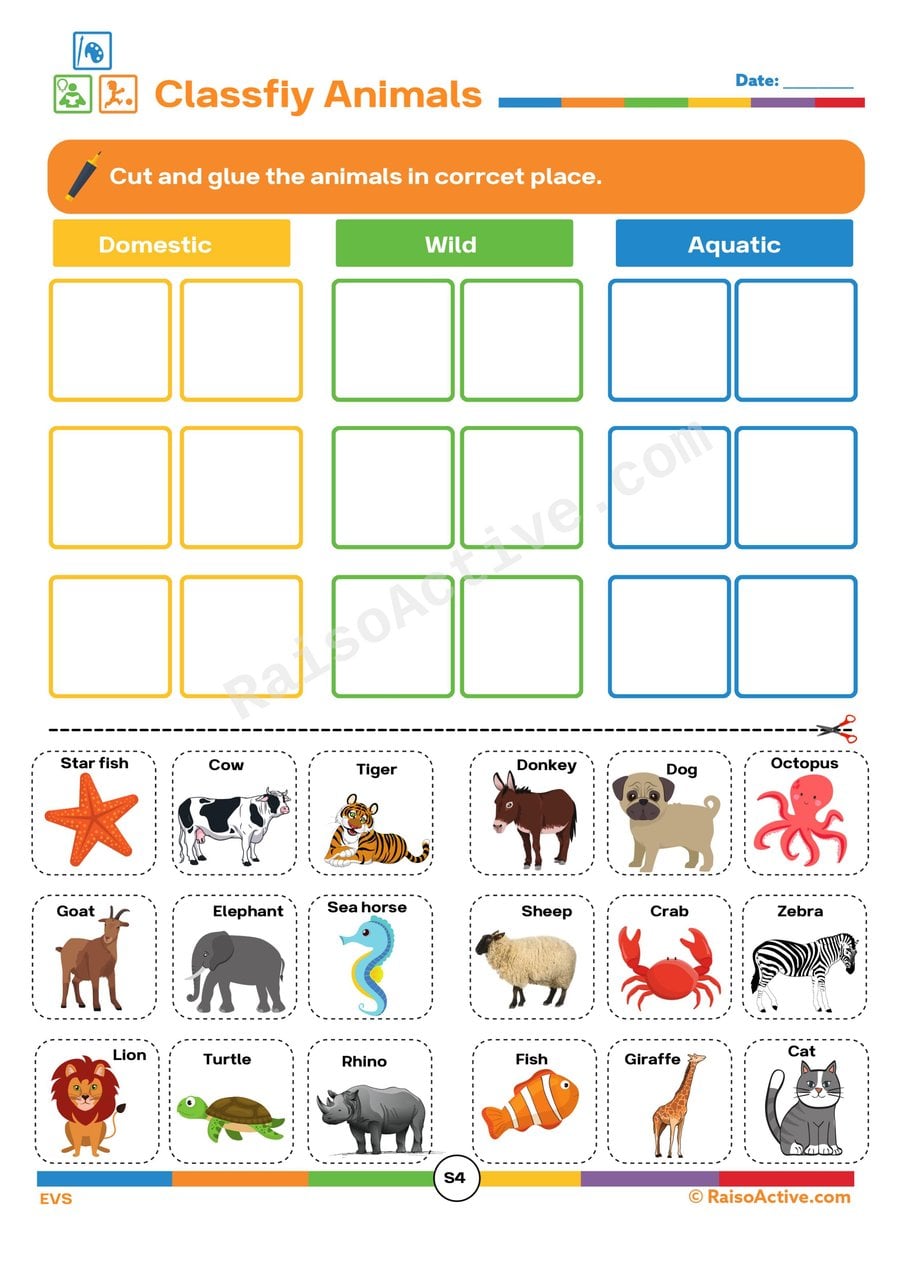
Classify Animals: Sorting Worksheet for Kids
Sorting animals into domestic, wild, and aquatic categories asks children ages 4-6 to classify based on habitat and human relationship rather than just appearance, a more advanced kind of categorization than simple color or shape sorting. This builds early scientific thinking, since children must consider where an animal lives and how it behaves to decide where it belongs. The cut-and-paste format also reinforces the categories through repeated physical sorting rather than a single verbal answer.

Animal Sorting Worksheet: Wild, Domestic, and Sea Animals!
This worksheet asks children ages 3-5 to classify animals into three categories - wild, domestic, and sea animals - based on where and how each one lives, building early categorization skills alongside animal and habitat vocabulary. Learning to sort by a shared characteristic, like habitat, is foundational scientific thinking that children will use again and again as they group and compare other things in the world around them.
Want Unlimited Downloads?
Subscribe to get unlimited access to all worksheets without watermarks
View Subscription Plans