Looking for a structured learning path?
Explore our age-wise monthly curriculum with 4 subjects per month
Free Printable Worksheets
Browse Worksheets
Download free educational worksheets for children ages 1-8. Perfect for preschool, kindergarten, and early elementary learning activities.
Filters
Age Range
Curriculum
Tags

Cut and Paste the Word: Fun Reading Worksheet for Kids!
This cut-and-paste decoding activity has children ages 4-5 sound out simple CVC (consonant-vowel-consonant) words like 'cat' or 'sun' and match the missing picture to complete each word, directly practicing the phonics blending skills that underpin early reading fluency. Because the word is partly built from letters already on the page, children must connect individual letter sounds to a whole word rather than just recognizing a picture in isolation. This bridges the gap between knowing individual letter sounds and reading complete three-letter words independently.

Phonics Parent's Guide: Decoding and Encoding for Early Readers
This is a reference guide for parents and teachers of children ages 3-5, laying out how phonics instruction actually works: the progression from hearing individual sounds, to blending them into words (decoding), to building words from sounds (encoding). Understanding these stages helps adults recognize which skill their child is working on at any given moment and choose activities that match, rather than jumping ahead to reading whole books before sound-blending is solid. It's designed to be read by the adult, not completed by the child.

Parent's Guide: Decoding and Encoding CVC Words Worksheet
This reference guide explains the phases of learning to decode (read) and encode (spell) CVC words, consonant digraphs, and vowel digraphs to parents of children ages 4-6. Understanding the difference between decoding and encoding — reading a word versus spelling it from sound — helps adults recognize that these are two related but distinct skills, both of which need dedicated practice time.
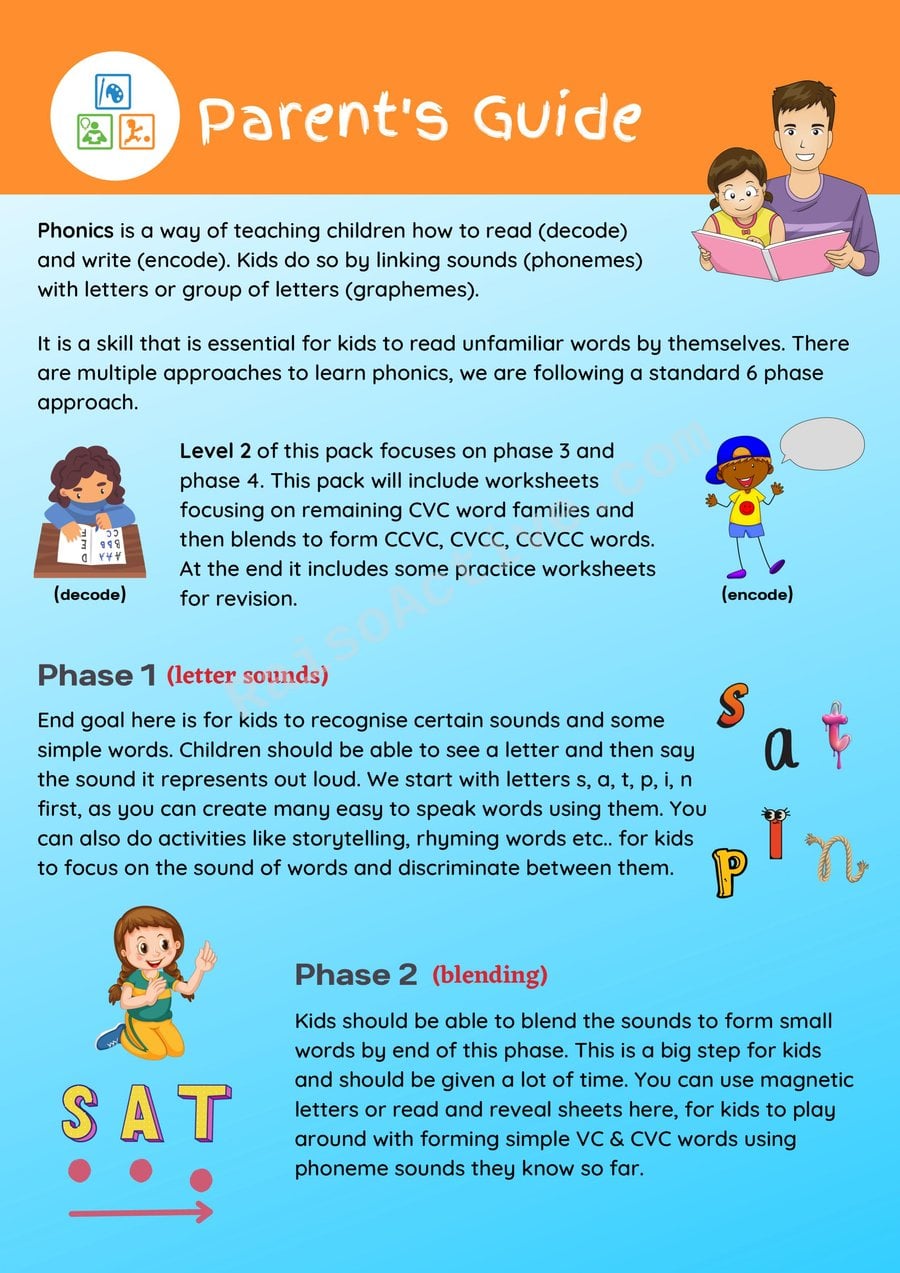
Phonics Fun: Decoding and Encoding Worksheet
This worksheet introduces children ages 3-5 to the two core directions of phonics work: decoding, or sounding out written letters to read a word, and encoding, or listening to sounds and writing the letters that represent them. Understanding that reading and writing are two sides of the same phonics coin helps children see the connection between the two skills rather than treating them as unrelated tasks. Practicing both directions together in one activity builds a more complete and flexible foundation than focusing on reading or writing alone.

Parent's Guide: Decoding and Encoding CVC Words Worksheet
This reference guide walks parents through the phases children ages 4-6 move through when learning to decode and encode consonant-vowel-consonant, or CVC, words, such as 'cat' or 'dog,' before progressing to trickier patterns involving consonant and vowel digraphs. Understanding these phases helps you pace phonics practice appropriately, since attempting digraphs before CVC blending is solid can overwhelm early readers.

Phonics Phase 1 & 2: Letter Sounds and Blending Worksheet
This worksheet introduces children ages 4-5 to blending, the process of combining individual letter sounds into a whole word, using the common early phonics sound set s, a, t, p, i, n to build the word 'sat.' Blending is one of the most important early reading skills, since it's the bridge between knowing individual letter sounds and actually reading connected words. Practicing with this specific sound set follows a widely used early phonics sequence, since these six letters combine to form many simple three-letter words.
Want Unlimited Downloads?
Subscribe to get unlimited access to all worksheets without watermarks
View Subscription Plans