Looking for a structured learning path?
Explore our age-wise monthly curriculum with 4 subjects per month
Free Printable Worksheets
Browse Worksheets
Download free educational worksheets for children ages 1-8. Perfect for preschool, kindergarten, and early elementary learning activities.
Filters
Age Range
Curriculum
Tags

Fall Leaf Patterns Matching Worksheet for Preschoolers
Children ages 3-5 build pattern recognition and logical reasoning skills by matching colored fall leaves to complete repeating patterns in a grid. Recognizing and continuing a pattern is an early algebraic thinking skill, teaching children to notice what comes next based on a repeating sequence — a foundation for later math concepts.

Mystery Numbers Worksheet: Find the Hidden Numbers!
This 'Mystery Numbers' worksheet challenges children ages 4-6 to use logical reasoning and clue-reading to identify a hidden number, moving them beyond simple counting into deductive thinking. Each clue narrows down the possibilities, so children practice holding multiple pieces of information in mind at once, an early step toward number sense and problem-solving. It also reinforces number recognition as they check candidate numbers against every clue before settling on an answer.
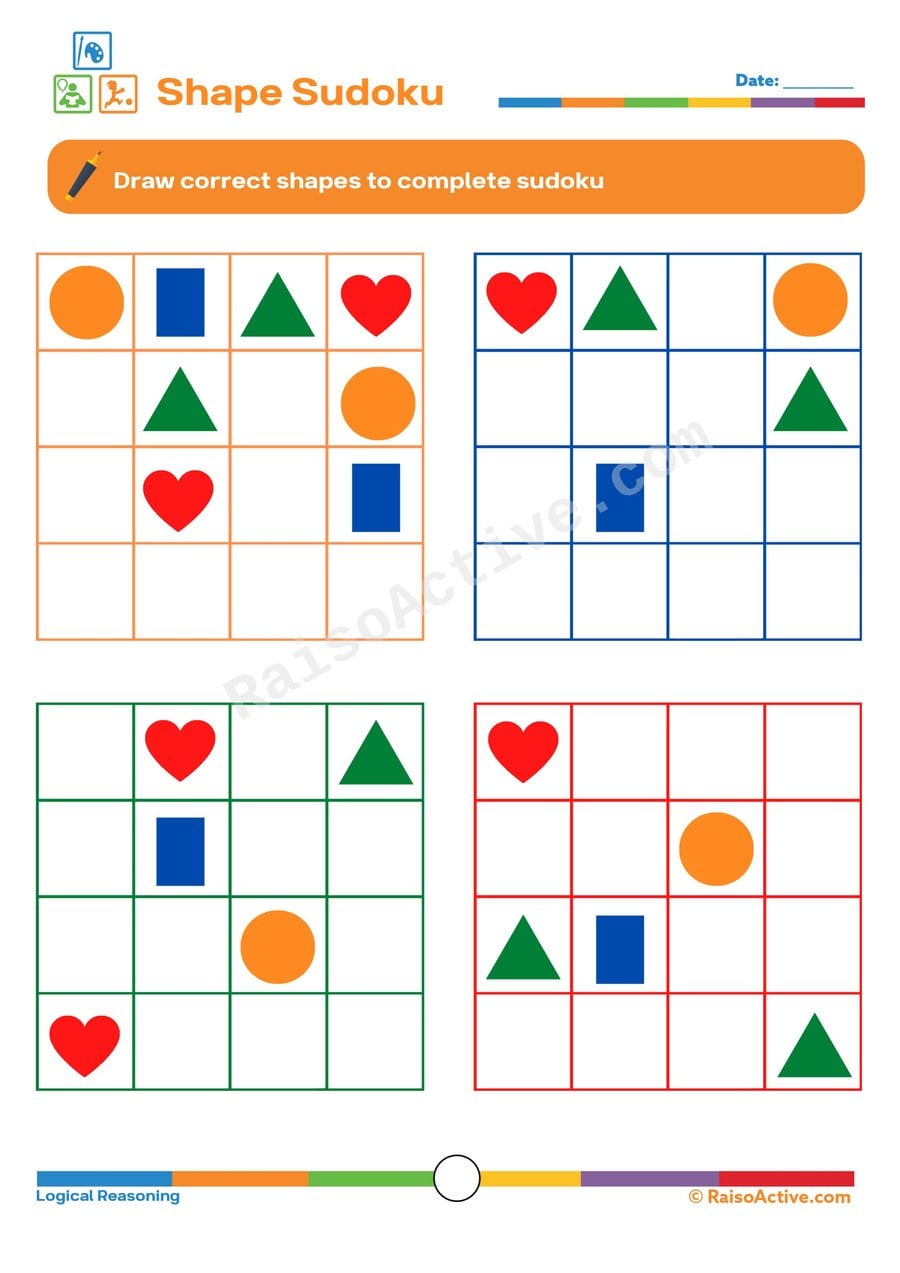
Shape Sudoku: Complete the Puzzles!
This shape-based Sudoku worksheet challenges children ages 4-6 to apply logical reasoning as they fill in missing shapes so that each row, column, and smaller grid section contains every shape exactly once. Unlike simple shape naming, Sudoku requires children to track multiple constraints at the same time and use process of elimination, an early and valuable introduction to structured logical thinking. Successfully completing even a simplified shape Sudoku builds real confidence in tackling multi-step problems methodically.

Find the Matching Image: A Fun Logical Reasoning Worksheet for Kids
Reading or listening to a short description and circling the image that matches it teaches children ages 3-5 to translate spoken or written language into a mental picture, then compare that picture against several visual options. This kind of description-to-image matching builds listening comprehension and logical reasoning, since children must hold multiple details in mind, like color, size, or action, before deciding which image fits all of them. It's a step up from simple visual matching because it requires connecting language to an image rather than comparing two pictures directly.
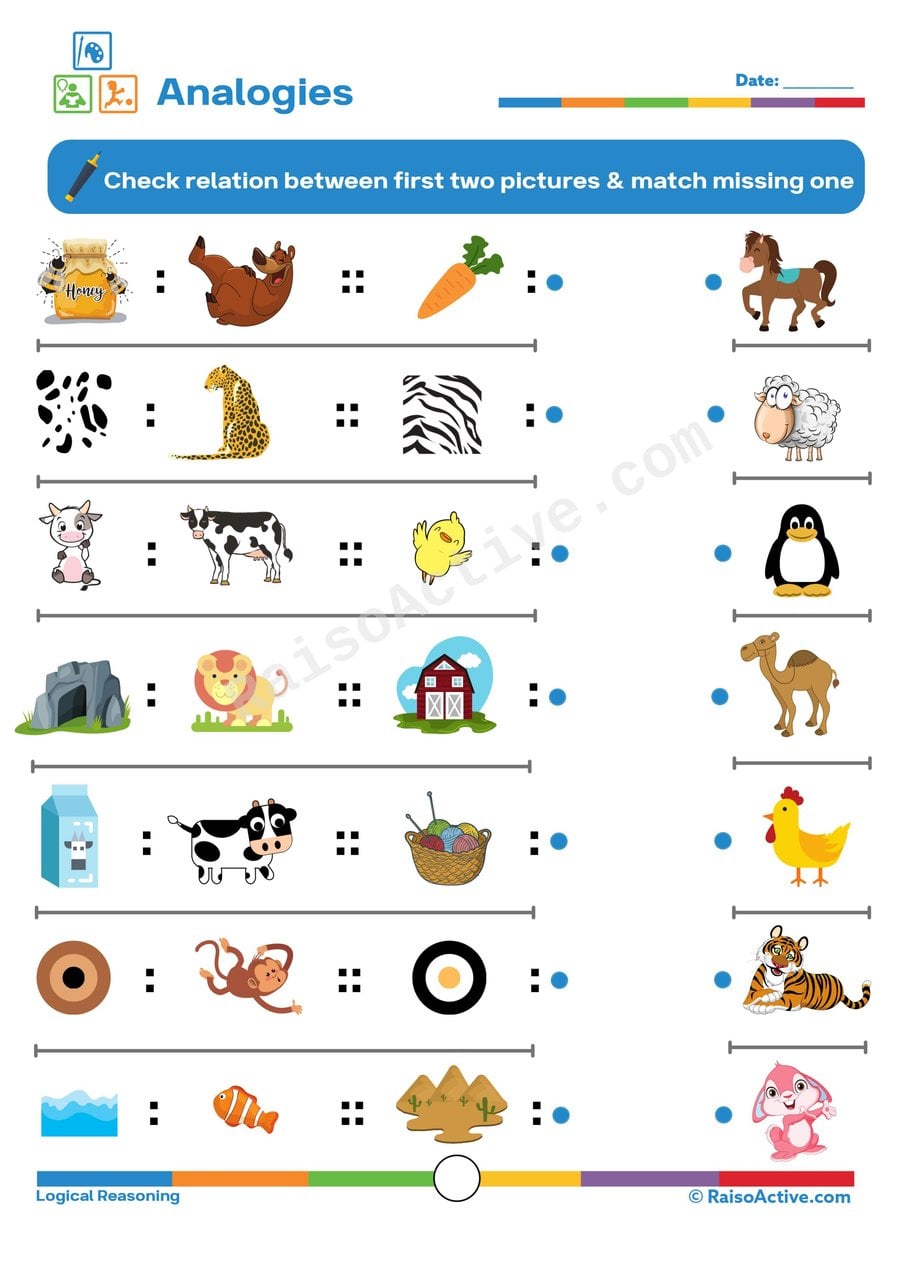
Analogies Worksheet: Match the Pictures!
Identifying the relationship between two pictures and then finding a third picture that completes the same relationship teaches children ages 4-6 an early form of analogical reasoning, a skill that underlies much of later logical and mathematical thinking. Because children must first figure out an abstract relationship, like cause and effect or part to whole, before applying it to a new pair, this worksheet is more advanced than simple picture matching. Drawing a line to connect the completed analogy gives a clear, hands-on way to show their reasoning.

Holiday Sudoku: Cut and Paste Picture Puzzle Worksheet
This holiday-themed sudoku worksheet builds logical reasoning and problem-solving skills in children ages 4-6 by having them determine which holiday picture is missing from each row and column of a puzzle grid. Solving a picture sudoku by elimination, rather than by simple matching, requires children to hold multiple constraints in mind at once — what's already in the row and what's already in the column — which is genuinely challenging early logic practice. The festive imagery adds motivation and seasonal fun to an otherwise abstract reasoning task.
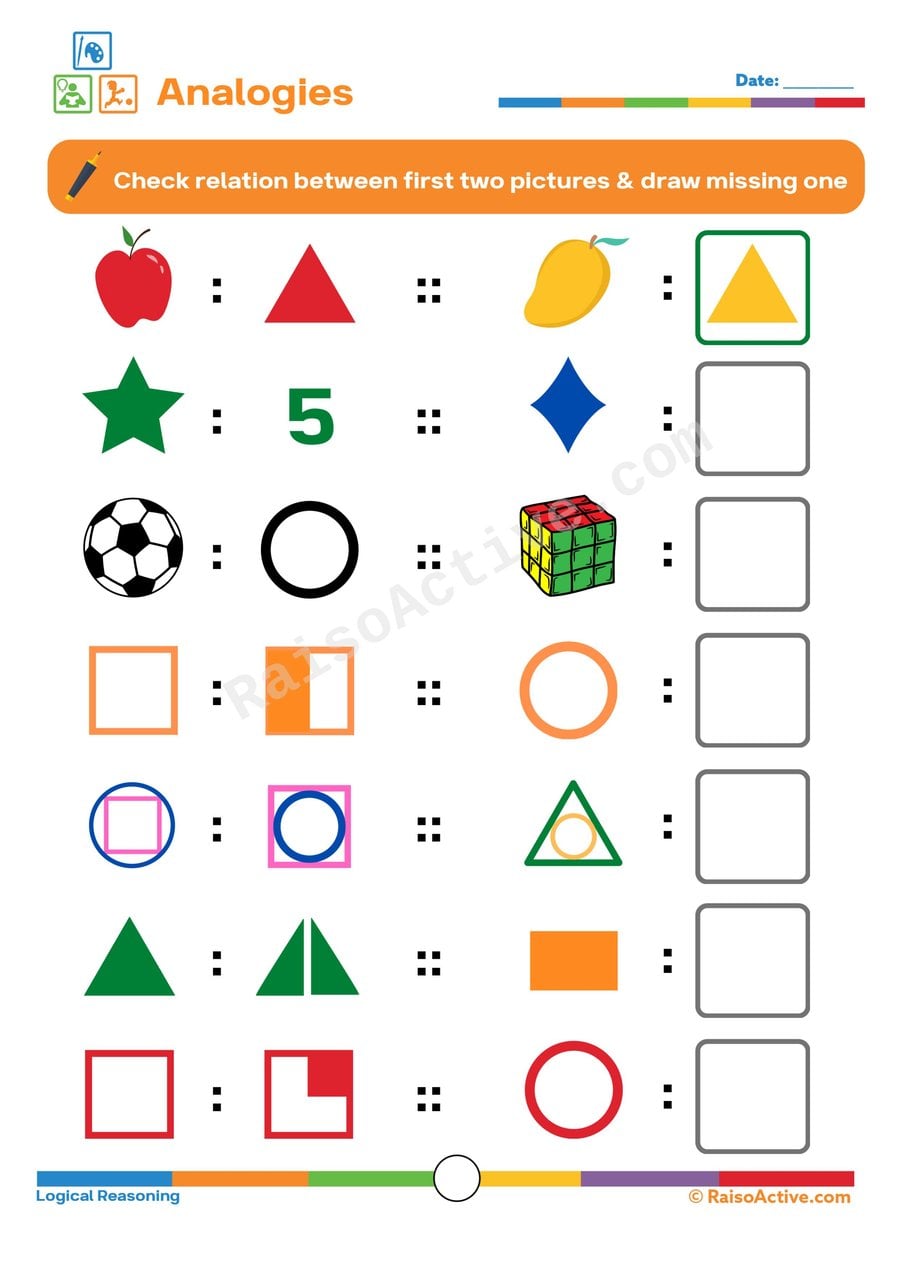
Shape Analogies Worksheet: Find the Pattern!
This shape analogy worksheet pushes children ages 3-5 beyond simple shape naming into relational reasoning, asking them to figure out how two shapes relate to each other and then apply that same relationship to a third shape. This 'this is to that as this is to what' thinking is an early form of the analogical reasoning used throughout later math and logic problems. Because the task requires holding two pieces of information in mind at once — the shape and the relationship — it offers meaningfully more challenge than basic shape matching.
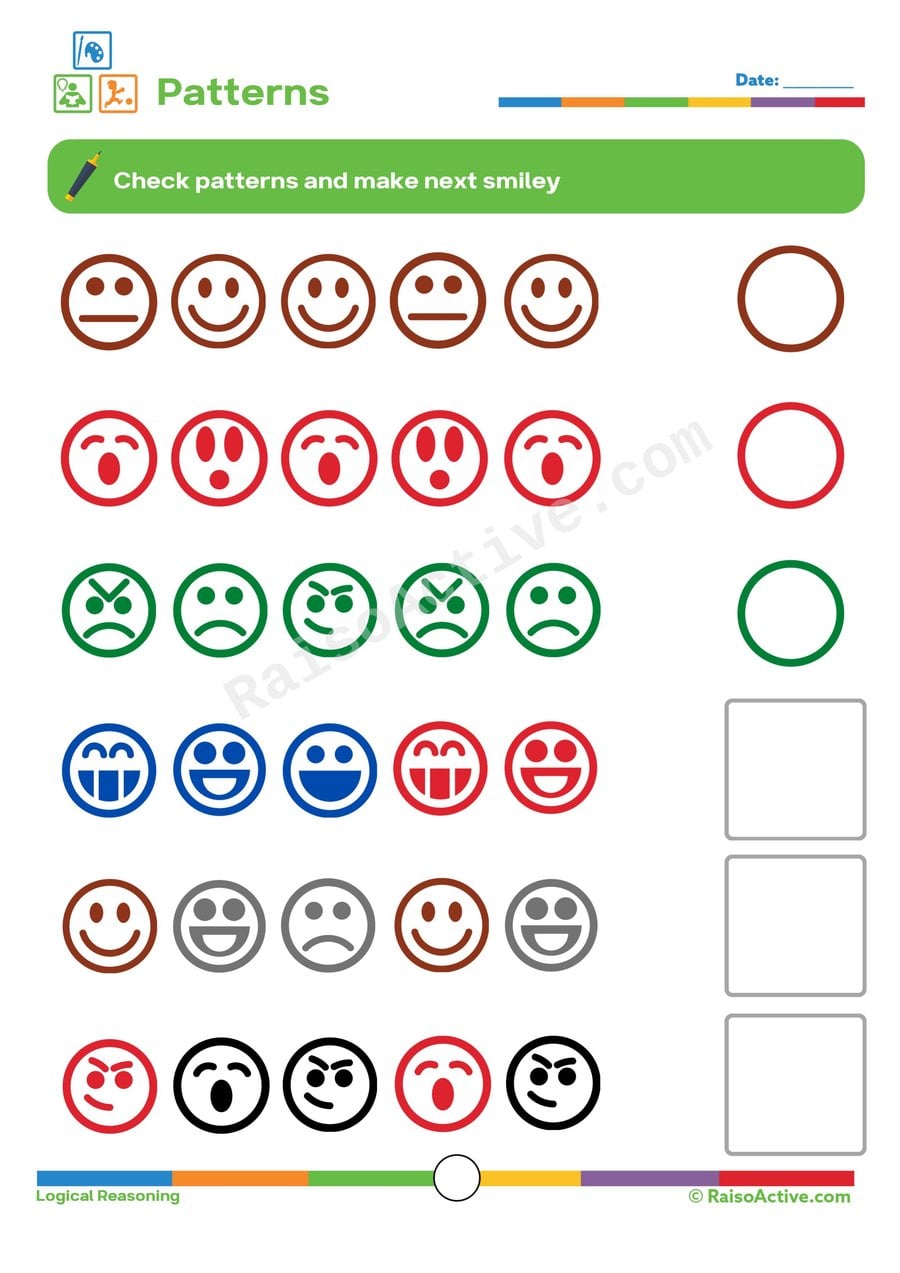
Smiley Face Patterns Worksheet for Preschoolers
This pattern worksheet has children ages 3-5 study a row of smiley faces with varying expressions or colors and determine what comes next in the repeating sequence, building foundational pattern recognition and logical reasoning skills. Recognizing and extending patterns is one of the earliest forms of mathematical thinking children encounter, laying groundwork for later work with number patterns, skip counting, and algebraic reasoning. Because the pattern uses a familiar, emotionally engaging image like a smiley face, children stay motivated through several rows of repeated practice.

Observe and Complete the Patterns Worksheet for Preschoolers
This worksheet builds foundational pattern-recognition skills in children ages 3-5 by asking them to study a repeating sequence of shapes or objects and determine what comes next. Recognizing patterns requires children to notice a repeating unit and apply logical prediction, skills that directly support later math concepts like skip counting, multiplication, and even reading number sequences. Coloring or drawing the missing item also reinforces the answer through a hands-on, creative response.
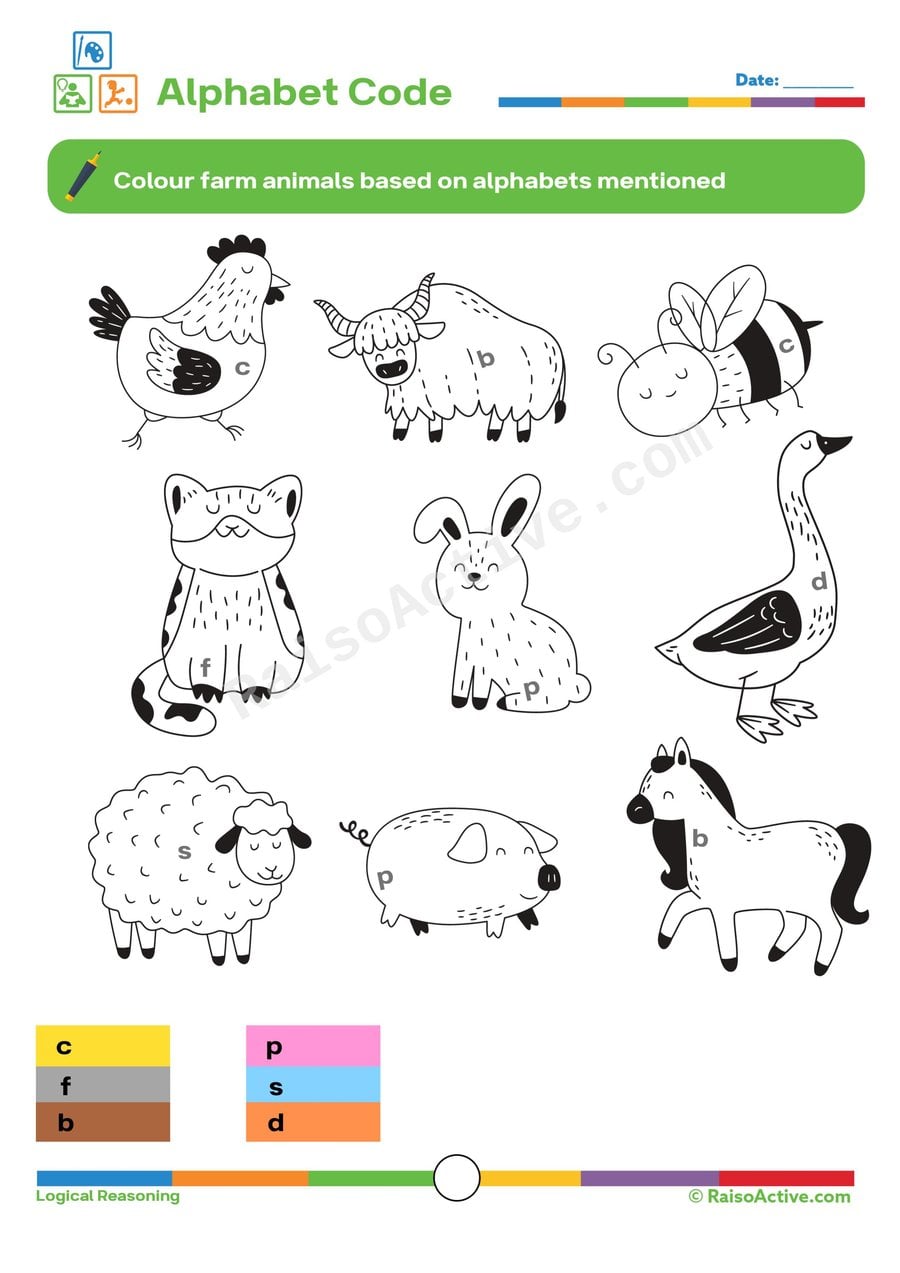
Color the Farm Animals! Alphabet Code Worksheet
Children ages 3-5 practice letter recognition and instruction-following by coloring farm animals according to a color code tied to specific letters. Matching a letter to its assigned color adds an extra layer of symbolic thinking beyond simple coloring, since children must hold both a letter and a color in mind at once.
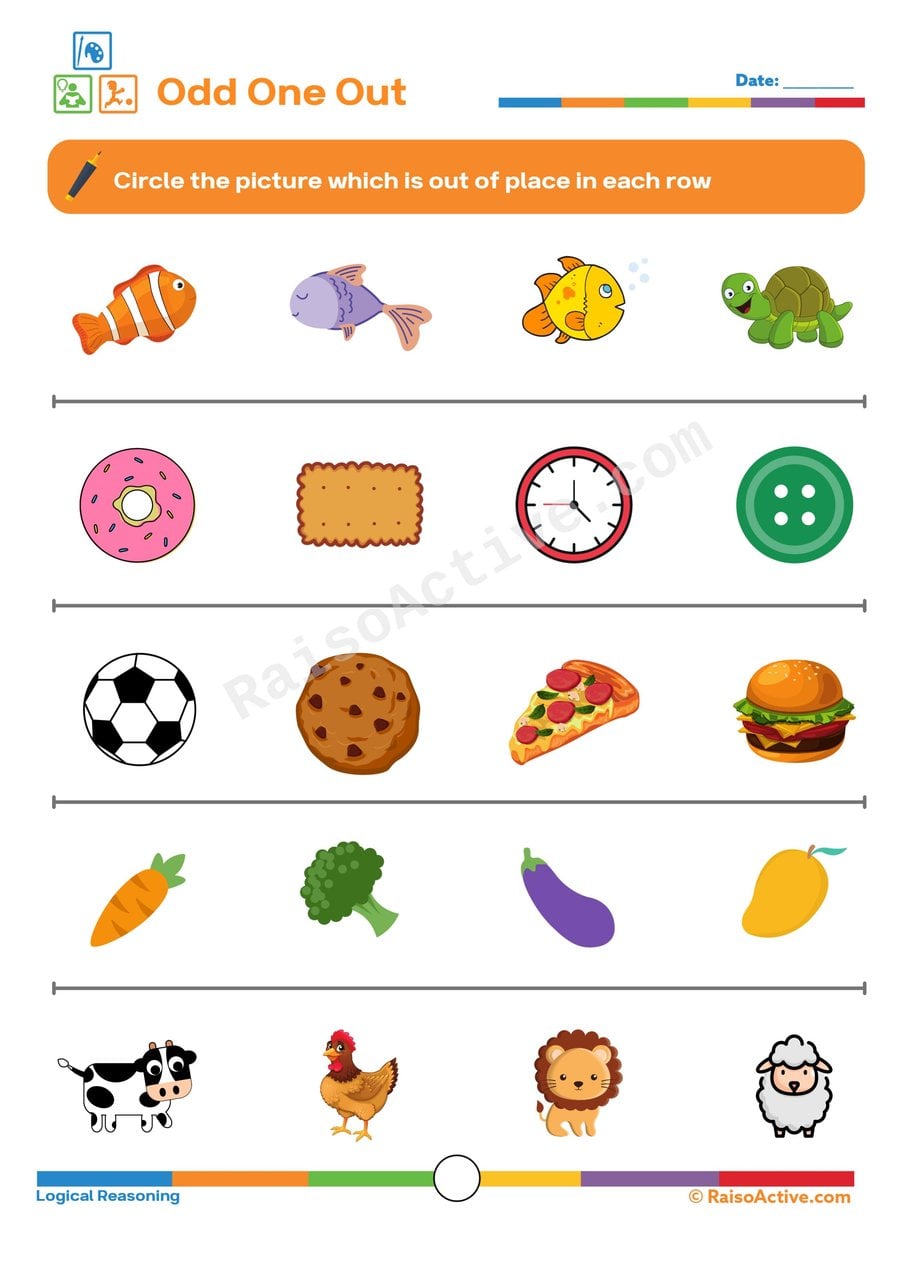
Odd One Out Worksheet: Spot the Differences!
Identifying which picture in a row is different from the others builds visual discrimination and logical reasoning in children ages 4-6, requiring them to compare multiple objects at once and notice a distinguishing feature rather than just spotting an obvious mismatch. This skill directly supports later academic tasks like sorting, categorizing, and comparing, since children must articulate what makes an item different, not just recognize that it is. Explaining their reasoning out loud after choosing also builds early verbal reasoning and communication skills.

Secret Words Worksheet: Matching Shapes and Letters!
Matching shapes to letters and then using that code to figure out a sequence of pictures teaches children ages 3-5 early symbolic reasoning, understanding that one thing, a shape, can stand in for another, a letter. This kind of code-breaking task builds logical thinking and pattern recognition beyond simple matching, since children must apply a rule consistently across multiple steps to reach a final answer. Framing the activity as uncovering a 'secret word' adds a sense of mystery and motivation that keeps children engaged through a multi-step reasoning task.
Want Unlimited Downloads?
Subscribe to get unlimited access to all worksheets without watermarks
View Subscription Plans