Navratri Festival Quest Certificate of Achievement
Ages 7-11 · Grade 2–Grade 3Ages 7-11 · Year 3–Year 4Ages 7-11 · Class 2–Class 3Ages 7-11
Children celebrate finishing the Navratri Festival Quest pack and record which levels they completed.
Free printable worksheets
Download free educational worksheets for children ages 2–8. Perfect for preschool, kindergarten, and early elementary learning activities.
Subscribe to get unlimited access to all worksheets without watermarks
View Subscription Plans289 topics match
64 worksheetsof 1,994
Ages 7-11 · Grade 2–Grade 3Ages 7-11 · Year 3–Year 4Ages 7-11 · Class 2–Class 3Ages 7-11
Children celebrate finishing the Navratri Festival Quest pack and record which levels they completed.
Ages 4-6 · Pre-K–KindergartenAges 4-6 · Reception–Year 1Ages 4-6 · LKG–UKGAges 4-6
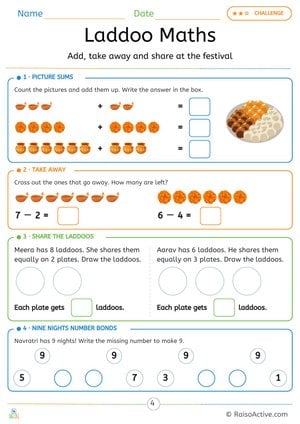
Children add two picture groups, take away by crossing out, share laddoos equally between plates and find the missing part of number bonds that make 9.
Ages 4-6 · Pre-K–KindergartenAges 4-6 · Reception–Year 1Ages 4-6 · LKG–UKGAges 4-6
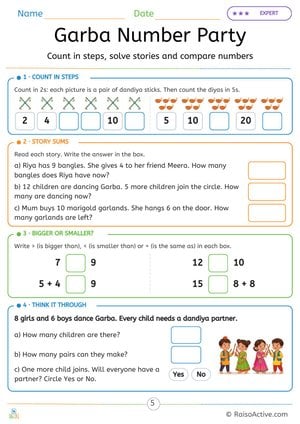
Children count in 2s and 5s, solve short story sums about bangles, dancers and marigold garlands, compare numbers using >, < and =, and work out how many pairs of dancers there are.
Ages 4-6 · Pre-K–KindergartenAges 4-6 · Reception–Year 1Ages 4-6 · LKG–UKGAges 4-6
Children celebrate finishing the Navratri Fun Time pages and see which levels they completed.
Ages 3-5 · Preschool–Pre-KAges 3-5 · Nursery–ReceptionAges 3-5 · Nursery–LKGAges 3-5
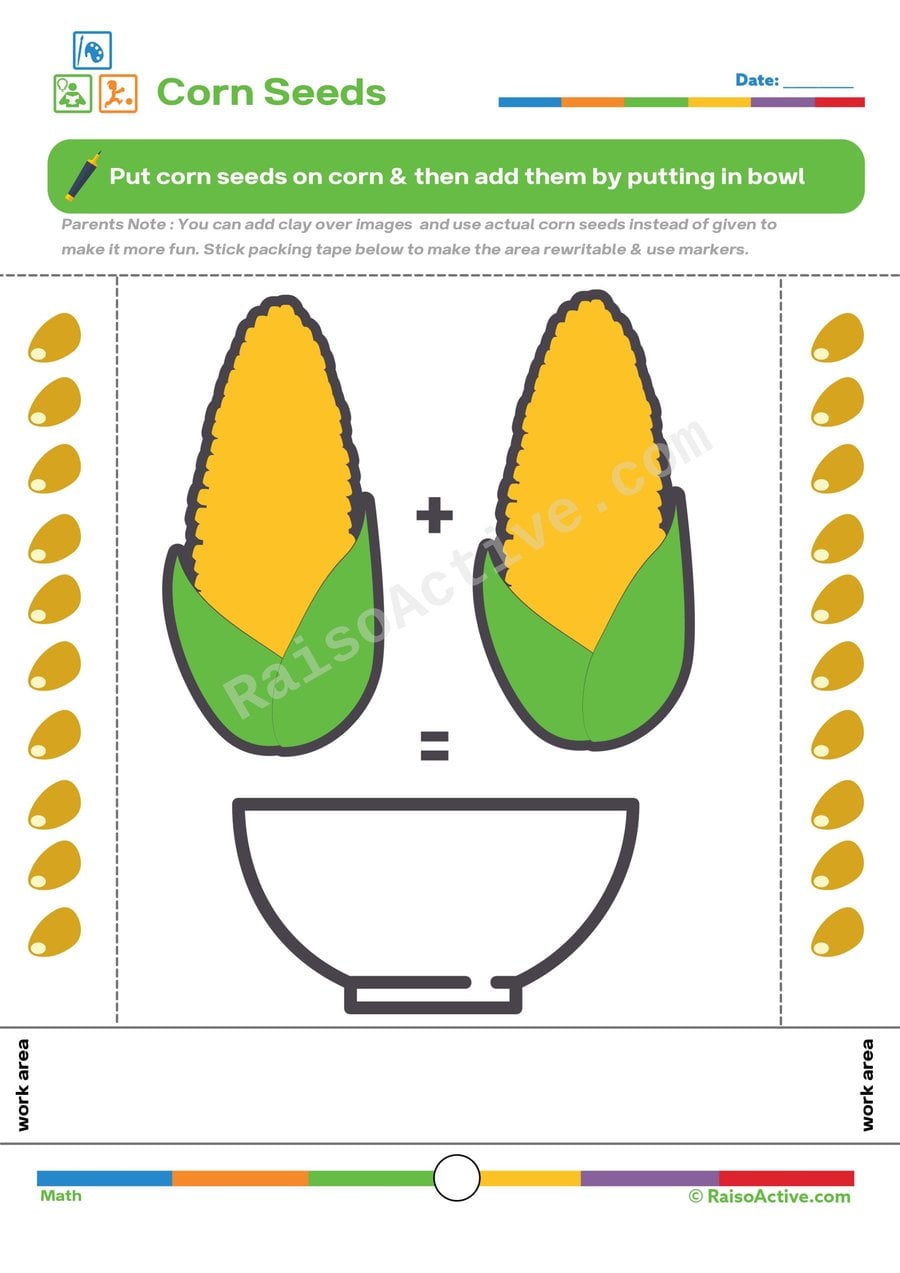
Counting corn seeds on two ears of corn and combining them into one total teaches children ages 3-5 the core concept of addition as joining groups together, using a concrete, countable image rather than abstract numerals alone. This worksheet also builds one-to-one correspondence, since accurate addition depends on touching or pointing to each seed exactly once while counting.
Ages 4-5 · Pre-KAges 4-5 · ReceptionAges 4-5 · LKGAges 4-5
This hands-on craft turns simple addition into a reusable game, as children ages 4-5 build a paper house with numbered windows and a door that can be changed with tape or number stripes. Physically swapping numbers to create new addition problems (like 2 windows + 1 door) helps children grasp that addition means combining separate groups into one total, rather than just memorizing facts.
Ages 4-6 · Pre-K–KindergartenAges 4-6 · Reception–Year 1Ages 4-6 · LKG–UKGAges 4-6
Children ages 4-6 sharpen counting accuracy and practice basic addition using festive Christmas visuals, including a snowman scene where sums are recorded directly on its body. This worksheet also introduces subtraction-style thinking by having children count what remains after some objects are 'struck out,' giving an early, concrete preview of take-away math.
Ages 3-5 · Preschool–Pre-KAges 3-5 · Nursery–ReceptionAges 3-5 · Nursery–LKGAges 3-5
This worksheet blends early addition with visual matching as children ages 3-5 combine two separate shape groups and then search for the Easter egg design that shows the same total. Because the 'answer' is a picture rather than a written number, children practice quantity comparison and pattern-matching without needing to know written numerals yet.
Ages 4-6 · Pre-K–KindergartenAges 4-6 · Reception–Year 1Ages 4-6 · LKG–UKGAges 4-6
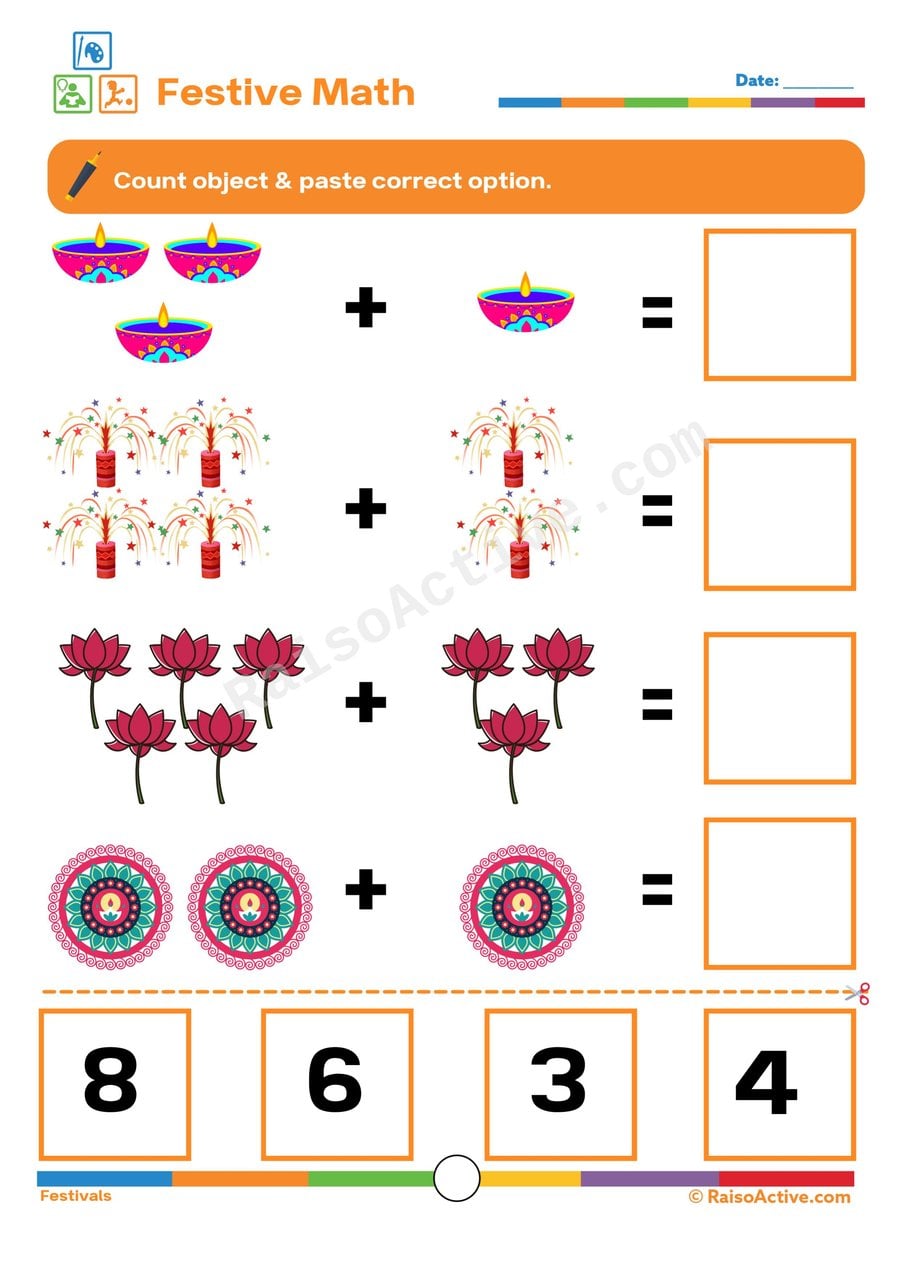
Children ages 4-6 practice counting groups of festival-themed objects and combining them through simple addition, building early number sense and the concept that addition means putting two groups together. Counting festive imagery keeps the math concrete and visual, which is especially important before children can add using abstract numerals alone.
Ages 4-6 · Pre-K–KindergartenAges 4-6 · Reception–Year 1Ages 4-6 · LKG–UKGAges 4-6
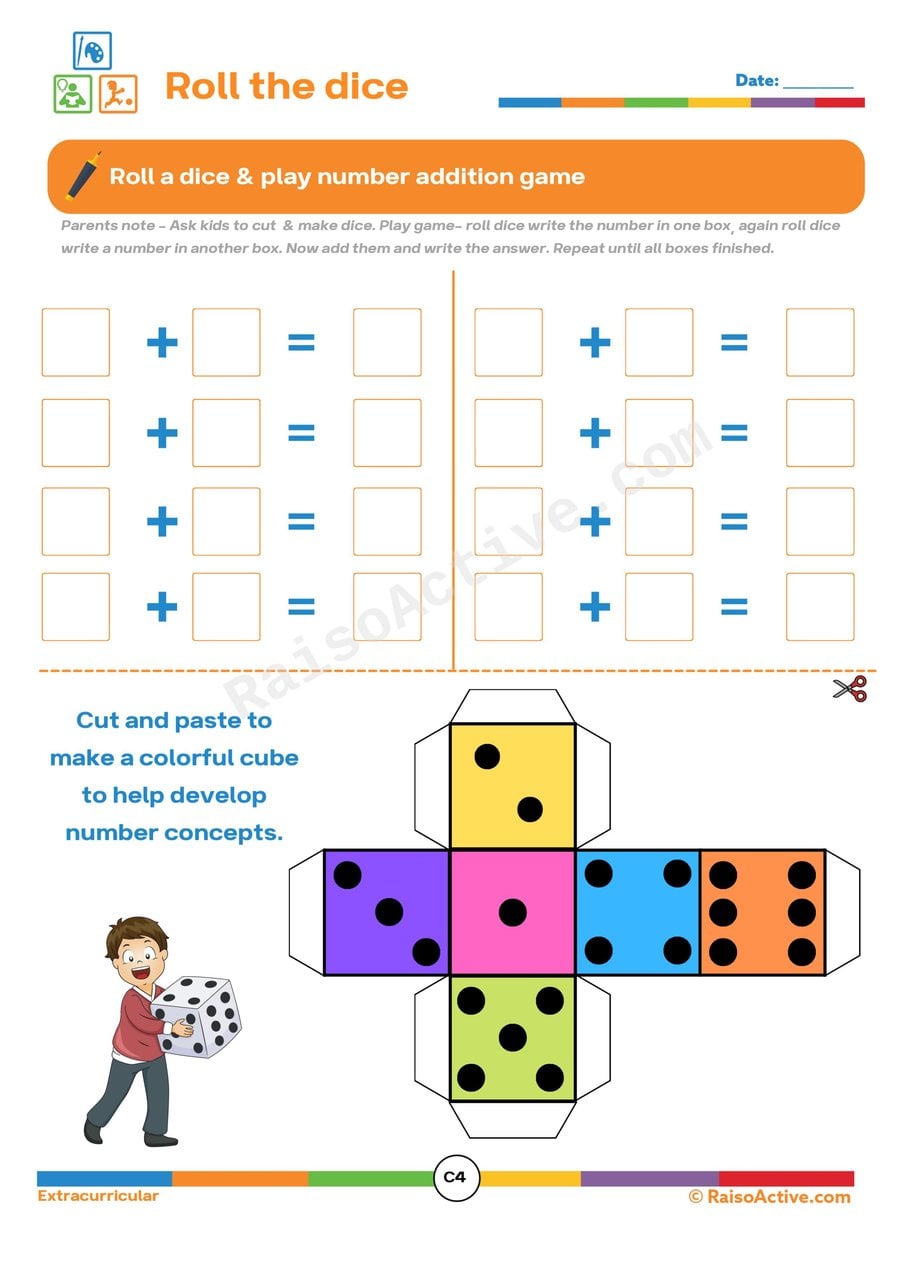
This dice-based addition worksheet gives children ages 4-6 hands-on practice combining two quantities into a sum, using a physical dice roll to make the abstract idea of addition concrete and random. Rolling, recording, and adding numbers repeatedly builds fluency with numbers 1-6 and reinforces that addition means 'putting together.' The repeated-roll format also builds working memory as children hold two numbers in mind to combine them.
Ages 3-5 · Preschool–Pre-KAges 3-5 · Nursery–ReceptionAges 3-5 · Nursery–LKGAges 3-5
This color-by-sums worksheet combines basic addition practice with color-by-number skills, asking children ages 3-5 to solve simple addition problems within each section of an air balloon and then color that section according to a matching color key. Solving a math problem correctly before coloring turns each section into a small, self-checking task, since an incorrect sum would lead to the wrong color choice. This blend of math and art keeps repetitive addition practice feeling like a creative activity rather than a drill.
Ages 4-6 · Pre-K–KindergartenAges 4-6 · Reception–Year 1Ages 4-6 · LKG–UKGAges 4-6
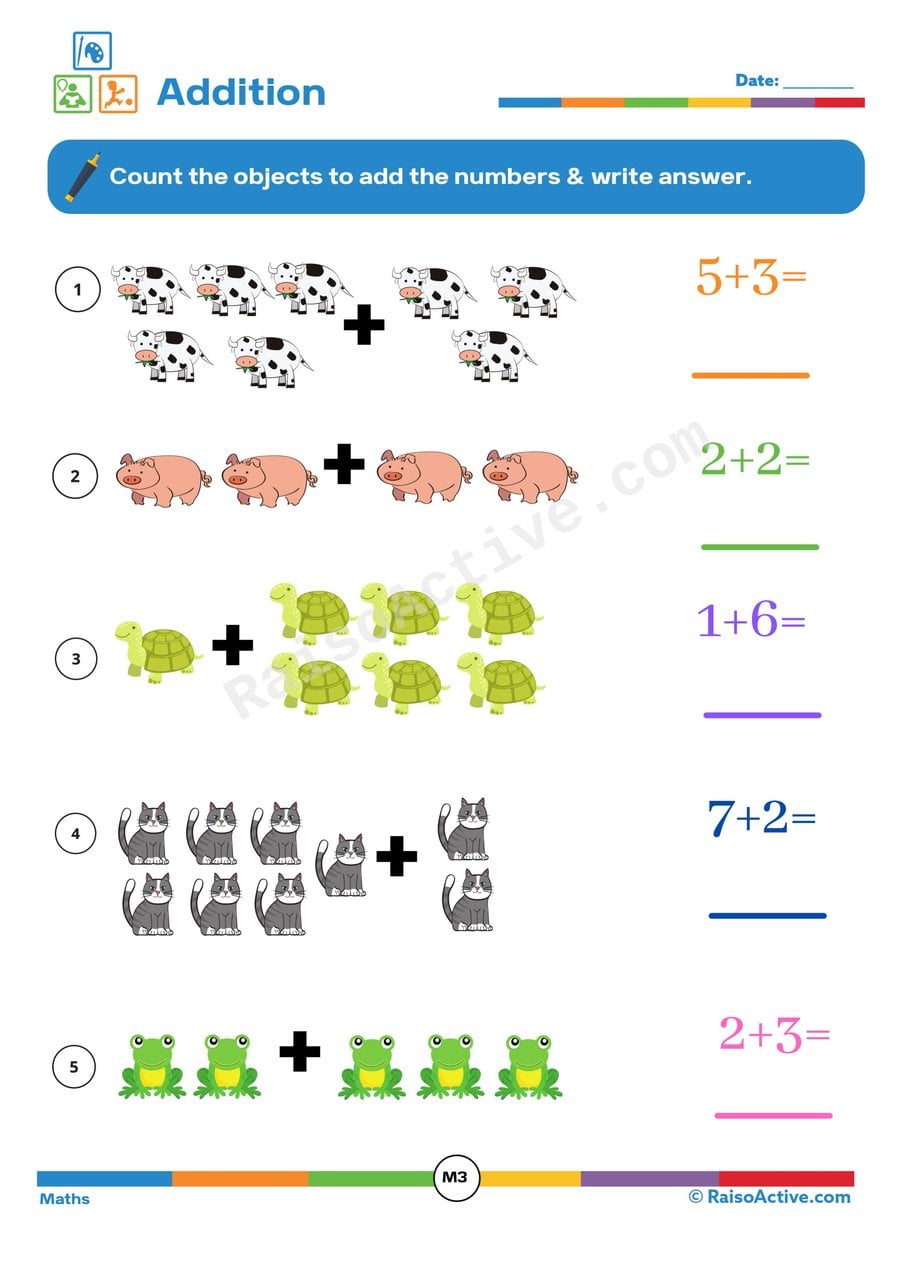
Counting two groups of pictured objects and writing their combined total introduces children ages 4-6 to addition as a concrete, visual process before they work with numbers alone. Because the objects are drawn out rather than represented only by digits, children can physically point and count to verify their answer, building confidence in early math reasoning. Repeated practice with this picture-based format helps children internalize what a plus sign means before they're expected to solve equations without visual support.