Togetherness Jar Worksheet: Fill with Family Moments!
This worksheet encourages children to reflect on specific, meaningful moments spent with family members and put those memories into words, building both emotional awareness and early narrative writing skills. For ages 3-6, the hands-on jar-making element also connects abstract reflection to a tangible, ongoing keepsake, reinforcing that family connection is something worth noticing and recording.
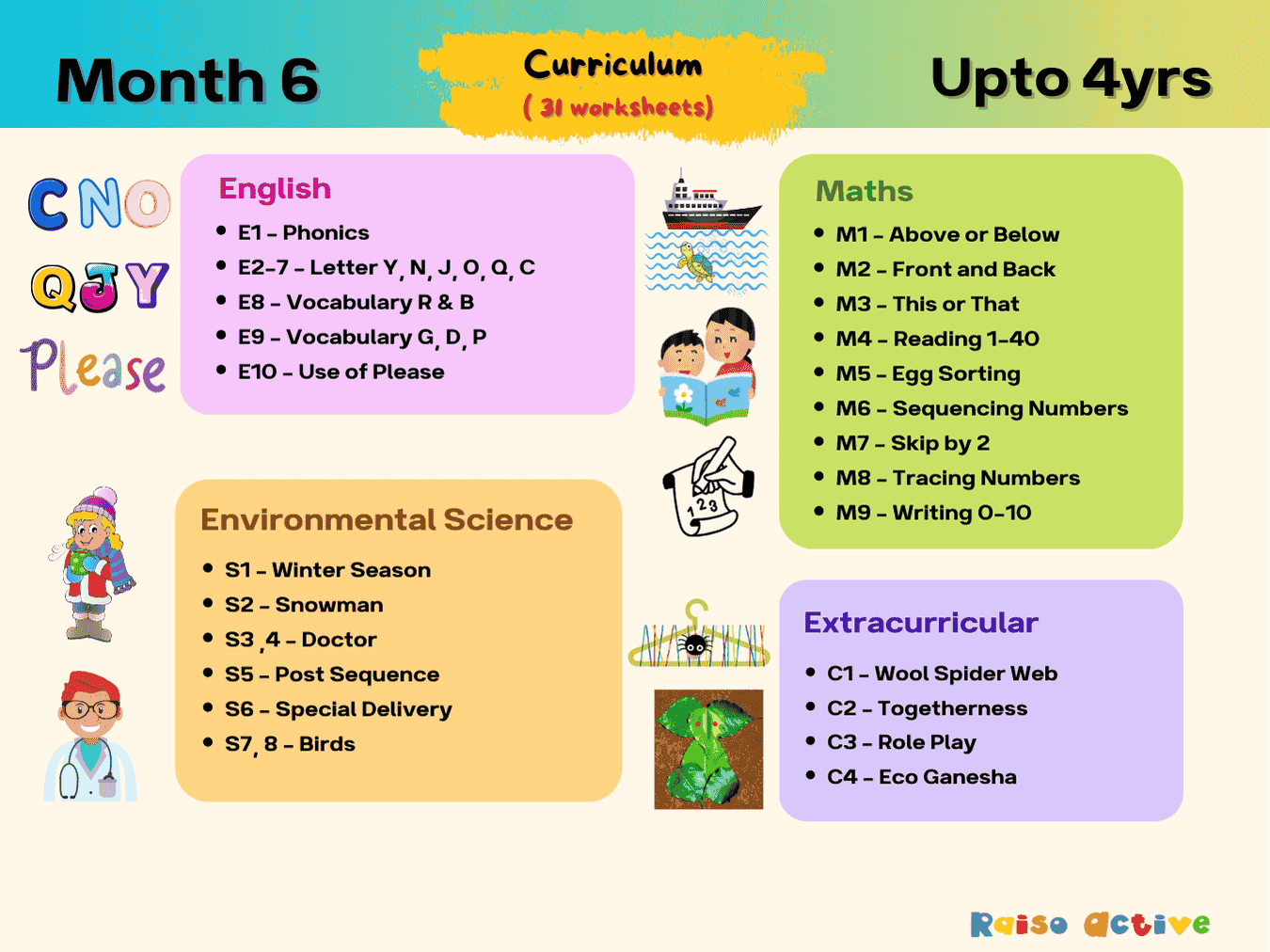
Part of the pack
Month 6: Toddler Preschool Foundational Skills | Ages Up to 4
This is page 32 of the pack. Ages 2-4 · PreschoolAges 2-4 · NurseryAges 2-4
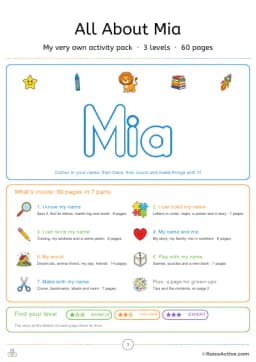
Made for your child
A whole activity pack made with their name
60 pages to spot, build, trace and write their own name, plus pages about their favourites, feelings and family. See a free preview with their name.
Make an All About Me packFree preview · free for members
Or start free: a name tracing sheet with their nameCurriculum
- SEL - Social Awareness > Social Skills
How to use this worksheet
Start by decorating a jar together using markers or crayons, making it feel special and personal to your family. Talk with your child about a few happy memories they've had with family members recently, prompting with questions like 'what did we do together that made you smile?' Help your child write or dictate each memory onto a small slip of paper, keeping the writing short and specific to one moment. Fold each note and place it into the decorated jar together, explaining that you'll keep adding new memories over time.
Materials needed
- Jar
- Markers or crayons
- Paper
- Scissors (optional)
Extension activities
- 1Draw a picture to go along with one of the written family moments before folding it and adding it to the jar.
- 2Read one memory from the jar together at dinner once a week to keep the tradition going.
- 3Take a photo of the family moment described in one note and print it out to display nearby.
- 4Start a second jar for a different family member's memories to compare favorite moments.
- 5Create a simple scrapbook page transferring a few of the jar's written memories alongside drawings or photos.

Written by
Hemsweta Jain · Teacher Cheena
MBA and Early Childhood Educator, teaching since 2014 · Founder of RaisoActive, Mumbai
Every RaisoActive worksheet is designed and checked by the founder before publishing.
Published · Last reviewed
Related worksheets
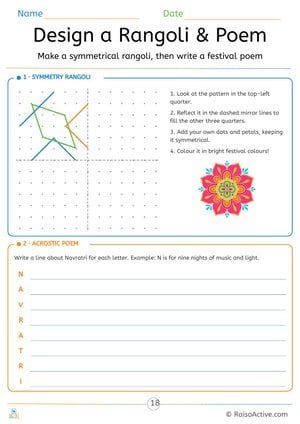
Navratri Symmetry Rangoli and Acrostic Poem
Ages 7-11 · Grade 2–Grade 3Ages 7-11 · Year 3–Year 4Ages 7-11 · Class 2–Class 3Ages 7-11
Children reflect a pattern in two mirror lines to complete a four-way symmetrical rangoli on a dot grid, add their own symmetrical details, and write an acrostic poem with one line for each letter of NAVRATRI.
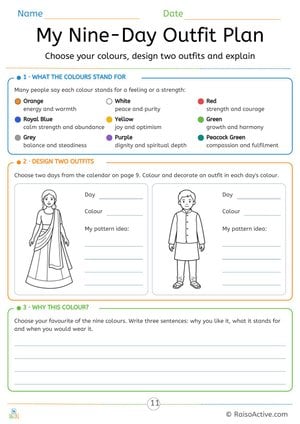
My Nine-Day Outfit Plan: Navratri Colours Design and Writing
Ages 7-11 · Grade 2–Grade 3Ages 7-11 · Year 3–Year 4Ages 7-11 · Class 2–Class 3Ages 7-11
Children read what each of the nine colours is often said to stand for, choose two days from the calendar, colour and pattern a lehenga-style outfit and a kurta outfit in those colours, and write three sentences explaining their favourite colour.
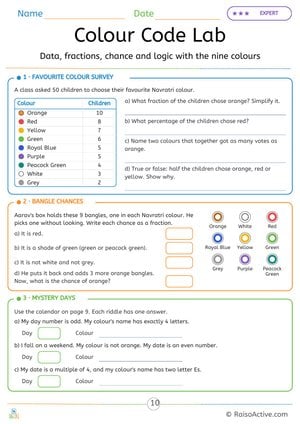
Colour Code Lab: Navratri Fractions, Percentages and Probability
Ages 7-11 · Grade 2–Grade 3Ages 7-11 · Year 3–Year 4Ages 7-11 · Class 2–Class 3Ages 7-11
Children read a survey of 50 children's favourite Navratri colours and write fractions and percentages, write the chance of picking each kind of bangle as a fraction, and solve three riddles using the colour calendar on page 9.
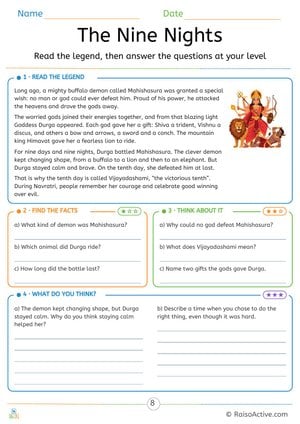
The Nine Nights: Durga and Mahishasura Reading Comprehension
Ages 7-11 · Grade 2–Grade 3Ages 7-11 · Year 3–Year 4Ages 7-11 · Class 2–Class 3Ages 7-11
Children read a retelling of the legend of Durga and Mahishasura, find facts in the text, answer inference questions about why things happened, and write their own opinion about staying calm and doing the right thing.
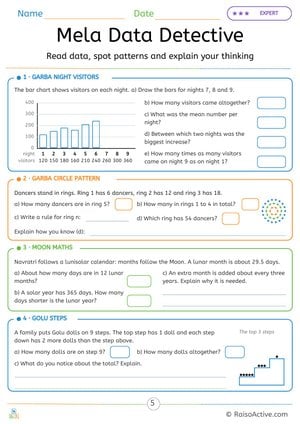
Mela Data Detective: Navratri Bar Chart, Patterns and Moon Maths
Ages 7-11 · Grade 2–Grade 3Ages 7-11 · Year 3–Year 4Ages 7-11 · Class 2–Class 3Ages 7-11
Children complete a bar chart of nine nights of visitors, find the total, the mean and the biggest increase, find and explain the rule for a growing pattern of dancers, compare a lunar year with a solar year, and add the dolls on nine Golu steps to discover a square number.

Navratri Picture Sudoku and Story Sequencing: Think It Through
Ages 4-6 · Pre-K–KindergartenAges 4-6 · Reception–Year 1Ages 4-6 · LKG–UKGAges 4-6
Children use logic to complete a 4x4 picture sudoku where each row and column has each picture once, and put four story pictures in order.

Clothing Pattern Match Worksheet for Preschoolers
Ages 3-5 · Preschool–Pre-KAges 3-5 · Nursery–ReceptionAges 3-5 · Nursery–LKGAges 3-5
This worksheet has children ages 3-5 study repeating patterns on clothing items — stripes, polka dots, or checks — and match each item to its identical twin, building visual discrimination and early pattern-sequencing skills. Distinguishing between similar-looking patterns also sharpens attention to detail, a skill that later supports letter and word recognition.

Trace the Numbers 1-9 Worksheet for Preschoolers
Ages 3-5 · Preschool–Pre-KAges 3-5 · Nursery–ReceptionAges 3-5 · Nursery–LKGAges 3-5
Tracing the numerals 1 through 9 gives children ages 3-5 repeated, guided practice with the specific pencil strokes each number requires, building the fine motor control and muscle memory needed for independent number writing. Because tracing follows a fixed, correct path, it also reinforces accurate numeral recognition, helping children tell visually similar digits apart.
Guides for this topic

Documenting Learning Without Drowning in Data: A Practical Guide for Parents and Teachers
Learn practical ways to document your child's learning without overwhelm. Simple portfolios, observation tips, and printable trackers for ages 1-8.
Portfolio Assessment with Young Children: A Comprehensive Guide to Meaningful Documentation
Learn how portfolio assessment captures your child's growth through meaningful documentation. Practical tips, templates, and age-appropriate strategies for ages 1-8.

Age-Appropriate Problem-Solving Activities: Building Critical Thinkers from the Ground Up
Discover fun, age-appropriate problem-solving activities for children ages 1-8. Build critical thinking, logic, and reasoning skills through play-based learning.
Reviews
Every worksheet for ages 3–6, no watermark
Members download the full library of 1,000+ worksheets and every activity pack without watermarks or daily limits. One year costs ₹999 in India or $20 elsewhere.
See membership plansOr download any worksheet free with a watermark (5 a day).