Looking for a structured learning path?
Explore our age-wise monthly curriculum with 4 subjects per month
Free Printable Worksheets
Browse Worksheets
Download free educational worksheets for children ages 1-8. Perfect for preschool, kindergarten, and early elementary learning activities.
Filters
Age Range
Curriculum
Tags
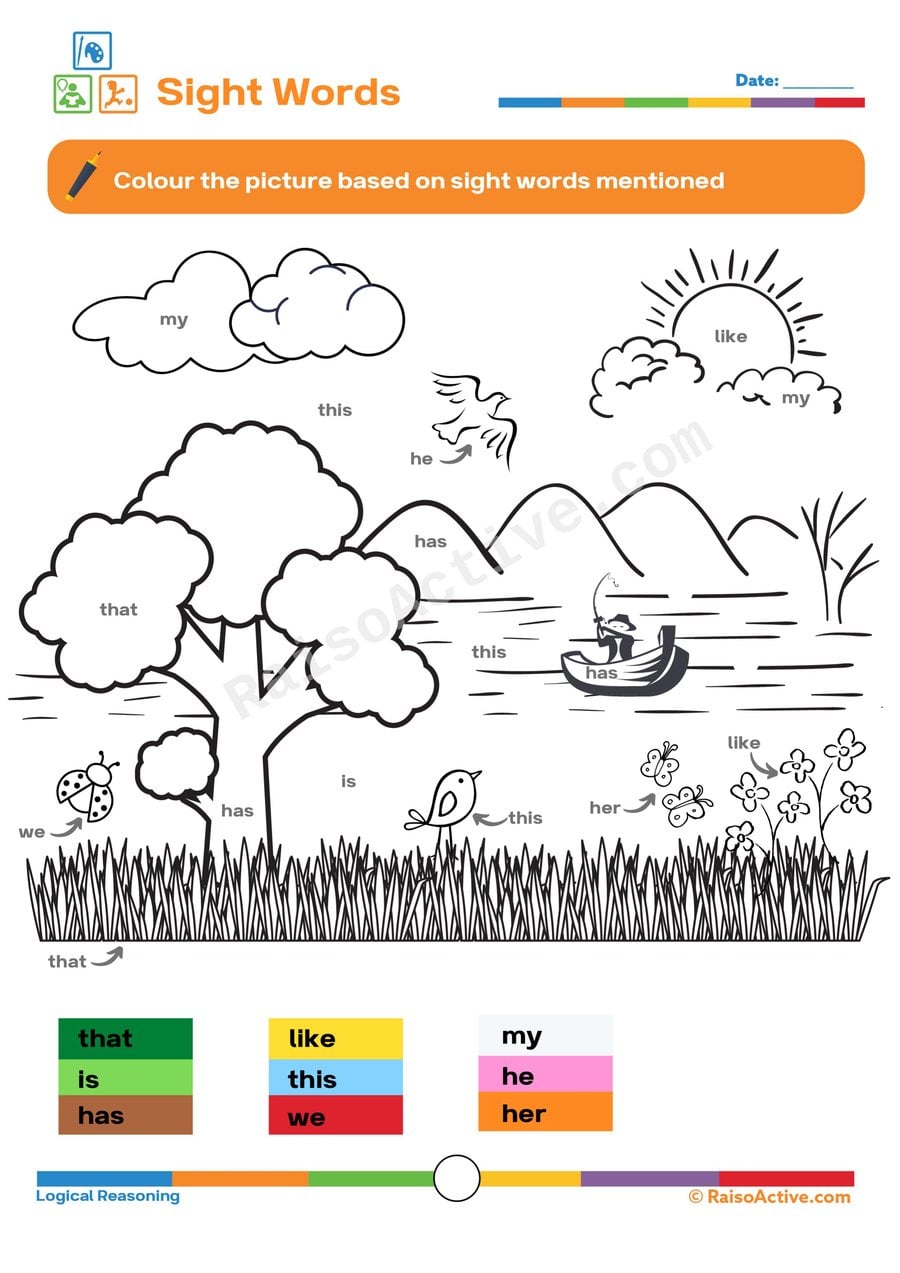
Sight Word Coloring Worksheet for Preschoolers
This worksheet helps children ages 3-5 build sight-word recognition by having them read common high-frequency words and use a color key to decide how to color the corresponding pictures. Connecting a printed word to a coloring decision requires children to actually read and recall the word's meaning, rather than just copying or tracing it, which is a genuine step toward independent reading. The coloring format also keeps the repeated word-reading practice feeling like an art activity rather than a drill.

Camera Spy - Pattern Recognition Worksheet for Preschoolers
This worksheet develops visual scanning and pattern-matching skills in children ages 3-5 as they use a 'spy camera' to find smaller patterns hidden within a larger image. Searching for a specific pattern among distractors builds sustained visual attention, a skill that supports later tasks like letter recognition and proofreading.

Camera Spy: Find the Patterns Worksheet for Preschoolers
This pattern-recognition worksheet has children ages 3-5 study a set pattern shown at the top of the page and then locate that same repeating sequence within smaller boxes below, training visual comparison and pattern-matching across separate parts of a page. Unlike simply continuing a pattern, this format asks children to recognize an identical pattern elsewhere, a subtly different and useful skill for later tasks like matching sets or comparing groups. Repeating this scan-and-match process across several boxes builds sustained visual attention.
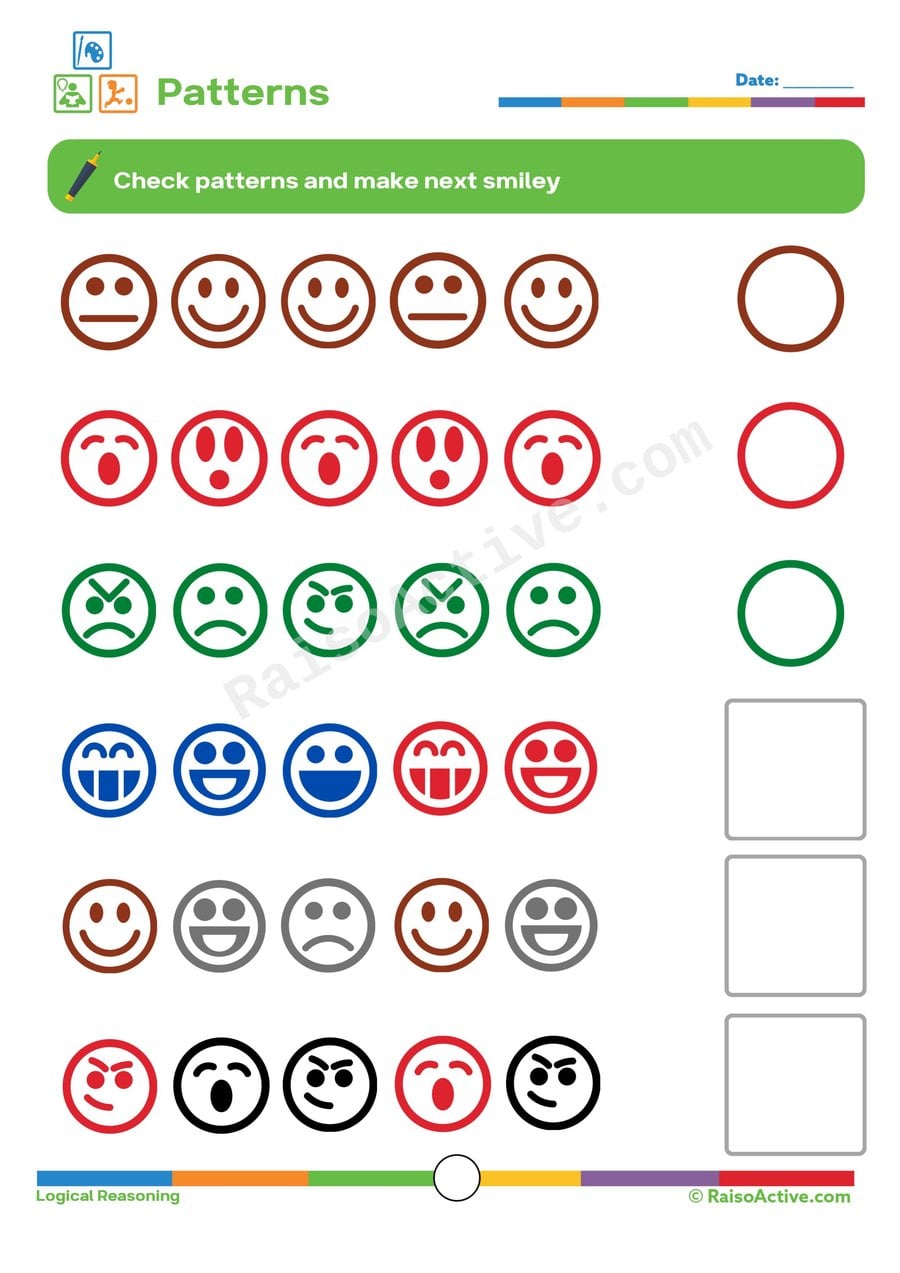
Smiley Face Patterns Worksheet for Preschoolers
This pattern worksheet has children ages 3-5 study a row of smiley faces with varying expressions or colors and determine what comes next in the repeating sequence, building foundational pattern recognition and logical reasoning skills. Recognizing and extending patterns is one of the earliest forms of mathematical thinking children encounter, laying groundwork for later work with number patterns, skip counting, and algebraic reasoning. Because the pattern uses a familiar, emotionally engaging image like a smiley face, children stay motivated through several rows of repeated practice.

Spot the Differences! Fun Coloring Worksheet for Kids
This spot-the-difference worksheet challenges children ages 3-5 to compare two nearly identical pictures and circle every visual difference they find, sharpening close observation and attention to detail. Coloring both images first, using slightly different choices between the two, adds an extra layer of visual comparison since children must notice both original design differences and any coloring variation. This kind of side-by-side visual analysis is a foundational skill for later proofreading and detail-oriented tasks.

Color by Number Snowman Worksheet for Preschoolers
This color-by-number worksheet helps children ages 3-5 practice number recognition and color matching simultaneously, using a snowman picture divided into numbered sections. Reading a number key and applying it consistently across an entire picture builds sustained attention and careful visual tracking, since a single mistake can be spotted easily against the intended design. This combination of numeracy and following directions makes color-by-number activities a favorite bridge between math and art.

Shape Frog Cut and Paste Worksheet for Preschoolers
This worksheet gives children ages 3-5 hands-on practice manipulating basic shapes — like triangles, circles, and squares — to assemble a complete picture of a frog. Building a recognizable animal out of separate geometric shapes helps children see how simple shapes combine to form more complex forms, an early step toward representational drawing and spatial construction. Cutting and precisely placing each shape piece also strengthens fine motor coordination.

This or That? Cut and Paste Worksheet for Early Learners
Sorting objects into 'this' and 'that' categories helps children ages 3-5 connect an abstract grammar concept to something they can physically place and see, reinforcing the idea that these words describe relative closeness rather than a fixed rule. This early categorization practice also builds general sorting and decision-making skills that extend well beyond grammar itself.
Want Unlimited Downloads?
Subscribe to get unlimited access to all worksheets without watermarks
View Subscription Plans