Navratri Festival Quest Certificate of Achievement
Ages 7-11 · Grade 2–Grade 3Ages 7-11 · Year 3–Year 4Ages 7-11 · Class 2–Class 3Ages 7-11
Children celebrate finishing the Navratri Festival Quest pack and record which levels they completed.
Free printable worksheets
Download free educational worksheets for children ages 2–8. Perfect for preschool, kindergarten, and early elementary learning activities.
Subscribe to get unlimited access to all worksheets without watermarks
View Subscription Plans289 topics match
90 worksheetsof 1,994
Ages 7-11 · Grade 2–Grade 3Ages 7-11 · Year 3–Year 4Ages 7-11 · Class 2–Class 3Ages 7-11
Children celebrate finishing the Navratri Festival Quest pack and record which levels they completed.
Ages 4-6 · Pre-K–KindergartenAges 4-6 · Reception–Year 1Ages 4-6 · LKG–UKGAges 4-6
Children celebrate finishing the Navratri Fun Time pages and see which levels they completed.
Ages 4-5 · Pre-KAges 4-5 · ReceptionAges 4-5 · LKGAges 4-5
This worksheet introduces children ages 4-5 to a basic building block of sentence grammar, teaching them that every sentence has a subject — who or what it's about — and a predicate — what that subject does or is. Sorting sentence fragments into these two categories helps children start to notice sentence structure, which supports both reading comprehension and their own sentence writing later on. This early grammar awareness lays groundwork for more formal sentence study in kindergarten and beyond.
Ages 4-6 · Pre-K–KindergartenAges 4-6 · Reception–Year 1Ages 4-6 · LKG–UKGAges 4-6
This worksheet teaches children ages 4-6 the rule that sentences begin with a capital letter, along with an introduction to capitalizing proper nouns like names and places. Rewriting sentences correctly, rather than just circling errors, gives children active practice applying the capitalization rule themselves, which builds the habit more effectively than passive correction exercises.
Ages 4-6 · Pre-K–KindergartenAges 4-6 · Reception–Year 1Ages 4-6 · LKG–UKGAges 4-6
Children ages 4-6 learn to distinguish between statements and questions by deciding whether each sentence needs a period or a question mark, an early step in understanding how punctuation changes meaning and tone. Recognizing the difference between a question and a statement also supports reading fluency, since readers naturally use rising or falling intonation depending on the punctuation at the end of a sentence.
Ages 4-6 · Pre-K–KindergartenAges 4-6 · Reception–Year 1Ages 4-6 · LKG–UKGAges 4-6
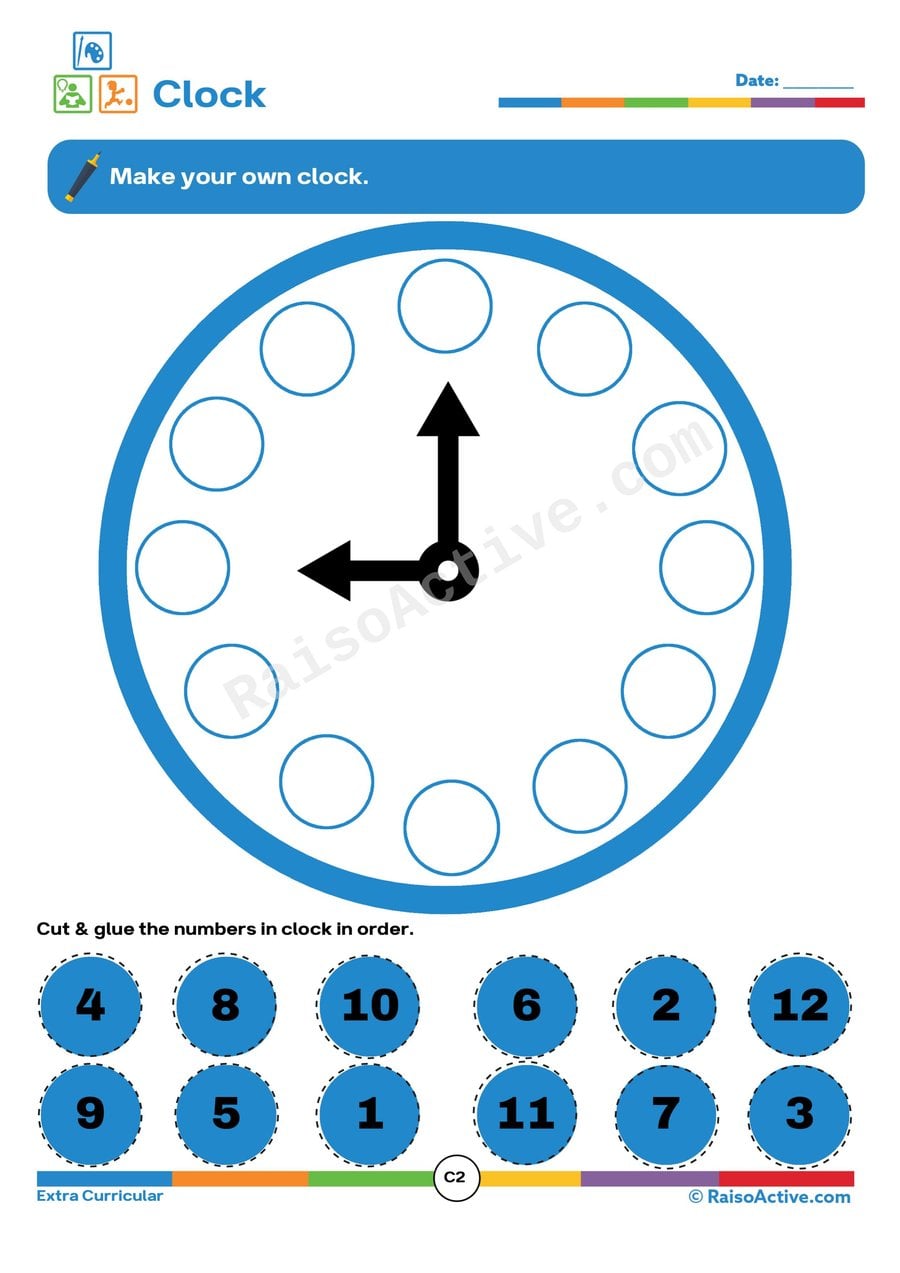
This hands-on craft has children ages 4-6 cut out and glue numbers in order around a clock face, then draw hands to show different times, combining number sequencing with an introduction to how an analog clock is structured. Physically placing each number themselves, rather than reading a pre-printed clock, helps children internalize why the numbers 1 through 12 are arranged in that specific circular order. Drawing the hands afterward extends the activity from static number placement into functional time-telling practice.
Ages 4-6 · Pre-K–KindergartenAges 4-6 · Reception–Year 1Ages 4-6 · LKG–UKGAges 4-6
This worksheet helps children ages 4-6 practice constructing complete, grammatically sound sentences by using a set of provided words alongside a picture prompt. Building sentences from a word bank forces children to think about word order and sentence structure directly, rather than just filling in a single blank, which is a meaningful step up in independent writing skill.
Ages 4-6 · Pre-K–KindergartenAges 4-6 · Reception–Year 1Ages 4-6 · LKG–UKGAges 4-6
Arranging a set of given words into a complete, correctly ordered sentence teaches children ages 4-6 basic sentence structure, helping them understand that word order changes meaning and that sentences follow predictable patterns like subject before action. Remembering to start with a capital letter and end with a period also reinforces early writing conventions alongside the sentence-building itself. This combination of grammar and mechanics gives children practice with the full process of forming a proper written sentence, not just choosing words.
Ages 3-5 · Preschool–Pre-KAges 3-5 · Nursery–ReceptionAges 3-5 · Nursery–LKGAges 3-5
This multi-activity guide gives children ages 3-5 hands-on practice with several different skills in one sitting — building a DIY paper clock to learn about time, assembling a simple no-fire recipe to build sequencing and following-directions skills, and exploring color mixing with tissue paper. Rotating through several short, varied activities keeps engagement high for young children whose attention spans are still developing. Each activity also builds language skills as children describe what they are doing.
Ages 4-6 · Pre-K–KindergartenAges 4-6 · Reception–Year 1Ages 4-6 · LKG–UKGAges 4-6
Choosing the correct punctuation mark to complete a sentence teaches children ages 4-6 that periods, question marks, and other marks change how a sentence should be read and understood, not just how it looks on paper. Matching sentences to their correct punctuation marks reinforces this by requiring children to recognize the tone or purpose of a sentence, whether it's a statement, a question, or an exclamation. This early grammar practice builds the foundation for reading with expression and writing complete, correctly punctuated sentences later on.
Ages 3-5 · Preschool–Pre-KAges 3-5 · Nursery–ReceptionAges 3-5 · Nursery–LKGAges 3-5
Children ages 3-5 practice identifying prepositions like 'in,' 'on,' and 'under' by looking at a picture and circling the word that correctly describes where an object is positioned. This builds early spatial vocabulary that children use constantly in everyday communication, from describing where a toy is to following directions.
Ages 4-6 · Pre-K–KindergartenAges 4-6 · Reception–Year 1Ages 4-6 · LKG–UKGAges 4-6
Children ages 4-6 practice sentence construction by rearranging scrambled words into a grammatically correct, meaningful sentence, building an understanding of proper word order in English. This hands-on rearranging task teaches children to recognize where a sentence's subject, action, and details belong, a skill they'll use in all future writing.