Where to Find Free Counting Worksheets for Preschoolers: A Complete Resource Guide
Author
RaisoActive - Kids Activities and Fun Learning
Published
Updated
Reading Time
22 min read

- A good counting worksheet builds a specific early maths skill — one-to-one correspondence, number recognition, subitising, or cardinality — not just asks a child to write numbers in a row.
- The most effective worksheet types include count-and-circle, ten-frame activities, number matching, cut-and-paste sets, and subitising cards — each targeting a distinct counting concept.
- In India, CBSE and ICSE nursery and LKG programmes expect children to count objects to 10 and recognise numerals to 20 by end of year — worksheets addressing these skills directly are curriculum-aligned practice, not extras.
- Worksheets work best alongside concrete manipulatives — buttons, blocks, dal seeds, coins — not instead of them; the physical act of touching each object as you count is irreplaceable in the preschool years.
- RaisoActive offers a curated, curriculum-aligned library of counting worksheets for preschoolers, freely available with a subscription and designed specifically for Indian children.
Why Most Counting Worksheets Miss the Point (And What to Look for Instead)
Search for "free counting worksheets for preschoolers" online and you will find thousands of results in seconds. Most of them look cheerful and educational — numbers printed large, bright clipart, dotted lines for tracing. And yet, many of these worksheets teach almost nothing about actual counting. They teach children to trace the numeral 5 without understanding what five objects look like. They ask children to write 1, 2, 3, 4, 5 in sequence — a rote memory task — without ever asking them to count a group of real things and match it to that numeral.
This matters enormously, because counting is far more complex than it looks from the outside. A preschooler who can recite "one, two, three, four, five" like a song has memorised a sequence of words — but they may not yet understand that each word maps to exactly one object, that the last number said tells you how many are in the group, or that five objects is always five objects whether arranged in a line or a circle or a messy heap. These are distinct, learnable skills, and a well-designed counting worksheet builds one of them deliberately. A poorly designed one keeps a child busy for twelve minutes and teaches nothing that will help them in mathematics.
In this guide, we walk you through exactly what makes a preschool counting worksheet genuinely useful, which types develop which skills, how to sequence worksheet practice as your child's number sense grows, how to use worksheets alongside the concrete objects that are essential at this age, and what Indian curriculum programmes actually expect by way of counting skills. We also share where to find high-quality, curriculum-aligned counting worksheets — including our growing collection at RaisoActive, built with Indian preschoolers and LKG children in mind.
Looking for ready-to-print counting worksheets?
Subscribe to RaisoActive for free access to count-and-circle, ten-frame, subitising, and number-matching worksheets designed for Indian preschoolers — new resources added every week.
What Makes a Good Preschool Counting Worksheet (Not Just Number-Writing Practice)
Before exploring specific worksheet types, it helps to understand the criteria that separate genuinely educational counting worksheets from the ocean of busywork. Five qualities consistently distinguish the effective from the merely printable.
It Targets One Specific Counting Concept
Early maths has several distinct sub-skills that are easy to conflate: rote counting (reciting number names in order), one-to-one correspondence (matching one number word to one object), cardinality (understanding that the last number counted tells you the total), number recognition (reading a numeral and knowing its value), and subitising (recognising small quantities instantly without counting). A worksheet that tries to address all of these simultaneously teaches none of them well. The best worksheets are focused: this worksheet practises counting a set of objects and writing the matching numeral; that worksheet practises recognising which numeral card matches a dotted arrangement. Specificity makes both teaching and assessment possible.
It Requires Active Counting, Not Just Numeral Writing
The most common failure mode in preschool maths worksheets is asking children to trace or write numerals without any corresponding quantity. Tracing the number 7 seven times builds fine motor skills and numeral formation — both useful — but it does not build number sense. A counting worksheet must involve groups of countable objects and ask the child to interact with those groups — counting them, circling the right number, matching them to a numeral, drawing additional objects to make a set, or cutting and pasting to form a group. If the worksheet has no objects to count, it is a handwriting worksheet wearing a maths costume.
It Uses Clear, Unambiguous Images
For young children, visual clarity is a significant factor in whether a worksheet teaches or confuses. Objects should be distinct, well-spaced, and easy to count without accidentally counting the same one twice. Cluttered arrangements, overlapping images, or very small clipart all make accurate counting harder than the maths itself. For Indian children in particular, images that include familiar objects — mangoes, diyas, autorickshaws, butterflies, rangoli dots — provide context that supports engagement and comprehension. A child who knows what they are counting is a child who is thinking about the maths, not decoding the picture.
It Is Matched to the Child's Current Number Range
Not all counting worksheets are appropriate for all preschoolers. A child who is just developing one-to-one correspondence needs worksheets with sets of two to five objects — large enough to see, small enough to count reliably. A child who has mastered counting to ten is ready for worksheets working in the 11–20 range. Giving a three-year-old a worksheet with groups of seventeen objects is not ambitious — it is frustrating and counterproductive. Giving a confident five-year-old worksheets that only go to five provides no challenge. Match the number range to the child, not the child to a generic age label.
Counting is a cluster of distinct skills, not a single ability — and good worksheets target each skill separately before asking a child to integrate them.
Research in early mathematics education identifies at least five separate counting principles children must master: stable order (number names always go in the same sequence), one-to-one correspondence (one number word per object), cardinality (the last number counted is the total), abstraction (any kind of object can be counted), and order irrelevance (you can count objects in any order and get the same answer). Most worksheet collections address only the first — reciting the sequence. Build a worksheet library that deliberately targets all five across the preschool years.
Types of Counting Worksheets That Actually Develop Number Sense
Once you know what you are looking for, it becomes much easier to evaluate any worksheet you find online. Here are the types that genuinely develop early counting and number sense — and what to watch for in each.
Count and Circle Worksheets
Count-and-circle is one of the most versatile and educationally sound formats for preschoolers. The child is shown a group of objects, counts them, and then circles the correct numeral from a set of options — or circles the group that matches a given numeral. This format directly tests one-to-one correspondence and cardinality: did the child count accurately, and do they know that the last number tells them the total? A well-designed count-and-circle worksheet shows objects in varied arrangements — not always a neat row — so children practise counting regardless of spatial arrangement. Look for worksheets where the numeral choices are plausible but distinct, which requires real discrimination rather than guessing.
Cut and Paste Counting Worksheets
Cut-and-paste activities combine fine motor practice with mathematical thinking in a format that most preschoolers find genuinely engaging. A typical cut-and-paste counting worksheet might show numeral cards at the bottom (1–5 or 1–10) and groups of objects at the top — the child cuts the numerals and pastes each one next to its matching group. Alternatively, the child cuts out pictures of objects and pastes them into the correct ten-frame square. The physical act of cutting, handling, and placing makes the matching activity more concrete than simply drawing a line, which matters for children who are still developing abstract thinking. Cutting practice itself is a valuable motor skill for preschoolers, so these worksheets always deliver on two fronts.
Ten-Frame Worksheets
The ten frame is one of the most powerful visual tools in early maths, and ten-frame worksheets leverage this beautifully. A ten frame is a two-by-five grid; filling it in helps children visualise numbers in relation to five and ten — foundational knowledge for mental arithmetic later. Ten-frame worksheets ask children to: draw dots to show a given number, count dots already in a frame and write the matching numeral, fill in missing dots to complete a number, or compare two frames and identify which shows more. Ten frames build an intuitive sense of number composition — a child who has worked extensively with ten frames "sees" that 8 is "two less than ten" and "three more than five" before they are ever formally taught subtraction.
For Indian preschoolers, ten-frame worksheets are particularly valuable because they bridge the gap between counting individual objects (which children learn first) and the grouped, structured thinking required by the Indian school curriculum from Class 1 onwards. Start with five frames (a single row of five) for younger or less confident children, then move to full ten frames as number sense in the 6–10 range develops.
Number Matching Worksheets
Number matching worksheets ask children to draw a line from a numeral to a matching group of objects — or from a group of objects to the correct numeral card. This seems simple, but it actively tests symbol-to-quantity correspondence, which is a distinct skill from counting. Many children can count a group of five objects correctly but then have no idea which of the numerals "3", "5", and "8" on the page represents their answer, because numeral recognition is a separate skill from oral counting. Number matching worksheets build both simultaneously. The best versions include a wide range of numerals, vary the arrangement of objects, and use diverse images to prevent guessing by process of elimination.
Subitising Worksheets
Subitising — the ability to instantly recognise the quantity of a small group without counting — is one of the most undertaught and undervalued skills in early maths. Adults subitise constantly: you see three pens on a desk and know there are three without counting one, two, three. Children can learn to subitise quantities up to about five with practice, and this ability is strongly associated with later mathematical fluency. Subitising worksheets typically show dot arrangements (like dice faces) or finger patterns and ask the child to circle the matching numeral quickly — the emphasis is on instant recognition, not counting. The classic dot pattern formats (two rows of dots, domino-style arrangements) are most effective because these become the mental images children use when calculating without objects.
Number Sequencing and Missing Number Worksheets
Once children have solid one-to-one correspondence and numeral recognition in the 1–10 range, sequencing worksheets extend their understanding to the order and structure of the number system. A missing number worksheet shows a sequence with one or two gaps — 4, __, 6 or __, 8, 9, __ — and asks the child to fill in the blanks. This develops stable-order understanding and the critical concept that numbers have a fixed position relative to each other. Number line worksheets are a closely related format and particularly valuable for the 11–20 range, where children who have strong 1–10 knowledge sometimes struggle to see the pattern continuing.
Ten-frame worksheets are among the highest-value formats in early maths — they build the visual number sense that underpins mental arithmetic for years to come.
A child who has genuinely internalised ten frames as a mental model — who can close their eyes and "see" that 7 is a full top row of five and two more in the bottom row — has a powerful cognitive tool that will support addition, subtraction, and number bonds well into primary school. This is why early childhood maths researchers consistently recommend ten-frame work from age three onwards, and why it is worth prioritising ten-frame worksheets even before children are fully confident with numerals to 10.
- Dal seeds, dried beans, or chickpeas in a bowl — perfect for counting, grouping, and filling ten frames drawn on card.
- Old buttons sorted by colour — ideal for count-and-sort activities that combine counting with classification.
- Coins (especially one-rupee coins) — familiar to Indian children and useful for counting in groups; touching and stacking makes one-to-one correspondence very physical.
- Ice cube trays used as ten frames — fill with small objects and count, exactly replicating what the worksheet shows in a tactile, three-dimensional way.
- Playing cards (remove face cards) — use the pip arrangements on cards 1–10 to practise subitising; the dot arrangements on standard cards are identical to the dot patterns used in subitising worksheets.
- Staircase towers of building blocks numbered 1–10 — building a tower of 1, then 2, then 3 blocks makes the increasing value of numbers physically visible.
- Before the child circles the correct numeral, ask them to count the objects aloud and touch each one with their finger — this "count-touch-say" routine ensures they are genuinely counting, not guessing from quantity estimation.
- After completing a count-and-circle worksheet, replicate the activity with real objects: "You circled 6 on the worksheet — can you count out 6 buttons into this cup?" This transfers the paper learning into three-dimensional understanding.
- Use stampers instead of pencils for dot-filling activities: a bingo dauber or a potato stamp makes filling ten-frame boxes satisfyingly physical and gives tactile feedback that crayons do not.
- For number matching worksheets, make a game of it: "Before you draw the line, show me that many fingers. Now we know it is 4 — can you find the 4 on the page?"
- Talk through the worksheet as you go: "You counted 8 mangoes and circled the number 8. So if I had 8 mangoes in a basket, how many would I have?" This connects the abstract worksheet task to real-world meaning.
- Too hard: The child guesses, cries, loses interest within two minutes, or asks you to do it for them — drop down a number range or try a simpler format.
- Too easy: The child finishes without looking, does not touch-count the objects, or says "I already know this" — move up to a harder range or a more demanding worksheet type.
- Just right: The child works deliberately, counts aloud, self-corrects once or twice, and finishes with a sense of accomplishment. That slight productive struggle is where learning actually happens.
- Never use worksheet difficulty as a measure of your child's intelligence — it is a measure of whether you have found the right starting point for them today.
Longitudinal research consistently shows that number sense at kindergarten entry — including one-to-one correspondence, cardinality, and basic number recognition — is one of the strongest predictors of long-term mathematics achievement. Targeted early counting practice, including well-designed worksheet use alongside manipulatives, is a high-leverage investment in a child's mathematical future.
Source: Duncan et al., Developmental Psychology; National Mathematics Advisory Panel
Research from early childhood mathematics studies found that children who could reliably subitise (instantly recognise without counting) quantities up to five by age four showed significantly stronger arithmetic performance in early primary school. Subitising is teachable through targeted practice — including subitising worksheets and dot card games — making it one of the highest-return skills to develop in the preschool years.
Source: Clements & Sarama, Learning and Teaching Early Math
Preschool Counting Worksheet Progression: Step by Step
Stage 1: Rote Counting and One-to-One Correspondence (Numbers 1–5)
Begin with worksheets that show very small groups of objects (1–5) and ask the child to count and either circle the group or write the numeral. Objects should be large, clear, and well-spaced. At this stage, also use count-and-colour activities: "colour 3 birds." The goal is establishing that each object gets exactly one number word — and that the last number said is the answer. Parallel this with physical practice: counting blocks, stacking cups, touching beads one by one. Worksheets alone cannot establish one-to-one correspondence; they reinforce it once the concept is forming.
Stage 2: Numeral Recognition and Matching (Numbers 1–10)
Once the child counts small groups reliably, introduce number matching and numeral recognition worksheets. The child must now connect the spoken number to the written symbol — a completely separate learning step. Use number matching worksheets (draw a line from the group to the numeral), number puzzles (find the numeral that belongs with this group), and beginning ten-frame work (fill in dots to show the number on the frame). Introduce subitising dot patterns for quantities 1–5 during this stage.
Stage 3: Counting and Grouping in the 6–10 Range
As children gain confidence to 10, increase the group sizes and introduce more varied arrangements. Count-and-circle worksheets should now show objects in circles, scattered groups, and rows — not just neat lines. Ten-frame work is central here: filling frames to make 7, 8, 9, and 10. Introduce cut-and-paste activities. Begin missing number sequences within 1–10 (_, 6, 7, _). At this stage, children are developing cardinality — the understanding that if you count 8 objects and then rearrange them, there are still 8.
Stage 4: Teen Numbers and the 11–20 Range
Teen numbers are notoriously difficult for young children because the naming in English is irregular ("eleven, twelve" rather than "ten-one, ten-two"). Use two ten-frame worksheets side by side — children fill one complete ten-frame (ten) and then add dots to a second frame to make 11, 12, 13, etc. This physically shows children that teen numbers are "ten and some more." Number sequencing worksheets for 1–20 help establish the full number line. Missing number activities in the 11–20 range consolidate the pattern.
Stage 5: Comparing, Ordering, and Beginning Number Operations
Once children are confident counting and recognising numbers to 20, counting worksheets can extend into comparing quantities (which group has more? which group has fewer?) and ordering number cards 1–20 in sequence. Some children at this stage are ready for very early addition worksheets that use pictures: "Here are 2 ducks and 3 more ducks — how many altogether?" These should always be paired with manipulatives first, then represented on the worksheet. Do not rush to this stage — solid foundations in stages 1–4 are more valuable than premature introduction of symbols.
- +Child counts visible objects and matches to a numeral
- +Objects arranged in varied patterns (circles, scattered, rows)
- +Ten-frame activities that build visual number sense
- +Subitising tasks using dot patterns or finger arrangements
- +Number matching across groups and numerals
- +Missing number sequences that test positional understanding
- -Child traces or copies numerals without any objects to count
- -Objects always in a neat left-to-right row (only teaches line counting)
- -Colouring pictures that happen to be numbered
- -Rote writing of 1–10 or 1–20 in sequence with no quantity context
- -Numeral tracing replacing genuine counting tasks
- -Writing the same numeral repeatedly across 50 boxes
Indian LKG assessment typically includes counting objects (not just reciting numbers), which means worksheets that require children to count visible groups are curriculum preparation — not enrichment.
Many parents focus on getting their child to recite numbers to 100 because it sounds impressive. But school assessments typically ask children to "count these 14 beads" or "circle the group of 9" — tasks that require one-to-one correspondence, not rote recitation. If a child can say numbers to 100 but cannot reliably count a group of 12 objects, they have practised the wrong skill. Balance rote counting practice with plenty of object-counting worksheet work in the 1–20 range.
Get Your Full Preschool Counting Worksheet Library — Free
Subscribe to RaisoActive for unlimited access to count-and-circle, ten-frame, subitising, number matching, and cut-and-paste counting worksheets aligned to CBSE and ICSE nursery and LKG standards. Designed for Indian children, new resources added every week.
Indian Curriculum Expectations: What CBSE and ICSE Nursery and LKG Actually Require
For parents choosing counting worksheets for Indian preschoolers, understanding the curriculum expectations that schools formally assess can help you prioritise what to practise. The landscape varies by school board and year level, but some broad patterns hold across most mainstream Indian preschool programmes.
In most CBSE-affiliated nursery programmes (typically age 3–4), children are expected to count objects to 5 with one-to-one correspondence, recognise numerals 1–10, and begin writing numerals with guidance. By the end of LKG (age 4–5), expectations rise significantly: children should count reliably to 20, write numerals 1–20 independently, match groups of objects to the correct numeral, arrange numbers in order, and identify which of two groups is "more" or "less." ICSE and IGCSE schools often introduce the concept of zero, simple number bonds to five, and beginning addition with objects within the LKG year. UKG typically consolidates counting to 100 in rote counting, with solid object-counting and numeral recognition expected to 30 or 50 depending on the school.
What this means practically: worksheets that focus purely on numeral tracing and rote sequence-writing will not prepare children for the actual assessment criteria most Indian schools use. The count-and-circle, number matching, and ten-frame worksheet types described in this guide are directly aligned to the skills being formally assessed — they are not optional extras for enthusiastic parents but core curriculum preparation.
Using Worksheets Alongside Manipulatives — Not Instead of Them
This is the most important principle in this entire guide, and it is worth stating plainly: for preschoolers and young children, physical counting objects are not optional enrichment — they are the primary mode of mathematical learning. The brain develops number sense through the hands and body before it can represent numbers symbolically on a page. A child who counts out seven blocks, touches each one as they say the number, and then sees the numeral "7" next to the completed group is building a neural association between quantity, action, language, and symbol. A child who traces the numeral 7 on a worksheet seven times is building fine motor skills and symbol formation — valuable, but not the same thing.
The ideal workflow for preschool counting practice is: manipulatives first, worksheet second. Work through a concept with physical objects until the child understands it clearly. Then introduce the worksheet as a representation of what they have already experienced concretely. This sequence — concrete, then representational — is backed by decades of research in early maths education and is the approach recommended by the National Council of Teachers of Mathematics.
RaisoActive was built to solve exactly the curation problem that Indian families face when searching for counting worksheets online. Our counting worksheet library is organised by counting concept — not just by number range — so you can find the right worksheet type for where your child actually is in their number sense development. Every worksheet is designed to require genuine counting engagement: objects to count, numerals to match, frames to fill. Because we create worksheets specifically for Indian preschoolers and LKG children, our resources use familiar imagery, align to CBSE and ICSE curriculum benchmarks, and are designed to work alongside the physical manipulatives that are already in most Indian homes.
Frequently Asked Questions About Free Counting Worksheets for Preschoolers
At what age should children start using counting worksheets?
What is the difference between counting and number sense, and do worksheets build both?
My child can count to 100 but struggles to count 15 objects accurately. What is happening?
How many counting worksheets should a preschooler do per day?
Are free counting worksheets as good as the ones sold in workbooks?
My child's LKG teacher only sends number-writing homework. Should I do counting worksheets at home too?
Free worksheets for this topic
Browse all worksheets
Treat Count Picture Graph: Halloween Data Handling Worksheet
Ages 4-8 · Pre-K–Grade 2Ages 4-8 · Reception–Year 3Ages 4-8 · LKG–Class 2Ages 4-8
Children count five kinds of Halloween treats, record them as a picture graph and read it to compare amounts.

Pumpkin Patch Maze, Seek and Count and Odd One Out Worksheet
Ages 4-8 · Pre-K–Grade 2Ages 4-8 · Reception–Year 3Ages 4-8 · LKG–Class 2Ages 4-8
Children plan a route through a maze, count small pictures and spot which picture does not belong in a row.
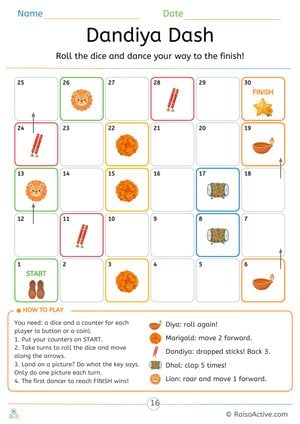
Dandiya Dash: Navratri Board Game for Kids
Ages 4-6 · Pre-K–KindergartenAges 4-6 · Reception–Year 1Ages 4-6 · LKG–UKGAges 4-6
Children count dots on a dice, count on along a number track to 30, take turns and follow simple game rules.
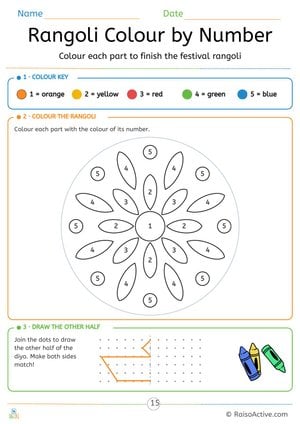
Navratri Rangoli Colour by Number and Symmetry Diya
Ages 4-6 · Pre-K–KindergartenAges 4-6 · Reception–Year 1Ages 4-6 · LKG–UKGAges 4-6
Children match numbers to colours using a key, colour a rangoli pattern carefully and draw the other half of a shape so both sides match.

Written by
Hemsweta Jain · Teacher Cheena
MBA and Early Childhood Educator, teaching since 2014 · Founder of RaisoActive, Mumbai
Published · Last reviewed
Related Resources
Printable Resources(10)
View all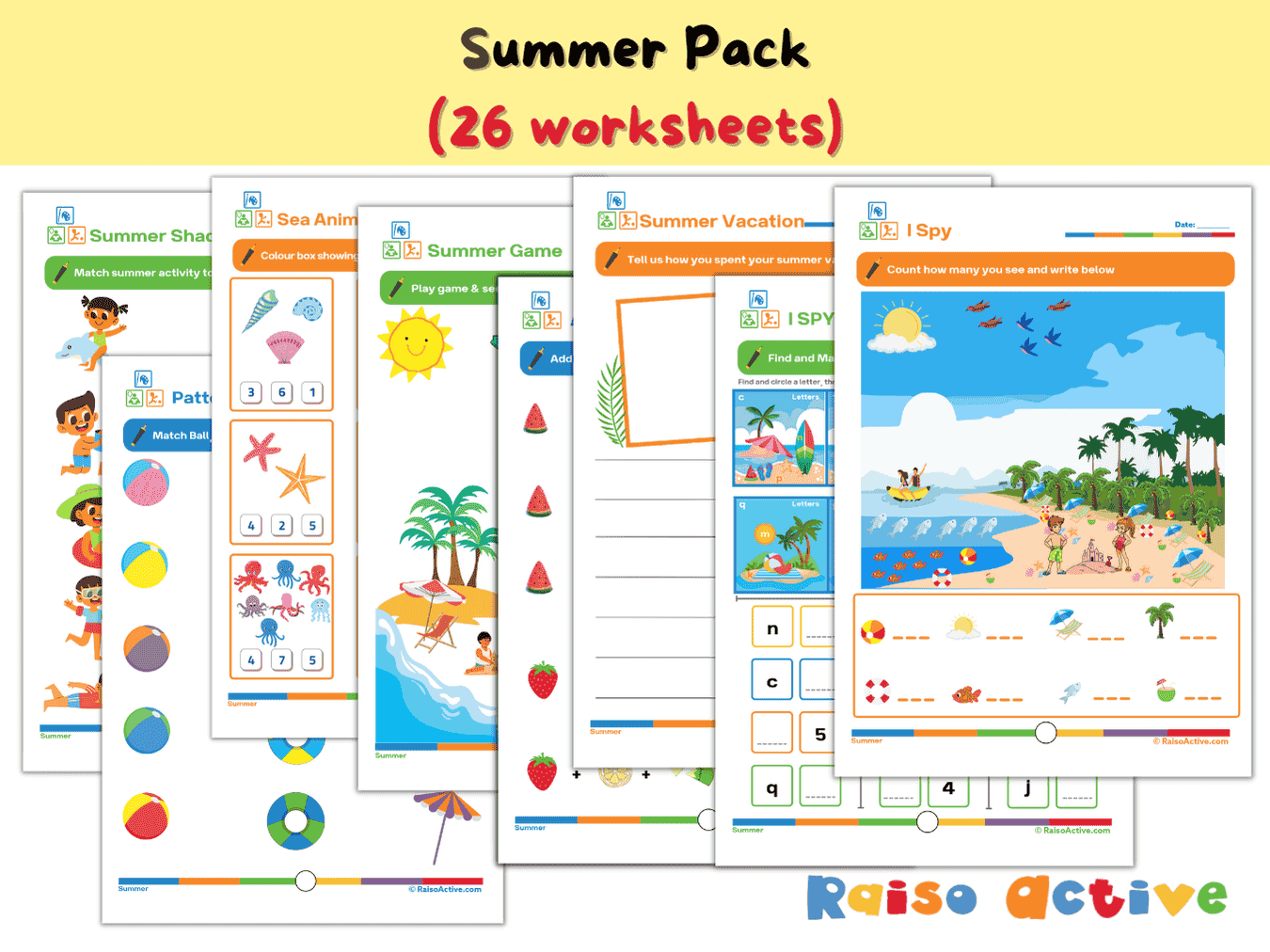

Summer Activity Pack: Math, Literacy, Puzzles & More for Preschool & Kindergarten
Ages 3-7 · Preschool–Grade 1Ages 3-7 · Nursery–Year 2Ages 3-7 · Nursery–Class 1Ages 3-7 · 26 pages
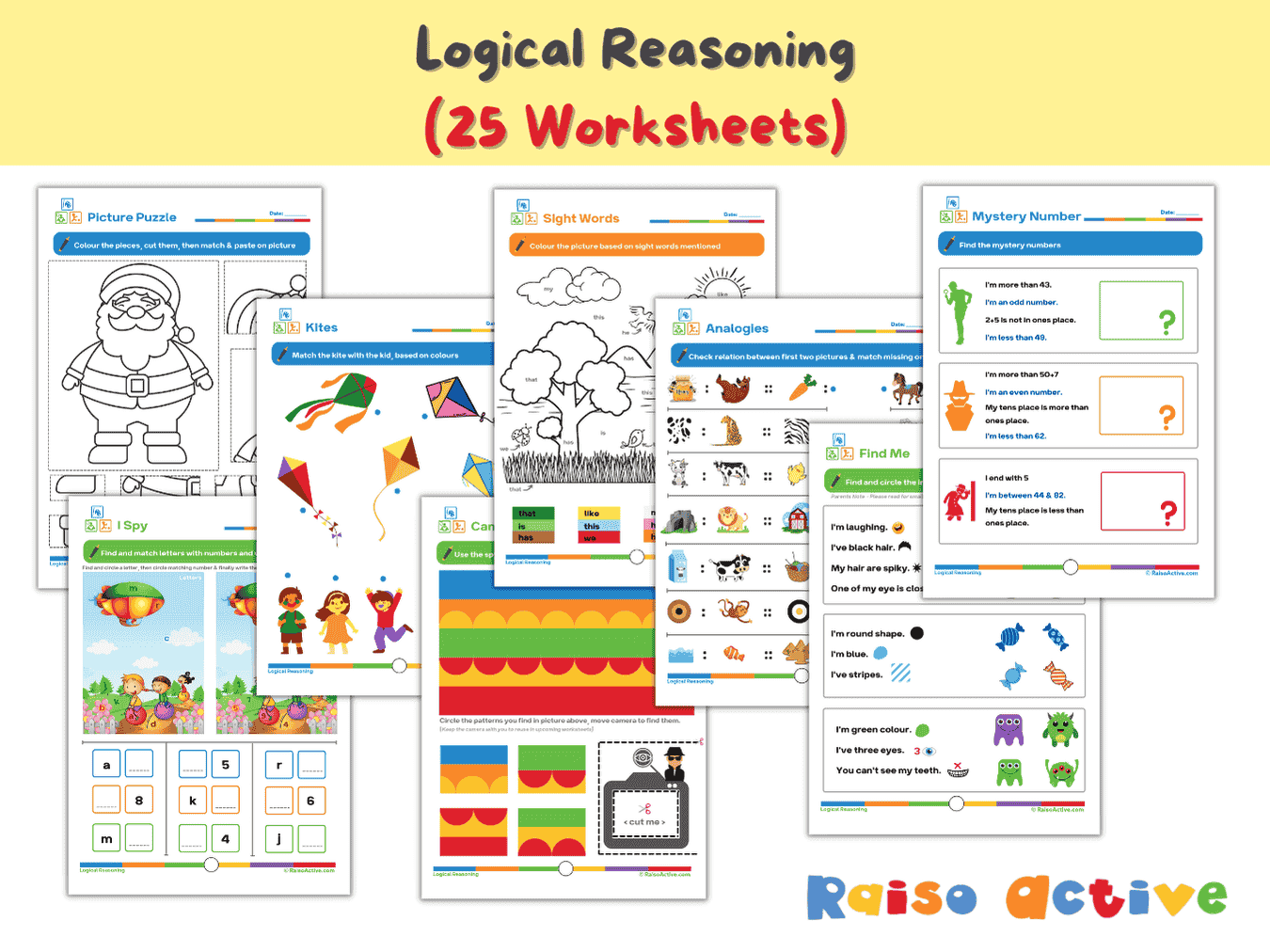

Logical Reasoning Activity Book for Preschool & Kindergarten | Patterns, Puzzles & Analogies
Ages 4-7 · Pre-K–Grade 1Ages 4-7 · Reception–Year 2Ages 4-7 · LKG–Class 1Ages 4-7 · 26 pages
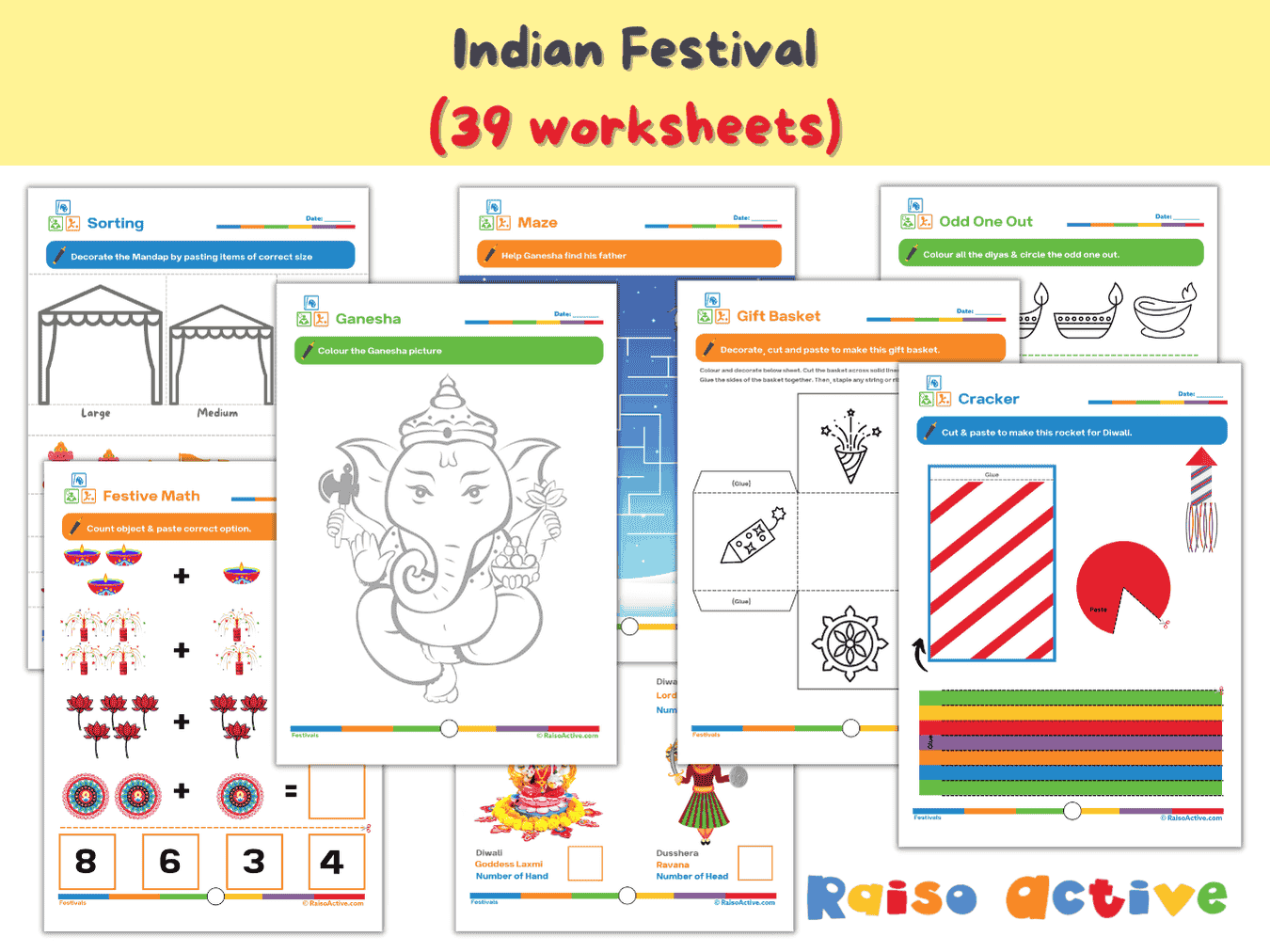
Festivals & Cultural Diversity Activity Book for Kids (Ages 4-8)
Ages 4-8 · Pre-K–Grade 2Ages 4-8 · Reception–Year 3Ages 4-8 · LKG–Class 2Ages 4-8 · 30 pages
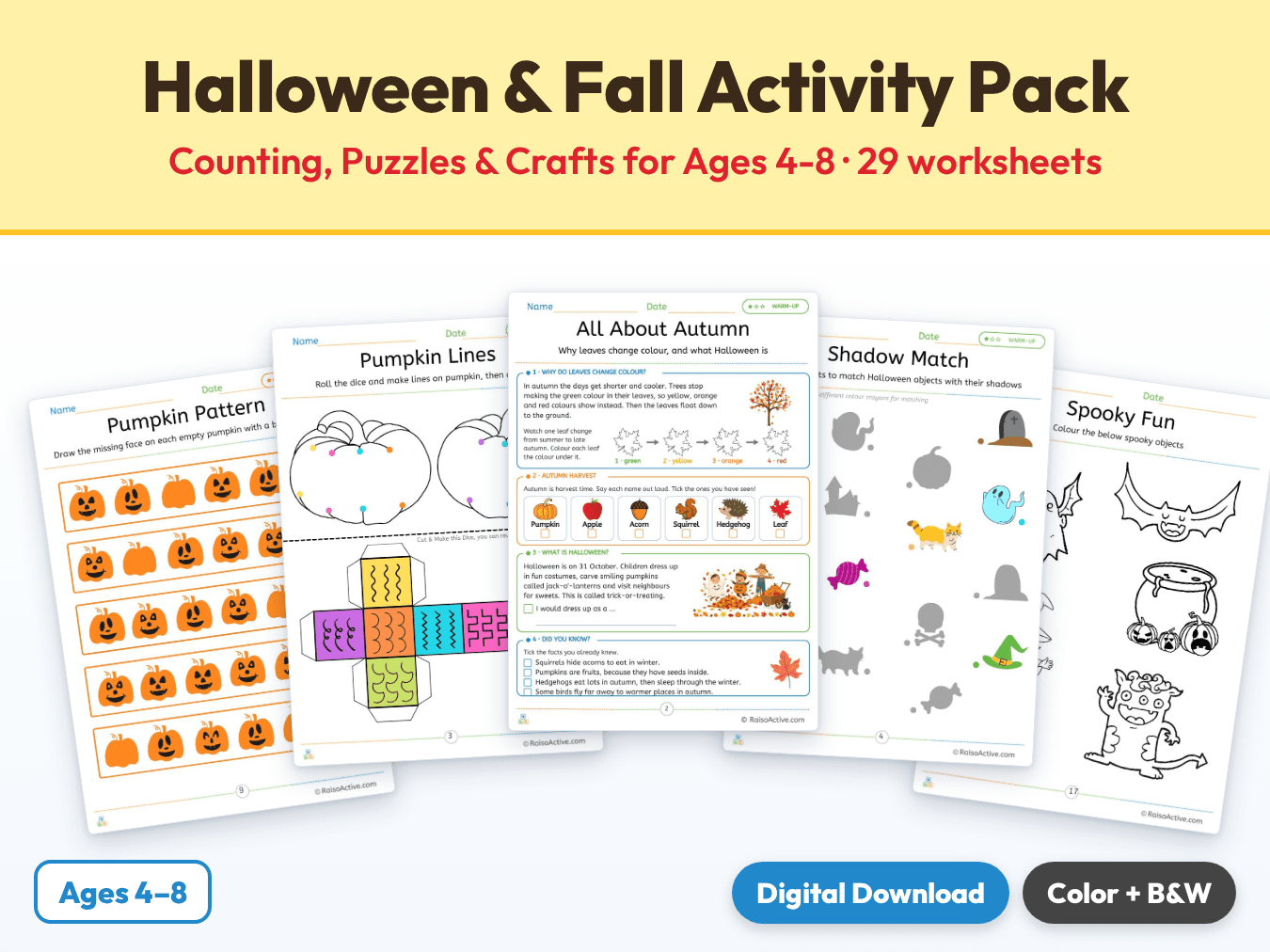
Halloween & Fall Activity Pack: Counting, Puzzles & Crafts for Ages 4-8
Ages 4-8 · Pre-K–Grade 2Ages 4-8 · Reception–Year 3Ages 4-8 · LKG–Class 2Ages 4-8 · 30 pages

Month 9: Holistic Preschool Play Learning | Ages Up to 4
Ages 3-4 · PreschoolAges 3-4 · NurseryAges 3-4 · 30 pages
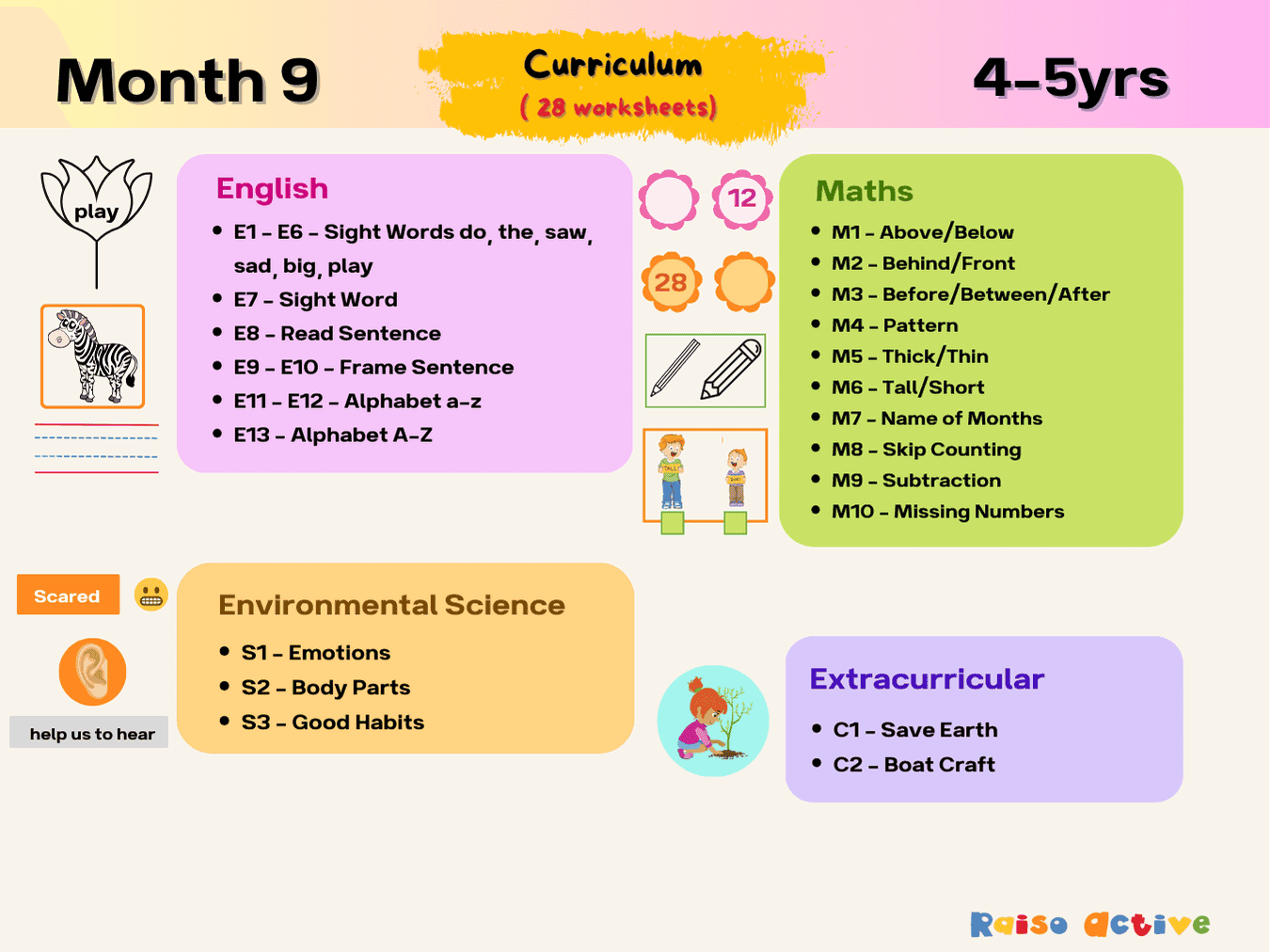
Month 9: Play-Based Preschool Foundational Skills | Ages 4-5
Ages 4-5 · Pre-KAges 4-5 · ReceptionAges 4-5 · LKGAges 4-5 · 31 pages
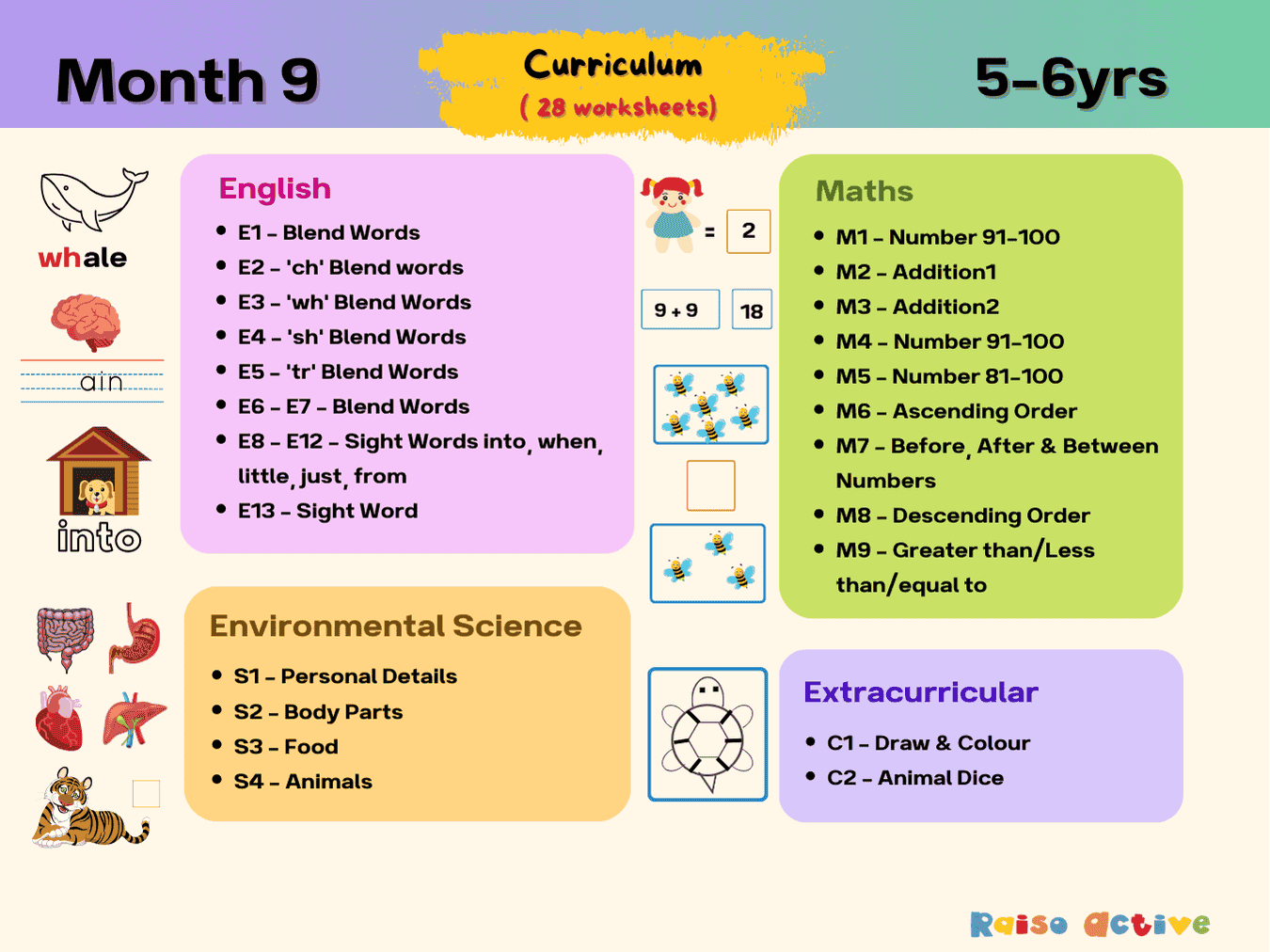
Month 9: Early Learning English Math Science | Ages 5-6
Ages 5-6 · KindergartenAges 5-6 · Year 1Ages 5-6 · UKGAges 5-6 · 31 pages
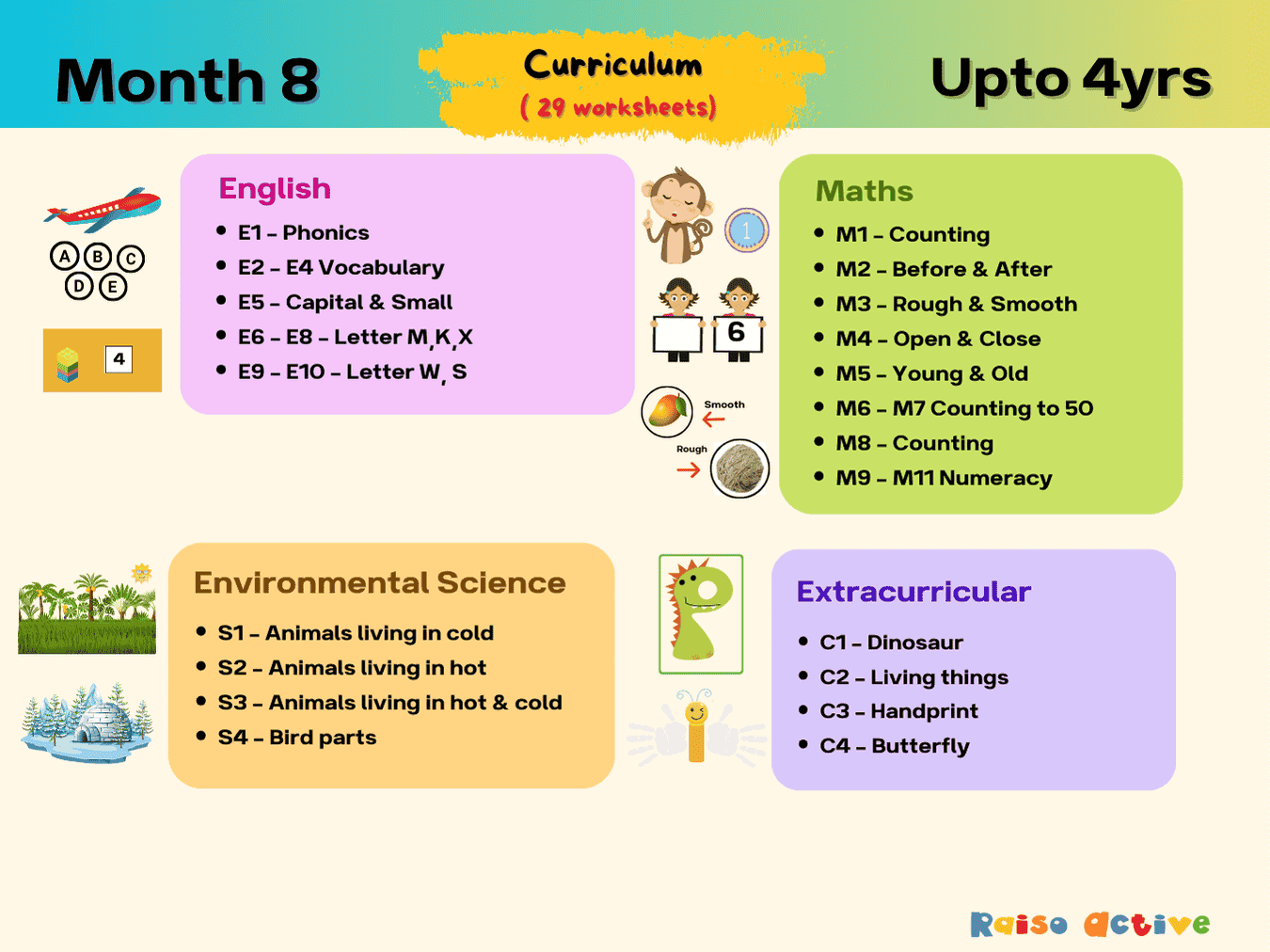
Month 8: Phonics, Math, Science, Creativity | Ages Up to 4
Ages 3-5 · Preschool–Pre-KAges 3-5 · Nursery–ReceptionAges 3-5 · Nursery–LKGAges 3-5 · 32 pages
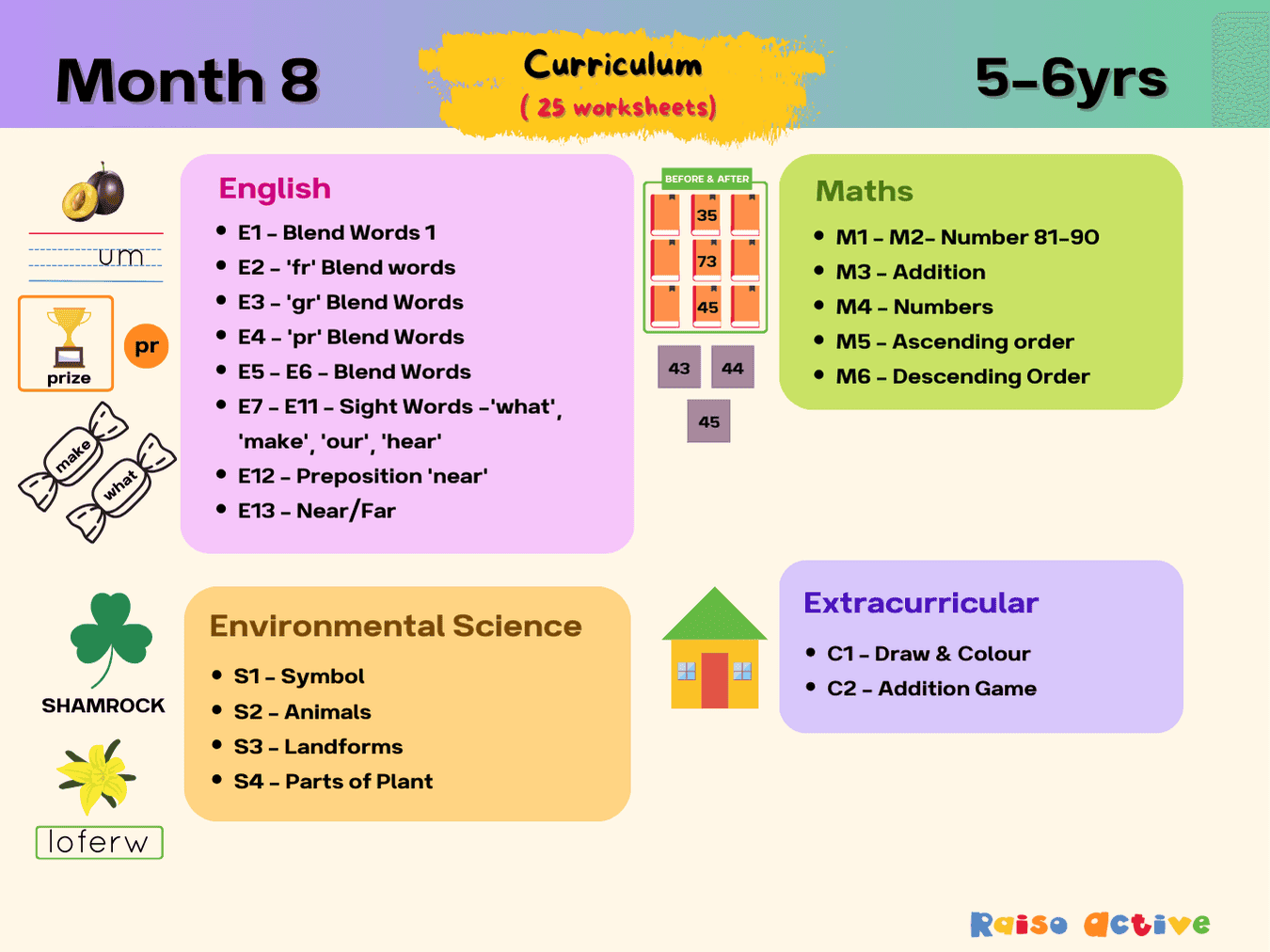
Month 8: Literacy, Math, Science Foundations | Ages 5-6
Ages 5-6 · KindergartenAges 5-6 · Year 1Ages 5-6 · UKGAges 5-6 · 28 pages
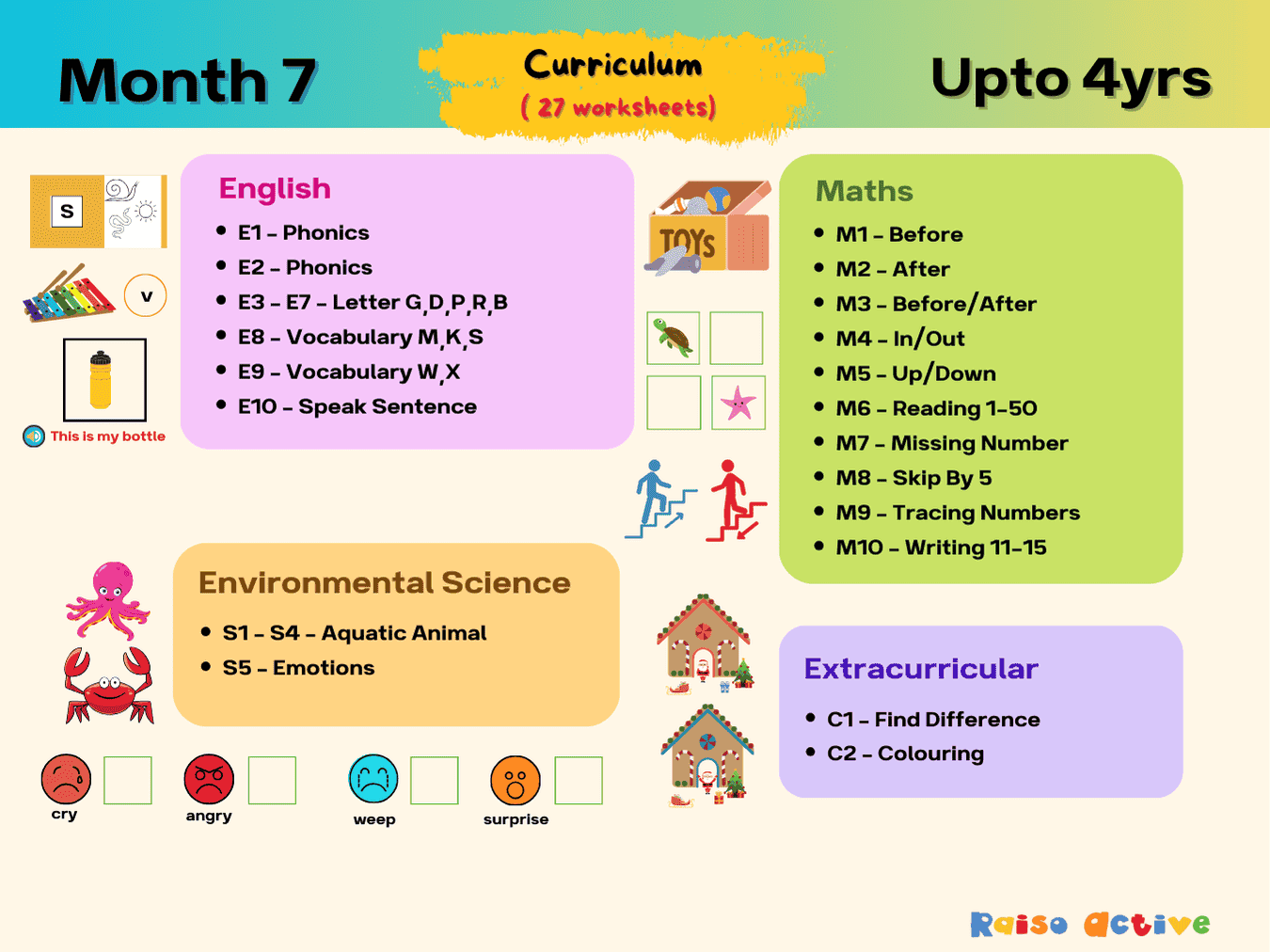
Month 7: Comprehensive preschool learning | Ages Up to 4
Ages 2-4 · PreschoolAges 2-4 · NurseryAges 2-4 · 30 pages