My Child Can Count But Can't Write Numbers — Is This Normal? A Parent's Complete Guide
Author
RaisoActive - Kids Activities and Fun Learning
Published
Updated
Reading Time
19 min read

- Counting is an oral and cognitive skill; writing numerals is a fine motor and spatial skill — they develop along completely separate pathways and it is entirely normal for one to be far ahead of the other
- Many children aged 3-5 can count fluently to 20 or beyond while being unable to write a single numeral correctly, because numeral writing requires hand strength, pencil control, and spatial memory that counting simply does not
- Before a child can write numerals, they need pre-writing foundations: strong hand muscles, the ability to copy basic strokes (vertical line, horizontal line, curve, diagonal), and spatial awareness of directionality
- Multi-sensory activities — playdough shaping, sand tray tracing, sky writing, number stamps — are far more effective than pencil practice for building number formation skills in young children
- Indian school systems often require numeral writing from LKG onwards, creating pressure before many children are physically ready; knowing the developmental timeline lets you support without panic
When Counting and Writing Do Not Arrive Together — And Why They Rarely Do
Your child counts to 20 without a single stumble. They can tell you there are seven mangoes in the bowl, point to the third step on the staircase, and confidently announce that they are four years old. And then you hand them a pencil and ask them to write the number 4 — and nothing comes out right. The numeral is backwards, the curves go the wrong way, or the child simply stares at you blankly and says they do not know how.
This is one of the most common and most misunderstood gaps in early childhood development. Parents — and sometimes teachers — assume that because a child understands numbers, writing them should follow naturally. But counting and numeral writing are two entirely different skills, built in different parts of the brain, requiring different types of development, and following different timelines. A child who counts beautifully but cannot yet write numerals is not behind — they are simply at a perfectly normal point in two separate developmental journeys.
This guide will explain exactly why these two skills diverge, what your child needs to build before numeral writing becomes achievable, and the best activities — many of which require nothing more than sand, playdough, or a shallow tray — to bridge the gap gently and effectively.
Counting vs Writing Numbers: Two Completely Different Skills
When a child counts, they are using language and memory. They have heard the number sequence repeated hundreds of times — in songs, in conversations, in rhymes — and they have memorised it as a verbal chain. Understanding the concept of five-ness (that five means this many objects) adds another cognitive layer, but it is still fundamentally a mental and linguistic skill. The hands are not involved at all.
Writing a numeral, on the other hand, is a motor skill with a spatial memory component. To write the number 2, a child must remember the specific sequence of strokes that make up that symbol, control a pencil with enough precision to execute those strokes, understand concepts like starting at the top, curving to the right, and sweeping back left, and coordinate their eyes and hand simultaneously. None of these abilities come from counting practice. They come from physical experience — specifically from the gradual development of the small muscles of the hand, wrist, and fingers, and from activities that build spatial body awareness.
Counting fluency tells you nothing about a child's readiness to write numerals. These are separate developmental achievements. A 4-year-old who counts to 30 but cannot write any numerals is showing completely normal development for their age.
Developmental research consistently shows that oral number knowledge typically precedes numeral writing by 12-18 months. Most children can count meaningfully by age 3-4 but are not ready for accurate numeral writing until age 5-5.5, when fine motor skills have sufficiently matured.
The Developmental Timeline for Numeral Writing
Understanding roughly when children typically achieve numeral writing milestones can relieve a great deal of parental anxiety. These are averages — individual children vary by six months or more in either direction — but they give you a useful framework.
Ages 2-3: Number Recognition Begins
Children begin recognising numerals as symbols — knowing that a '3' is a special mark that means something — but have no ability to reproduce them. At this age, any marks they make are exploratory scribbles. This is exactly right.
Ages 3-4: Attempting Numerals Through Drawing
Some children begin attempting numerals by drawing shapes that vaguely resemble them — a circle for 0, a stick for 1. The results are unrecognisable to most adults and that is completely fine. What matters is that the child is beginning to connect the symbol to a motor intention. Reversals (writing 2 backwards, for instance) are universal at this stage and not a cause for concern.
Ages 4-5: Copying Numerals With Support
Most children can begin copying simple numerals (1, 0, 7) when shown a clear model. More complex numerals (2, 3, 5, 6, 8, 9) are genuinely difficult and many children will still produce them with significant errors or reversals. This is entirely normal. Writing from memory (without a model to copy from) is harder still and typically comes later.
Ages 5-6: Reliable Numeral Writing Develops
Between ages 5 and 6, most children develop the fine motor maturity to write numerals 0-9 with increasing consistency, though reversals may continue for some numerals (especially 3, 5, 6, and 9) until age 6.5-7. Writing numerals from memory, without a model, typically becomes reliable around age 5.5-6.
Research in developmental psychology shows that the tendency to reverse numerals and letters is not a sign of dyslexia or learning difficulty in children under 7. The brain's ability to encode directionality — distinguishing a '3' from its mirror image — is a specific developmental achievement that takes time. Most children resolve reversals naturally as their visual-spatial processing matures.
Source: Journal of Learning Disabilities and Developmental Psychology
What Must Come Before Numeral Writing: The Pre-Writing Foundation
Just as a building needs a foundation before walls can go up, numeral writing requires a set of prerequisite skills to be in place before pencil-on-paper practice becomes productive. Trying to teach numeral writing before these foundations exist is like building on sand — it will not hold.
Basic Stroke Mastery
Every numeral is made up of a combination of a small set of basic strokes: vertical lines (1, 7), horizontal lines (parts of 4, 5, 7), curves (0, 2, 3, 5, 6, 8, 9), and diagonals (parts of 4). A child who cannot yet draw a reasonably straight vertical line or a smooth curve will find every numeral impossible. Before number tracing, check that your child can copy these basic strokes in isolation — large, with a fat crayon on plain paper.
Hand Strength and Finger Control
The small intrinsic muscles of the hand — the ones that live inside the palm and between the fingers — are what give precise control to fine movements. In young children these muscles are still developing. A child who has had lots of experience squeezing, pinching, rolling, tearing, and manipulating objects will have stronger intrinsic hand muscles and will find pencil control significantly easier. A child who has had little of this experience will grip the pencil too tightly, fatigue quickly, and produce shaky or heavy strokes.
Directionality Awareness
Numerals are not just shapes — they are shapes with a specific orientation. A 3 faces right; its mirror image is wrong. A 6 opens at the bottom; a 9 at the top. Understanding directionality — left and right, top and bottom, which way a curve opens — is a spatial concept that develops through body movement and experience, not through copying practice. Children who have not yet developed directionality will produce reversals consistently regardless of how often they practise.
Starting Point and Stroke Sequence Awareness
Each numeral has a correct starting point and a sequence of strokes. Writing 8 from the bottom up creates a very different (and usually messier) result than starting from the top. Young children who have not been explicitly taught starting points will begin wherever seems natural to them — which is often not the most efficient or legible approach. This is best taught through verbally narrated multi-sensory activities before it is taught through worksheet practice.
The four foundations — basic stroke mastery, hand strength, directionality awareness, and starting point knowledge — must all be building before numeral writing practice on worksheets will pay off. If any of these are missing, activities that build them will produce faster results than more worksheet time.
Multi-Sensory Activities That Build Number Formation Skills
The research on early literacy and numeracy is consistent: children learn the shapes of symbols fastest when they experience those shapes through multiple senses simultaneously. Hearing the name of the numeral, seeing its shape, and feeling it through touch and movement together create much stronger neural pathways than seeing it on a page alone. Here are the most effective multi-sensory activities for building number formation at home.
Sand Tray Number Tracing
Spread fine sand, atta (wheat flour), or semolina in a shallow tray or thali. Hold your child's index finger and trace a numeral together in the sand, narrating aloud: 'For number 1, we start at the top and slide straight down.' Then invite the child to try while you narrate. The texture of the sand provides rich sensory feedback to the fingertip, helping the brain encode the shape more deeply than pencil on paper alone. Erase and repeat. This activity is free, mess-contained, and can be done in minutes.
Playdough Number Shaping
Roll playdough into thin ropes and shape them into numerals on a flat surface. This is extraordinarily effective because the child must spatially construct the numeral in three dimensions — deciding which way it curves, where it starts, how it connects — using their hands, not a pencil. The physical act of shaping reinforces the spatial memory far more than tracing a ready-made numeral. Number-shaped cookie cutters can then be used to press out the shape and compare with the child's own version.
Sky Writing and Air Tracing
Sky writing — drawing large numerals in the air with the whole arm — uses the shoulder and elbow joints to encode the shape at a gross motor level before the fine motor system takes over. Hold your child's whole arm at the wrist and guide them through large numeral movements in the air, calling out the directions: 'Big curve to the right, now loop back left — that is our 2!' The large movement is much easier than pencil work and builds the directional memory that transfers down to the hand.
Finger Painting Numerals
Print large numeral outlines on paper and invite the child to paint along the shape using one finger dipped in poster paint. This removes the pencil-holding challenge entirely while preserving the visual tracking and directional movement practice. Start with the simplest numerals: 1 (a straight stroke), then 0 (a smooth oval), then 7, then 4, before moving to the curvier numerals that need more precision.
Textured Number Tracing Cards
Make simple tracing cards by gluing string, sandpaper strips, or coarse salt along the shape of each numeral on cardboard. The child traces the raised numeral with their index finger, feeling the shape while you narrate the direction. The tactile contrast between the numeral and the smooth card makes the shape feel distinct and memorable. These cards take about ten minutes to make and can be used repeatedly.
- Sand tray tracing — Spread atta or fine sand in a thali. Hold the child's finger and trace numerals together while saying the steps aloud
- Playdough ropes — Roll thin ropes and shape them into numerals on the table. Compare with a number card beside it
- Sky writing — Stand behind your child, hold their arm at the wrist, and draw large numerals in the air together. Use whole-arm movements
- Wet sponge on tiles — Dip a small sponge in water and write numerals on bathroom or kitchen tiles. Watch them disappear and repeat
- Sticker number outlines — Draw large numeral outlines on paper and have the child place dot stickers along the path — this builds the directional shape without any pencil pressure
- Rice tray — Press cooked rice into a thin layer in a tray and draw numerals in it with a finger. The resistance of the rice builds finger strength alongside spatial practice
Number Formation: Which Numerals Are Easiest and Why
Not all numerals are equally difficult to write. When introducing numeral writing, matching the starting numeral to your child's current motor ability makes a significant difference to their confidence and success rate. Here is a rough order of difficulty, from easiest to hardest, with the reason why.
- +1 — Easiest
- +0 — Very Easy
- +7 — Easy
- +4 — Moderate
- +2 — Moderate
- +3 — Moderately Hard
- +5 — Hard
- +6 — Hard
- +9 — Hard
- +8 — Hardest
- -A single straight downward stroke — only one direction, no curve
- -A single smooth oval — one continuous stroke, no change of direction
- -Two straight strokes at an angle — simple but requires diagonal control
- -Three strokes including a diagonal — the sequence and meeting point trip children up
- -Starts at top, curves right, sweeps back left — requires smooth directional change
- -Two back-to-back open curves — directional changes are subtle and easily reversed
- -Starts with a horizontal, curves into a vertical, then a horizontal — complex sequence
- -Starts with a curve that closes, then curves into a counter-curve — easily confused with 5
- -A loop at the top closing into a curved tail — tail direction is frequently reversed
- -Two continuous loops, one above the other — sustained motor control across the whole numeral
If your child is struggling with numeral writing, start only with 1 and 0, build success and confidence there, then add 7. Once those three are solid, add 4. Resist the temptation to teach all ten numerals at once — mastery of two or three is far more valuable than confused exposure to all ten.
The Indian School Context: Navigating Real Pressure With Developmental Honesty
In many Indian preschools and LKG programmes, children are expected to write numerals 1-10 (sometimes 1-100) from the first term of school — often at age 3.5 or 4. Number copy books appear in school bags within weeks of a child starting. Some schools use numeral writing ability as a signal of school readiness or grade them on handwriting neatness from a very early age.
This creates a very specific kind of parental anxiety: watching other children's copy books come home neater than your child's, hearing from the teacher that your child is not focusing, or comparing your four-year-old's wobbly 3 with a classmate's apparently perfect version. It is worth knowing that the international developmental consensus is that formal numeral writing should not be expected before age 5, and most children are not reliably accurate until 5.5-6. Indian curriculum timelines are not set by child development research — they are set by tradition, parental expectation, and competitive culture.
This does not mean you should ignore the school's requirements. It means you should complete the school's copy work in short, low-pressure sessions (five minutes maximum for a 3-4 year old, ten minutes for a 4-5 year old), and then invest the larger portion of your child's learning time in the multi-sensory foundation activities described in this guide. A child with strong foundations will overtake peers who have had only copy-book practice within a few months, and will write more legibly and with less fatigue because the underlying skills are properly built.
The solution to 'my child can count but cannot write numbers' is almost never more numeral copying. It is building the underlying skills — hand strength, basic stroke mastery, directionality — through play-based activities, then returning to the worksheet with a properly prepared hand.
Most children who are given the right foundation activities and allowed to develop at their own pace will be forming numerals with confidence within 6-10 weeks.
- Keep copy-book sessions short — 5 minutes for ages 3-4, 10 minutes for ages 4-5. Stop before frustration peaks
- Celebrate attempts, not accuracy. 'You tried so hard with that 3!' matters more than a correct 3 at this age
- Do multi-sensory activities at home (sand tray, playdough, sky writing) for 10-15 minutes daily — these will pay off in the copy book faster than extra copy-book practice
- If the teacher raises concerns, share that you are actively working on fine motor and number formation skills at home through play-based activities. Most teachers appreciate engaged parents
- Avoid comparing your child's copy book to siblings' or classmates' books. Development timelines vary widely and comparisons create anxiety without useful information
Studies in early maths education consistently show that embodied, multi-sensory learning — using sand, playdough, movement, and touch — creates stronger and more durable neural encoding of numeral shapes than drill-based copying. The sensory richness of 3D activities engages more brain regions simultaneously, which is why the learning sticks better.
Source: Early Childhood Education Journal, Multi-Sensory Mathematics Research
Step-by-Step: Teaching Number Formation at Home
The Number Writing Readiness Progression
Step 1: Build Hand Strength First (Weeks 1-2)
Before any numeral practice, spend two weeks building hand strength through play: squeezing playdough, tearing newspaper into small pieces, using tongs to transfer objects, threading beads, and peeling stickers. These activities develop the intrinsic hand muscles that will later control the pencil. Ten minutes daily is enough.
Step 2: Practise Basic Strokes Without Numbers (Weeks 2-3)
Draw large basic strokes on paper — long straight lines (top to bottom, left to right), smooth curves (like a rainbow or a hill), and diagonals (like a slide). Ask your child to trace them with a fat crayon or finger-paint along them. These are the building blocks of every numeral. Mastery here makes numeral writing far easier.
Step 3: Introduce Numerals 1 and 0 Through Multi-Sensory Play (Weeks 3-4)
Introduce just two numerals using sand trays, playdough shaping, sky writing, and finger painting — not pencil-on-paper yet. Narrate the direction clearly and consistently each time: 'For 1, we start at the top and go straight down. For 0, we make a smooth oval, like an egg.' Repeat the same narration every time so the child builds a verbal memory of the shape.
Step 4: Move to Pencil Tracing of 1 and 0 (Weeks 4-5)
Once the child can form 1 and 0 in the sand tray and with playdough, introduce large dotted numeral outlines on paper — dots spaced at least 2cm apart — and a fat crayon or thick washable marker (not a pencil yet). Trace just these two numerals. Five minutes is enough. Celebrate every attempt.
Step 5: Add Numerals Gradually, Easiest First (Ongoing)
Add one new numeral every 3-5 days, in order of difficulty: 7, then 4, then 2, then 3, then 5, then 6, then 9, then 8. Each time, introduce the new numeral multi-sensorially first (sand, playdough, sky writing) before bringing it to paper. Keep revisiting earlier numerals so the learning stays fresh.
Step 6: Introduce Standard Pencil and Smaller Numerals (When Ready)
Once the child can form numerals 1-9 with a fat crayon on large dotted outlines, introduce a standard pencil with smaller numeral guides. Gradually reduce the dot spacing and the numeral size over weeks. Standard school-sized numeral writing typically becomes achievable between ages 5 and 5.5 for most children — this is the realistic, developmentally sound endpoint.
- Your child is 6 years or older and cannot yet copy even the simplest numerals (1, 0) despite several months of varied multi-sensory practice
- The child shows strong avoidance of all drawing, colouring, and writing tasks and becomes very distressed when asked to hold a pencil or crayon
- Hand grip is unusually weak — the child cannot squeeze playdough, use scissors, or manipulate small objects that peers manage easily
- Reversals persist for all numerals consistently after age 7, especially if accompanied by difficulty with letter reversals or reading
- Numeral writing difficulty is accompanied by other concerns: significant speech delays, balance difficulties, very high or very low sensitivity to touch, or pronounced attention challenges
- If multiple signs are present together, a paediatric occupational therapist is an excellent first step — they can assess hand strength, visual-motor integration, and spatial processing, and give you a personalised home programme
Worksheets That Support Number Formation
Once your child has built some multi-sensory foundation and is ready to come to paper, the right worksheets can be genuinely helpful — provided they are matched to where the child actually is. Large dotted numerals on plain backgrounds, with clear starting-point arrows, are most useful. Avoid worksheets that cram many small numerals onto a page with no starting point guidance — these are appropriate for reinforcement practice, not for learning.
Frequently Asked Questions
My child is 4 years old, counts perfectly to 20, but cannot write a single numeral. Is something wrong?
My child writes all the numerals backwards. Should I correct them every time?
Which numerals should I teach first?
How long should number writing practice sessions be?
The school expects my child to write numbers 1-100 in LKG. What do I do?
Are there any activities I should avoid when trying to help with numeral writing?
Free worksheets for this topic
Browse all worksheets
Pumpkin Lines Dice Game: Halloween Pre-Writing Worksheet
Ages 4-8 · Pre-K–Grade 2Ages 4-8 · Reception–Year 3Ages 4-8 · LKG–Class 2Ages 4-8
Children practise wavy, zigzag and looped pre-writing lines while playing a simple dice game.
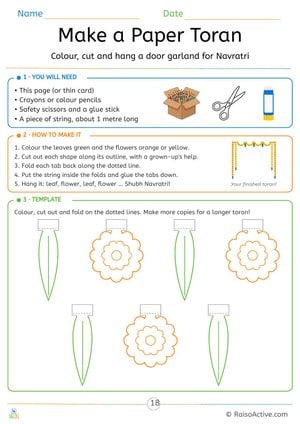
Make a Paper Toran: Navratri Craft Template
Ages 4-6 · Pre-K–KindergartenAges 4-6 · Reception–Year 1Ages 4-6 · LKG–UKGAges 4-6
Children follow step-by-step instructions to colour, cut, fold and glue a festival decoration, building scissor skills and fine motor control.
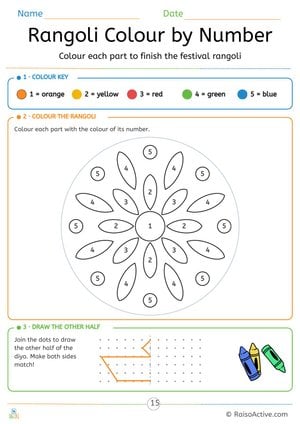
Navratri Rangoli Colour by Number and Symmetry Diya
Ages 4-6 · Pre-K–KindergartenAges 4-6 · Reception–Year 1Ages 4-6 · LKG–UKGAges 4-6
Children match numbers to colours using a key, colour a rangoli pattern carefully and draw the other half of a shape so both sides match.

Navratri Nine Colours Colouring Page: Colour the Garba Dancers
Ages 4-6 · Pre-K–KindergartenAges 4-6 · Reception–Year 1Ages 4-6 · LKG–UKGAges 4-6
Children learn the colour linked with each of the nine days of Navratri 2026 and practise colouring inside the lines.

Written by
Hemsweta Jain · Teacher Cheena
MBA and Early Childhood Educator, teaching since 2014 · Founder of RaisoActive, Mumbai
Published · Last reviewed
Related Resources
Printable Resources(10)
View all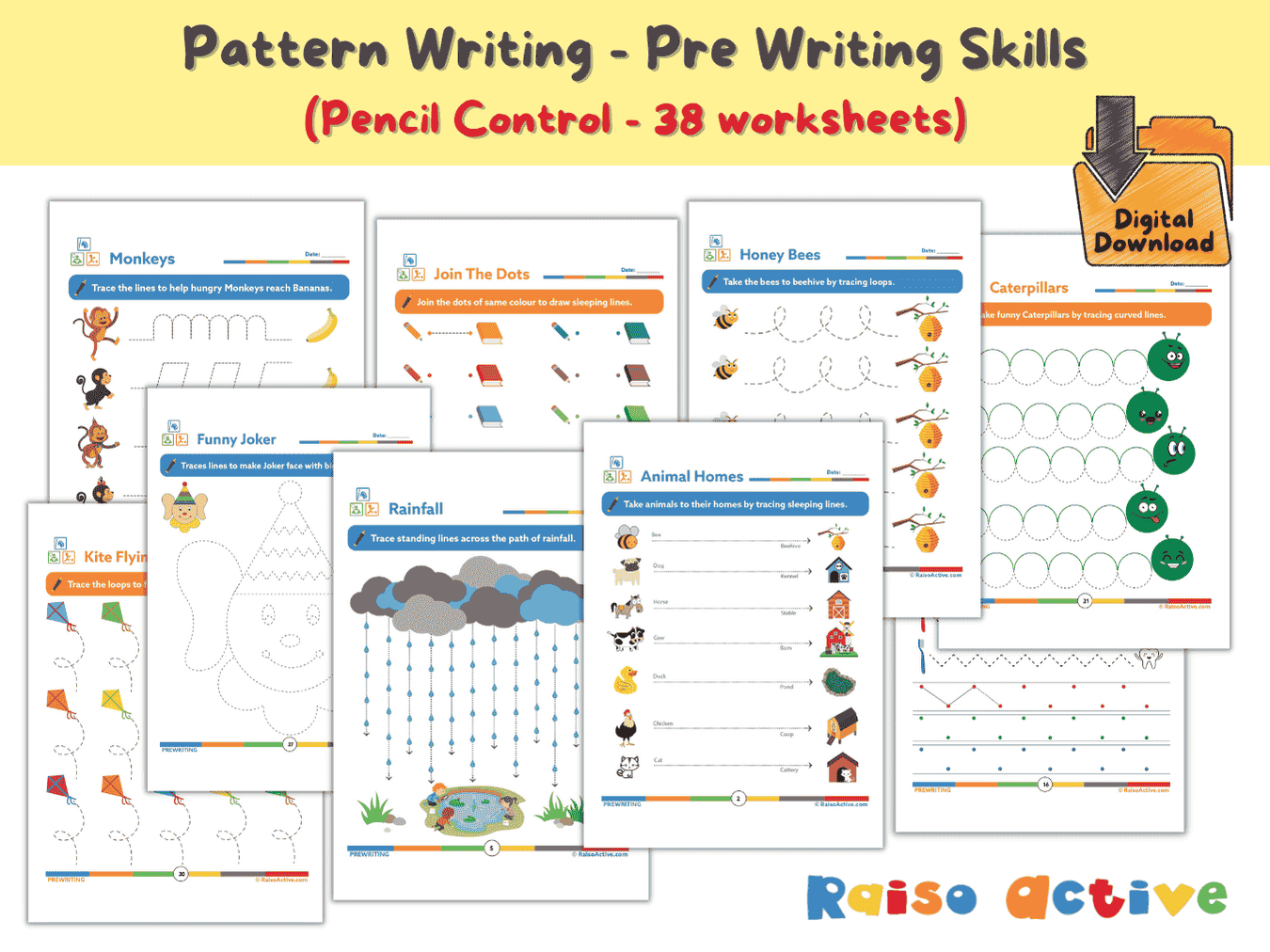

Pattern Writing Pre-writing Skills Activity Book for 3-4 Year Olds
Ages 3-4 · PreschoolAges 3-4 · NurseryAges 3-4 · 44 pages

Summer Activity Pack: Math, Literacy, Puzzles & More for Preschool & Kindergarten
Ages 3-7 · Preschool–Grade 1Ages 3-7 · Nursery–Year 2Ages 3-7 · Nursery–Class 1Ages 3-7 · 26 pages

Logical Reasoning Activity Book for Preschool & Kindergarten | Patterns, Puzzles & Analogies
Ages 4-7 · Pre-K–Grade 1Ages 4-7 · Reception–Year 2Ages 4-7 · LKG–Class 1Ages 4-7 · 26 pages

Lifecycles Activity Book & Flashcards for Preschool & Early Elementary
Ages 3-8 · Preschool–Grade 2Ages 3-8 · Nursery–Year 3Ages 3-8 · Nursery–Class 2Ages 3-8 · 46 pages
Preschool Scissor Skills Activity Book: Fine Motor & Craft Fun for Ages 3-6
Ages 3-6 · Preschool–KindergartenAges 3-6 · Nursery–Year 1Ages 3-6 · Nursery–UKGAges 3-6 · 35 pages
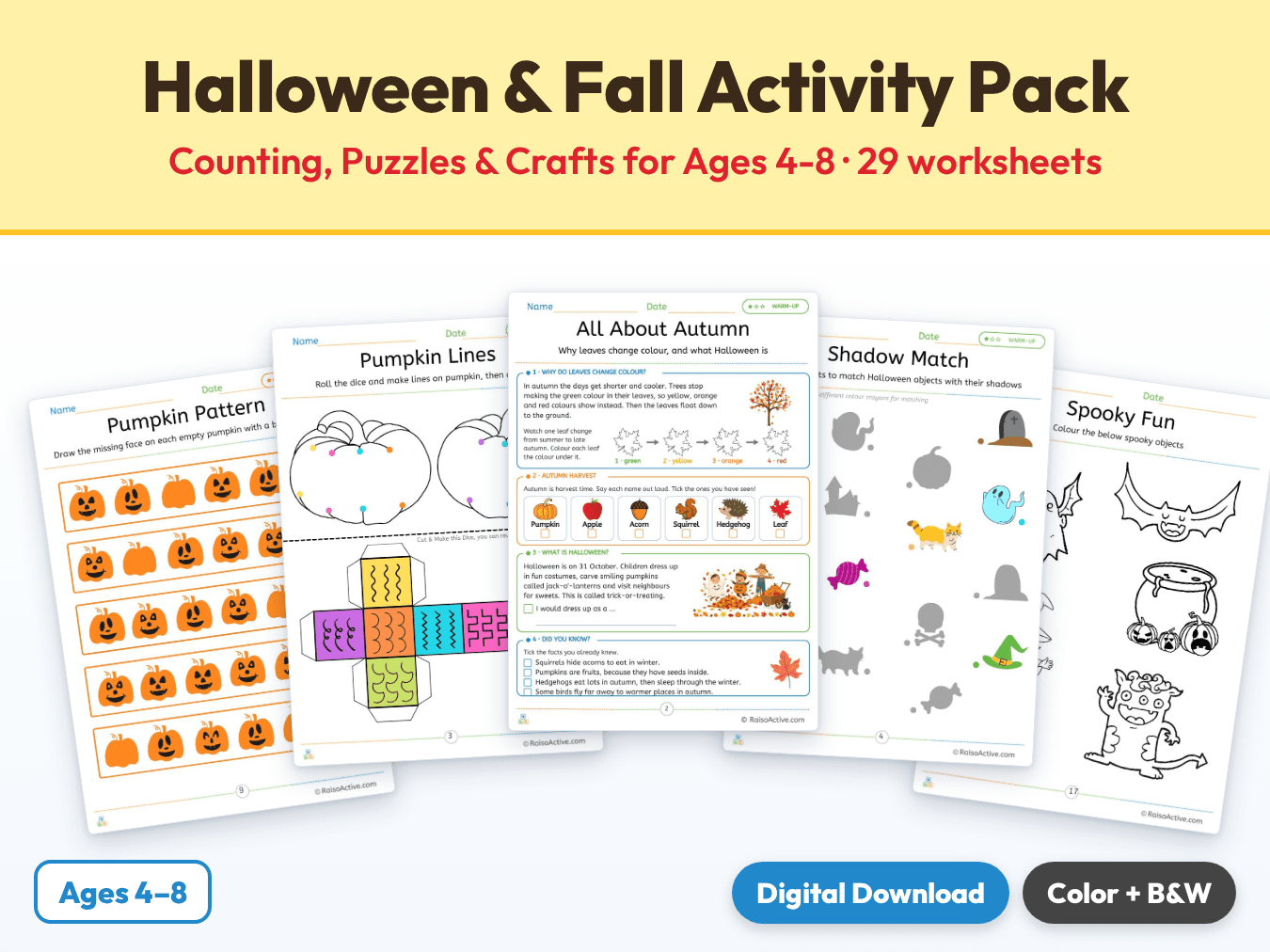
Halloween & Fall Activity Pack: Counting, Puzzles & Crafts for Ages 4-8
Ages 4-8 · Pre-K–Grade 2Ages 4-8 · Reception–Year 3Ages 4-8 · LKG–Class 2Ages 4-8 · 30 pages
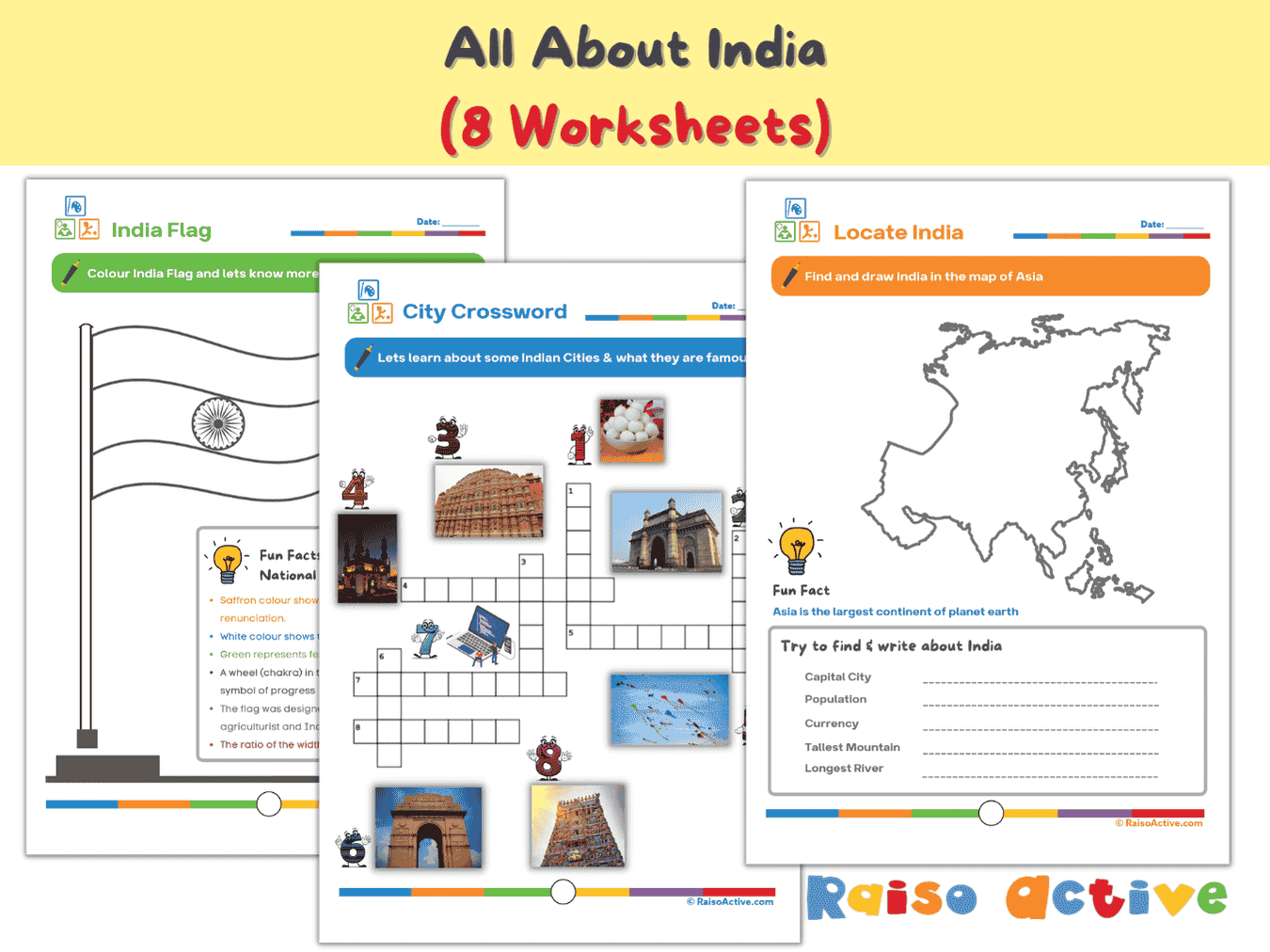
India Activity Book for Kids: Explore Geography, Culture & Symbols (Ages 5-8)
Ages 5-8 · Kindergarten–Grade 2Ages 5-8 · Year 1–Year 3Ages 5-8 · UKG–Class 2Ages 5-8 · 8 pages

Month 9: Holistic Preschool Play Learning | Ages Up to 4
Ages 3-4 · PreschoolAges 3-4 · NurseryAges 3-4 · 30 pages
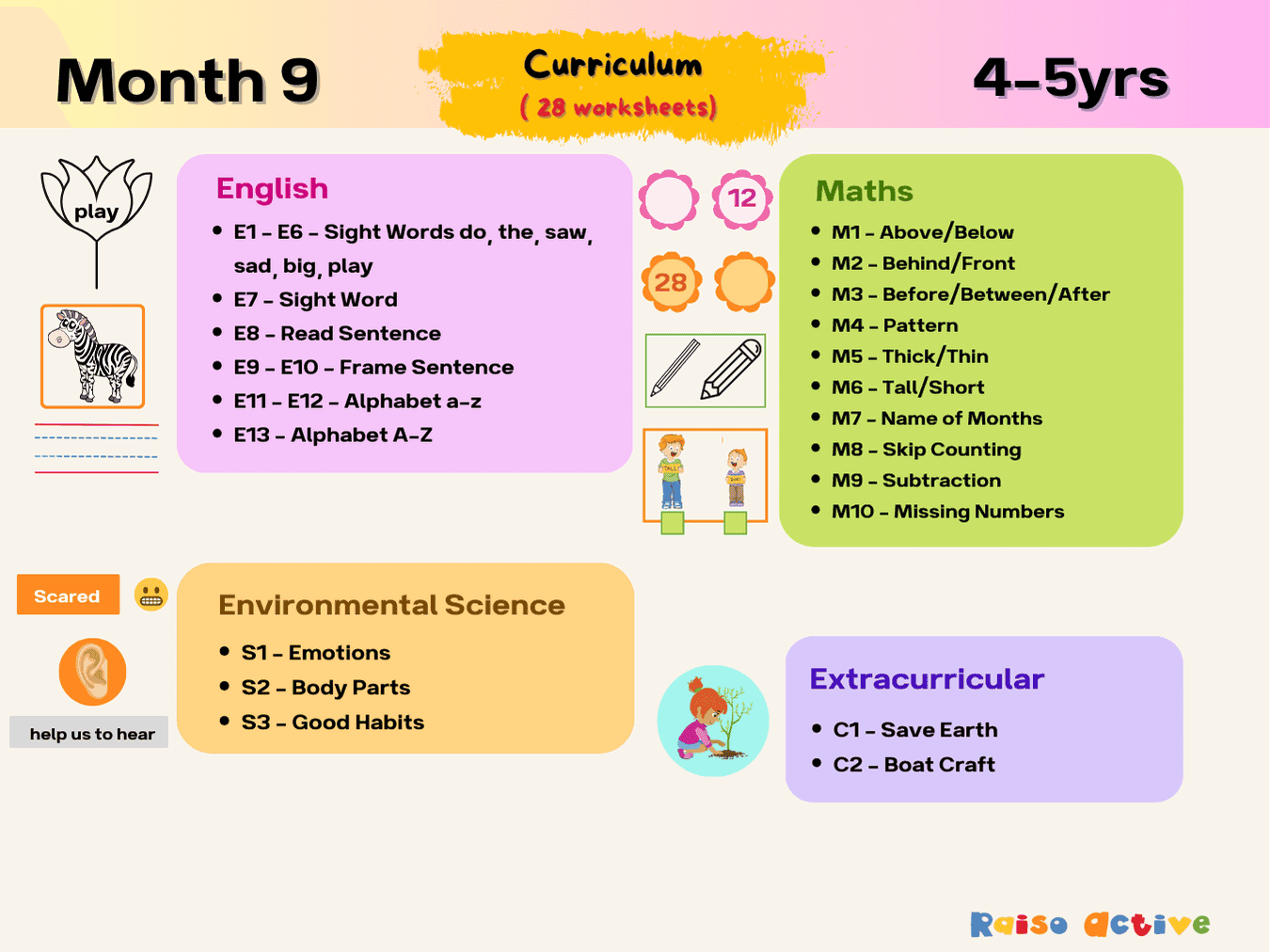
Month 9: Play-Based Preschool Foundational Skills | Ages 4-5
Ages 4-5 · Pre-KAges 4-5 · ReceptionAges 4-5 · LKGAges 4-5 · 31 pages
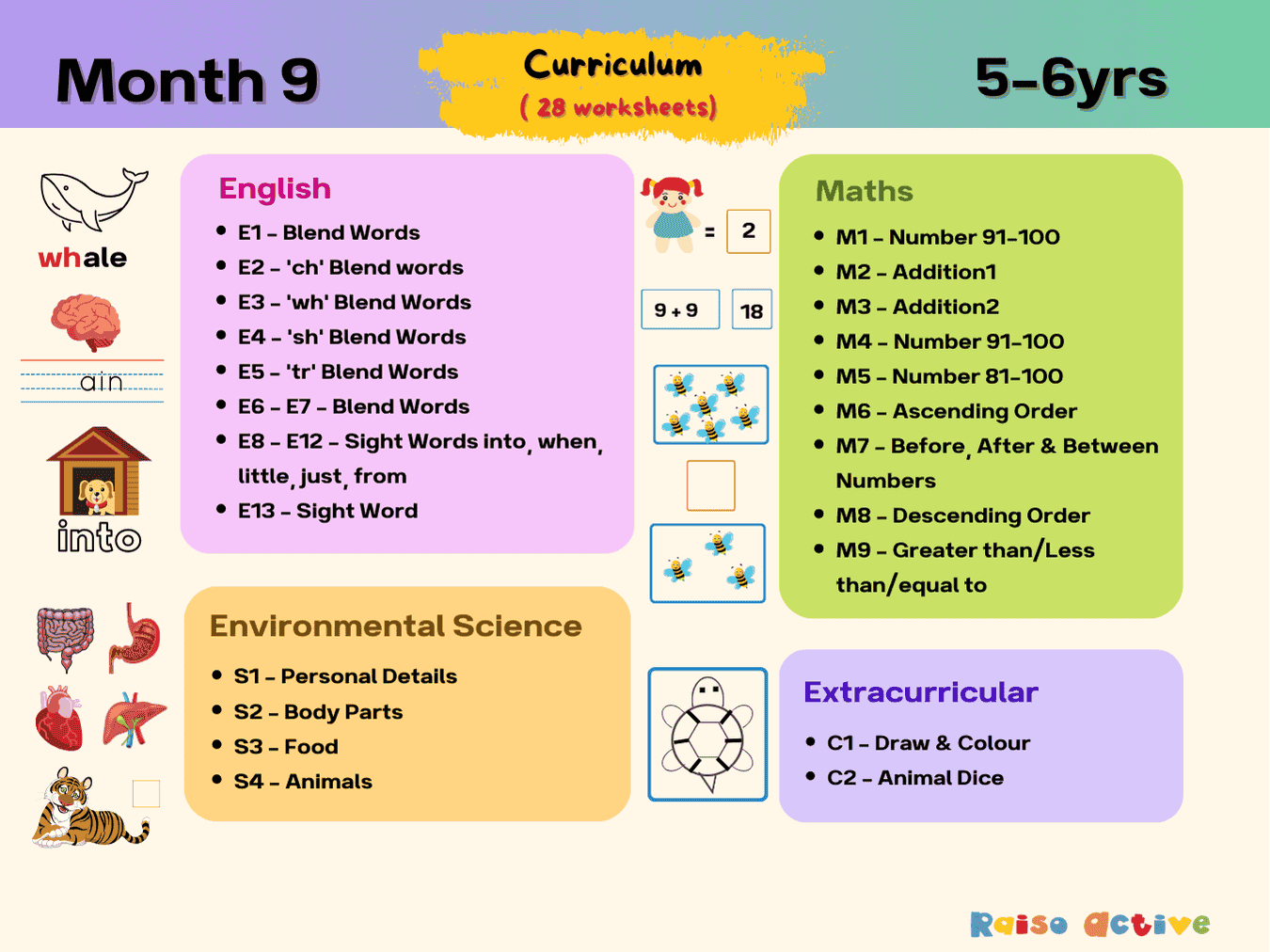
Month 9: Early Learning English Math Science | Ages 5-6
Ages 5-6 · KindergartenAges 5-6 · Year 1Ages 5-6 · UKGAges 5-6 · 31 pages