Trace and Write the Letter K Worksheet for Preschoolers
Isolating the uppercase K lets children give full attention to its trickiest feature — the two diagonal lines meeting the vertical stroke at the same point — without the added demand of a differently-shaped lowercase k. At ages 3-5, mastering this single case thoroughly builds the angled-stroke precision that will make future letters like R and X easier to approach.
Part of the pack
Capital Letter Tracing Activity Book A-Z for Preschool & Kindergarten
This is page 12 of the pack. Ages 3-6 · Preschool–KindergartenAges 3-6 · Nursery–Year 1Ages 3-6 · Nursery–UKGAges 3-6
Made for your child
A whole activity pack made with their name
60 pages to spot, build, trace and write their own name, plus pages about their favourites, feelings and family. See a free preview with their name.
Make an All About Me packFree preview · free for members
Or start free: a name tracing sheet with their nameCurriculum
- Writing > Letter Tracing A-Z
- Pre-Writing > Straight Lines
- Pre-Writing > Letter Pre-Writing
How to use this worksheet
Trace the dotted lines to practice writing the letter K, following the straight vertical line first and then the two diagonal strokes meeting it. Once your child feels ready, have them try writing the letter K on their own on the blank lines. Talk about K words together, like kite or key, as they work. Let them color any pictures on the page once the writing practice is finished.
Materials needed
- Pencil
- Crayons
Extension activities
- 1Find objects that start with the letter K, like keys, a kite, or a toy kangaroo.
- 2Color the pictures on the worksheet and say each K word out loud.
- 3Fly a kite outside, or watch a short video of one, and talk about the letter K.
- 4Practice writing K with a fingertip in sand, focusing on where the diagonals meet the vertical line.
- 5Build the letter K out of craft sticks glued onto paper.

Written by
Hemsweta Jain · Teacher Cheena
MBA and Early Childhood Educator, teaching since 2014 · Founder of RaisoActive, Mumbai
Every RaisoActive worksheet is designed and checked by the founder before publishing.
Published · Last reviewed
More from Capital Letter Tracing Activity Book A-Z for Preschool & Kindergarten

Trace and Write the Letter R Worksheet for Preschoolers
Ages 3-5 · Preschool–Pre-KAges 3-5 · Nursery–ReceptionAges 3-5 · Nursery–LKGAges 3-5
This worksheet isolates the uppercase R — a straight line, a rounded bump, and a diagonal leg — so children can give full attention to its trickiest feature, the curve, without also managing a different-shaped lowercase r. Practicing this single form repeatedly at ages 3-5 builds the curve-plus-angle control that supports later letters like B and P as well.

Trace and Write the Letter O Worksheet for Preschoolers
Ages 3-5 · Preschool–Pre-KAges 3-5 · Nursery–ReceptionAges 3-5 · Nursery–LKGAges 3-5
This letter O worksheet has children ages 3-5 trace a full closed loop, a stroke that requires more control than a simple curve because the pencil must return to its starting point. Practicing this shape strengthens the fine motor skills needed for round letters and numbers, including O, Q, and 0. The page also reinforces the short /o/ sound found in words like 'octopus' and 'orange.'

Trace and Write the Letter X Worksheet for Preschoolers
Ages 3-5 · Preschool–Pre-KAges 3-5 · Nursery–ReceptionAges 3-5 · Nursery–LKGAges 3-5
This worksheet has children ages 3-5 trace the uppercase letter X, practicing two diagonal lines that cross in the middle, a stroke pattern that requires more precise pencil control than straight or curved letters alone. Because relatively few common words start with X, this page also introduces the idea that a letter's position within a word, not just the beginning, matters for reading, since children may know X best from words like 'box' or 'fox.' Mastering this crossing stroke also supports other skills like drawing intersecting lines in later math and geometry work.

Trace and Write the Letter S Worksheet for Preschoolers
Ages 3-5 · Preschool–Pre-KAges 3-5 · Nursery–ReceptionAges 3-5 · Nursery–LKGAges 3-5
Focusing only on the uppercase S lets children give undivided attention to its single continuous curve, without also managing the nearly identical but smaller lowercase form on the same page. At ages 3-5, this kind of concentrated single-case practice helps the smooth, flowing hand motion S requires become more automatic before it's tested with a second letter form.

Trace and Write the Letter U Worksheet for Preschoolers
Ages 3-5 · Preschool–Pre-KAges 3-5 · Nursery–ReceptionAges 3-5 · Nursery–LKGAges 3-5
This worksheet isolates the uppercase U — a smooth curve that dips down and comes back up — giving children focused repetition on one letter form before they meet the nearly identical but smaller lowercase u elsewhere. Practicing this curve independently at ages 3-5 continues building the smooth-stroke control introduced by earlier curved letters like C and O.
Letter L Tracing Worksheet for Preschoolers
Ages 3-5 · Preschool–Pre-KAges 3-5 · Nursery–ReceptionAges 3-5 · Nursery–LKGAges 3-5
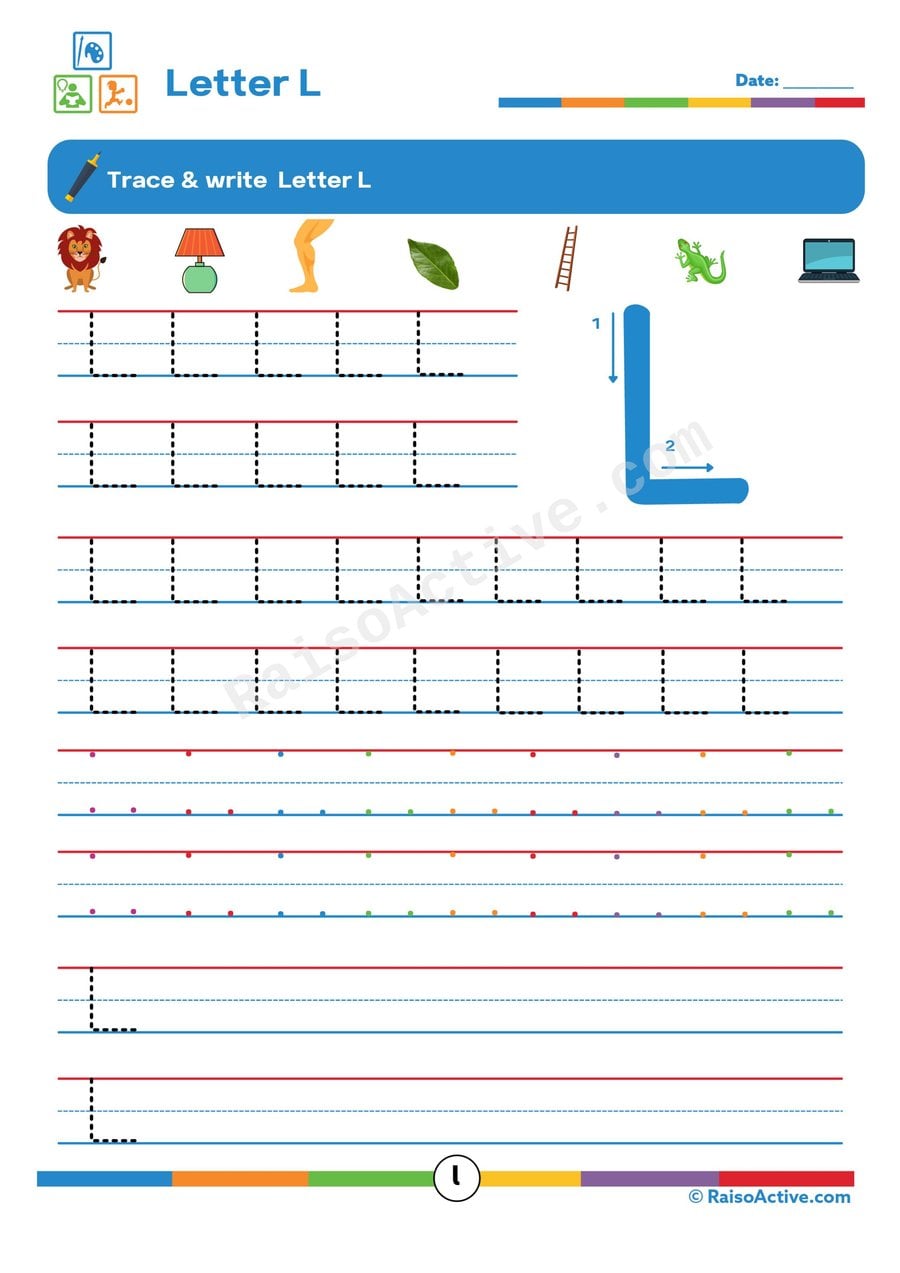
This worksheet gives focused, repeated practice on just the uppercase L — a single vertical line and a single horizontal line meeting at a clean right angle — which makes it one of the more approachable capital letters for 3-5 year olds to master fully in one sitting. Practicing it in isolation helps build the sharp-corner precision that other 'L-shaped' letters partly rely on.

Trace and Write the Letter J Worksheet for Preschoolers
Ages 3-5 · Preschool–Pre-KAges 3-5 · Nursery–ReceptionAges 3-5 · Nursery–LKGAges 3-5
Tracing the uppercase letter J has children ages 3-5 practice a downward line that curves into a small hook at the bottom, a stroke pattern distinct from the straight lines and simple curves used in most earlier letters. This hooked stroke also appears in cursive-style movements children will encounter later, making it useful early practice for more advanced handwriting. The worksheet reinforces the /j/ sound in words like 'jump,' 'jar,' and 'juice.'

Trace and Write the Letter B Worksheet for Preschoolers
Ages 3-5 · Preschool–Pre-KAges 3-5 · Nursery–ReceptionAges 3-5 · Nursery–LKGAges 3-5
This worksheet isolates just the uppercase B, giving children focused repetition on its two stacked curves without the added complexity of switching to the differently-shaped lowercase form. At ages 3-5, this kind of single-case focus helps build real muscle memory for one letter shape before layering on a second version later.
Related worksheets
Hindi Letter ऋ (ri) Practice 1: Write, Fix the Letter and Find | ऋ का अभ्यास · भाग 1
Ages 4-7 · Pre-K–Grade 1Ages 4-7 · Reception–Year 2Ages 4-7 · LKG–Class 1Ages 4-7
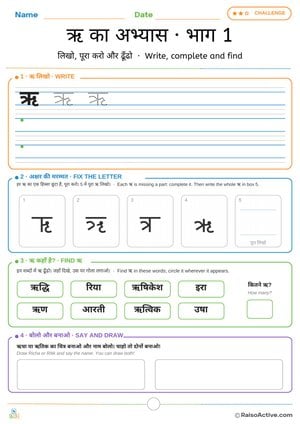
A challenge page: write ऋ between the lines, complete four letters that are each missing a part and then write the whole ऋ in box 5, find ऋ in words such as ऋद्धि, ऋषिकेश, ऋण and ऋत्विक, and draw a picture. Because ऋ is a special vowel, this page helps adults say it as 'ri' and keep it apart from इ and र.
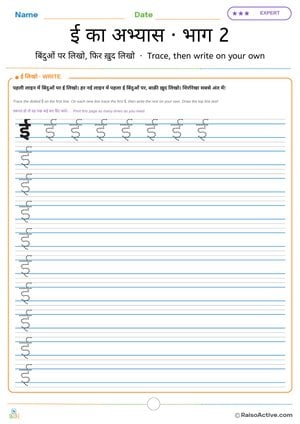
Hindi Letter ई Practice Part 2: Trace and Write on Your Own | ई का अभ्यास · भाग 2
Ages 3-7 · Preschool–Grade 1Ages 3-7 · Nursery–Year 2Ages 3-7 · Nursery–Class 1Ages 3-7
Children build writing fluency by tracing the dotted line ई on the first line and then writing the letter on their own, line after line, as the dotted help fades. The headline (शिरोरेखा) is drawn last, as in Hindi handwriting.

Say It Kindly: Build I-Messages, Blame or Kind and Fix-It Cards
Ages 7-10 · Grade 2–Grade 3Ages 7-10 · Year 3–Year 4Ages 7-10 · Class 2–Class 3Ages 7-10
Children learn the I-message pattern 'I feel... when... I need...', sort blaming and kind sentences with B or K, match oops moments to repairs and think how a classmate might feel.
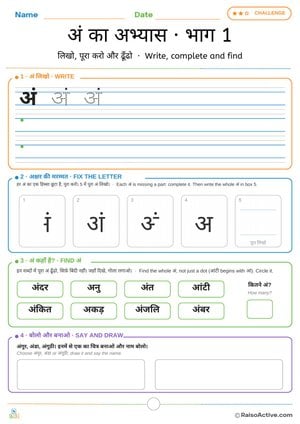
Hindi Letter अं (am) Practice 1: Write, Fix the Letter and Find | अं का अभ्यास · भाग 1
Ages 4-7 · Pre-K–Grade 1Ages 4-7 · Reception–Year 2Ages 4-7 · LKG–Class 1Ages 4-7
A challenge page: write अं between the lines, complete four letters that are each missing a part and then write the whole अं in box 5, find अं in words such as अंदर, अंत, अंकित, अंजलि and अंबर, and draw a picture. Children find the whole अं, not just a dot: आंटी begins with आं, not अं.
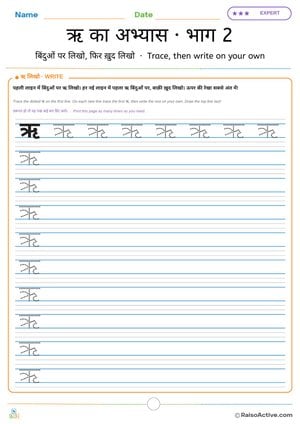
Hindi Letter ऋ (ri) Practice 2: Trace, then Write on Your Own | ऋ का अभ्यास · भाग 2
Ages 5-7 · Kindergarten–Grade 1Ages 5-7 · Year 1–Year 2Ages 5-7 · UKG–Class 1Ages 5-7
An expert page for confident writers: trace the dotted ऋ on the first line, then on each new line trace the first ऋ and write the rest on your own, adding the top line last.
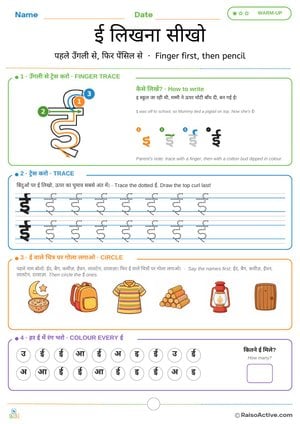
Hindi Letter ई (ee) Writing Practice: Finger and Pencil Tracing | ई लिखना सीखो
Ages 3-7 · Preschool–Grade 1Ages 3-7 · Nursery–Year 2Ages 3-7 · Nursery–Class 1Ages 3-7
Children learn the stroke order of ई. They trace it with a finger along numbered arrows, trace the dotted letters with a pencil, add the headline (शिरोरेखा) last, circle the pictures that start with ई and colour every ई in a row of mixed vowels.
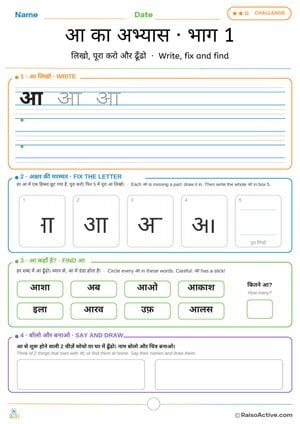
Hindi Letter आ Practice Part 1: Write, Fix and Find | आ का अभ्यास · भाग 1
Ages 3-7 · Preschool–Grade 1Ages 3-7 · Nursery–Year 2Ages 3-7 · Nursery–Class 1Ages 3-7
Children write आ on guide lines, complete four partly drawn letters, circle आ in eight words (while avoiding its look-alike अ), count how many they found, then think of two more words at home that start with आ and draw them.
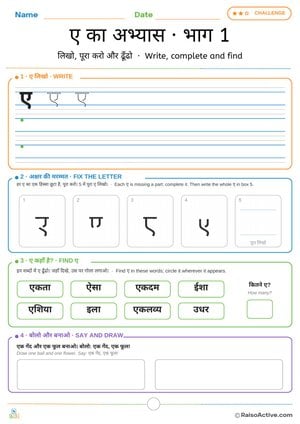
Hindi Letter ए (e) Practice 1: Write, Fix the Letter and Find | ए का अभ्यास · भाग 1
Ages 4-7 · Pre-K–Grade 1Ages 4-7 · Reception–Year 2Ages 4-7 · LKG–Class 1Ages 4-7
A challenge page: write ए between the lines, complete four letters that are each missing a part and then write the whole ए in box 5, find ए in words such as एकता, एकदम, एशिया and एकलव्य, and draw a picture. ए is not the short form of ऐ; the practice page keeps them apart.
Guides for this topic

Documenting Learning Without Drowning in Data: A Practical Guide for Parents and Teachers
Learn practical ways to document your child's learning without overwhelm. Simple portfolios, observation tips, and printable trackers for ages 1-8.

How to Help Your Child with Letter Reversals: A Complete Guide for Parents and Teachers
Letter reversals are normal until age 7-8. Learn the best multisensory strategies, anchor letter tricks, and activities to help children write b, d, p, and q correctly.

Activities That Help with Pencil Grip Development: A Complete Guide for Parents and Teachers
Discover fun, research-backed activities to develop pencil grip in young children. Age-wise exercises, play ideas, and expert tips for parents and teachers.
Reviews
Every worksheet for ages 3–5, no watermark
Members download the full library of 1,000+ worksheets and every activity pack without watermarks or daily limits. One year costs ₹999 in India or $20 elsewhere.
See membership plansOr download any worksheet free with a watermark (5 a day).