Navratri Festival Quest Certificate of Achievement
Ages 7-11 · Grade 2–Grade 3Ages 7-11 · Year 3–Year 4Ages 7-11 · Class 2–Class 3Ages 7-11
Children celebrate finishing the Navratri Festival Quest pack and record which levels they completed.
Free printable worksheets
Download free educational worksheets for children ages 2–8. Perfect for preschool, kindergarten, and early elementary learning activities.
Subscribe to get unlimited access to all worksheets without watermarks
View Subscription Plans289 topics match
29 worksheetsof 1,994
Ages 7-11 · Grade 2–Grade 3Ages 7-11 · Year 3–Year 4Ages 7-11 · Class 2–Class 3Ages 7-11
Children celebrate finishing the Navratri Festival Quest pack and record which levels they completed.
Ages 4-6 · Pre-K–KindergartenAges 4-6 · Reception–Year 1Ages 4-6 · LKG–UKGAges 4-6
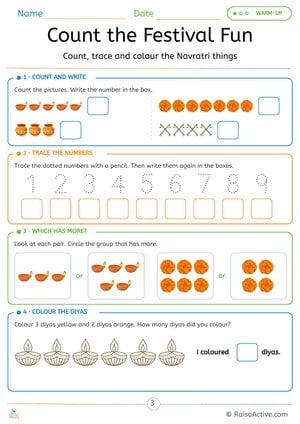
Children count small groups of festival pictures and write the number, trace and write the numbers 1 to 9, compare two groups to find the one with more, and colour a set number of diyas.
Ages 4-6 · Pre-K–KindergartenAges 4-6 · Reception–Year 1Ages 4-6 · LKG–UKGAges 4-6
Children celebrate finishing the Navratri Fun Time pages and see which levels they completed.
Ages 4-6 · Pre-K–KindergartenAges 4-6 · Reception–Year 1Ages 4-6 · LKG–UKGAges 4-6
Children ages 4-6 learn to compare two numbers and choose the correct symbol — greater than, less than, or equal to — building an essential foundation for later work with inequalities and algebra. Comparing quantities and representing the relationship symbolically is a more abstract skill than simple counting, so this worksheet stretches children just past straightforward number recognition into true numerical reasoning.
Ages 4-6 · Pre-K–KindergartenAges 4-6 · Reception–Year 1Ages 4-6 · LKG–UKGAges 4-6
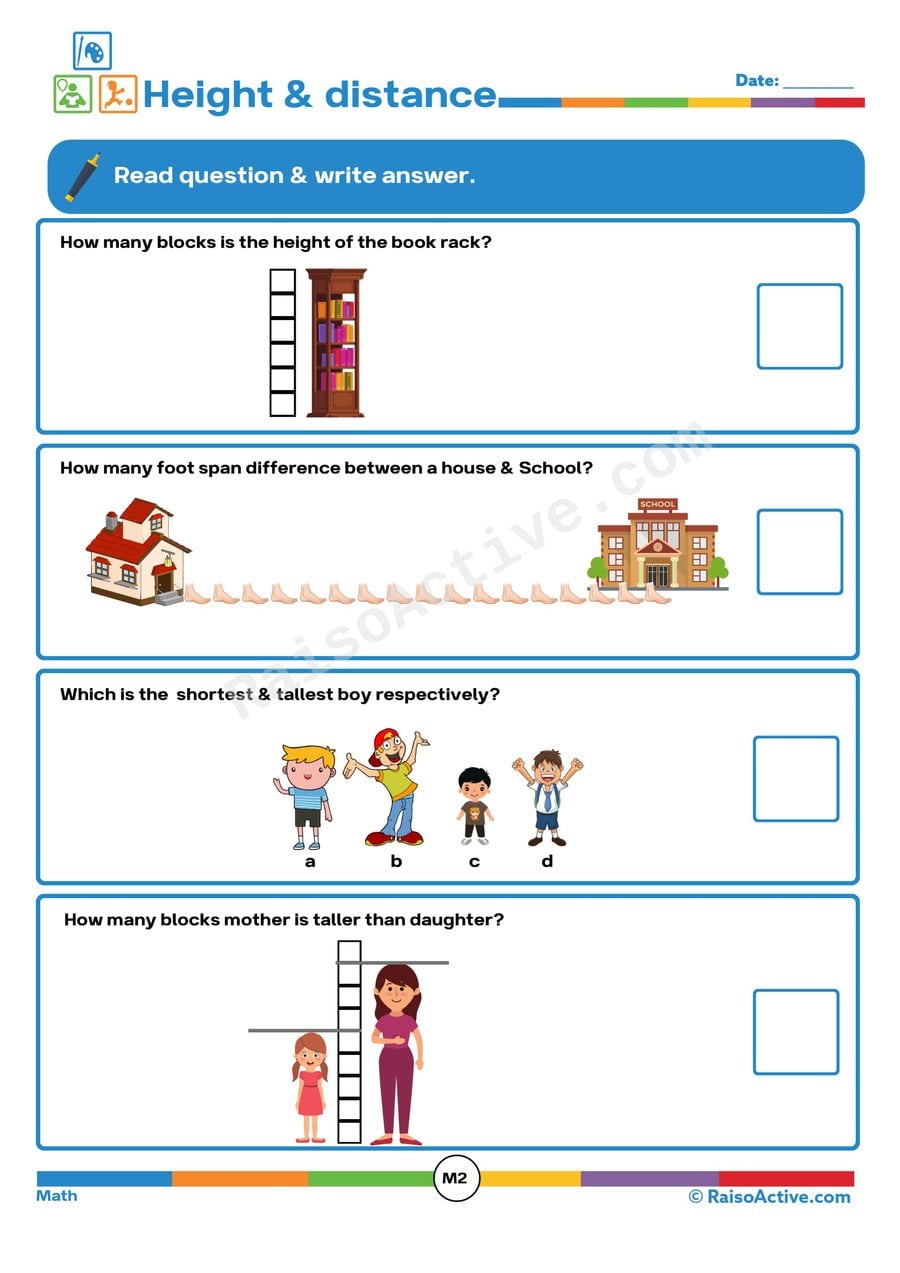
Children ages 4-6 practice comparing height and distance using visual examples, building early measurement and comparison skills that form the basis for later lessons in math involving length and size. Learning to compare 'taller,' 'shorter,' 'closer,' and 'farther' helps children describe the physical world with more precise language.
Ages 4-6 · Pre-K–KindergartenAges 4-6 · Reception–Year 1Ages 4-6 · LKG–UKGAges 4-6
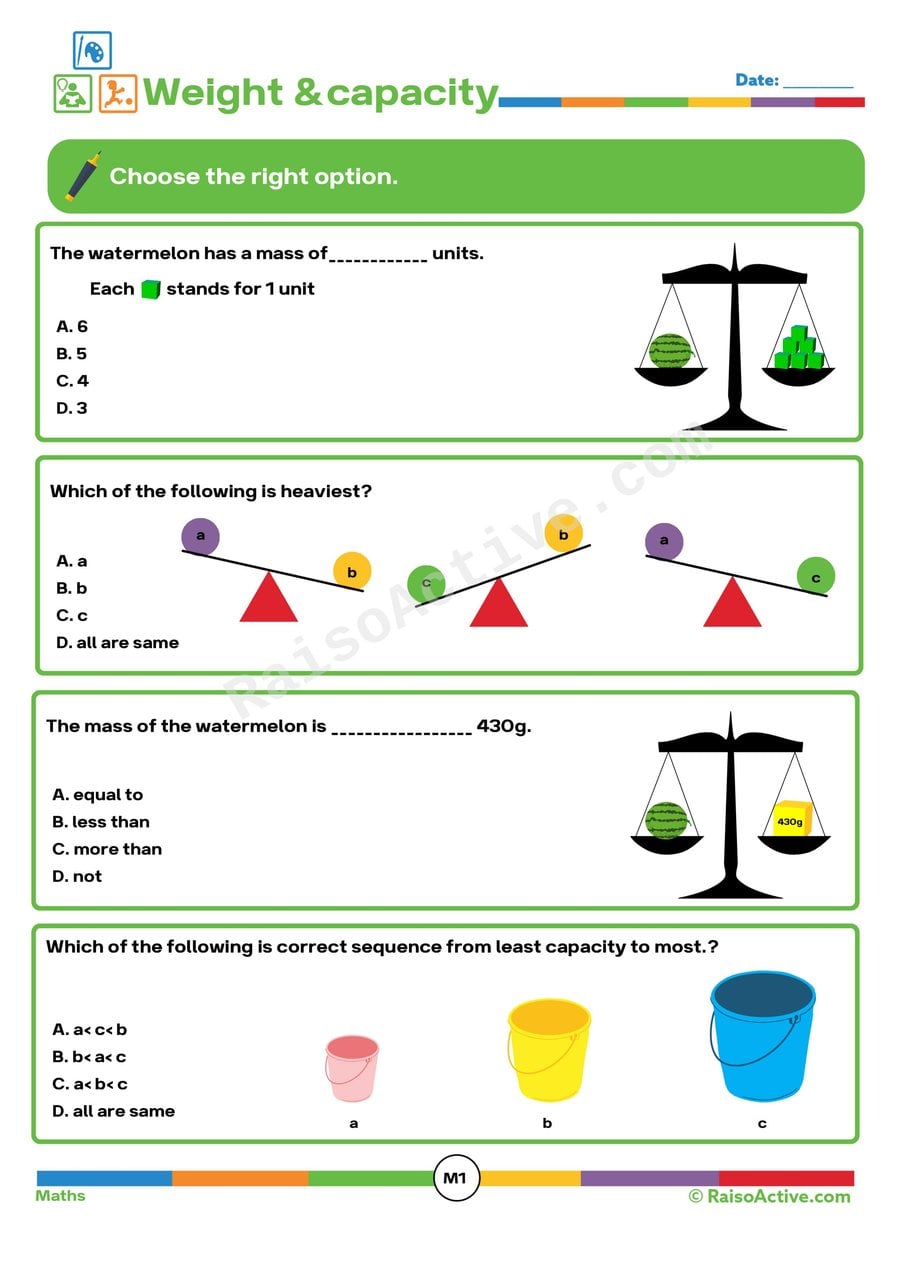
Comparing objects visually to judge which is heavier or holds more introduces children ages 4-6 to early measurement concepts, building the comparative reasoning that underlies later formal measurement with scales and measuring cups.
Ages 3-5 · Preschool–Pre-KAges 3-5 · Nursery–ReceptionAges 3-5 · Nursery–LKGAges 3-5
This worksheet builds early measurement vocabulary for children ages 3-5 as they compare the heights of pictured objects and people, circling the taller or shorter one as instructed. Beyond simple height comparison, the final section asks your child to identify both the tallest and smallest in a group, requiring them to compare more than two items at once, a step up in reasoning from simple pairwise comparison.
Ages 3-5 · Preschool–Pre-KAges 3-5 · Nursery–ReceptionAges 3-5 · Nursery–LKGAges 3-5
This worksheet develops early measurement vocabulary as children ages 3-5 compare pairs of objects and decide which is thinner or thicker. Because thickness must be judged visually rather than counted, this task sharpens visual discrimination and comparative reasoning — skills that later support understanding of size, width, and other measurement concepts. Circling the correct object also reinforces the vocabulary words 'thin' and 'thick' through repeated, hands-on use.
Ages 4-6 · Pre-K–KindergartenAges 4-6 · Reception–Year 1Ages 4-6 · LKG–UKGAges 4-6
This worksheet builds on basic counting by asking children to compare two separate groups of pictures and decide whether one group has more, fewer, or the same number as the other, then represent that relationship with the correct symbol. For four- to six-year-olds, this task combines accurate counting with comparative reasoning, both of which are essential building blocks for later mathematical problem solving.
Ages 4-6 · Pre-K–KindergartenAges 4-6 · Reception–Year 1Ages 4-6 · LKG–UKGAges 4-6
This worksheet teaches children ages 4-6 to compare two numbers using the 'hungry alligator' mnemonic, where the alligator's mouth always opens toward the larger number. Understanding greater than, less than, and equal to is an essential building block for later place value, ordering, and basic algebra concepts.
Ages 3-5 · Preschool–Pre-KAges 3-5 · Nursery–ReceptionAges 3-5 · Nursery–LKGAges 3-5
This worksheet helps children ages 3-5 understand the concept of weight by looking at balance scale pictures and identifying which object is heavier or lighter, then sorting objects into heavy and light categories through a cut-and-paste activity. Comparing weight this way introduces an early physics concept and builds the comparative reasoning skills used across many areas of math.
Ages 3-5 · Preschool–Pre-KAges 3-5 · Nursery–ReceptionAges 3-5 · Nursery–LKGAges 3-5
This worksheet helps children ages 3-5 understand the concepts of 'more' and 'less' by counting and comparing different groups of pictured objects, like eggs in a nest or fruits in a basket. Comparing quantities visually and numerically builds early number sense that supports later addition, subtraction, and greater-than or less-than reasoning.