Navratri Festival Quest Certificate of Achievement
Ages 7-11 · Grade 2–Grade 3Ages 7-11 · Year 3–Year 4Ages 7-11 · Class 2–Class 3Ages 7-11
Children celebrate finishing the Navratri Festival Quest pack and record which levels they completed.
Free printable worksheets
Download free educational worksheets for children ages 2–8. Perfect for preschool, kindergarten, and early elementary learning activities.
Subscribe to get unlimited access to all worksheets without watermarks
View Subscription Plans289 topics match
13 worksheetsof 1,994
Ages 7-11 · Grade 2–Grade 3Ages 7-11 · Year 3–Year 4Ages 7-11 · Class 2–Class 3Ages 7-11
Children celebrate finishing the Navratri Festival Quest pack and record which levels they completed.
Ages 7-11 · Grade 2–Grade 3Ages 7-11 · Year 3–Year 4Ages 7-11 · Class 2–Class 3Ages 7-11
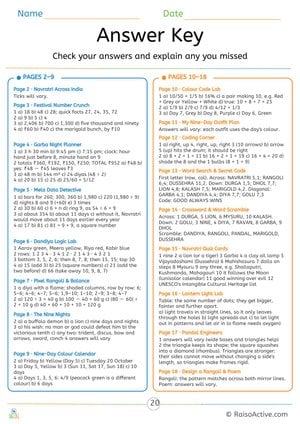
Grown-ups can check every answer in the pack, with workings for the maths, grid positions for the word search, the logic grid and sudoku solutions, and the reasons behind the science results.
Ages 4-6 · Pre-K–KindergartenAges 4-6 · Reception–Year 1Ages 4-6 · LKG–UKGAges 4-6
Children celebrate finishing the Navratri Fun Time pages and see which levels they completed.
Ages 4-6 · Pre-K–KindergartenAges 4-6 · Reception–Year 1Ages 4-6 · LKG–UKGAges 4-6
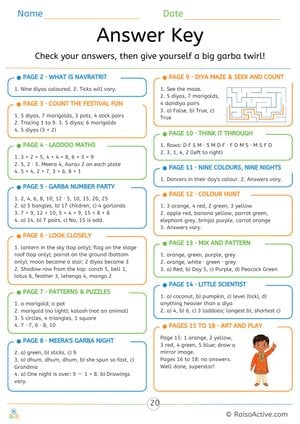
Grown-ups can quickly check every answer in the Navratri Fun Time pack, page by page.
Ages 3-5 · Preschool–Pre-KAges 3-5 · Nursery–ReceptionAges 3-5 · Nursery–LKGAges 3-5
Cutting along the card's outer lines strengthens scissor control and hand strength, while folding the card in half builds the bilateral coordination of holding with one hand and creasing with the other. Composing a short message inside also introduces children ages 3-5 to early written expression tied to a real feeling.
Ages 3-5 · Preschool–Pre-KAges 3-5 · Nursery–ReceptionAges 3-5 · Nursery–LKGAges 3-5
This Valentine's Day printable pack gives children ages 3-5 a mix of festive activities that build fine motor control, color recognition, and holiday vocabulary like heart, love, and card, all through a theme they find engaging and motivating. Because it bundles several short activities rather than one long task, it also helps young children practice switching between different types of tasks while staying on one overall theme.
Ages 3-5 · Preschool–Pre-KAges 3-5 · Nursery–ReceptionAges 3-5 · Nursery–LKGAges 3-5
Coloring a teddy bear surrounded by Valentine's hearts gives children ages 3-5 practice with sustained hand control as they work to stay within an outline, a skill that develops gradually through repeated, low-pressure coloring practice rather than all at once. The holiday theme also builds simple color-word vocabulary and gives your child a chance to make deliberate color choices, an early form of creative decision-making.
Ages 3-5 · Preschool–Pre-KAges 3-5 · Nursery–ReceptionAges 3-5 · Nursery–LKGAges 3-5
This worksheet combines coloring with a letter-recognition search, asking children ages 3-5 to find and identify the letter V hidden within a Valentine's cupcake design while also practicing sustained hand control as they color. Searching for a specific letter within a busier picture, rather than tracing it in isolation, builds visual scanning skills, since the child has to filter out distracting shapes and colors to spot the target letter.
Ages 4-6 · Pre-K–KindergartenAges 4-6 · Reception–Year 1Ages 4-6 · LKG–UKGAges 4-6
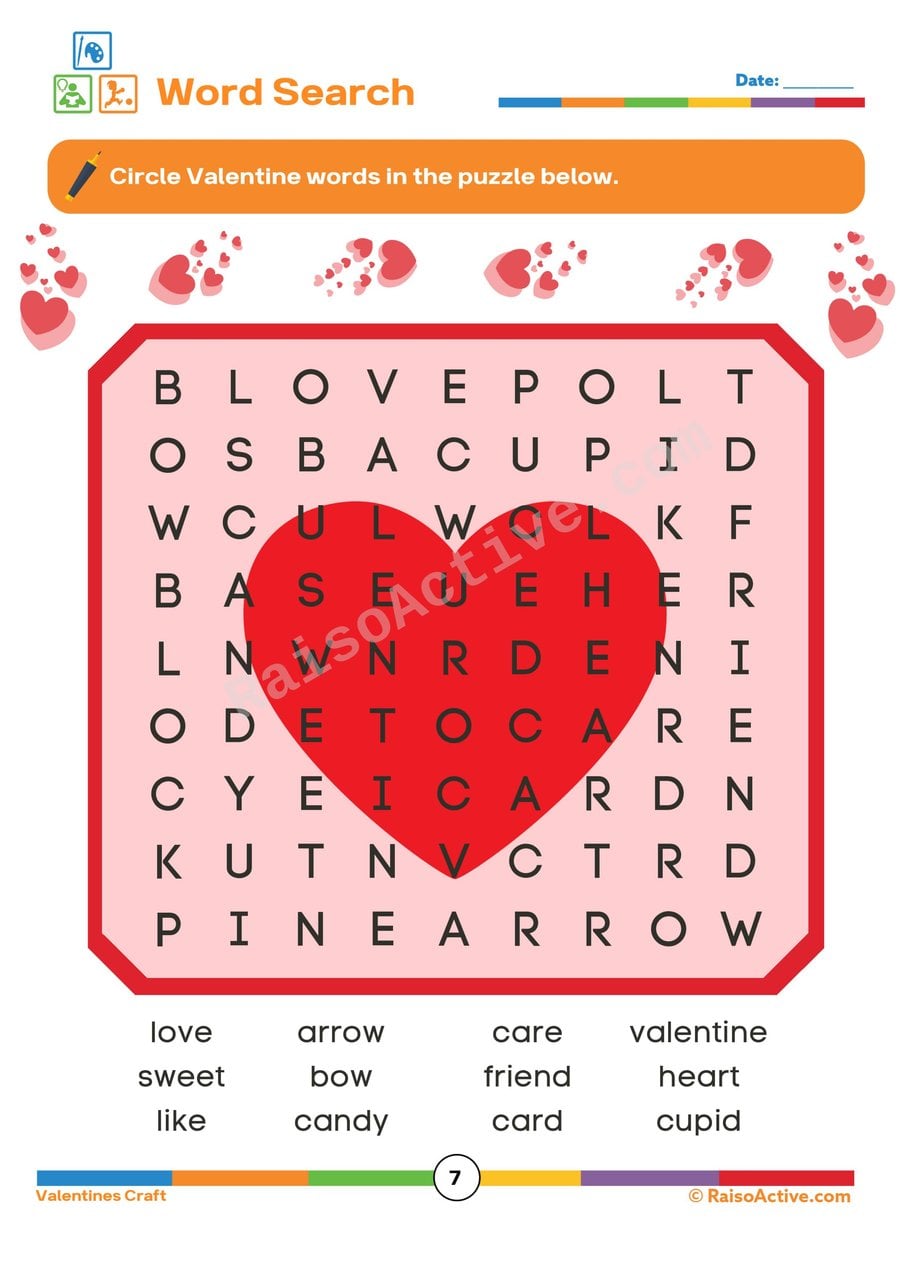
This Valentine's Day word search worksheet helps children aged 4-6 strengthen critical pre-reading and early reading skills. By actively scanning for words like 'love,' 'heart,' and 'friend,' young learners develop visual discrimination, recognize letter patterns, and improve their ability to track text from left to right. This engaging activity also expands their vocabulary with festive terms, building a foundational understanding of word recognition and spelling.
Ages 3-5 · Preschool–Pre-KAges 3-5 · Nursery–ReceptionAges 3-5 · Nursery–LKGAges 3-5
Cutting several small heart shapes and arranging them around a center point to form a flower teaches children ages 3-5 both scissor control and an early sense of symmetry, since the petals need to be spaced somewhat evenly to look flower-like. This kind of arranging-before-gluing task also builds planning skills, since children have to think ahead about where each piece goes rather than gluing randomly.
Ages 3-5 · Preschool–Pre-KAges 3-5 · Nursery–ReceptionAges 3-5 · Nursery–LKGAges 3-5
This Valentine-themed cut-and-paste activity builds scissor control and hand-eye coordination in children ages 3-5 as they cut along lines to separate heart pieces, then strengthens spatial reasoning as they figure out how each piece fits back together into a whole picture. Reassembling something from parts is an early puzzle skill that also supports later understanding of how wholes are made of smaller parts, useful in both math and reading.
Ages 3-5 · Preschool–Pre-KAges 3-5 · Nursery–ReceptionAges 3-5 · Nursery–LKGAges 3-5
Cutting and assembling a mouse face teaches children ages 3-5 to snip along both straight and curved lines, since ears are typically rounder than the face outline, while also building spatial awareness as they figure out where each facial feature belongs. Placing ears, eyes, and a nose in the correct spots on a face template is an early lesson in facial anatomy and proportion that carries over into their own drawing later on.