Phonics Level 1 Sound Mat 3: Long Vowels and Other Vowel Sounds
Children and grown-ups see every other vowel sound in English: long vowels, r-influenced vowels and ow, oy, oo and schwa, each with spellings and example words.
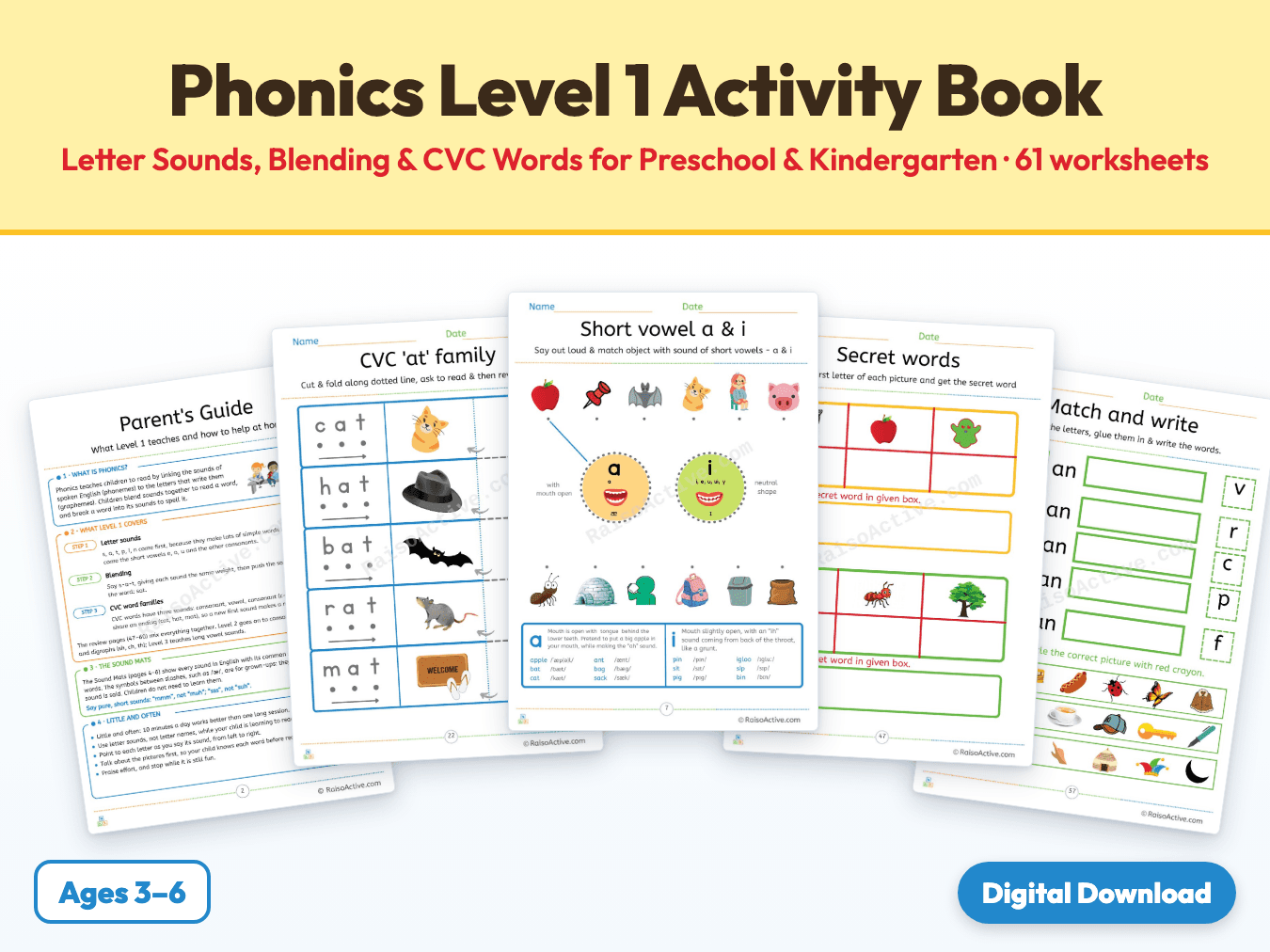
Part of the pack
Phonics Level 1 Activity Book: Letter Sounds, Blending & CVC Words for Preschool & Kindergarten
This is page 6 of the pack. Ages 3-6 · Preschool–KindergartenAges 3-6 · Nursery–Year 1Ages 3-6 · Nursery–UKGAges 3-6
Made for your child
A whole activity pack made with their name
60 pages to spot, build, trace and write their own name, plus pages about their favourites, feelings and family. See a free preview with their name.
Make an All About Me packFree preview · free for members
Or start free: a name tracing sheet with their nameCurriculum
- Phonics - Letter Sounds > Vowel Sounds
How to use this worksheet
Use it as a reference for later levels. In Level 1, look at it together and spot the words your child already knows.
Materials needed
- None
Extension activities
- 1Find the picture for your child's name sound
- 2Read the example words aloud together

Written by
Hemsweta Jain · Teacher Cheena
MBA and Early Childhood Educator, teaching since 2014 · Founder of RaisoActive, Mumbai
Every RaisoActive worksheet is designed and checked by the founder before publishing.
Published · Last reviewed
More from Phonics Level 1 Activity Book: Letter Sounds, Blending & CVC Words for Preschool & Kindergarten
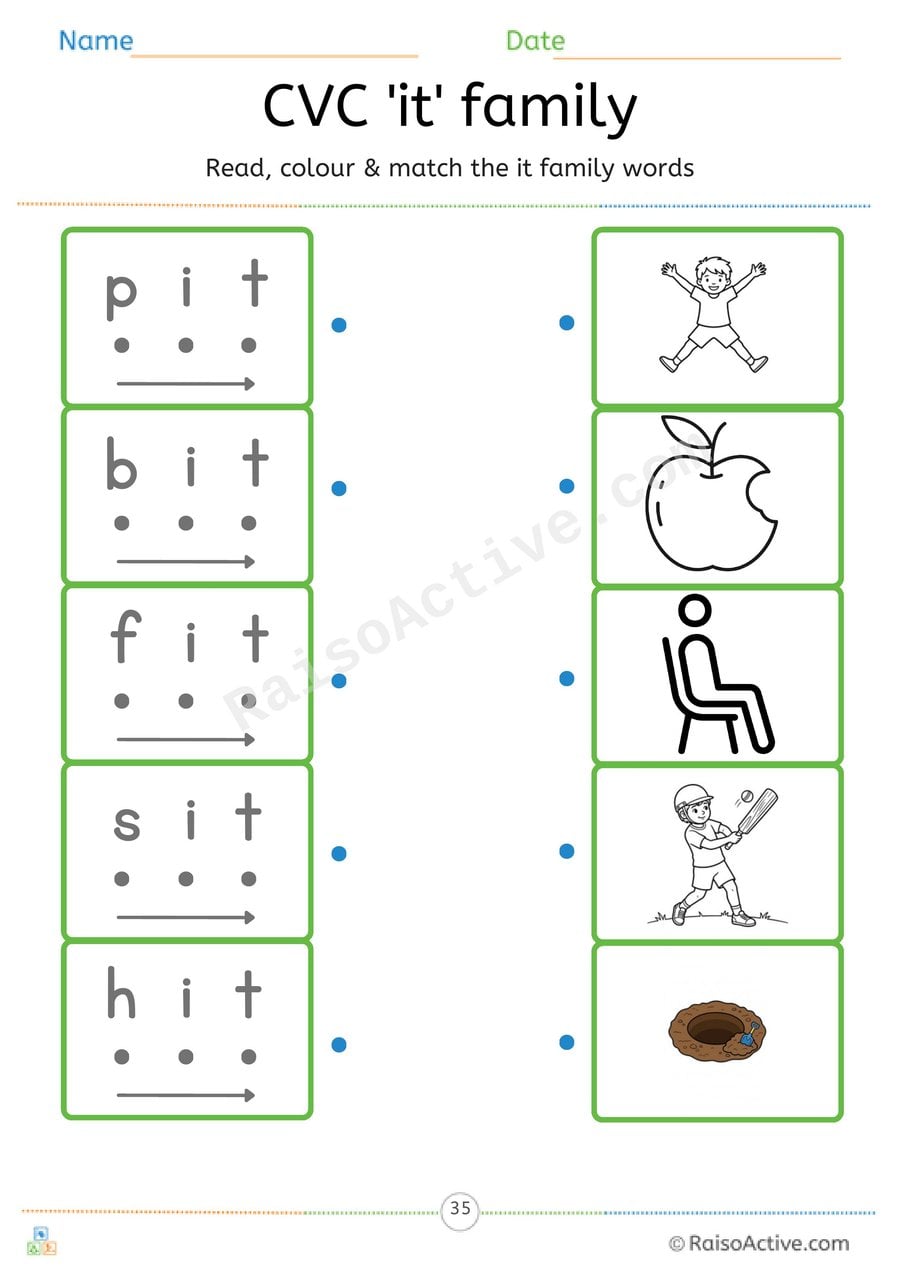
CVC 'it' Word Family Read, Colour and Match Worksheet
Ages 3-6 · Preschool–KindergartenAges 3-6 · Nursery–Year 1Ages 3-6 · Nursery–UKGAges 3-6
Children read the 'it' words pit, bit, fit, sit and hit on their own and match each word to its picture, checking that they understood what they read.

CVC 'in' Word Family Read, Colour and Match Worksheet
Ages 3-6 · Preschool–KindergartenAges 3-6 · Nursery–Year 1Ages 3-6 · Nursery–UKGAges 3-6
Children read the 'in' words pin, fin, win, bin and tin on their own and match each word to its picture, checking that they understood what they read.

Circle the Picture: Read CVC Words and Write First Letters
Ages 3-6 · Preschool–KindergartenAges 3-6 · Nursery–Year 1Ages 3-6 · Nursery–UKGAges 3-6
Children read the CVC words bag, sad and dad and find the right picture, then write the first letter of fish, grapes, kite, egg, bat, jug, duck, hat and leaf.
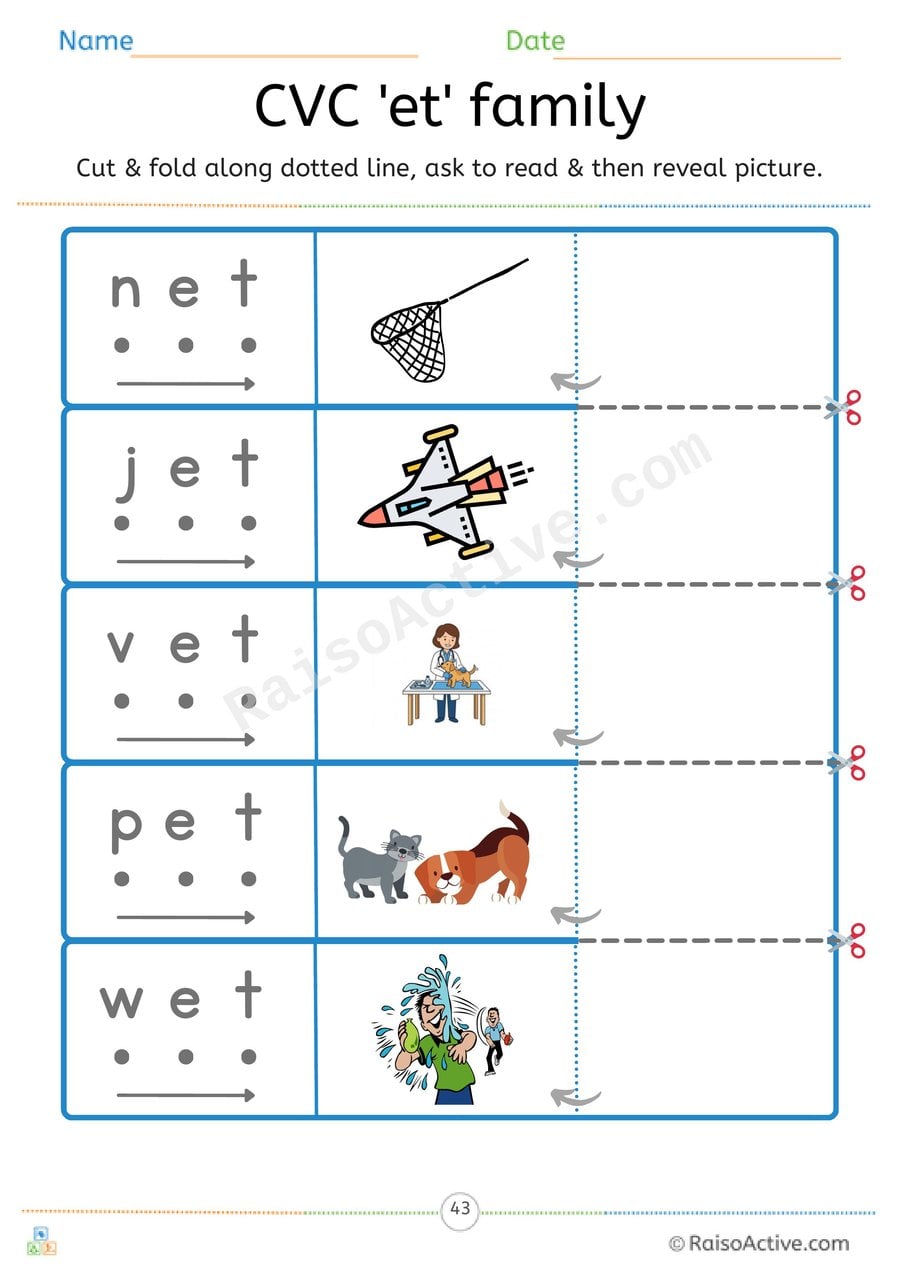
CVC 'et' Word Family Read and Reveal Worksheet
Ages 3-6 · Preschool–KindergartenAges 3-6 · Nursery–Year 1Ages 3-6 · Nursery–UKGAges 3-6
Children read five 'et' family words sound by sound, net, jet, vet, pet and wet, and see that changing the first sound makes a new word.

Letter Sounds s and t Say and Match Worksheet
Ages 3-6 · Preschool–KindergartenAges 3-6 · Nursery–Year 1Ages 3-6 · Nursery–UKGAges 3-6
Children hear and say the s and t sounds, see the mouth shape for each one and match pictures to the right sound. s: snake, sun, sleep, mouse, soup and sock. t: tiger, table, tooth, top, letter and cat.

Phonics Level 1 Sound Mat 2: Consonants and Consonant Digraphs
Ages 3-6 · Preschool–KindergartenAges 3-6 · Nursery–Year 1Ages 3-6 · Nursery–UKGAges 3-6
Children see the consonant sounds j, k, l, r, v, w, y and z and the digraph sounds th (two ways), sh, ch, zh and ng, with pictures and example words.
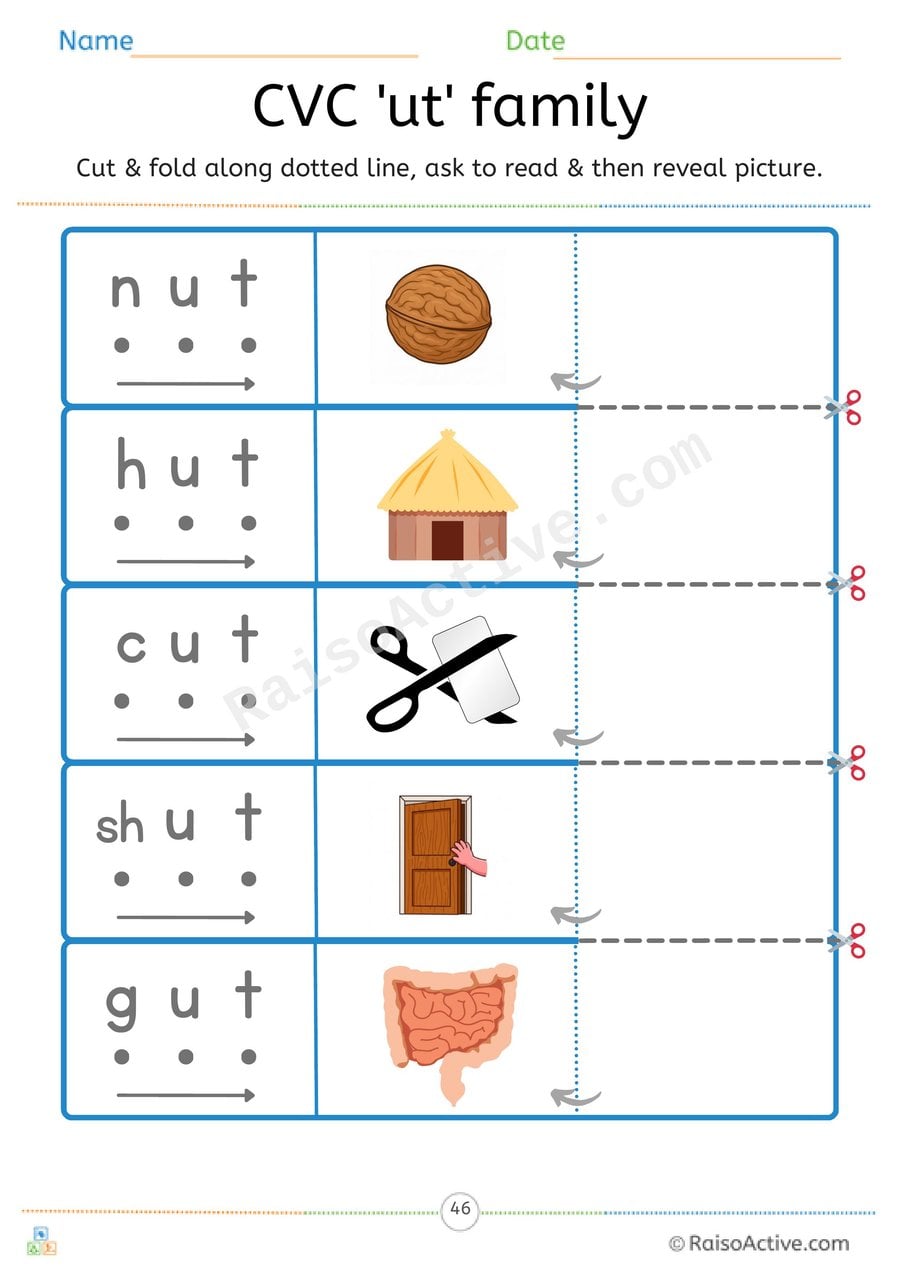
CVC 'ut' Word Family Read and Reveal Worksheet
Ages 3-6 · Preschool–KindergartenAges 3-6 · Nursery–Year 1Ages 3-6 · Nursery–UKGAges 3-6
Children read five 'ut' family words sound by sound, nut, hut, cut, shut and gut, and see that changing the first sound makes a new word. Shut starts with the digraph sh: say it as one sound.

CVC 'ig' Word Family Read and Reveal Worksheet
Ages 3-6 · Preschool–KindergartenAges 3-6 · Nursery–Year 1Ages 3-6 · Nursery–UKGAges 3-6
Children read five 'ig' family words sound by sound, big, dig, fig, pig and wig, and see that changing the first sound makes a new word.
Related worksheets
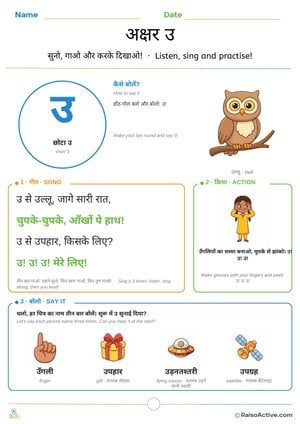
Hindi Letter उ (u) Song, Action and Say It | अक्षर उ
Ages 3-7 · Preschool–Grade 1Ages 3-7 · Nursery–Year 2Ages 3-7 · Nursery–Class 1Ages 3-7
Children hear and say the short vowel उ, learn a short rhyme with an action, and say the names of the picture words उल्लू (owl), उँगली (finger), उपहार (gift), उड़नतश्तरी (flying saucer), उपग्रह (satellite) to practise hearing उ at the start.
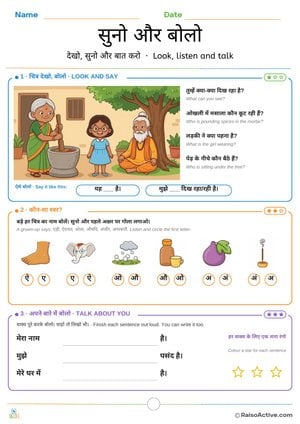
Hindi Vowels Listen and Speak: Look, Listen and Talk | सुनो और बोलो
Ages 3-7 · Preschool–Grade 1Ages 3-7 · Nursery–Year 2Ages 3-7 · Nursery–Class 1Ages 3-7
Three short activities at three levels: look at a picture and answer four questions, say each picture name and circle its first vowel from a pair, and finish three sentences about yourself (मेरा नाम ... है, मुझे ... पसंद है, मेरे घर में ... है).
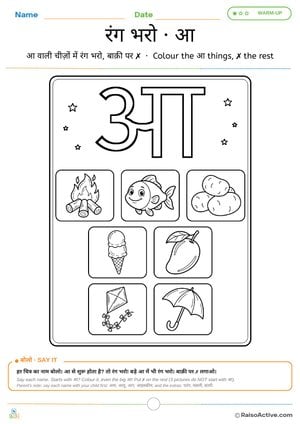
Colour the आ Things: Hindi Letter आ Colouring Page | रंग भरो · आ
Ages 3-7 · Preschool–Grade 1Ages 3-7 · Nursery–Year 2Ages 3-7 · Nursery–Class 1Ages 3-7
Children listen for the first sound of each picture name and decide whether it starts with आ. They colour the आ pictures, cross out the others and colour the big letter.
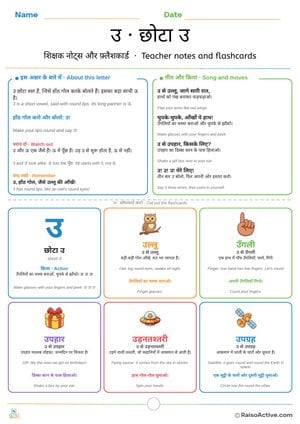
Hindi Letter उ (u) Teacher Notes and Flashcards | उ · छोटा उ
Ages 3-7 · Preschool–Grade 1Ages 3-7 · Nursery–Year 2Ages 3-7 · Nursery–Class 1Ages 3-7
Children meet the short vowel उ with a short note for adults, a song with actions and cut-out flashcards for उल्लू (owl), उँगली (finger), उपहार (gift), उड़नतश्तरी (flying saucer), उपग्रह (satellite). They hear the sound at the start of real words and link it to a hand action.
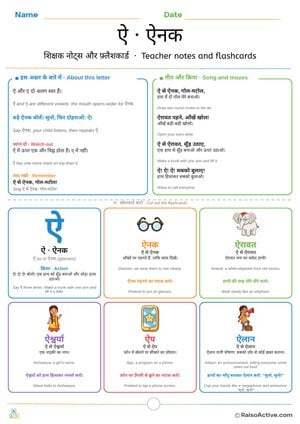
Hindi Letter ऐ (ai) Teacher Notes and Flashcards | ऐ शिक्षक नोट्स और फ़्लैशकार्ड
Ages 3-7 · Preschool–Grade 1Ages 3-7 · Nursery–Year 2Ages 3-7 · Nursery–Class 1Ages 3-7
Teacher notes and six cut-out flashcards for ऐ (ai) with the words ऐनक, ऐरावत, ऐश्वर्या, ऐप and ऐलान. Each card has a sentence and a small action, and the page ends with a short song to sing and move to.
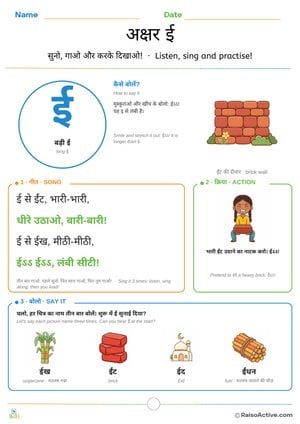
Hindi Letter ई (ee) Song, Action and Say It | अक्षर ई
Ages 3-7 · Preschool–Grade 1Ages 3-7 · Nursery–Year 2Ages 3-7 · Nursery–Class 1Ages 3-7
Children hear and say the long vowel ई, learn a short rhyme with an action, and say the names of the picture words ईंट (brick), ईख (sugarcane), ईद (Eid), ईंधन (fuel) to practise hearing ई at the start.
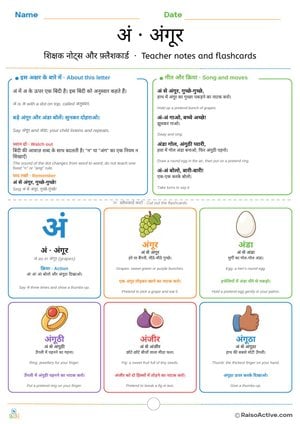
Hindi Letter अं (am) Teacher Notes and Flashcards | अं शिक्षक नोट्स और फ़्लैशकार्ड
Ages 3-7 · Preschool–Grade 1Ages 3-7 · Nursery–Year 2Ages 3-7 · Nursery–Class 1Ages 3-7
Teacher notes and six cut-out flashcards for अं (am) with the words अंगूर, अंडा, अंगूठी, अंजीर and अंगूठा. Each card has a sentence and a small action, and the page ends with a short song to sing and move to.
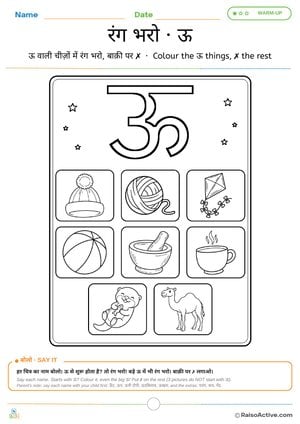
Colour the ऊ Things: Hindi Letter ऊ Colouring Page | रंग भरो · ऊ
Ages 3-7 · Preschool–Grade 1Ages 3-7 · Nursery–Year 2Ages 3-7 · Nursery–Class 1Ages 3-7
Children listen for the first sound of each picture name and decide whether it starts with ऊ. They colour the ऊ pictures, cross out the others and colour the big letter.
Guides for this topic

How to Teach CVC Blending: A Step-by-Step Method That Works in Two Weeks
A step-by-step method for teaching CVC blending, covering continuous sounds, word families, common errors, and a 14-day plan that most children finish reading CVC words.
Phase 2 Phonics at Home: Sound Order, Blending Games, Worksheets
Phase 2 phonics at home: the five sound sets in order, oral blending, tricky words, a two-week routine, common mistakes, and free worksheets.

Reception Year Explained: EYFS Learning and How to Help at Home
A teacher's plain-English guide to the Reception Year: the seven areas of learning, Early Learning Goals, Phase 2/3 phonics, the RBA and home routines.
Reviews
Every worksheet for ages 3–6, no watermark
Members download the full library of 1,000+ worksheets and every activity pack without watermarks or daily limits. One year costs ₹999 in India or $20 elsewhere.
See membership plansOr download any worksheet free with a watermark (5 a day).