Match the Blend and Write the Word Worksheet: sk, st, dr, gr, sc, sw
Children join each blend to the word ending that fits the picture and write the whole word: skid, stem, drop, grip, scab and swim.
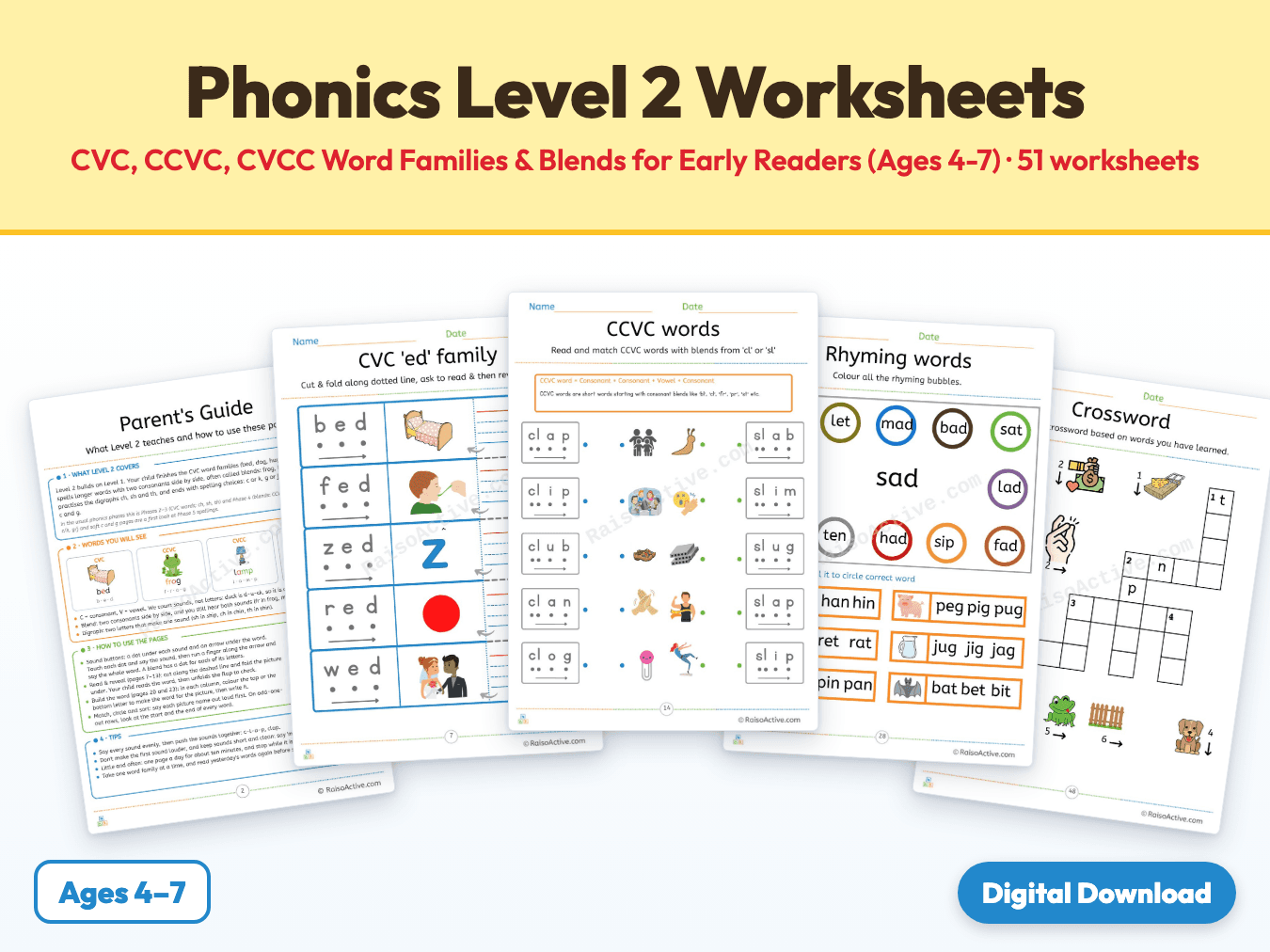
Part of the pack
Phonics Level 2 Worksheets: CVC, CCVC, CVCC Word Families & Blends for Early Readers (Ages 4-7)
This is page 19 of the pack. Ages 4-7 · Pre-K–Grade 1Ages 4-7 · Reception–Year 2Ages 4-7 · LKG–Class 1Ages 4-7
Made for your child
Spelling practice, made for your child
Their own spelling words turned into a pack: trace or look-cover-write-check, roll and write, a secret picture code, a word search, a crossword and a test, with their name in it.
Make a spelling packFree preview · free for members
Or start free: a word search with sight wordsCurriculum
- Phonics - Blends > Consonant Blends
- Phonics - Blends > CCVC Words
How to use this worksheet
The first one (skid) is done. Your child says the picture name, finds the ending, draws the line and writes the word in the box.
Materials needed
- Pencil
Extension activities
- 1Mime each word for someone else to guess
- 2Write the words again with a new ending, like swim to swam

Written by
Hemsweta Jain · Teacher Cheena
MBA and Early Childhood Educator, teaching since 2014 · Founder of RaisoActive, Mumbai
Every RaisoActive worksheet is designed and checked by the founder before publishing.
Published · Last reviewed
More from Phonics Level 2 Worksheets: CVC, CCVC, CVCC Word Families & Blends for Early Readers (Ages 4-7)

Phonics Level 2 Certificate of Achievement: Super Reader
Ages 4-7 · Pre-K–Grade 1Ages 4-7 · Reception–Year 2Ages 4-7 · LKG–Class 1Ages 4-7
Children celebrate reading and spelling words with blends and digraphs, and tick what they can read: CVC words, blends and digraphs.

CVC 'ob' Word Family Read, Cut and Reveal Worksheet
Ages 4-7 · Pre-K–Grade 1Ages 4-7 · Reception–Year 2Ages 4-7 · LKG–Class 1Ages 4-7
Children read five 'ob' words (cob, job, mob, rob, sob) by blending three sounds, check each one against a hidden picture (a corn cob, a person at work, a crowd, a monkey taking fruit and a crying child) and write it, so they see that changing the first sound makes a new word.

Hard and Soft G Sound Sorting Worksheet
Ages 4-7 · Pre-K–Grade 1Ages 4-7 · Reception–Year 2Ages 4-7 · LKG–Class 1Ages 4-7
Children learn that g often says /j/ before e, i or y and /g/ before a, o, u or a consonant, then circle soft g words in blue (gem, giraffe, gym, germ, bridge, ginger) and hard g words in pink (goat, game, gum, glass, goal, guest).

Phonics Level 2 Sound Mat 2: Consonants and Consonant Digraphs
Ages 4-7 · Pre-K–Grade 1Ages 4-7 · Reception–Year 2Ages 4-7 · LKG–Class 1Ages 4-7
Children meet more consonant sounds and the digraphs th, sh, ch, zh and ng, with pictures, spellings and example words.

Short e Word Puzzle and First Letter Sounds Worksheet
Ages 4-7 · Pre-K–Grade 1Ages 4-7 · Reception–Year 2Ages 4-7 · LKG–Class 1Ages 4-7
Children find leg, beg, met, pet and vet hidden in rows of letters, then write the first letter of candle, octopus, umbrella, hat, butterfly, tree, igloo, clock and apple.
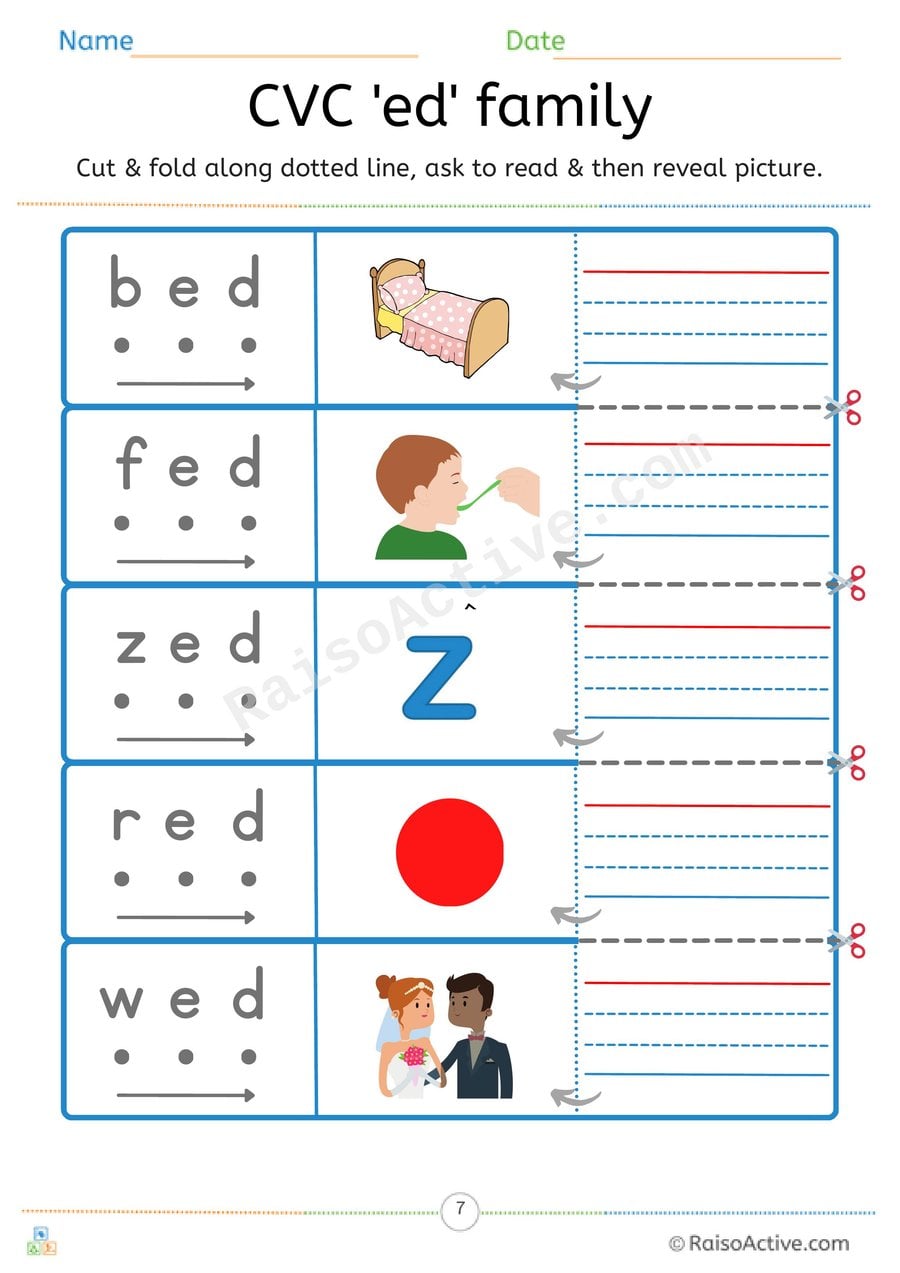
CVC 'ed' Word Family Read, Cut and Reveal Worksheet
Ages 4-7 · Pre-K–Grade 1Ages 4-7 · Reception–Year 2Ages 4-7 · LKG–Class 1Ages 4-7
Children read five 'ed' words (bed, fed, zed, red, wed) by blending three sounds, check each one against a hidden picture (a bed, a child being fed, a letter z, a red dot and a wedding) and write it, so they see that changing the first sound makes a new word.

CVCC Words Read, Colour and Match Worksheet
Ages 4-7 · Pre-K–Grade 1Ages 4-7 · Reception–Year 2Ages 4-7 · LKG–Class 1Ages 4-7
Children read tent, desk, milk, belt, lamp and hand with sound buttons, match each word to its outline picture and colour it.
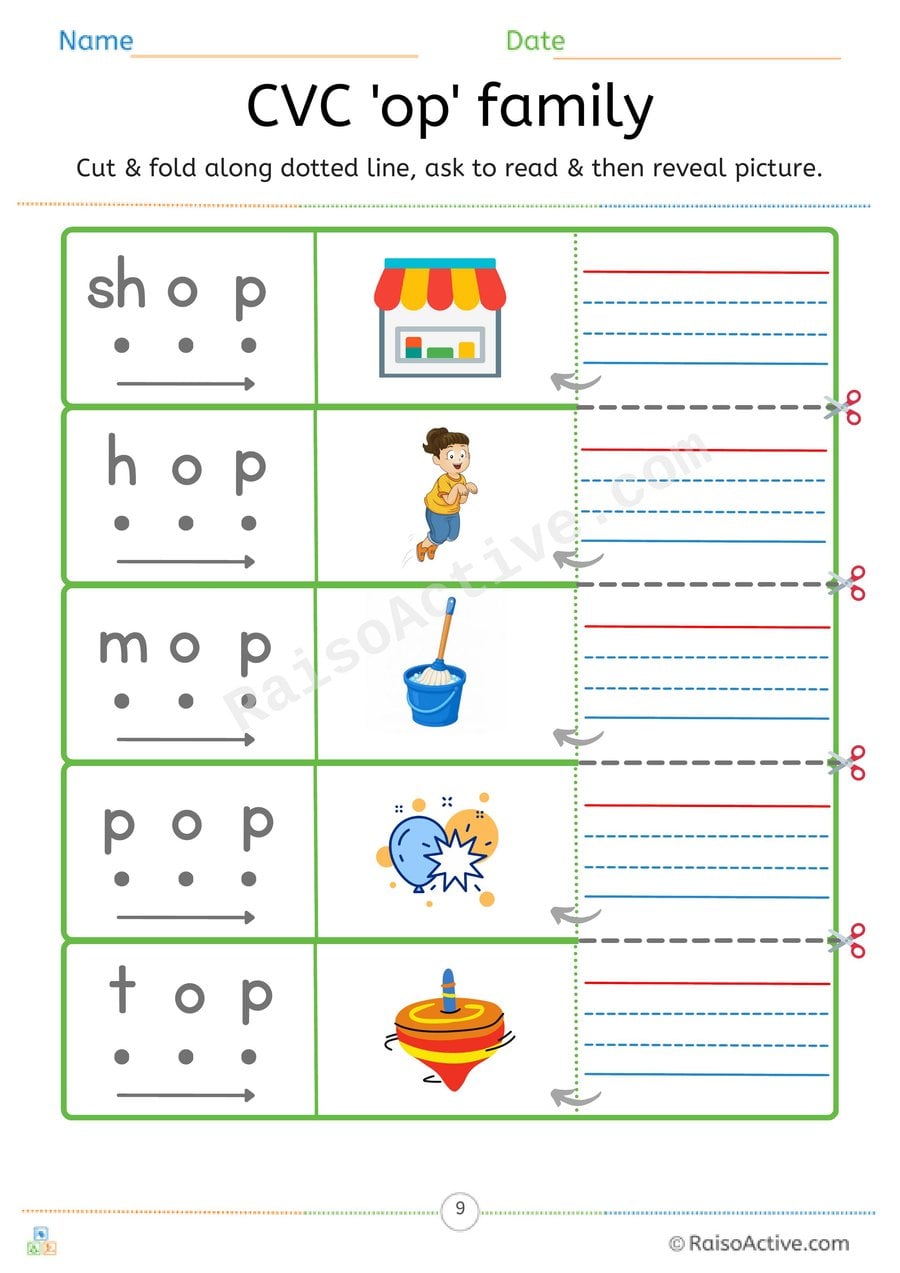
CVC 'op' Word Family Read, Cut and Reveal Worksheet
Ages 4-7 · Pre-K–Grade 1Ages 4-7 · Reception–Year 2Ages 4-7 · LKG–Class 1Ages 4-7
Children read five 'op' words (shop, hop, mop, pop, top) by blending three sounds, check each one against a hidden picture (a shop, a hopping child, a mop, a popping balloon and a spinning top) and write it, so they see that changing the first sound makes a new word.
Related worksheets

When Do We Celebrate? Indian Festivals and the Months of the Year
Ages 4-8 · Pre-K–Grade 2Ages 4-8 · Reception–Year 3Ages 4-8 · LKG–Class 2Ages 4-8
Children connect each festival to the month it falls in and learn that some festivals follow the moon, so their dates change each year.

Plant Parts Worksheet: Identify and Label the Parts of a Plant!
Ages 4-6 · Pre-K–KindergartenAges 4-6 · Reception–Year 1Ages 4-6 · LKG–UKGAges 4-6
This worksheet teaches children ages 4-6 to identify and independently label the flower, stem, leaf, and roots of a plant, moving a step beyond simple matching toward recalling vocabulary from memory. Optionally adding pulses or grains to the diagram introduces a tactile, sensory layer that helps reinforce which part is which through touch as well as sight.
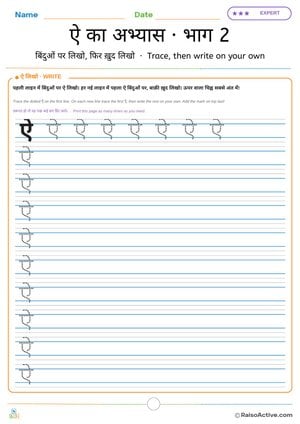
Hindi Letter ऐ (ai) Practice 2: Trace, then Write on Your Own | ऐ का अभ्यास · भाग 2
Ages 5-7 · Kindergarten–Grade 1Ages 5-7 · Year 1–Year 2Ages 5-7 · UKG–Class 1Ages 5-7
An expert page for confident writers: trace the dotted ऐ on the first line, then on each new line trace the first ऐ and write the rest on your own, adding the mark on top last.
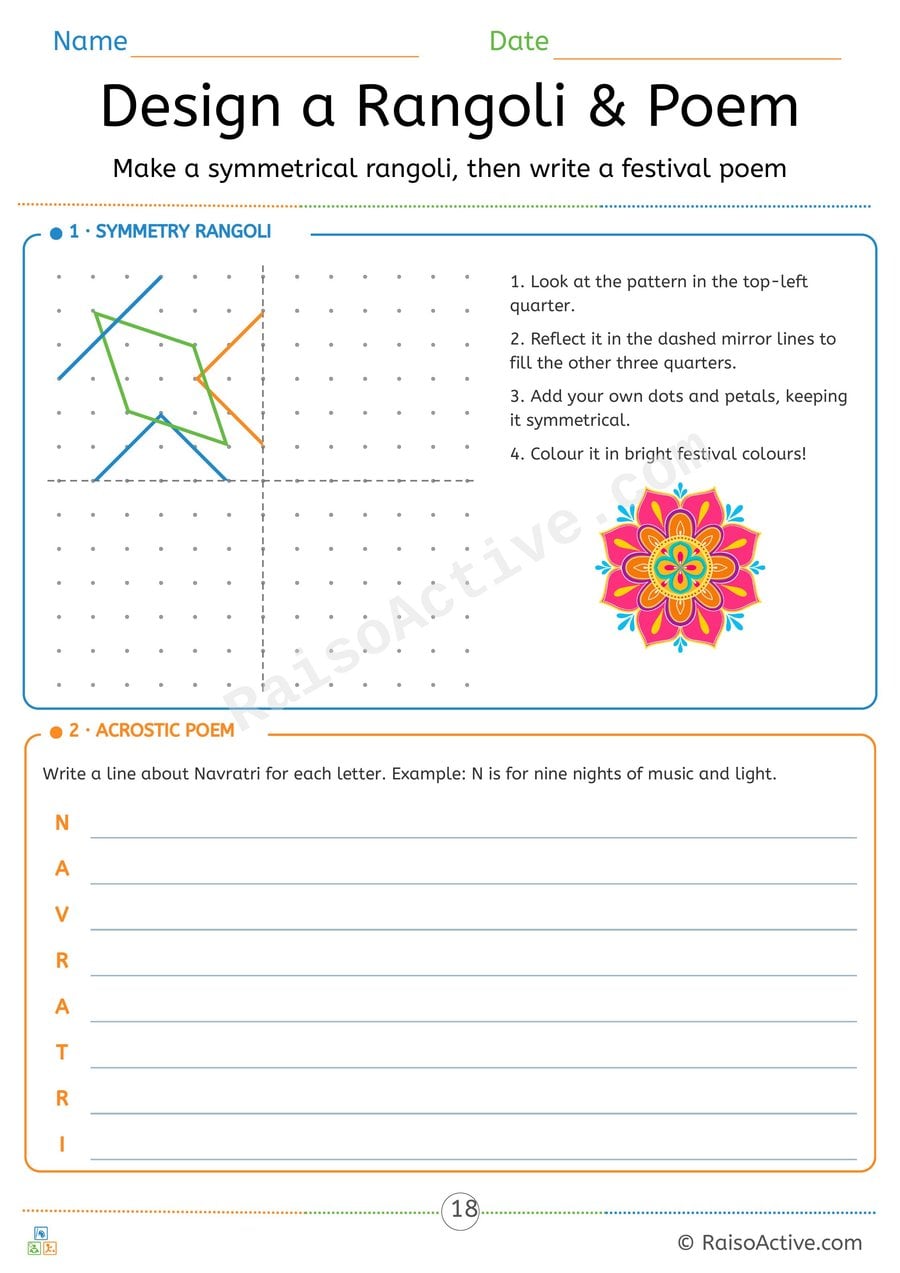
Navratri Symmetry Rangoli and Acrostic Poem
Ages 7-11 · Grade 2–Grade 3Ages 7-11 · Year 3–Year 4Ages 7-11 · Class 2–Class 3Ages 7-11
Children reflect a pattern in two mirror lines to complete a four-way symmetrical rangoli on a dot grid, add their own symmetrical details, and write an acrostic poem with one line for each letter of NAVRATRI.
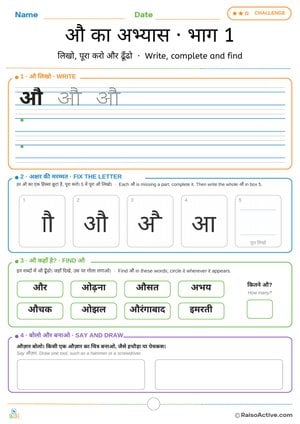
Hindi Letter औ (au) Practice 1: Write, Fix the Letter and Find | औ का अभ्यास · भाग 1
Ages 4-7 · Pre-K–Grade 1Ages 4-7 · Reception–Year 2Ages 4-7 · LKG–Class 1Ages 4-7
A challenge page: write औ between the lines, complete four letters that are each missing a part and then write the whole औ in box 5, find औ in words such as और, औसत, औचक and औरंगाबाद, and draw a picture. औ and ओ are different vowels; औ has two marks on top and ओ has one.

Phonics Level 1 Answer Key
Ages 3-6 · Preschool–KindergartenAges 3-6 · Nursery–Year 1Ages 3-6 · Nursery–UKGAges 3-6
Grown-ups can check every Phonics Level 1 page that has one right answer, page by page.

Christmas Fill-in-the-Blanks Worksheet for Preschoolers
Ages 3-5 · Preschool–Pre-KAges 3-5 · Nursery–ReceptionAges 3-5 · Nursery–LKGAges 3-5
Filling in missing letters of Christmas words like 'S_ _W' or 'TR_ _' helps children ages 3-5 connect letter sounds to their written form, an essential early step toward independent spelling. Using the accompanying picture as a clue also teaches them to cross-check visual and phonetic information — a strategy they'll rely on throughout early reading.
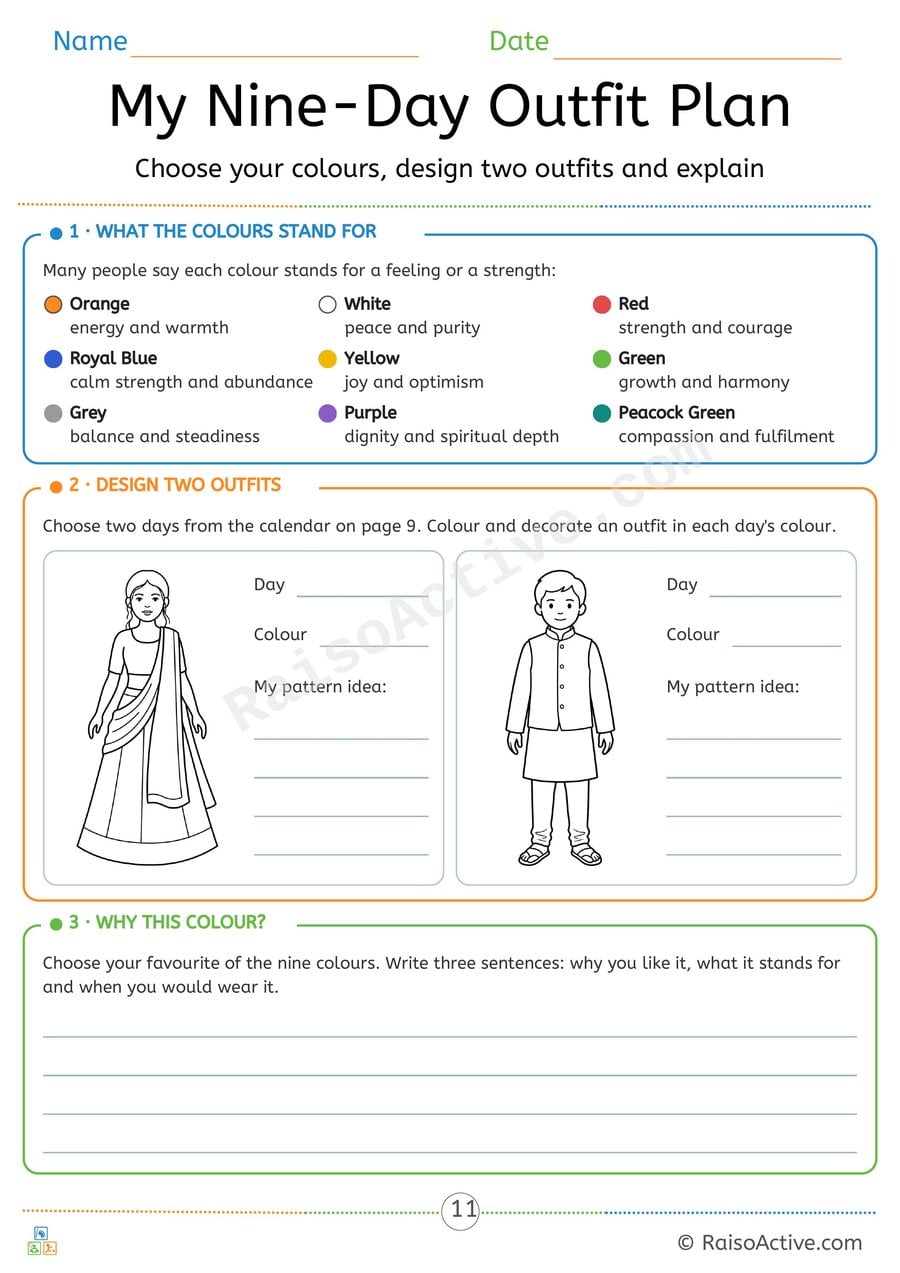
My Nine-Day Outfit Plan: Navratri Colours Design and Writing
Ages 7-11 · Grade 2–Grade 3Ages 7-11 · Year 3–Year 4Ages 7-11 · Class 2–Class 3Ages 7-11
Children read what each of the nine colours is often said to stand for, choose two days from the calendar, colour and pattern a lehenga-style outfit and a kurta outfit in those colours, and write three sentences explaining their favourite colour.
Guides for this topic

How to Teach CVC Blending: A Step-by-Step Method That Works in Two Weeks
A step-by-step method for teaching CVC blending, covering continuous sounds, word families, common errors, and a 14-day plan that most children finish reading CVC words.
Phase 2 Phonics at Home: Sound Order, Blending Games, Worksheets
Phase 2 phonics at home: the five sound sets in order, oral blending, tricky words, a two-week routine, common mistakes, and free worksheets.

Reception Year Explained: EYFS Learning and How to Help at Home
A teacher's plain-English guide to the Reception Year: the seven areas of learning, Early Learning Goals, Phase 2/3 phonics, the RBA and home routines.
Reviews
Every worksheet for ages 4–7, no watermark
Members download the full library of 1,000+ worksheets and every activity pack without watermarks or daily limits. One year costs ₹999 in India or $20 elsewhere.
See membership plansOr download any worksheet free with a watermark (5 a day).