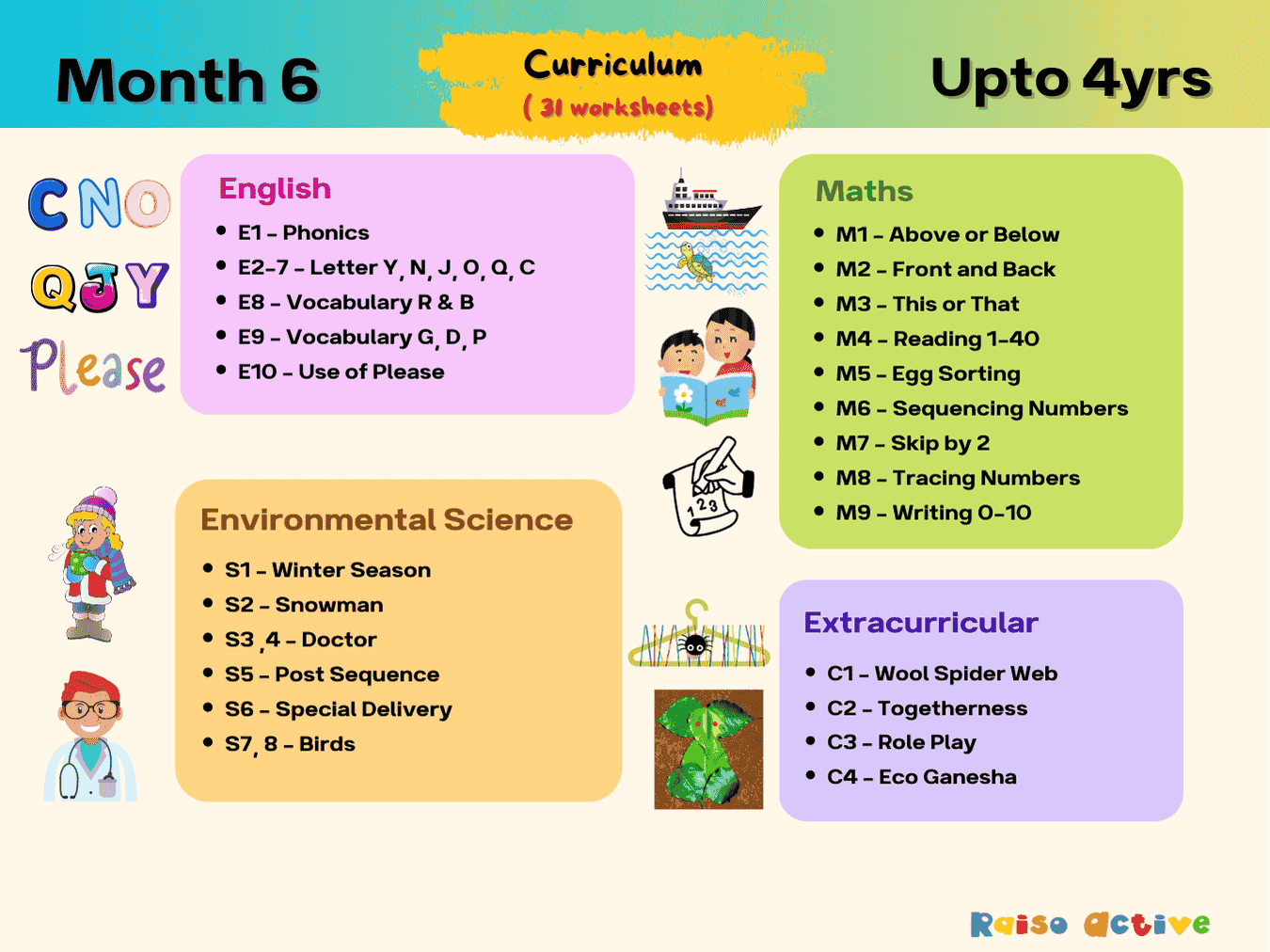
Month 6: Toddler Preschool Foundational Skills | Ages Up to 4 - Page 19
As part of an ongoing toddler foundational skills series, this page gives children up to age 4 low-pressure practice with coloring and simple fine motor prompts, building the pencil and crayon grip control that comes before formal writing instruction. Repeated, varied activity pages like this one help very young children build attention span and comfort with sitting down to a focused task, both important readiness skills for structured learning ahead.
Part of the pack
Month 6: Toddler Preschool Foundational Skills | Ages Up to 4
This is page 19 of the pack. Ages 2-4 · PreschoolAges 2-4 · NurseryAges 2-4
Made for your child
A whole activity pack made with their name
60 pages to spot, build, trace and write their own name, plus pages about their favourites, feelings and family. See a free preview with their name.
Make an All About Me packFree preview · free for members
Or start free: a name tracing sheet with their nameCurriculum
- Phonics - Letter Sounds > Beginning Sounds
How to use this worksheet
Look over the page together first and point out the activity prompts and any pictures to color. Talk through what's being asked in simple terms your toddler can follow, breaking it into one small step at a time. Hand your toddler a crayon and guide their attention to the first prompt, offering hand-over-hand support if their grip is still developing. Move through the remaining prompts on the page at your toddler's pace, taking breaks as needed since attention spans are naturally short at this age.
Extension activities
- 1Offer a variety of coloring tools, like chunky crayons, washable markers, or dot stampers, to build grip strength in different ways.
- 2Turn coloring time into a naming game, asking your toddler to point to and name colors as they use them.
- 3Practice simple pincer-grasp activities, like picking up small pom-poms or cereal pieces, to build fine motor strength alongside coloring.
- 4Read a short picture book together afterward as a calm follow-up activity that continues building focus and attention.
- 5Set up a simple sensory coloring station using bath crayons or chalk for a change of texture and setting.

Written by
Hemsweta Jain · Teacher Cheena
MBA and Early Childhood Educator, teaching since 2014 · Founder of RaisoActive, Mumbai
Every RaisoActive worksheet is designed and checked by the founder before publishing.
Published · Last reviewed
More from Month 6: Toddler Preschool Foundational Skills | Ages Up to 4

Doctor Role Play Worksheet: Patient Emergency Form
Ages 3-5 · Preschool–Pre-KAges 3-5 · Nursery–ReceptionAges 3-5 · Nursery–LKGAges 3-5
Through pretend-play as a doctor filling out a patient form, children practice early functional writing and decision-making, selecting a 'patient,' identifying what hurts, and choosing a treatment. This kind of role play also builds empathy and emotional vocabulary around illness and care, helping ages 3-5 process what happens during real doctor visits in a low-stakes, imaginative context.
R & B Word Jumble Worksheet for Preschoolers
Ages 4-5 · Pre-KAges 4-5 · ReceptionAges 4-5 · LKGAges 4-5
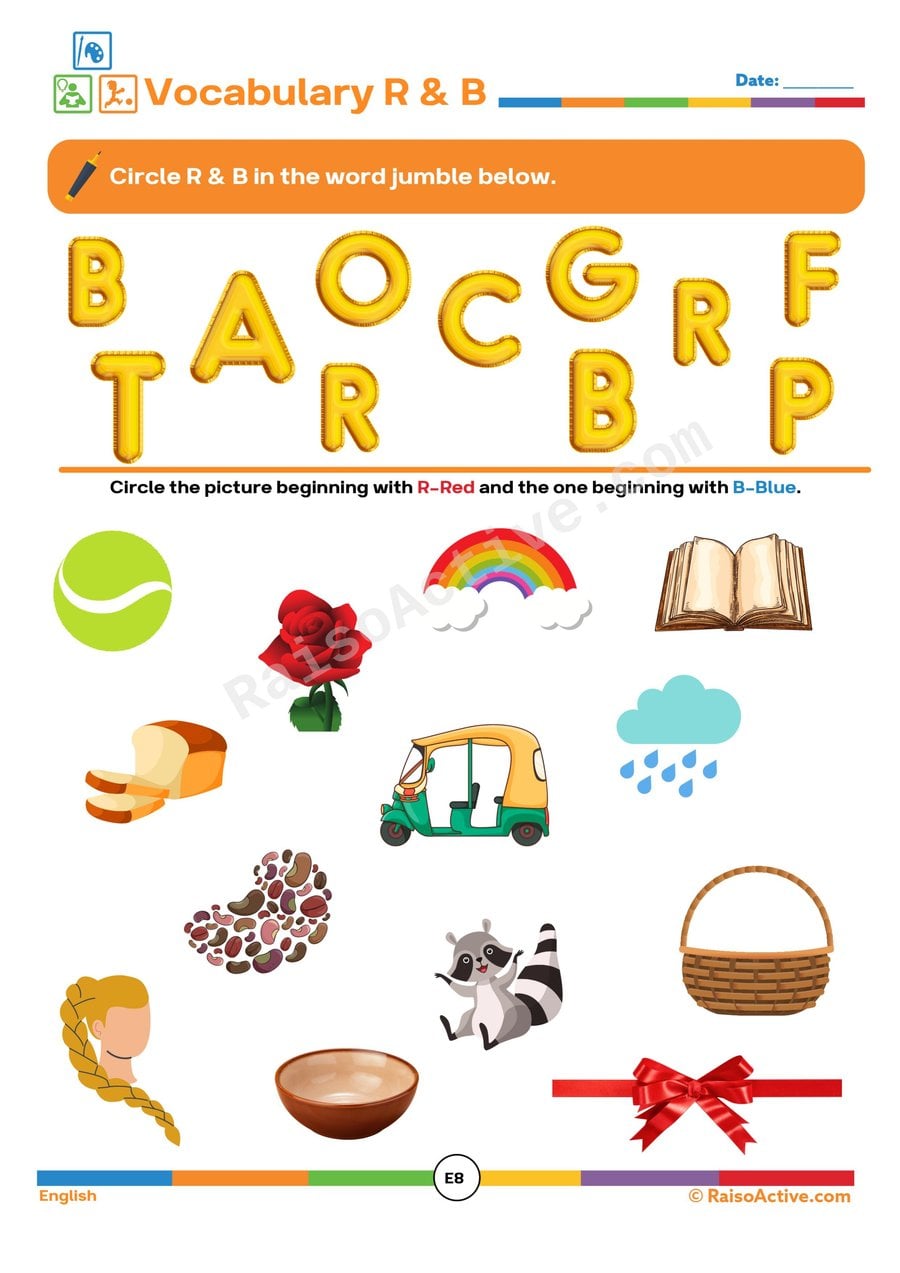
Circling the letters R and B within a jumbled group of letters sharpens visual discrimination for children ages 4-5, training their eyes to spot a specific letter shape among similar-looking distractions. Pairing this with picture identification for words that start with R and B reinforces beginning-sound recognition, connecting the visual letter search to actual spoken sounds.
Trace the Numbers: Practice Writing Numbers 9-12!
Ages 3-5 · Preschool–Pre-KAges 3-5 · Nursery–ReceptionAges 3-5 · Nursery–LKGAges 3-5
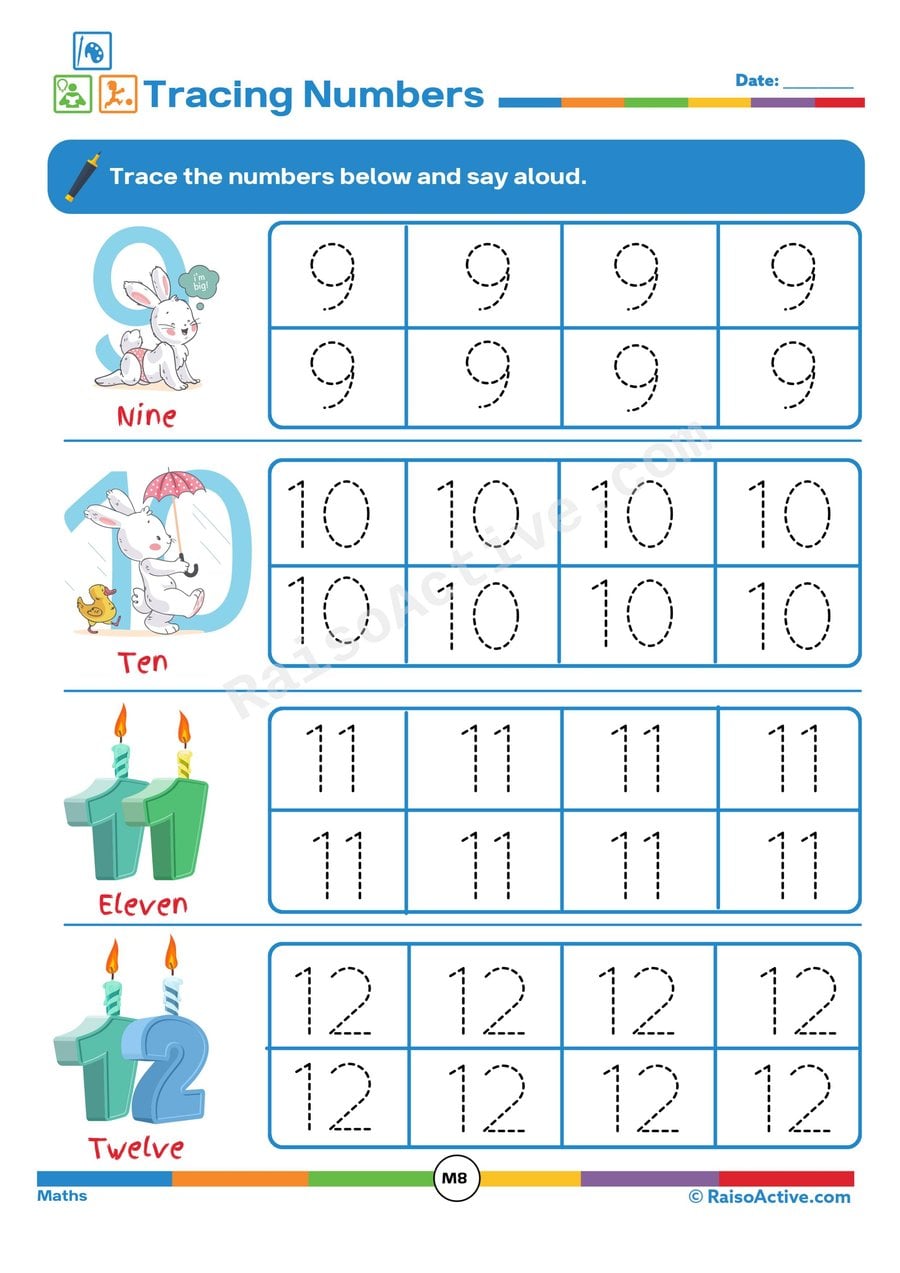
Tracing numerals 9 through 12 strengthens the small hand muscles and pencil control preschoolers need for later handwriting, while repeated exposure to each numeral's shape builds the visual memory that underlies number recognition. Ages 3-5 are also learning that a written numeral represents a specific quantity, so pairing the traced digit with its name reinforces early number sense alongside the motor skill.

Front and Back Matching Worksheet for Preschoolers
Ages 3-5 · Preschool–Pre-KAges 3-5 · Nursery–ReceptionAges 3-5 · Nursery–LKGAges 3-5
This cut-and-paste worksheet builds spatial reasoning by asking children to recognize that many objects and animals look different from the front versus the back, and to match each front view to its correct back view. For ages 3-5, this kind of visual matching strengthens observational skills and the beginning of perspective-taking, understanding that the same object can look different depending on which side you're viewing.

Above and Below the Sea Worksheet: Counting Objects
Ages 3-5 · Preschool–Pre-KAges 3-5 · Nursery–ReceptionAges 3-5 · Nursery–LKGAges 3-5
This worksheet combines counting practice with the positional concepts of 'above' and 'below,' asking children to count separate groups of objects located in different parts of an ocean scene. For ages 3-5, connecting counting to spatial position adds an extra layer of thinking beyond simple one-to-one counting, reinforcing both numeracy and early positional vocabulary.

Use Please: A Fun Worksheet to Practice Polite Language!
Ages 3-5 · Preschool–Pre-KAges 3-5 · Nursery–ReceptionAges 3-5 · Nursery–LKGAges 3-5
This worksheet teaches children the specific social skill of using the word 'please' when making requests, connecting polite language to real, relatable everyday scenarios shown in pictures. For ages 3-5, learning concrete phrases for politeness supports both social-emotional development and early reading, since children practice recognizing and repeating a functional sight word in context.
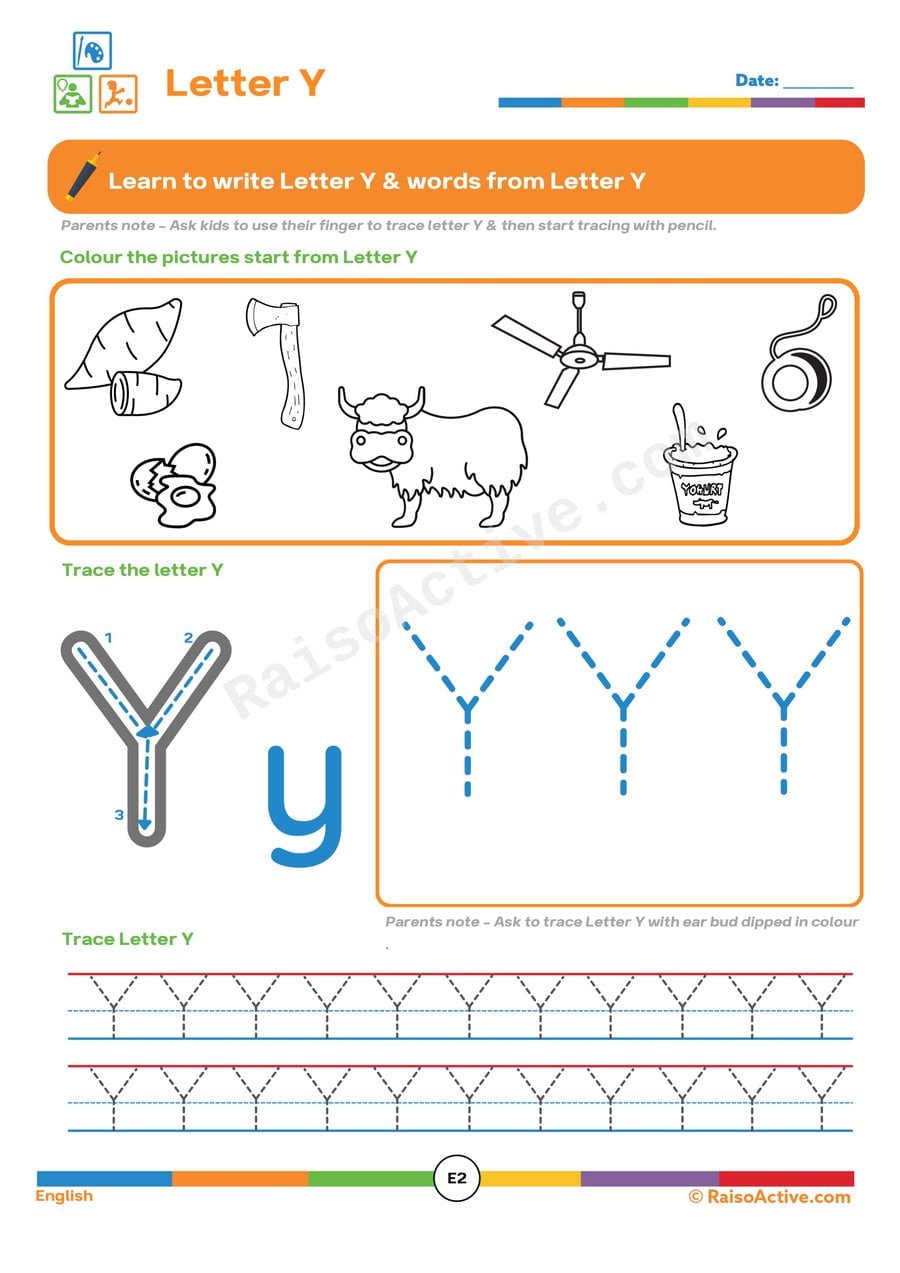
Letter Y Tracing Worksheet for Preschoolers
Ages 3-5 · Preschool–Pre-KAges 3-5 · Nursery–ReceptionAges 3-5 · Nursery–LKGAges 3-5
Tracing the uppercase and lowercase letter Y builds the fine motor control and pencil grip preschoolers need for handwriting, while linking the letter to words that start with its sound strengthens early phonemic awareness. For ages 3-5, repeated tracing also builds the visual memory needed to recognize the letter Y instantly, both in print and eventually in their own writing.
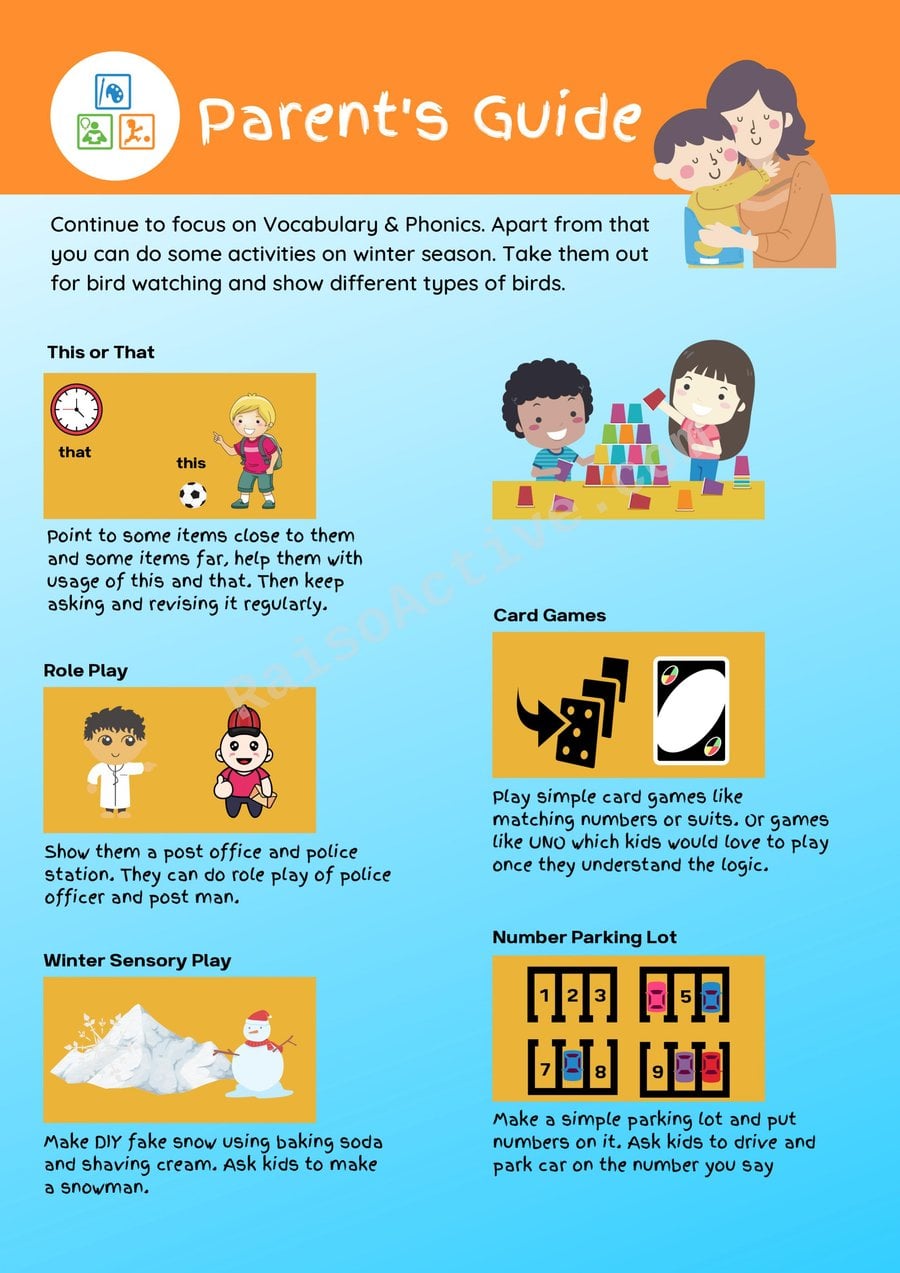
Winter Fun Activities for Kids: Parent's Guide
Ages 3-5 · Preschool–Pre-KAges 3-5 · Nursery–ReceptionAges 3-5 · Nursery–LKGAges 3-5
This parent's guide bundles several short winter-themed activities, from vocabulary games to sensory play, that build language skills, matching ability, and role-play confidence in one seasonal package. For ages 3-5, mixing modalities like talking, sorting, and hands-on sensory exploration keeps engagement high while reinforcing skills across different learning styles.
Related worksheets
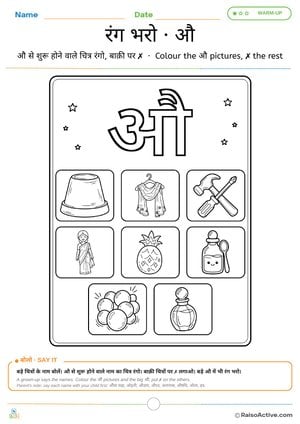
Colour the औ Words – Hindi Letter औ (au) Colouring Worksheet | औ वाली चीज़ों में रंग भरो
Ages 3-7 · Preschool–Grade 1Ages 3-7 · Nursery–Year 2Ages 3-7 · Nursery–Class 1Ages 3-7
Children say each picture name aloud, decide whether it starts with औ, colour the matching pictures (औंधा घड़ा, औज़ार, औरत and औषधि) and the big outline letter, and put a cross on the rest. Sorting by first sound trains the ear and colouring builds hand control.

Navratri Rangoli Colour by Number and Symmetry Diya
Ages 4-6 · Pre-K–KindergartenAges 4-6 · Reception–Year 1Ages 4-6 · LKG–UKGAges 4-6
Children match numbers to colours using a key, colour a rangoli pattern carefully and draw the other half of a shape so both sides match.
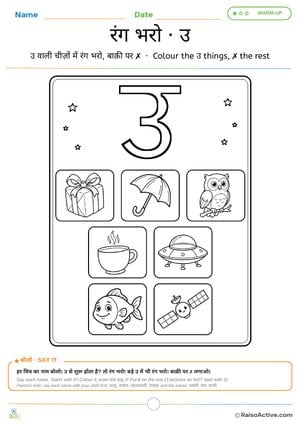
Colour the उ Things: Hindi Letter उ Colouring Page | रंग भरो · उ
Ages 3-7 · Preschool–Grade 1Ages 3-7 · Nursery–Year 2Ages 3-7 · Nursery–Class 1Ages 3-7
Children listen for the first sound of each picture name and decide whether it starts with उ. They colour the उ pictures, cross out the others and colour the big letter.

Rocking Santa Card Craft Worksheet for Preschoolers
Ages 3-5 · Preschool–Pre-KAges 3-5 · Nursery–ReceptionAges 3-5 · Nursery–LKGAges 3-5
This rocking Santa card craft has children ages 3-5 cut out individual shape pieces and assemble them onto a folded card base, combining scissor control with an early understanding of how folding creates movement, since the 'rocking' effect comes from the card's fold. Following the assembly steps in order also reinforces sequencing and attention to visual instructions.
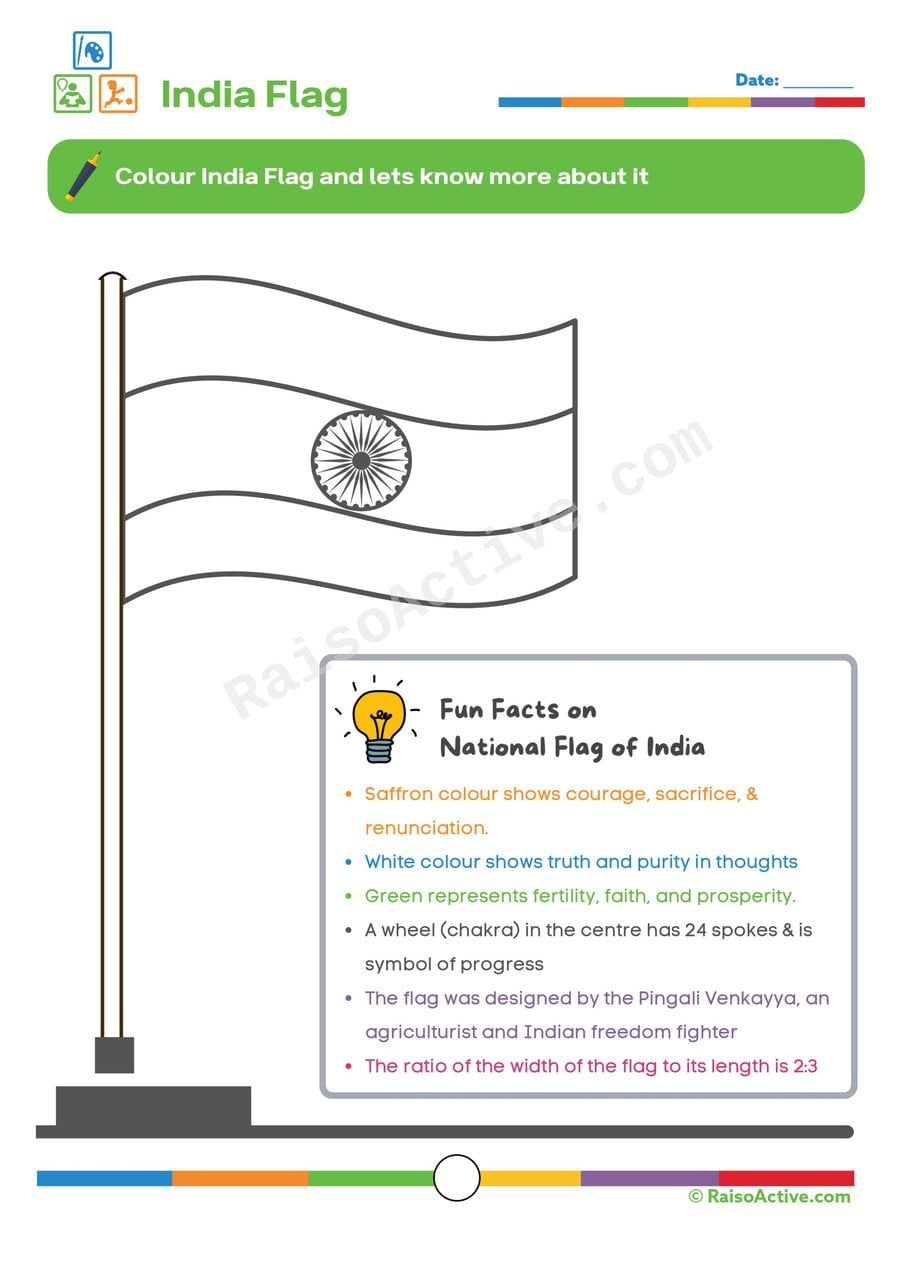
Color the India Flag Worksheet for Preschoolers
Ages 3-5 · Preschool–Pre-KAges 3-5 · Nursery–ReceptionAges 3-5 · Nursery–LKGAges 3-5
This worksheet teaches children ages 3-5 the three colors and layout of the Indian national flag, saffron, white, and green with the navy wheel, while practicing careful, section-by-section coloring. Reading a few simple facts about the flag alongside the coloring also introduces the idea that national symbols carry meaning, an early building block for civic and cultural awareness.

Ganesha Colouring Page for Ganesh Chaturthi
Ages 4-8 · Pre-K–Grade 2Ages 4-8 · Reception–Year 3Ages 4-8 · LKG–Class 2Ages 4-8
Children learn that Ganesh Chaturthi celebrates the arrival of Lord Ganesha and that people offer him modaks, his favourite sweet.

Spring Table Color by Number Worksheet for Preschoolers
Ages 3-5 · Preschool–Pre-KAges 3-5 · Nursery–ReceptionAges 3-5 · Nursery–LKGAges 3-5
This color-by-number worksheet has children ages 3-5 practice matching numerals to a specific color key and then applying that color accurately across a picture, reinforcing both number recognition and one-to-one correspondence between a symbol and an action. Rolling a dice to determine which color to use next also adds an element of chance that keeps the repetitive coloring task engaging.
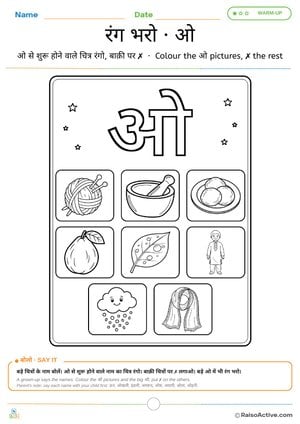
Colour the ओ Words – Hindi Letter ओ (o) Colouring Worksheet | ओ वाली चीज़ों में रंग भरो
Ages 3-7 · Preschool–Grade 1Ages 3-7 · Nursery–Year 2Ages 3-7 · Nursery–Class 1Ages 3-7
Children say each picture name aloud, decide whether it starts with ओ, colour the matching pictures (ओखली, ओस, ओला and ओढ़नी) and the big outline letter, and put a cross on the rest. Sorting by first sound trains the ear and colouring builds hand control.
Guides for this topic

Best Worksheets for 3-Year-Olds: What Works and What to Avoid
What works on worksheets for 3-year-olds: short sessions, crayons, tracing lines, matching, cutting, a free weekly plan, and signs one is too advanced.
Fostering Creativity in Structured Learning: The Perfect Balance for Young Minds
Learn how to blend creativity with structured learning for children ages 1-8. Practical strategies, activities, and printable worksheets for parents and teachers.
How to Balance Free vs. Paid Educational Resources: A Parent's Strategic Guide to Smart Learning Investments
Learn how to strategically balance free and paid educational resources for your child. Save money while ensuring quality learning with this practical Indian parent guide.
Reviews
Every worksheet for ages 2–4, no watermark
Members download the full library of 1,000+ worksheets and every activity pack without watermarks or daily limits. One year costs ₹999 in India or $20 elsewhere.
See membership plansOr download any worksheet free with a watermark (5 a day).