Odd One Out Worksheet: Find the Object That Doesn't Belong!
Spotting 'the odd one out' in a row of objects trains visual discrimination — the ability to notice small differences in shape, color, size, or category that make one item not belong with the rest. For 3-5 year olds, this is genuine critical thinking practice: they have to compare every item against every other item before deciding which one breaks the pattern, rather than just naming what they see. It's also an early step toward categorization skills that later support sorting, grouping, and basic reasoning tasks in school.
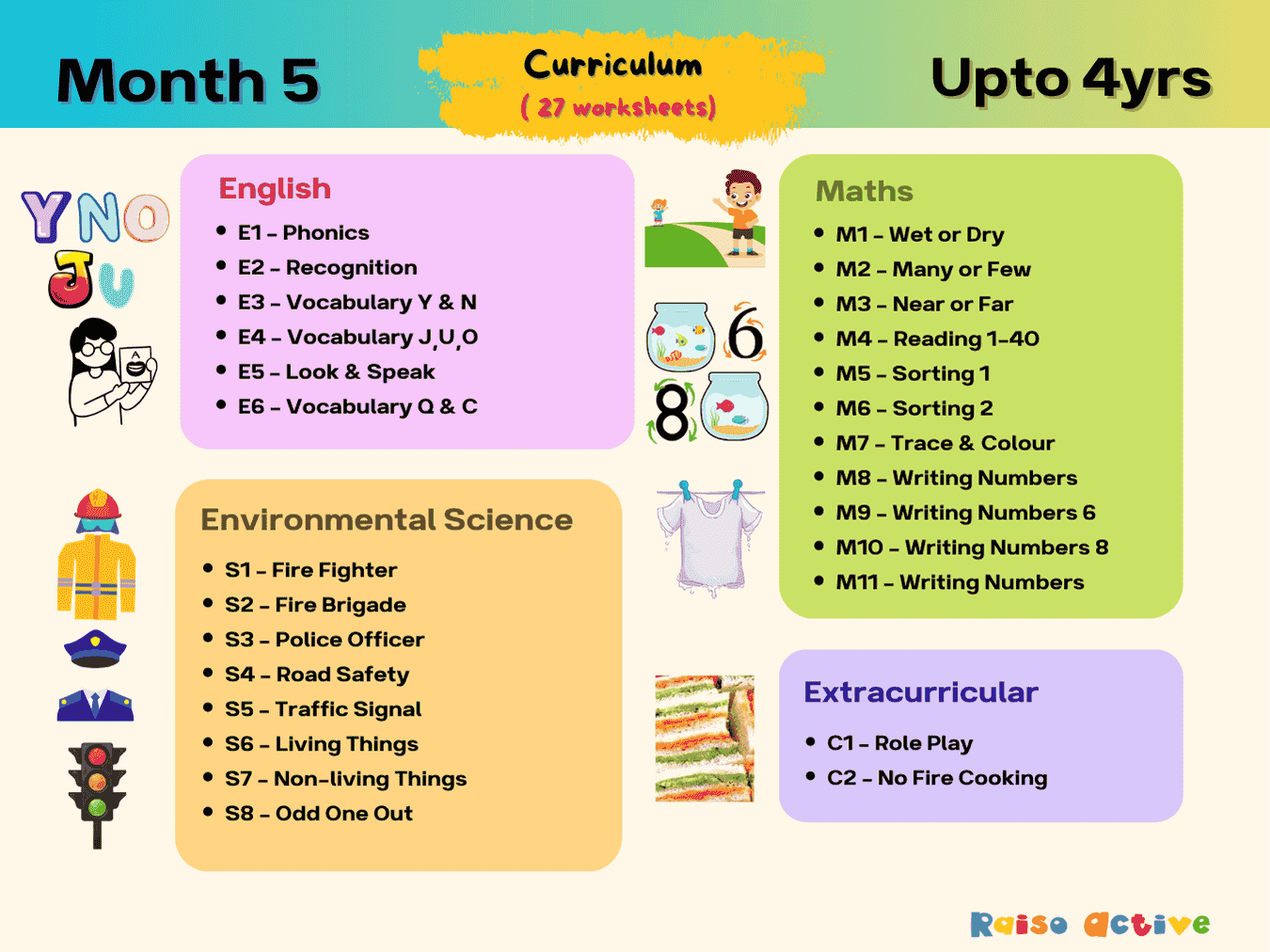
Part of the pack
Month 5: Preschool Subjects and Play | Ages Up to 4
This is page 28 of the pack. Ages 2-4 · PreschoolAges 2-4 · NurseryAges 2-4
Curriculum
- Cognitive - Attention > Visual Discrimination
How to use this worksheet
Look at the first row of objects together and name each one out loud. Ask your child to study all the objects and think about what most of them have in common before deciding which one is different. Have them circle or color the object that doesn't belong, then ask them to explain why they picked it. Move row by row down the page, letting them work through the reasoning out loud each time rather than rushing to the answer.
Materials needed
- Pencil
- Crayons or colored pencils
Extension activities
- 1Gather five household objects, four with something in common and one that doesn't fit, and ask your child to spot the odd one out.
- 2Talk about why each 'odd' object on the worksheet was different — was it the color, the size, or the category?
- 3Flip through a magazine or storybook together and challenge your child to spot something unusual on a page.
- 4Create your own odd-one-out row using toys, snacks, or crayons and let your child sort them.
- 5Play the reverse game: show four unrelated objects and ask your child to invent a reason they could belong together.

Written by
Hemsweta Jain · Teacher Cheena
MBA and Early Childhood Educator, teaching since 2014 · Founder of RaisoActive, Mumbai
Every RaisoActive worksheet is designed and checked by the founder before publishing.
Published · Last reviewed
More from Month 5: Preschool Subjects and Play | Ages Up to 4

Role Play: Color, Cut, and Create Your Neighborhood!
Ages 3-5 · Preschool–Pre-KAges 3-5 · Nursery–ReceptionAges 3-5 · Nursery–LKGAges 3-5
This hands-on activity turns community-helper knowledge into a 3D building project: children color buildings and helper figures, cut them out along the dotted lines, and assemble a small neighborhood on cardboard. That construction step is what makes this different from a typical coloring page — folding tabs and sticking pieces upright requires spatial reasoning about how a flat cutout becomes a standing structure, on top of the fine motor demands of careful cutting. It also reinforces community-helper roles by having your child literally place each helper into the neighborhood they belong in.

Trace and Color the Fruits: Number Matching Worksheet
Ages 4-6 · Pre-K–KindergartenAges 4-6 · Reception–Year 1Ages 4-6 · LKG–UKGAges 4-6
This worksheet links three number skills together for 4-6 year olds: tracing dotted numerals for handwriting practice, counting a row of fruit for quantity, and then checking that the fruit count actually matches the traced number — a self-checking loop that reinforces number-to-quantity correspondence rather than treating tracing and counting as separate tasks. That verification step (does the fruit count really match?) pushes your child to count carefully rather than just glance and guess.

Firefighter Fun: Circle the Equipment & Maze Worksheet
Ages 3-5 · Preschool–Pre-KAges 3-5 · Nursery–ReceptionAges 3-5 · Nursery–LKGAges 3-5
Circling firefighter equipment builds vocabulary and visual discrimination for children ages 3-5, since they must identify which pictured items — a hose, helmet, or ladder — actually belong to a firefighter's tools versus unrelated objects. Guiding the fire truck through a maze to reach the station afterward adds a hands-on problem-solving and fine motor challenge, requiring children to plan and trace a path with a pencil. Combining a community-helper theme with a maze keeps the page varied while introducing real vocabulary about an occupation many young children find exciting.
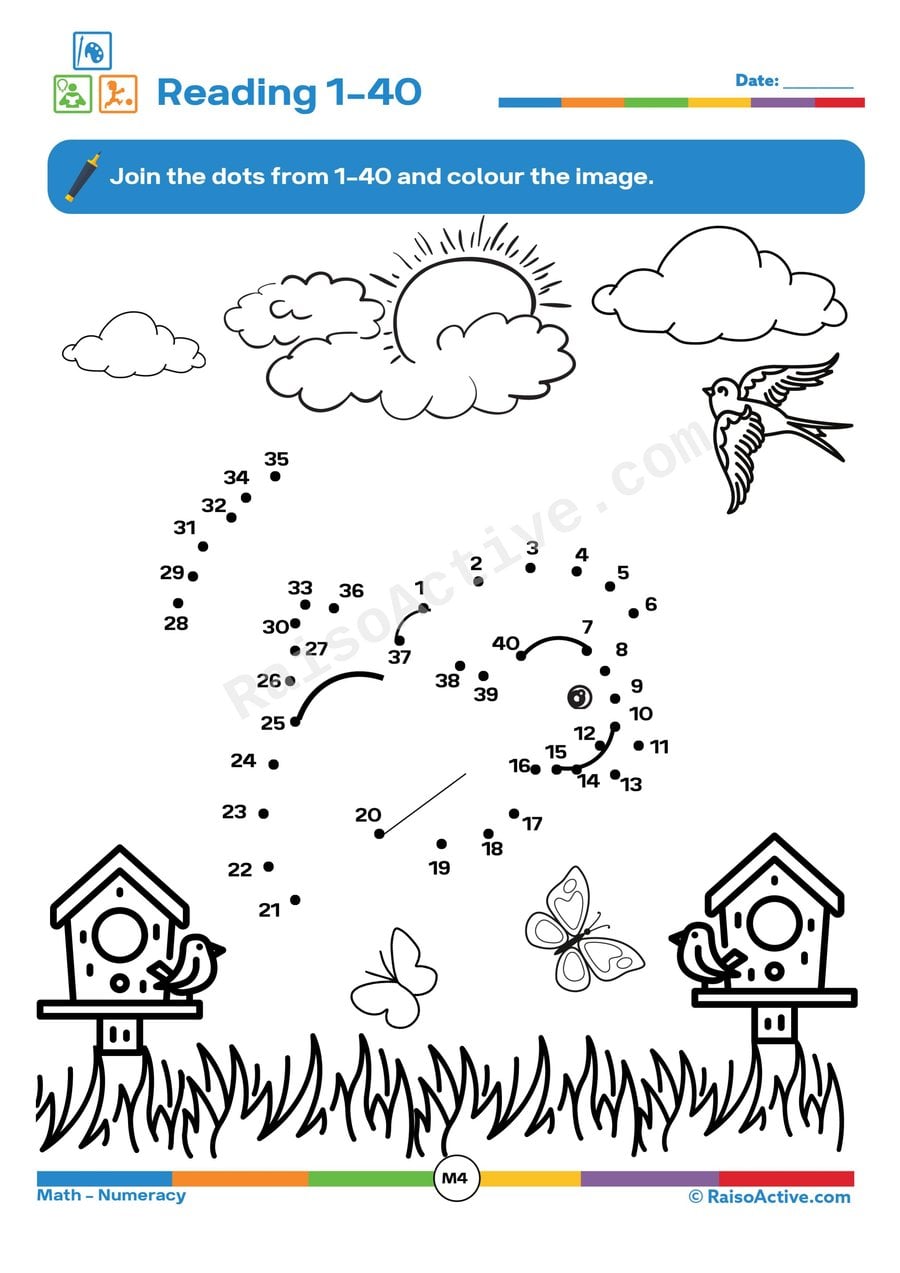
Connect the Dots: Sunny Day Picture Worksheet
Ages 3-5 · Preschool–Pre-KAges 3-5 · Nursery–ReceptionAges 3-5 · Nursery–LKGAges 3-5
Connecting the dots from 1 to 40 gives 3-5 year olds real practice with number sequencing well beyond the basic 1-10 range most preschool materials cover, while the physical act of drawing a line from dot to dot builds the same pencil control needed for handwriting. Because the picture only appears once every number has been found and connected in order, it also rewards sustained attention — your child has to keep track of where they are in the sequence across a fairly long worksheet, which is a real stretch at this age.
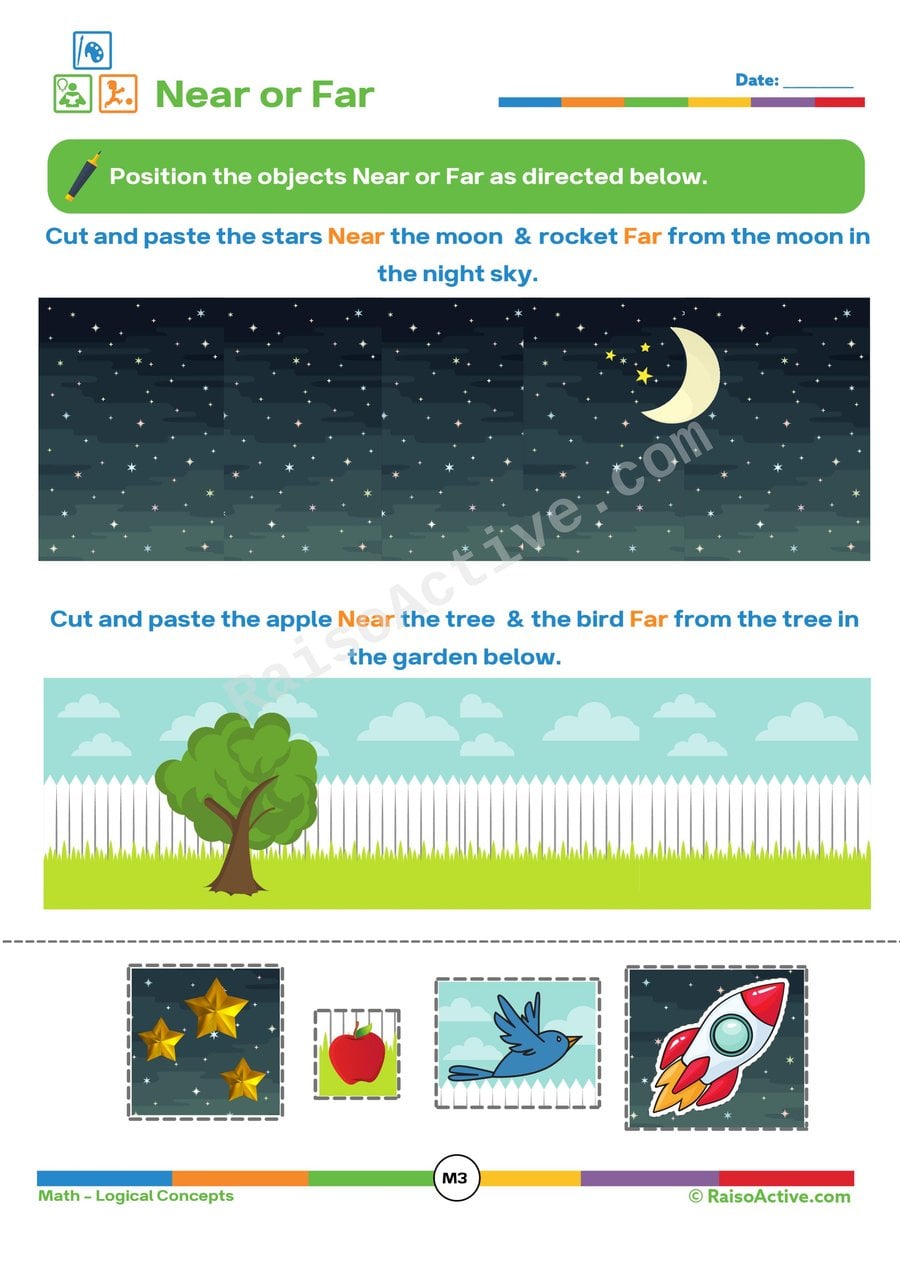
Near or Far Worksheet: Cut and Paste Fun!
Ages 3-5 · Preschool–Pre-KAges 3-5 · Nursery–ReceptionAges 3-5 · Nursery–LKGAges 3-5
Cutting and pasting objects into 'near' and 'far' positions relative to a fixed point, like a moon or a tree, gives children ages 3-5 concrete practice applying spatial vocabulary rather than just hearing the words in passing. This hands-on placement task requires children to think about relative distance, an early step toward more advanced spatial reasoning and measurement concepts. The specific, varied instructions across the page — near the moon, far from the moon, near the tree, far from the tree — also build careful listening and multi-step following of directions.

Community Helpers & Early Learning Activities Worksheet
Ages 3-5 · Preschool–Pre-KAges 3-5 · Nursery–ReceptionAges 3-5 · Nursery–LKGAges 3-5
This worksheet bundles several community-helper-themed activities, coloring, role-play, and object identification, to build vocabulary and social understanding around the different people who help in a community, like police officers or firefighters. For ages 3-5, learning about community helpers builds both social awareness and early classification skills as children learn to associate specific tools or uniforms with specific jobs.

Number 8 Worksheet: Trace, Count, and Color Butterflies!
Ages 3-5 · Preschool–Pre-KAges 3-5 · Nursery–ReceptionAges 3-5 · Nursery–LKGAges 3-5
Tracing the number 8 while counting and coloring eight butterflies helps children ages 3-5 connect the written numeral to the actual quantity it represents, reinforcing number sense alongside handwriting. The final step, drawing any eight objects of the child's choosing, moves beyond guided practice into independent application, checking whether the concept of 'eight' has truly transferred rather than just been copied. This progression from tracing to counting to free drawing builds a complete, layered understanding of one specific number.

Make a Colorful No-Fire Sandwich! A Fun Cooking Worksheet
Ages 3-5 · Preschool–Pre-KAges 3-5 · Nursery–ReceptionAges 3-5 · Nursery–LKGAges 3-5
This cooking activity gets 3-5 year olds following a multi-step recipe without any heat involved, which builds sequencing skills (first the spread, then the veggies, then the arrangement) alongside genuine fine motor practice from spreading, placing, and arranging ingredients. Because no cooking is involved, it's also a safe, hands-on way to introduce basic kitchen participation and sensory exploration of new foods and textures at an age when picky eating is common.
Related worksheets

Find the Similar Objects! Coloring Worksheet for Preschoolers
Ages 3-5 · Preschool–Pre-KAges 3-5 · Nursery–ReceptionAges 3-5 · Nursery–LKGAges 3-5
Preschoolers ages 3-5 sharpen visual discrimination by scanning sets of objects to spot which ones are identical, a skill that underlies later letter and word recognition. Comparing shapes, colors, and small details strengthens attention to detail and careful observation. Coloring the matching pairs also reinforces the finding with a hands-on, satisfying finish.

Sequencing Worksheet for Kids: First, Next, Last
Ages 4-7 · Pre-K–Grade 1Ages 4-7 · Reception–Year 2Ages 4-7 · LKG–Class 1Ages 4-7
Children put three-step stories in order using first, next and last, then work backwards to find what came before a picture. This builds sequencing, time vocabulary and cause and effect thinking.
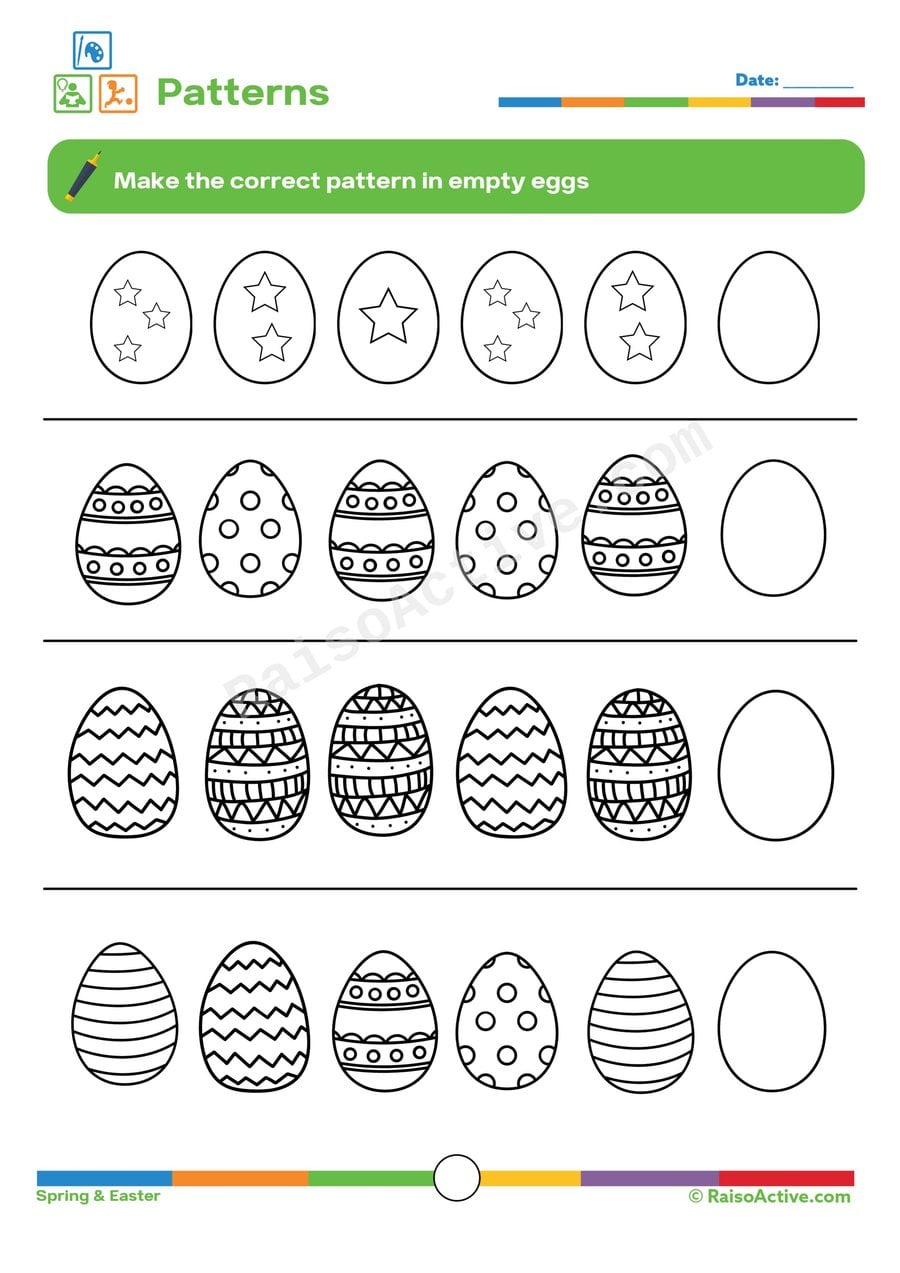
Easter Egg Patterns Worksheet for Preschoolers
Ages 3-5 · Preschool–Pre-KAges 3-5 · Nursery–ReceptionAges 3-5 · Nursery–LKGAges 3-5
This worksheet asks children ages 3-5 to study a sequence of patterned Easter eggs and figure out what design should come next, then draw it into the empty egg themselves. Predicting and completing a pattern, rather than just matching an existing one, pushes children a step further into the kind of what-comes-next reasoning that underlies early math and logic.

Navratri Picture Sudoku and Story Sequencing: Think It Through
Ages 4-6 · Pre-K–KindergartenAges 4-6 · Reception–Year 1Ages 4-6 · LKG–UKGAges 4-6
Children use logic to complete a 4x4 picture sudoku where each row and column has each picture once, and put four story pictures in order.

Soap & Pepper Science Experiment Worksheet for Preschoolers
Ages 3-5 · Preschool–Pre-KAges 3-5 · Nursery–ReceptionAges 3-5 · Nursery–LKGAges 3-5
This hands-on demonstration shows children ages 3-5 how soap disrupts water's surface tension, using floating pepper as a simple, visible indicator of the change. Because the reaction happens instantly and dramatically, it gives young children a strong, memorable first experience with predicting an outcome and then observing whether their prediction was right.
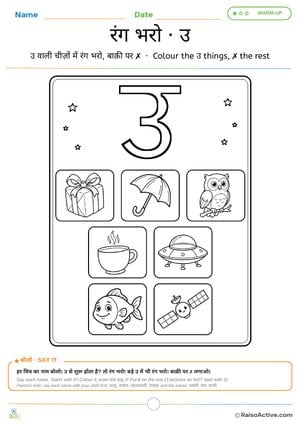
Colour the उ Things: Hindi Letter उ Colouring Page | रंग भरो · उ
Ages 3-7 · Preschool–Grade 1Ages 3-7 · Nursery–Year 2Ages 3-7 · Nursery–Class 1Ages 3-7
Children listen for the first sound of each picture name and decide whether it starts with उ. They colour the उ pictures, cross out the others and colour the big letter.

Symmetry Fun Worksheet for Kids: Complete and Color!
Ages 3-5 · Preschool–Pre-KAges 3-5 · Nursery–ReceptionAges 3-5 · Nursery–LKGAges 3-5
This symmetry worksheet challenges children ages 3-5 to study a half-drawn Christmas picture and draw the missing mirror-image half, introducing the early geometry concept that two sides of a shape can match exactly. Completing and then coloring the picture also builds visual comparison skills, since children must check their drawn half against the original before filling it in with color.
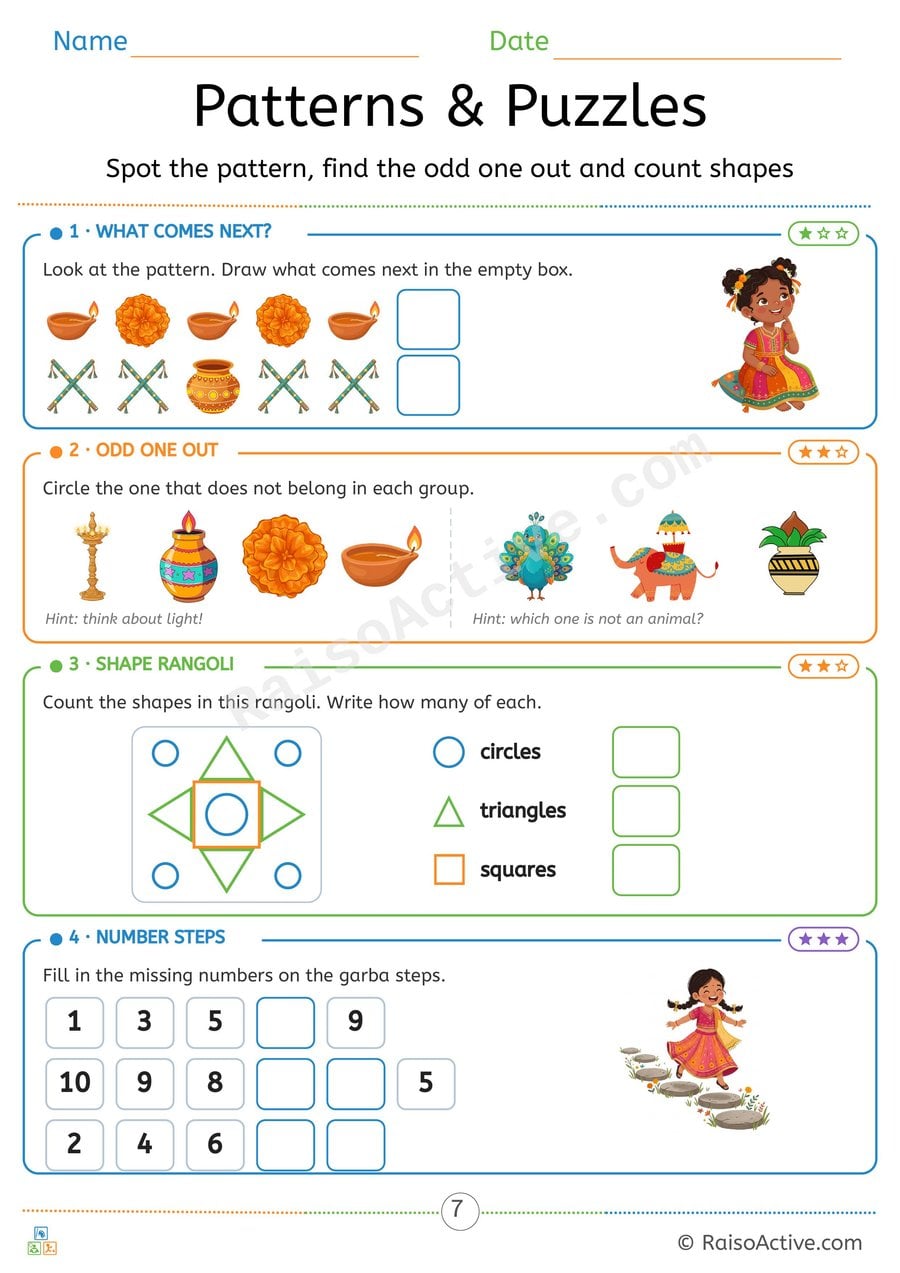
Navratri Patterns and Puzzles: What Comes Next?
Ages 4-6 · Pre-K–KindergartenAges 4-6 · Reception–Year 1Ages 4-6 · LKG–UKGAges 4-6
Children continue picture patterns, find the one that does not belong, count circles, triangles and squares in a rangoli, and fill in missing numbers counting up, down and in 2s.
Guides for this topic

Age-Appropriate Problem-Solving Activities: Building Critical Thinkers from the Ground Up
Discover fun, age-appropriate problem-solving activities for children ages 1-8. Build critical thinking, logic, and reasoning skills through play-based learning.
Critical Thinking Activities That Actually Work for Young Children: Building Tomorrow's Thinkers Today
Discover proven critical thinking activities for young children. Age-wise logic games, questioning techniques, and hands-on ideas to build thinking skills at home.

Preparing Your Child for a Rapidly Changing World: Essential Skills for Future Success
Discover the essential 21st century skills your child needs for future success. Practical tips on creativity, critical thinking, digital literacy & emotional intelligence for ages 1-8.
Reviews
Every worksheet for ages 3–5, no watermark
Members download the full library of 1,000+ worksheets and every activity pack without watermarks or daily limits. One year costs ₹999 in India or $20 elsewhere.
See membership plansOr download any worksheet free with a watermark (5 a day).