Find the Similar Objects! Coloring Worksheet for Preschoolers
Preschoolers ages 3-5 sharpen visual discrimination by scanning sets of objects to spot which ones are identical, a skill that underlies later letter and word recognition. Comparing shapes, colors, and small details strengthens attention to detail and careful observation. Coloring the matching pairs also reinforces the finding with a hands-on, satisfying finish.
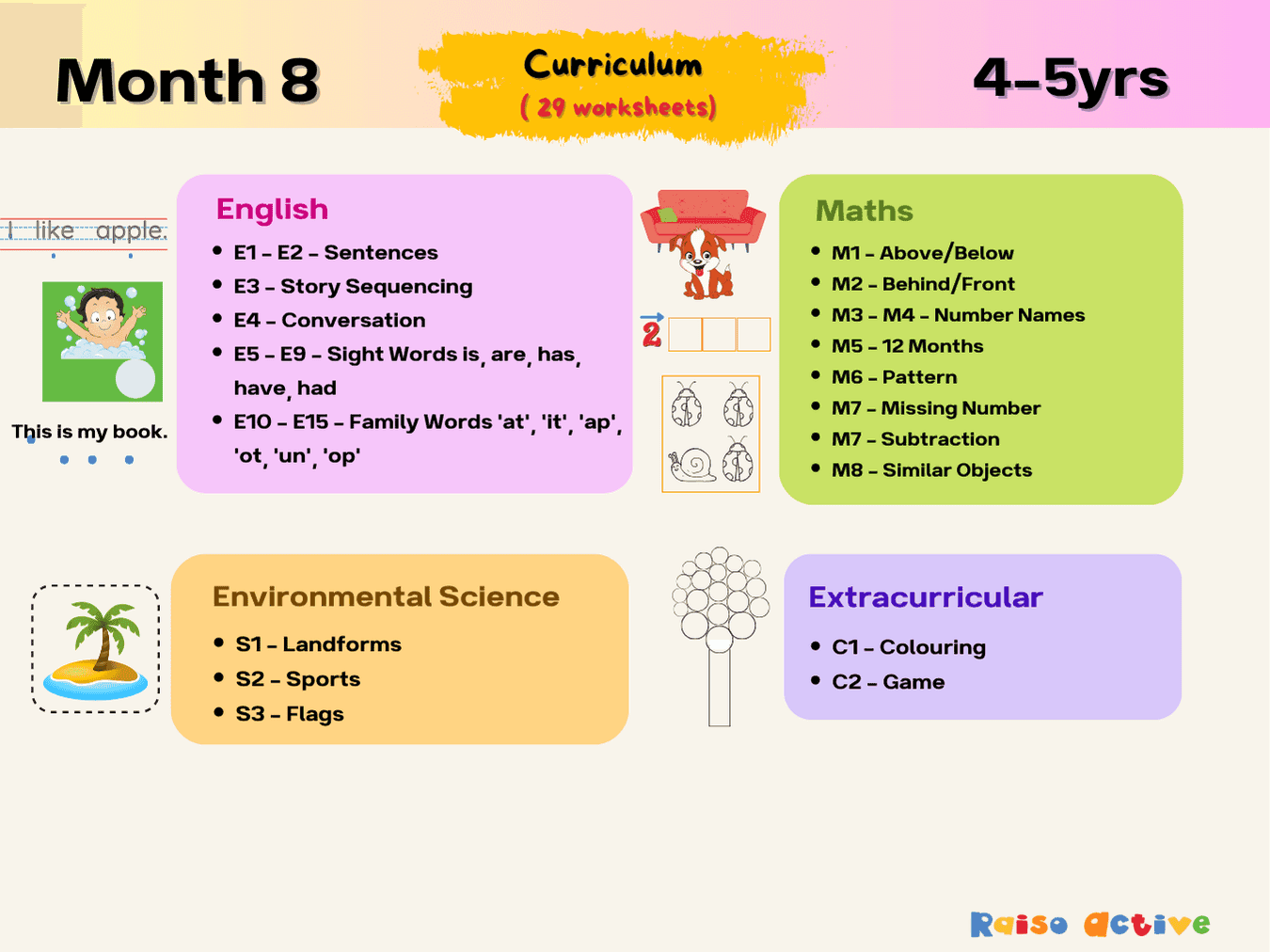
Part of the pack
Month 8: English, Math, Science Foundations | Ages 4-5
This is page 27 of the pack. Ages 4-5 · Pre-KAges 4-5 · ReceptionAges 4-5 · LKGAges 4-5
Made for your child
A whole activity pack made with their name
60 pages to spot, build, trace and write their own name, plus pages about their favourites, feelings and family. See a free preview with their name.
Make an All About Me packFree preview · free for members
Or start free: a name tracing sheet with their nameCurriculum
- Cognitive - Attention > Visual Discrimination
How to use this worksheet
Point to the first set of objects and ask your child to look closely at every detail — shape, color, size, and pattern. Guide them to compare each object against the others one at a time rather than glancing quickly, asking 'how are these different?' for any that look similar but aren't identical. Once they find the two (or more) objects that match exactly, have them color those specific objects while leaving the non-matching ones uncolored. Repeat for each row or set on the page.
Materials needed
- Pencil
- Crayons
Extension activities
- 1Set up a simple 'spot the difference' game using two nearly identical household objects, like two spoons of different sizes.
- 2Play a matching card game like Memory, flipping cards to find identical pairs.
- 3Line up a row of socks or toys and ask your child to find the two that are exactly alike.
- 4Draw three simple shapes where two match and one is slightly different, and have your child circle the odd one out.
- 5Sort a mixed pile of buttons or coins by finding all the ones that look identical.

Written by
Hemsweta Jain · Teacher Cheena
MBA and Early Childhood Educator, teaching since 2014 · Founder of RaisoActive, Mumbai
Every RaisoActive worksheet is designed and checked by the founder before publishing.
Published · Last reviewed
More from Month 8: English, Math, Science Foundations | Ages 4-5

Learn the Sight Word 'Had' | Fun Reading Worksheet for Preschoolers
Ages 4-5 · Pre-KAges 4-5 · ReceptionAges 4-5 · LKGAges 4-5
Children ages 4-5 build instant recognition of the sight word 'had', another high-frequency word that resists standard phonics decoding and must be memorized visually. This worksheet layers coloring, tracing, writing, grid-searching, and fill-in-the-blank practice, giving the word multiple forms of repeated exposure that solidify memory. Completing sentences with 'had' also shows children how the word is used naturally in storytelling, especially when talking about the past.

Front and Behind Animals Worksheet: Identify Positions!
Ages 3-5 · Preschool–Pre-KAges 3-5 · Nursery–ReceptionAges 3-5 · Nursery–LKGAges 3-5
Preschoolers ages 3-5 build early spatial reasoning by identifying which pictured animals are positioned 'in front of' an object, a positional concept that requires comparing the relative location of two things in a scene. Understanding front-and-behind relationships lays groundwork for later concepts like map reading, following multi-step directions, and geometry. Circling only the correctly positioned animals also sharpens visual attention and careful looking.
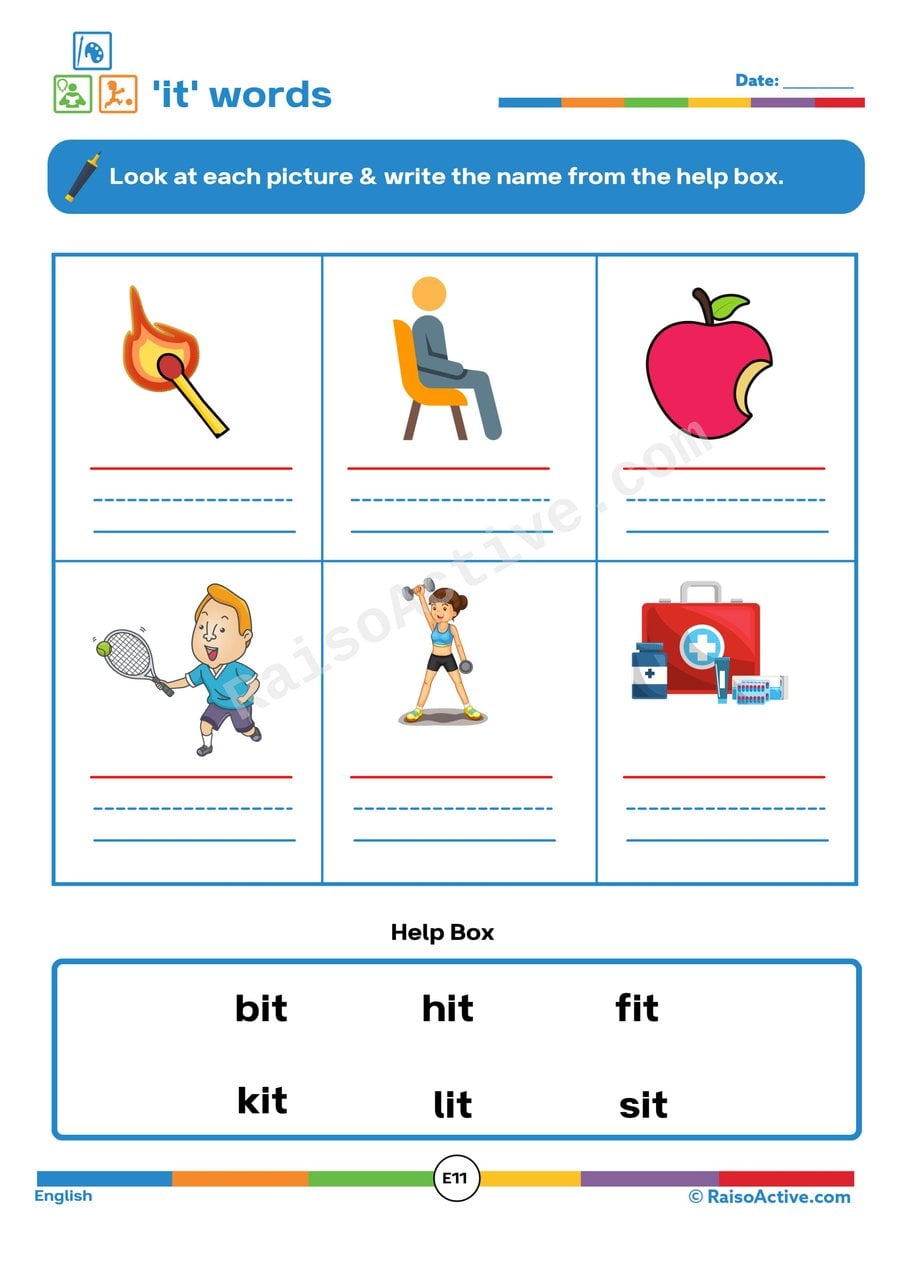
It Words Worksheet: Read and Write 'it' Words!
Ages 4-6 · Pre-K–KindergartenAges 4-6 · Reception–Year 1Ages 4-6 · LKG–UKGAges 4-6
Children ages 4-6 build phonics fluency by reading and writing CVC words from the 'it' family, such as 'sit', 'bit', and 'fit'. Recognizing this word family pattern teaches children that groups of letters carry predictable, reusable sounds, which speeds up decoding of new words they encounter later. Writing each word after identifying it also reinforces correct spelling and letter sequencing.
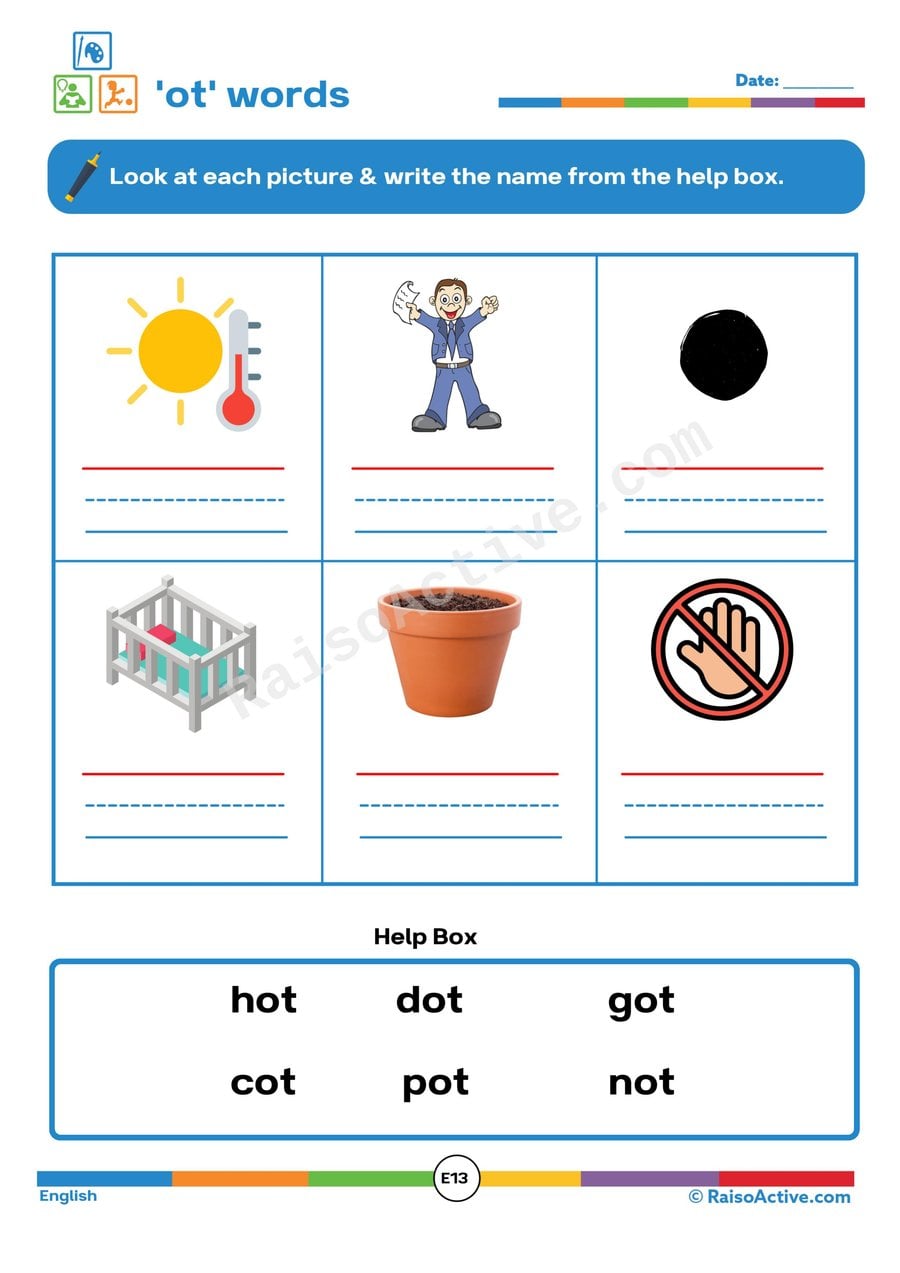
Ot Word Fun: 'ot' Word Worksheet for Early Readers
Ages 4-6 · Pre-K–KindergartenAges 4-6 · Reception–Year 1Ages 4-6 · LKG–UKGAges 4-6
Children ages 4-6 build phonics fluency by reading and writing CVC words in the 'ot' family, like 'pot', 'dot', and 'hot'. Recognizing this consistent letter pattern teaches early readers that groups of letters make predictable sounds, a key strategy for decoding unfamiliar words independently. Writing the words afterward reinforces the sound-to-letter connection needed for spelling.

Above and Below Worksheet: Identifying Object Positions
Ages 3-5 · Preschool–Pre-KAges 3-5 · Nursery–ReceptionAges 3-5 · Nursery–LKGAges 3-5
Positional words like 'above' and 'below' give three-to-five-year-olds a vocabulary for describing where things are in space, a skill that underpins everything from map reading to following multi-step instructions later on. This activity page asks children to look closely at a scene and decide whether each object sits above or below a reference point, sharpening visual scanning and the ability to hold a spatial rule in mind while checking multiple items against it.

Landforms Cut and Paste Worksheet for Preschoolers
Ages 3-5 · Preschool–Pre-KAges 3-5 · Nursery–ReceptionAges 3-5 · Nursery–LKGAges 3-5
This worksheet introduces preschoolers to the idea that the Earth's surface takes many different forms — mountains, beaches, islands — and asks them to match a picture of each landform to its name, an early step in geography and classification skills. Sorting pictures by category also reinforces visual discrimination, since children must notice defining features, like water on all sides for an island or a peak for a mountain, rather than relying on color or size alone.

Match the Sentence: Picture Matching Worksheet for Early Readers
Ages 4-6 · Pre-K–KindergartenAges 4-6 · Reception–Year 1Ages 4-6 · LKG–UKGAges 4-6
Reading a full sentence and connecting it to the picture it describes asks children ages 4-6 to move beyond single-word recognition into genuine sentence comprehension, checking that they understood the sentence's overall meaning rather than just decoding individual words. This worksheet builds that comprehension skill by having children read several simple sentences and match each one to the correct illustration, reinforcing that reading is about extracting meaning, not just producing sounds. Developing this kind of sentence-level comprehension early is an important bridge between phonics-based decoding and true reading fluency.

Months of the Year Cut and Paste Worksheet for Kids
Ages 4-6 · Pre-K–KindergartenAges 4-6 · Reception–Year 1Ages 4-6 · LKG–UKGAges 4-6
This cut-and-paste activity teaches children ages 4-6 the correct sequence of the twelve months, a foundational calendar and time-concept skill. Physically cutting and placing each month name in order reinforces sequencing logic while the scissor work builds fine motor control needed for handwriting. Understanding month order also helps children later grasp seasons, birthdays, and holidays in context.
Related worksheets

Odd One Out Worksheet: Find the Object That Doesn't Belong!
Ages 3-5 · Preschool–Pre-KAges 3-5 · Nursery–ReceptionAges 3-5 · Nursery–LKGAges 3-5
Spotting 'the odd one out' in a row of objects trains visual discrimination — the ability to notice small differences in shape, color, size, or category that make one item not belong with the rest. For 3-5 year olds, this is genuine critical thinking practice: they have to compare every item against every other item before deciding which one breaks the pattern, rather than just naming what they see. It's also an early step toward categorization skills that later support sorting, grouping, and basic reasoning tasks in school.

Navratri Rangoli Colour by Number and Symmetry Diya
Ages 4-6 · Pre-K–KindergartenAges 4-6 · Reception–Year 1Ages 4-6 · LKG–UKGAges 4-6
Children match numbers to colours using a key, colour a rangoli pattern carefully and draw the other half of a shape so both sides match.

Balloon Pattern Matching Worksheet for Preschoolers
Ages 3-5 · Preschool–Pre-KAges 3-5 · Nursery–ReceptionAges 3-5 · Nursery–LKGAges 3-5
This worksheet strengthens pattern recognition in children ages 3-5 by having them study a repeating sequence of colored balloons and locate the matching arrangement elsewhere on the page. Recognizing and reproducing a pattern is an early pre-algebra skill, laying groundwork for later number patterns and logical sequencing.

Holi Colour Mixing: Colour the Picture and Mix the Colours
Ages 4-8 · Pre-K–Grade 2Ages 4-8 · Reception–Year 3Ages 4-8 · LKG–Class 2Ages 4-8
Children learn that Holi is the festival of colours that welcomes spring, and discover which colours they get when they mix two primary colours.
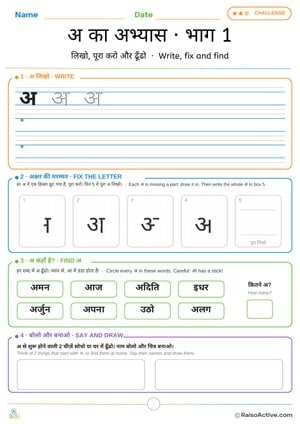
Hindi Letter अ Practice Part 1: Write, Fix and Find | अ का अभ्यास · भाग 1
Ages 3-7 · Preschool–Grade 1Ages 3-7 · Nursery–Year 2Ages 3-7 · Nursery–Class 1Ages 3-7
Children write अ on guide lines, complete four partly drawn letters, circle अ in eight words (while avoiding its look-alike आ), count how many they found, then think of two more words at home that start with अ and draw them.

Navratri Picture Sudoku and Story Sequencing: Think It Through
Ages 4-6 · Pre-K–KindergartenAges 4-6 · Reception–Year 1Ages 4-6 · LKG–UKGAges 4-6
Children use logic to complete a 4x4 picture sudoku where each row and column has each picture once, and put four story pictures in order.
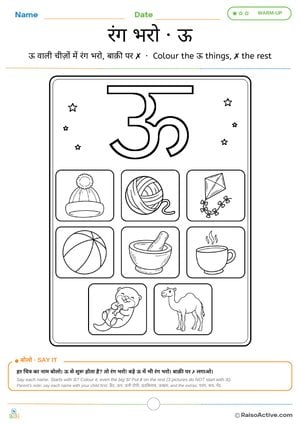
Colour the ऊ Things: Hindi Letter ऊ Colouring Page | रंग भरो · ऊ
Ages 3-7 · Preschool–Grade 1Ages 3-7 · Nursery–Year 2Ages 3-7 · Nursery–Class 1Ages 3-7
Children listen for the first sound of each picture name and decide whether it starts with ऊ. They colour the ऊ pictures, cross out the others and colour the big letter.

Parts of a Leaf Worksheet for Preschoolers: Learn and Play!
Ages 3-5 · Preschool–Pre-KAges 3-5 · Nursery–ReceptionAges 3-5 · Nursery–LKGAges 3-5
This hands-on activity teaches children ages 3-5 the parts of a leaf — tip, blade, veins, midrib, petiole, and stem — by having them shape a leaf from playdough while comparing it to a real leaf. Building a physical model alongside a real specimen helps children connect abstract vocabulary to tangible features they can see and touch, which is especially effective for this age group.
Guides for this topic

Best Worksheets for 3-Year-Olds: What Works and What to Avoid
What works on worksheets for 3-year-olds: short sessions, crayons, tracing lines, matching, cutting, a free weekly plan, and signs one is too advanced.

Age-Appropriate Problem-Solving Activities: Building Critical Thinkers from the Ground Up
Discover fun, age-appropriate problem-solving activities for children ages 1-8. Build critical thinking, logic, and reasoning skills through play-based learning.
Fostering Creativity in Structured Learning: The Perfect Balance for Young Minds
Learn how to blend creativity with structured learning for children ages 1-8. Practical strategies, activities, and printable worksheets for parents and teachers.
Reviews
Every worksheet for ages 3–5, no watermark
Members download the full library of 1,000+ worksheets and every activity pack without watermarks or daily limits. One year costs ₹999 in India or $20 elsewhere.
See membership plansOr download any worksheet free with a watermark (5 a day).