Paryushan Forgiveness Card Worksheet for Kids
Children learn that at Paryushan, Jains ask forgiveness with the words Micchami Dukkadam, and think about saying sorry for hurt caused by thoughts, words or deeds.
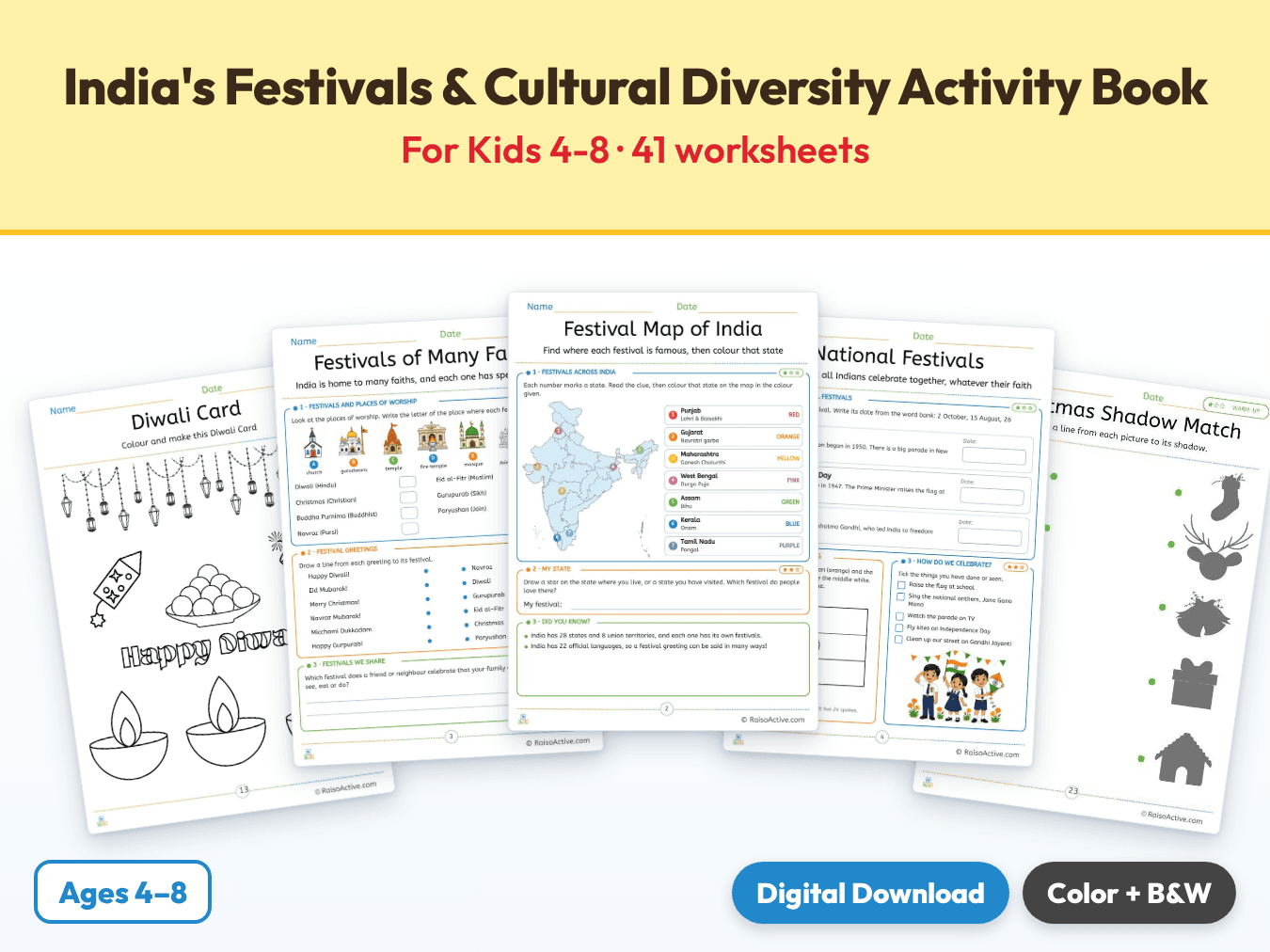
Part of the pack
India's Festivals & Cultural Diversity Activity Book for Kids 4-8
This is page 8 of the pack. Ages 4-8 · Pre-K–Grade 2Ages 4-8 · Reception–Year 3Ages 4-8 · LKG–Class 2Ages 4-8
Curriculum
- Culture & Festivals > Multi-Festival Learning
How to use this worksheet
Colour the card, fold along the lines so the folded hands meet, and write or draw a sorry message inside for someone you care about.
Materials needed
- Crayons
- Scissors
- Pencil
Extension activities
- 1Give the card to a family member
- 2Make a list of kind words you can use every day

Written by
Hemsweta Jain · Teacher Cheena
MBA and Early Childhood Educator, teaching since 2014 · Founder of RaisoActive, Mumbai
Every RaisoActive worksheet is designed and checked by the founder before publishing.
Published · Last reviewed
More from India's Festivals & Cultural Diversity Activity Book for Kids 4-8

Festival Fun Crossword Puzzle Worksheet for Kids
Ages 4-8 · Pre-K–Grade 2Ages 4-8 · Reception–Year 3Ages 4-8 · LKG–Class 2Ages 4-8
Children use picture clues and a word bank to fill a crossword with ten festivals, including Diwali, Eid, Christmas, Pongal, Lohri and Navratri.

Ganesha Puzzle Worksheet for Kids: Cut and Paste Fun!
Ages 4-8 · Pre-K–Grade 2Ages 4-8 · Reception–Year 3Ages 4-8 · LKG–Class 2Ages 4-8
Children colour Ganesha, paste the page on card and cut out the jigsaw pieces, then put the puzzle back together, building spatial reasoning.

Help Ganesha Find His Father: A Fun Maze Worksheet
Ages 4-8 · Pre-K–Grade 2Ages 4-8 · Reception–Year 3Ages 4-8 · LKG–Class 2Ages 4-8
Children help Ganesha find his way through a round maze to his father, Lord Shiva, then colour and count modaks and spot Ganesha's mouse, Mooshak.

Harvests & New Years: One Harvest, Many Names Across India
Ages 4-8 · Pre-K–Grade 2Ages 4-8 · Reception–Year 3Ages 4-8 · LKG–Class 2Ages 4-8
Children learn that the same winter harvest is celebrated with different names across India, and that many states have their own New Year festival.

India's Festivals Activity Book Answer Key (Part 2)
Ages 4-8 · Pre-K–Grade 2Ages 4-8 · Reception–Year 3Ages 4-8 · LKG–Class 2Ages 4-8
Grown-ups can check children's answers quickly for the second part of the book.
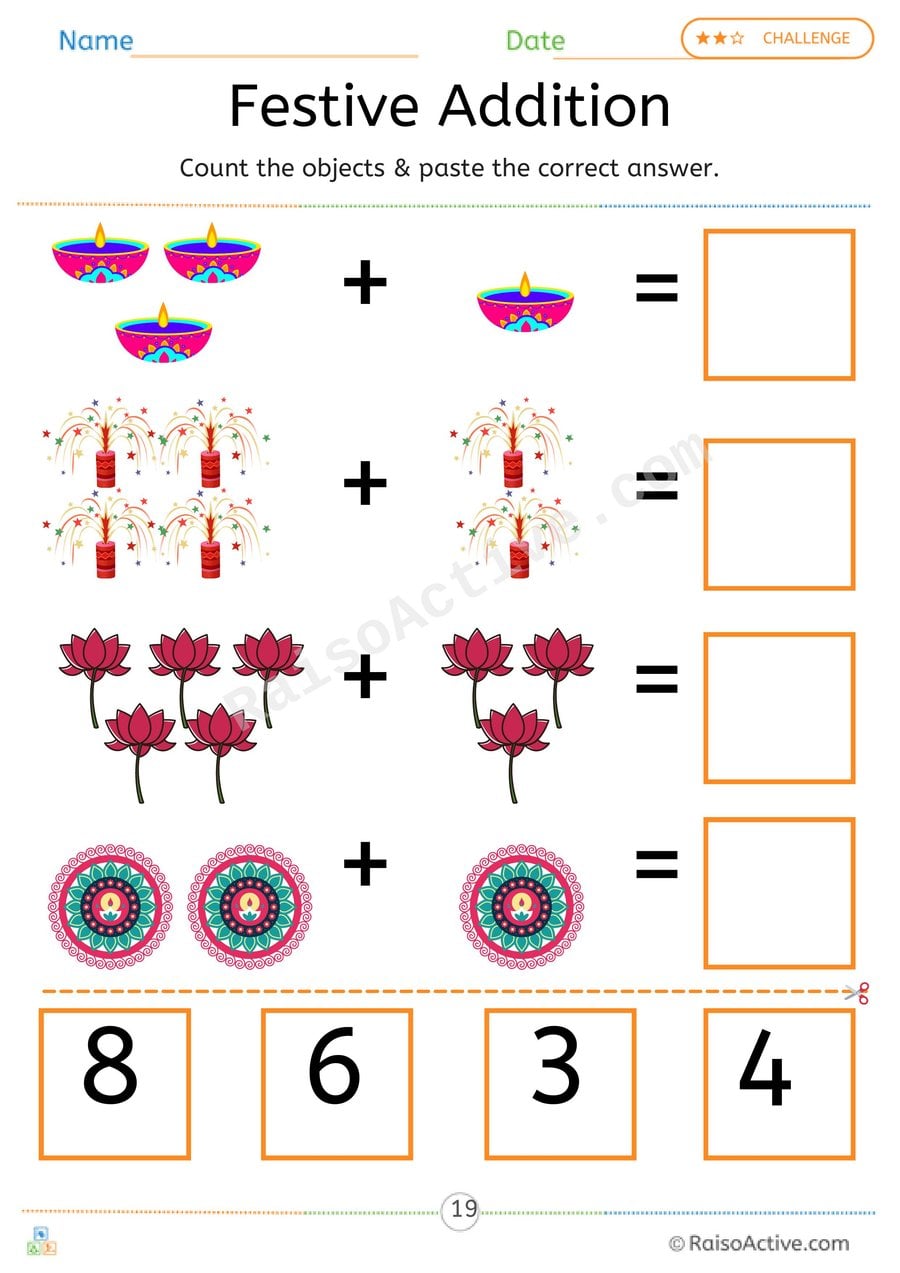
Festive Math: Count and Add Objects Worksheet
Ages 4-8 · Pre-K–Grade 2Ages 4-8 · Reception–Year 3Ages 4-8 · LKG–Class 2Ages 4-8
Children count festive objects in each picture sum, add the two groups and paste the right answer card, practising addition within 10.
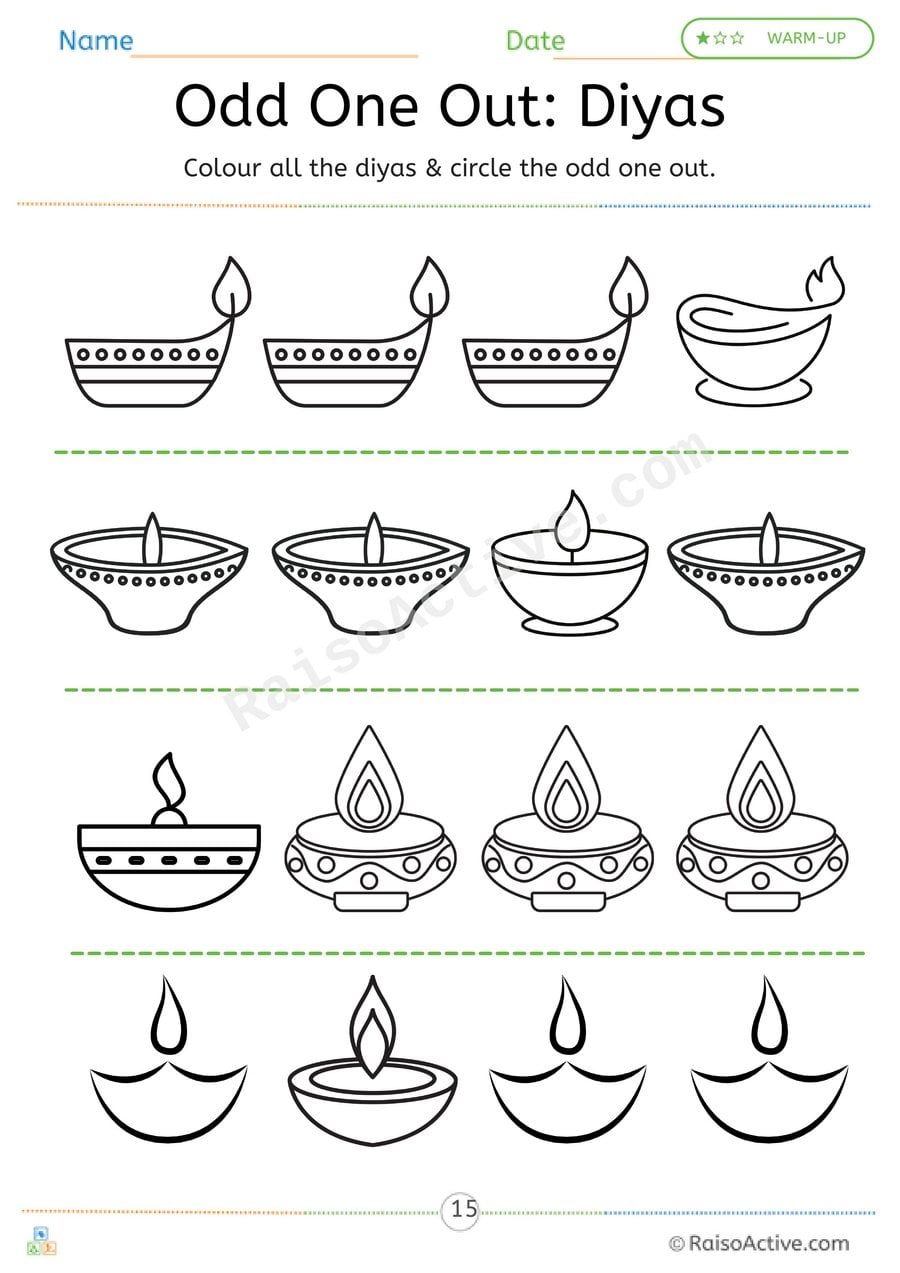
Diya Odd One Out Worksheet for Kids
Ages 4-8 · Pre-K–Grade 2Ages 4-8 · Reception–Year 3Ages 4-8 · LKG–Class 2Ages 4-8
Children look closely at rows of diyas and find the one that is different in each row, building attention and visual discrimination.

Festive Math: Counting Hands and Heads Worksheet
Ages 4-8 · Pre-K–Grade 2Ages 4-8 · Reception–Year 3Ages 4-8 · LKG–Class 2Ages 4-8
Children count the hands of Goddess Durga, Goddess Laxmi and Lord Ram and the heads of Ravana, and learn which festival each one belongs to.
Related worksheets
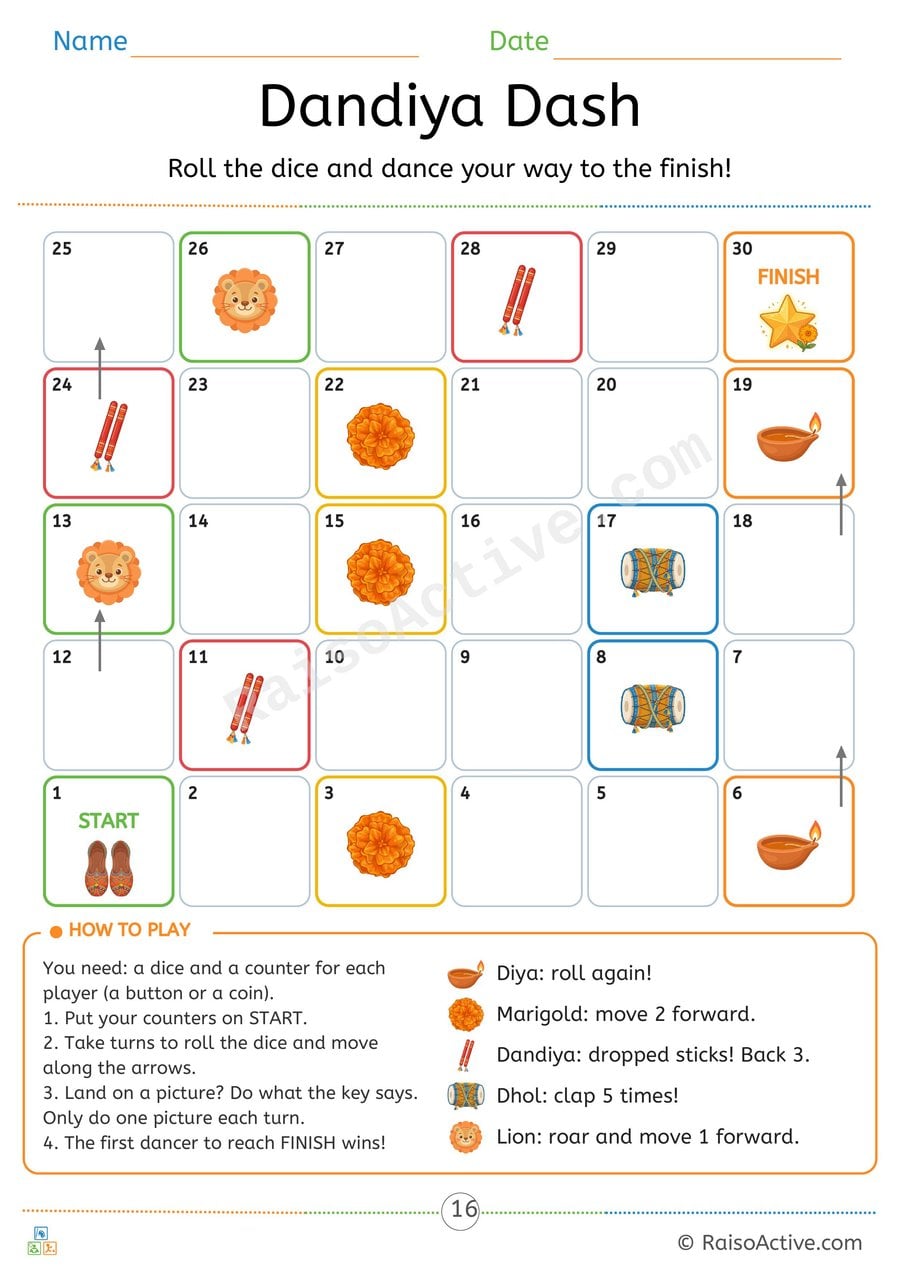
Dandiya Dash: Navratri Board Game for Kids
Ages 4-6 · Pre-K–KindergartenAges 4-6 · Reception–Year 1Ages 4-6 · LKG–UKGAges 4-6
Children count dots on a dice, count on along a number track to 30, take turns and follow simple game rules.
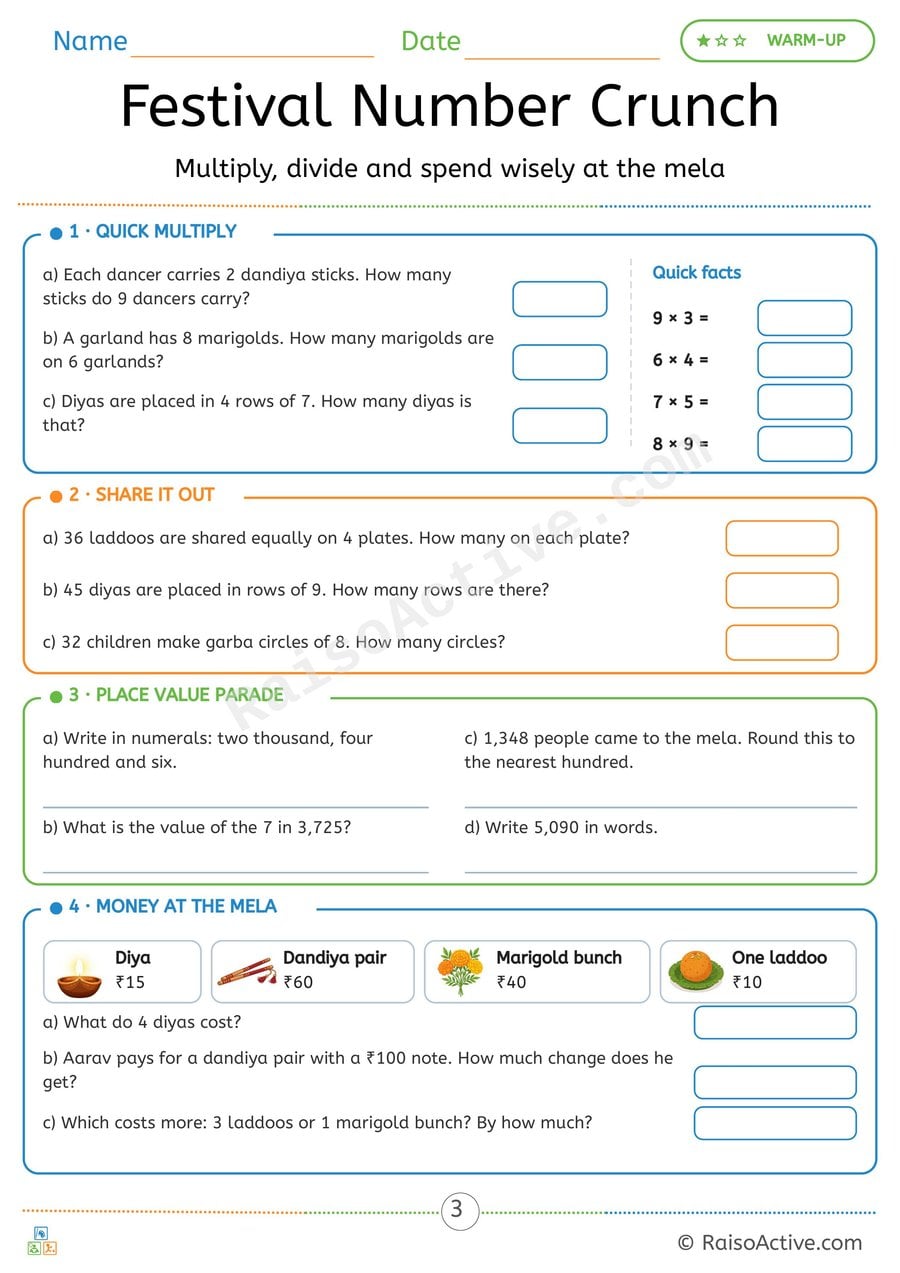
Festival Number Crunch: Navratri Multiply, Divide and Money Worksheet
Ages 7-11 · Grade 2–Grade 3Ages 7-11 · Year 3–Year 4Ages 7-11 · Class 2–Class 3Ages 7-11
Children solve multiplication and division word problems about dancers, garlands, diyas and laddoos, practise times-table facts, write and round four-digit numbers, and work out costs and change in rupees at a mela stall.

Navratri Colour Hunt: Colour Words, Matching and Bangles
Ages 4-6 · Pre-K–KindergartenAges 4-6 · Reception–Year 1Ages 4-6 · LKG–UKGAges 4-6
Children read colour words, colour bangles to match, count how many of each colour, match everyday things to their colours and find colours around the home.
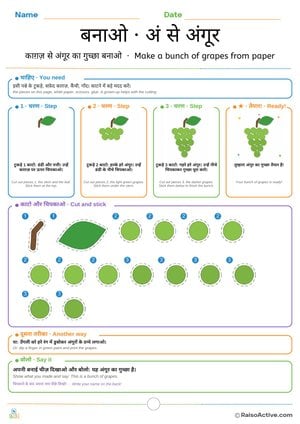
Make a Bunch of Paper Grapes: Hindi Letter अं (am) Cut and Stick Craft | बनाओ · अं से अंगूर
Ages 4-7 · Pre-K–Grade 1Ages 4-7 · Reception–Year 2Ages 4-7 · LKG–Class 1Ages 4-7
Children cut out the numbered pieces and stick them in order to make a bunch of grapes from light and dark green circles, then show it and say a full sentence about it. It links the letter अं with a real picture word, अंगूर, and practises scissor control and following steps.

Navratri Picture Sudoku and Story Sequencing: Think It Through
Ages 4-6 · Pre-K–KindergartenAges 4-6 · Reception–Year 1Ages 4-6 · LKG–UKGAges 4-6
Children use logic to complete a 4x4 picture sudoku where each row and column has each picture once, and put four story pictures in order.
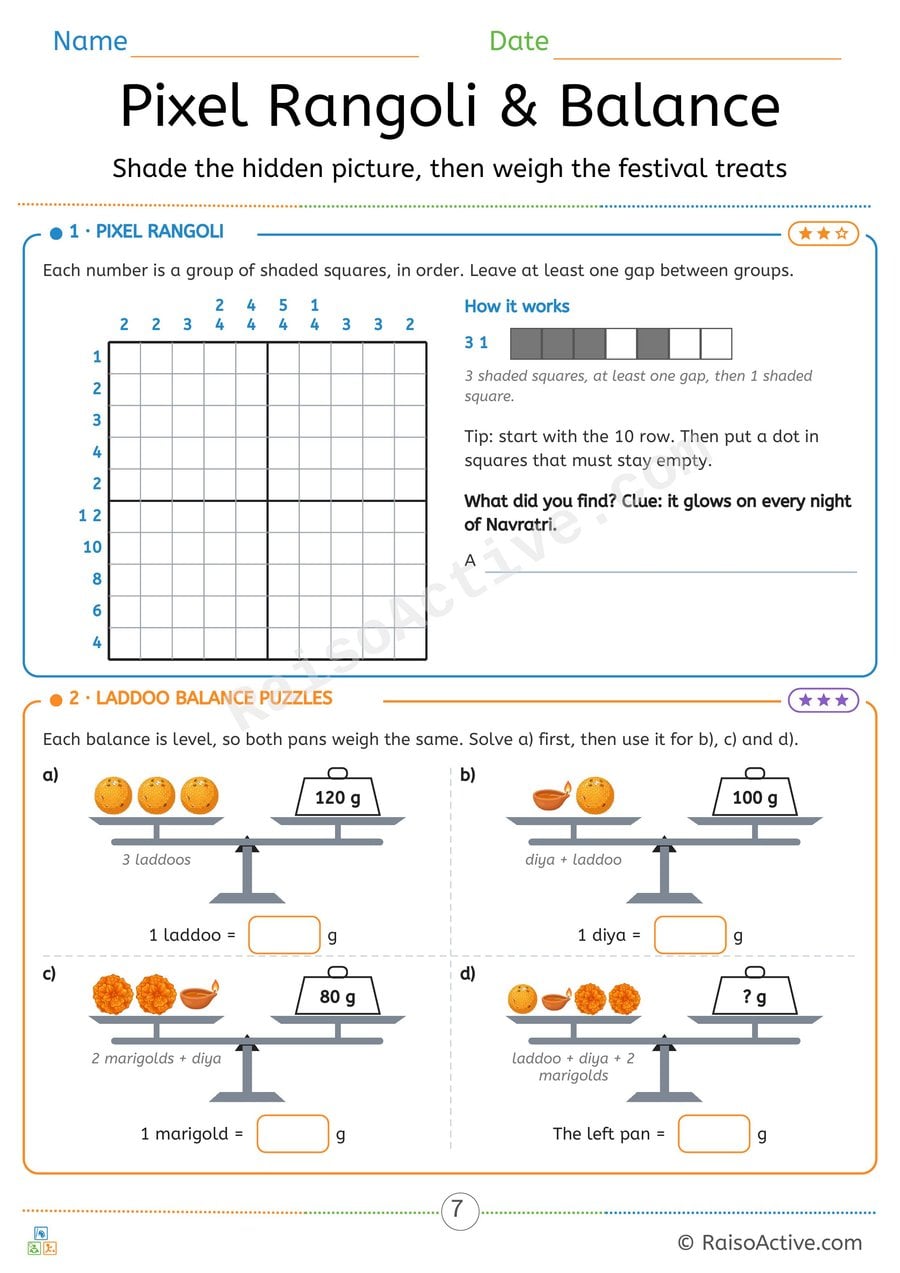
Pixel Rangoli and Laddoo Balance Puzzles for Navratri
Ages 7-11 · Grade 2–Grade 3Ages 7-11 · Year 3–Year 4Ages 7-11 · Class 2–Class 3Ages 7-11
Children use row and column clues to shade a 10 x 10 grid and reveal a hidden festival picture, then solve four balance puzzles in grams, using each answer to work out the next: a first step into algebra.
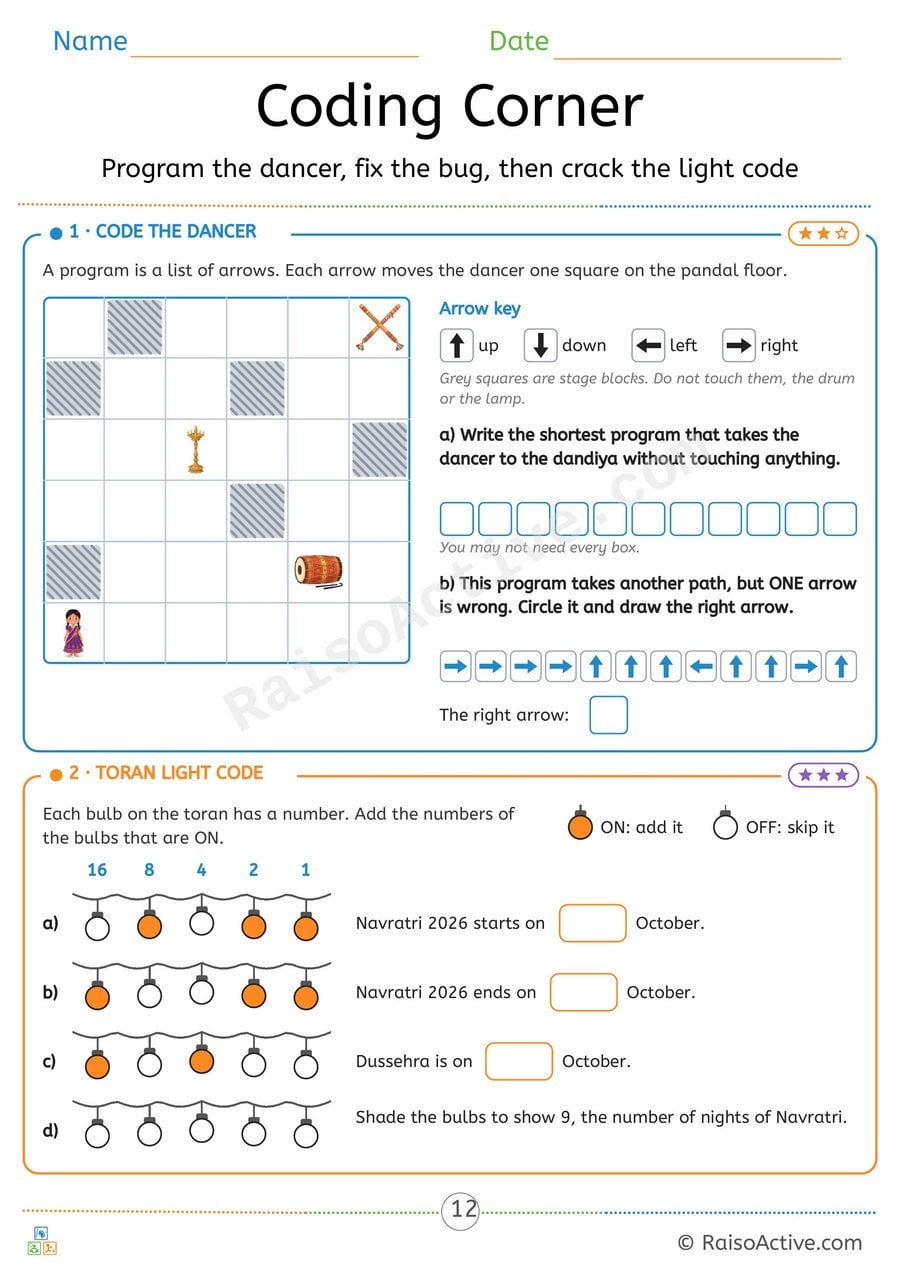
Navratri Coding Corner: Program the Dancer and Toran Light Code
Ages 7-11 · Grade 2–Grade 3Ages 7-11 · Year 3–Year 4Ages 7-11 · Class 2–Class 3Ages 7-11
Children write the shortest arrow program to move a dancer across a grid without touching obstacles, find and fix a bug in another program, and add the values of lit bulbs (16, 8, 4, 2, 1) to read binary numbers that give the dates of Navratri 2026 and Dussehra.
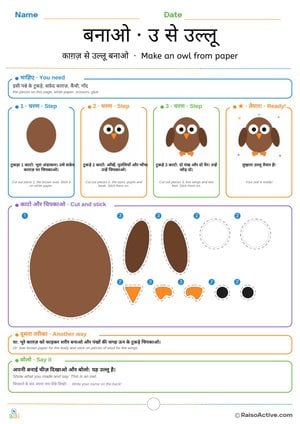
Make a Paper Owl: Hindi Letter उ Craft | बनाओ · उ से उल्लू
Ages 3-7 · Preschool–Grade 1Ages 3-7 · Nursery–Year 2Ages 3-7 · Nursery–Class 1Ages 3-7
Children cut out the pieces, put them together following three step pictures and make a paper owl. Saying the word उल्लू as they make it links the sound उ to something they built themselves.
Guides for this topic

Preparing Your Child for a Rapidly Changing World: Essential Skills for Future Success
Discover the essential 21st century skills your child needs for future success. Practical tips on creativity, critical thinking, digital literacy & emotional intelligence for ages 1-8.
Social-Emotional Learning Activities for Preschoolers: Nurturing Hearts and Minds
Discover practical social-emotional learning activities for preschoolers. Build emotional intelligence, empathy, and cooperation skills with fun, age-appropriate SEL activities.
Bridging Two Worlds: A Complete Guide to Teaching Heritage Languages Alongside English
A practical guide to raising bilingual children who speak both their heritage language and English with confidence. Research-backed strategies, activities, and tips for Indian families.
Reviews
Every worksheet for ages 4–8, no watermark
Members download the full library of 1,000+ worksheets and every activity pack without watermarks or daily limits. One year costs ₹999 in India or $20 elsewhere.
See membership plansOr download any worksheet free with a watermark (5 a day).