Climb Calm Mountain: A Team Board Game with a Paper-Clip Spinner
Children play a cooperative game up a 20-stone mountain. Feeling stops, calm stops, storm stones and a rainbow bridge practise naming feelings, using calm tools and saying kind words. Everyone wins by arriving at the lantern.
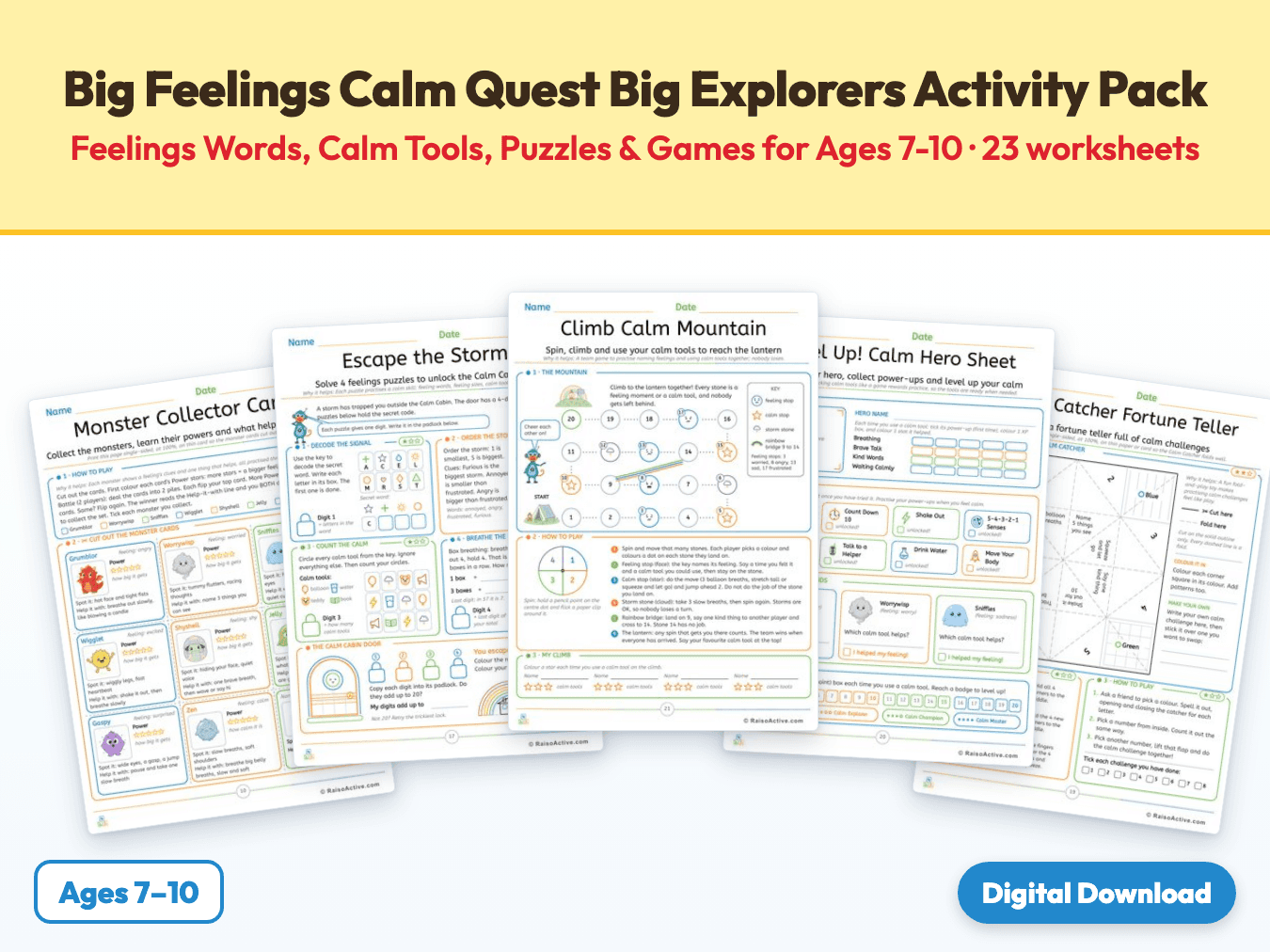
Part of the pack
Big Feelings Calm Quest Big Explorers Activity Pack: Feelings Words, Calm Tools, Puzzles & Games for Ages 7-10
This is page 21 of the pack. Ages 7-10 · Grade 2–Grade 3Ages 7-10 · Year 3–Year 4Ages 7-10 · Class 2–Class 3Ages 7-10
How to use this worksheet
Make the paper-clip spinner by flicking a clip around a pencil point. Spin, move that many stones and colour each stone you land on. Follow the rule for feeling, calm, storm and rainbow stones. The team wins when everyone has arrived.
Materials needed
- Pencil
- Crayons
- Paper clip
- Counters or small tokens (optional)
Extension activities
- 1Add a new kind of stone with your own rule.
- 2Track your calm tools in the My Climb box.

Written by
Hemsweta Jain · Teacher Cheena
MBA and Early Childhood Educator, teaching since 2014 · Founder of RaisoActive, Mumbai
Every RaisoActive worksheet is designed and checked by the founder before publishing.
Published · Last reviewed
More from Big Feelings Calm Quest Big Explorers Activity Pack: Feelings Words, Calm Tools, Puzzles & Games for Ages 7-10

How Big Is It? Feelings Thermometer and Matching the Size of the Reaction
Ages 7-10 · Grade 2–Grade 3Ages 7-10 · Year 3–Year 4Ages 7-10 · Class 2–Class 3Ages 7-10
Children rank five feelings from coolest to hottest, decide whether a problem is small, medium or big and match the size of the reaction, then think of a reaction that fits a small problem.

Say It Kindly: Build I-Messages, Blame or Kind and Fix-It Cards
Ages 7-10 · Grade 2–Grade 3Ages 7-10 · Year 3–Year 4Ages 7-10 · Class 2–Class 3Ages 7-10
Children learn the I-message pattern 'I feel... when... I need...', sort blaming and kind sentences with B or K, match oops moments to repairs and think how a classmate might feel.

Feelings Word Wheel: 24 Feeling Words in Six Families and How Big Each One Feels
Ages 7-10 · Grade 2–Grade 3Ages 7-10 · Year 3–Year 4Ages 7-10 · Class 2–Class 3Ages 7-10
Children build a richer feelings vocabulary with 24 words in six colour-coded families, from annoyed to furious and content to overjoyed. They learn that words in a family are cousins, not the same.

Choose Your Path: The Volcano Morning Story with Choices and Endings
Ages 7-10 · Grade 2–Grade 3Ages 7-10 · Year 3–Year 4Ages 7-10 · Class 2–Class 3Ages 7-10
Children follow a branching story: Leo's sister breaks his rocket and a feeling like a volcano rises. Each choice leads to one of four endings, and children pick out the calm tools and write a new ending.

Big Feelings Calm Quest Certificate: Calm Quest Champion
Ages 7-10 · Grade 2–Grade 3Ages 7-10 · Year 3–Year 4Ages 7-10 · Class 2–Class 3Ages 7-10
A certificate of achievement for children who explored big feelings and completed the Big Feelings Calm Quest pack. Tick the three levels completed.

Escape the Storm! A Feelings Escape Room Puzzle Worksheet
Ages 7-10 · Grade 2–Grade 3Ages 7-10 · Year 3–Year 4Ages 7-10 · Class 2–Class 3Ages 7-10
Children solve four mini puzzles (a picture code, ordering by size, counting calm tools and box breathing arithmetic) to get four digits, then check that the digits add up to 20.

Calm Catcher Fortune Teller: Fold a Paper Fortune Teller of Calm Challenges
Ages 7-10 · Grade 2–Grade 3Ages 7-10 · Year 3–Year 4Ages 7-10 · Class 2–Class 3Ages 7-10
Children cut and fold a fortune teller (cootie catcher) whose eight flaps hold calm challenges: balloon breaths, name five things you see, stretch tall, squeeze and let go, say one kind thing and more.

Mixed Feelings Lab: Feeling Potions and Leo's Feelings Line Graph
Ages 7-10 · Grade 2–Grade 3Ages 7-10 · Year 3–Year 4Ages 7-10 · Class 2–Class 3Ages 7-10
Children learn that we can feel two things at once (excited and nervous, sad and happy). They match potions to moments, plot a line graph of Leo's day and explain the biggest change.
Related worksheets

Feelings Detective for Kids: Clue Cards, Story Order and Draw a Proud Moment
Ages 4-6 · Pre-K–KindergartenAges 4-6 · Reception–Year 1Ages 4-6 · LKG–UKGAges 4-6
Children use body clues (fists, a wobbly tummy, standing tall) and what happened to work out the feeling, put three pictures in order and talk about a proud moment.
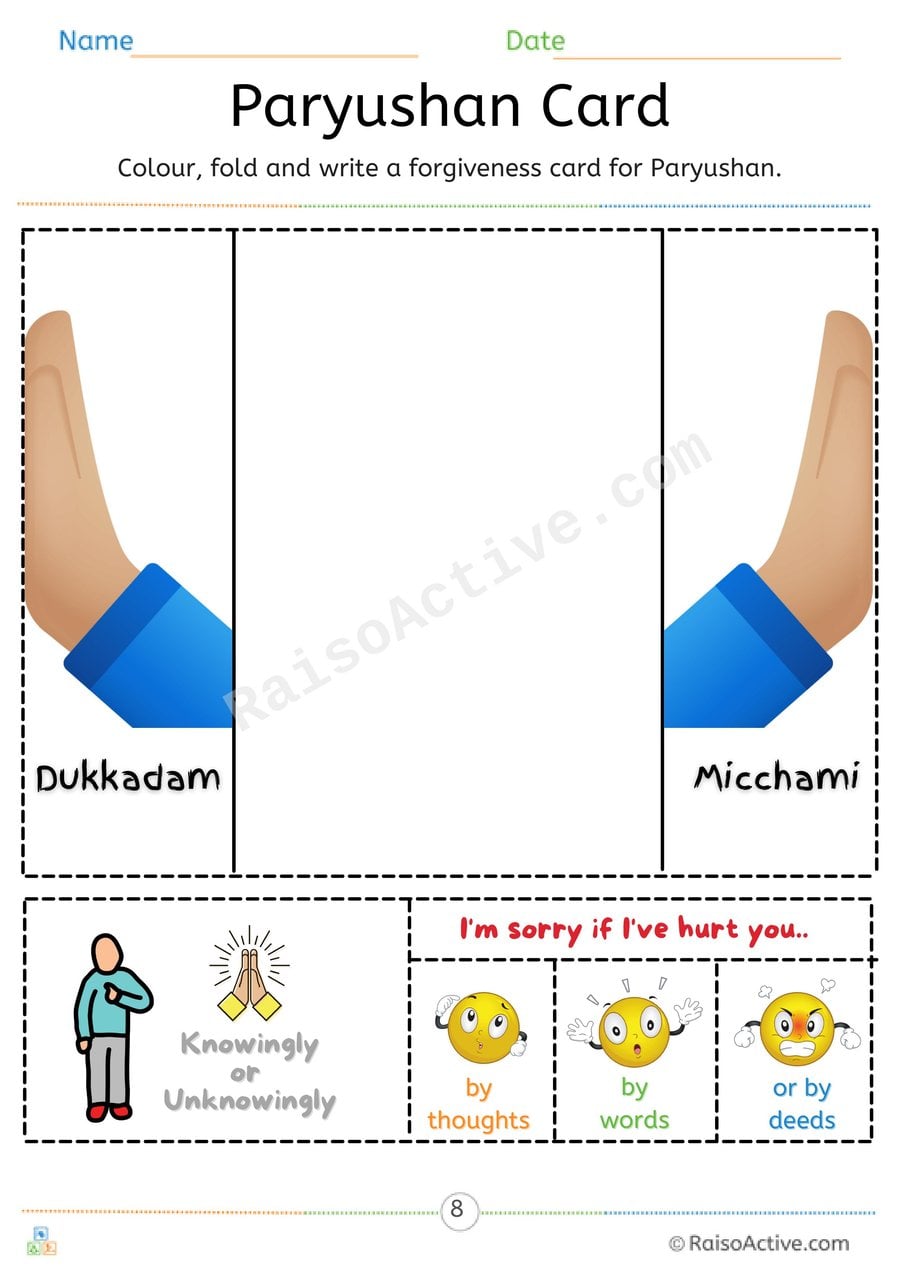
Paryushan Forgiveness Card Worksheet for Kids
Ages 4-8 · Pre-K–Grade 2Ages 4-8 · Reception–Year 3Ages 4-8 · LKG–Class 2Ages 4-8
Children learn that at Paryushan, Jains ask forgiveness with the words Micchami Dukkadam, and think about saying sorry for hurt caused by thoughts, words or deeds.
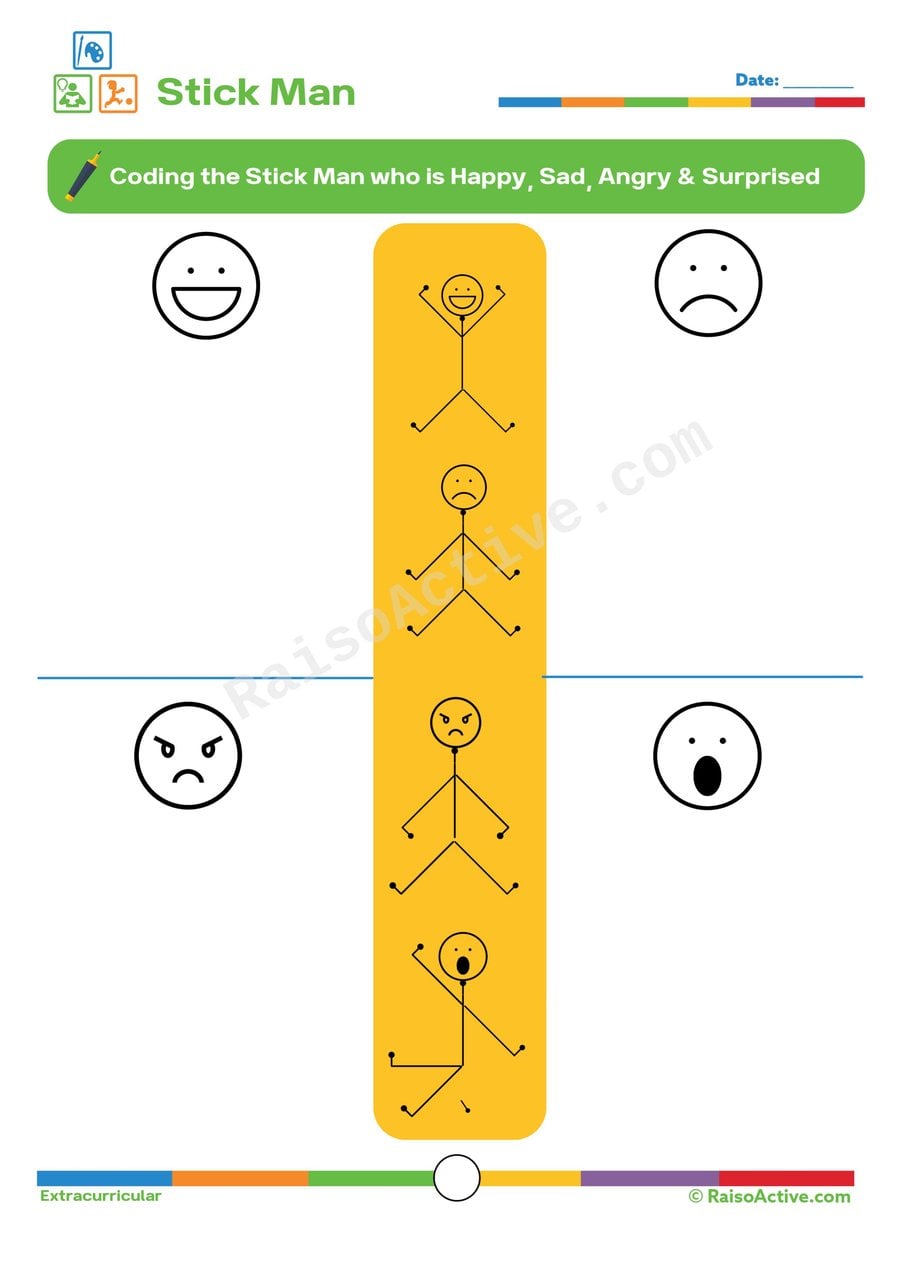
Stick Man Emotions Worksheet: Happy, Sad, Angry & Surprised!
Ages 3-5 · Preschool–Pre-KAges 3-5 · Nursery–ReceptionAges 3-5 · Nursery–LKGAges 3-5
Matching simple stick-figure faces to emotion words helps children ages 3-5 build an early emotional vocabulary, connecting facial cues like a curved mouth or raised eyebrows to specific feeling words. This kind of emotion recognition is a foundational social-emotional skill, helping children name what they and others are feeling instead of just reacting.

Shake and Settle Calm Jar: Make a Pull-Strip Calm-Down Jar
Ages 4-6 · Pre-K–KindergartenAges 4-6 · Reception–Year 1Ages 4-6 · LKG–UKGAges 4-6
Children build a paper calm jar. When they pull the strip up slowly, a swirly, busy jar changes to a settled one, showing how a busy head can calm down. They then tick three calm tools.

Kai and the Stuck Kite: A Feelings Story with a Pull-Tab Slider
Ages 4-6 · Pre-K–KindergartenAges 4-6 · Reception–Year 1Ages 4-6 · LKG–UKGAges 4-6
Children listen to a short story where Kai feels sad, then angry, then calm after balloon breaths, and finally happy. They answer at their own level and build a feelings slider.

Family Relations Worksheet: Learn About Family Members!
Ages 3-5 · Preschool–Pre-KAges 3-5 · Nursery–ReceptionAges 3-5 · Nursery–LKGAges 3-5
Writing the correct family member name next to each person on a family tree helps children ages 3-5 understand family relationships and structure, connecting a written word to a specific role like mother, father, or sibling. This early exposure to family trees also introduces the idea of organizing information visually, a skill used across many later school subjects.

My School Cut and Paste Worksheet for Preschoolers
Ages 3-5 · Preschool–Pre-KAges 3-5 · Nursery–ReceptionAges 3-5 · Nursery–LKGAges 3-5
Cutting out school-related pictures and pasting them into the correct spaces on a school building teaches children ages 3-5 vocabulary for familiar school spaces, like a classroom or playground, while also strengthening spatial matching and fine motor cutting and pasting skills. This activity helps children who are new to school, or preparing to start, connect words to places they'll actually encounter.

Golden Words Worksheet: Practice Using 'Excuse Me', 'Please', 'Thank You', and 'Sorry'
Ages 3-5 · Preschool–Pre-KAges 3-5 · Nursery–ReceptionAges 3-5 · Nursery–LKGAges 3-5
This worksheet teaches children ages 3-5 when and how to use four essential polite phrases — 'Excuse Me,' 'Please,' 'Thank You,' and 'Sorry' — by choosing the correct one to complete everyday social scenarios. Learning to match the right polite phrase to the right situation, rather than just memorizing the words, builds real social communication skills that children use constantly in daily interactions.
Guides for this topic

Preparing Your Child for a Rapidly Changing World: Essential Skills for Future Success
Discover the essential 21st century skills your child needs for future success. Practical tips on creativity, critical thinking, digital literacy & emotional intelligence for ages 1-8.
Social-Emotional Learning Activities for Preschoolers: Nurturing Hearts and Minds
Discover practical social-emotional learning activities for preschoolers. Build emotional intelligence, empathy, and cooperation skills with fun, age-appropriate SEL activities.
Celebrating Diversity: How to Incorporate Cultural Awareness in Learning Activities for Young Children
Practical cultural awareness activities for young children aged 2-8. Explore Indian festivals, world cultures, food, music, and crafts to teach diversity and inclusion.
Reviews
Every worksheet for ages 7–10, no watermark
Members download the full library of 1,000+ worksheets and every activity pack without watermarks or daily limits. One year costs ₹999 in India or $20 elsewhere.
See membership plansOr download any worksheet free with a watermark (5 a day).