Mixed Feelings Lab: Feeling Potions and Leo's Feelings Line Graph
Children learn that we can feel two things at once (excited and nervous, sad and happy). They match potions to moments, plot a line graph of Leo's day and explain the biggest change.
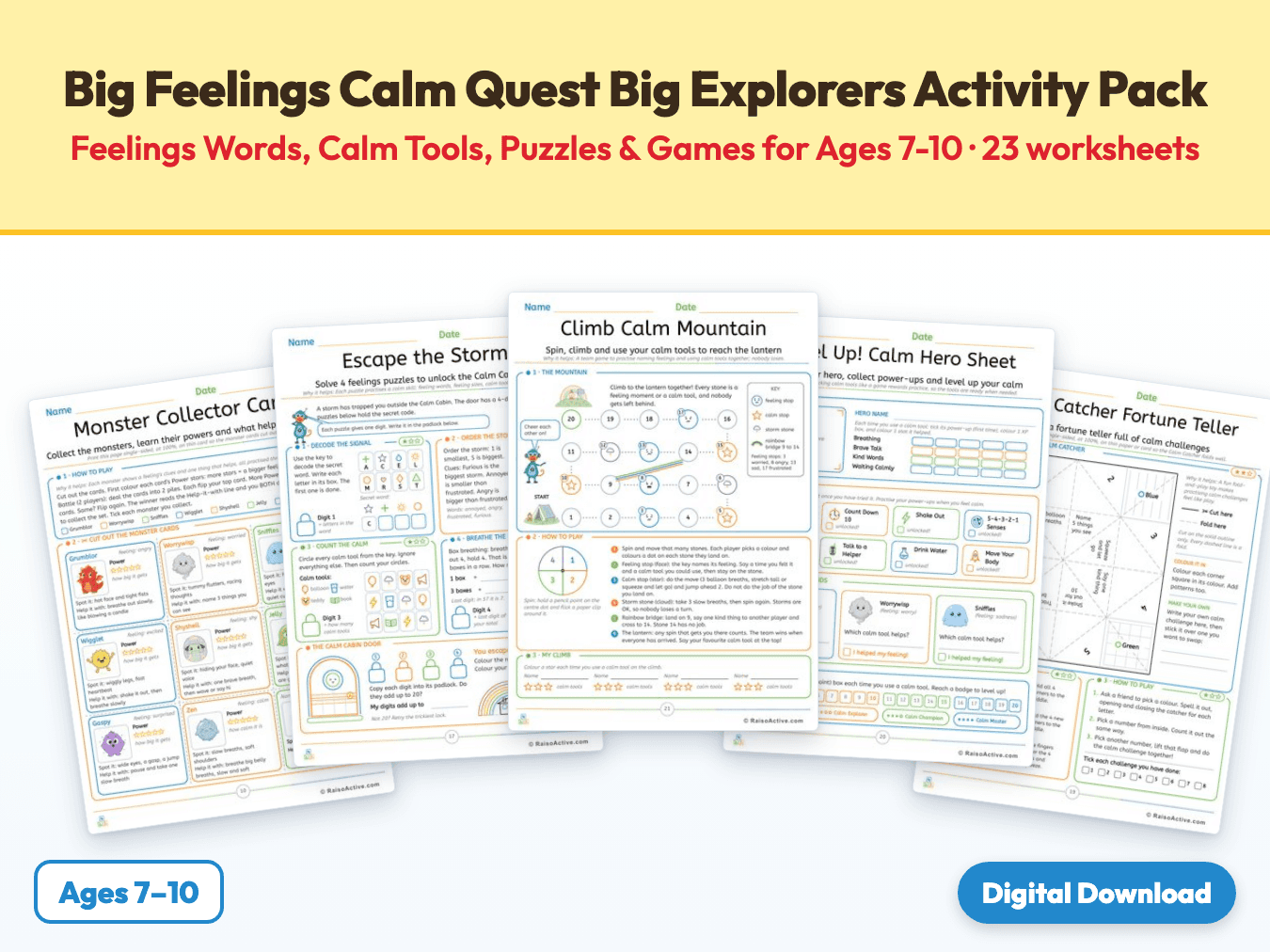
Part of the pack
Big Feelings Calm Quest Big Explorers Activity Pack: Feelings Words, Calm Tools, Puzzles & Games for Ages 7-10
This is page 5 of the pack. Ages 7-10 · Grade 2–Grade 3Ages 7-10 · Year 3–Year 4Ages 7-10 · Class 2–Class 3Ages 7-10
How to use this worksheet
Match each potion to its moment, then invent your own. Read Leo's day, plot a dot for each time on the 1 to 5 scale and join the dots. Answer the two explain-it questions.
Materials needed
- Pencil
- Crayons
Extension activities
- 1Plot your own day on a feelings line.
- 2Invent a third potion with two new feelings.

Written by
Hemsweta Jain · Teacher Cheena
MBA and Early Childhood Educator, teaching since 2014 · Founder of RaisoActive, Mumbai
Every RaisoActive worksheet is designed and checked by the founder before publishing.
Published · Last reviewed
More from Big Feelings Calm Quest Big Explorers Activity Pack: Feelings Words, Calm Tools, Puzzles & Games for Ages 7-10

Feelings Word Search and Secret Code: Find Ten Words and Crack the Calm Code
Ages 7-10 · Grade 2–Grade 3Ages 7-10 · Year 3–Year 4Ages 7-10 · Class 2–Class 3Ages 7-10
Children find ten feeling words (across, down and diagonal) in a grid, use a symbol key to decode a calm message, and write their own message in code.

Feelings Monsters Collector Cards: Cut-Out Monster Cards and Monster Snap
Ages 7-10 · Grade 2–Grade 3Ages 7-10 · Year 3–Year 4Ages 7-10 · Class 2–Class 3Ages 7-10
Children collect eight monster cards, each showing a feeling, how to spot it and how to help it. They colour Power stars for how big each feeling gets for them, play Monster Snap and design their own monster.

Breathe Lab: Box and Lazy-8 Breathing and a Heartbeat Experiment
Ages 7-10 · Grade 2–Grade 3Ages 7-10 · Year 3–Year 4Ages 7-10 · Class 2–Class 3Ages 7-10
Children trace box and lazy-8 breathing shapes, then run a simple experiment: predict, count pulse beats for 15 seconds, multiply by 4 and compare resting, after star jumps and after slow breathing. They fill in a bar chart.

Big Feelings Calm Quest Answer Key for Grown-Ups
Ages 7-10 · Grade 2–Grade 3Ages 7-10 · Year 3–Year 4Ages 7-10 · Class 2–Class 3Ages 7-10
A page-by-page answer key for the Big Feelings Calm Quest pack, including the logic puzzle, escape room digits, word search positions and the calm code, with notes on open pages.

Name That Feeling: Match Meanings, Sort Feeling Families and Pick the Best Word
Ages 7-10 · Grade 2–Grade 3Ages 7-10 · Year 3–Year 4Ages 7-10 · Class 2–Class 3Ages 7-10
Children match words such as proud, nervous and embarrassed to their meanings, sort eleven words into three feeling families, and choose the best feeling word for four short moments.

Escape the Storm! A Feelings Escape Room Puzzle Worksheet
Ages 7-10 · Grade 2–Grade 3Ages 7-10 · Year 3–Year 4Ages 7-10 · Class 2–Class 3Ages 7-10
Children solve four mini puzzles (a picture code, ordering by size, counting calm tools and box breathing arithmetic) to get four digits, then check that the digits add up to 20.

Body Clues and Triggers: Spot the Early Warning Signs Before a Feeling Gets Big
Ages 7-10 · Grade 2–Grade 3Ages 7-10 · Year 3–Year 4Ages 7-10 · Class 2–Class 3Ages 7-10
Children label body clues (racing heart, hot face, tight fists, butterflies, tears, shaky legs), tick the feeling six situations might give them, and list their own early warning signs for anger.

5-4-3-2-1 Senses Hunt: A Calm Grounding Game with a Picture and Your Room
Ages 7-10 · Grade 2–Grade 3Ages 7-10 · Year 3–Year 4Ages 7-10 · Class 2–Class 3Ages 7-10
Children practise a simple 5-4-3-2-1 senses game: five things to see, four to touch, three to hear, two to smell and one to taste. They try it first in a picture, then in their own room, and notice how they feel.
Related worksheets

Feelings Faces Worksheet: Match, Trace and Circle the Happy Faces
Ages 4-6 · Pre-K–KindergartenAges 4-6 · Reception–Year 1Ages 4-6 · LKG–UKGAges 4-6
Children link everyday moments (bubbles, ice cream, blocks, a storm, a gift) to the face that shows the feeling, trace four feelings words and count happy faces.
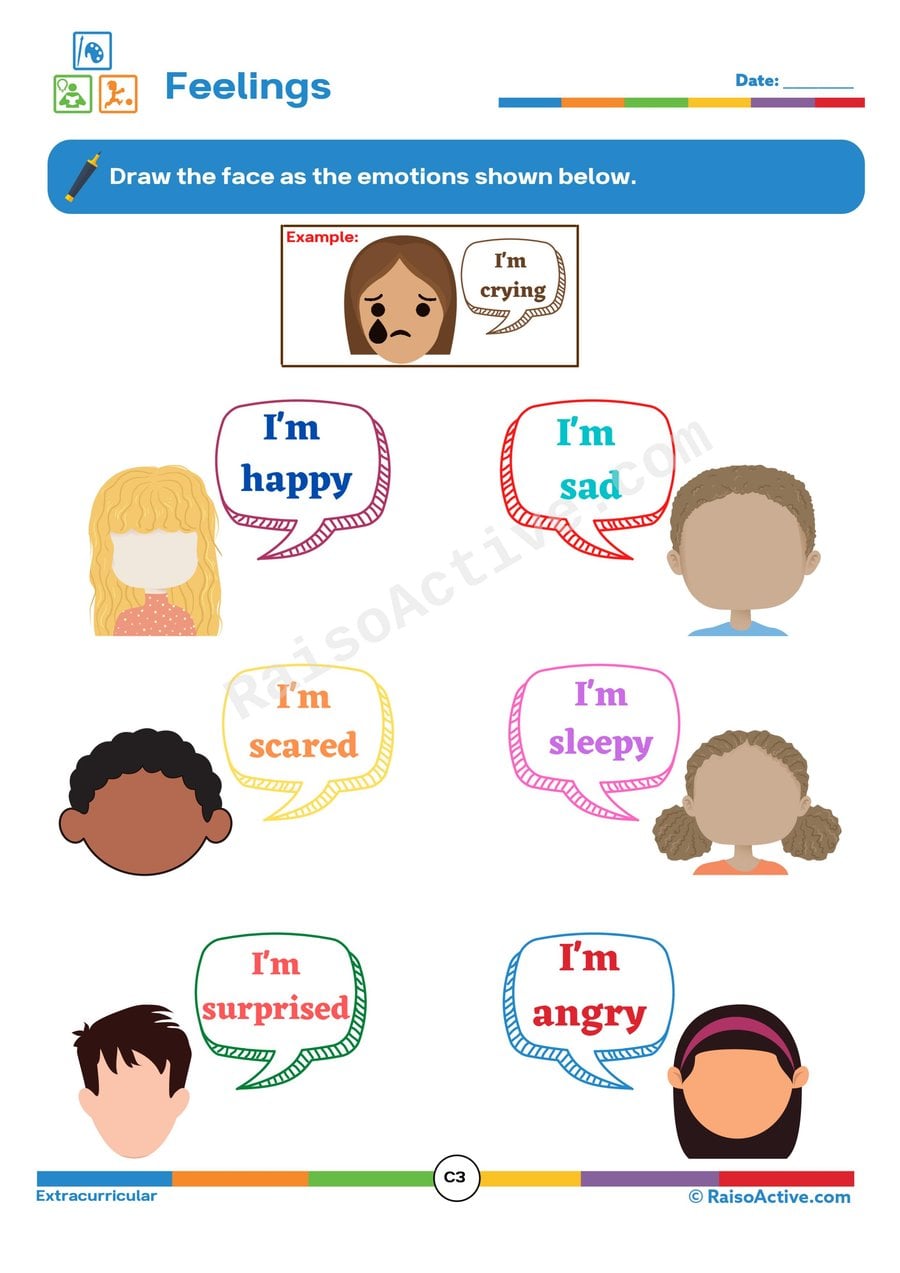
Feelings Worksheet: Draw the Faces!
Ages 3-5 · Preschool–Pre-KAges 3-5 · Nursery–ReceptionAges 3-5 · Nursery–LKGAges 3-5
This worksheet builds emotional literacy by having children draw a face expressing a specific feeling named in a word bubble, such as happy, sad, angry, or surprised. For three- to five-year-olds, practicing how to represent an emotion visually helps them build the vocabulary and self-awareness needed to name and talk about their own feelings, a key early social-emotional skill.

Vijayadashami Challenge: Vidyarambham, Dussehra and Calendar Maths
Ages 7-11 · Grade 2–Grade 3Ages 7-11 · Year 3–Year 4Ages 7-11 · Class 2–Class 3Ages 7-11
Children read about Saraswati, Vidyarambham and Dussehra. They time themselves writing letters in a rice tray and draw a bar chart, plan reading a 60-page book with division, remainders and calendar dates, and multiply and use fractions with Ravana figures.

Parent's Guide: Fun Activities for Gross Motor Development and Emotional Learning
Ages 3-5 · Preschool–Pre-KAges 3-5 · Nursery–ReceptionAges 3-5 · Nursery–LKGAges 3-5
This parent guide equips caregivers of children ages 3-5 with activities spanning gross motor skills, emotional expression, family concepts, shape recognition, and calendar awareness, using role play, finger puppets, and simple games. Combining physical movement with emotional vocabulary practice, such as making different facial expressions, helps children build body awareness and feelings vocabulary side by side. Rotating through several distinct activity types in one guide also keeps a young child's attention across a longer play session.

Navratri Mix and Pattern: Mixing Colours and Bead Patterns
Ages 4-6 · Pre-K–KindergartenAges 4-6 · Reception–Year 1Ages 4-6 · LKG–UKGAges 4-6
Children learn which two colours mix to make green, orange, purple and grey, continue colour patterns on beads and read a simple chart to answer questions.

Pinwheel Breathing Buddy: Make a Pinwheel and Spin It with Slow Breaths
Ages 4-6 · Pre-K–KindergartenAges 4-6 · Reception–Year 1Ages 4-6 · LKG–UKGAges 4-6
Children colour and build a pinwheel, then use it to feel the difference between fast and slow breaths. Three breath games ask which breath spins it smoothly and how they feel after.

Kai and the Stuck Kite: A Feelings Story with a Pull-Tab Slider
Ages 4-6 · Pre-K–KindergartenAges 4-6 · Reception–Year 1Ages 4-6 · LKG–UKGAges 4-6
Children listen to a short story where Kai feels sad, then angry, then calm after balloon breaths, and finally happy. They answer at their own level and build a feelings slider.

My Pocket Calm Book: A Mini Book of Six Calm Tools
Ages 4-6 · Pre-K–KindergartenAges 4-6 · Reception–Year 1Ages 4-6 · LKG–UKGAges 4-6
Children make a pocket-sized book with six calm tools: balloon breath, flower and candle, turtle pause, squeeze and let go, shake it out, and hug and talk. They tick 'I tried it!' as they practise.
Guides for this topic

Resources for Children with Multiple Disabilities: A Comprehensive Guide for Families
Discover essential resources for children with multiple disabilities. Therapies, inclusive learning, assistive technology, and printable activities for ages 1-8.
Understanding Standardized Testing in Early Childhood: A Parent's Guide to Assessment Balance
Learn how standardised tests work in early childhood, when they help, when they harm, and how to balance formal assessment with observation-based learning.
Addressing Mental Health with Young Children: A Compassionate Guide for Families
Learn how to support your young child's mental health with compassionate strategies. Recognise signs, build emotional resilience, and know when to seek professional help.
Reviews
Every worksheet for ages 7–10, no watermark
Members download the full library of 1,000+ worksheets and every activity pack without watermarks or daily limits. One year costs ₹999 in India or $20 elsewhere.
See membership plansOr download any worksheet free with a watermark (5 a day).