Long or Short Vowel e Cut and Paste Sort Worksheet
Children sort 20 picture-word cards by the e sound. Long e: bee, he, emu, key, piece, sheep, beat, queen. Short e: said, tell, many, pen, bell, thread, bread, hen, egg, bed, net, den.
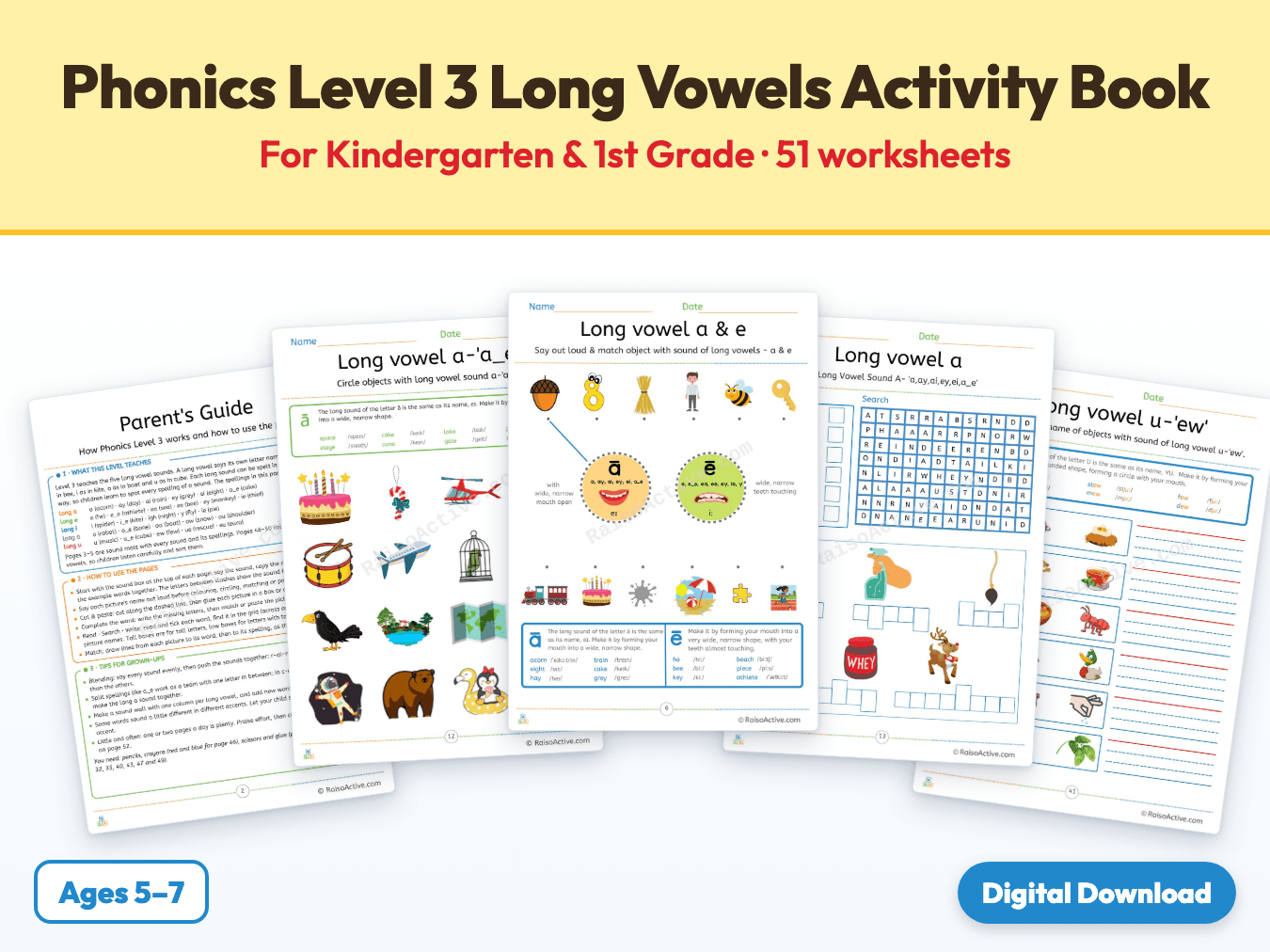
Part of the pack
Phonics Level 3 Long Vowels Activity Book for Kindergarten & 1st Grade
This is page 47 of the pack. Ages 5-7 · Kindergarten–Grade 1Ages 5-7 · Year 1–Year 2Ages 5-7 · UKG–Class 1Ages 5-7
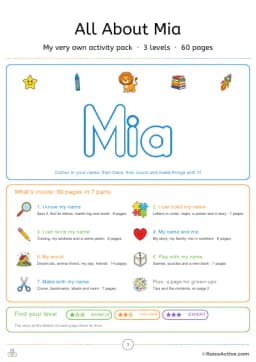
Made for your child
A whole activity pack made with their name
60 pages to spot, build, trace and write their own name, plus pages about their favourites, feelings and family. See a free preview with their name.
Make an All About Me packFree preview · free for members
Or start free: a name tracing sheet with their nameCurriculum
- Phonics - Long Vowels > Long Vowel E
- Phonics - Letter Sounds > Short Vowel Sounds
How to use this worksheet
Read the rule boxes. Cut out the cards along the dashed lines, read each word aloud and glue it into the Long Vowel or Short Vowel box.
Materials needed
- Scissors
- Glue stick
- Pencil
Extension activities
- 1Sort the short e words by spelling (e, ea, ai, a)
- 2Say a sentence with one long and one short e word

Written by
Hemsweta Jain · Teacher Cheena
MBA and Early Childhood Educator, teaching since 2014 · Founder of RaisoActive, Mumbai
Every RaisoActive worksheet is designed and checked by the founder before publishing.
Published · Last reviewed
More from Phonics Level 3 Long Vowels Activity Book for Kindergarten & 1st Grade
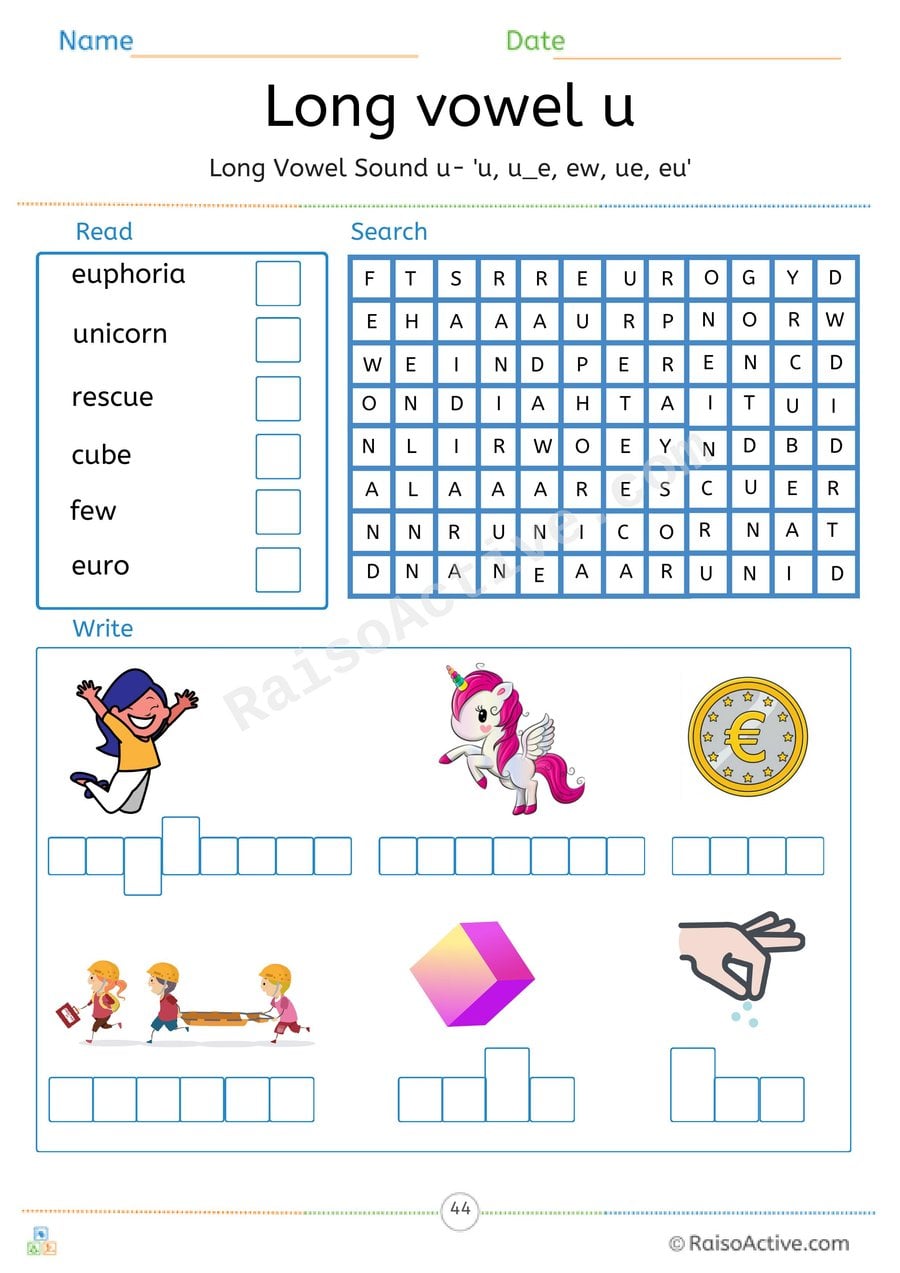
Long Vowel u Read, Search and Write Worksheet
Ages 5-7 · Kindergarten–Grade 1Ages 5-7 · Year 1–Year 2Ages 5-7 · UKG–Class 1Ages 5-7
Children review long u spellings (u, u_e, ew, ue, eu) by reading, finding and writing the words euphoria, unicorn, rescue, cube, few and euro.

Long Vowel a Say and Colour Worksheet
Ages 5-7 · Kindergarten–Grade 1Ages 5-7 · Year 1–Year 2Ages 5-7 · UKG–Class 1Ages 5-7
Children listen for the long a sound, which says its own letter name, and colour only the pictures that have it: paper, acorn, lady, radio, table and baby.

Long Vowel o 'oa' Circle and Write Worksheet
Ages 5-7 · Kindergarten–Grade 1Ages 5-7 · Year 1–Year 2Ages 5-7 · UKG–Class 1Ages 5-7
Children spot the long o 'oa' word in each row of three pictures, then spell it: boat, goat, loaf, toast, soap and road.

Long Vowel e Spellings Match Worksheet: e, e_e, ea, ee, ey, ie
Ages 5-7 · Kindergarten–Grade 1Ages 5-7 · Year 1–Year 2Ages 5-7 · UKG–Class 1Ages 5-7
Children link each picture to its word and then to its long e spelling (Egypt: e; athlete: e_e; jeans: ea; cheese: ee; honey: ey; thief: ie).

Long Vowel a 'ei' Complete the Word and Paste Worksheet
Ages 5-7 · Kindergarten–Grade 1Ages 5-7 · Year 1–Year 2Ages 5-7 · UKG–Class 1Ages 5-7
Children write the missing 'ei' letters to finish six long a words (eight, reindeer, weight, veil, sleigh and neigh) and paste the matching picture above each word.

Long or Short Vowel a Colour Sort Worksheet
Ages 5-7 · Kindergarten–Grade 1Ages 5-7 · Year 1–Year 2Ages 5-7 · UKG–Class 1Ages 5-7
Children decide whether each word has a long a (says its name, as in rain and cake) or a short a (as in cat). Long: acorn, baby, train, play, grey, reign, plane. Short: bat, hat.

Long Vowel u Spellings Match Worksheet: u, u_e, ew, ue, eu
Ages 5-7 · Kindergarten–Grade 1Ages 5-7 · Year 1–Year 2Ages 5-7 · UKG–Class 1Ages 5-7
Children link each picture to its word and then to its long u spelling (eucalyptus: eu; mule: u_e; cucumber: u; statue: ue; news: ew; tissue: ue). One spelling, ue, is used twice.
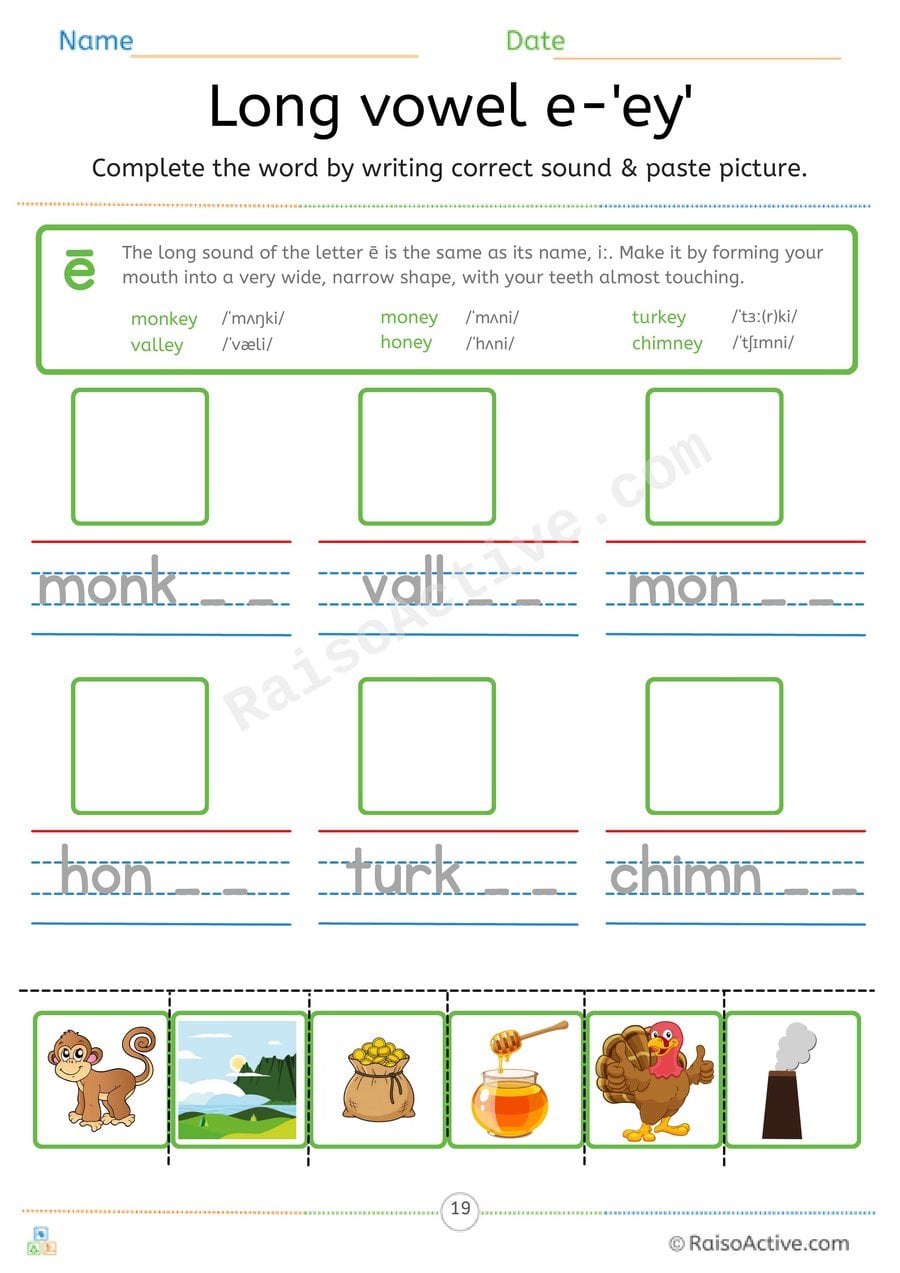
Long Vowel e 'ey' Complete the Word and Paste Worksheet
Ages 5-7 · Kindergarten–Grade 1Ages 5-7 · Year 1–Year 2Ages 5-7 · UKG–Class 1Ages 5-7
Children write the missing 'ey' letters to finish six long e words (monkey, valley, money, honey, turkey and chimney) and paste the matching picture above each word.
Related worksheets
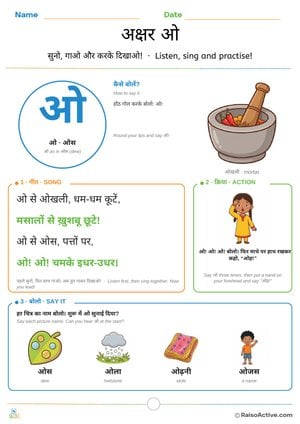
Hindi Letter ओ (o) Song and Action Worksheet | अक्षर ओ गीत और क्रिया
Ages 3-7 · Preschool–Grade 1Ages 3-7 · Nursery–Year 2Ages 3-7 · Nursery–Class 1Ages 3-7
Children meet the Hindi vowel ओ (o) through a four-line song, a body action and picture words such as ओखली, ओस, ओला, ओढ़नी and ओजस. Hearing, saying and moving together helps the sound stick before any writing begins.
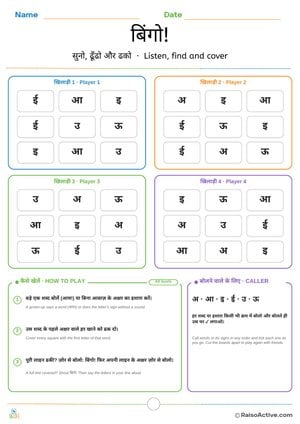
Hindi Vowels Bingo: Listen, Find and Cover (अ आ इ ई उ ऊ) | बिंगो!
Ages 3-7 · Preschool–Grade 1Ages 3-7 · Nursery–Year 2Ages 3-7 · Nursery–Class 1Ages 3-7
Four 3×3 bingo boards with the six vowels. The caller says a word (like आम) or a sound without showing it, and players find the first letter and cover it. A full line wins and the player shouts बिंगो!
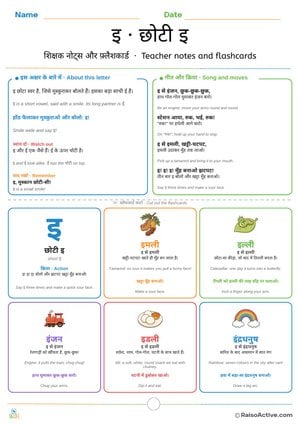
Hindi Letter इ (i) Teacher Notes and Flashcards | इ · छोटी इ
Ages 3-7 · Preschool–Grade 1Ages 3-7 · Nursery–Year 2Ages 3-7 · Nursery–Class 1Ages 3-7
Children meet the short vowel इ with a short note for adults, a song with actions and cut-out flashcards for इमली (tamarind), इल्ली (caterpillar), इंजन (engine), इडली (idli), इंद्रधनुष (rainbow). They hear the sound at the start of real words and link it to a hand action.
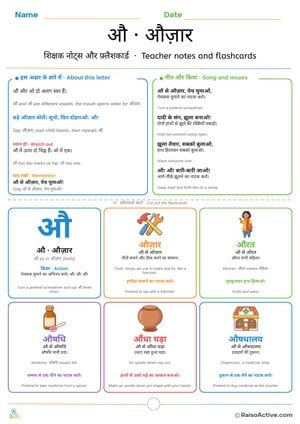
Hindi Letter औ (au) Teacher Notes and Flashcards | औ शिक्षक नोट्स और फ़्लैशकार्ड
Ages 3-7 · Preschool–Grade 1Ages 3-7 · Nursery–Year 2Ages 3-7 · Nursery–Class 1Ages 3-7
Teacher notes and six cut-out flashcards for औ (au) with the words औज़ार, औरत, औषधि, औंधा घड़ा and औषधालय. Each card has a sentence and a small action, and the page ends with a short song to sing and move to.
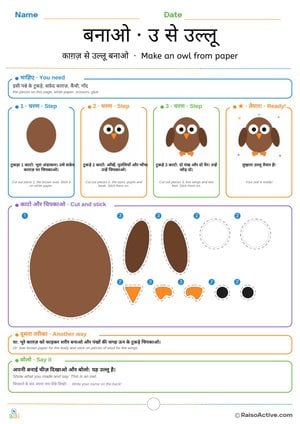
Make a Paper Owl: Hindi Letter उ Craft | बनाओ · उ से उल्लू
Ages 3-7 · Preschool–Grade 1Ages 3-7 · Nursery–Year 2Ages 3-7 · Nursery–Class 1Ages 3-7
Children cut out the pieces, put them together following three step pictures and make a paper owl. Saying the word उल्लू as they make it links the sound उ to something they built themselves.
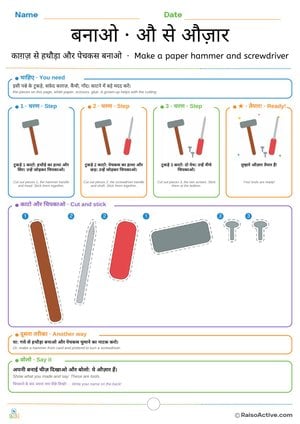
Make a Paper Hammer and Screwdriver: Hindi Letter औ (au) Cut and Stick Craft | बनाओ · औ से औज़ार
Ages 4-7 · Pre-K–Grade 1Ages 4-7 · Reception–Year 2Ages 4-7 · LKG–Class 1Ages 4-7
Children cut out the numbered pieces and stick them in order to make a hammer and a screwdriver with two screws, then show it and say a full sentence about it. It links the letter औ with a real picture word, औज़ार (tools), and practises scissor control and following steps.
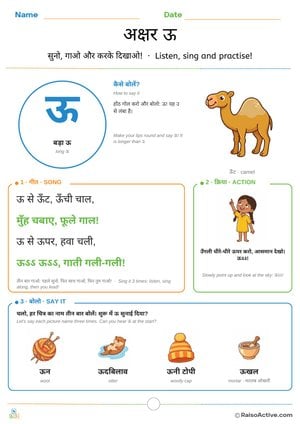
Hindi Letter ऊ (oo) Song, Action and Say It | अक्षर ऊ
Ages 3-7 · Preschool–Grade 1Ages 3-7 · Nursery–Year 2Ages 3-7 · Nursery–Class 1Ages 3-7
Children hear and say the long vowel ऊ, learn a short rhyme with an action, and say the names of the picture words ऊँट (camel), ऊन (wool), ऊनी टोपी (woolly cap), ऊदबिलाव (otter), ऊखल (mortar) to practise hearing ऊ at the start.

Logic Grid Puzzle for Kids: Sort by Two Rules
Ages 4-7 · Pre-K–Grade 1Ages 4-7 · Reception–Year 2Ages 4-7 · LKG–Class 1Ages 4-7
Children sort eight numbered objects by two rules at once (big or small, striped or plain) and then use clues in a simple logic grid to work out which child has which pet. This builds classification and deductive reasoning.
Guides for this topic

How to Teach CVC Blending: A Step-by-Step Method That Works in Two Weeks
A step-by-step method for teaching CVC blending, covering continuous sounds, word families, common errors, and a 14-day plan that most children finish reading CVC words.
Phase 2 Phonics at Home: Sound Order, Blending Games, Worksheets
Phase 2 phonics at home: the five sound sets in order, oral blending, tricky words, a two-week routine, common mistakes, and free worksheets.

Reception Year Explained: EYFS Learning and How to Help at Home
A teacher's plain-English guide to the Reception Year: the seven areas of learning, Early Learning Goals, Phase 2/3 phonics, the RBA and home routines.
Reviews
Every worksheet for ages 5–7, no watermark
Members download the full library of 1,000+ worksheets and every activity pack without watermarks or daily limits. One year costs ₹999 in India or $20 elsewhere.
See membership plansOr download any worksheet free with a watermark (5 a day).