Dandiya Dash: Navratri Board Game for Kids
Ages 4-6 · Pre-K–KindergartenAges 4-6 · Reception–Year 1Ages 4-6 · LKG–UKGAges 4-6
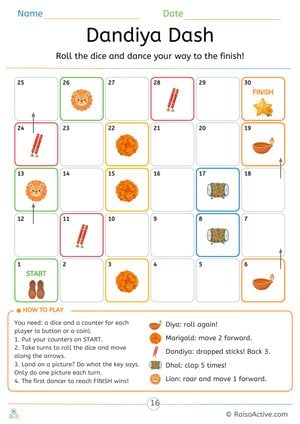
Children count dots on a dice, count on along a number track to 30, take turns and follow simple game rules.
Free printable worksheets
Download free educational worksheets for children ages 2–8. Perfect for preschool, kindergarten, and early elementary learning activities.
Subscribe to get unlimited access to all worksheets without watermarks
View Subscription Plans289 topics match
23 worksheetsof 1,994
Ages 4-6 · Pre-K–KindergartenAges 4-6 · Reception–Year 1Ages 4-6 · LKG–UKGAges 4-6
Children count dots on a dice, count on along a number track to 30, take turns and follow simple game rules.
Ages 4-5 · Pre-KAges 4-5 · ReceptionAges 4-5 · LKGAges 4-5
Circling vowels within a word and sorting letters into 'vowels' and 'consonants' columns builds foundational phonics knowledge for children ages 4-5, an essential distinction for later decoding and spelling.
Ages 3-5 · Preschool–Pre-KAges 3-5 · Nursery–ReceptionAges 3-5 · Nursery–LKGAges 3-5
This multi-activity guide introduces children ages 3-5 to blend words, simple story reading, and hands-on science experiments like making a chocolate shake and testing dissolving, all in one session. Moving between literacy and science tasks builds flexible thinking and shows children that reading and hands-on exploration are connected, reinforcing that new vocabulary can describe real, observable experiments.
Ages 3-5 · Preschool–Pre-KAges 3-5 · Nursery–ReceptionAges 3-5 · Nursery–LKGAges 3-5
This worksheet builds recognition and formation of the letter Y through guided tracing practice and by identifying pictures of words that start with Y, like 'yarn' or 'yo-yo.' For three- to five-year-olds, tracing first with a finger and then with a pencil builds the motor memory needed before a child can form the letter confidently on their own.
Ages 3-5 · Preschool–Pre-KAges 3-5 · Nursery–ReceptionAges 3-5 · Nursery–LKGAges 3-5
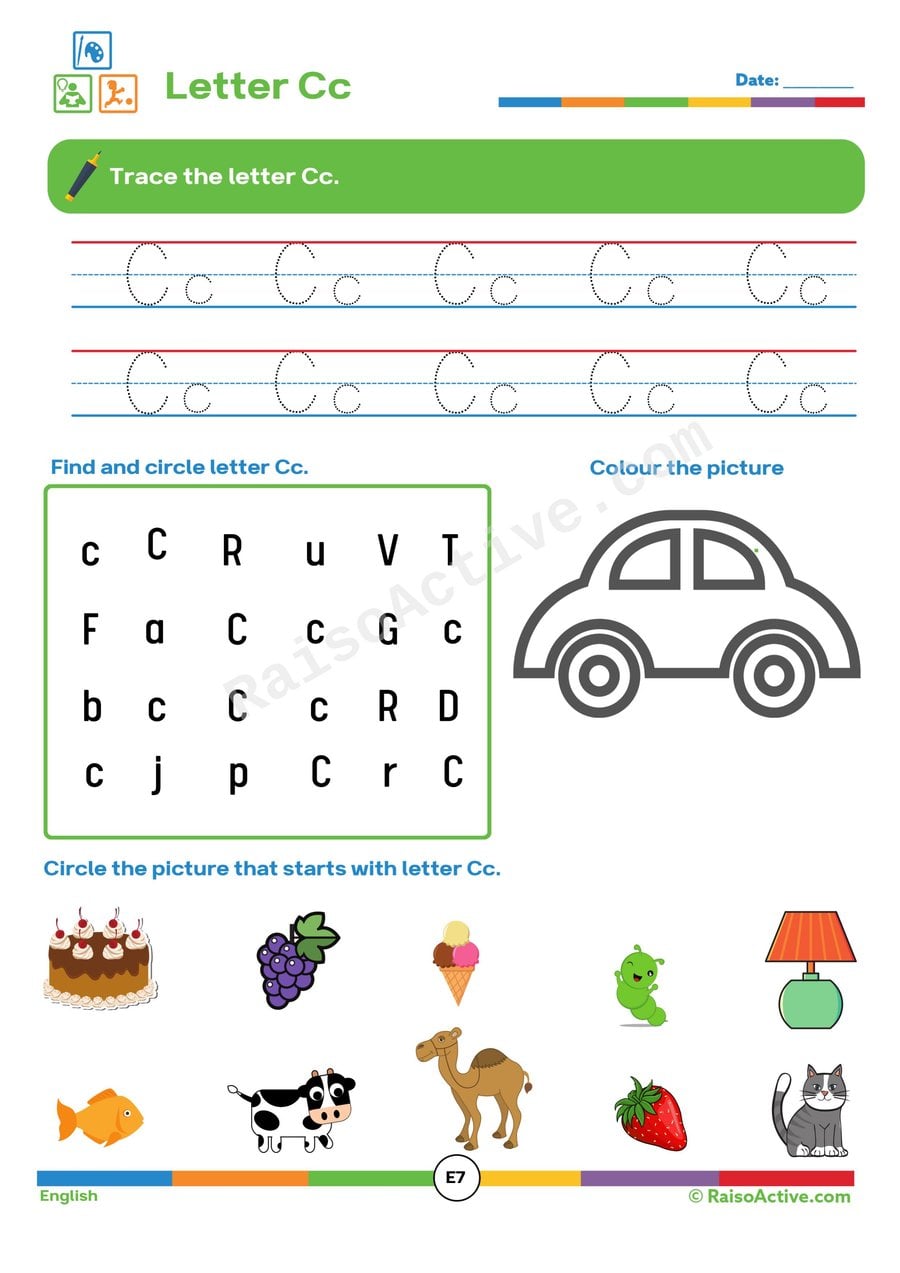
This worksheet has children ages 3-5 trace the letter Cc, search a grid to find and circle every instance of it, then color a picture of a car and identify other pictures that start with C. Layering tracing, visual search, and picture-sound matching in one worksheet gives repeated exposure to the same letter in several different formats, which builds stronger recognition than any single task alone.
Ages 4-6 · Pre-K–KindergartenAges 4-6 · Reception–Year 1Ages 4-6 · LKG–UKGAges 4-6
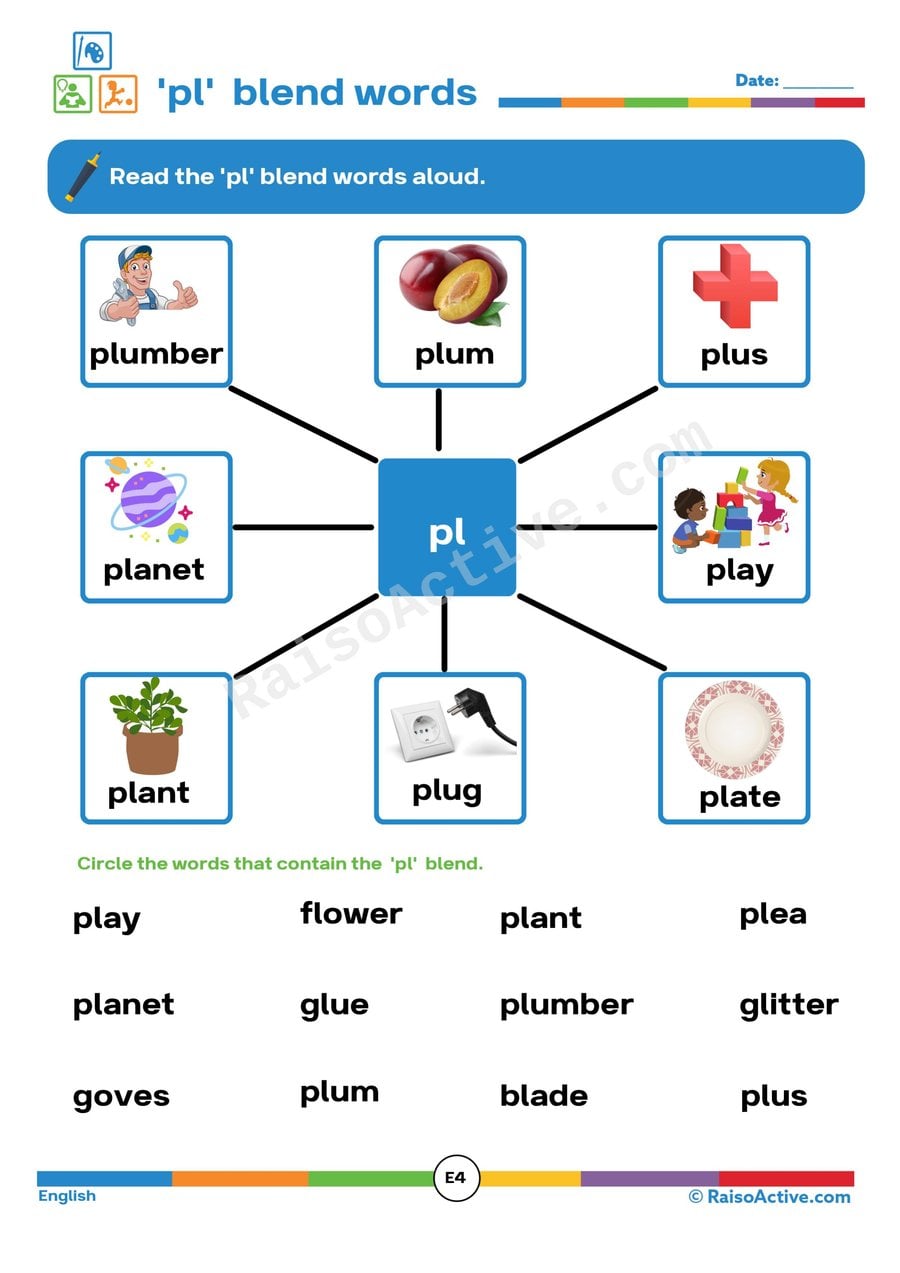
This worksheet targets the 'pl' consonant blend, helping children recognize and read words like 'play,' 'plane,' and 'plant' where two consonant sounds combine at the start of a word. For ages 4-6, mastering blends is a key phonics milestone that comes after single letter sounds, since blending two consonants together requires more advanced sound segmentation skills.
Ages 4-6 · Pre-K–KindergartenAges 4-6 · Reception–Year 1Ages 4-6 · LKG–UKGAges 4-6
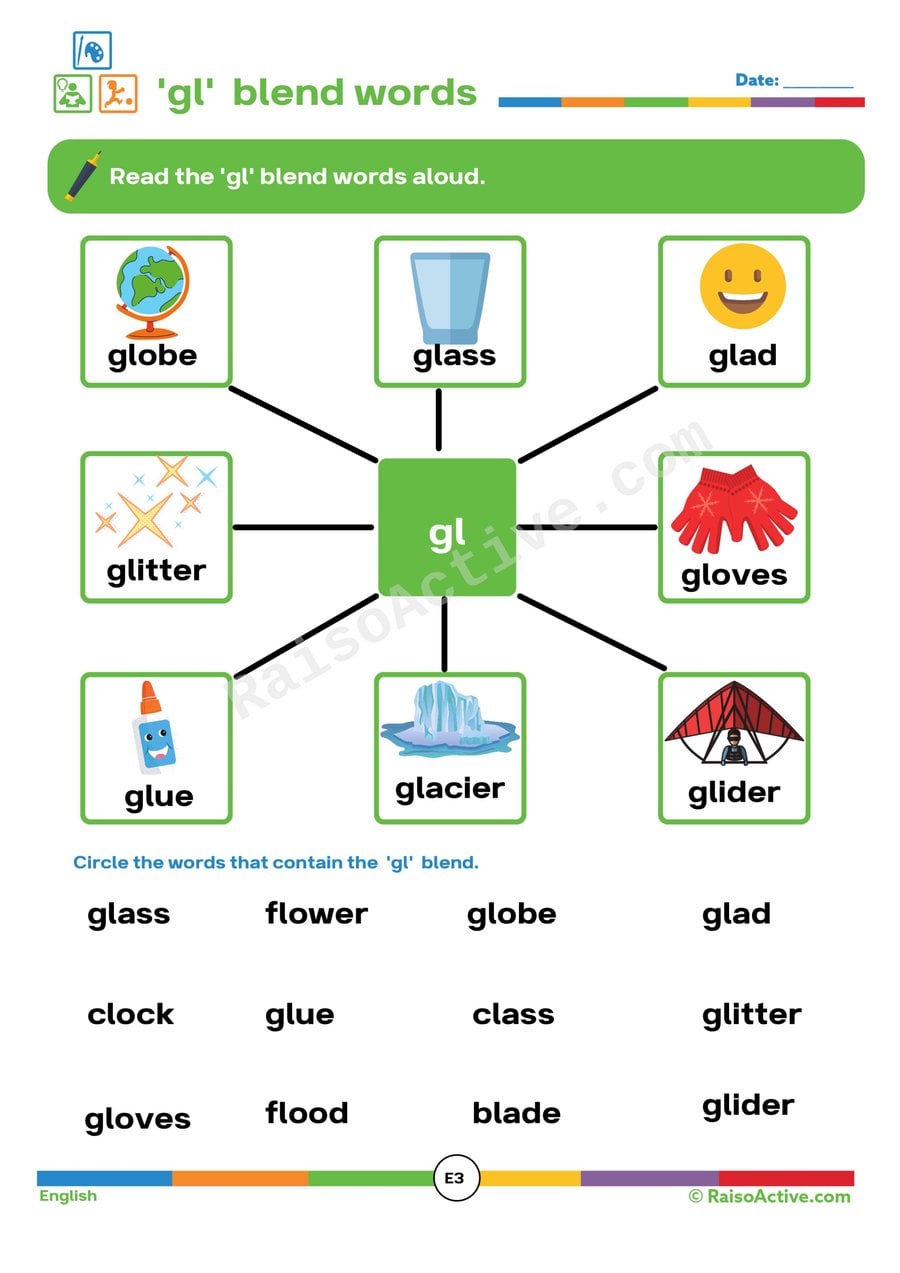
This worksheet builds phonics skills around the 'gl' consonant blend, helping children recognize and read words like 'glass,' 'glue,' and 'glow' where the sounds of g and l combine at the start of a word. For ages 4-6, practicing blends like gl strengthens the sound-segmentation skills needed to decode increasingly complex words as reading develops.
Ages 3-5 · Preschool–Pre-KAges 3-5 · Nursery–ReceptionAges 3-5 · Nursery–LKGAges 3-5
This worksheet trains children to hear and recognize the 'br' consonant blend at the start of words like 'bread' or 'brush,' building on single-letter phonics toward the more complex blended sounds that make up much of early reading vocabulary. For ages three to five, matching a read word to its picture also reinforces that written letters correspond to real, specific meanings rather than abstract symbols.
Ages 4-6 · Pre-K–KindergartenAges 4-6 · Reception–Year 1Ages 4-6 · LKG–UKGAges 4-6
This worksheet builds beginning-sound recognition for children ages 4-6 with the letters 'y' and 'z', two consonants that appear less frequently at the start of common words, giving children practice with sounds they may hear less often than 's', 't', or 'm'. Matching each picture to its correct starting letter reinforces the sound-symbol connection while also expanding vocabulary, since words like 'yarn' or 'zebra' may be less familiar to young learners. This rounds out a child's coverage of consonant sounds toward full alphabet mastery.
Ages 3-5 · Preschool–Pre-KAges 3-5 · Nursery–ReceptionAges 3-5 · Nursery–LKGAges 3-5
This worksheet helps children ages 3-5 tell apart the 'v' and 'w' sounds, two consonants that can sound similar to a young ear, by matching pictures to the correct starting letter. Because 'v' and 'w' involve different mouth and teeth positions (top teeth touching bottom lip for 'v', rounded lips for 'w'), this practice trains children to listen closely rather than guess. Matching, rather than writing, keeps the focus on the auditory skill for children who are still developing letter-writing control.
Ages 4-6 · Pre-K–KindergartenAges 4-6 · Reception–Year 1Ages 4-6 · LKG–UKGAges 4-6
Distinguishing between 'l' and 'r' is one of the trickier auditory discriminations in early phonics, since the two sounds are formed with similar tongue positions and are frequently confused by young English learners. This worksheet gives children ages 4-6 focused practice listening for the difference at the start of familiar object names, then matching each picture to its correct consonant. Strengthening this specific sound contrast supports both clearer speech and more accurate spelling later on.
Ages 4-6 · Pre-K–KindergartenAges 4-6 · Reception–Year 1Ages 4-6 · LKG–UKGAges 4-6
The letters J and K are frequently mixed up by children ages 4-6 because both are less common consonants that don't appear in as many early words as letters like S or T, so this worksheet gives them focused, repeated practice distinguishing the two sounds. Matching each letter to a picture that starts with its sound builds the letter-sound association needed before a child can spell or read J and K words confidently. This kind of targeted practice on less-frequent letters fills a gap that broader phonics worksheets often skip over.