Navratri Festival Quest Certificate of Achievement
Ages 7-11 · Grade 2–Grade 3Ages 7-11 · Year 3–Year 4Ages 7-11 · Class 2–Class 3Ages 7-11
Children celebrate finishing the Navratri Festival Quest pack and record which levels they completed.
Free printable worksheets
Download free educational worksheets for children ages 2–8. Perfect for preschool, kindergarten, and early elementary learning activities.
Subscribe to get unlimited access to all worksheets without watermarks
View Subscription Plans289 topics match
34 worksheetsof 1,994
Ages 7-11 · Grade 2–Grade 3Ages 7-11 · Year 3–Year 4Ages 7-11 · Class 2–Class 3Ages 7-11
Children celebrate finishing the Navratri Festival Quest pack and record which levels they completed.
Ages 4-6 · Pre-K–KindergartenAges 4-6 · Reception–Year 1Ages 4-6 · LKG–UKGAges 4-6
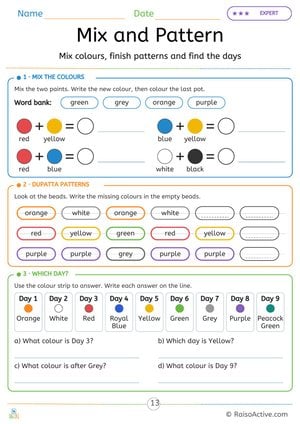
Children learn which two colours mix to make green, orange, purple and grey, continue colour patterns on beads and read a simple chart to answer questions.
Ages 4-6 · Pre-K–KindergartenAges 4-6 · Reception–Year 1Ages 4-6 · LKG–UKGAges 4-6
Children celebrate finishing the Navratri Fun Time pages and see which levels they completed.
Ages 3-5 · Preschool–Pre-KAges 3-5 · Nursery–ReceptionAges 3-5 · Nursery–LKGAges 3-5
By comparing clothing items and connecting each one to its pattern match, children ages 3-5 build visual discrimination skills, learning to notice fine differences in stripes, dots, or repeated shapes. This close-looking practice supports the same attention-to-detail children will later need to tell similar-looking letters and numbers apart.
Ages 3-5 · Preschool–Pre-KAges 3-5 · Nursery–ReceptionAges 3-5 · Nursery–LKGAges 3-5
This worksheet strengthens pattern recognition in children ages 3-5 by having them study a repeating sequence of colored balloons and locate the matching arrangement elsewhere on the page. Recognizing and reproducing a pattern is an early pre-algebra skill, laying groundwork for later number patterns and logical sequencing.
Ages 3-5 · Preschool–Pre-KAges 3-5 · Nursery–ReceptionAges 3-5 · Nursery–LKGAges 3-5
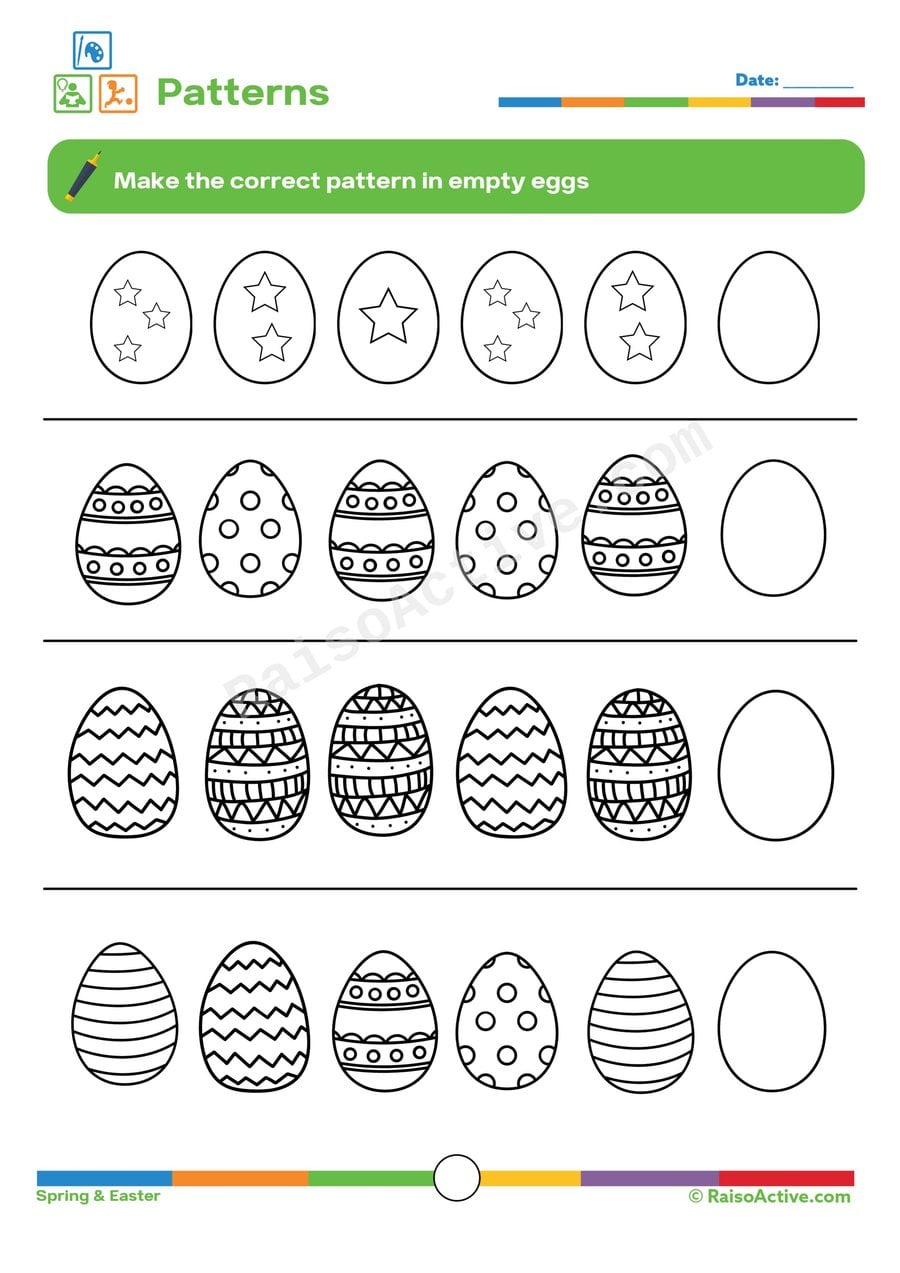
This worksheet asks children ages 3-5 to study a sequence of patterned Easter eggs and figure out what design should come next, then draw it into the empty egg themselves. Predicting and completing a pattern, rather than just matching an existing one, pushes children a step further into the kind of what-comes-next reasoning that underlies early math and logic.
Ages 3-5 · Preschool–Pre-KAges 3-5 · Nursery–ReceptionAges 3-5 · Nursery–LKGAges 3-5
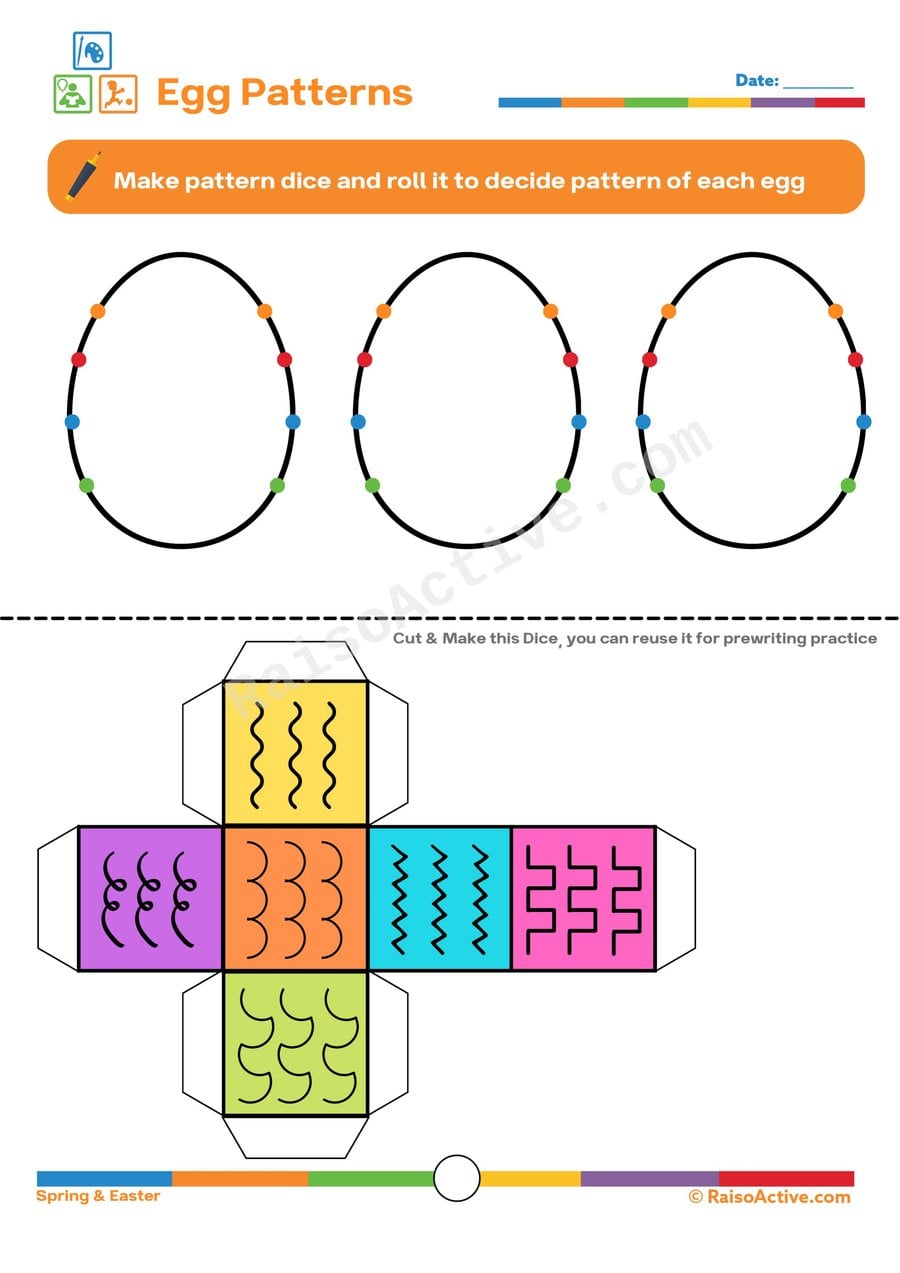
This egg-pattern activity has children ages 3-5 build a simple pattern dice and use it to generate and recreate repeating designs, developing pattern-recognition skills that underpin later math concepts like sequencing and multiplication. Rolling the dice and transferring the result onto each egg also connects a random outcome to a deliberate drawing action, strengthening cause-and-effect thinking.
Ages 3-5 · Preschool–Pre-KAges 3-5 · Nursery–ReceptionAges 3-5 · Nursery–LKGAges 3-5
This worksheet has children ages 3-5 study a repeating pattern shown across a set of bunny, basket, and egg images, then identify which item on the right continues or matches that same pattern. Recognizing a pattern by its color or design sequence builds early algebraic thinking, since spotting what comes next is a skill children will rely on throughout math.
Ages 3-5 · Preschool–Pre-KAges 3-5 · Nursery–ReceptionAges 3-5 · Nursery–LKGAges 3-5
This worksheet builds pattern recognition and fine motor drawing skills in children ages 3-5 as they study a sequence of pumpkin faces and draw the missing face to complete each pattern. Unlike matching or pasting, drawing the answer requires children to actively recall and reproduce the pattern rather than simply selecting from options, which deepens their understanding.
Ages 3-5 · Preschool–Pre-KAges 3-5 · Nursery–ReceptionAges 3-5 · Nursery–LKGAges 3-5
Children ages 3-5 build pattern recognition and logical reasoning skills by matching colored fall leaves to complete repeating patterns in a grid. Recognizing and continuing a pattern is an early algebraic thinking skill, teaching children to notice what comes next based on a repeating sequence — a foundation for later math concepts.
Ages 3-5 · Preschool–Pre-KAges 3-5 · Nursery–ReceptionAges 3-5 · Nursery–LKGAges 3-5
This seasonal worksheet strengthens pattern-recognition and visual matching skills in children ages 3-5 by having them connect a decorative pattern to the Easter egg that displays the same design. Matching a pattern swatch to its corresponding decorated egg requires close visual comparison of colors, shapes, and repeating elements, sharpening the same attention-to-detail skills used in reading and early math. The seasonal egg theme adds festive motivation to the visual discrimination practice.
Ages 3-5 · Preschool–Pre-KAges 3-5 · Nursery–ReceptionAges 3-5 · Nursery–LKGAges 3-5
This worksheet develops visual scanning and pattern-matching skills in children ages 3-5 as they use a 'spy camera' to find smaller patterns hidden within a larger image. Searching for a specific pattern among distractors builds sustained visual attention, a skill that supports later tasks like letter recognition and proofreading.