Navratri Festival Quest Certificate of Achievement
Ages 7-11 · Grade 2–Grade 3Ages 7-11 · Year 3–Year 4Ages 7-11 · Class 2–Class 3Ages 7-11
Children celebrate finishing the Navratri Festival Quest pack and record which levels they completed.
Free printable worksheets
Download free educational worksheets for children ages 2–8. Perfect for preschool, kindergarten, and early elementary learning activities.
Subscribe to get unlimited access to all worksheets without watermarks
View Subscription Plans289 topics match
9 worksheetsof 1,994
Ages 7-11 · Grade 2–Grade 3Ages 7-11 · Year 3–Year 4Ages 7-11 · Class 2–Class 3Ages 7-11
Children celebrate finishing the Navratri Festival Quest pack and record which levels they completed.
Ages 4-6 · Pre-K–KindergartenAges 4-6 · Reception–Year 1Ages 4-6 · LKG–UKGAges 4-6
Children celebrate finishing the Navratri Fun Time pages and see which levels they completed.
Ages 3-5 · Preschool–Pre-KAges 3-5 · Nursery–ReceptionAges 3-5 · Nursery–LKGAges 3-5
Tracing the numerals 1 through 9 gives children ages 3-5 repeated, guided practice with the specific pencil strokes each number requires, building the fine motor control and muscle memory needed for independent number writing. Because tracing follows a fixed, correct path, it also reinforces accurate numeral recognition, helping children tell visually similar digits apart.
Ages 4-5 · Pre-KAges 4-5 · ReceptionAges 4-5 · LKGAges 4-5
Children ages 4-5 practice tracing and writing the number 5 while reinforcing counting up to five through a picture-based matching task. Repeating the number in multiple formats — tracing, writing, and counting — helps cement both the shape of the numeral and the quantity it represents.
Ages 3-5 · Preschool–Pre-KAges 3-5 · Nursery–ReceptionAges 3-5 · Nursery–LKGAges 3-5
This worksheet helps children ages 3-5 learn to recognize, trace, and write the number 3 using its correct stroke pattern, while a hands-and-ducks counting activity reinforces that the numeral 3 represents exactly three objects. Combining tracing with counting connects the written symbol to its real quantity, which is central to early number sense.
Ages 4-6 · Pre-K–KindergartenAges 4-6 · Reception–Year 1Ages 4-6 · LKG–UKGAges 4-6
This worksheet helps children ages 4-6 practice tracing and writing the number words from eleven to fifteen, moving beyond single-digit numbers into the trickier teen range where number names don't always follow an obvious pattern. Matching the number of dots on dice to the correct written number name also reinforces that these longer number words still represent a specific countable quantity.
Ages 3-5 · Preschool–Pre-KAges 3-5 · Nursery–ReceptionAges 3-5 · Nursery–LKGAges 3-5
Counting a group of objects, writing the total, and then tracing that same number gives children ages 3-5 a complete loop of practice — recognizing a quantity, representing it with a written numeral, and reinforcing the numeral's shape through tracing. This combination targets both number sense and handwriting in a single page, which is more efficient and engaging than practicing each skill separately. Repeating this pattern across several different numbers also builds flexibility, since children must apply the process freshly to each new quantity rather than following a single fixed routine.
Ages 4-6 · Pre-K–KindergartenAges 4-6 · Reception–Year 1Ages 4-6 · LKG–UKGAges 4-6
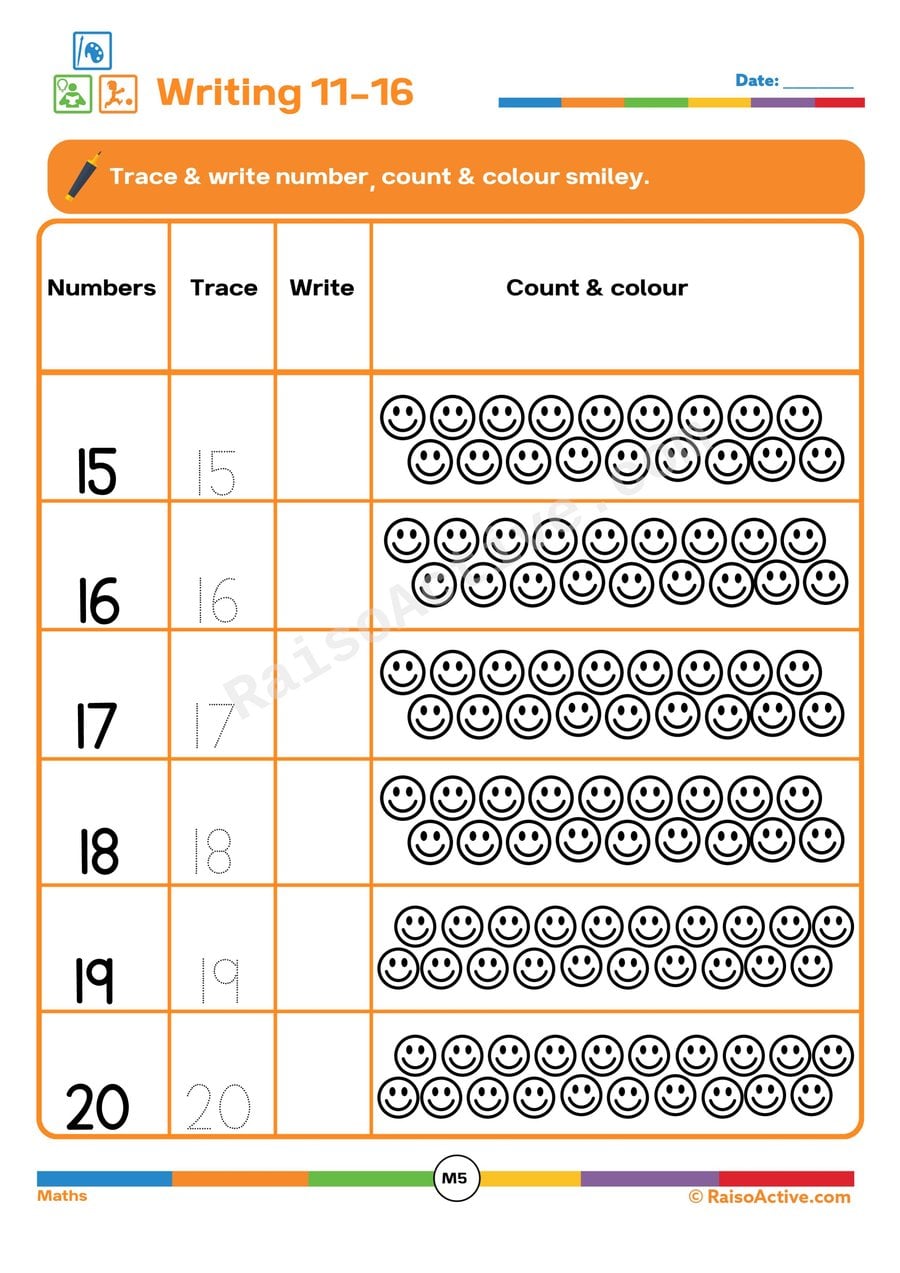
This worksheet layers three connected numeracy skills for children ages 4-6: tracing numerals to build correct number formation, writing numbers independently from memory, and counting objects to connect a written numeral to an actual quantity. Number formation practice at this age matters because children often develop habits — like starting a number from the wrong point — that are hard to unlearn later, so guided tracing helps establish correct strokes early. Pairing that with counting smiley faces ensures the numeral isn't just a shape being copied but a quantity being understood.
Ages 4-6 · Pre-K–KindergartenAges 4-6 · Reception–Year 1Ages 4-6 · LKG–UKGAges 4-6
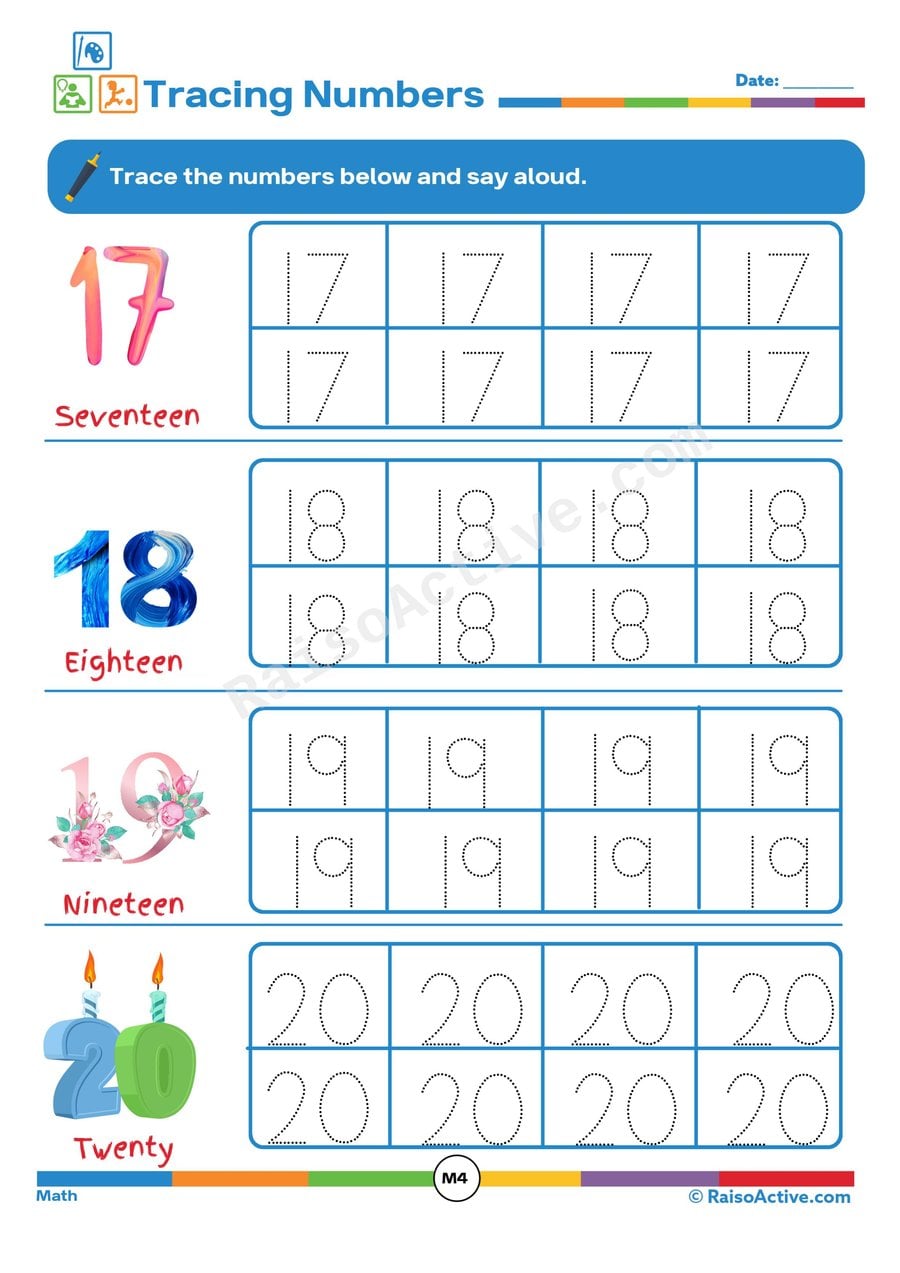
This tracing worksheet helps children ages 4-6 build number-writing fluency and number-name recognition for 17 through 20, a range that's often trickier than smaller numbers because it involves two-digit sequencing and less familiar number words like 'seventeen' and 'nineteen'. Tracing the dotted numerals builds the fine motor control and muscle memory needed for independent number writing, while saying each number aloud reinforces the link between the written numeral and its spoken name. This range also sets up the transition into the twenties and beyond.