Phonics Games for Kids: 8 Worksheet Games That Feel Like Play

Let's play with letters! Pick one page, grab a crayon and sound it out together.
- 5 minutes a game, one a day
- Printer, crayons, scissors
- At a table or on the floor
- Sounds, blending, early reading
Phonics games for kids do not need a screen or a box of props. A single printed page can be a game when your child has something to find, fold, circle or reveal. Here are eight worksheet games, from picking out first sounds to sorting long and short vowels, that we use to turn sounds into reading, five minutes at a time.
Every game below uses a real page from our phonics worksheets. Start with the one that matches what your child can do now, play it for about five minutes and stop while it is still fun. Reading is built from very small wins, and a game they ask to play again is worth more than a page they finish and forget.
How do I turn a phonics worksheet into a game?
A worksheet becomes a game when your child does something with it besides write: folds a flap, colours a hidden word, races a grown-up or checks their own answer. Keep the sounds out loud, because decoding starts in the ears and the mouth. Point under each letter, say the sound, blend the sounds and then check.
- Print the page and keep a crayon and pencil nearby
- Sit side by side so your child can lead and you can watch
- Say the sounds aloud, and let them point under every letter
- Praise the sounding out, not just the right answer
- Stop after five minutes, or sooner if they are tired
What are some fun phonics games for kids to play at home?
Eight phonics games, one page each
They run from easiest to trickiest. Pick one, play it and tick it off. You do not need to play them all in a week.
0 of 8 done
Look at each picture and say its name, listen for the very first sound and write that letter in the box. When all the boxes are full, the letters spell a secret word. Say the sounds slowly, then blend them together and see if your child can read it out. This is the gentlest game, because it only needs first sounds.

Point to a word, sound it out and circle the picture that matches it. Pages like this one use short three-letter words such as bag, cat and pan. Go down the list together and let your child do the pointing, one sound at a time.

Fold the picture back along the dotted line so only the word shows. Your child points under each letter dot, sounds out the word and then flips the picture over to check. Finally they write the word on the line. Word-family pages such as 'ed' (bed, fed, red, wed) let one sound pattern repeat, which helps early readers feel quick and clever.

Read the word in the middle, here 'sad', and colour every bubble that rhymes with it. Say each word out loud before you colour, because rhyme is something we hear first and read second. The lower half is a quick 'say it, tap it, spell it' round: circle the correct spelling next to each picture.

Find the hidden words in a grid of letters and colour each one in. Our page hides bat, rat, pat and cat. Then draw a line from each word to its picture. Ask your child to run a finger along a word and say the sounds as they go, which turns scanning a grid into reading practice.

Say the picture name, look at the jumbled letters and write the word in the box. A cat becomes a c t, a pan becomes p n a and a map becomes a m p. Say each sound as you move the letters about, then read the whole word back. The lower half has fill-in-the-letter words for another go.

When single sounds feel easy, try words that start with two sounds, such as flip, flag, frog and drum. Read each word on the left and draw a line to its picture. Say both starting sounds quickly together, 'fl-ip', and tap along the dots. The page continues with a second list of words to match.

Look at each picture, say its name and listen for the vowel: is the 'a' long, like its name, or short? Colour the circle red for long and blue for short. A bat and a hat have a short 'a' and a train and a plane have a long one. It is a lovely game for children who are ready for the next step after short vowel words.

You earned a sticker!
All eight games played. That is a lot of reading practice that felt like play!
- Keep it short: one game, five minutes, then stop while your child still wants more.
- Let them hold the pencil and do the pointing, and you do the cheering.
- If a word is too hard, say the first sound for them and let them finish it.
- Play the same game again a few days later. Repeating a game they know builds confidence.
Why do phonics games help children learn to read?
Phonics teaches that letters stand for sounds, and that we can blend those sounds into words. Children need to practise that link many times, and games give them a reason to. Fold-and-reveal pages let them check their own reading, rhyme hunts train the ears, and unscrambling turns spelling into a puzzle.
Sounds, blending, rhyme, spelling and long and short vowels, one small game at a time
Secret words and read-and-circle pages practise first sounds and blending. Fold-and-reveal and word-family pages show that one sound pattern makes many words. Rhyme hunts and hidden words train listening and scanning, unscrambling builds spelling, and the blend and vowel pages prepare children for longer words. Short, frequent games are easier for young children to keep up than one long session.
How can I make phonics games easier or harder?
Change the game to suit your child
Little ones
- Play Secret word with just the first picture and say the sound together.
- Read the words aloud first and let your child just point to the picture.
- Cover half of the page so there is less to look at.
Older kids
- Race a grown-up through the hidden words and see who finds all four first.
- Ask them to write a silly sentence using two words from the page.
- Ask for three new words that rhyme with the word in the middle of the rhyme hunt.
Where can I find more phonics practice?
If your child is just starting to blend, our how to teach CVC blending post goes through the steps one at a time, and our Phase 2 phonics at home post suggests an order for the first sounds with games to match. If you are choosing a whole approach, see our guide to phonics programmes for homeschooling.
The games above come from the phonics worksheets hub, where pages are sorted by sound and word family, and our kindergarten phonics worksheets carry on to blends and long vowels. For a whole programme on paper, the Phonics packs below gather the pages in teaching order.
Questions parents ask about phonics games
What are good phonics games for kids who are just starting?
How long should a phonics game last?
Do phonics games need to be on a screen?
What if my child guesses words from the pictures?
When should we move on to blends and long vowels?
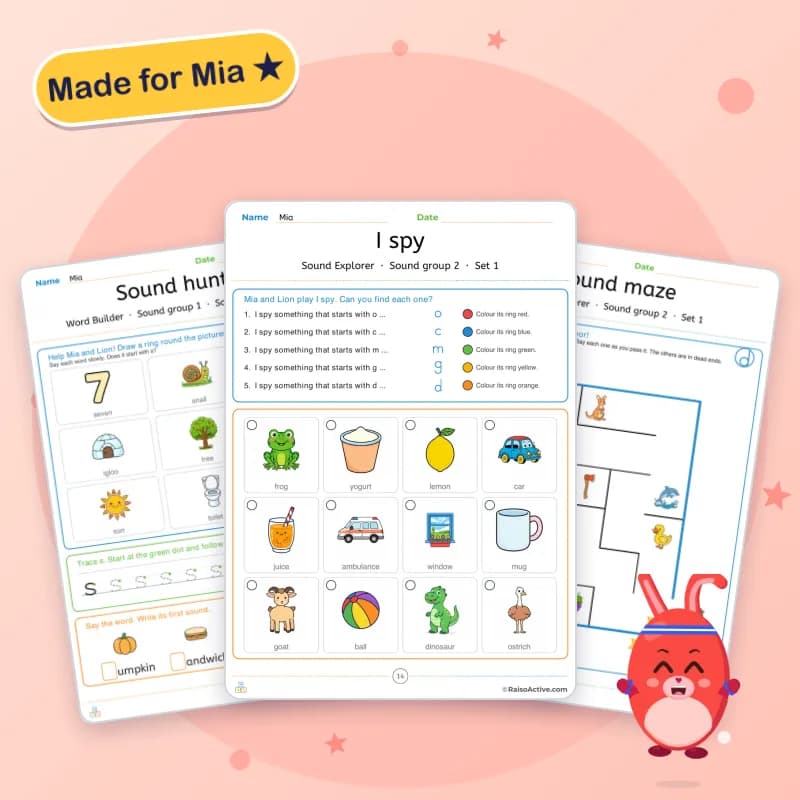
Made for your child
Phonics Sound Hunt, starring your child
A letter sounds pack made for one child: their animal hunts for six sounds, in the order schools teach them (s a t p i n first), with tracing, mazes, sorting, I spy and blending. Ages 3 to 7, and new pictures whenever you like.
Make a phonics packFree preview · free for members
See all 7 personalised packs
Written by
Hemsweta Jain · Teacher Cheena
MBA and Early Childhood Educator, teaching since 2014 · Founder of RaisoActive, Mumbai
Published · Last reviewed
Related posts

How to Balance Free vs. Paid Educational Resources: A Parent's Strategic Guide to Smart Learning Investments
Learn how to strategically balance free and paid educational resources for your child. Save money while ensuring quality learning with this practical Indian parent guide.
Children's Day Activities for Kids: 9 Games to Play at Home
Nine Children's Day activities for kids to print and play at home: a spinner, paper crown, board game, rights rainbow, friend award and prize hunt.
Printable Diwali Activities for Kids: An 8-Game Play Plan
Eight printable Diwali activities for kids: seek and find, bingo, a paper lantern, family game night and more. Print, play and make together this week.