Comma Practice Worksheet for Kids: Separating Items in a List!
Children ages 4-6 learn exactly where commas belong when writing a list of three or more items in a sentence, a specific punctuation rule that makes their early writing readable to others. Practicing this now, before they start composing longer sentences independently, builds a habit that carries straight into school writing tasks.
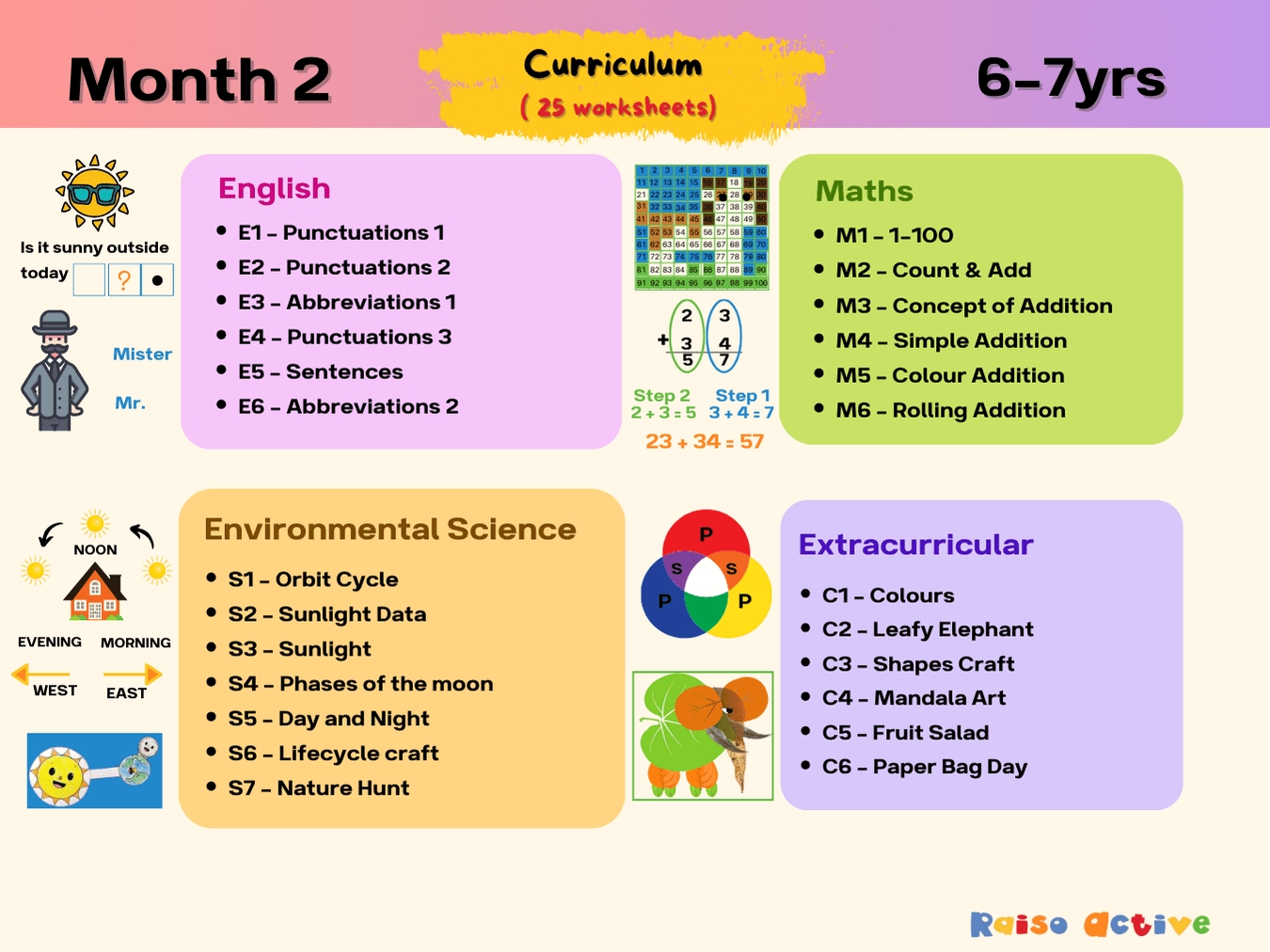
Part of the pack
Month 2: Learning & Development | Ages 6-7
This is page 5 of the pack. Ages 6-7 · Grade 1Ages 6-7 · Year 2Ages 6-7 · Class 1Ages 6-7
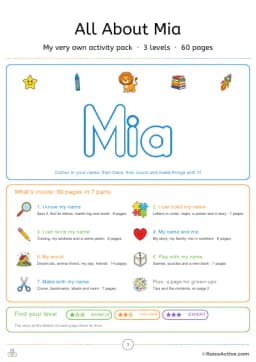
Made for your child
A whole activity pack made with their name
60 pages to spot, build, trace and write their own name, plus pages about their favourites, feelings and family. See a free preview with their name.
Make an All About Me packFree preview · free for members
Or start free: a name tracing sheet with their nameCurriculum
- Mechanics > Punctuation
How to use this worksheet
Read the unpunctuated list sentences aloud together first, pausing naturally where a comma should go. Have your child add a comma after each item in the list using their pencil, leaving the word 'and' before the last item comma-free unless the sentence calls for it. After correcting the given sentences, ask your child to write their own sentence listing three classmates' names, adding commas between each name and a period at the end.
Materials needed
- Pencil
Extension activities
- 1Dictate a grocery list of four items and have your child write it with commas in the right places.
- 2Search a favorite picture book together for sentences that list several items, circling every comma you find.
- 3Play 'comma detective': read sentences aloud, some missing commas, and have your child clap wherever a pause belongs.
- 4Ask your child to name their three favorite toys, then write the sentence together and place the commas as they speak.

Written by
Hemsweta Jain · Teacher Cheena
MBA and Early Childhood Educator, teaching since 2014 · Founder of RaisoActive, Mumbai
Every RaisoActive worksheet is designed and checked by the founder before publishing.
Published · Last reviewed
More from Month 2: Learning & Development | Ages 6-7

Count and Add: Fruits, Vehicles, and Sweets Worksheet for Preschoolers
Ages 3-5 · Preschool–Pre-KAges 3-5 · Nursery–ReceptionAges 3-5 · Nursery–LKGAges 3-5
This worksheet practices counting and basic addition by having children count several different groups of everyday objects — fruits, vehicles, and sweets — and then add the totals together. For three- to five-year-olds, varying the objects being counted across different sections keeps the counting practice fresh while reinforcing that the process of counting and adding works the same way no matter what's being counted.
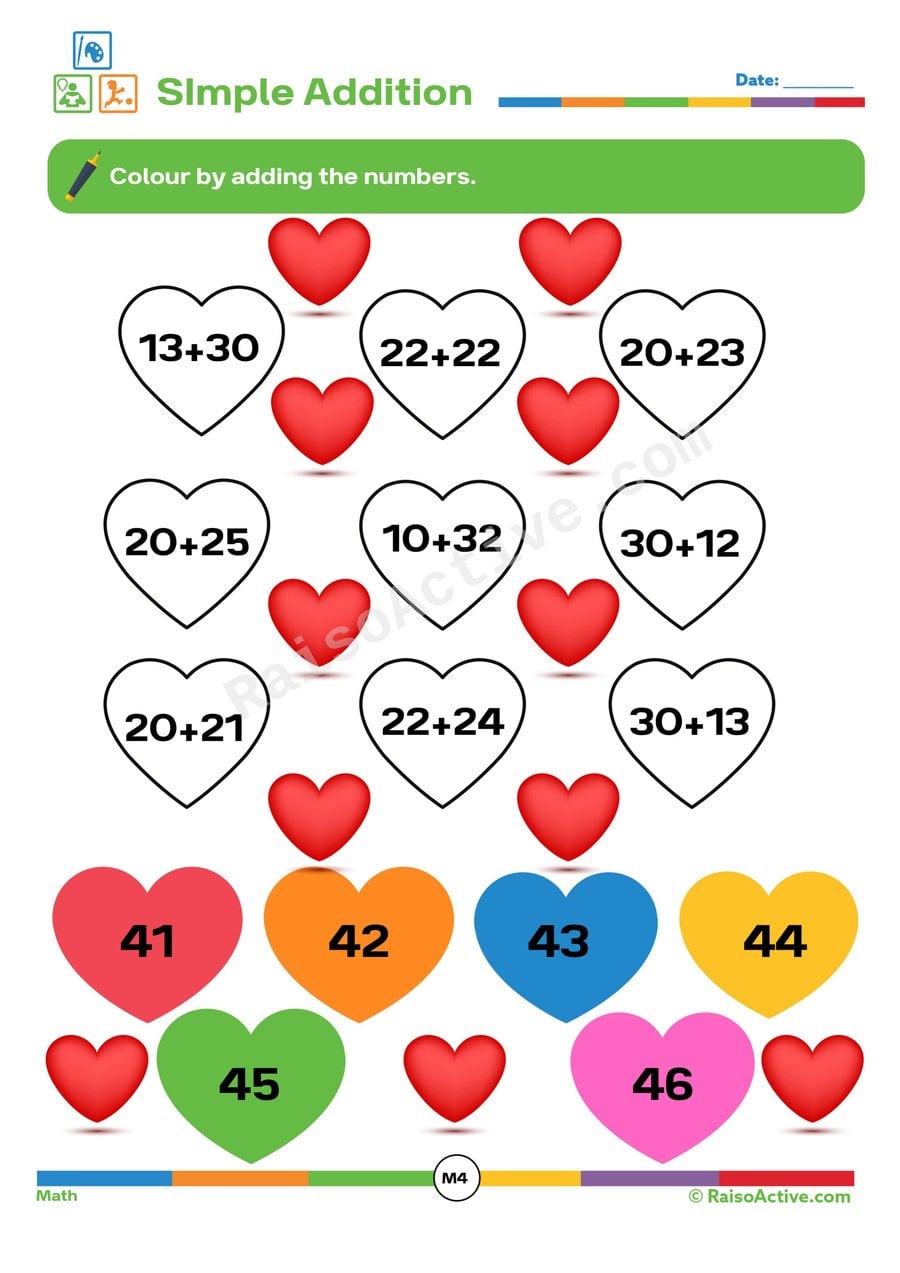
Simple Addition Worksheet: Color by Sums!
Ages 4-6 · Pre-K–KindergartenAges 4-6 · Reception–Year 1Ages 4-6 · LKG–UKGAges 4-6
Children ages 4-6 practice quick single-digit addition facts while also following a color key, combining early math fluency with visual attention to detail. Solving each problem before coloring gives an immediate, satisfying way to check their own accuracy as the picture comes together.

Shape Dog Craft: Cut and Assemble a Fun Shapes Worksheet!
Ages 3-5 · Preschool–Pre-KAges 3-5 · Nursery–ReceptionAges 3-5 · Nursery–LKGAges 3-5
This worksheet helps children ages 3-5 recognize and assemble basic shapes, like circles, triangles, and squares, into a recognizable dog, reinforcing shape recognition while also building the fine motor precision needed to cut and place pieces accurately. Following a visual example to combine multiple shapes into one picture also strengthens early spatial reasoning.
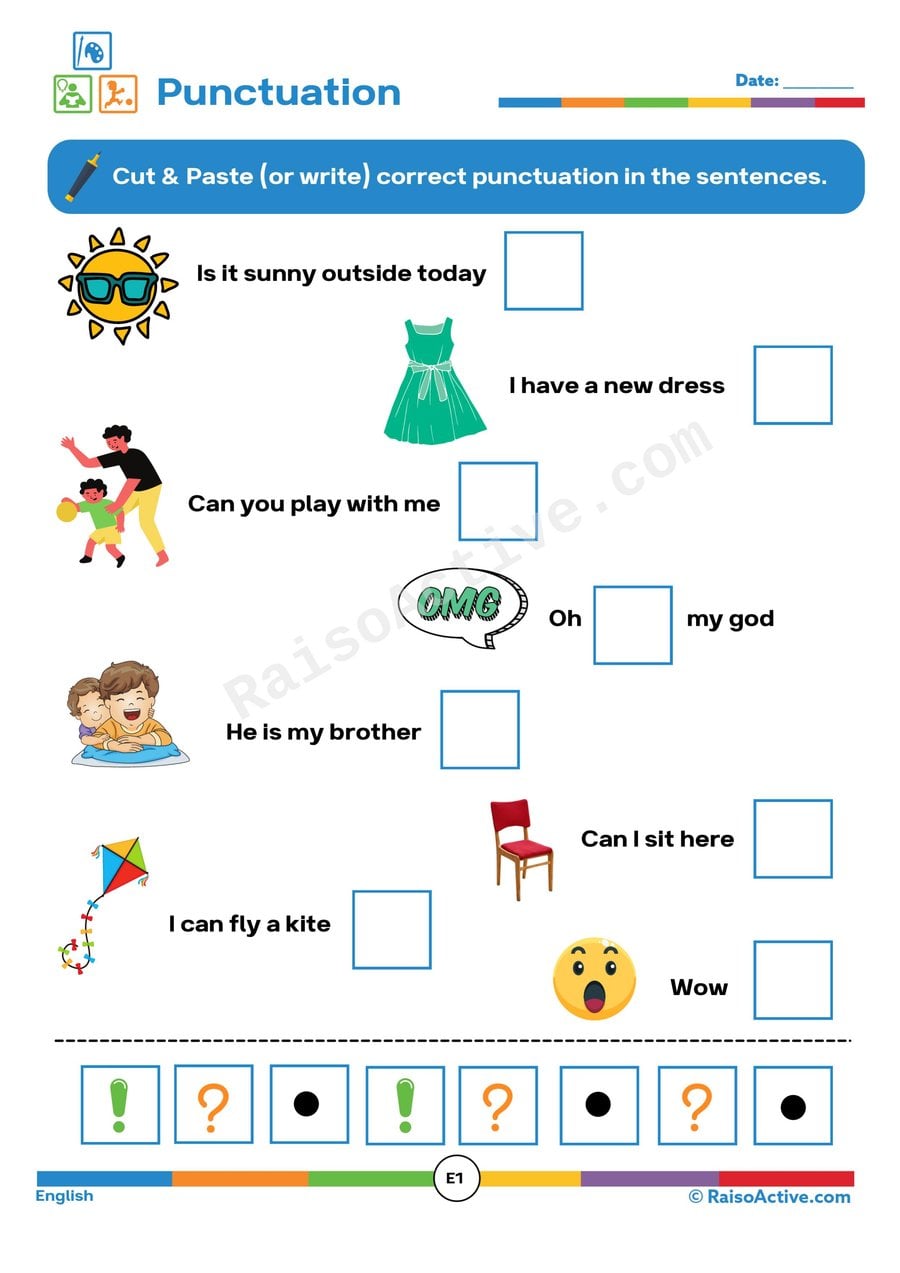
Punctuation Fun: Cut & Paste Punctuation Worksheet
Ages 4-6 · Pre-K–KindergartenAges 4-6 · Reception–Year 1Ages 4-6 · LKG–UKGAges 4-6
This worksheet teaches children to recognize and apply correct end punctuation — periods, question marks, and exclamation points — by reading simple sentences and choosing the punctuation mark that fits each one's tone. For four- to six-year-olds, connecting a sentence's meaning (a statement, a question, an exclamation) to its correct punctuation mark is an early step toward understanding that punctuation changes how a sentence should be read and understood.
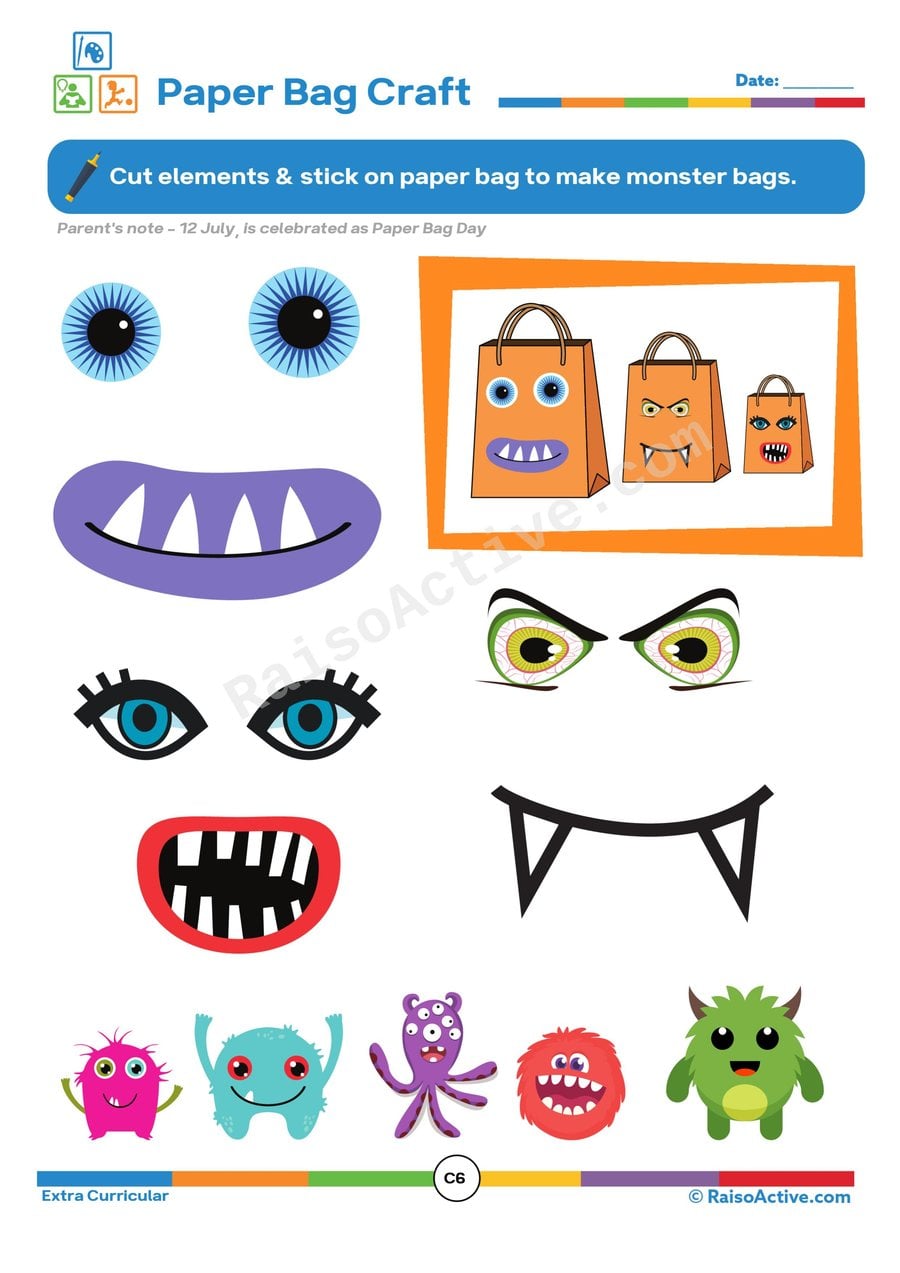
Monster Bag Craft: Cut and Paste Worksheet
Ages 3-5 · Preschool–Pre-KAges 3-5 · Nursery–ReceptionAges 3-5 · Nursery–LKGAges 3-5
This worksheet builds fine motor skills by having children cut out monster features — eyes, teeth, horns — and glue them onto a paper bag to design their own imaginative monster face. For three- to five-year-olds, the open-ended nature of choosing and arranging the features also encourages creative decision-making, since there's no single correct way to build the monster.
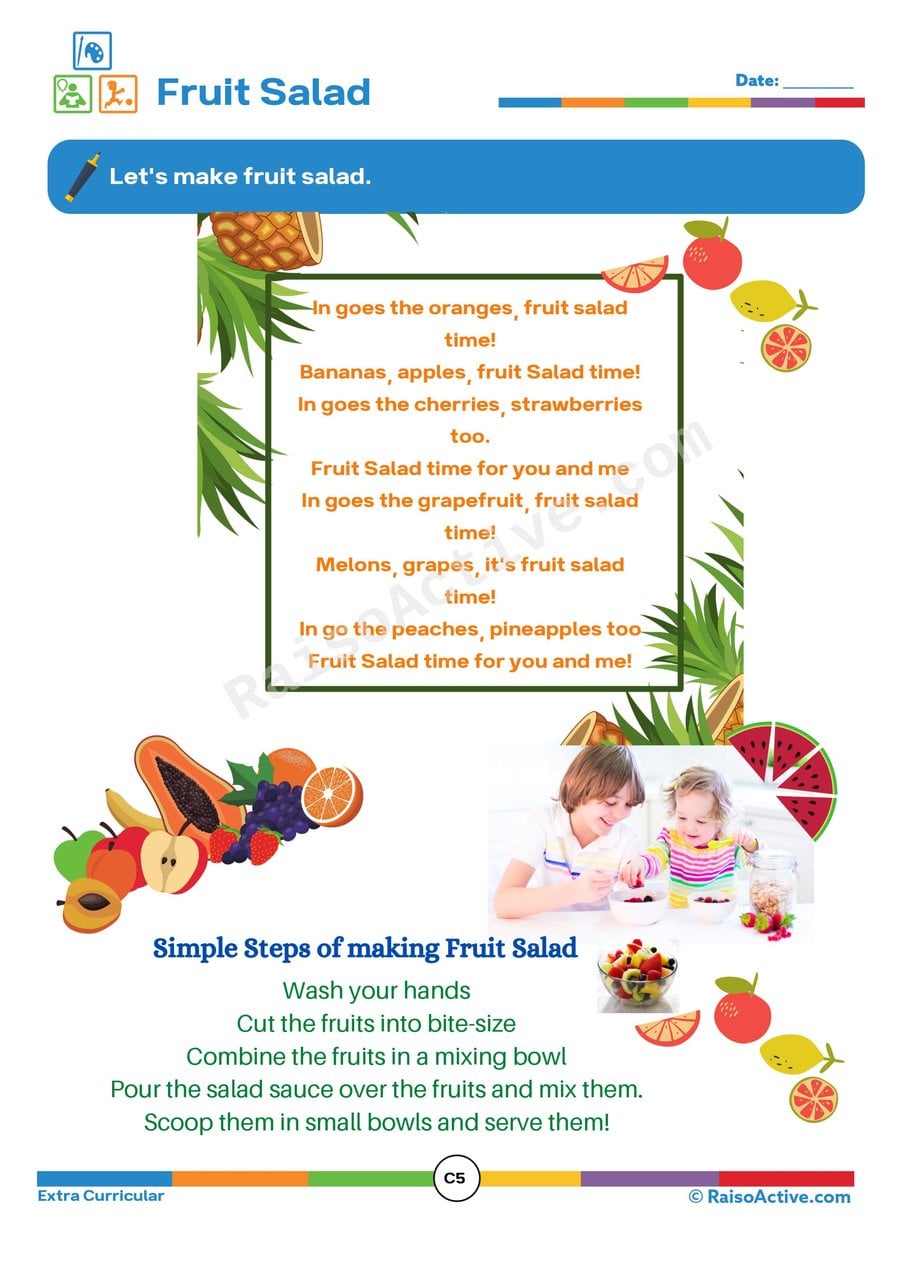
Fruit Salad Fun: A Recipe Worksheet for Kids
Ages 3-5 · Preschool–Pre-KAges 3-5 · Nursery–ReceptionAges 3-5 · Nursery–LKGAges 3-5
This worksheet uses a simple fruit salad recipe to teach children ages 3-5 how to follow a sequence of steps in order, a skill that underlies both reading comprehension and later procedural thinking in math and science. It also introduces healthy eating concepts as children name and draw the fruits that go into their salad.

Abbreviations Worksheet for Kids: Road, Doctor, and More!
Ages 4-6 · Pre-K–KindergartenAges 4-6 · Reception–Year 1Ages 4-6 · LKG–UKGAges 4-6
This worksheet introduces children ages 4-6 to abbreviations like Rd. for Road and Dr. for Doctor, teaching them that a shortened form can stand in for a longer, familiar word. Recognizing abbreviations is an early vocabulary and reading skill children will meet constantly on street signs, envelopes, and forms.

Sunlight Data Worksheet: Exploring Seasons and Sunlight Hours!
Ages 3-5 · Preschool–Pre-KAges 3-5 · Nursery–ReceptionAges 3-5 · Nursery–LKGAges 3-5
This worksheet introduces the science concept that daylight hours change with the seasons by having children record estimated sunlight hours for winter and summer dates and compare the two. For three- to five-year-olds, comparing two simple data points side by side is an early introduction to the idea of collecting and reading information, well before formal data or graphing skills are taught.
Related worksheets
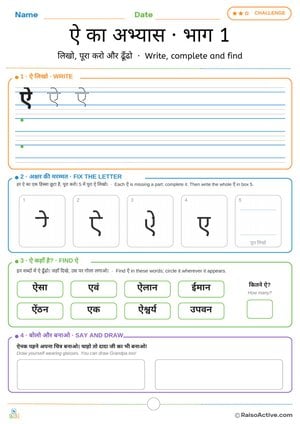
Hindi Letter ऐ (ai) Practice 1: Write, Fix the Letter and Find | ऐ का अभ्यास · भाग 1
Ages 4-7 · Pre-K–Grade 1Ages 4-7 · Reception–Year 2Ages 4-7 · LKG–Class 1Ages 4-7
A challenge page: write ऐ between the lines, complete four letters that are each missing a part and then write the whole ऐ in box 5, find ऐ in words such as ऐसा, ऐलान, ऐंठन and ऐश्वर्य, and draw a picture. ऐ is a different vowel from ए, not a long version of it.
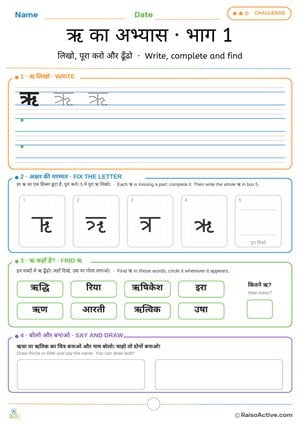
Hindi Letter ऋ (ri) Practice 1: Write, Fix the Letter and Find | ऋ का अभ्यास · भाग 1
Ages 4-7 · Pre-K–Grade 1Ages 4-7 · Reception–Year 2Ages 4-7 · LKG–Class 1Ages 4-7
A challenge page: write ऋ between the lines, complete four letters that are each missing a part and then write the whole ऋ in box 5, find ऋ in words such as ऋद्धि, ऋषिकेश, ऋण and ऋत्विक, and draw a picture. Because ऋ is a special vowel, this page helps adults say it as 'ri' and keep it apart from इ and र.
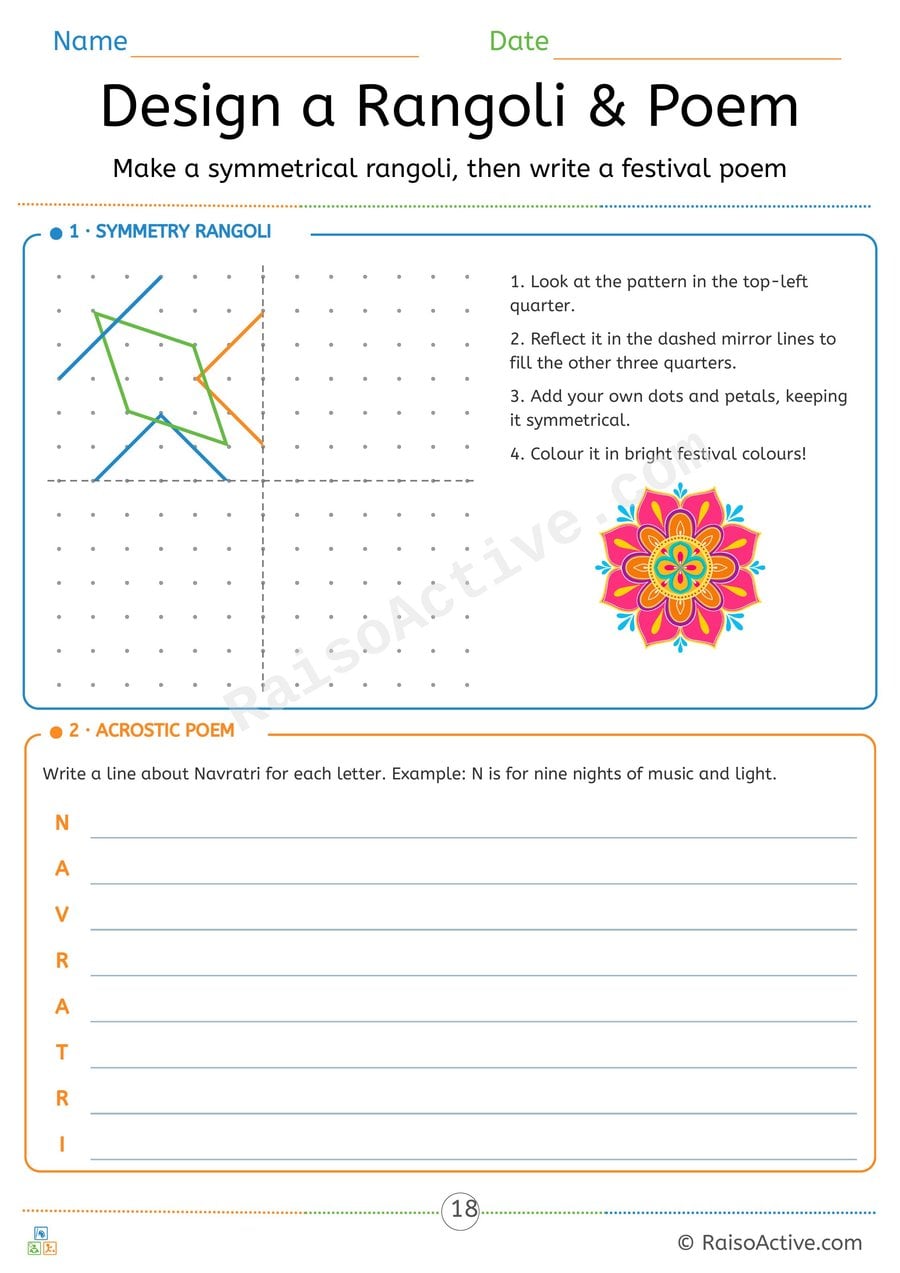
Navratri Symmetry Rangoli and Acrostic Poem
Ages 7-11 · Grade 2–Grade 3Ages 7-11 · Year 3–Year 4Ages 7-11 · Class 2–Class 3Ages 7-11
Children reflect a pattern in two mirror lines to complete a four-way symmetrical rangoli on a dot grid, add their own symmetrical details, and write an acrostic poem with one line for each letter of NAVRATRI.

I Spy Letters and Numbers Worksheet: Find, Match, and Write!
Ages 4-5 · Pre-KAges 4-5 · ReceptionAges 4-5 · LKGAges 4-5
This worksheet blends letter and number recognition for children ages 4-5, asking them to spot a hidden letter within a picture, find its matching number, and then write both symbols down, combining visual search with early literacy and numeracy in a single activity. Working with letters and numbers side by side reinforces that both are symbols that carry specific meaning and can be found, matched, and recorded.
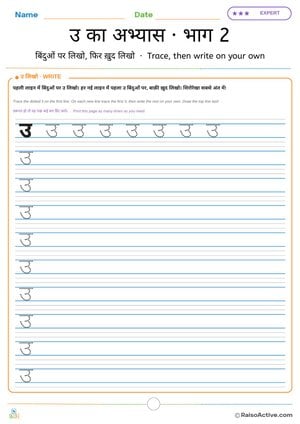
Hindi Letter उ Practice Part 2: Trace and Write on Your Own | उ का अभ्यास · भाग 2
Ages 3-7 · Preschool–Grade 1Ages 3-7 · Nursery–Year 2Ages 3-7 · Nursery–Class 1Ages 3-7
Children build writing fluency by tracing the dotted line उ on the first line and then writing the letter on their own, line after line, as the dotted help fades. The headline (शिरोरेखा) is drawn last, as in Hindi handwriting.

Festival Fun: Name the Festivals Worksheet for Kids
Ages 4-8 · Pre-K–Grade 2Ages 4-8 · Reception–Year 3Ages 4-8 · LKG–Class 2Ages 4-8
Children look at nine festival pictures and write the right name under each, from Diwali and Navratri to Lohri, Pongal and Paryushan Parv.

Christmas Fill-in-the-Blanks Worksheet for Preschoolers
Ages 3-5 · Preschool–Pre-KAges 3-5 · Nursery–ReceptionAges 3-5 · Nursery–LKGAges 3-5
Filling in missing letters of Christmas words like 'S_ _W' or 'TR_ _' helps children ages 3-5 connect letter sounds to their written form, an essential early step toward independent spelling. Using the accompanying picture as a clue also teaches them to cross-check visual and phonetic information — a strategy they'll rely on throughout early reading.
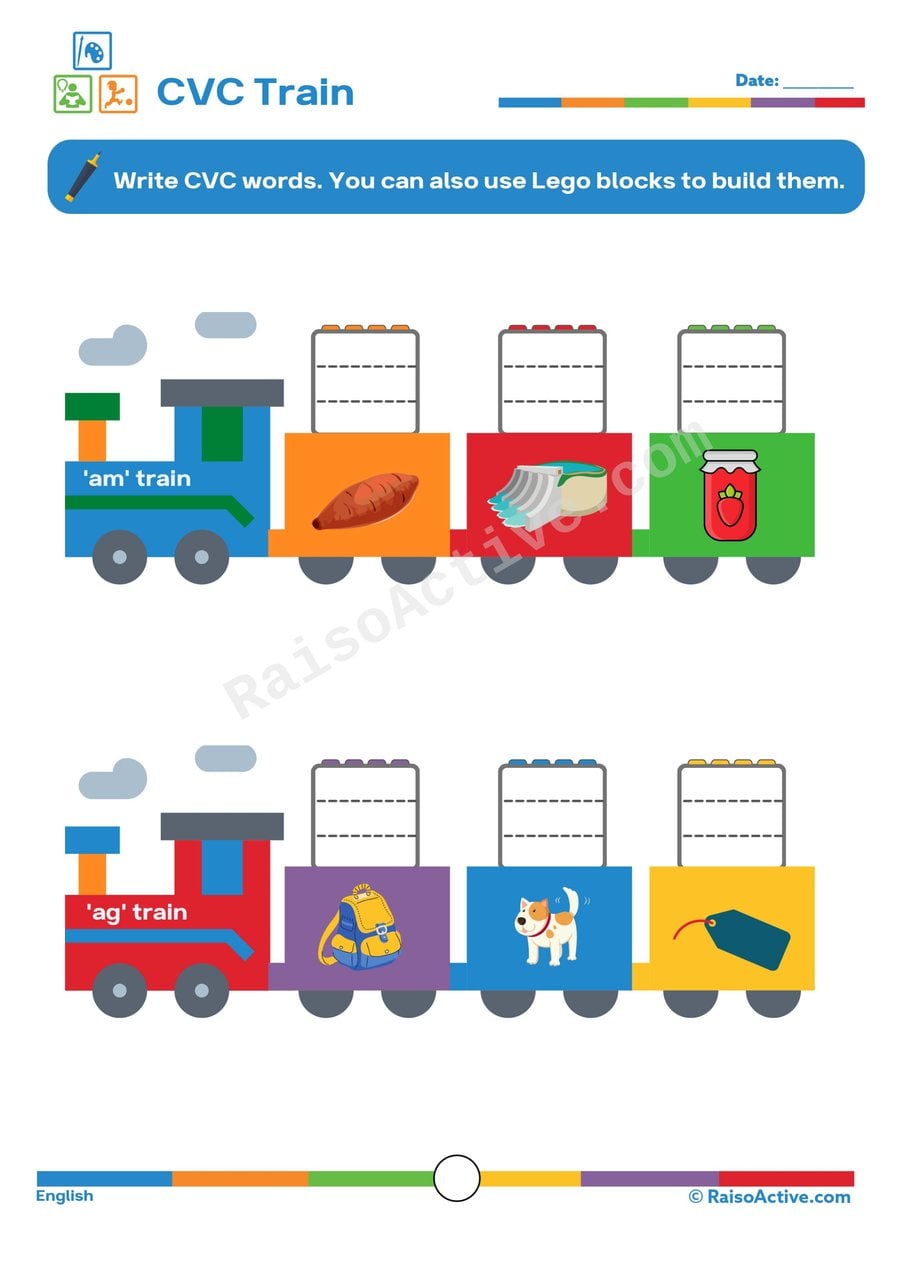
CVC Train Worksheet: Write and Build CVC Words!
Ages 4-6 · Pre-K–KindergartenAges 4-6 · Reception–Year 1Ages 4-6 · LKG–UKGAges 4-6
This worksheet gives children ages 4-6 focused practice blending letter sounds into consonant-vowel-consonant words, using train-car pictures as clues for words like 'dog,' 'hen,' or 'cup.' Because children both write the word and can optionally build it with Lego blocks, this worksheet reinforces the same phonics skill through two different physical actions — handwriting and hands-on construction — which helps the spelling patterns stick.
Guides for this topic

Documenting Learning Without Drowning in Data: A Practical Guide for Parents and Teachers
Learn practical ways to document your child's learning without overwhelm. Simple portfolios, observation tips, and printable trackers for ages 1-8.

How to Help Your Child with Letter Reversals: A Complete Guide for Parents and Teachers
Letter reversals are normal until age 7-8. Learn the best multisensory strategies, anchor letter tricks, and activities to help children write b, d, p, and q correctly.

Activities That Help with Pencil Grip Development: A Complete Guide for Parents and Teachers
Discover fun, research-backed activities to develop pencil grip in young children. Age-wise exercises, play ideas, and expert tips for parents and teachers.
Reviews
Every worksheet for ages 4–6, no watermark
Members download the full library of 1,000+ worksheets and every activity pack without watermarks or daily limits. One year costs ₹999 in India or $20 elsewhere.
See membership plansOr download any worksheet free with a watermark (5 a day).