Punctuation Fun: Cut & Paste Punctuation Worksheet
This worksheet teaches children to recognize and apply correct end punctuation — periods, question marks, and exclamation points — by reading simple sentences and choosing the punctuation mark that fits each one's tone. For four- to six-year-olds, connecting a sentence's meaning (a statement, a question, an exclamation) to its correct punctuation mark is an early step toward understanding that punctuation changes how a sentence should be read and understood.
Part of the pack
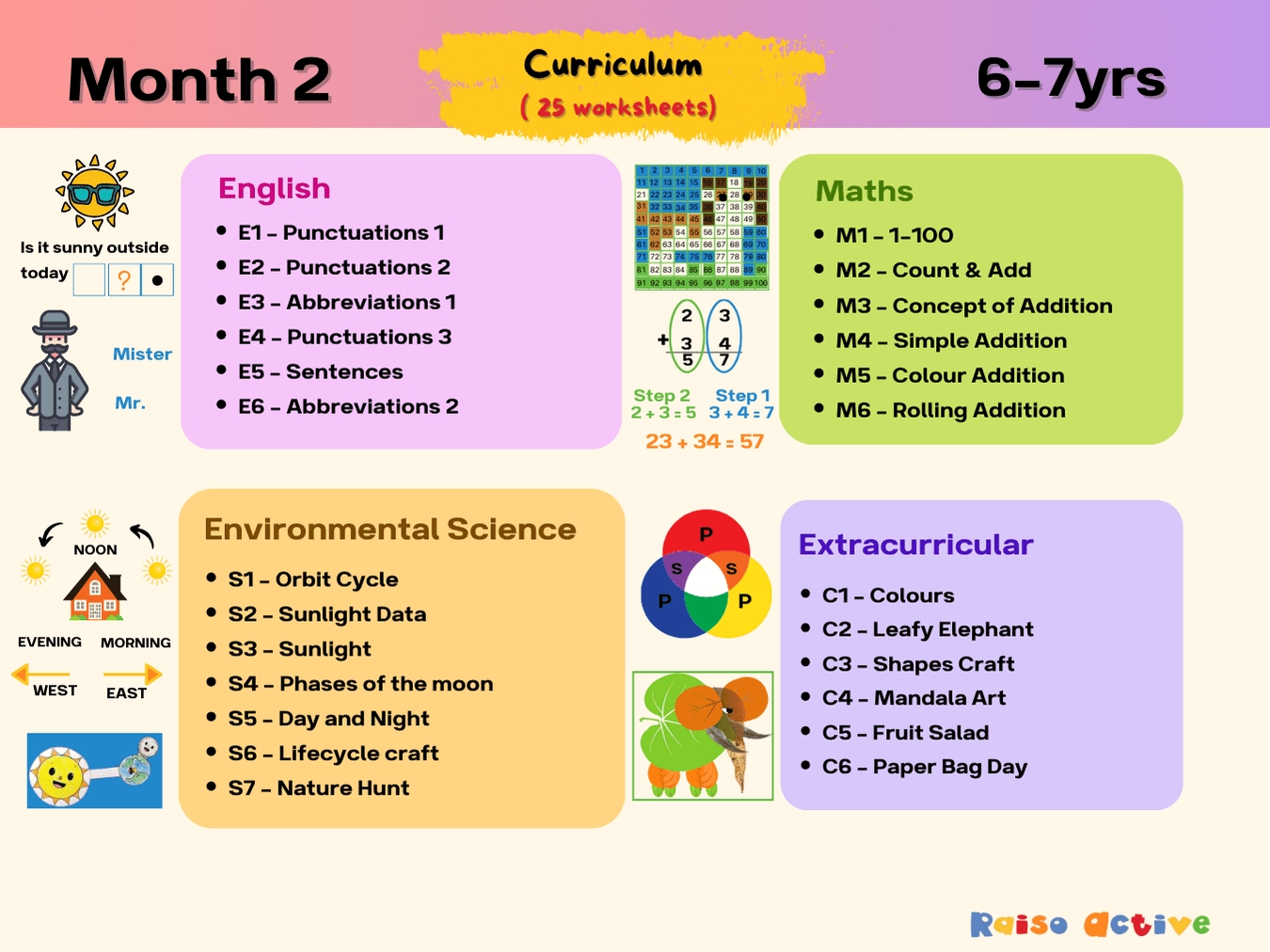
Month 2: Learning & Development | Ages 6-7
This is page 4 of the pack. Ages 6-7 · Grade 1Ages 6-7 · Year 2Ages 6-7 · Class 1Ages 6-7
Made for your child
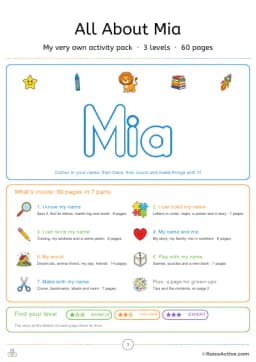
A whole activity pack made with their name
60 pages to spot, build, trace and write their own name, plus pages about their favourites, feelings and family. See a free preview with their name.
Make an All About Me packFree preview · free for members
Or start free: a name tracing sheet with their nameCurriculum
- Mechanics > Punctuation
How to use this worksheet
Cut out the punctuation marks at the bottom of the page together. Read the first sentence aloud, paying attention to whether it's a statement, a question, or an excited exclamation. Ask your child to choose the punctuation mark that matches the sentence's tone and glue it into the box at the end. Continue through each sentence, rereading it aloud with the chosen punctuation to check that it sounds right.
Materials needed
- Scissors
- Glue
- Pencil
Extension activities
- 1Write your own sentences together using different punctuation marks, then read them aloud with matching expression.
- 2Read a book together and identify the punctuation marks used on a page, discussing why each one was chosen.
- 3Practice reading the same sentence with different punctuation, like 'Stop.' versus 'Stop!,' to hear how tone changes.
- 4Play a punctuation sorting game, grouping written sentences by whether they need a period, question mark, or exclamation point.
- 5Create a short comic strip together using speech bubbles with different punctuation marks.

Written by
Hemsweta Jain · Teacher Cheena
MBA and Early Childhood Educator, teaching since 2014 · Founder of RaisoActive, Mumbai
Every RaisoActive worksheet is designed and checked by the founder before publishing.
Published · Last reviewed
More from Month 2: Learning & Development | Ages 6-7

Parent's Guide: Fun Activities for Early Learning
Ages 3-5 · Preschool–Pre-KAges 3-5 · Nursery–ReceptionAges 3-5 · Nursery–LKGAges 3-5
This parent guide brings together five activities spanning punctuation, moon phases, subject and predicate, the solar system, and counting and addition, giving children ages 3-5 a broad sampler of language arts, science, and math concepts through hands-on materials like Oreo biscuits and a flashlight. Working across such different topics in one guide helps children practice shifting attention between subjects, a skill that supports the more structured subject-switching they'll encounter in school.
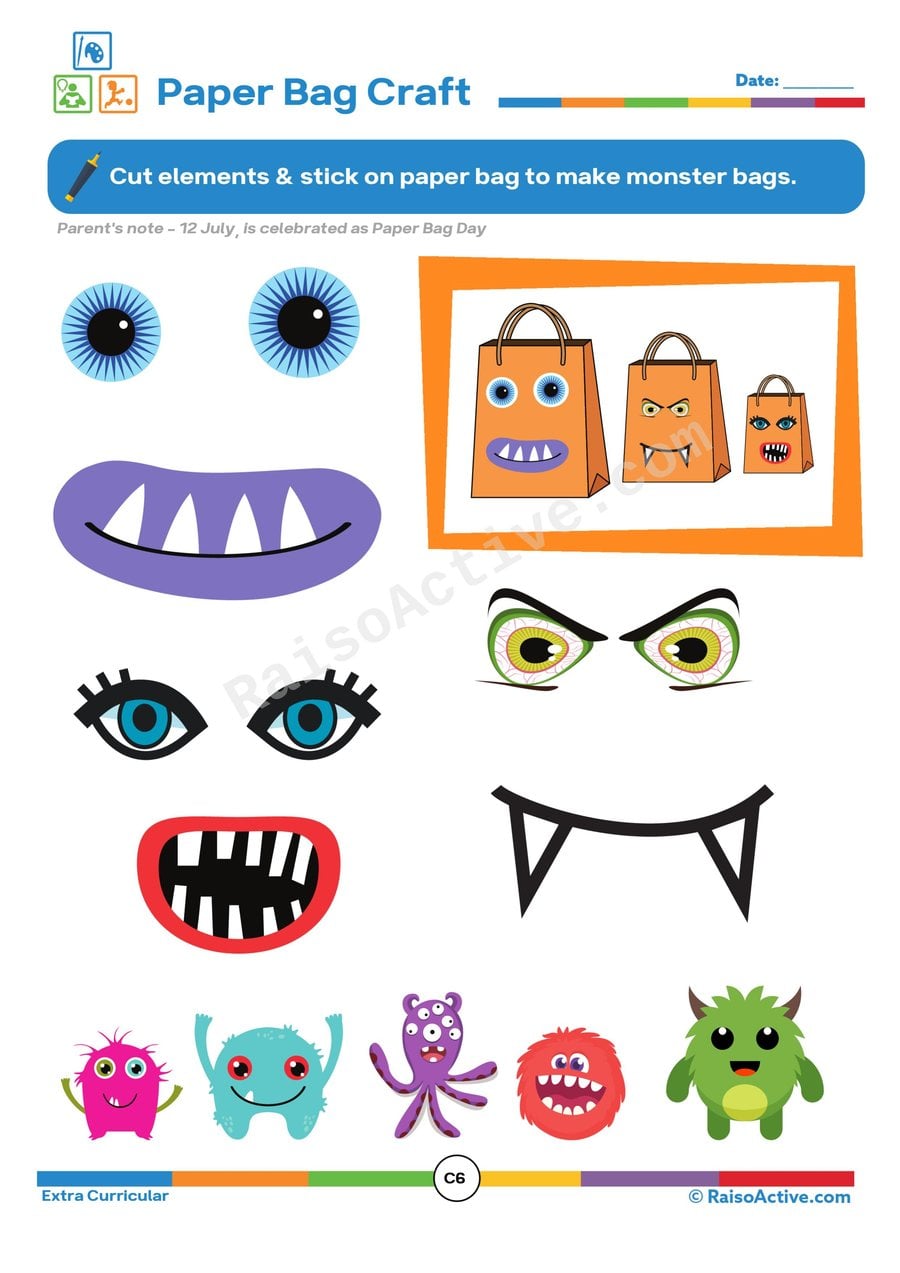
Monster Bag Craft: Cut and Paste Worksheet
Ages 3-5 · Preschool–Pre-KAges 3-5 · Nursery–ReceptionAges 3-5 · Nursery–LKGAges 3-5
This worksheet builds fine motor skills by having children cut out monster features — eyes, teeth, horns — and glue them onto a paper bag to design their own imaginative monster face. For three- to five-year-olds, the open-ended nature of choosing and arranging the features also encourages creative decision-making, since there's no single correct way to build the monster.

Sunlight Worksheet: Learn About the Sun and Seasons!
Ages 3-5 · Preschool–Pre-KAges 3-5 · Nursery–ReceptionAges 3-5 · Nursery–LKGAges 3-5
This worksheet introduces children ages 3-5 to the idea that the sun's warmth and position change across the year, giving rise to the four seasons. By matching descriptions to pictures and completing sentences about the sun's daily movement, children build early scientific observation skills and the vocabulary needed to describe weather and time of day.

Abbreviations Worksheet: Matching Words and Abbreviations!
Ages 4-6 · Pre-K–KindergartenAges 4-6 · Reception–Year 1Ages 4-6 · LKG–UKGAges 4-6
This worksheet teaches children common abbreviations, like 'Dr.' for Doctor or 'St.' for Street, by having them match each full word to its shortened form. For four- to six-year-olds who are building early reading and writing fluency, recognizing abbreviations is a practical real-world skill, since these shortened forms appear regularly in addresses, titles, and everyday writing.

Abbreviations Worksheet for Kids: Road, Doctor, and More!
Ages 4-6 · Pre-K–KindergartenAges 4-6 · Reception–Year 1Ages 4-6 · LKG–UKGAges 4-6
This worksheet introduces children ages 4-6 to abbreviations like Rd. for Road and Dr. for Doctor, teaching them that a shortened form can stand in for a longer, familiar word. Recognizing abbreviations is an early vocabulary and reading skill children will meet constantly on street signs, envelopes, and forms.
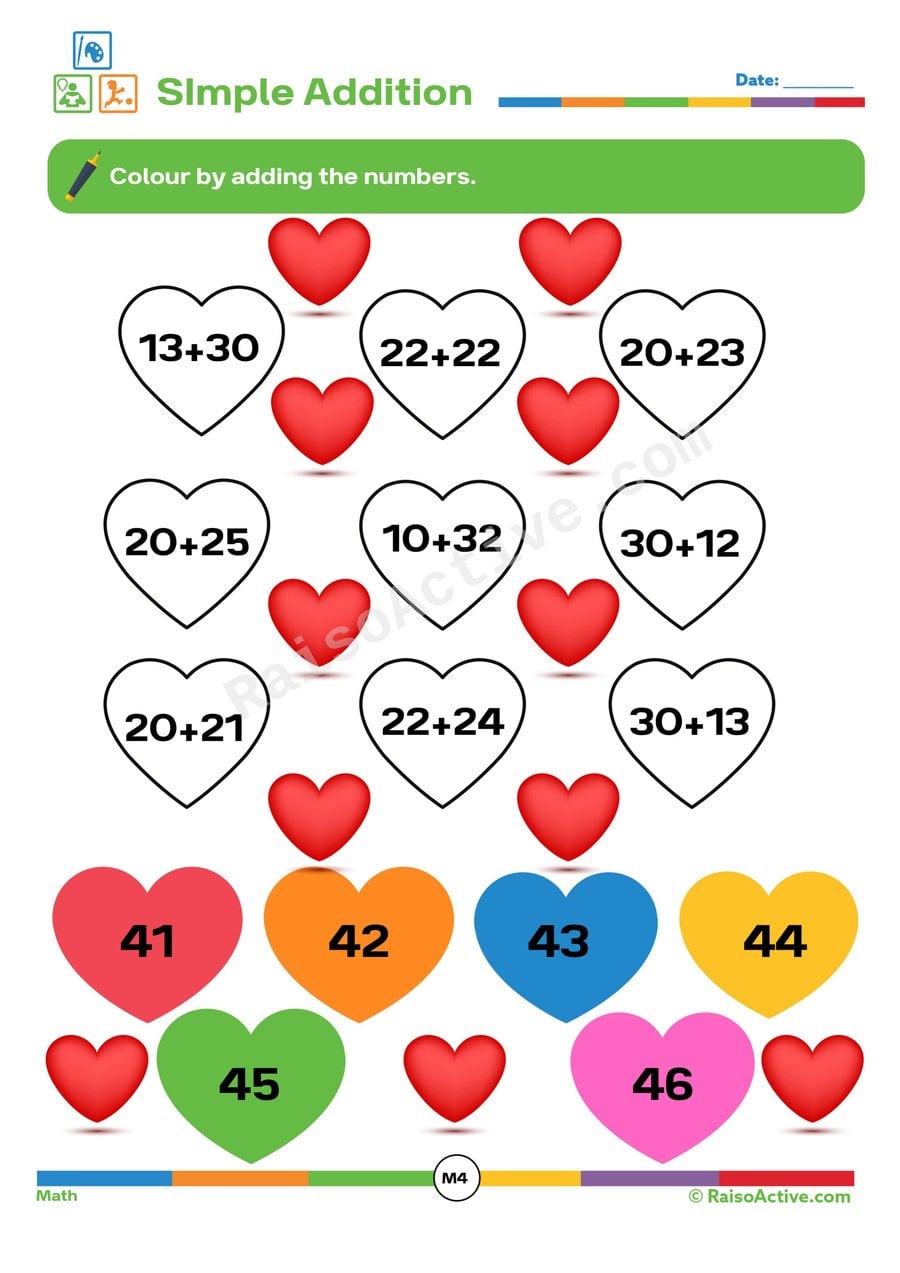
Simple Addition Worksheet: Color by Sums!
Ages 4-6 · Pre-K–KindergartenAges 4-6 · Reception–Year 1Ages 4-6 · LKG–UKGAges 4-6
Children ages 4-6 practice quick single-digit addition facts while also following a color key, combining early math fluency with visual attention to detail. Solving each problem before coloring gives an immediate, satisfying way to check their own accuracy as the picture comes together.

Shape Dog Craft: Cut and Assemble a Fun Shapes Worksheet!
Ages 3-5 · Preschool–Pre-KAges 3-5 · Nursery–ReceptionAges 3-5 · Nursery–LKGAges 3-5
This worksheet helps children ages 3-5 recognize and assemble basic shapes, like circles, triangles, and squares, into a recognizable dog, reinforcing shape recognition while also building the fine motor precision needed to cut and place pieces accurately. Following a visual example to combine multiple shapes into one picture also strengthens early spatial reasoning.
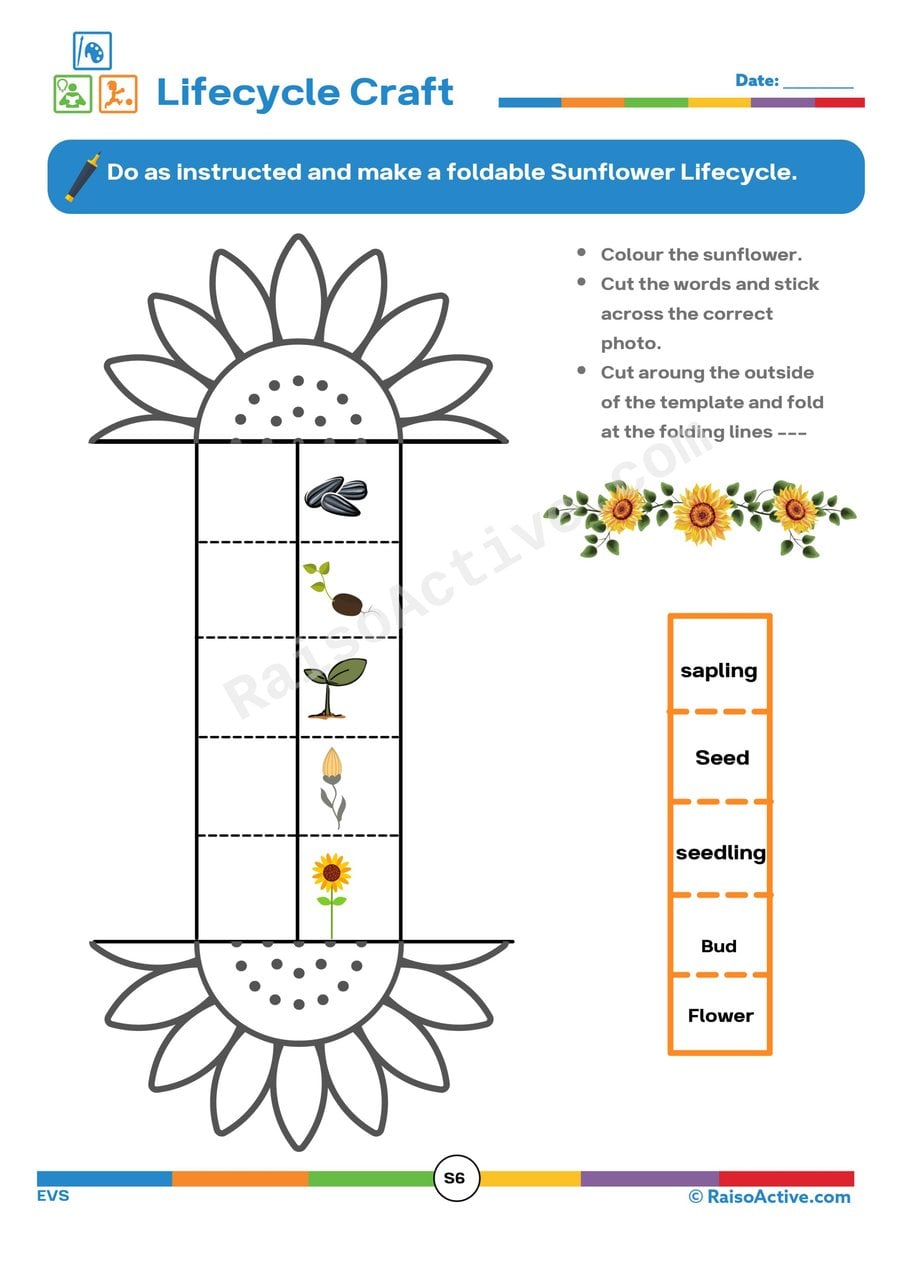
Sunflower Life Cycle Worksheet: Learn and Fold!
Ages 4-6 · Pre-K–KindergartenAges 4-6 · Reception–Year 1Ages 4-6 · LKG–UKGAges 4-6
This worksheet introduces the plant life cycle by walking children through the sequential stages a sunflower passes through — from seed, to sprout, to full bloom — using coloring, labeling, and folding. For four- to six-year-olds, understanding that living things grow through a fixed, ordered set of stages is a foundational science concept that also applies to animals, insects, and their own growth.
Related worksheets

Punctuation Fun: Practice Using Punctuation Marks!
Ages 4-6 · Pre-K–KindergartenAges 4-6 · Reception–Year 1Ages 4-6 · LKG–UKGAges 4-6
Choosing the correct punctuation mark to complete a sentence teaches children ages 4-6 that periods, question marks, and other marks change how a sentence should be read and understood, not just how it looks on paper. Matching sentences to their correct punctuation marks reinforces this by requiring children to recognize the tone or purpose of a sentence, whether it's a statement, a question, or an exclamation. This early grammar practice builds the foundation for reading with expression and writing complete, correctly punctuated sentences later on.
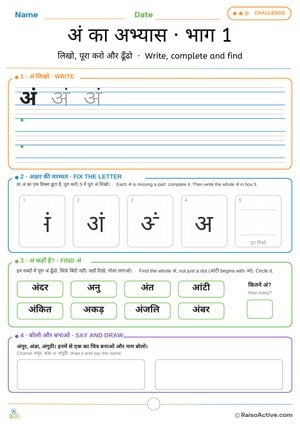
Hindi Letter अं (am) Practice 1: Write, Fix the Letter and Find | अं का अभ्यास · भाग 1
Ages 4-7 · Pre-K–Grade 1Ages 4-7 · Reception–Year 2Ages 4-7 · LKG–Class 1Ages 4-7
A challenge page: write अं between the lines, complete four letters that are each missing a part and then write the whole अं in box 5, find अं in words such as अंदर, अंत, अंकित, अंजलि and अंबर, and draw a picture. Children find the whole अं, not just a dot: आंटी begins with आं, not अं.
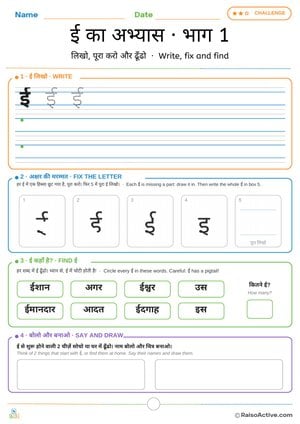
Hindi Letter ई Practice Part 1: Write, Fix and Find | ई का अभ्यास · भाग 1
Ages 3-7 · Preschool–Grade 1Ages 3-7 · Nursery–Year 2Ages 3-7 · Nursery–Class 1Ages 3-7
Children write ई on guide lines, complete four partly drawn letters, circle ई in eight words (while avoiding its look-alike इ), count how many they found, then think of two more words at home that start with ई and draw them.
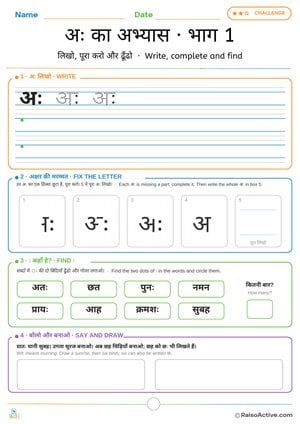
Hindi Visarga अः (ah) Practice 1: Write, Fix the Letter and Find | अः का अभ्यास · भाग 1
Ages 4-7 · Pre-K–Grade 1Ages 4-7 · Reception–Year 2Ages 4-7 · LKG–Class 1Ages 4-7
A challenge page: write अः between the lines, complete four letters each missing a part and write the whole अः in box 5, find the two dots ः in words such as अतः, पुनः, प्रायः and क्रमशः, and draw a sunrise with six birds (छः can also be written छह).
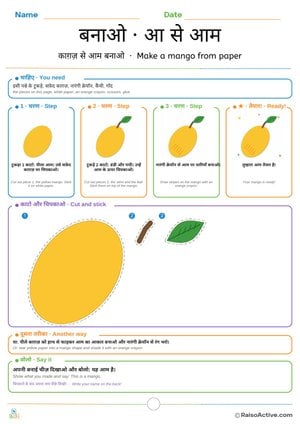
Make a Paper Mango: Hindi Letter आ Craft | बनाओ · आ से आम
Ages 3-7 · Preschool–Grade 1Ages 3-7 · Nursery–Year 2Ages 3-7 · Nursery–Class 1Ages 3-7
Children cut out the pieces, put them together following three step pictures and make a paper mango. Saying the word आम as they make it links the sound आ to something they built themselves.
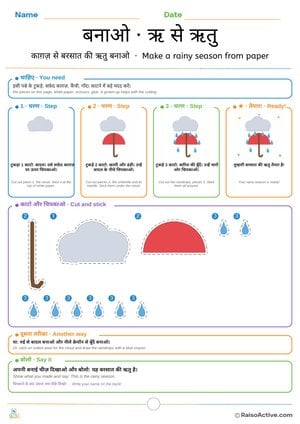
Make a Paper Rainy Season: Hindi Letter ऋ (ri) Cut and Stick Craft | बनाओ · ऋ से ऋतु
Ages 4-7 · Pre-K–Grade 1Ages 4-7 · Reception–Year 2Ages 4-7 · LKG–Class 1Ages 4-7
Children cut out the numbered pieces and stick them in order to make a rainy season scene with a cloud, umbrella and rain, then show it and say a full sentence about it. It links the letter ऋ with a real picture word, ऋतु (season), and practises scissor control and following steps.

Trace the Numbers 1-9 Worksheet for Preschoolers
Ages 3-5 · Preschool–Pre-KAges 3-5 · Nursery–ReceptionAges 3-5 · Nursery–LKGAges 3-5
Tracing the numerals 1 through 9 gives children ages 3-5 repeated, guided practice with the specific pencil strokes each number requires, building the fine motor control and muscle memory needed for independent number writing. Because tracing follows a fixed, correct path, it also reinforces accurate numeral recognition, helping children tell visually similar digits apart.
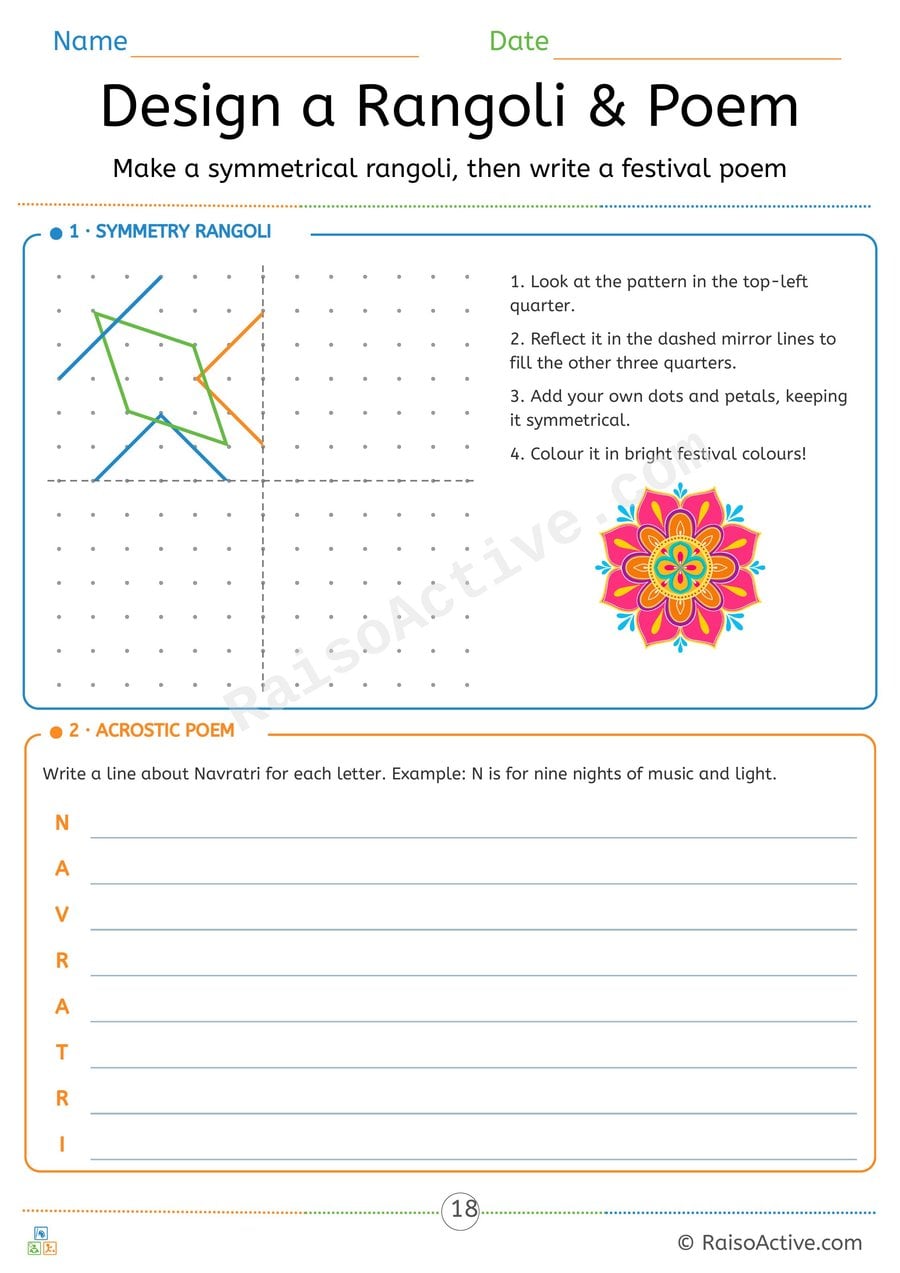
Navratri Symmetry Rangoli and Acrostic Poem
Ages 7-11 · Grade 2–Grade 3Ages 7-11 · Year 3–Year 4Ages 7-11 · Class 2–Class 3Ages 7-11
Children reflect a pattern in two mirror lines to complete a four-way symmetrical rangoli on a dot grid, add their own symmetrical details, and write an acrostic poem with one line for each letter of NAVRATRI.
Guides for this topic

Documenting Learning Without Drowning in Data: A Practical Guide for Parents and Teachers
Learn practical ways to document your child's learning without overwhelm. Simple portfolios, observation tips, and printable trackers for ages 1-8.

How to Help Your Child with Letter Reversals: A Complete Guide for Parents and Teachers
Letter reversals are normal until age 7-8. Learn the best multisensory strategies, anchor letter tricks, and activities to help children write b, d, p, and q correctly.

Activities That Help with Pencil Grip Development: A Complete Guide for Parents and Teachers
Discover fun, research-backed activities to develop pencil grip in young children. Age-wise exercises, play ideas, and expert tips for parents and teachers.
Reviews
Every worksheet for ages 4–6, no watermark
Members download the full library of 1,000+ worksheets and every activity pack without watermarks or daily limits. One year costs ₹999 in India or $20 elsewhere.
See membership plansOr download any worksheet free with a watermark (5 a day).