Fall Colors Dice Game Worksheet for Preschoolers
Rolling a die and matching the number to a color key teaches children ages 3-5 to connect a numeral with a specific color while practicing number recognition up to six in a low-stakes, game-like format. Because the color to use depends entirely on the number rolled, children also build symbolic thinking, understanding that one thing (a number) can stand for another (a color instruction). The chance element of the dice roll adds motivation and turn-taking practice, which supports early self-regulation.
Part of the pack
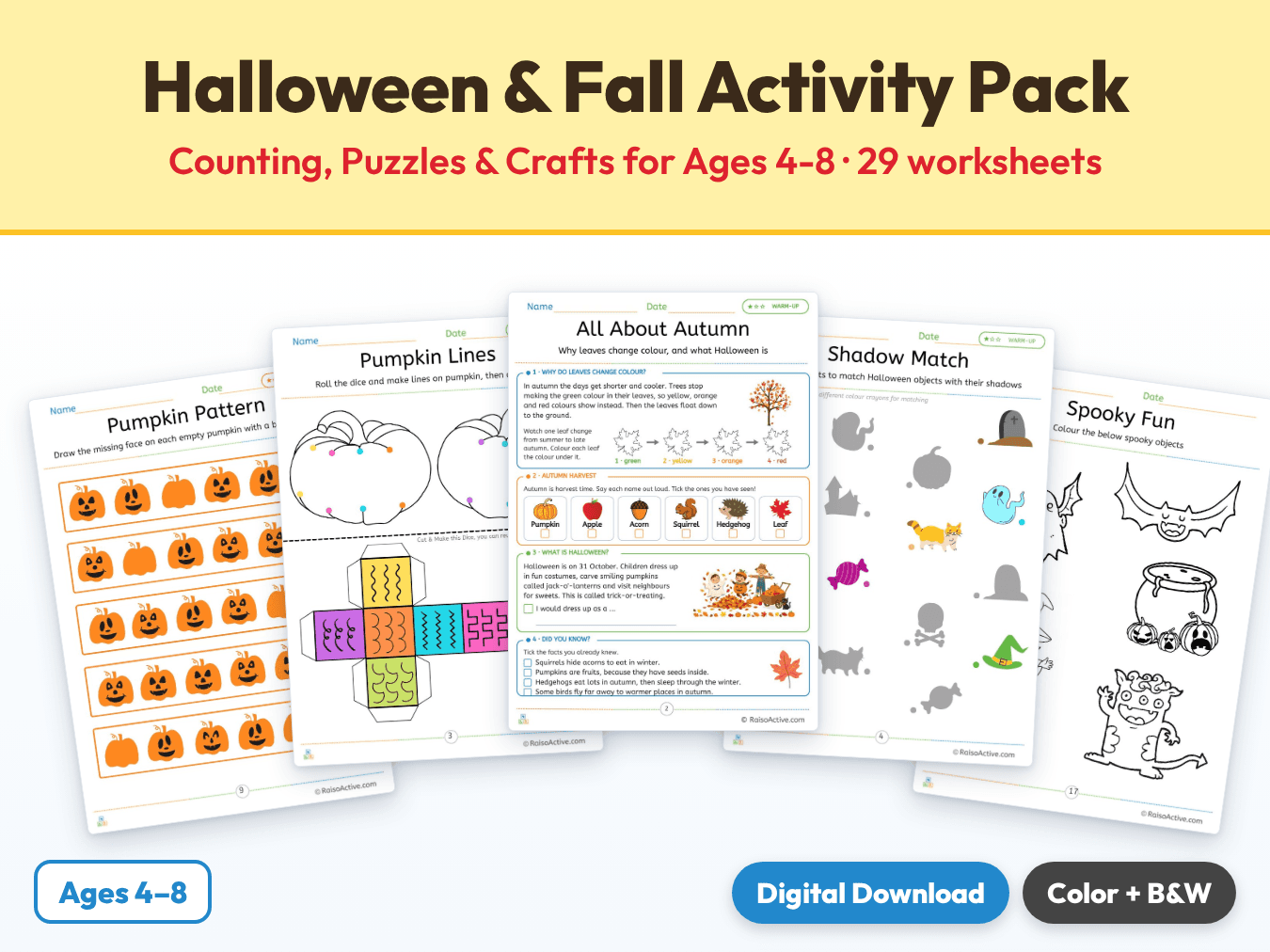
Halloween & Fall Activity Pack: Counting, Puzzles & Crafts for Ages 4-8
This is page 15 of the pack. Ages 4-8 · Pre-K–Grade 2Ages 4-8 · Reception–Year 3Ages 4-8 · LKG–Class 2Ages 4-8

Made for your child
Counting to 10, made for your child
A maths pack with your child's name in it: pictures that explain, practice at three levels, puzzles and story sums about them. Print a new set whenever they finish.
Make a maths packFree preview · free for members
Curriculum
- Cognitive - Attention > Colors & Sorting
How to use this worksheet
Show your child the color key at the top of the page and read each number-to-color pairing aloud together. Have your child roll the die, say the number out loud, and find that number in the key to identify which color to use. Find an uncolored fall image on the page and color it with the matching crayon, then roll again for the next image. Continue rolling and coloring until every fall picture on the page has a color, checking the key together whenever your child is unsure.
Materials needed
- Dice
- Crayons or colored pencils
Extension activities
- 1Make your own color-coded dice game using fall leaves collected outside and a number die.
- 2Sort crayons by color and count how many crayons match each number on the key.
- 3Take a walk outside and count how many different fall colors you can spot on trees and the ground.
- 4Create a second color key using different colors and re-color a fresh copy of the worksheet.
- 5Practice rolling the die and simply naming the number before adding the coloring step, for extra number practice.

Written by
Hemsweta Jain · Teacher Cheena
MBA and Early Childhood Educator, teaching since 2014 · Founder of RaisoActive, Mumbai
Every RaisoActive worksheet is designed and checked by the founder before publishing.
Published · Last reviewed
More from Halloween & Fall Activity Pack: Counting, Puzzles & Crafts for Ages 4-8

Halloween Match: Find and Color the Identical Objects!
Ages 3-5 · Preschool–Pre-KAges 3-5 · Nursery–ReceptionAges 3-5 · Nursery–LKGAges 3-5
This visual discrimination worksheet asks children ages 3-5 to scan a row of similar-looking Halloween objects and identify the two that are truly identical, sharpening their attention to small details like size, shading, and shape. Coloring the matched pair afterward gives a satisfying finishing step while reinforcing which items they correctly identified.

Treat Count Picture Graph: Halloween Data Handling Worksheet
Ages 4-8 · Pre-K–Grade 2Ages 4-8 · Reception–Year 3Ages 4-8 · LKG–Class 2Ages 4-8
Children count five kinds of Halloween treats, record them as a picture graph and read it to compare amounts.

Spooky Vocabulary Worksheet: Fill in the Missing Letters!
Ages 4-6 · Pre-K–KindergartenAges 4-6 · Reception–Year 1Ages 4-6 · LKG–UKGAges 4-6
This worksheet has children ages 4-6 look at a Halloween picture and fill in the missing letters of its matching word, building phonics skills and reinforcing correct spelling patterns for seasonal vocabulary. Because only some letters are missing rather than the whole word, children practice using partial information and sound-based reasoning to complete each word correctly.

All About Autumn: Why Leaves Change Colour and What Halloween Is
Ages 4-8 · Pre-K–Grade 2Ages 4-8 · Reception–Year 3Ages 4-8 · LKG–Class 2Ages 4-8
Children learn that leaves change colour because trees stop making green, meet harvest foods and animals, and find out what Halloween is.

Spider Count Worksheet: Finger Painting Fun for Halloween!
Ages 3-5 · Preschool–Pre-KAges 3-5 · Nursery–ReceptionAges 3-5 · Nursery–LKGAges 3-5
Dabbing fingertips or Q-tips in paint to create the exact number of spiders shown on each web gives children ages 3-5 hands-on practice with one-to-one counting while also strengthening the small hand muscles needed for pencil control later on. Because each web has a target number, children must count as they paint rather than just decorating freely, which reinforces number recognition in a playful, low-pressure way. The messy, sensory nature of finger painting also supports focus and engagement at an age when seated paper-and-pencil tasks can be hard to sustain.

Pumpkin Shapes and Sizes: Halloween Ordering and Shapes Worksheet
Ages 4-8 · Pre-K–Grade 2Ages 4-8 · Reception–Year 3Ages 4-8 · LKG–Class 2Ages 4-8
Children order objects by size, recognise and count triangles, circles, squares and stars, and use shapes to design a face.
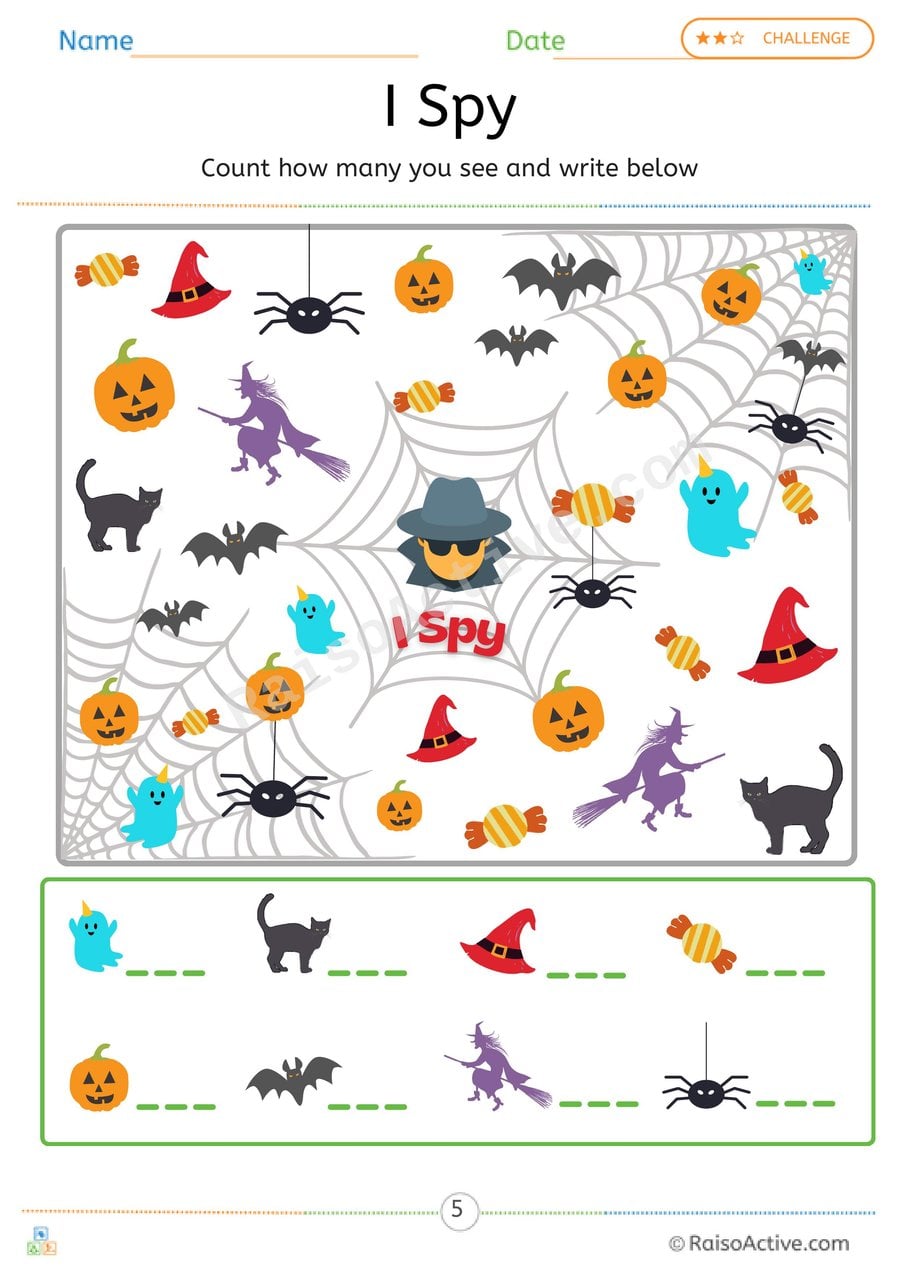
I Spy Halloween Worksheet: Count and Write!
Ages 4-6 · Pre-K–KindergartenAges 4-6 · Reception–Year 1Ages 4-6 · LKG–UKGAges 4-6
This 'I Spy' worksheet has children ages 4-6 scan a busy Halloween scene to count how many of each specific object appear, then write the total as a numeral, combining visual search skills with number-writing practice. Because several object types are mixed together in one picture, children must also stay organized and avoid recounting the same object twice.

Pumpkin Lines Dice Game: Halloween Pre-Writing Worksheet
Ages 4-8 · Pre-K–Grade 2Ages 4-8 · Reception–Year 3Ages 4-8 · LKG–Class 2Ages 4-8
Children practise wavy, zigzag and looped pre-writing lines while playing a simple dice game.
Related worksheets

Color Sorting Fun: Cut and Paste Worksheet for Preschoolers
Ages 3-5 · Preschool–Pre-KAges 3-5 · Nursery–ReceptionAges 3-5 · Nursery–LKGAges 3-5
Sorting cut-out objects by color teaches children ages 3-5 to classify items based on a single shared visual attribute, an early categorization skill that lays groundwork for more advanced sorting and grouping tasks in math and science. The cutting and gluing also reinforces color recognition through repeated, hands-on decision-making rather than passive naming.

Color Sorting Worksheet: Cut and Paste the Pictures!
Ages 3-5 · Preschool–Pre-KAges 3-5 · Nursery–ReceptionAges 3-5 · Nursery–LKGAges 3-5
This worksheet helps children ages 3-5 practice color recognition and sorting by cutting out pictures and gluing each one into the row matching its color. Physically sorting objects by a single shared attribute, like color, builds early categorization skills, while the cutting and gluing strengthens fine motor coordination needed for more complex craft and writing tasks later on.

Color the Circles: Vocabulary Worksheet for Preschoolers
Ages 3-5 · Preschool–Pre-KAges 3-5 · Nursery–ReceptionAges 3-5 · Nursery–LKGAges 3-5
Matching a chart of letter-color pairings to circles below reinforces alphabet recognition for children ages 3-5 while training them to hold a two-step visual instruction in mind — find the letter, then find its color — while coloring.

Color Sorting Worksheet: Cut and Paste the Objects!
Ages 3-5 · Preschool–Pre-KAges 3-5 · Nursery–ReceptionAges 3-5 · Nursery–LKGAges 3-5
This cut-and-paste worksheet has 3-5 year olds identify the color of each pictured object and sort it into the matching color square — a task that requires accurate color recognition rather than guessing, since some colors (teal versus blue, or orange versus red) can be genuinely tricky to distinguish at this age. Cutting the pictures out along their edges and matching each to a labeled color square also builds fine motor control alongside the sorting logic.

Color Sorting Fun: Cut and Paste Worksheet for Preschoolers
Ages 3-5 · Preschool–Pre-KAges 3-5 · Nursery–ReceptionAges 3-5 · Nursery–LKGAges 3-5
This cut-and-paste activity builds color recognition alongside fine motor control, as children use scissors to cut out pictures and glue them into matching color categories. For ages 3-5, sorting by a single attribute like color is an early classification skill that lays the groundwork for later math concepts like grouping and comparing.
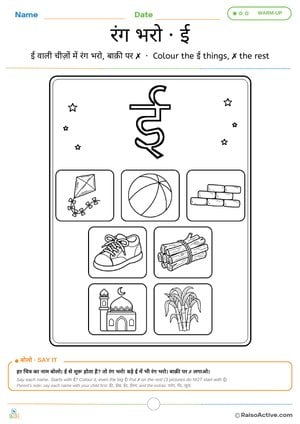
Colour the ई Things: Hindi Letter ई Colouring Page | रंग भरो · ई
Ages 3-7 · Preschool–Grade 1Ages 3-7 · Nursery–Year 2Ages 3-7 · Nursery–Class 1Ages 3-7
Children listen for the first sound of each picture name and decide whether it starts with ई. They colour the ई pictures, cross out the others and colour the big letter.

Navratri Nine Colours Colouring Page: Colour the Garba Dancers
Ages 4-6 · Pre-K–KindergartenAges 4-6 · Reception–Year 1Ages 4-6 · LKG–UKGAges 4-6
Children learn the colour linked with each of the nine days of Navratri 2026 and practise colouring inside the lines.
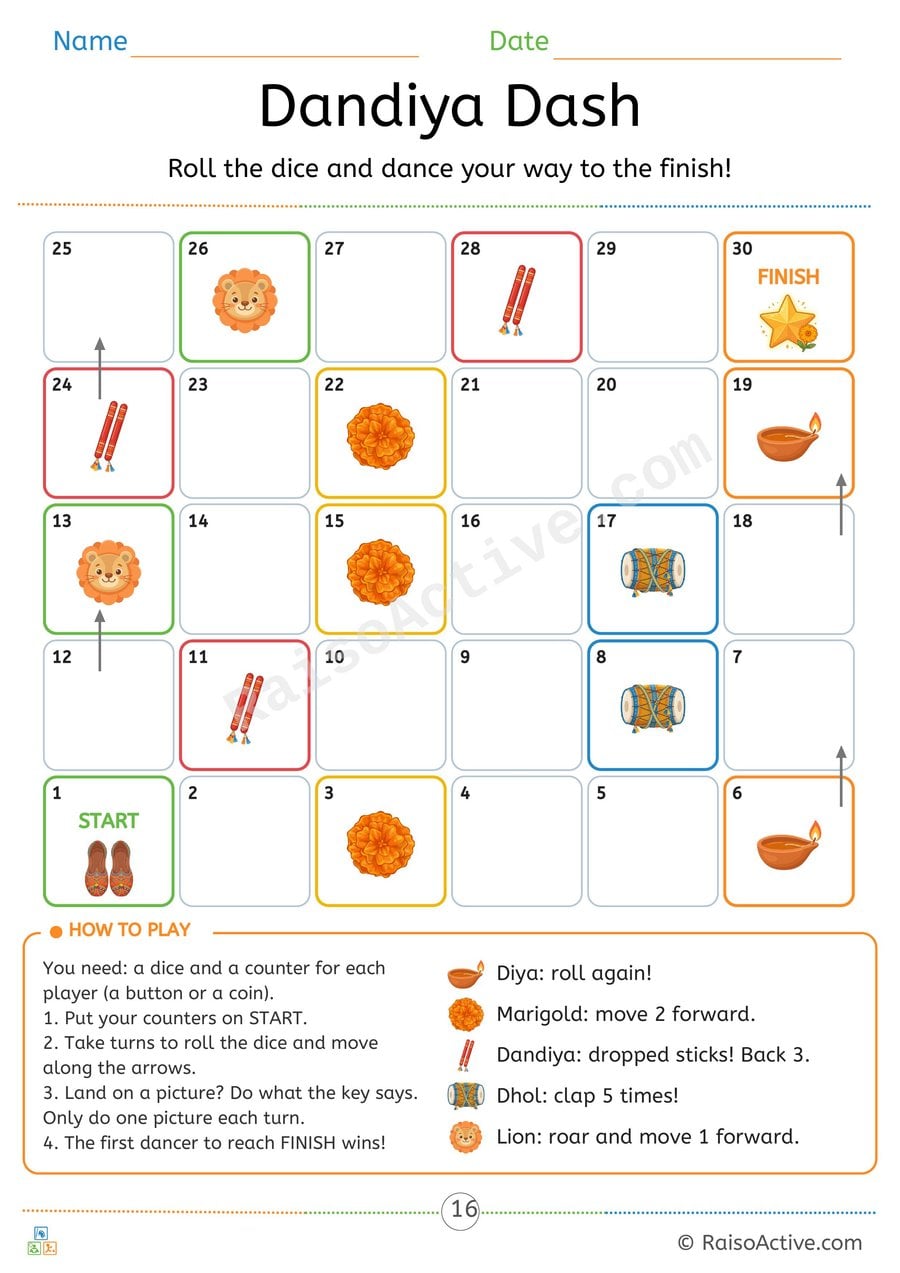
Dandiya Dash: Navratri Board Game for Kids
Ages 4-6 · Pre-K–KindergartenAges 4-6 · Reception–Year 1Ages 4-6 · LKG–UKGAges 4-6
Children count dots on a dice, count on along a number track to 30, take turns and follow simple game rules.
Guides for this topic

Best Worksheets for 3-Year-Olds: What Works and What to Avoid
What works on worksheets for 3-year-olds: short sessions, crayons, tracing lines, matching, cutting, a free weekly plan, and signs one is too advanced.
Fostering Creativity in Structured Learning: The Perfect Balance for Young Minds
Learn how to blend creativity with structured learning for children ages 1-8. Practical strategies, activities, and printable worksheets for parents and teachers.
Christmas and Winter Activities That Combine Fun and Learning: Creating Magical Educational Experiences
Discover Christmas and winter activities that combine festive fun with real learning. Crafts, counting, literacy, and printable worksheets for ages 2 to 8 — perfect for home and school.
Reviews
Every worksheet for ages 3–5, no watermark
Members download the full library of 1,000+ worksheets and every activity pack without watermarks or daily limits. One year costs ₹999 in India or $20 elsewhere.
See membership plansOr download any worksheet free with a watermark (5 a day).