Color Sorting Worksheet: Cut and Paste the Objects!
This cut-and-paste worksheet has 3-5 year olds identify the color of each pictured object and sort it into the matching color square — a task that requires accurate color recognition rather than guessing, since some colors (teal versus blue, or orange versus red) can be genuinely tricky to distinguish at this age. Cutting the pictures out along their edges and matching each to a labeled color square also builds fine motor control alongside the sorting logic.
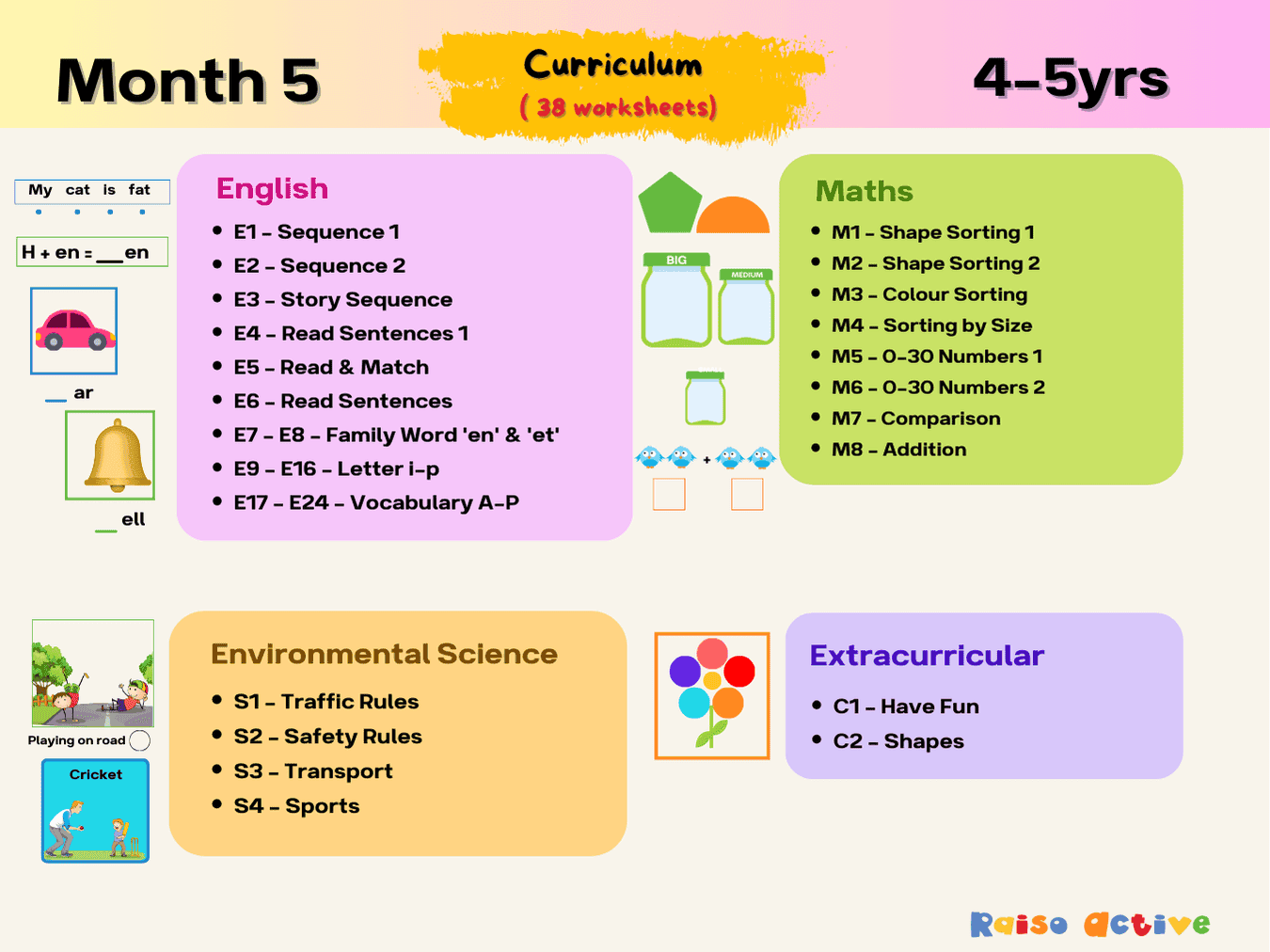
Part of the pack
Month 5: Literacy, Math, Environmental Science | Ages 4-5
This is page 30 of the pack. Ages 4-5 · Pre-KAges 4-5 · ReceptionAges 4-5 · LKGAges 4-5
Curriculum
- Cognitive - Attention > Colors & Sorting
How to use this worksheet
Cut out the pictures at the bottom of the page together, laying them out so your child can see all of them at once. Look at the first picture and ask your child to name its color out loud. Have them find the matching color square and glue the picture into place. Repeat for each remaining picture, checking together at the end that every object landed in the correct color square.
Materials needed
- Scissors
- Glue
- Pencil or Marker (optional)
Extension activities
- 1Go on a color hunt around the house, finding objects that match each color square from the worksheet.
- 2Draw a new picture for one of the colors and explain why it belongs there.
- 3Use playdough to make small objects in different colors and sort them the same way.
- 4Set up color sorting baskets at home for toys and practice regularly.
- 5Play a quick game where you name a color and your child races to find something in the room that matches.

Written by
Hemsweta Jain · Teacher Cheena
MBA and Early Childhood Educator, teaching since 2014 · Founder of RaisoActive, Mumbai
Every RaisoActive worksheet is designed and checked by the founder before publishing.
Published · Last reviewed
More from Month 5: Literacy, Math, Environmental Science | Ages 4-5

First Letter Fun: Identify and Write the Beginning Sounds Worksheet
Ages 4-5 · Pre-KAges 4-5 · ReceptionAges 4-5 · LKGAges 4-5
Naming each pictured object and writing its first letter helps children ages 4-5 practice phonemic awareness, the skill of isolating the very first sound in a word, which is a key building block for spelling and early reading. This worksheet turns that listening skill into a writing task, reinforcing the connection between a spoken sound and its written letter.

Comparing Objects: A Fun Counting Worksheet for Preschoolers!
Ages 4-5 · Pre-KAges 4-5 · ReceptionAges 4-5 · LKGAges 4-5
This worksheet has 4-5 year olds count two groups of objects and then compare the totals using the greater-than, less-than, and equal-to symbols — an early but genuine step into formal math notation that goes beyond simple counting into representing a comparison symbolically. Because your child has to count accurately before comparing, this worksheet also reinforces that math symbols stand for real relationships between quantities, not arbitrary marks to memorize.

First Letter Fun: Identify and Write! A Vocabulary Worksheet for Kids
Ages 4-6 · Pre-K–KindergartenAges 4-6 · Reception–Year 1Ages 4-6 · LKG–UKGAges 4-6
Designed for 4-6 year olds, this worksheet pairs vocabulary building with first-letter phonics — your child has to recognize or learn each pictured object's name and then isolate and write its opening sound, which stretches both spoken vocabulary and early spelling skills together. Because this version targets a slightly older age range, it's a good check for whether your child can move through the naming-and-writing process more independently than a beginning 3-year-old would.

Letter 'i' Tracing and Matching Worksheet for Preschoolers
Ages 3-5 · Preschool–Pre-KAges 3-5 · Nursery–ReceptionAges 3-5 · Nursery–LKGAges 3-5
This worksheet builds recognition of the letter 'i' for 3-5 year olds through tracing, picture matching, and a highlighting activity, giving repeated exposure to both the letter's shape and its sound in a single sitting. Matching objects that start with 'i' alongside the tracing practice connects the visual letter shape to real vocabulary, reinforcing that letters aren't abstract marks but stand for actual sounds your child hears in words they already know.
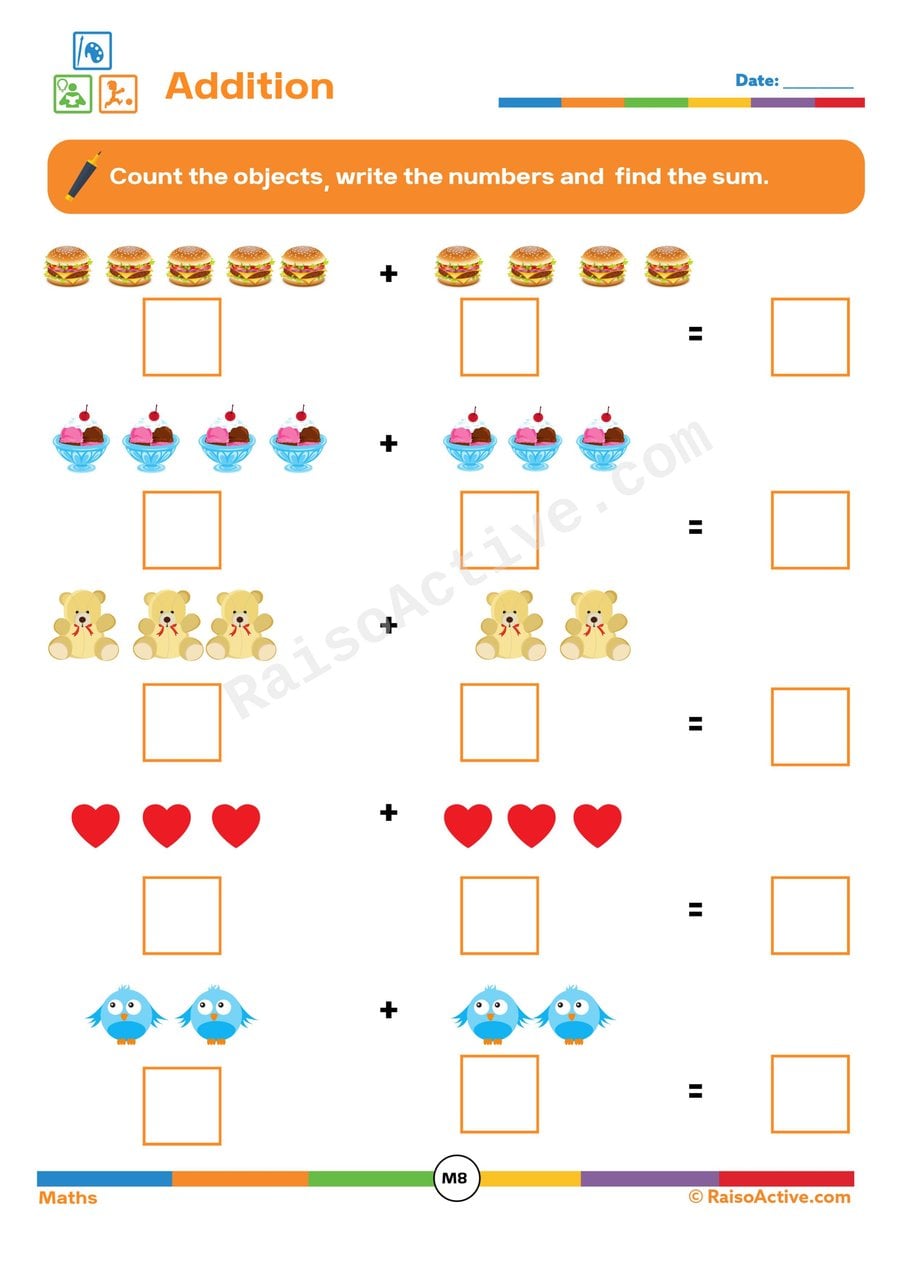
Addition Worksheet: Count and Add!
Ages 4-5 · Pre-KAges 4-5 · ReceptionAges 4-5 · LKGAges 4-5
Counting two separate groups of objects and writing the sum teaches children ages 4-5 the basic concept of addition as combining quantities, an essential foundation for all later arithmetic. Writing the number for each group before adding also reinforces accurate one-to-one counting, since an error there would carry through to the final sum.
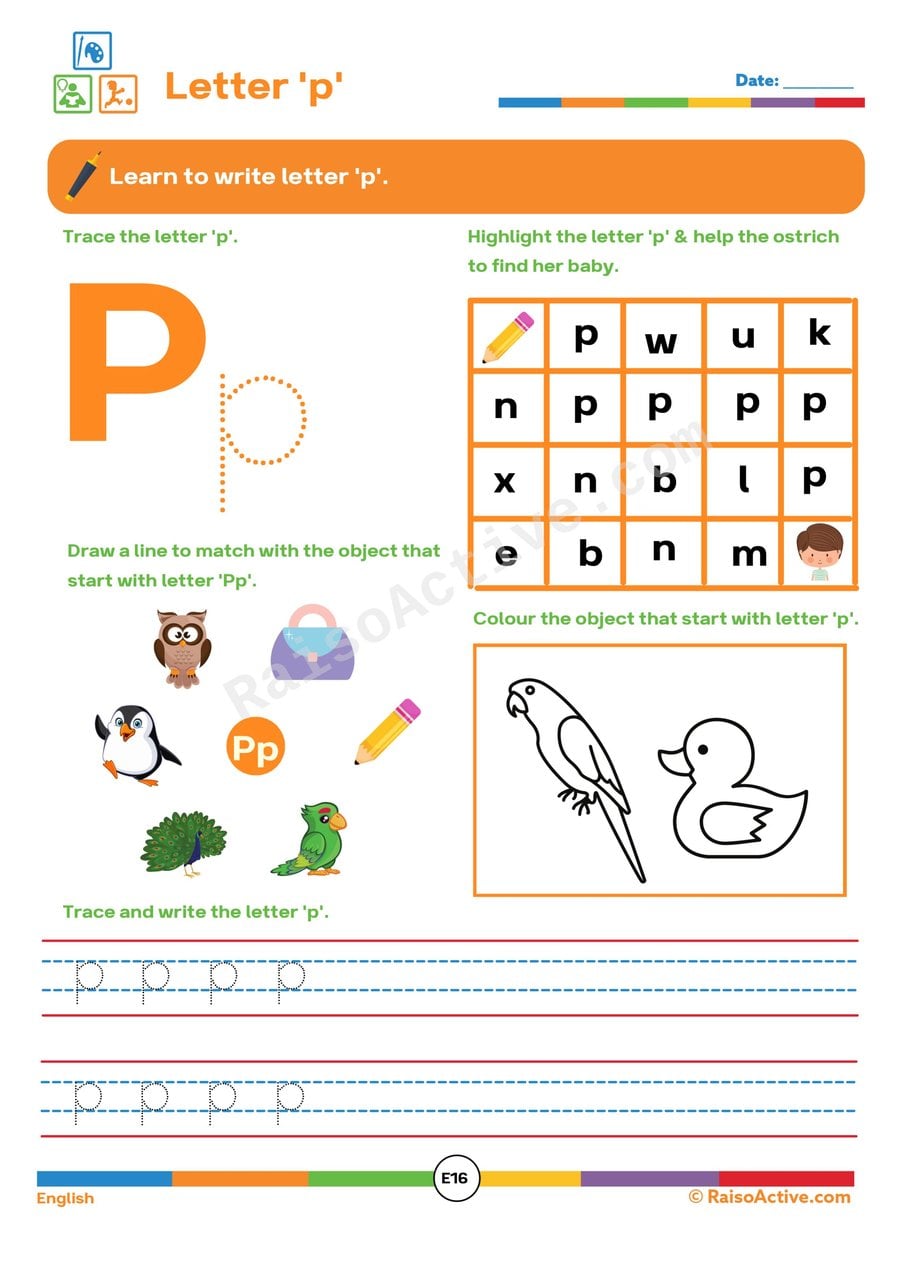
Letter 'p' Fun: Trace, Find, and Color the Letter 'p'!
Ages 3-5 · Preschool–Pre-KAges 3-5 · Nursery–ReceptionAges 3-5 · Nursery–LKGAges 3-5
Tracing both uppercase and lowercase 'p' builds handwriting muscle memory for children ages 3-5, while searching for the letter in a word search sharpens visual discrimination between similar letter shapes. Matching and coloring objects that start with 'p' rounds out the practice by linking the written letter to its spoken sound and real-world examples.
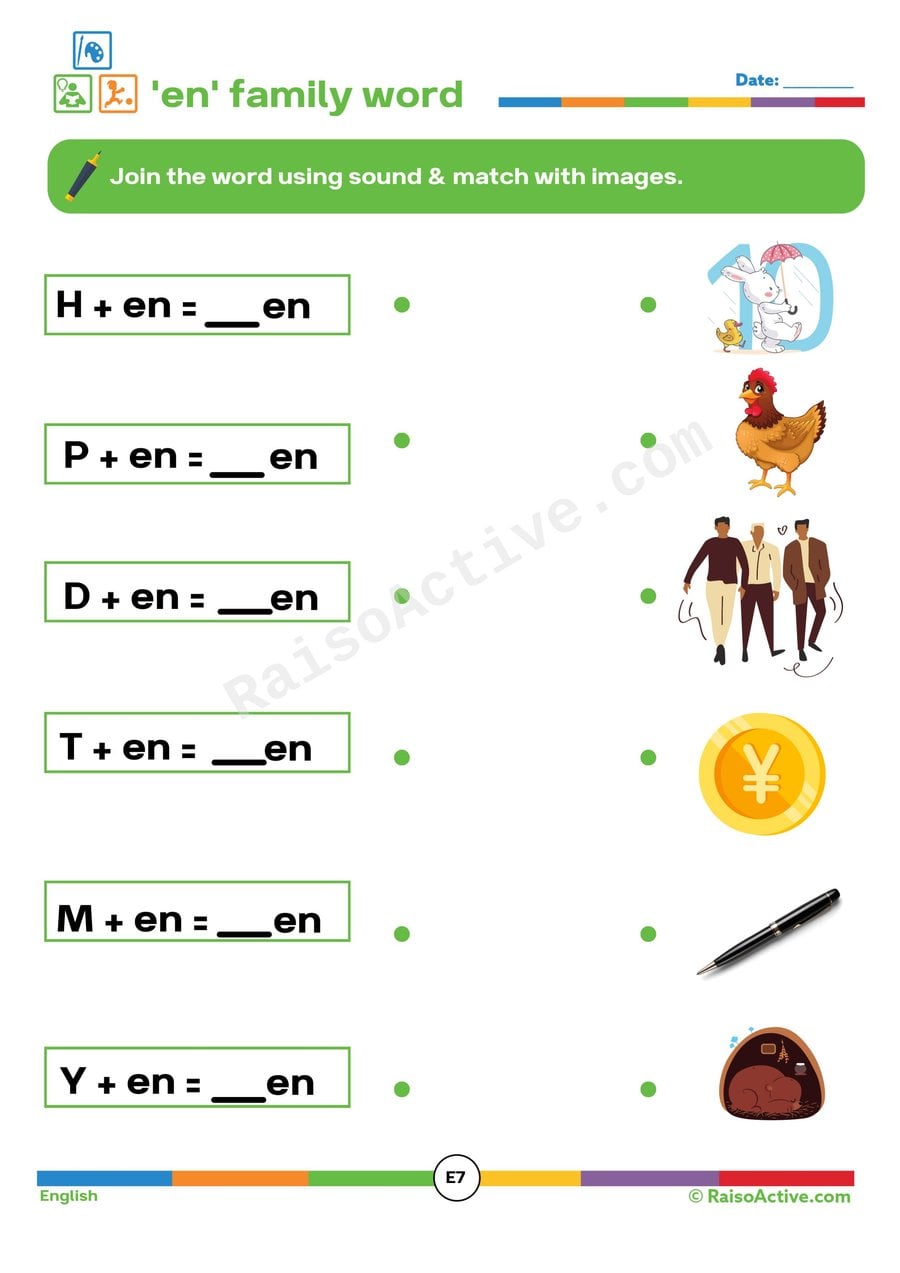
Fun 'en' Family Word Worksheet for Preschoolers
Ages 3-5 · Preschool–Pre-KAges 3-5 · Nursery–ReceptionAges 3-5 · Nursery–LKGAges 3-5
This worksheet introduces 3-5 year olds to the 'en' word family — pen, hen, ten — teaching them that once they know one ending pattern, they can read a whole group of words just by changing the beginning sound. That's a big efficiency gain in early phonics: instead of memorizing each word individually, your child learns to blend a new beginning sound onto a familiar chunk, which is exactly how fluent word-family reading develops.

Learn the Letter 'L': Tracing, Matching, and Coloring Worksheet for Preschoolers
Ages 3-5 · Preschool–Pre-KAges 3-5 · Nursery–ReceptionAges 3-5 · Nursery–LKGAges 3-5
This worksheet builds letter 'L' recognition through tracing, matching, a themed maze that highlights the letter while guiding a lion to its meat, and coloring — a four-part structure that keeps 3-5 year olds engaged across several formats while reinforcing the same letter each time. The maze section in particular adds a playful goal to what would otherwise be repetitive letter-spotting, motivating your child to scan carefully for every 'L' along the path.
Related worksheets

Color Sorting Worksheet: Cut and Paste the Pictures!
Ages 3-5 · Preschool–Pre-KAges 3-5 · Nursery–ReceptionAges 3-5 · Nursery–LKGAges 3-5
This worksheet helps children ages 3-5 practice color recognition and sorting by cutting out pictures and gluing each one into the row matching its color. Physically sorting objects by a single shared attribute, like color, builds early categorization skills, while the cutting and gluing strengthens fine motor coordination needed for more complex craft and writing tasks later on.
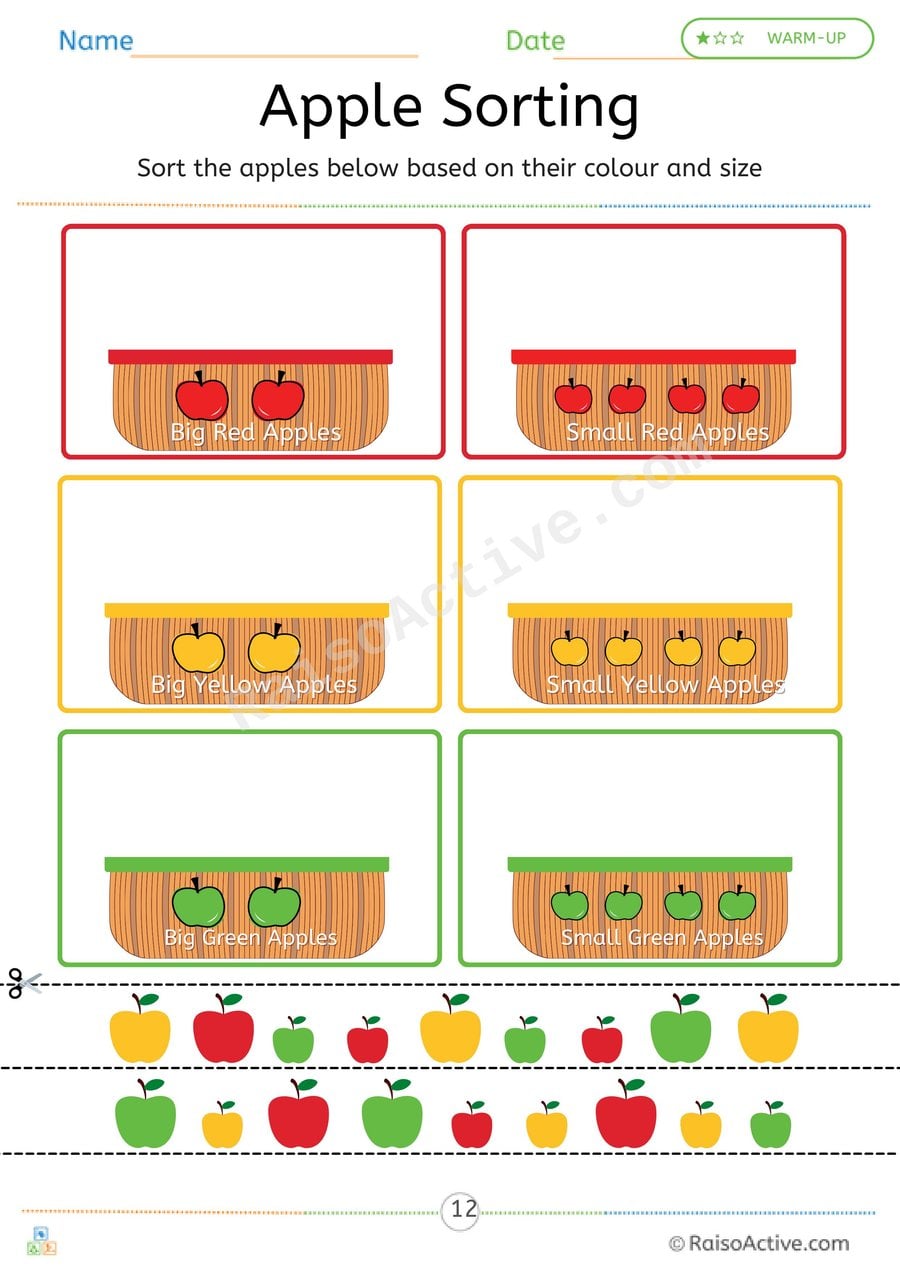
Apple Sorting Worksheet: Color and Size Fun!
Ages 4-6 · Pre-K–KindergartenAges 4-6 · Reception–Year 1Ages 4-6 · LKG–UKGAges 4-6
This sorting worksheet has children ages 4-6 classify a set of cut-out apples by two different attributes, color and size, simultaneously, which builds more advanced categorization skills than sorting by a single trait alone. Deciding which basket an apple belongs in based on two criteria at once also strengthens early logical reasoning.

Color Sorting Fun: Cut and Paste Worksheet for Preschoolers
Ages 3-5 · Preschool–Pre-KAges 3-5 · Nursery–ReceptionAges 3-5 · Nursery–LKGAges 3-5
This cut-and-paste activity builds color recognition alongside fine motor control, as children use scissors to cut out pictures and glue them into matching color categories. For ages 3-5, sorting by a single attribute like color is an early classification skill that lays the groundwork for later math concepts like grouping and comparing.

Color the Circles: Vocabulary Worksheet for Preschoolers
Ages 3-5 · Preschool–Pre-KAges 3-5 · Nursery–ReceptionAges 3-5 · Nursery–LKGAges 3-5
Matching a chart of letter-color pairings to circles below reinforces alphabet recognition for children ages 3-5 while training them to hold a two-step visual instruction in mind — find the letter, then find its color — while coloring.

Fall Colors Dice Game Worksheet for Preschoolers
Ages 3-5 · Preschool–Pre-KAges 3-5 · Nursery–ReceptionAges 3-5 · Nursery–LKGAges 3-5
Rolling a die and matching the number to a color key teaches children ages 3-5 to connect a numeral with a specific color while practicing number recognition up to six in a low-stakes, game-like format. Because the color to use depends entirely on the number rolled, children also build symbolic thinking, understanding that one thing (a number) can stand for another (a color instruction). The chance element of the dice roll adds motivation and turn-taking practice, which supports early self-regulation.

Color Sorting Fun: Cut and Paste Worksheet for Preschoolers
Ages 3-5 · Preschool–Pre-KAges 3-5 · Nursery–ReceptionAges 3-5 · Nursery–LKGAges 3-5
Sorting cut-out objects by color teaches children ages 3-5 to classify items based on a single shared visual attribute, an early categorization skill that lays groundwork for more advanced sorting and grouping tasks in math and science. The cutting and gluing also reinforces color recognition through repeated, hands-on decision-making rather than passive naming.
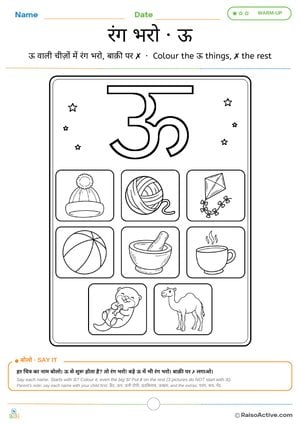
Colour the ऊ Things: Hindi Letter ऊ Colouring Page | रंग भरो · ऊ
Ages 3-7 · Preschool–Grade 1Ages 3-7 · Nursery–Year 2Ages 3-7 · Nursery–Class 1Ages 3-7
Children listen for the first sound of each picture name and decide whether it starts with ऊ. They colour the ऊ pictures, cross out the others and colour the big letter.

Ganesha Colouring Page for Ganesh Chaturthi
Ages 4-8 · Pre-K–Grade 2Ages 4-8 · Reception–Year 3Ages 4-8 · LKG–Class 2Ages 4-8
Children learn that Ganesh Chaturthi celebrates the arrival of Lord Ganesha and that people offer him modaks, his favourite sweet.
Guides for this topic

Best Worksheets for 3-Year-Olds: What Works and What to Avoid
What works on worksheets for 3-year-olds: short sessions, crayons, tracing lines, matching, cutting, a free weekly plan, and signs one is too advanced.

Age-Appropriate Problem-Solving Activities: Building Critical Thinkers from the Ground Up
Discover fun, age-appropriate problem-solving activities for children ages 1-8. Build critical thinking, logic, and reasoning skills through play-based learning.
Fostering Creativity in Structured Learning: The Perfect Balance for Young Minds
Learn how to blend creativity with structured learning for children ages 1-8. Practical strategies, activities, and printable worksheets for parents and teachers.
Reviews
Every worksheet for ages 3–5, no watermark
Members download the full library of 1,000+ worksheets and every activity pack without watermarks or daily limits. One year costs ₹999 in India or $20 elsewhere.
See membership plansOr download any worksheet free with a watermark (5 a day).