Find the Matching Objects! A Fun Sorting Worksheet for Kids
Spotting which objects in a set are truly identical, rather than just similar, sharpens the visual discrimination skills that ages 3-5 need before they can tell apart similarly shaped letters like 'b' and 'd' later on. This sorting worksheet also builds early critical thinking, since children must compare size, color, and shape details across several objects instead of relying on a first glance. Circling only the matching pair(s) in each row teaches them to look carefully before deciding.
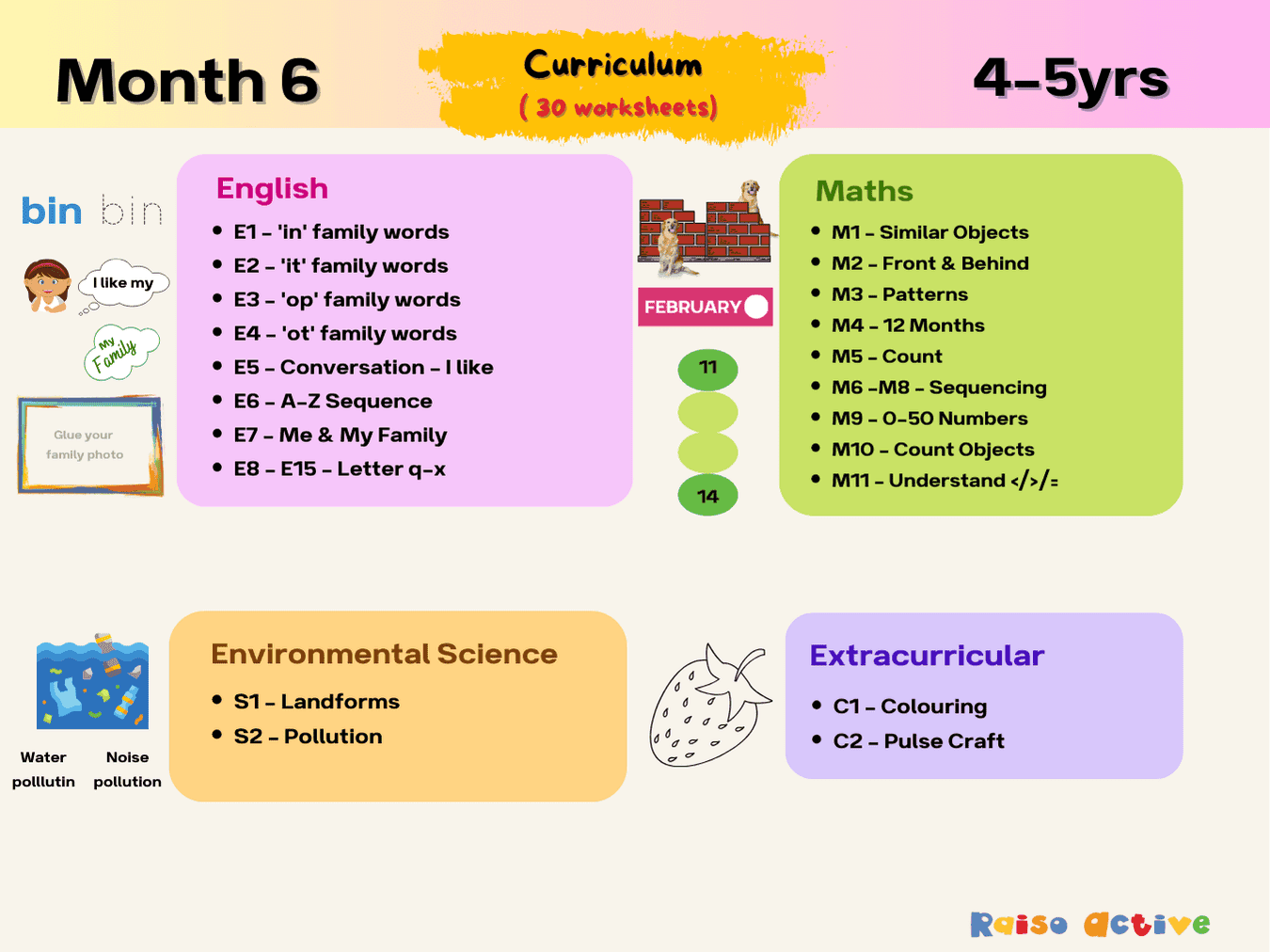
Part of the pack
Month 6: Preschool multi-subject foundational skills | Ages 4-5
This is page 19 of the pack. Ages 4-5 · Pre-KAges 4-5 · ReceptionAges 4-5 · LKGAges 4-5

Made for your child
Counting to 10, made for your child
A maths pack with your child's name in it: pictures that explain, practice at three levels, puzzles and story sums about them. Print a new set whenever they finish.
Make a maths packFree preview · free for members
Curriculum
- 2D Shapes > Shapes & Sorting
How to use this worksheet
Point to the first row of objects and ask your child to name what they see in each picture. Have them look closely at every object's shape, color, and size, comparing them one at a time rather than guessing. Once they've found the two (or more) that are exactly the same, have them circle those matching objects with a pencil or crayon. Move row by row, encouraging your child to explain out loud why the objects they circled match.
Materials needed
- Pencil
- Crayons
Extension activities
- 1Set out pairs of household items, like two identical spoons among mismatched ones, and have your child find the matching pair.
- 2Cut the printed objects apart and turn them into a simple memory-matching card game.
- 3Create a matching game using socks from the laundry basket, asking your child to pair up identical ones.
- 4Give your child two nearly identical drawings with a few small differences and ask them to spot what's different.
- 5Sort toy blocks or buttons by color and shape, discussing which ones are 'the same' and which are 'different.'

Written by
Hemsweta Jain · Teacher Cheena
MBA and Early Childhood Educator, teaching since 2014 · Founder of RaisoActive, Mumbai
Every RaisoActive worksheet is designed and checked by the founder before publishing.
Published · Last reviewed
More from Month 6: Preschool multi-subject foundational skills | Ages 4-5

Color the Fruits Worksheet: Watermelon and Strawberry Fun!
Ages 3-5 · Preschool–Pre-KAges 3-5 · Nursery–ReceptionAges 3-5 · Nursery–LKGAges 3-5
Coloring a watermelon and a strawberry using specific colors in a specific order teaches children ages 3-5 to follow multi-step visual instructions rather than coloring freely, a skill that transfers directly to following classroom directions later on. Staying within the lines of curved fruit shapes also strengthens the fine motor control needed for handwriting, since the small hand movements required are similar. Observing and replicating real fruit coloring, like the red flesh and green rind of a watermelon, builds early observational skills too.

Sequencing Numbers Train Worksheet for Preschoolers
Ages 4-5 · Pre-KAges 4-5 · ReceptionAges 4-5 · LKGAges 4-5
This train-themed worksheet asks children ages 4-5 to fill in missing numbers within a given sequence, which builds a much deeper number sense than simply counting from one — they must recognize what number comes before or after a given value anywhere in the run. Practicing sequencing this way strengthens working memory and prepares children for later mental math skills like skip counting and addition. The train-car format also keeps the abstract task of ordering numbers visually organized and engaging.
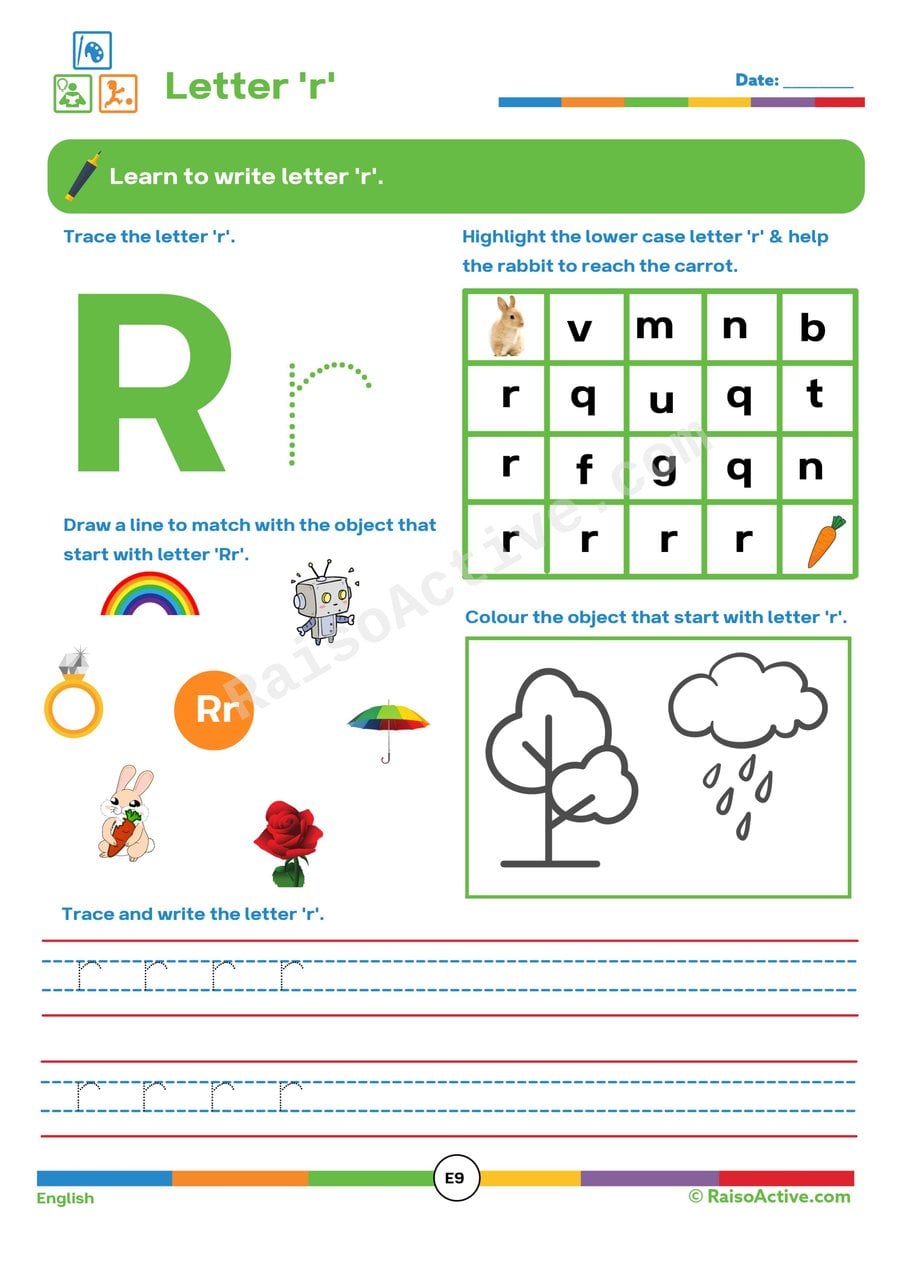
Letter 'r' Worksheet: Trace, Match, and Color!
Ages 3-5 · Preschool–Pre-KAges 3-5 · Nursery–ReceptionAges 3-5 · Nursery–LKGAges 3-5
This multi-part worksheet builds letter recognition for both uppercase and lowercase 'r' through tracing, while the matching and maze-style activities reinforce the beginning 'r' sound through picture identification. For ages 3-5, combining tracing with sound-based matching in one sitting strengthens the connection between a letter's shape and its sound from multiple angles.
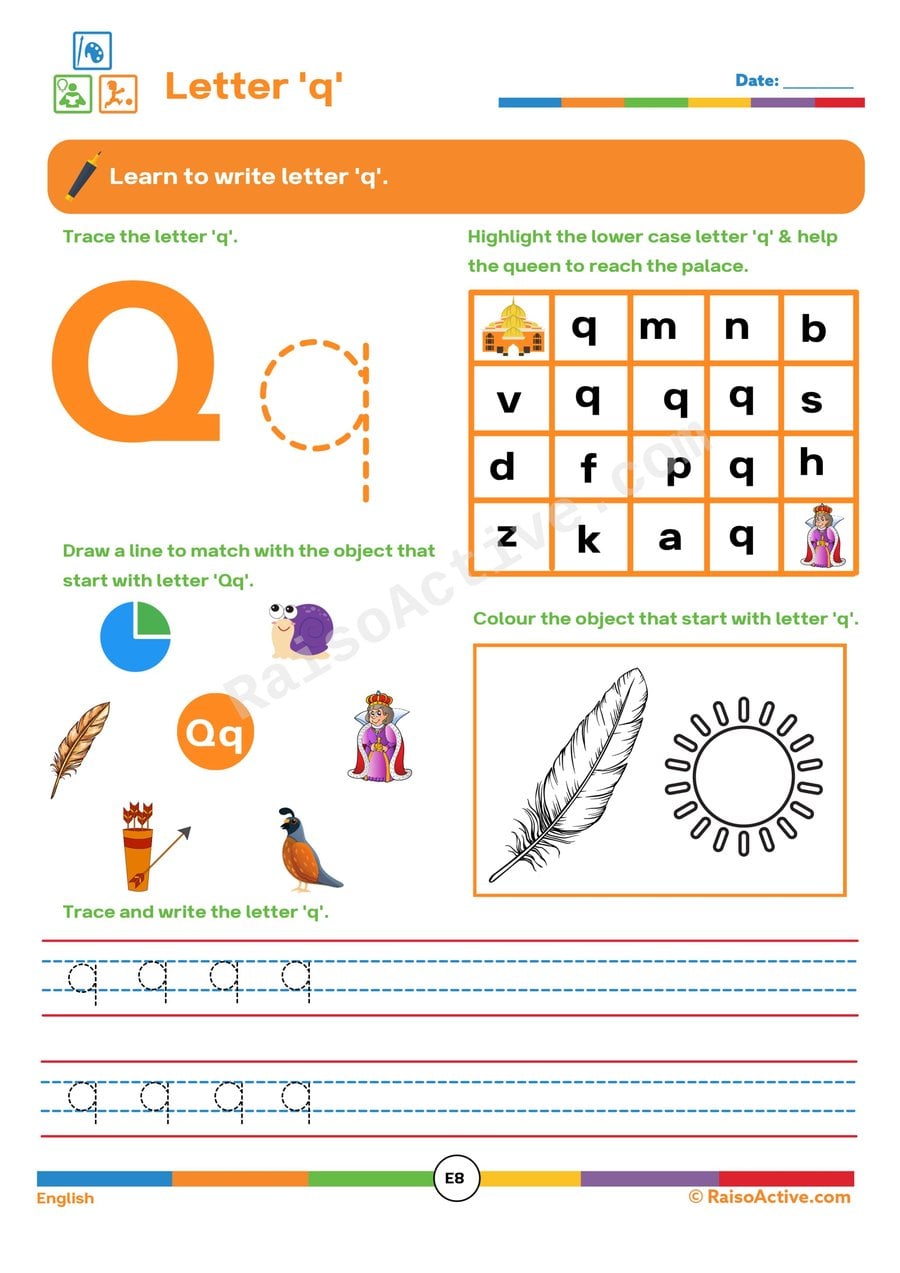
Letter 'q' Worksheet: Trace, Match, and Color!
Ages 3-5 · Preschool–Pre-KAges 3-5 · Nursery–ReceptionAges 3-5 · Nursery–LKGAges 3-5
This worksheet builds letter recognition for 'q' in both its uppercase and lowercase forms for children ages 3-5, a letter that's often trickier than most since it almost always pairs with 'u' and rarely appears alone in early vocabulary. Tracing the letter strengthens the fine motor control for its distinctive tail stroke, while matching and highlighting activities reinforce visual recognition across a busy grid. Helping the queen reach the palace through a simple letter-hunt maze adds a playful, motivating goal to an otherwise repetitive tracing task.

Front and Behind Worksheet: Identifying Positional Words
Ages 3-5 · Preschool–Pre-KAges 3-5 · Nursery–ReceptionAges 3-5 · Nursery–LKGAges 3-5
Understanding 'front' and 'behind' gives children ages 3-5 the spatial vocabulary they need to follow instructions and describe the world around them accurately, an important stepping stone toward later concepts like ordinal position and basic geometry. This worksheet asks them to apply the words to specific pictures rather than just hear them in passing, which cements the connection between the word and the physical relationship it describes. Positional language like this also supports following multi-step directions at home and in the classroom.

Pollution Awareness Worksheet for Kids: Circle the Correct Answer!
Ages 4-6 · Pre-K–KindergartenAges 4-6 · Reception–Year 1Ages 4-6 · LKG–UKGAges 4-6
This worksheet introduces children ages 4-6 to the idea that pollution comes in different forms — air, water, and land — and asks them to connect each type to a picture, building early environmental science vocabulary alongside visual reasoning. Sorting items into recycling categories afterward extends the lesson from simply naming a problem to practicing a real-world solution, which helps young children start to see themselves as capable of taking action. This blend of identification and hands-on sorting suits a preschooler's concrete way of understanding abstract ideas like 'the environment.'
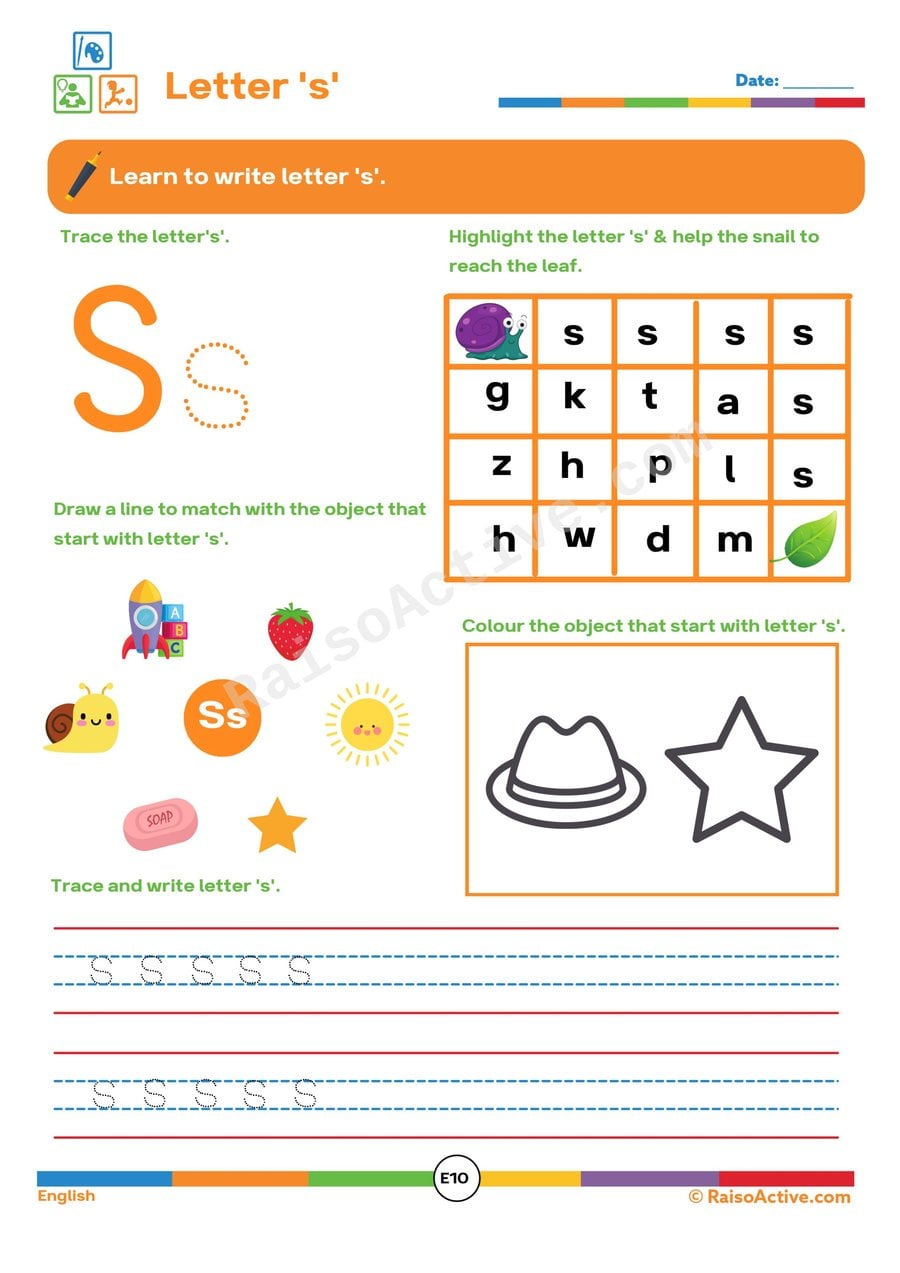
Letter 's' Worksheet: Trace, Match, and Color!
Ages 3-5 · Preschool–Pre-KAges 3-5 · Nursery–ReceptionAges 3-5 · Nursery–LKGAges 3-5
This worksheet gives children ages 3-5 focused practice forming the letter 's,' one of the trickier curved strokes for beginning writers to control with a pencil. Beyond handwriting, matching pictures to the letter and coloring only the 's' objects builds phonemic awareness by linking the letter shape to its /s/ sound at the start of words. Combining tracing, matching, and coloring in one page also keeps a young child's attention across multiple related tasks.

Complete the Pattern: Cut and Paste Worksheet for Preschoolers
Ages 3-5 · Preschool–Pre-KAges 3-5 · Nursery–ReceptionAges 3-5 · Nursery–LKGAges 3-5
Completing a simple visual pattern by cutting and pasting the next correct picture asks children ages 3-5 to notice a repeating rule, such as circle-square-circle-square, and predict what logically comes next — an early and important building block of mathematical and logical thinking. This skill underlies later concepts in math, coding, and even music, all of which rely on recognizing and extending sequences. The cut-and-paste format adds a fine motor and decision-making layer, since children must select the correct piece from several options rather than simply pointing to an answer.
Related worksheets

Navratri Look Closely: Spot the Difference and Shadow Match
Ages 4-6 · Pre-K–KindergartenAges 4-6 · Reception–Year 1Ages 4-6 · LKG–UKGAges 4-6
Children compare two pictures carefully to find what is different and match objects to their shadows by looking at shape.

Problem Solvers: Stop, Think, Choose, Try and Matching the Right Calm Tool
Ages 7-10 · Grade 2–Grade 3Ages 7-10 · Year 3–Year 4Ages 7-10 · Class 2–Class 3Ages 7-10
Children use four steps, Stop, Think, Choose and Try, to help Nia after a spill. They match calm tools to places (class, bed, field, shop) and brainstorm three ideas for a friend who wants a different game.

Feelings Detective for Kids: Clue Cards, Story Order and Draw a Proud Moment
Ages 4-6 · Pre-K–KindergartenAges 4-6 · Reception–Year 1Ages 4-6 · LKG–UKGAges 4-6
Children use body clues (fists, a wobbly tummy, standing tall) and what happened to work out the feeling, put three pictures in order and talk about a proud moment.
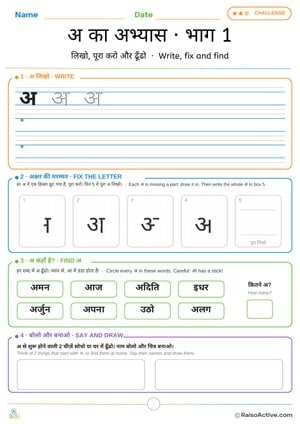
Hindi Letter अ Practice Part 1: Write, Fix and Find | अ का अभ्यास · भाग 1
Ages 3-7 · Preschool–Grade 1Ages 3-7 · Nursery–Year 2Ages 3-7 · Nursery–Class 1Ages 3-7
Children write अ on guide lines, complete four partly drawn letters, circle अ in eight words (while avoiding its look-alike आ), count how many they found, then think of two more words at home that start with अ and draw them.
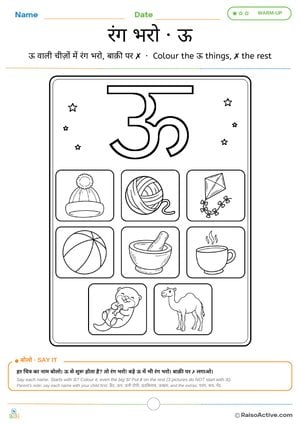
Colour the ऊ Things: Hindi Letter ऊ Colouring Page | रंग भरो · ऊ
Ages 3-7 · Preschool–Grade 1Ages 3-7 · Nursery–Year 2Ages 3-7 · Nursery–Class 1Ages 3-7
Children listen for the first sound of each picture name and decide whether it starts with ऊ. They colour the ऊ pictures, cross out the others and colour the big letter.

Navratri Picture Sudoku and Story Sequencing: Think It Through
Ages 4-6 · Pre-K–KindergartenAges 4-6 · Reception–Year 1Ages 4-6 · LKG–UKGAges 4-6
Children use logic to complete a 4x4 picture sudoku where each row and column has each picture once, and put four story pictures in order.

How Big Is It? Feelings Thermometer and Matching the Size of the Reaction
Ages 7-10 · Grade 2–Grade 3Ages 7-10 · Year 3–Year 4Ages 7-10 · Class 2–Class 3Ages 7-10
Children rank five feelings from coolest to hottest, decide whether a problem is small, medium or big and match the size of the reaction, then think of a reaction that fits a small problem.

Coding Worksheet for Kids: Arrow Codes and Robot Grid
Ages 4-7 · Pre-K–Grade 1Ages 4-7 · Reception–Year 2Ages 4-7 · LKG–Class 1Ages 4-7
Children read arrow codes to move a robot across a grid, write their own arrow code to take the bee to the flower, and spot the one wrong arrow in a code. These are first steps in coding, sequencing and debugging.
Guides for this topic

Best Worksheets for 3-Year-Olds: What Works and What to Avoid
What works on worksheets for 3-year-olds: short sessions, crayons, tracing lines, matching, cutting, a free weekly plan, and signs one is too advanced.

Age-Appropriate Problem-Solving Activities: Building Critical Thinkers from the Ground Up
Discover fun, age-appropriate problem-solving activities for children ages 1-8. Build critical thinking, logic, and reasoning skills through play-based learning.
Critical Thinking Activities That Actually Work for Young Children: Building Tomorrow's Thinkers Today
Discover proven critical thinking activities for young children. Age-wise logic games, questioning techniques, and hands-on ideas to build thinking skills at home.
Reviews
Every worksheet for ages 3–5, no watermark
Members download the full library of 1,000+ worksheets and every activity pack without watermarks or daily limits. One year costs ₹999 in India or $20 elsewhere.
See membership plansOr download any worksheet free with a watermark (5 a day).