
Half and Half Coloring Worksheet for Preschoolers
Completing the missing half of a symmetrical picture teaches children ages 3-5 an early concept of symmetry — that one side of an image should mirror the other — while giving them focused practice matching lines, curves, and proportions by eye. This visual-matching skill supports both drawing development and the spatial reasoning children will later use in shape and geometry work.
Part of the pack
Month 3: Learning & Development | Ages 6-7Curriculum
How to use this worksheet
Look at the completed half of each picture together and describe what you see — its shape, size, and where the lines start and end. Ask your child to draw the missing half on the blank side, matching the lines as closely as they can to create a whole, balanced picture. Encourage them to check their drawing against the finished half before moving on. Once both halves are drawn, let your child color the entire completed picture.
Materials needed
- Pencil
- Crayons
Extension activities
- •Fold a piece of paper in half, paint one side, then press it closed to make a symmetrical 'ink blot' picture together.
- •Look for symmetrical objects around the house, like a butterfly picture, a face, or a table, and talk about their matching sides.
- •Draw a simple half-shape on paper and challenge your child to complete the other half freehand.
- •Cut a paper heart or butterfly by folding paper in half first and cutting one edge, then unfolding to reveal the symmetrical shape.
- •Use a small mirror held along the center line of a half-picture to show your child what the completed image should look like.
Tips for parents and teachers
Symmetry is a genuinely tricky visual skill at this age, so expect the drawn half to be a rough approximation rather than a precise mirror image — that's developmentally normal. If your child is stuck, help them find a reference point, like 'the line starts at the top and curves down to here.' Praise their attempt at matching before pointing out any differences, and let the coloring step be pure creative fun.

Written by
Hemsweta Jain · Teacher Cheena
MBA and Early Childhood Educator, teaching since 2014 · Founder of RaisoActive, Mumbai
Every RaisoActive worksheet is designed and checked by the founder before publishing.
Published · Last reviewed
Related worksheets
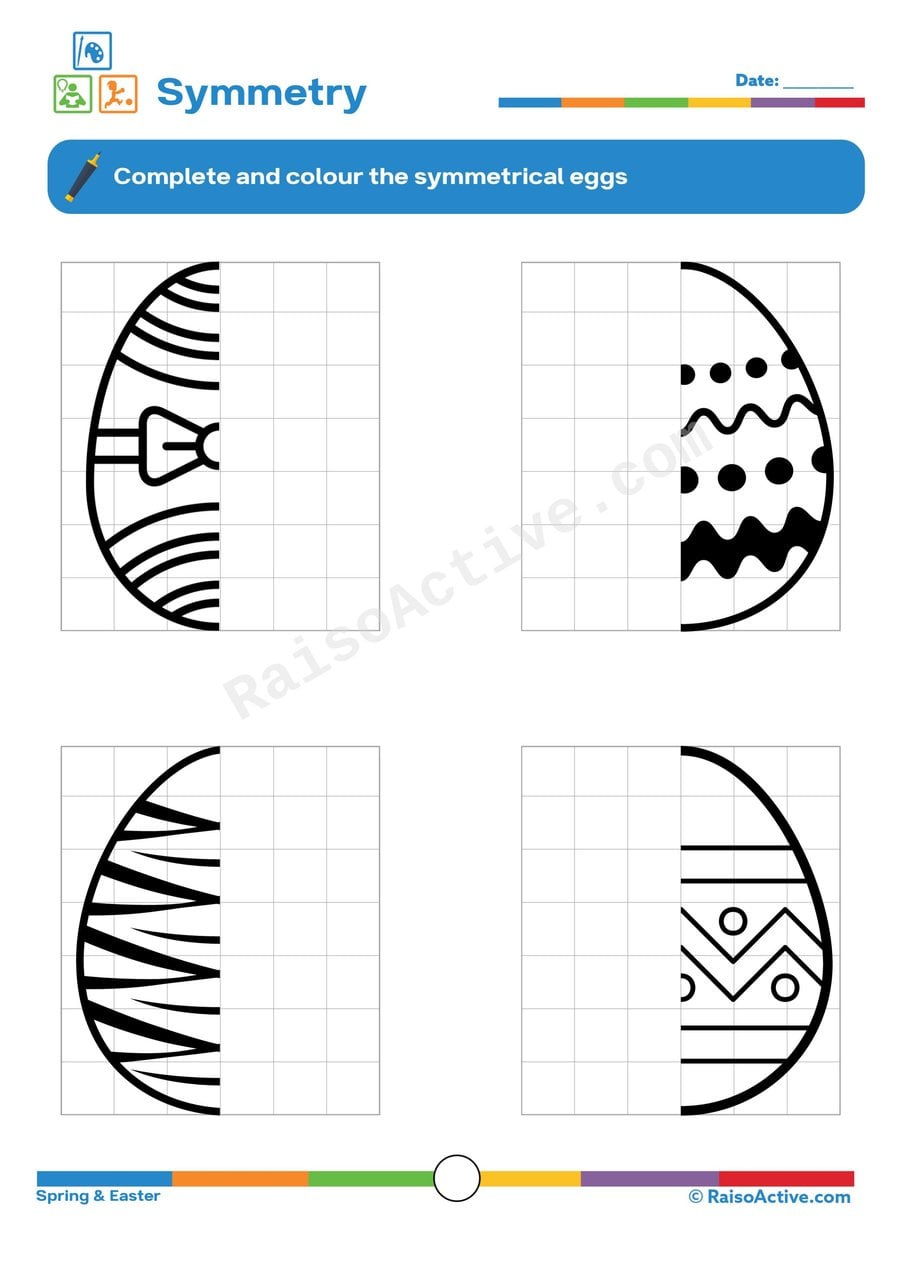
Symmetry Eggs Worksheet for Preschoolers
This worksheet introduces children ages 4-6 to the concept of symmetry by having them complete the missing mirrored half of an egg design. Drawing a matching reflection requires children to closely observe shape, size, and placement on one side and reproduce it accurately on the other — an early geometry skill that also sharpens visual attention to detail.

Elephant Shapes: Fun Sorting Worksheet for Preschoolers!
This playful sorting worksheet has children ages 3-5 use an elephant's 'trunk' (their own hand reaching through a cut circle) to pick and sort shapes, building both shape recognition and simple classification skills. Physically selecting and grouping shapes by type, rather than just naming them on sight, helps solidify the concept that shapes can share a category even when their size or color differs.
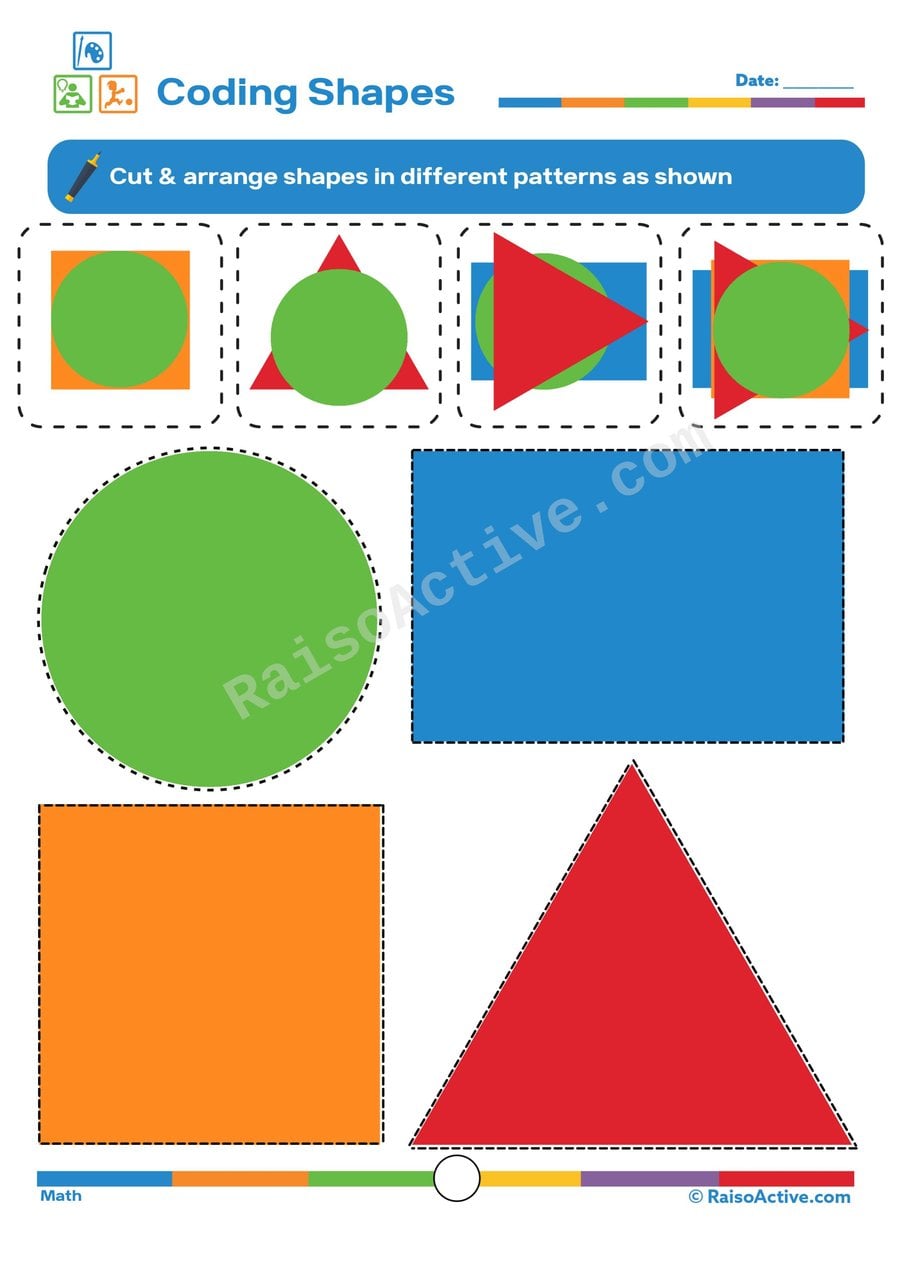
Coding Shapes Worksheet: Cut and Arrange Shapes!
This cut-and-paste worksheet has children ages 3-5 recreate example shape sequences by cutting out individual pieces and arranging them to match, combining shape recognition with the ordered, step-by-step thinking used in early coding and pattern logic. The physical act of cutting and precisely placing each piece also strengthens fine motor control and spatial planning.

3D Shapes Worksheet: Explore and Learn with Playdough!
This worksheet teaches children ages 4-6 the basic components of 3D shapes — vertices, edges, and faces — by having them count each feature on shapes like cubes and cones, then build matching shapes out of playdough. Physically constructing a shape and counting its parts by hand builds a far deeper understanding of geometry than looking at flat pictures alone, since children can touch and rotate what they've made.
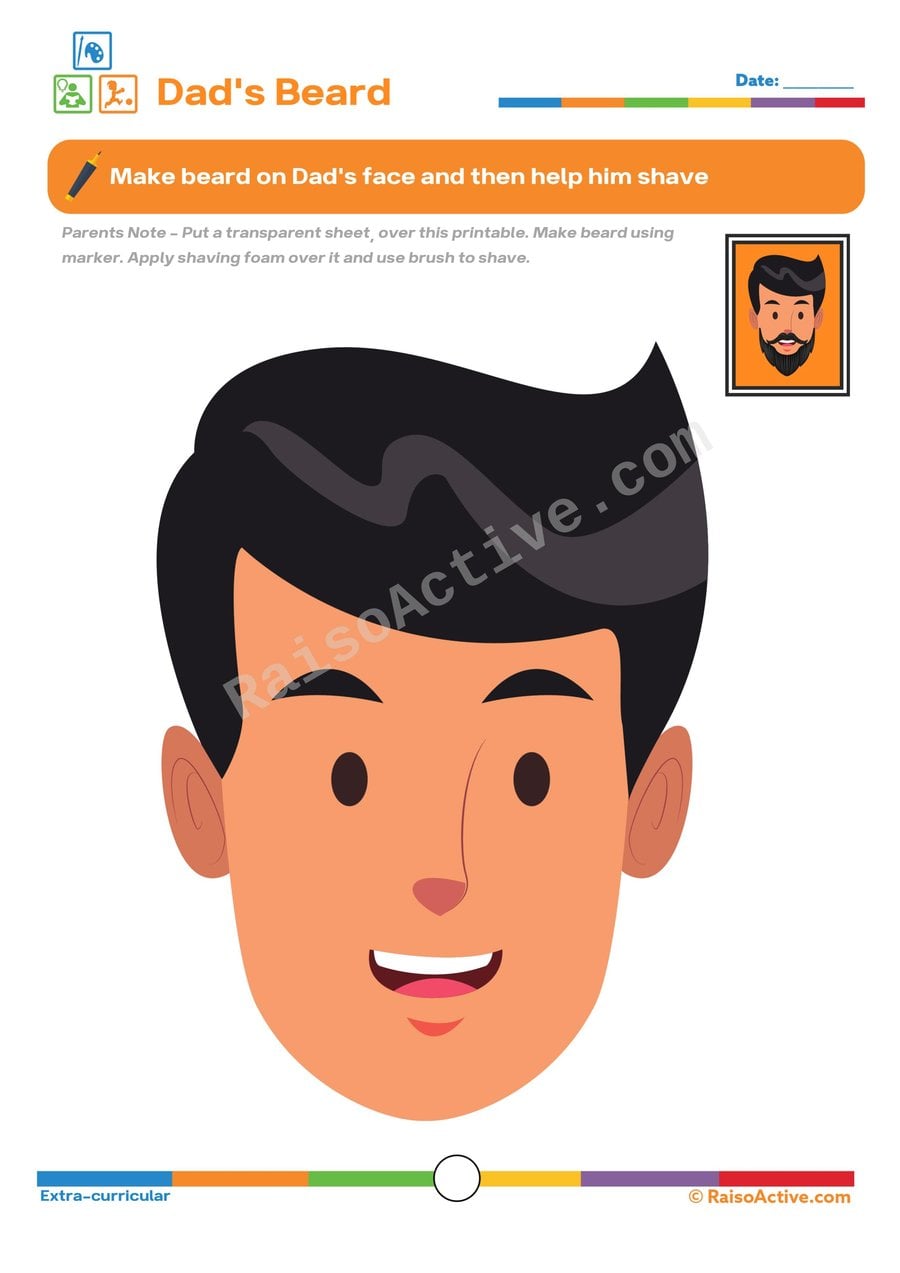
Dad's Beard: A Fun Shaving Activity for Kids!
This sensory pretend-shaving activity builds fine motor precision and hand control in children ages 3-5, as they draw a beard with a marker and then carefully brush away shaving foam in controlled strokes. Beyond motor skills, it gives children a playful, low-stakes way to imitate a grown-up grooming routine they've likely observed at home.

Coding Shapes Worksheet for Preschoolers: Cut and Paste Patterns
This cut-and-paste activity has children ages 3-5 recreate shape sequences shown in sample boxes, combining shape recognition with the same ordered, step-by-step thinking used in beginner coding concepts. Cutting out individual shapes and arranging them in the correct sequence also builds fine motor precision and spatial planning.

Find and Draw India's Major Rivers Worksheet for Kids
This activity teaches children ages 5-8 to locate and draw ten of India's major rivers on a blank map, building map-reading skills and geographic memory of the country's physical features. Translating a written list into hand-drawn lines on a map also strengthens the connection between abstract information (a river's name and rough course) and concrete spatial representation.

Coloring Worksheet: Identify and Color the Symbols!
This worksheet introduces children ages 3-5 to national symbols by having them color each one and then match or write its name from a list of options. Beyond fine motor coloring practice, naming each symbol builds early cultural knowledge and category-matching skills, since children must connect a picture to the correct word rather than color at random.
Guides for this topic
Number Formation Rhymes 0–9 and How to Fix Reversals
Original number formation rhymes for 0–9, the correct stroke order for each digit, why 3, 5 and 7 get reversed most often, and multisensory fixes that work.
Pre-Writing Strokes in Order: From Standing Lines to Loops (With Printable Patterns)
The developmental order of pre-writing strokes, from vertical lines to loops, and why practicing them in sequence makes letter formation much easier to learn.
Kindergarten Readiness Checklist: 25 Skills to Practice Before the First Day
A kindergarten readiness checklist of 25 literacy, math, motor, self-regulation and self-help skills, with an 8-week summer plan and notes on when not to worry.
Reviews
Every worksheet for ages 3–5, no watermark
Members download the full library of 1,000+ worksheets and every activity pack without watermarks or daily limits. One year costs ₹1,000 in India or $20 elsewhere.
See membership plansOr download any worksheet free with a watermark (5 a day).