Inside My Brain: Guard Dog and Wise Owl Hand-Brain Activity
Children meet two story helpers: the guard dog, who keeps us safe fast, and the wise owl, who thinks and chooses. They make a hand model, sort eight thoughts and choose calm tools that help the owl come back.
Part of the pack
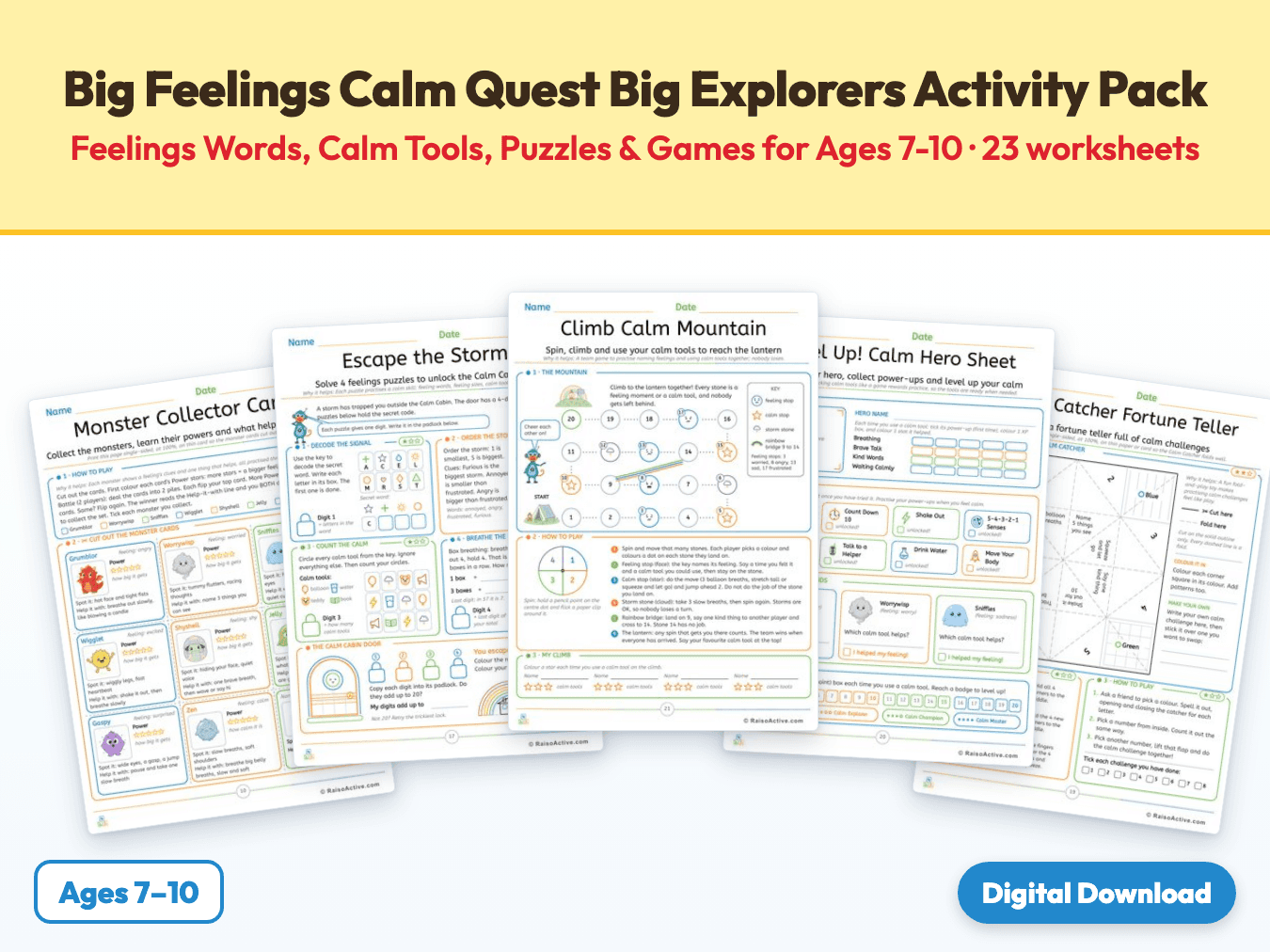
Big Feelings Calm Quest Big Explorers Activity Pack: Feelings Words, Calm Tools, Puzzles & Games for Ages 7-10
This is page 6 of the pack. Ages 7-10 · Grade 2–Grade 3Ages 7-10 · Year 3–Year 4Ages 7-10 · Class 2–Class 3Ages 7-10
How to use this worksheet
Follow the four steps to make the hand brain, tick 'I tried it', then write D or O for each thought. Finish the four sentences with calm tools and a grown-up who can help.
Materials needed
- Pencil
- Crayons
Extension activities
- 1Teach the hand brain to a friend or sibling.
- 2Draw the guard dog and wise owl.

Written by
Hemsweta Jain · Teacher Cheena
MBA and Early Childhood Educator, teaching since 2014 · Founder of RaisoActive, Mumbai
Every RaisoActive worksheet is designed and checked by the founder before publishing.
Published · Last reviewed
More from Big Feelings Calm Quest Big Explorers Activity Pack: Feelings Words, Calm Tools, Puzzles & Games for Ages 7-10

Mixed Feelings Lab: Feeling Potions and Leo's Feelings Line Graph
Ages 7-10 · Grade 2–Grade 3Ages 7-10 · Year 3–Year 4Ages 7-10 · Class 2–Class 3Ages 7-10
Children learn that we can feel two things at once (excited and nervous, sad and happy). They match potions to moments, plot a line graph of Leo's day and explain the biggest change.

Calm Catcher Fortune Teller: Fold a Paper Fortune Teller of Calm Challenges
Ages 7-10 · Grade 2–Grade 3Ages 7-10 · Year 3–Year 4Ages 7-10 · Class 2–Class 3Ages 7-10
Children cut and fold a fortune teller (cootie catcher) whose eight flaps hold calm challenges: balloon breaths, name five things you see, stretch tall, squeeze and let go, say one kind thing and more.

Body Clues and Triggers: Spot the Early Warning Signs Before a Feeling Gets Big
Ages 7-10 · Grade 2–Grade 3Ages 7-10 · Year 3–Year 4Ages 7-10 · Class 2–Class 3Ages 7-10
Children label body clues (racing heart, hot face, tight fists, butterflies, tears, shaky legs), tick the feeling six situations might give them, and list their own early warning signs for anger.

Feelings Word Search and Secret Code: Find Ten Words and Crack the Calm Code
Ages 7-10 · Grade 2–Grade 3Ages 7-10 · Year 3–Year 4Ages 7-10 · Class 2–Class 3Ages 7-10
Children find ten feeling words (across, down and diagonal) in a grid, use a symbol key to decode a calm message, and write their own message in code.

Escape the Storm! A Feelings Escape Room Puzzle Worksheet
Ages 7-10 · Grade 2–Grade 3Ages 7-10 · Year 3–Year 4Ages 7-10 · Class 2–Class 3Ages 7-10
Children solve four mini puzzles (a picture code, ordering by size, counting calm tools and box breathing arithmetic) to get four digits, then check that the digits add up to 20.

Feelings Word Wheel: 24 Feeling Words in Six Families and How Big Each One Feels
Ages 7-10 · Grade 2–Grade 3Ages 7-10 · Year 3–Year 4Ages 7-10 · Class 2–Class 3Ages 7-10
Children build a richer feelings vocabulary with 24 words in six colour-coded families, from annoyed to furious and content to overjoyed. They learn that words in a family are cousins, not the same.

Choose Your Path: The Volcano Morning Story with Choices and Endings
Ages 7-10 · Grade 2–Grade 3Ages 7-10 · Year 3–Year 4Ages 7-10 · Class 2–Class 3Ages 7-10
Children follow a branching story: Leo's sister breaks his rocket and a feeling like a volcano rises. Each choice leads to one of four endings, and children pick out the calm tools and write a new ending.

Feelings Detective Case Files: A Logic Clue Puzzle and Case Notes
Ages 7-10 · Grade 2–Grade 3Ages 7-10 · Year 3–Year 4Ages 7-10 · Class 2–Class 3Ages 7-10
Children use clues to cross out and work out who feels proud, nervous, disappointed or relieved, then read three case notes and decide the feeling and the best clue: face, body or what happened.
Related worksheets
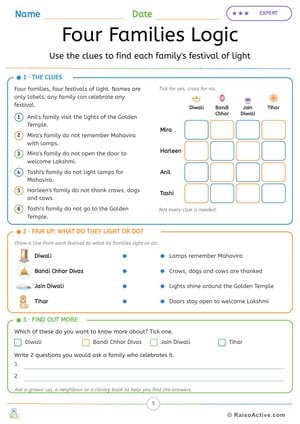
Four Families Logic: Diwali Festivals Logic Grid Puzzle
Ages 7-10 · Grade 2–Grade 3Ages 7-10 · Year 3–Year 4Ages 7-10 · Class 2–Class 3Ages 7-10
Children use six clues to solve a logic grid with four families and four festivals of light, then draw lines to match each festival to what its families light or do and write two questions to ask.

Calm Path Board Game with a Make-Your-Own Calm Die
Ages 4-6 · Pre-K–KindergartenAges 4-6 · Reception–Year 1Ages 4-6 · LKG–UKGAges 4-6
Children play a cooperative game with feeling squares, storm squares, rainbow squares and kind hearts. They practise naming feelings, using calm tools such as balloon breaths and squeezing and letting go, and saying kind words.

Flip-a-Feeling Finger Puppets: Two-Sided Puppets and a Puppet Show
Ages 4-6 · Pre-K–KindergartenAges 4-6 · Reception–Year 1Ages 4-6 · LKG–UKGAges 4-6
Children build eight finger puppets that each show two feelings (sad to happy, angry to calm, scared to brave, worried to excited). A short puppet show helps them practise a calm tool and flip the feeling.

Feelings Puzzles: Spot 5 Differences, Odd One Out and Face Patterns
Ages 4-6 · Pre-K–KindergartenAges 4-6 · Reception–Year 1Ages 4-6 · LKG–UKGAges 4-6
Children practise looking closely with a spot-the-difference picture, find the face that shows a different feeling in each row, and finish simple face patterns (AB, AAB and ABC).

Feelings Detective for Kids: Clue Cards, Story Order and Draw a Proud Moment
Ages 4-6 · Pre-K–KindergartenAges 4-6 · Reception–Year 1Ages 4-6 · LKG–UKGAges 4-6
Children use body clues (fists, a wobbly tummy, standing tall) and what happened to work out the feeling, put three pictures in order and talk about a proud moment.
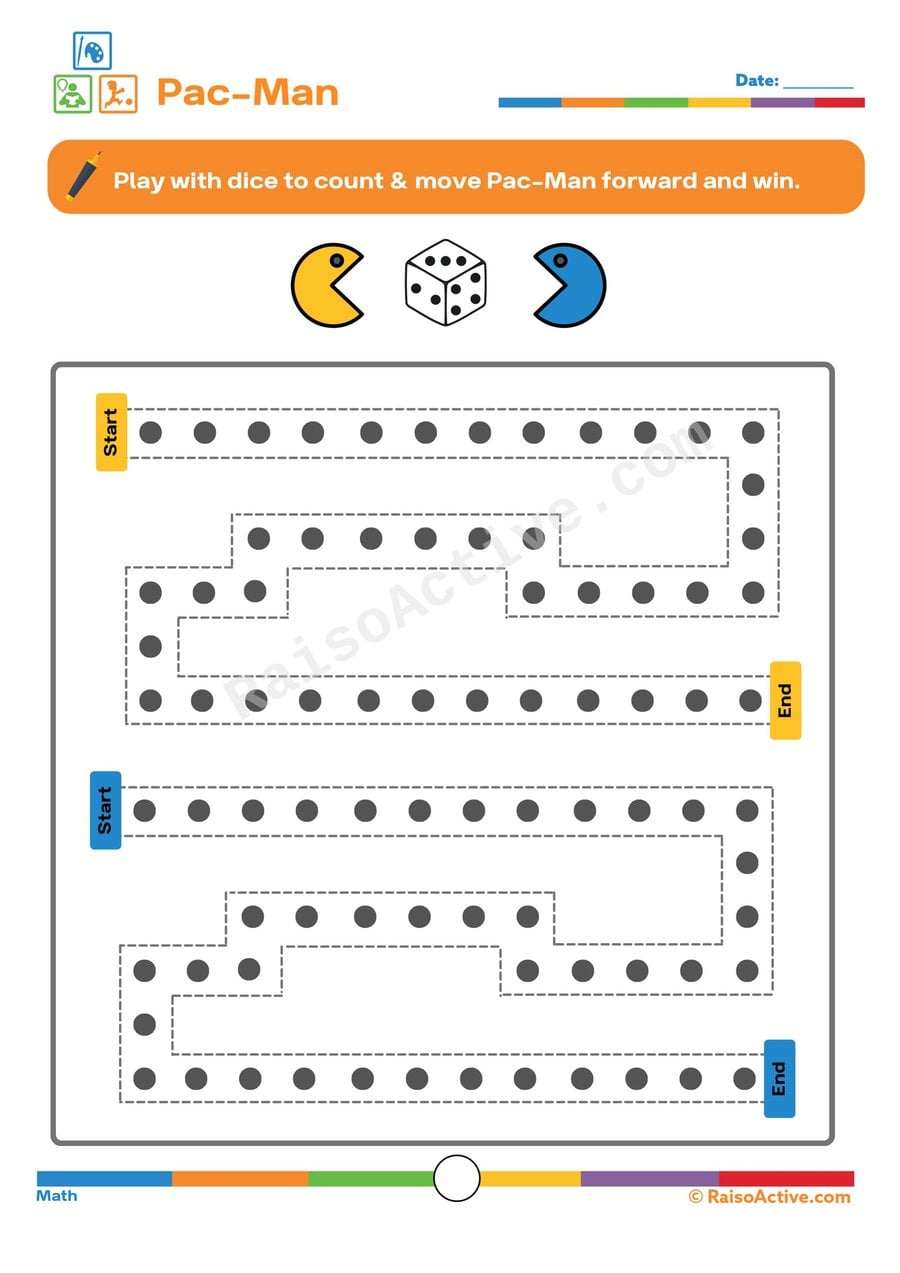
Pac-Man Maze Worksheet: Count and Move!
Ages 3-5 · Preschool–Pre-KAges 3-5 · Nursery–ReceptionAges 3-5 · Nursery–LKGAges 3-5
This dice-driven maze combines counting practice with path-following for children ages 3-5, since they must accurately count dots on a die before moving Pac-Man the matching number of spaces forward. Deciding how far to move and staying on the correct path also builds early strategic thinking, as children track their current position within the maze after each turn.

Elephant Shapes: Fun Sorting Worksheet for Preschoolers!
Ages 3-5 · Preschool–Pre-KAges 3-5 · Nursery–ReceptionAges 3-5 · Nursery–LKGAges 3-5
This playful sorting worksheet has children ages 3-5 use an elephant's 'trunk' (their own hand reaching through a cut circle) to pick and sort shapes, building both shape recognition and simple classification skills. Physically selecting and grouping shapes by type, rather than just naming them on sight, helps solidify the concept that shapes can share a category even when their size or color differs.

Coding Worksheet for Kids: Arrow Codes and Robot Grid
Ages 4-7 · Pre-K–Grade 1Ages 4-7 · Reception–Year 2Ages 4-7 · LKG–Class 1Ages 4-7
Children read arrow codes to move a robot across a grid, write their own arrow code to take the bee to the flower, and spot the one wrong arrow in a code. These are first steps in coding, sequencing and debugging.
Guides for this topic

Resources for Children with Multiple Disabilities: A Comprehensive Guide for Families
Discover essential resources for children with multiple disabilities. Therapies, inclusive learning, assistive technology, and printable activities for ages 1-8.
Understanding Standardized Testing in Early Childhood: A Parent's Guide to Assessment Balance
Learn how standardised tests work in early childhood, when they help, when they harm, and how to balance formal assessment with observation-based learning.

Age-Appropriate Problem-Solving Activities: Building Critical Thinkers from the Ground Up
Discover fun, age-appropriate problem-solving activities for children ages 1-8. Build critical thinking, logic, and reasoning skills through play-based learning.
Reviews
Every worksheet for ages 7–10, no watermark
Members download the full library of 1,000+ worksheets and every activity pack without watermarks or daily limits. One year costs ₹999 in India or $20 elsewhere.
See membership plansOr download any worksheet free with a watermark (5 a day).