
Lifecycle Circle Book: Cut & Paste Activity for Young Learners
Children ages 3-5 compare and sequence the life cycles of two different animals — frogs and turtles — by assembling circular 'lifecycle books' for each. This side-by-side approach helps children notice that not all animals grow the same way, building early skills in comparison and scientific observation.
Curriculum
How to use this worksheet
Start by looking at the frog and turtle images together and naming each stage shown. Have your child cut out the circles for each animal, keeping the frog and turtle sets separate. Guide them to arrange and glue each set of circles in the correct life cycle order — for example, egg, tadpole, froglet, and adult frog. Once both circle books are complete, ask your child to compare them: which animal's babies look most different from the adult?
Materials needed
- Scissors
- Glue
- Pencil
Extension activities
- •Watch tadpoles in a local pond, if possible, and observe how they change over several weeks.
- •Draw your own two-animal comparison chart showing a frog's and a turtle's life cycle side by side.
- •Read a picture book about frogs or turtles and pause to identify each life stage.
- •Create a turtle shell craft using a paper plate and compare its size to a real turtle egg.
- •Research another animal with a very different-looking baby stage, such as a ladybug or butterfly.
Tips for parents and teachers
Encourage your child to spot differences, not just similarities, between the frog and turtle cycles — this comparison skill is more advanced than single-animal sequencing. If cutting two sets of circles feels like a lot, split the activity across two short sessions rather than rushing through both at once. Praise their attention to detail when gluing circles in the correct rotating order.

Written by
Hemsweta Jain · Teacher Cheena
MBA and Early Childhood Educator, teaching since 2014 · Founder of RaisoActive, Mumbai
Every RaisoActive worksheet is designed and checked by the founder before publishing.
Published · Last reviewed
Related worksheets
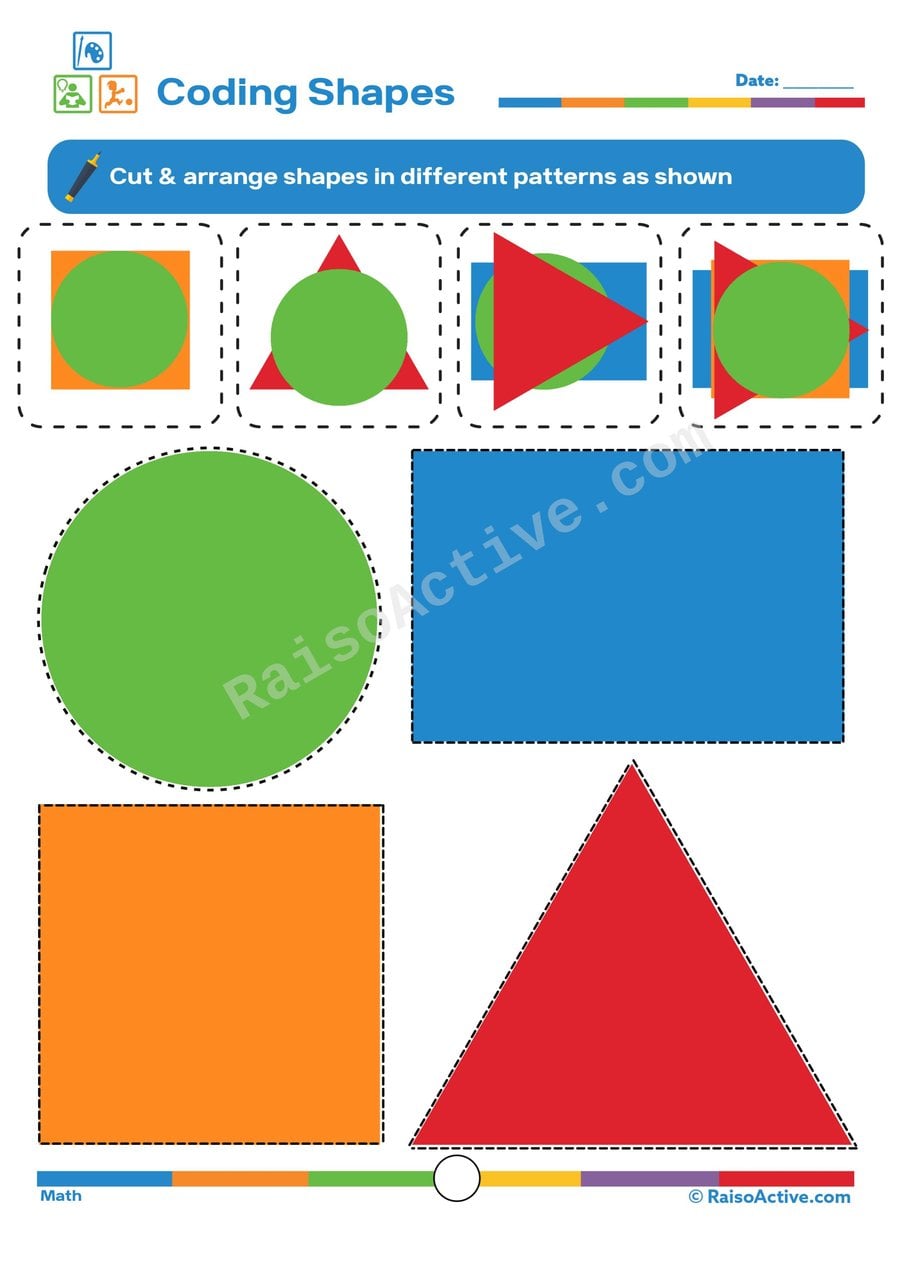
Coding Shapes Worksheet: Cut and Arrange Shapes!
This cut-and-paste worksheet has children ages 3-5 recreate example shape sequences by cutting out individual pieces and arranging them to match, combining shape recognition with the ordered, step-by-step thinking used in early coding and pattern logic. The physical act of cutting and precisely placing each piece also strengthens fine motor control and spatial planning.

Coding Shapes Worksheet for Preschoolers: Cut and Paste Patterns
This cut-and-paste activity has children ages 3-5 recreate shape sequences shown in sample boxes, combining shape recognition with the same ordered, step-by-step thinking used in beginner coding concepts. Cutting out individual shapes and arranging them in the correct sequence also builds fine motor precision and spatial planning.

Christmas Cut and Paste Worksheet for Preschoolers
Cutting out a moon, snowman, gifts, and trees and arranging them inside a circle builds scissor precision and compositional thinking in children ages 3-5. Because there's no single 'correct' layout, children also practice early creative decision-making — choosing where each element belongs within a bordered space, which supports spatial awareness.

Rocking Santa Card Craft Worksheet for Preschoolers
This rocking Santa card craft has children ages 3-5 cut out individual shape pieces and assemble them onto a folded card base, combining scissor control with an early understanding of how folding creates movement, since the 'rocking' effect comes from the card's fold. Following the assembly steps in order also reinforces sequencing and attention to visual instructions.
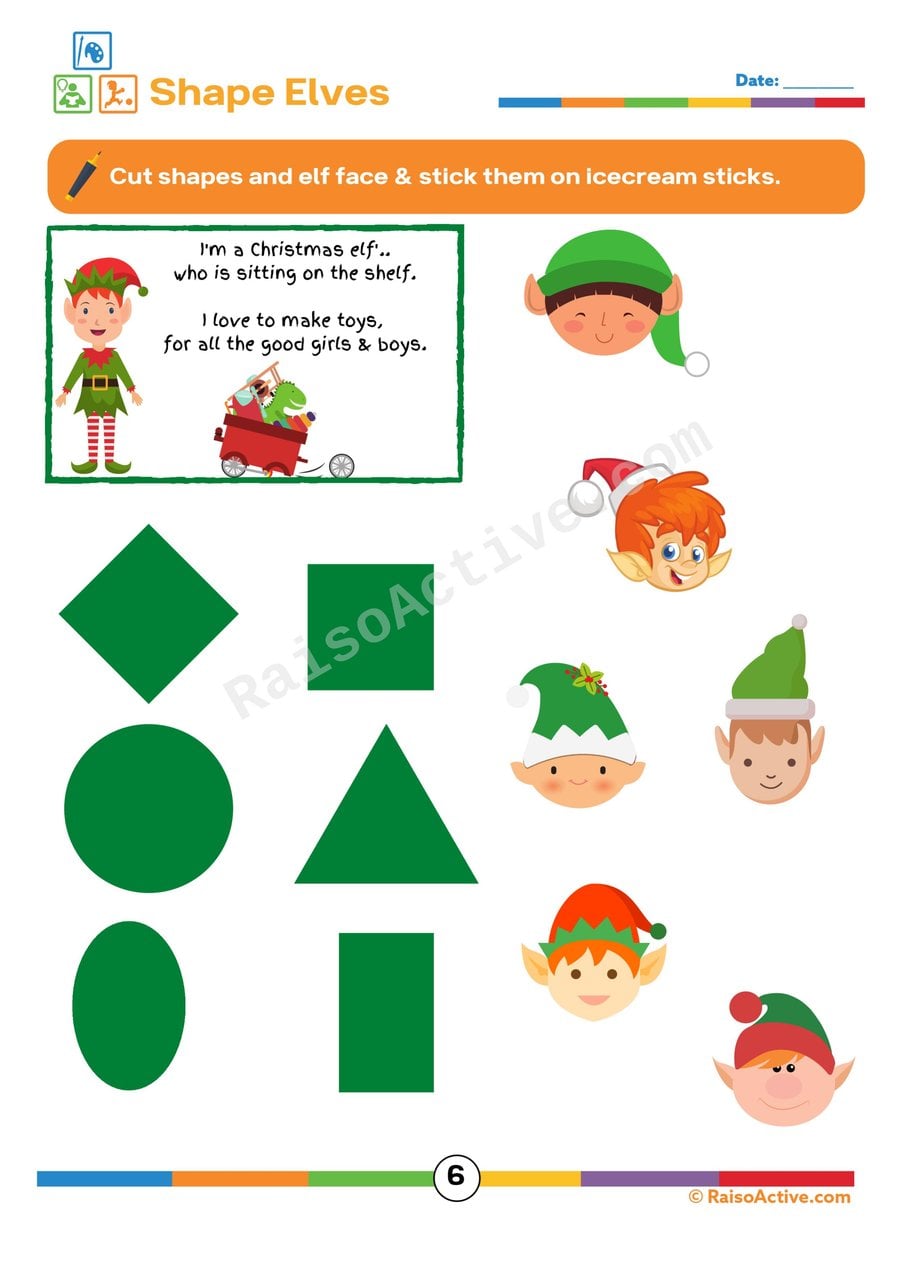
Shape Elves Worksheet: Cut, Paste, and Create!
Cutting out circles, triangles, and rectangles to assemble an elf face teaches children ages 3-5 to recognize and name basic 2D shapes while practicing scissor control along both straight and curved lines. Because each shape has to go in a specific spot to form a recognizable face, children also build spatial reasoning as they figure out which shape works as eyes, a nose, or a hat. Turning geometry into a craft project makes an abstract math concept feel like creative play.

Decorate the Christmas Tree! Cut and Paste Worksheet
This cut-and-paste activity builds scissor control and hand strength in children ages 3-5 as they snip out ornaments, stars, and lights to decorate their own Christmas tree. Deciding where each decoration goes also develops spatial planning and following a visual guide, since children compare their tree to the sample image while placing pieces.

Spring Sudoku Worksheet: Cut and Paste Puzzle for Kids
Placing cut-out pictures into a sudoku-style grid so that no image repeats in any row, column, or box teaches children ages 4-6 early logical reasoning and systematic thinking, since they must check multiple directions before deciding where each piece belongs. Cutting out the small picture squares beforehand also builds scissor control and hand-eye coordination. Together, this combines a pre-math logic puzzle with fine motor practice in a single spring-themed activity.

Human Skeleton Cut and Join Worksheet for Preschoolers
This hands-on worksheet introduces children ages 4-6 to basic human anatomy as they cut out individual bone shapes, like the skull, ribs, arms, and legs, and assemble them into a complete skeleton. Beyond scissor control, the activity requires spatial reasoning, since children must figure out where each bone belongs relative to the others to build an accurate body shape.
Guides for this topic
Coding Activities for Preschoolers: Building Tomorrow's Thinkers Today
Discover 15+ unplugged and screen-based coding activities for preschoolers that build sequencing, logic, and problem-solving skills through play. NEP 2020 aligned.
Christmas and Winter Activities That Combine Fun and Learning: Creating Magical Educational Experiences
Discover Christmas and winter activities that combine festive fun with real learning. Crafts, counting, literacy, and printable worksheets for ages 2 to 8 — perfect for home and school.
Creating Engaging Themed Learning Units for Young Children: A Complete Guide to Integrated Learning
Discover how to create engaging themed learning units for young children that integrate literacy, maths, science, and art — with practical examples and free worksheets.
Reviews
Every worksheet for ages 3–5, no watermark
Members download the full library of 1,000+ worksheets and every activity pack without watermarks or daily limits. One year costs ₹1,000 in India or $20 elsewhere.
See membership plansOr download any worksheet free with a watermark (5 a day).