Match the Life Stages: A Fun Worksheet for Kids!
This worksheet has children ages 3-5 match a picture of an animal to the correct life stage shown on the opposite side of the page, reinforcing that living things look different depending on how old they are. Coloring the pictures after matching adds a fine motor component and gives children a reason to look closely at each image a second time.
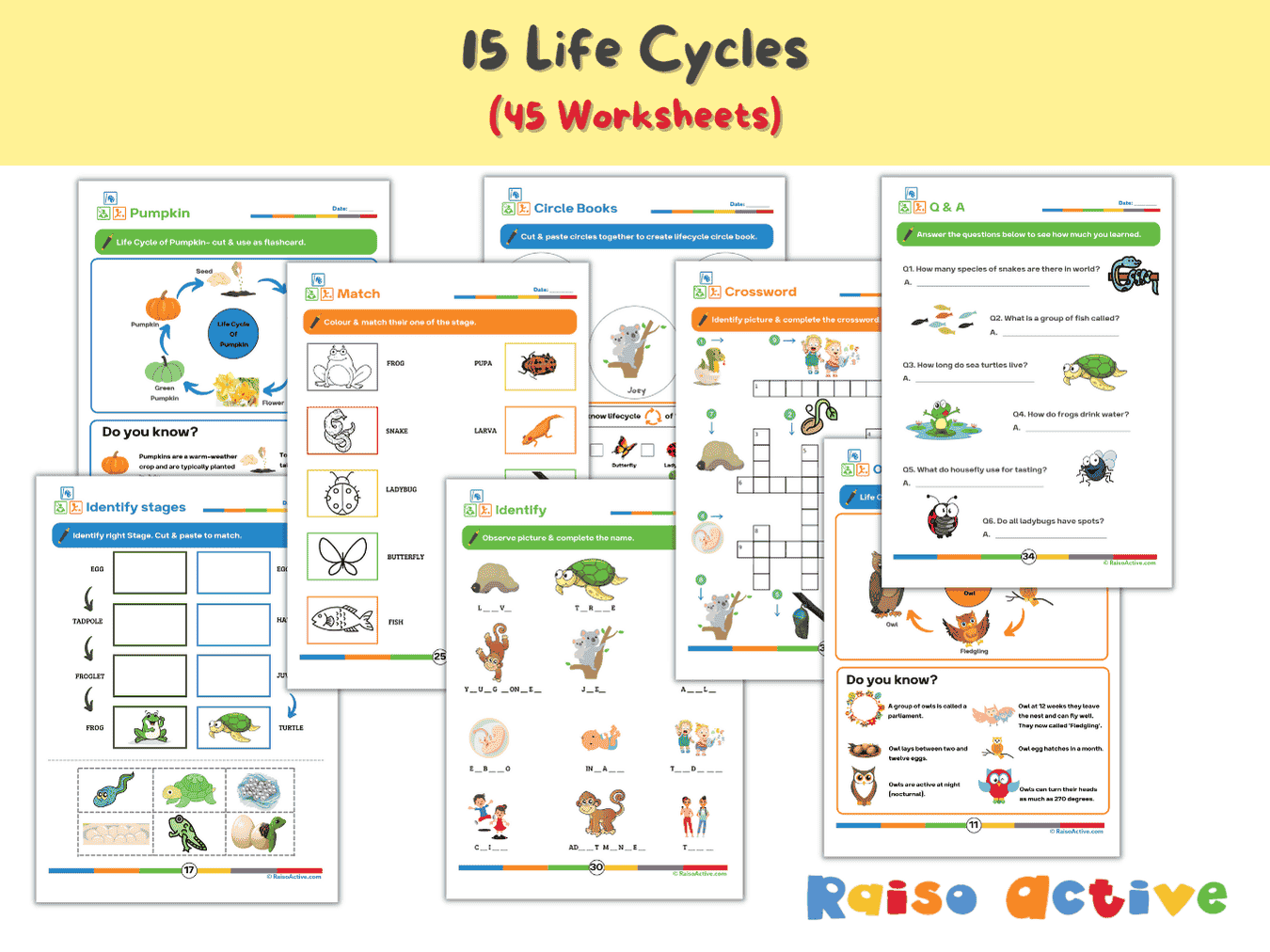
Part of the pack
Lifecycles Activity Book & Flashcards for Preschool & Early Elementary
This is page 28 of the pack. Ages 3-8 · Preschool–Grade 2Ages 3-8 · Nursery–Year 3Ages 3-8 · Nursery–Class 2Ages 3-8

Made for your child
Counting to 10, made for your child
A maths pack with your child's name in it: pictures that explain, practice at three levels, puzzles and story sums about them. Print a new set whenever they finish.
Make a maths packFree preview · free for members
Curriculum
- Living Things - Animals > Animal Life Cycles
How to use this worksheet
Look at the pictures on the left side of the page together, naming each animal or stage shown. Then look at the options on the right and help your child find the stage that correctly matches each animal. Have them draw a line connecting each matching pair, working through the page one row at a time. Once all the matches are made, offer crayons so your child can color the pictures.
Materials needed
- Pencil
- Crayons
Extension activities
- 1Draw your own animal life cycle showing at least two stages.
- 2Research the life cycle of a different animal not shown on the worksheet.
- 3Sort pictures of baby and adult animals into two separate piles.
- 4Visit a zoo, farm, or park to observe animals at different life stages.
- 5Play an I Spy game guessing whether a picture shows a baby or adult animal.

Written by
Hemsweta Jain · Teacher Cheena
MBA and Early Childhood Educator, teaching since 2014 · Founder of RaisoActive, Mumbai
Every RaisoActive worksheet is designed and checked by the founder before publishing.
Published · Last reviewed
More from Lifecycles Activity Book & Flashcards for Preschool & Early Elementary

Match the Life Cycle Stages Worksheet for Preschoolers
Ages 3-5 · Preschool–Pre-KAges 3-5 · Nursery–ReceptionAges 3-5 · Nursery–LKGAges 3-5
Children ages 3-5 practice matching animals and plants to their correct life cycle stage, reinforcing the broader science concept that all living things grow and change over time. Working across multiple types of living things — not just one animal — helps children recognize life cycles as a general pattern in nature rather than a fact specific to a single creature.

Animal Q&A Worksheet for Kids: Learn About Snakes, Fish, and More!
Ages 3-5 · Preschool–Pre-KAges 3-5 · Nursery–ReceptionAges 3-5 · Nursery–LKGAges 3-5
This worksheet builds early reading comprehension and animal knowledge in children ages 3-5 as they answer simple questions about snakes, fish, and other animals using picture clues. Answering varied questions about multiple animals, rather than one, helps children practice applying the same comprehension skill flexibly across different content.

Word Search Worksheet: Find the Hidden Words!
Ages 4-6 · Pre-K–KindergartenAges 4-6 · Reception–Year 1Ages 4-6 · LKG–UKGAges 4-6
This life-cycle-themed word search has children ages 4-6 scan a grid of letters to locate vocabulary words related to growth and change, building visual tracking skills and reinforcing spelling patterns for words they've likely already encountered on other life-cycle worksheets. Searching row by row and diagonally also strengthens the kind of systematic visual scanning that supports later reading fluency.

Complete the Words: A Fun Worksheet for Early Readers!
Ages 3-5 · Preschool–Pre-KAges 3-5 · Nursery–ReceptionAges 3-5 · Nursery–LKGAges 3-5
This worksheet helps children ages 3-5 practice early letter recognition and phonics as they look at a picture and fill in the missing letters to complete an animal-themed word. Saying the finished word aloud after writing it connects the written letters to their spoken sounds, reinforcing the link between reading and speaking that underlies early literacy.

Chicken Lifecycle Cut and Paste Worksheet for Preschoolers
Ages 3-5 · Preschool–Pre-KAges 3-5 · Nursery–ReceptionAges 3-5 · Nursery–LKGAges 3-5
This worksheet has children ages 3-5 cut out circular images representing a chicken's life stages, egg, chick, and adult hen or rooster, and glue them in the correct growing order, building sequencing skills alongside scissor and gluing practice. Working with round shapes specifically also gives children extra scissor practice on curves, which are trickier to cut than straight lines.

Pumpkin Life Cycle Flashcards: Learn About Pumpkins!
Ages 3-5 · Preschool–Pre-KAges 3-5 · Nursery–ReceptionAges 3-5 · Nursery–LKGAges 3-5
These flashcards walk children ages 3-5 through the stages a pumpkin passes through, from seed to sprout to vine to ripe pumpkin, building an early understanding of plant growth and the passage of time. Sequencing the cards in order also introduces the concept that living things change in a predictable pattern, a foundational science idea.

Lifecycle Circle Book: Cut & Paste Activity for Young Learners
Ages 3-5 · Preschool–Pre-KAges 3-5 · Nursery–ReceptionAges 3-5 · Nursery–LKGAges 3-5
This activity has children ages 3-5 cut out circular pages and assemble them into a small 'circle book' that flips through different animals' life cycles, combining fine motor cutting and gluing with the concept that a book can hold information in sequence. Matching each animal to its correct life stage across several circles also reinforces the idea that different animals go through different growth patterns.

Lifecycle Circle Book: Cut & Paste Activity for Early Learners
Ages 3-5 · Preschool–Pre-KAges 3-5 · Nursery–ReceptionAges 3-5 · Nursery–LKGAges 3-5
Children ages 3-5 explore the stages of human growth — baby, child, teenager, and adult — by building a hands-on circular lifecycle book. Applying the same 'lifecycle' concept they may know from animals to people themselves helps children make a meaningful, personal connection to the idea of growing and changing over time.
Related worksheets
Spring Shadow Match Worksheet for Preschoolers
Ages 3-5 · Preschool–Pre-KAges 3-5 · Nursery–ReceptionAges 3-5 · Nursery–LKGAges 3-5
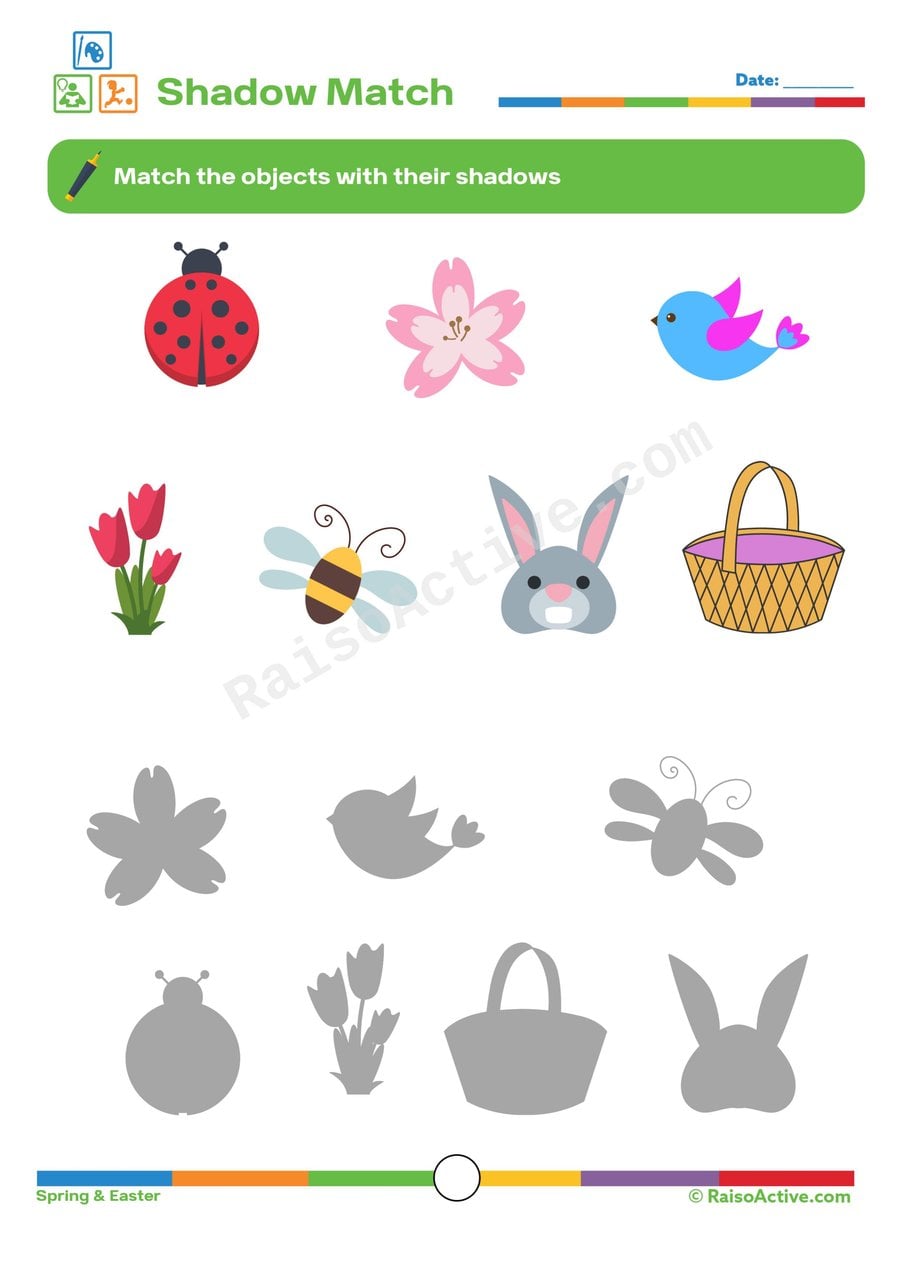
Children ages 3-5 practice visual discrimination by matching spring-themed objects to their correct silhouette shadows. Because shadows strip away color and detail, leaving only outline shape, this activity sharpens a child's ability to focus on form alone — a more advanced visual skill than matching by color or pattern.

Thought Switch: Turn Unhelpful Thoughts into Helpful Thoughts
Ages 7-10 · Grade 2–Grade 3Ages 7-10 · Year 3–Year 4Ages 7-10 · Class 2–Class 3Ages 7-10
Children compare unhelpful and helpful thoughts (such as 'I can't do it yet, I'll keep trying'), match each unhelpful thought to a helpful one and write their own switches.

Fall Leaf Patterns Matching Worksheet for Preschoolers
Ages 3-5 · Preschool–Pre-KAges 3-5 · Nursery–ReceptionAges 3-5 · Nursery–LKGAges 3-5
Children ages 3-5 build pattern recognition and logical reasoning skills by matching colored fall leaves to complete repeating patterns in a grid. Recognizing and continuing a pattern is an early algebraic thinking skill, teaching children to notice what comes next based on a repeating sequence — a foundation for later math concepts.

Festivals of Many Faiths: Places of Worship and Greetings
Ages 4-8 · Pre-K–Grade 2Ages 4-8 · Reception–Year 3Ages 4-8 · LKG–Class 2Ages 4-8
Children learn that India is home to many faiths, each with its own festivals, places of worship and festival greetings.

Lock and Key Matching Worksheet for Preschoolers
Ages 3-5 · Preschool–Pre-KAges 3-5 · Nursery–ReceptionAges 3-5 · Nursery–LKGAges 3-5
Matching each key to the lock sharing the same letter helps children ages 3-5 practice letter recognition in a playful, puzzle-like context rather than rote drilling. Because each key must be checked against several similar-looking locks before finding the right match, this worksheet also builds visual scanning and careful comparison skills that support problem-solving.

Plant Parts Worksheet: Identify and Label the Parts of a Plant!
Ages 4-6 · Pre-K–KindergartenAges 4-6 · Reception–Year 1Ages 4-6 · LKG–UKGAges 4-6
This worksheet teaches children ages 4-6 to identify and independently label the flower, stem, leaf, and roots of a plant, moving a step beyond simple matching toward recalling vocabulary from memory. Optionally adding pulses or grains to the diagram introduces a tactile, sensory layer that helps reinforce which part is which through touch as well as sight.
Lantern Light Lab: Navratri Garba Pot Light Experiment
Ages 7-11 · Grade 2–Grade 3Ages 7-11 · Year 3–Year 4Ages 7-11 · Class 2–Class 3Ages 7-11
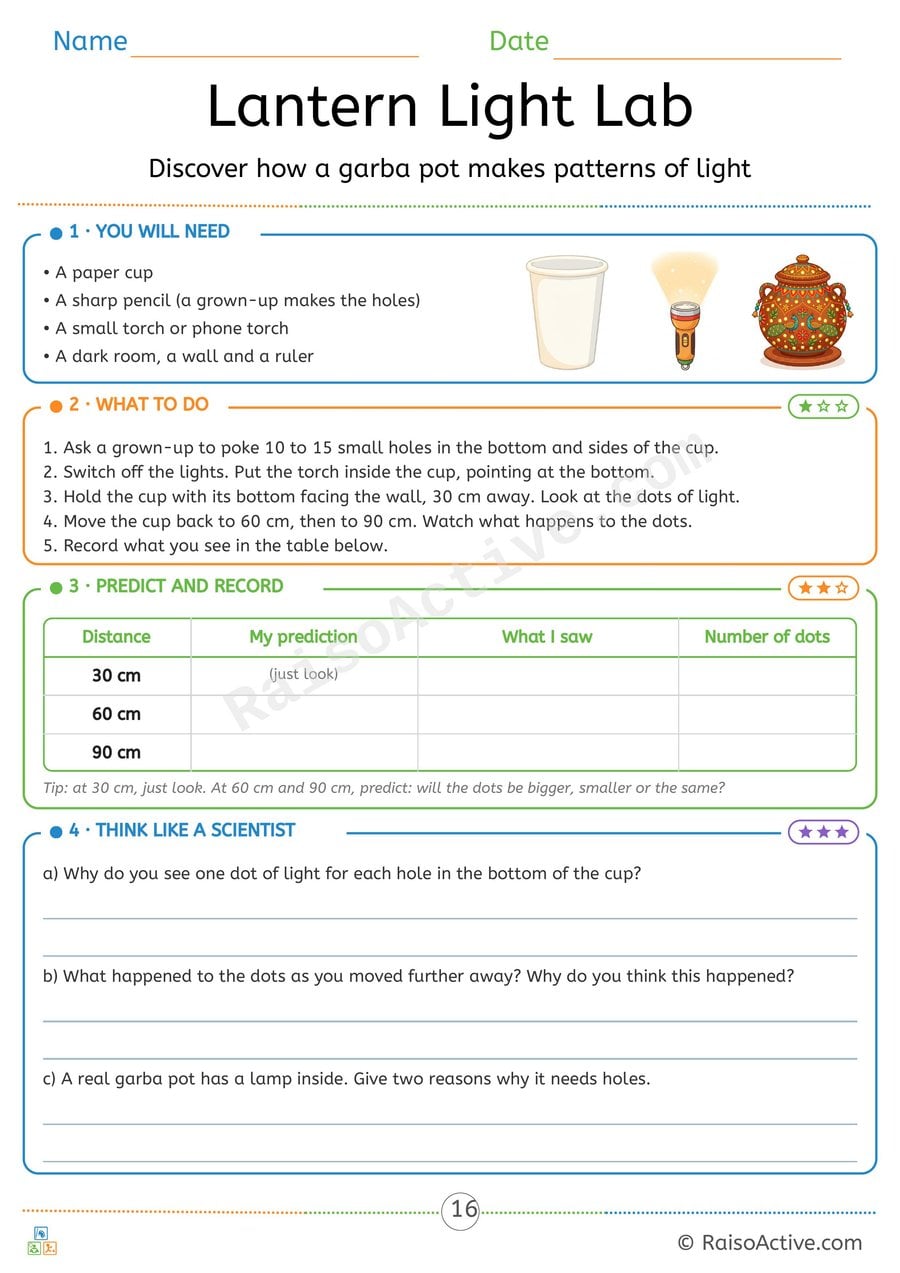
Children make holes in a paper cup, shine a torch through it and see one spot of light for each hole. They predict and record what happens as they move further from the wall, and explain the results and why a real garba pot needs holes.
Skeleton Matching Worksheet: Learn About Bones!
Ages 4-6 · Pre-K–KindergartenAges 4-6 · Reception–Year 1Ages 4-6 · LKG–UKGAges 4-6
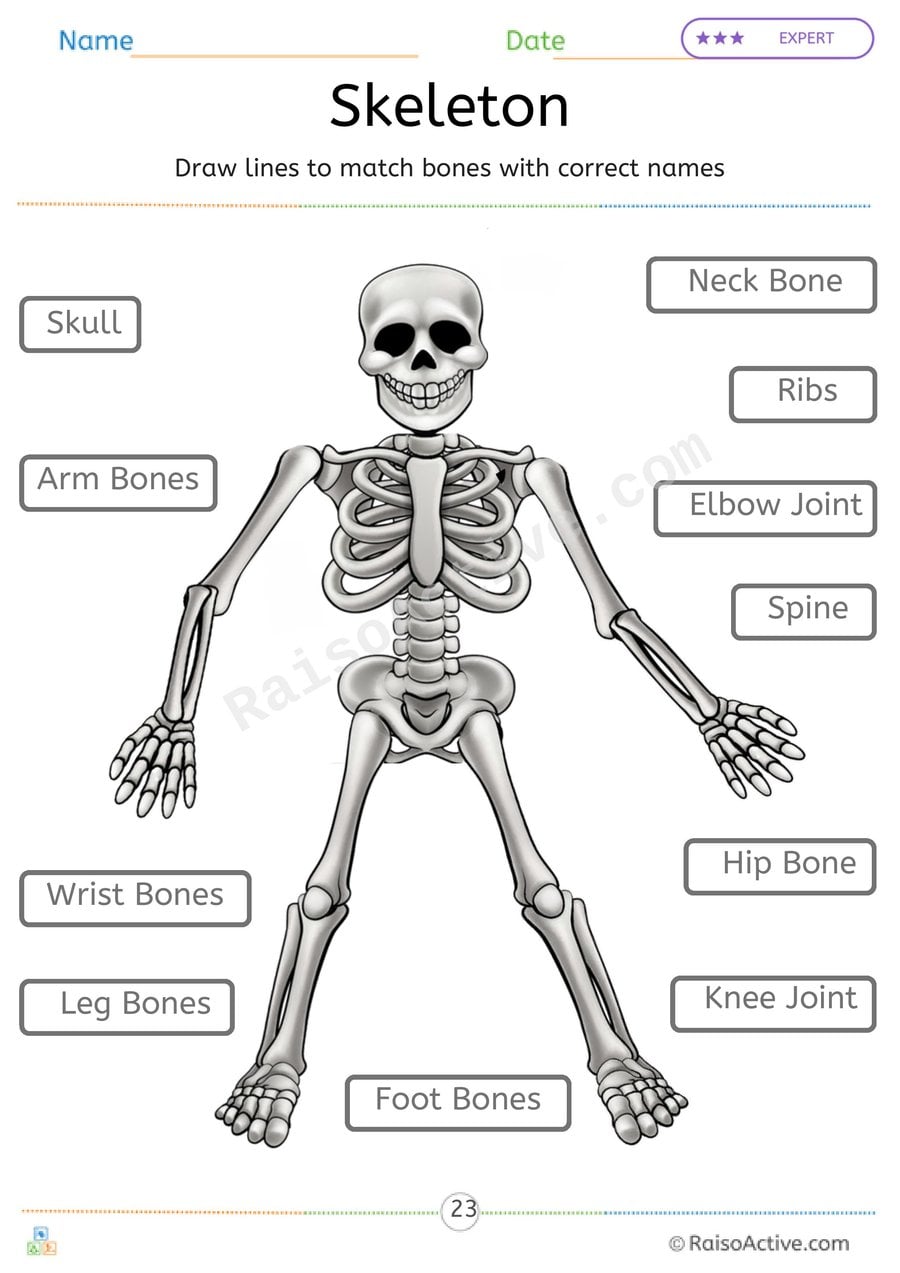
Drawing lines from bone names to their locations on a skeleton diagram introduces children ages 4-6 to basic human anatomy vocabulary, such as skull, ribs, or spine, while practicing left-to-right reading and matching skills. Because children must read a word and then visually locate the correct part of the body, this worksheet also strengthens the connection between written language and real-world objects, an important step toward reading comprehension. The Halloween-skeleton framing makes an otherwise academic science topic feel playful and approachable.
Guides for this topic

Best Worksheets for 3-Year-Olds: What Works and What to Avoid
What works on worksheets for 3-year-olds: short sessions, crayons, tracing lines, matching, cutting, a free weekly plan, and signs one is too advanced.

Discovering Wonder: Nature-Based Learning Activities That Captivate Young Children
Explore nature-based learning activities for children ages 2–7 — leaf rubbings, bug hunts, nature journals, and seasonal Indian outdoor ideas that spark wonder.

Creating Engaging Themed Learning Units for Young Children: A Complete Guide to Integrated Learning
Discover how to create engaging themed learning units for young children that integrate literacy, maths, science, and art — with practical examples and free worksheets.
Reviews
Every worksheet for ages 3–5, no watermark
Members download the full library of 1,000+ worksheets and every activity pack without watermarks or daily limits. One year costs ₹999 in India or $20 elsewhere.
See membership plansOr download any worksheet free with a watermark (5 a day).