Push or Pull Worksheet: Identifying Actions!
This worksheet introduces a basic physics concept to children ages 3-5 by having them identify whether an action shown in each picture is a push or a pull, building early scientific observation skills around force and motion. Learning to name these two opposite actions also strengthens comparative vocabulary and lays groundwork for more formal physics concepts later in school.
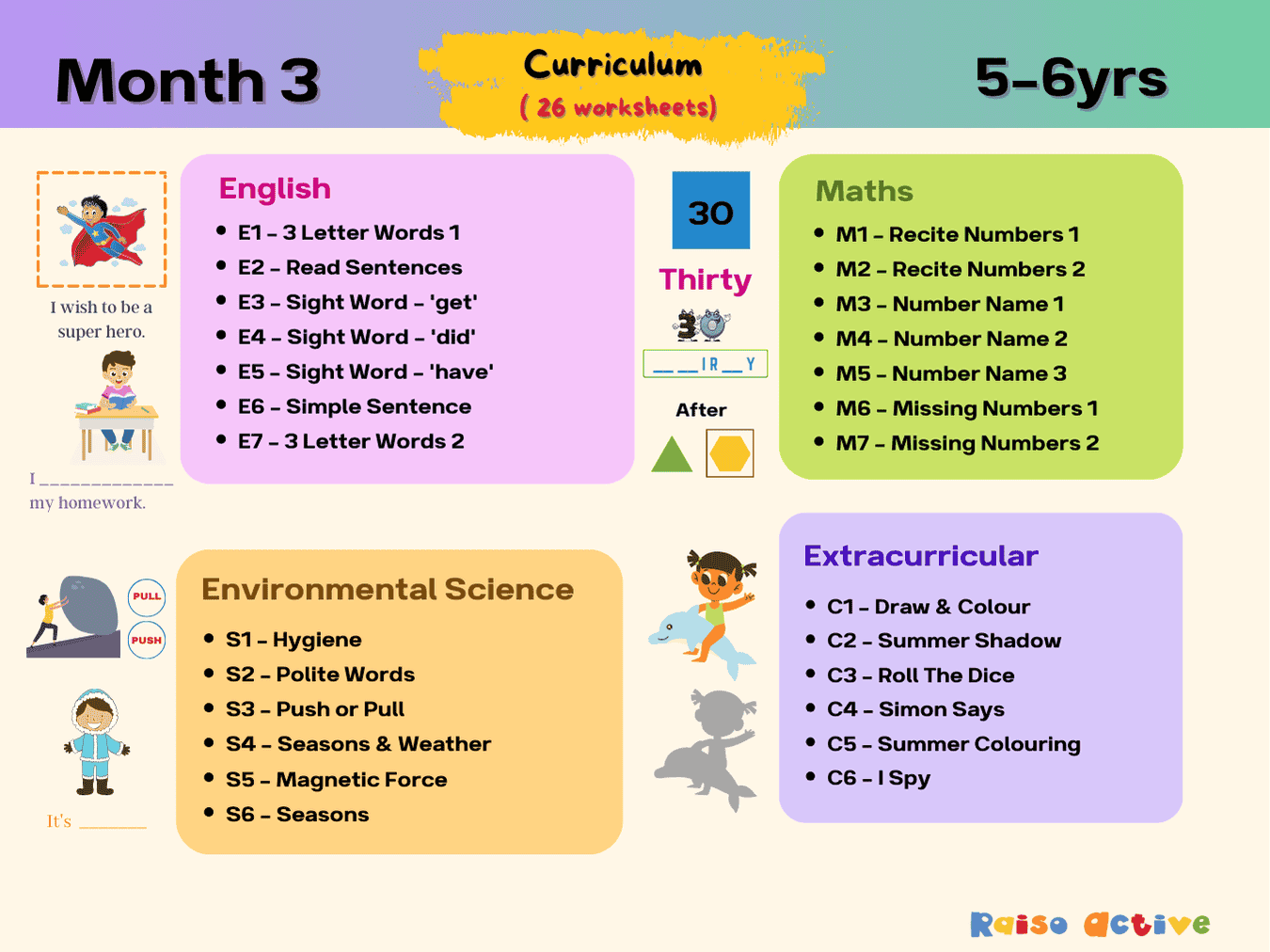
Part of the pack
Month 3: Learning & Development | Ages 5-6
This is page 20 of the pack. Ages 5-6 · KindergartenAges 5-6 · Year 1Ages 5-6 · UKGAges 5-6
Made for your child
A whole activity pack made with their name
60 pages to spot, build, trace and write their own name, plus pages about their favourites, feelings and family. See a free preview with their name.
Make an All About Me packFree preview · free for members
Or start free: a name tracing sheet with their nameCurriculum
- Cognitive - Critical Thinking > Push and Pull Forces
How to use this worksheet
Look at the first picture together and act out the motion shown, whether it's pushing a swing or pulling a wagon. Ask your child whether the action is a push or a pull, and have them write the correct word underneath the picture. Move to the sentence-completion section, reading each sentence aloud and having your child fill in 'push' or 'pull.' Finish by coloring the correct action word for each picture as directed.
Materials needed
- Pencil
- Crayons
Extension activities
- 1Act out pushing and pulling different real objects around the house, like a chair or a toy wagon.
- 2Find examples of pushing and pulling in your home or classroom, like opening a drawer (pull) or closing a door (push).
- 3Draw your own pictures showing a push action and a pull action.
- 4Play a simple tug-of-war game to physically feel the difference between pushing and pulling.

Written by
Hemsweta Jain · Teacher Cheena
MBA and Early Childhood Educator, teaching since 2014 · Founder of RaisoActive, Mumbai
Every RaisoActive worksheet is designed and checked by the founder before publishing.
Published · Last reviewed
More from Month 3: Learning & Development | Ages 5-6
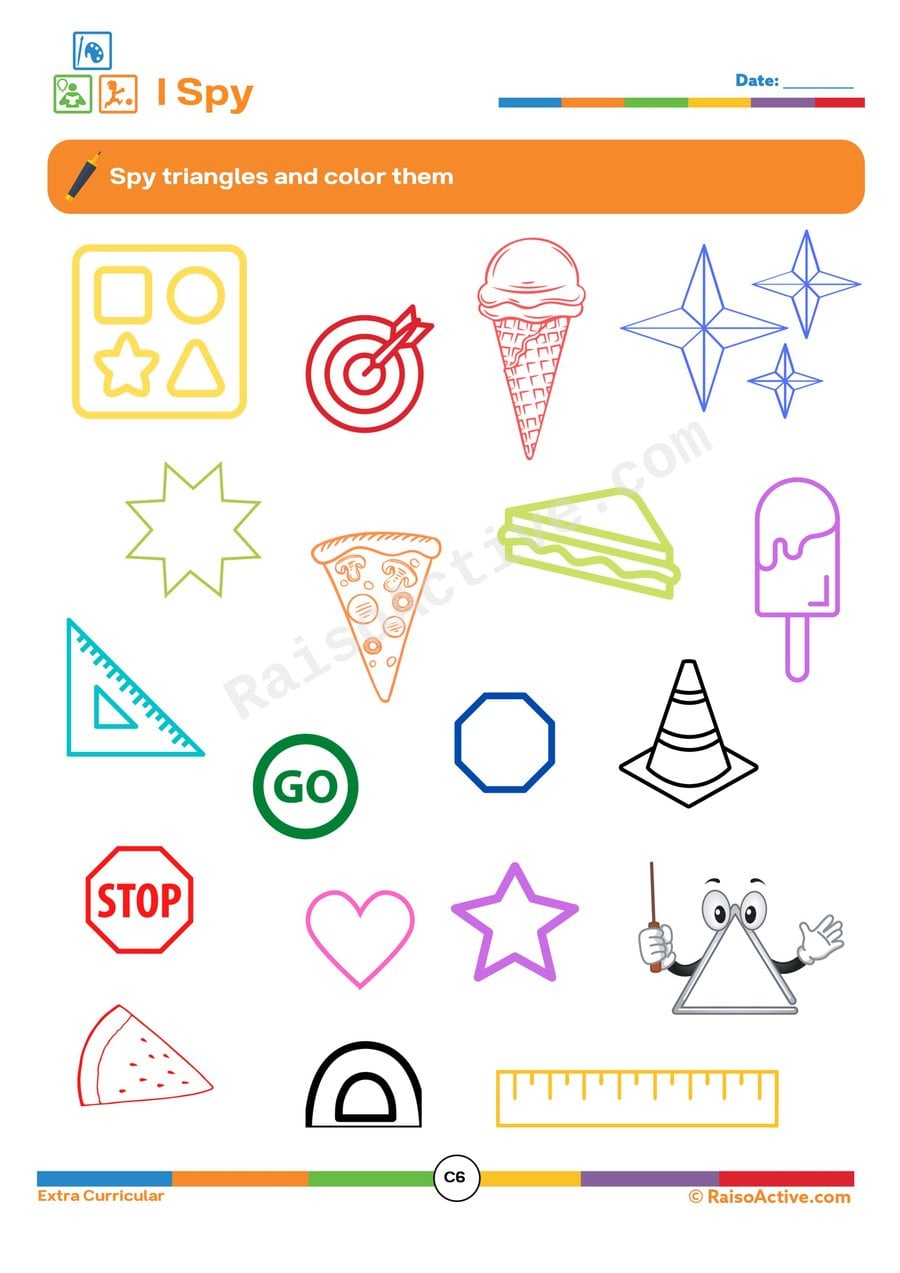
I Spy Triangles Worksheet: Find and Color!
Ages 3-5 · Preschool–Pre-KAges 3-5 · Nursery–ReceptionAges 3-5 · Nursery–LKGAges 3-5
This 'I Spy' style worksheet trains children ages 3-5 to visually pick out triangles hidden within a busier picture, building the visual discrimination skill of recognizing a specific shape by its defining feature — three straight sides and three corners — even when it's surrounded by other shapes or details. This kind of active shape-hunting goes beyond simple shape naming to real visual search practice.

Summer Coloring Fun: Color the Summer-Related Objects!
Ages 3-5 · Preschool–Pre-KAges 3-5 · Nursery–ReceptionAges 3-5 · Nursery–LKGAges 3-5
This worksheet builds vocabulary and category recognition for children ages 3-5 as they color a collection of objects associated with summer, like sunglasses, ice cream, or a beach ball, reinforcing that certain items belong together under a seasonal theme. Coloring within outlined shapes also continues to build the fine motor control and hand strength children need for future writing.

Simon Says: Follow the Instructions and Get Moving!
Ages 3-5 · Preschool–Pre-KAges 3-5 · Nursery–ReceptionAges 3-5 · Nursery–LKGAges 3-5
This worksheet turns the classic listening game into a written record, having children track which Simon Says instructions they followed correctly. For three- to five-year-olds, the game builds gross motor skills like jumping, spinning, and balancing, while also strengthening auditory attention — the ability to listen carefully and act only when the right cue ('Simon says') is given.
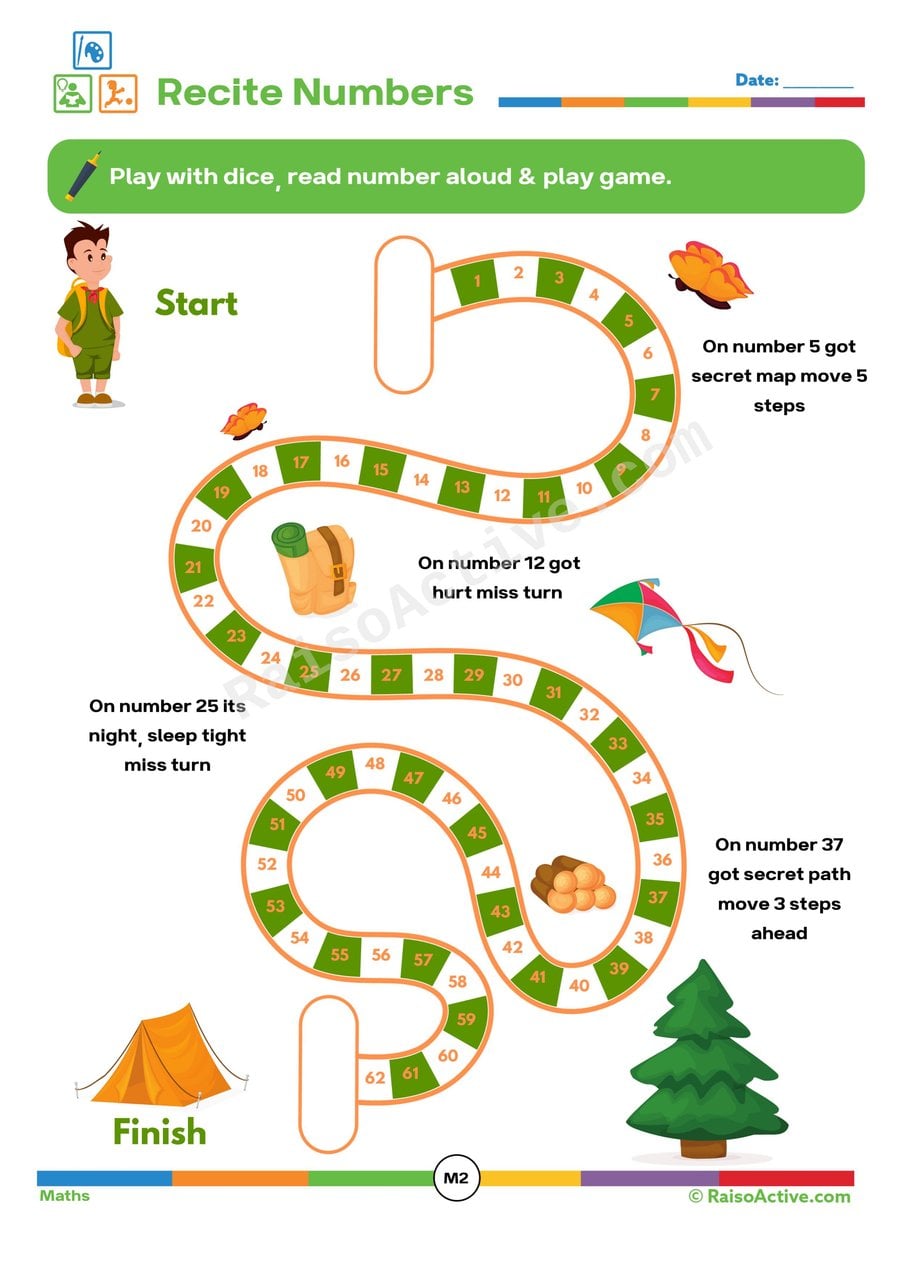
Recite Numbers Game Worksheet for Kids
Ages 4-6 · Pre-K–KindergartenAges 4-6 · Reception–Year 1Ages 4-6 · LKG–UKGAges 4-6
This game-based worksheet helps children ages 4-6 practice number recognition and following multi-step directions as they roll a die, move along a numbered path, and read each number aloud when they land on it. Turning number practice into a game increases motivation and repetition, both of which are key to building automatic number recognition.
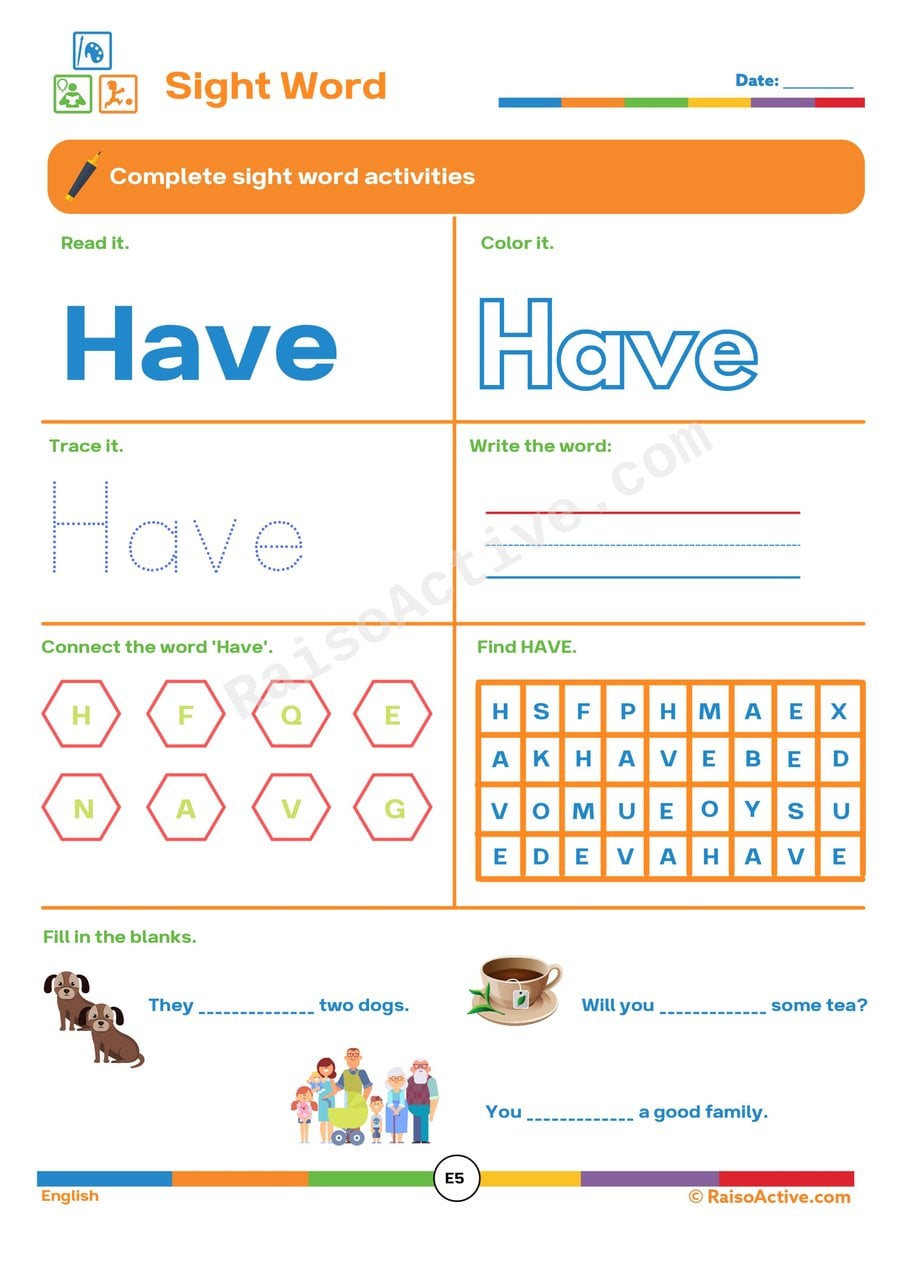
Sight Word 'Have' Worksheet for Preschoolers
Ages 3-5 · Preschool–Pre-KAges 3-5 · Nursery–ReceptionAges 3-5 · Nursery–LKGAges 3-5
This multi-step worksheet builds deep familiarity with the sight word 'have' for children ages 3-5 by having them read, color, trace, write, and search for the word in several different formats. Repeating the same word across varied tasks — rather than practicing it once — is exactly how high-frequency sight words become instantly recognizable to early readers.

Golden Words Worksheet: Practice Using 'Excuse Me', 'Please', 'Thank You', and 'Sorry'
Ages 3-5 · Preschool–Pre-KAges 3-5 · Nursery–ReceptionAges 3-5 · Nursery–LKGAges 3-5
This worksheet teaches children ages 3-5 when and how to use four essential polite phrases — 'Excuse Me,' 'Please,' 'Thank You,' and 'Sorry' — by choosing the correct one to complete everyday social scenarios. Learning to match the right polite phrase to the right situation, rather than just memorizing the words, builds real social communication skills that children use constantly in daily interactions.

Seasons and Weather Worksheet: Fill in the Blanks!
Ages 3-5 · Preschool–Pre-KAges 3-5 · Nursery–ReceptionAges 3-5 · Nursery–LKGAges 3-5
This worksheet builds early science vocabulary by asking children to fill in blanks connecting each of the four seasons to its typical weather, such as snow in winter or sunshine in summer. For three- to five-year-olds, tying weather words to the season they experience it in helps organize their everyday observations of the world into a simple, memorable framework.

Missing Numbers Worksheet: Before, After, and Between!
Ages 4-6 · Pre-K–KindergartenAges 4-6 · Reception–Year 1Ages 4-6 · LKG–UKGAges 4-6
This worksheet strengthens number sequencing by asking children to figure out which number comes before, after, or between two given numbers, rather than simply counting from one in order. For four- to six-year-olds, working with numbers 'out of context' like this builds a flexible mental number line, an essential foundation for later addition, subtraction, and skip counting.
Related worksheets

Push or Pull Worksheet for Kids: Circle the Correct Answer!
Ages 3-5 · Preschool–Pre-KAges 3-5 · Nursery–ReceptionAges 3-5 · Nursery–LKGAges 3-5
Children ages 3-5 build early physics vocabulary by identifying whether an action shown in a picture is a push or a pull, a foundational concept in understanding forces and motion. Learning to categorize everyday actions this way helps children start noticing cause and effect in the physical world around them, well before they encounter formal science lessons.
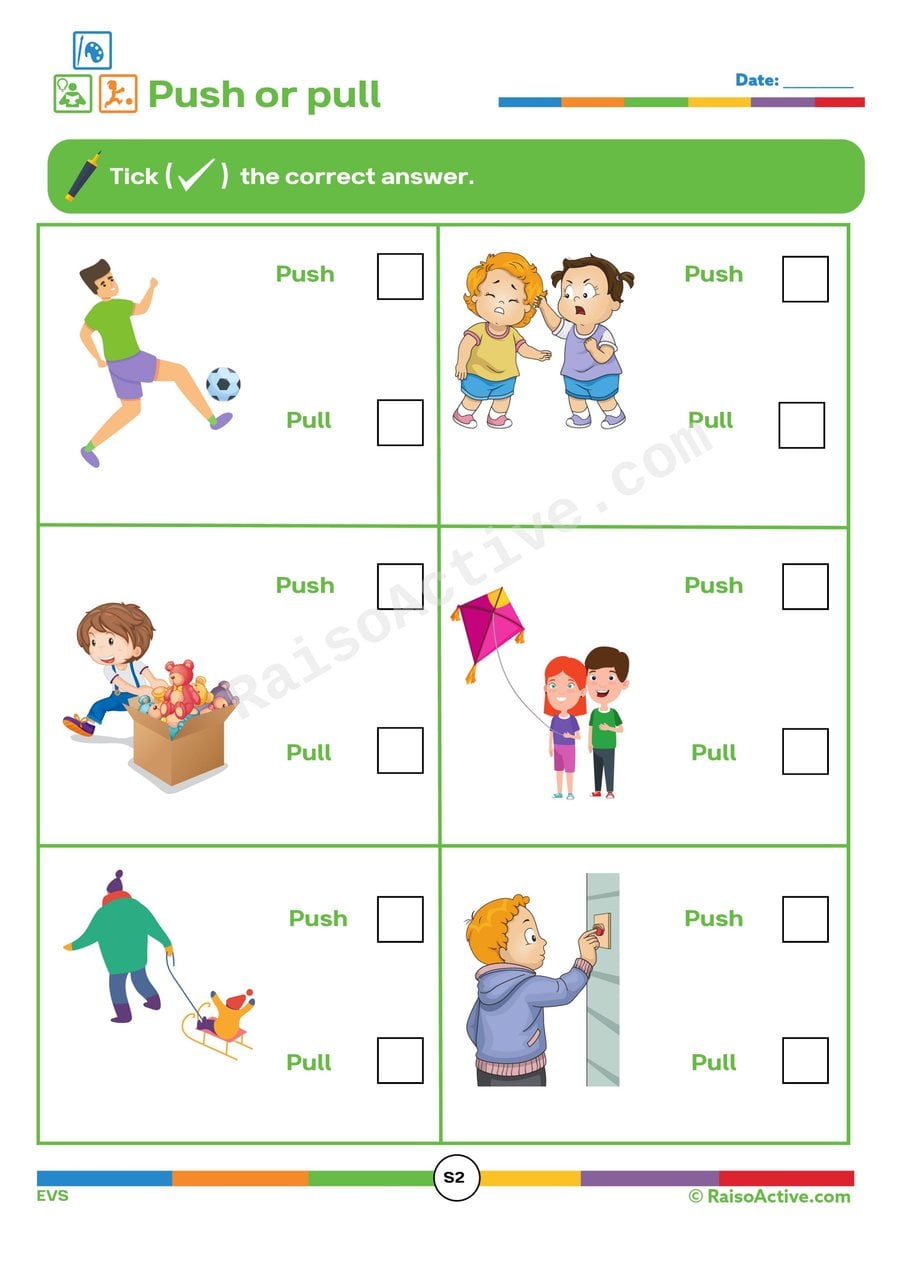
Push or Pull Worksheet: Identify Actions!
Ages 3-5 · Preschool–Pre-KAges 3-5 · Nursery–ReceptionAges 3-5 · Nursery–LKGAges 3-5
Deciding whether an action shown in a picture is a push or a pull introduces children ages 3-5 to a basic physics concept, force and motion, by having them classify everyday actions like opening a door or pulling a wagon. This early science reasoning requires children to picture the direction an object is moving relative to the person acting on it, which builds spatial thinking alongside scientific vocabulary. Learning to categorize actions this way is a first step toward understanding cause and effect in the physical world.
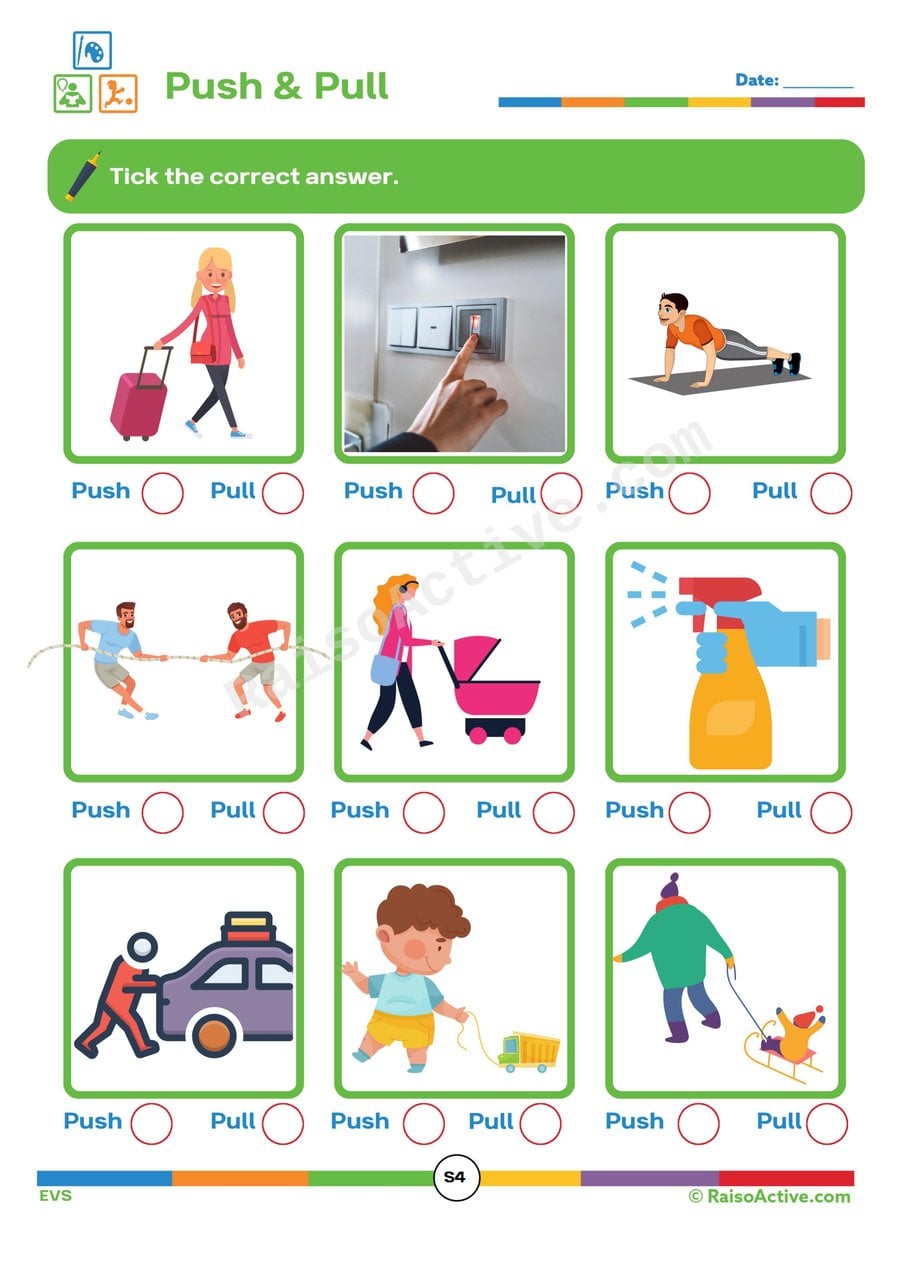
Push and Pull Worksheet for Preschoolers
Ages 3-5 · Preschool–Pre-KAges 3-5 · Nursery–ReceptionAges 3-5 · Nursery–LKGAges 3-5
Deciding whether each pictured action is a push or a pull introduces children ages 3-5 to an early physics concept: that forces move objects toward or away from us. Sorting actions this way builds observational skills and gives children the vocabulary to describe motion they see every day.

Coding Shapes Worksheet for Preschoolers: Cut and Paste Patterns
Ages 3-5 · Preschool–Pre-KAges 3-5 · Nursery–ReceptionAges 3-5 · Nursery–LKGAges 3-5
This cut-and-paste activity has children ages 3-5 recreate shape sequences shown in sample boxes, combining shape recognition with the same ordered, step-by-step thinking used in beginner coding concepts. Cutting out individual shapes and arranging them in the correct sequence also builds fine motor precision and spatial planning.

Elephant Shapes: Fun Sorting Worksheet for Preschoolers!
Ages 3-5 · Preschool–Pre-KAges 3-5 · Nursery–ReceptionAges 3-5 · Nursery–LKGAges 3-5
This playful sorting worksheet has children ages 3-5 use an elephant's 'trunk' (their own hand reaching through a cut circle) to pick and sort shapes, building both shape recognition and simple classification skills. Physically selecting and grouping shapes by type, rather than just naming them on sight, helps solidify the concept that shapes can share a category even when their size or color differs.

States of Matter Worksheet: Exploring Solids, Liquids, and Gases!
Ages 4-6 · Pre-K–KindergartenAges 4-6 · Reception–Year 1Ages 4-6 · LKG–UKGAges 4-6
This worksheet introduces children ages 4-6 to the three states of matter — solid, liquid, and gas — by having them examine images and sort each one into its correct category. Learning to classify familiar objects (like ice, water, and steam) by their physical state builds early scientific reasoning, since children must look past an object's identity and focus on its underlying properties.

Navratri Picture Sudoku and Story Sequencing: Think It Through
Ages 4-6 · Pre-K–KindergartenAges 4-6 · Reception–Year 1Ages 4-6 · LKG–UKGAges 4-6
Children use logic to complete a 4x4 picture sudoku where each row and column has each picture once, and put four story pictures in order.
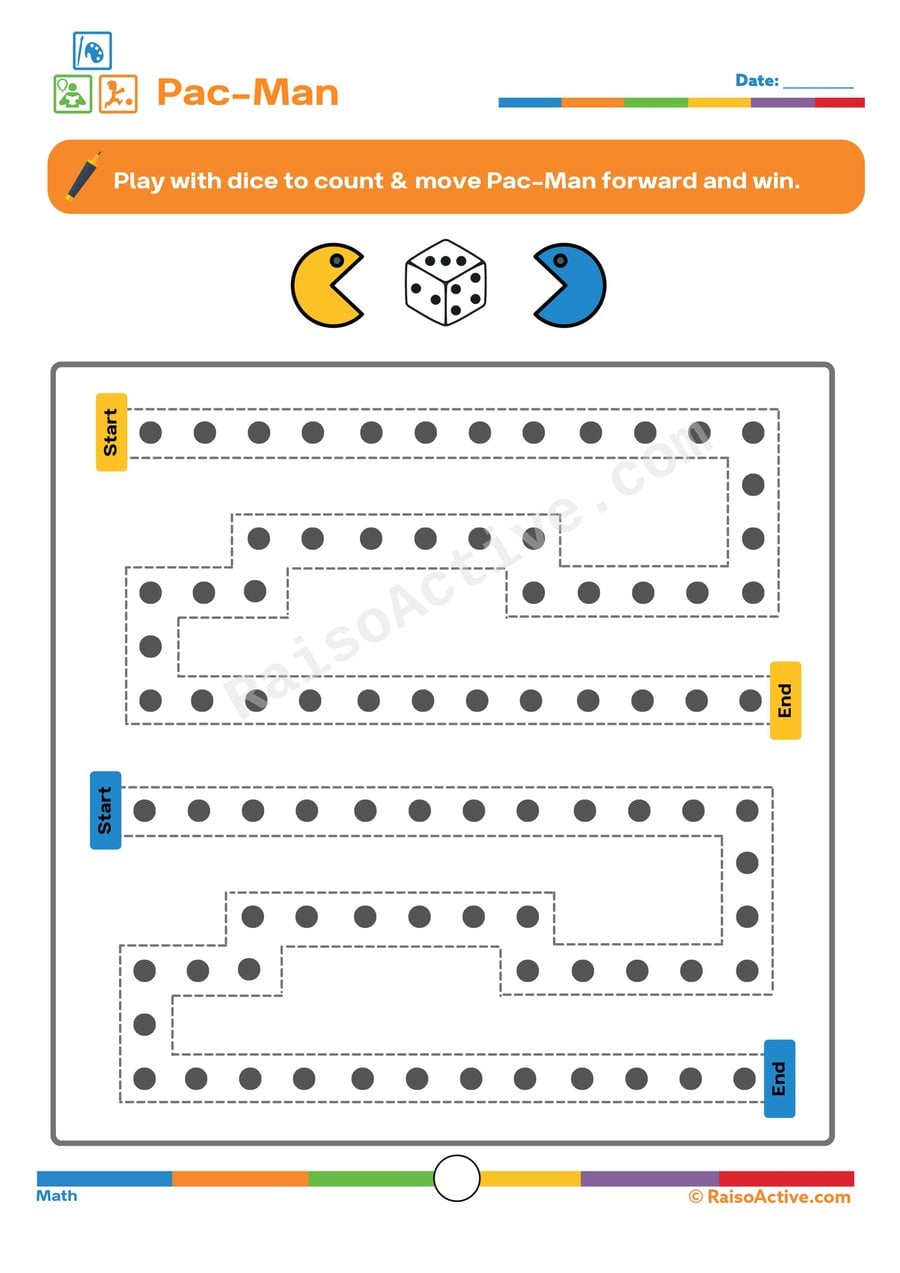
Pac-Man Maze Worksheet: Count and Move!
Ages 3-5 · Preschool–Pre-KAges 3-5 · Nursery–ReceptionAges 3-5 · Nursery–LKGAges 3-5
This dice-counting maze gives children ages 3-5 repeated practice matching a rolled number to the correct number of moves, reinforcing accurate counting under a bit of playful pressure. Tracking Pac-Man's current position after each roll also builds short-term spatial memory, since children must remember where they left off before moving again.
Guides for this topic

Age-Appropriate Problem-Solving Activities: Building Critical Thinkers from the Ground Up
Discover fun, age-appropriate problem-solving activities for children ages 1-8. Build critical thinking, logic, and reasoning skills through play-based learning.
Critical Thinking Activities That Actually Work for Young Children: Building Tomorrow's Thinkers Today
Discover proven critical thinking activities for young children. Age-wise logic games, questioning techniques, and hands-on ideas to build thinking skills at home.

Preparing Your Child for a Rapidly Changing World: Essential Skills for Future Success
Discover the essential 21st century skills your child needs for future success. Practical tips on creativity, critical thinking, digital literacy & emotional intelligence for ages 1-8.
Reviews
Every worksheet for ages 3–5, no watermark
Members download the full library of 1,000+ worksheets and every activity pack without watermarks or daily limits. One year costs ₹999 in India or $20 elsewhere.
See membership plansOr download any worksheet free with a watermark (5 a day).