Trace and Write the Letter E Worksheet for Preschoolers
This worksheet has children ages 3-5 trace the uppercase letter E, a shape built from three horizontal lines meeting one vertical line, requiring careful spacing to keep the three horizontal strokes evenly placed. Because E shares its vertical-plus-horizontal structure with letters like F and L, practicing it builds a stroke pattern children will reuse often. The page also reinforces the short /e/ sound heard in words like 'egg,' 'elephant,' and 'elbow.'
Part of the pack
Capital Letter Tracing Activity Book A-Z for Preschool & Kindergarten
This is page 6 of the pack. Ages 3-6 · Preschool–KindergartenAges 3-6 · Nursery–Year 1Ages 3-6 · Nursery–UKGAges 3-6
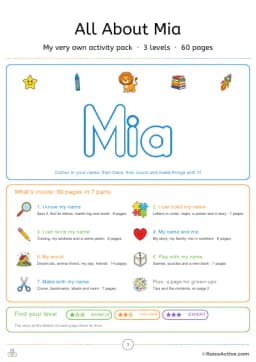
Made for your child
A whole activity pack made with their name
60 pages to spot, build, trace and write their own name, plus pages about their favourites, feelings and family. See a free preview with their name.
Make an All About Me packFree preview · free for members
Or start free: a name tracing sheet with their nameCurriculum
- Writing > Letter Tracing A-Z
- Pre-Writing > Straight Lines
- Pre-Writing > Letter Pre-Writing
How to use this worksheet
Point to the dotted letter E and show your child the vertical line first, then the three horizontal lines branching off it at the top, middle, and bottom. Have them trace several guided Es, paying attention to keeping the horizontal lines roughly the same length. Once they've traced the guided letters, let them try writing E independently on the blank lines, then color any pictures on the page while naming the objects together.
Materials needed
- Pencil
- Crayons
Extension activities
- 1Search for objects that start with E, like an egg or an elephant toy, and say 'E is for...' with each one.
- 2Practice writing E in a tray of sand or rice, counting out loud '1, 2, 3' for each horizontal line.
- 3Use craft sticks or straws to build the letter E on a table, one line at a time.
- 4Look through a picture book together and count how many times the letter E appears on one page.

Written by
Hemsweta Jain · Teacher Cheena
MBA and Early Childhood Educator, teaching since 2014 · Founder of RaisoActive, Mumbai
Every RaisoActive worksheet is designed and checked by the founder before publishing.
Published · Last reviewed
More from Capital Letter Tracing Activity Book A-Z for Preschool & Kindergarten

Trace and Write the Letter P Worksheet for Preschoolers
Ages 3-5 · Preschool–Pre-KAges 3-5 · Nursery–ReceptionAges 3-5 · Nursery–LKGAges 3-5
Tracing the uppercase letter P introduces children ages 3-5 to a two-part stroke, a straight vertical line followed by a curved loop at the top, which builds on the straight-line control they've likely practiced with letters like T and the curved control practiced with letters like C. This combination stroke is good preparation for other letters that mix lines and curves, such as R and B. The worksheet also reinforces the /p/ sound in words like 'pig,' 'pencil,' and 'popcorn.'

Trace and Write the Letter O Worksheet for Preschoolers
Ages 3-5 · Preschool–Pre-KAges 3-5 · Nursery–ReceptionAges 3-5 · Nursery–LKGAges 3-5
This letter O worksheet has children ages 3-5 trace a full closed loop, a stroke that requires more control than a simple curve because the pencil must return to its starting point. Practicing this shape strengthens the fine motor skills needed for round letters and numbers, including O, Q, and 0. The page also reinforces the short /o/ sound found in words like 'octopus' and 'orange.'

Trace and Write the Letter G Worksheet for Preschoolers
Ages 4-5 · Pre-KAges 4-5 · ReceptionAges 4-5 · LKGAges 4-5
This worksheet isolates the uppercase G — a large curve with a small inward hook — so 4-5 year olds can build solid mastery of this one form before later tackling the more complex lowercase g with its descending tail. At this slightly older end of the preschool range, moving from traced copying to independent writing on the same page reflects a meaningful step up in handwriting expectations.

Trace and Write the Letter Y Worksheet for Preschoolers
Ages 3-5 · Preschool–Pre-KAges 3-5 · Nursery–ReceptionAges 3-5 · Nursery–LKGAges 3-5
Tracing the uppercase letter Y gives children ages 3-5 repeated practice with the diagonal-to-vertical stroke pattern that makes Y one of the trickier capital letters to form by hand. Because Y starts words like 'yellow,' 'yarn,' and 'yo-yo,' this page also reinforces the /y/ sound so children begin connecting how a letter looks with how it sounds. That letter-sound pairing is a core building block for early reading.

Trace and Write the Letter U Worksheet for Preschoolers
Ages 3-5 · Preschool–Pre-KAges 3-5 · Nursery–ReceptionAges 3-5 · Nursery–LKGAges 3-5
This worksheet isolates the uppercase U — a smooth curve that dips down and comes back up — giving children focused repetition on one letter form before they meet the nearly identical but smaller lowercase u elsewhere. Practicing this curve independently at ages 3-5 continues building the smooth-stroke control introduced by earlier curved letters like C and O.

Trace and Write the Letter V Worksheet for Preschoolers
Ages 3-5 · Preschool–Pre-KAges 3-5 · Nursery–ReceptionAges 3-5 · Nursery–LKGAges 3-5
This worksheet has children ages 3-5 trace the uppercase letter V, made of two diagonal lines meeting at a point, building the diagonal-stroke control that will later support more complex letters like W and Y. Because V is formed from just two clean strokes, it's a manageable introduction to diagonal lines before tackling letters that combine more of them. The page also reinforces the /v/ sound in words like 'van,' 'vase,' and 'volcano.'

Trace and Write the Letter N Worksheet for Preschoolers
Ages 3-5 · Preschool–Pre-KAges 3-5 · Nursery–ReceptionAges 3-5 · Nursery–LKGAges 3-5
This worksheet has children ages 3-5 trace the uppercase letter N, formed from two vertical lines connected by a diagonal stroke, building the diagonal-line control that will also help with letters like M, W, and Z. Because N requires three distinct strokes in a specific order, it's a good exercise in following a sequence rather than drawing a single continuous shape. The page also reinforces the /n/ sound in words like 'nest,' 'nose,' and 'net.'

Trace and Write the Letter Z Worksheet for Preschoolers
Ages 3-5 · Preschool–Pre-KAges 3-5 · Nursery–ReceptionAges 3-5 · Nursery–LKGAges 3-5
This letter Z tracing page asks children ages 3-5 to follow a horizontal-diagonal-horizontal zigzag, a stroke pattern that's different from the curves and straight lines used in most other capital letters. Practicing this shape builds the fine motor control needed for handwriting while reinforcing that Z makes the buzzing /z/ sound heard in 'zebra,' 'zipper,' and 'zoo.' Since Z is one of the last letters children usually master, this worksheet often marks a milestone in completing the full alphabet.
Related worksheets

Letter E Tracing and Coloring Worksheet for Preschoolers
Ages 3-5 · Preschool–Pre-KAges 3-5 · Nursery–ReceptionAges 3-5 · Nursery–LKGAges 3-5
This tracing and coloring worksheet teaches children ages 3-5 to recognize and write both the uppercase and lowercase letter E, while also identifying pictures of objects that begin with that letter's sound. Practicing a letter in both its capital and lowercase forms helps children see that they represent the same sound despite looking different, an important early literacy concept. Circling matching pictures alongside the tracing also connects the visual letter shape to its corresponding beginning sound in spoken words.
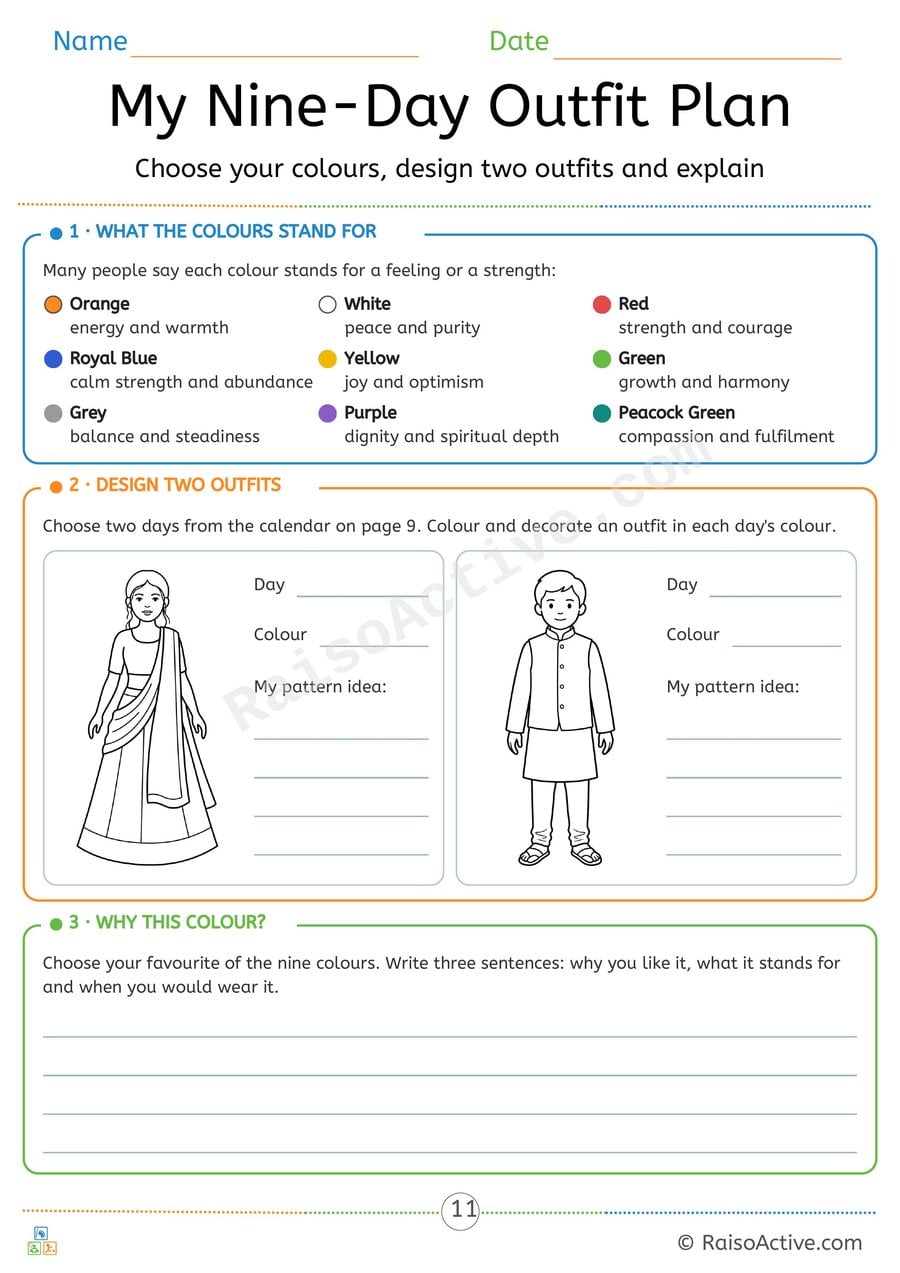
My Nine-Day Outfit Plan: Navratri Colours Design and Writing
Ages 7-11 · Grade 2–Grade 3Ages 7-11 · Year 3–Year 4Ages 7-11 · Class 2–Class 3Ages 7-11
Children read what each of the nine colours is often said to stand for, choose two days from the calendar, colour and pattern a lehenga-style outfit and a kurta outfit in those colours, and write three sentences explaining their favourite colour.
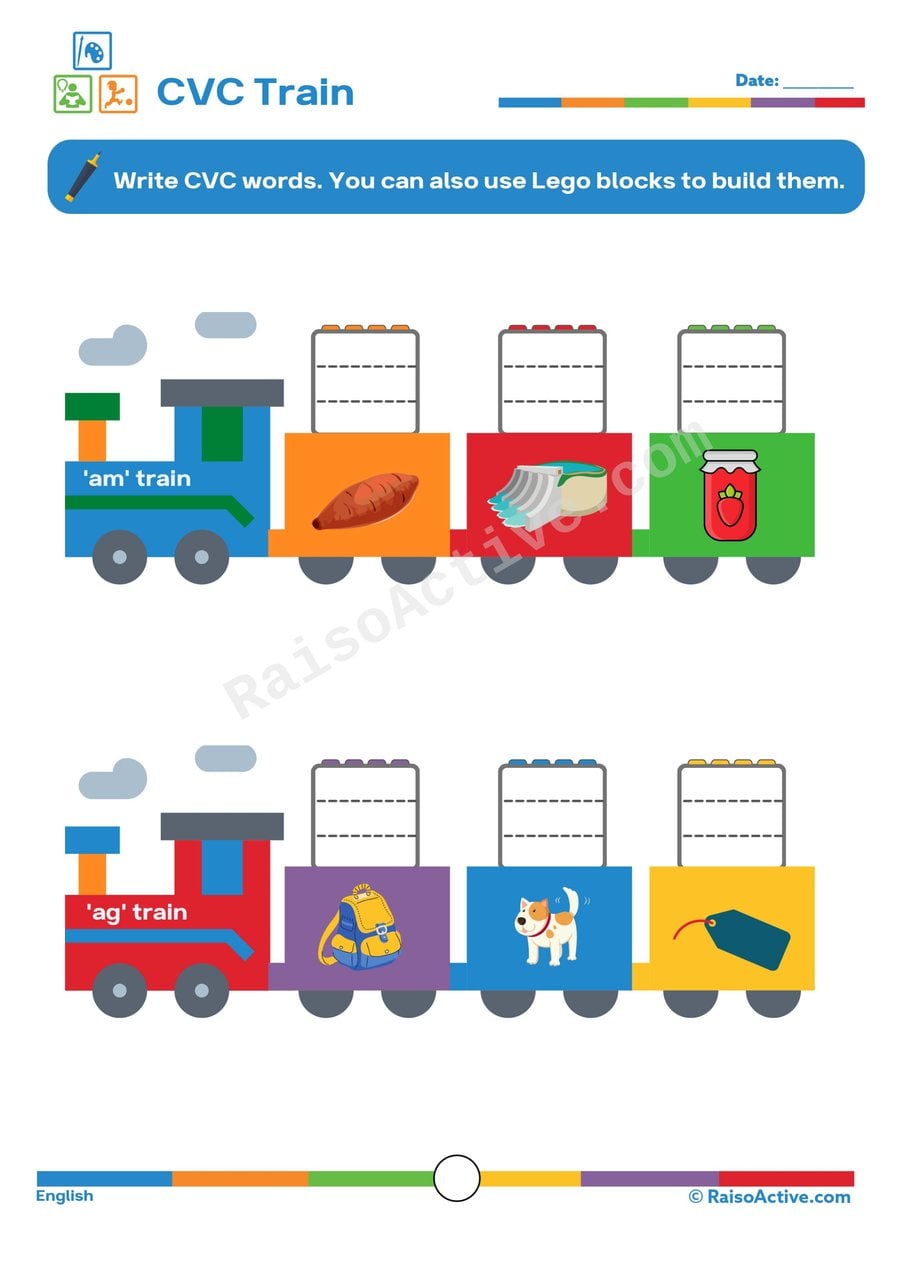
CVC Train Worksheet: Write and Build CVC Words!
Ages 4-6 · Pre-K–KindergartenAges 4-6 · Reception–Year 1Ages 4-6 · LKG–UKGAges 4-6
This worksheet gives children ages 4-6 focused practice blending letter sounds into consonant-vowel-consonant words, using train-car pictures as clues for words like 'dog,' 'hen,' or 'cup.' Because children both write the word and can optionally build it with Lego blocks, this worksheet reinforces the same phonics skill through two different physical actions — handwriting and hands-on construction — which helps the spelling patterns stick.
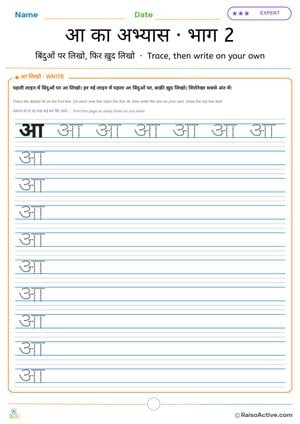
Hindi Letter आ Practice Part 2: Trace and Write on Your Own | आ का अभ्यास · भाग 2
Ages 3-7 · Preschool–Grade 1Ages 3-7 · Nursery–Year 2Ages 3-7 · Nursery–Class 1Ages 3-7
Children build writing fluency by tracing the dotted line आ on the first line and then writing the letter on their own, line after line, as the dotted help fades. The headline (शिरोरेखा) is drawn last, as in Hindi handwriting.
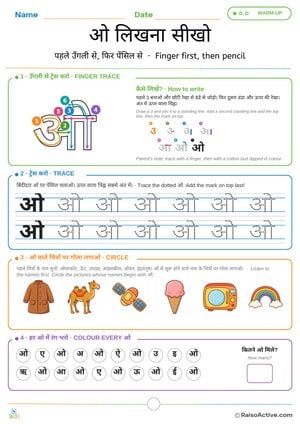
Learn to Write Hindi Letter ओ (o) – Tracing Worksheet | ओ लिखना सीखो
Ages 3-7 · Preschool–Grade 1Ages 3-7 · Nursery–Year 2Ages 3-7 · Nursery–Class 1Ages 3-7
Children learn to write ओ step by step: a 3 joined to a standing line, a second standing line, the top line, and last the mark on top. They trace with a finger first, then trace dotted rows with a pencil, circle the ओ pictures and colour every ओ in a grid.
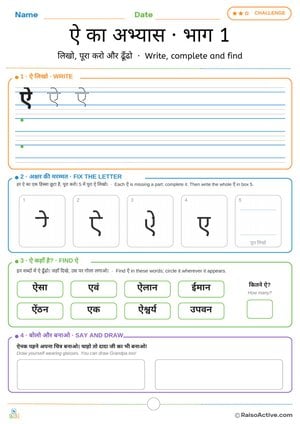
Hindi Letter ऐ (ai) Practice 1: Write, Fix the Letter and Find | ऐ का अभ्यास · भाग 1
Ages 4-7 · Pre-K–Grade 1Ages 4-7 · Reception–Year 2Ages 4-7 · LKG–Class 1Ages 4-7
A challenge page: write ऐ between the lines, complete four letters that are each missing a part and then write the whole ऐ in box 5, find ऐ in words such as ऐसा, ऐलान, ऐंठन and ऐश्वर्य, and draw a picture. ऐ is a different vowel from ए, not a long version of it.
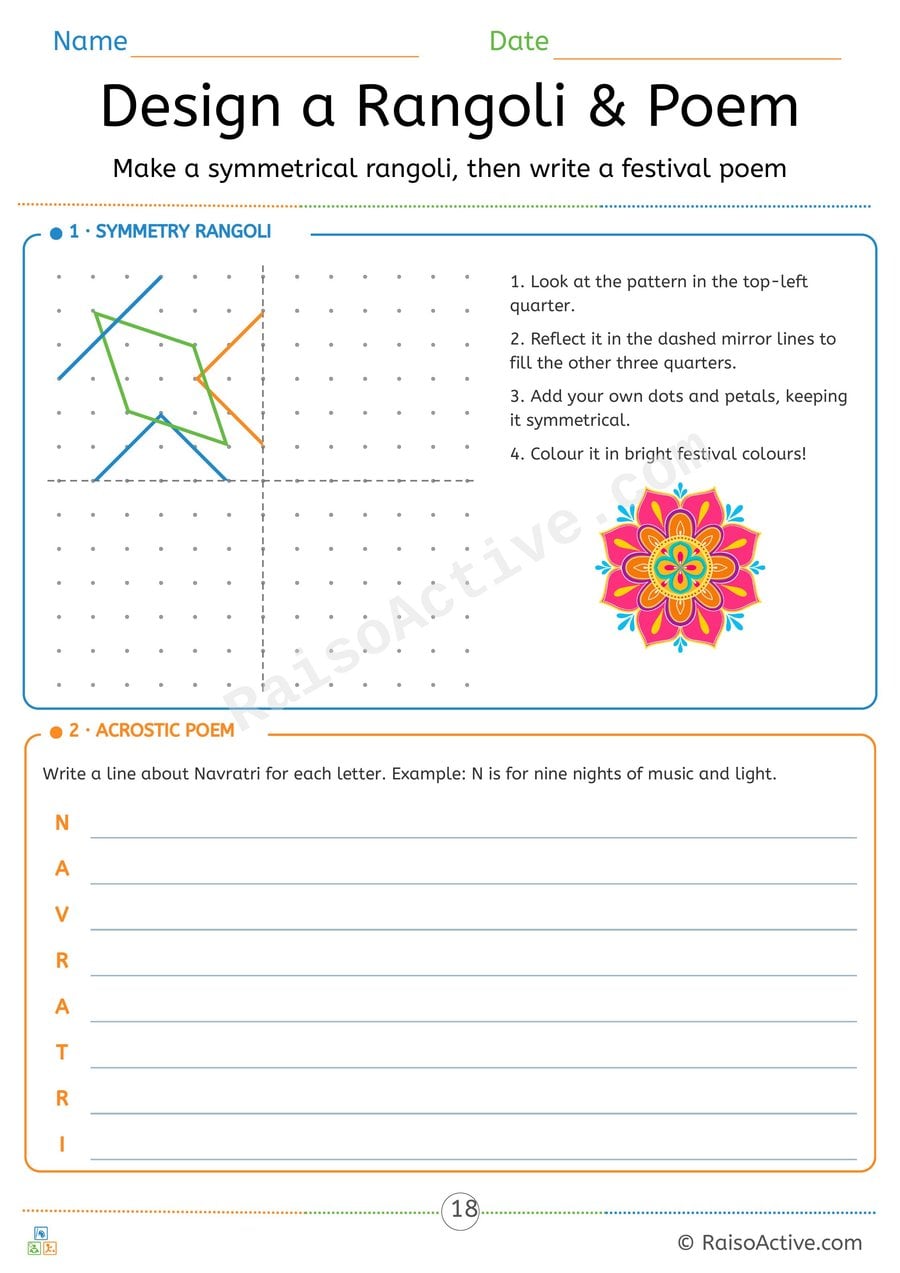
Navratri Symmetry Rangoli and Acrostic Poem
Ages 7-11 · Grade 2–Grade 3Ages 7-11 · Year 3–Year 4Ages 7-11 · Class 2–Class 3Ages 7-11
Children reflect a pattern in two mirror lines to complete a four-way symmetrical rangoli on a dot grid, add their own symmetrical details, and write an acrostic poem with one line for each letter of NAVRATRI.
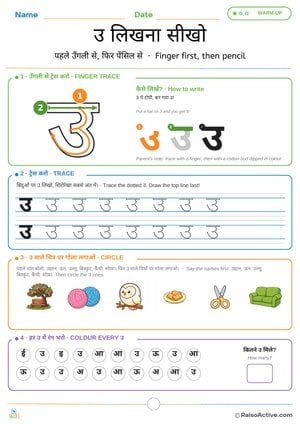
Hindi Letter उ (u) Writing Practice: Finger and Pencil Tracing | उ लिखना सीखो
Ages 3-7 · Preschool–Grade 1Ages 3-7 · Nursery–Year 2Ages 3-7 · Nursery–Class 1Ages 3-7
Children learn the stroke order of उ. They trace it with a finger along numbered arrows, trace the dotted letters with a pencil, add the headline (शिरोरेखा) last, circle the pictures that start with उ and colour every उ in a row of mixed vowels.
Guides for this topic

Documenting Learning Without Drowning in Data: A Practical Guide for Parents and Teachers
Learn practical ways to document your child's learning without overwhelm. Simple portfolios, observation tips, and printable trackers for ages 1-8.

How to Help Your Child with Letter Reversals: A Complete Guide for Parents and Teachers
Letter reversals are normal until age 7-8. Learn the best multisensory strategies, anchor letter tricks, and activities to help children write b, d, p, and q correctly.

Activities That Help with Pencil Grip Development: A Complete Guide for Parents and Teachers
Discover fun, research-backed activities to develop pencil grip in young children. Age-wise exercises, play ideas, and expert tips for parents and teachers.
Reviews
Every worksheet for ages 3–5, no watermark
Members download the full library of 1,000+ worksheets and every activity pack without watermarks or daily limits. One year costs ₹999 in India or $20 elsewhere.
See membership plansOr download any worksheet free with a watermark (5 a day).